
- “Twin Melodies”, a play in three acts by Mitra Phukan: characters, the story act by act, themes and the meaning of the title
- “A Friend Found in Music”, a poem by Bryanna T. Perkins: meaning, poetic devices, rhyme scheme and message
- The grammar and vocabulary the unit teaches: aside, non-lexical fillers, music words, exclamatory sentences, reported speech, phrasal verbs
- The two writing formats: a play script and an invitation letter
1 Twin Melodies: the Play at a Glance
“Twin Melodies” is a short play in three acts written by Mitra Phukan. It is about Shruti, a young violinist who wants to play in an Indo-Western fusion group with her friends, and her father, a strict classical violinist who is against fusion music. In the end, her mother reminds the father of his own past, and he supports his daughter.
Indo-Western fusion simply means music that mixes Indian and Western styles and instruments. In the play, the group mixes the tabla and flute with the keyboard and violin.
Stage directions are the instructions in a play script that tell the actors what to do and how to deliver their lines. They are not spoken aloud. Words in brackets show the manner of delivery or an action, for example “(very loudly)” or “(getting up)”: “Brackets (parentheses) serve to convey to the actor the manner in which to deliver the words.” Scene descriptions such as “The scene opens to the notes of a beautiful Indo-Western fusion music piece…” are stage directions too.
2 Characters
| Character | Who they are (the book’s own description) | Key trait in the play |
|---|---|---|
| Shruti Sharma | “A young aspiring violinist” | Talented, respects her father, but torn between his wishes and her wish to try fusion |
| Guru Nabin Sharma | Shruti’s father, a violinist, and the Principal of Sangeetika Music School | Strict, proud of classical music; changes his mind in Act III |
| Leela Devi | Shruti’s mother | Humorous, fair; scolds Shruti for hiding, then opens Nabin’s eyes |
| Avinash | Tabla player of the fusion group | Cheerful, teasing; practical advice: talk to your father |
| Iqbal | Flutist of the fusion group | Reassuring and funny; the practice happens in his room |
| Peter | Keyboard player of the fusion group | Encouraging; first suggests just telling the parents about the practice |
3 The Story, Act by Act
3.1 Act I: in Iqbal’s room, after rehearsal
3.2 Act II: at the dinner table
3.3 Act III: back at Iqbal’s house
Shruti does not tell her father during Act III that she is dropping out. Her plan, given in an aside, is to tell her friends that she cannot join the performance, but her parents arrive during the practice before she can do so. Also, it is Shruti’s mother, not a friend, who changes Nabin’s mind.
4 Two Stories, One Pattern: Why “Twin Melodies”
Leela’s revelation in Act III shows that the father and the daughter lived through the same conflict, one generation apart. Nabin’s family were vocalists who had “painstakingly nurtured” their musical heritage. Nabin chose a Western instrument, the violin, at a time when it “had not yet been incorporated into classical Indian music”. His father saw this as “a kind of betrayal of family values and tradition”, but Nabin “worked his fingers to the bone” (worked very hard) and succeeded.
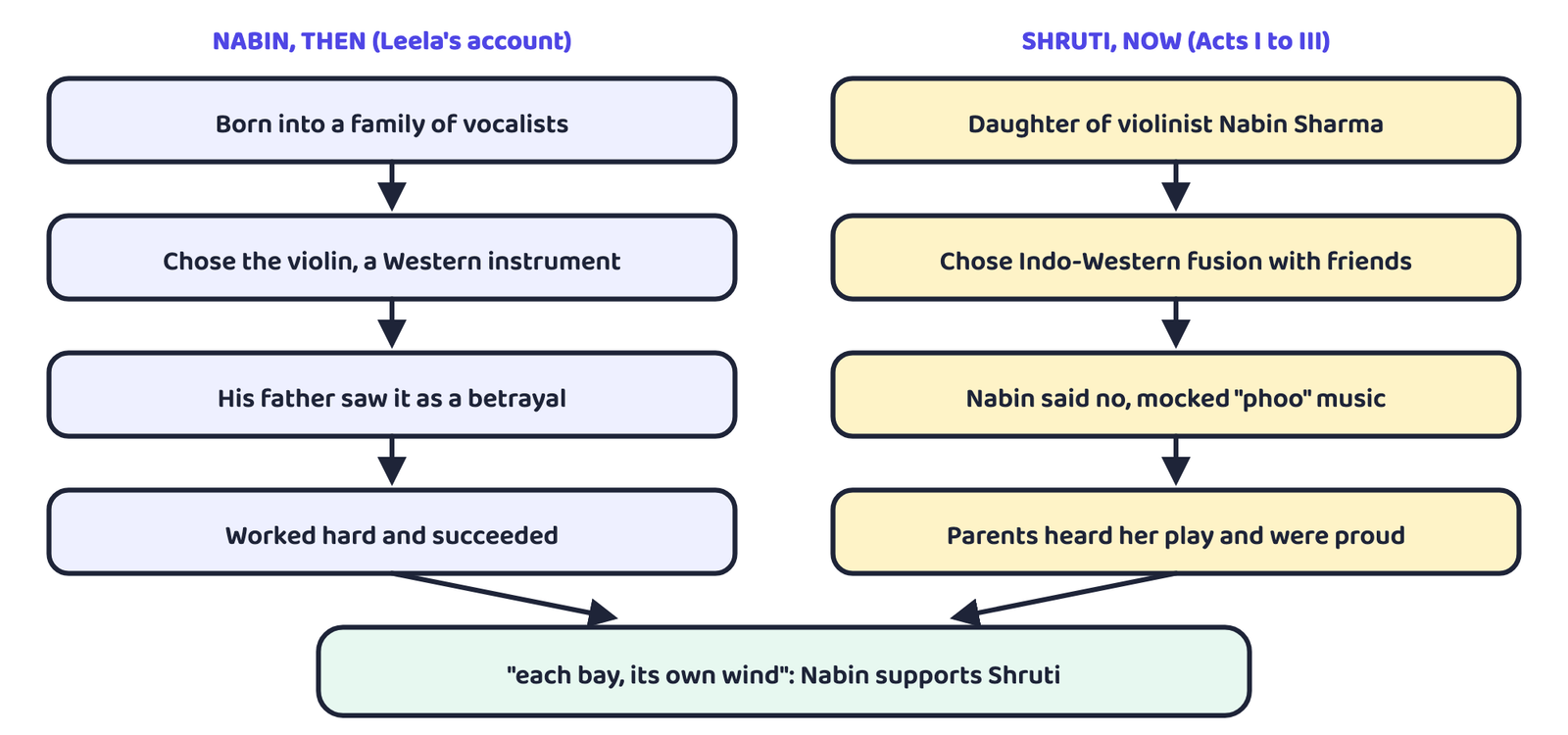
Give at least two readings of the title “Twin Melodies”: (1) two kinds of music, classical and fusion, which the play shows can live together (Shruti keeps the raga’s notes even in fusion); (2) two matching life stories, father and daughter who both followed their own path; (3) tradition and modernity in harmony, like two melodies played together. Quote “each bay, its own wind” to finish.
5 Themes
5.1 Five themes these notes draw from the play
Tradition and modernity
Nabin stands for classical Hindustani music “with its ragas and aalaaps”; Shruti wants to try Indo-Western fusion. The ending shows the two can meet: her fusion playing keeps the raga’s notes.
The generation gap
Children and elders see music differently. In the play, the gap narrows through honest talk and through the elder remembering his own youth: “I had forgotten my own past.”
Duty to family vs personal passion
Shruti cares about her father’s opinion (“because I do”) but also wants to “give this a try”. She hides the practice, then chooses honesty.
Every artist’s own path
“Each bay, its own wind” means each person has a unique journey and style; one rule does not fit everyone.
Friendship and cultural diversity
Four friends play Indian and Western instruments together (tabla, flute, keyboard, violin) and support one another. The mix of players and instruments is itself the “fusion” the play celebrates.
6 How Nabin Changes
Nabin in Act II
- Refuses at once: “No is the answer.”
- Believes fusion ruins musicality
- Mocks it as “‘phoo’ music”
- Gets up with a start and leaves
Nabin in Act III
- Taps his feet, claps with pride
- “Wah, how soulful!”
- Offers the music room
- “I trust you Shruti”
The reason for the change: he sees that his fear was “baseless”. He had been “afraid you would be lost to us”, that fusion would pull Shruti away from their own musical tradition. Hearing that she “did not lose sight of the notes of the raga even once and performed it to excellence” shows him the “power of our own music”.
7 Lines to Remember
“I don’t want papa to feel that I don’t care about his opinions, because I do.”
Shruti, Act I: her inner conflict in one line
“All ways are right ways, Shruti. He is your father, he will understand.”
Iqbal, Act I: reassurance
“More than that, familiarity breeds contempt.”
Nabin, Act II: his reason for one performance in six months
“I must admit it was Leela who opened my eyes. I had forgotten my own past.”
Nabin, Act III
“After all each bay, its own wind.”
Nabin, Act III: the key line of the play
8 Language of the Play: Grammar and Vocabulary
8.1 Aside and non-lexical fillers
An aside is a dramatic device where a character speaks directly to the audience. The other characters on stage are taken to be unaware of it. Example: Shruti’s “(Aside) Oh, how much I enjoy performing this piece.”
Non-lexical fillers are words or sounds like “uh” or “um” used in speech to fill pauses while the speaker gathers their thoughts or moves between ideas. Examples from the play: “Ahem ahem”, “I … er …”.
| Filler | Feeling it shows |
|---|---|
| arrgh | frustration, panic |
| ahem-ahem | clearing the throat, drawing attention |
| whew | relief |
| hmmm | thinking, doubt |
| err | hesitation |
8.2 Words from the world of music
| Word | Meaning |
|---|---|
| notes | a single sound at a certain pitch, shown as a symbol on a music sheet |
| crescendo | a gradual increase in the volume or intensity of sound |
| rhythm | the pattern of beats or time intervals in music |
| tempo | the speed or pace at which music is played |
| bass (said “base”) | the lowest tone or part in music |
| baritone | a male voice between the higher and lower ranges |
| cacophony | a mixture of loud unpleasant sounds |
| pitch | how high or low a sound is |
| scale | a series of notes moving upwards or downwards |
8.3 Words and phrases from the play
| Word / phrase | Meaning |
|---|---|
| bite the bullet | face a difficult situation with courage |
| bring it up | start talking about a topic |
| come round / come around | change one’s mind and agree |
| desecration | disrespect towards something sacred |
| ragas and aalaaps | elements of Hindustani classical music |
| contempt | a strong feeling of dislike and disrespect |
| hubbub | a loud noise |
| iterated | repeated |
| painstakingly | with great care and effort |
| worked his fingers to the bone | worked very hard |
| root (for) | show support |
| drown your individual style | lose your own special style by blindly following others |
| sense of musicality | a natural feel and talent for music |
| go down the drain | be wasted |
8.4 Literal or figurative? (Reflect and Respond IV)
The book asks whether the phrases in its box have a literal or a figurative meaning. Most are figurative (idioms). Three of them, in the play, describe what a person visibly does, so they stay close to their literal sense.
| Phrase | Literal or figurative | Meaning |
|---|---|---|
| winding up | figurative | finishing (a practice, a meeting) |
| bite the bullet | figurative | face a difficult situation with courage |
| bring it up | figurative | start talking about a topic |
| come around | figurative | change one’s mind and agree |
| throw a party | figurative | hold a party (nothing is thrown) |
| lost in his thoughts | figurative | so deep in thought that one does not notice others |
| wearing a look of distress | close to literal | looking upset; in the play, “Shruti wears a look of distress on her face” |
| found words | close to literal | managed to say what one wanted; in the play, “while Shruti finds the words” |
| sweating on | close to literal in the play | Peter’s “sweating on the vi-o-lin!” means working hard at the violin |
8.5 Exclamatory sentences in reported speech
An exclamatory sentence expresses strong feeling and ends with an exclamation mark, for example “Wah, how soulful!”
Direct: “Wow Shruti! You’re a sensation!” suggested Avinash.
Reported: Avinash exclaimed with wonder that Shruti was a great sensation.
8.6 Speaking: stress and intonation
The book’s Speaking Activity shows that stress (which words are spoken more strongly) and intonation (the rise and fall of the voice) can change the meaning or emotional impact of a line.
| Line | Stress | Intonation and effect |
|---|---|---|
| “I don’t want papa to feel that I don’t care about his opinions, because I do.” | “don’t” in the first part and “do” in the second part | start with a slightly lower tone, conveying concern, and rise towards the end; this highlights the contrast in Shruti’s internal conflict |
| “Tonight, at dinner, I promise to bring this up.” | “promise” and “bring this up” | a decisive tone on “promise”, then a slight rise in pitch and volume on “bring this up”, to show resolve |
| “Why are you lost in thought my dear child?” | “lost” and “thought” | a gentle tone, raised on “lost”; it draws attention to the concern in Leela’s question |
| “Each bay, its own wind” | “each” and “own” | a thoughtful, slightly philosophical tone; it highlights the uniqueness of each path |
9 Writing a Play Script
The play itself is the model for the unit’s writing task. The book’s box explains why a script looks different from a story: brackets do the job of a reporting verb.
Characters: Anuradha, a teenage tabla player · Father, a vocalist and music teacher · Mother · Brother
Setting: The family’s living room, evening.
ANURADHA: (sitting alone, tapping the table softly) The event is next week … and Papa still wants me to be a vocalist, not a tabla player.
BROTHER: (entering) Still thinking? Just tell him, Anu. Mummy and I are with you.
ANURADHA: (Aside) If only it were that easy. Hmmm …
10 Listening Text: the Yazh
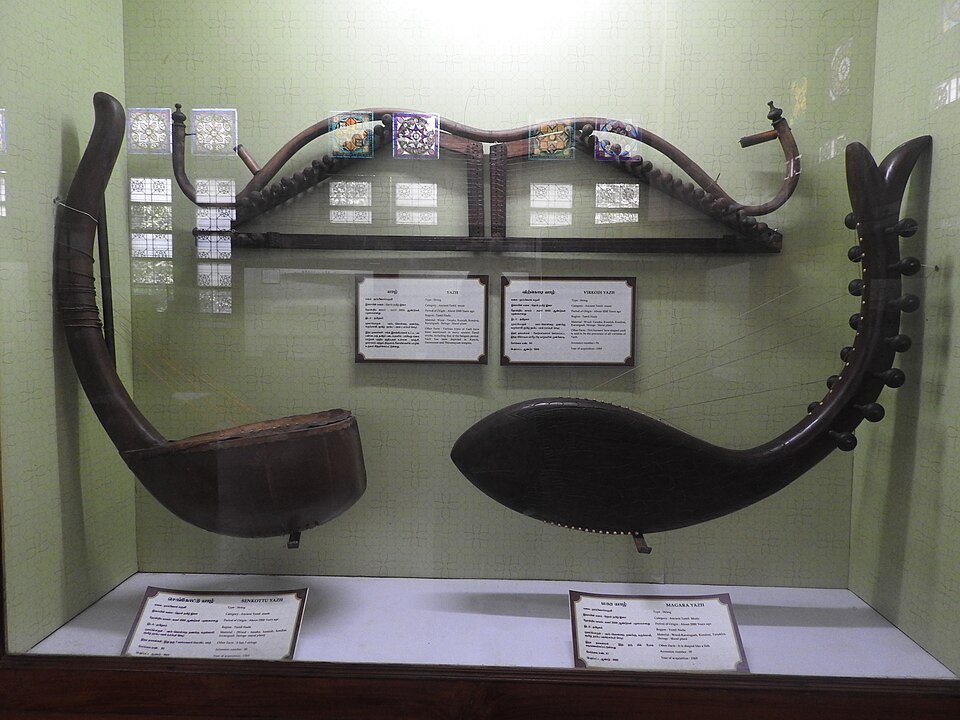
The unit’s listening passage (NCERT Appendix, p. 270) describes an ancient instrument. These facts come straight from that transcript.
| Point | Fact |
|---|---|
| What it is | an Indian harp, used in ancient Tamil music |
| Called the ancestor of | the modern day veena |
| Name comes from | its stem tip, carved into the head of the mythological animal Yali |
| Build | open-stringed; gut strings; a wooden, boat-shaped, skin-covered resonator; an ebony stem |
| Tuning | by pegs, or by rings of gut moved up and down the string |
| Varieties | mayuri (peacock), makara (crocodile), matsya (fish), vil (bow string) yazh |
The Recycled Orchestra of Cateura, Paraguay, formed in 2012, has children as part of it. They play instruments made from scrap materials collected from landfills. (Learning Beyond the Text)
Indigenous musical instruments are made from natural materials like bamboo, gourds, animal hides and shells. They range from percussion instruments like drums and rattles to wind instruments like flutes. (Learning Beyond the Text)
The unit ends with another poem about music, “Music” by Walter de la Mare. It opens “When music sounds, gone is the earth I know,” and each part begins with “When music sounds”. A Naiad, named in it, is “a water nymph said to inhabit a river, spring, or waterfall”.
11 A Friend Found in Music: the Poem
“A Friend Found in Music” is a short poem of twelve lines by Bryanna T. Perkins. The speaker (“I”) describes what music means to her: it comforts her when she is sad, stays with her when she is happy, and is a friend when no one else seems to care.
11.1 Meaning, four lines at a time
11.2 Poetic devices
A metaphor compares two things by saying one thing is another, without “like” or “as”. Example: “Music is the ocean”.
Personification gives human actions or feelings to a thing that is not human. Example: music “moves me” and “lifts my spirits”.
The book explains the phrase: “‘moves me’ means ‘to make somebody do something'”. “Move” also means to change position, to make progress, to take action, or to cause strong feelings.
The rhyme scheme is the pattern of rhyming words at the ends of lines, shown with letters (a, b, c…), the same letter for lines that rhyme.
| Device | Line(s) from the poem | What it does |
|---|---|---|
| Metaphor | “Music is the ocean” · “Music is the rhythm” · “Music is the therapy” · “Music is the needed friend” | shows music as vast, moving, healing and loyal |
| Personification | “That moves me to the core.” · “Music lifts my spirits” | music acts like a caring person |
| Repetition (anaphora) | “Music” begins lines 1, 3, 5, 7 and 11 | keeps music at the centre; adds a song-like beat |
| Idiom | “I need when I feel blue.” · “To make sure I pull through.” | “feel blue” = feel sad; “pull through” = succeed in a hard time |
| Rhyme | shore/core · blue/through · there/care | the 2nd and 4th lines of each group of four rhyme, giving a musical flow |
abcb · defe · ghih
Only the 2nd and 4th line of each group of four rhyme (shore/core, blue/through, there/care). The regular rhyme makes the poem sound like a song, which suits a poem about music.
11.3 Central idea, mood and speaker
Central idea
Music is a dependable friend: it comforts in sadness, is present in happiness, and is there “When no one seems to care.”
Mood
Thoughtful: the speaker reflects on what music does for her.
Speaker
The poet herself, speaking in the first person: “me”, “I” and “my” run through the first nine lines.
12 Language of the Poem: Vocabulary
12.1 Words for feelings
Positive (happiness)
- lifts my spirits
- most cheerful
- elation, jubilant, euphoric
Mixed
- nostalgia: a fond longing for cherished past moments
Negative (sadness)
- feel blue
- despondence, anguish, despair, melancholy
12.2 Phrasal verbs
A phrasal verb has two parts: a verb, and a preposition or adverb. Together they give a completely different meaning. Example: “pull” + “through” = pull through, “to succeed in doing something very difficult”.
| Phrasal verb | Meaning |
|---|---|
| move out | leave a place where one has been living |
| move in | begin living in a new home or place |
| move on | start doing or discussing something new |
| move over | shift position to make space for someone |
| move along | go to a new position, to make room for others |
| move off | start moving; leave |
13 Writing an Invitation Letter
The task: invite your grandparents to your school’s musical evening on 21 June, World Music Day, where you are presenting a Sitar recital. A full model letter is in the NCERT Solutions for this unit.
14 Listening Text: Jaspreet and the Santoor
India’s own texts discuss music’s effect on the mind. Raga Chikitsa describes the healing properties of music, and Sangita Sudha, a seventeenth-century work, gives an account of the effects of music on emotions. (Learning Beyond the Text)
- “Twin Melodies”: a play in three acts by Mitra Phukan; “A Friend Found in Music”: a 12-line poem by Bryanna T. Perkins
- Act I: Iqbal’s room; the fusion group (Iqbal flute, Avinash tabla, Peter keyboard, Shruti violin); Shruti fears her father; decides to “bite the bullet”
- Act II: dinner; Nabin refuses (one performance in six months, “familiarity breeds contempt”, “‘phoo’ music”); Leela scolds Shruti for hiding
- Act III: parents hear the practice; “Wah, how soulful!”; music room offered; Leela reveals Nabin once went against his vocalist family to play the violin
- Key line: “each bay, its own wind”, every artist has a unique path
- Themes: tradition and modernity, generation gap, duty vs passion, honesty, friendship and diversity
- Poem: metaphors (ocean, rhythm, therapy, friend); rhyme scheme abcb defe ghih; mood thoughtful; message: music is a faithful friend
- Grammar: aside, non-lexical fillers, exclamatory sentences reported with “exclaimed”, phrasal verbs with “move”
- Can I name all six characters and the instrument each friend plays?
- Can I tell the story of each act in three lines?
- Can I give two meanings of the title “Twin Melodies”?
- Can I explain “each bay, its own wind” and say who says it?
- Can I list the poem’s four metaphors and write its rhyme scheme?
- Can I report an exclamation using “exclaimed”?