
- Explain the meaning and concept of sports training, with the book’s definitions
- Describe the ten principles of sports training, including periodization and its three cycles
- Explain training load (outer and inner load), overload with its types, causes and symptoms
- Explain adaptation, its conditions, and the three stages of recovery
- Describe the types, methods and importance of warming up, and the benefits of limbering down
- Tell skill, technique, style, tactics and strategy apart, with examples
- Explain the concept of doping, WADA’s rule violations and list, and the side effects of each substance and method
In the CBSE Physical Education (048) curriculum for Class XI, this is Unit 10: Training & Doping in Sports, worth 7 marks. The curriculum lists five topics: concept and principles of sports training; training load (overload, adaptation and recovery); warming-up and limbering down (types, method and importance); concept of skill, technique, tactics and strategies; and concept of doping and its disadvantages. The prescribed book is CBSE’s own Physical Education Class XI textbook.
1 Sports Training: Meaning and Concept
Sports performance training is the training of the body and mind to prepare the athlete for the rigors (hard demands) of a specific sport. It is different from personal training: the athlete is prepared to compete in her or his sport of choice, not just for broader general fitness.
The coach combines the athlete’s individual characteristics (age, gender and fitness level) with scientifically proven methods to make a customized, sports-specific workout plan. The aim is better performance in competition, using sports science and kinesiology, by improving overall athleticism: strength, agility, speed, power, coordination and balance.
Her exercises copy the movements she makes on the court. She focuses on reaction, balance, vertical leap, agility and high-intensity interval training. By modelling training on the demands of her sport, she develops exactly the abilities she needs in a match.
1.1 Why training has become scientific
Training for competition is not a new idea, but today far more time and effort go into it. New techniques in athletics and new weight-training methods have given very encouraging results, so training has become technical and needs a scientific approach.
Sports training is based on: specific individual care, improved fitness, scientific ways, psychological feedback, technical help, sound machines and apparatus, climate, diet and safety precautions. Training methods follow scientific principles in a systematic order.
Training develops fundamental skills, advanced skills, techniques, tactics, strategies, emotional stability during competition and motivational forces. It gives the trainee practical and theoretical knowledge about performance and shows how to improve further.
“Sports training is a pedagogical (educational) process, based on scientific principles to prepare sportsmen for higher performances in sports competition.” (Hardyal Singh)
“Sports training is the basic form of an athlete’s training. It is the preparation systematically organized with the help of exercises, which in fact is a pedagogically organized process of controlling an athlete’s development.” (Matveyev)
| Given by | Other definitions of sports training in the book |
|---|---|
| Mathew | “Sports training is the basic form of preparation of sportsmen.” |
| Harre | “Sports training is based on scientific knowledge and a pedagogical process of sports perfection which through systematic effect on psycho-physical performance ability and performance readiness aims at leading a sportsman to top level of performance.” |
| Martin | “Sports training is a planned and controlled process in which, for achieving a goal, changes in complex sports and motor performance ability to act and behaviour are made through measures of content methods and organisation.” |
| G. Thiess and G. Schnabel | “Sports training is a scientific-based and pedagogically organized process through which planned and systematic effect on performance ability and performance readiness aim at sports perfection and performance improvement as well as at the contest in sports competition.” |
| Todd Townes | “Sports training is a targeted approach to training focused on your sport of choice.” |
| P. Garrison | “Sports training is training designed specifically to increase performance and minimize injury of general sports performance as well as specialized sports performance.” |
Sports training prepares athletes for a specific competition through long-term planning. The book names four parts of this preparation:
Conditioning training
Strength training, endurance training and flexibility training.
Technical preparation
Training of technique.
Tactical preparation
Training of tactics.
Psychological training
Mental preparation.
An ancient Olympic athlete prepared for months, even years, in the gymnasium, a public place for training, education, exercise and socializing, like a modern community centre. It hosted wrestling and weight lifting as well as music rehearsals and philosophy lectures, because a balance of body and mind was valued.
2 Principles of Sports Training
Coaches follow certain principles to plan, carry out and develop the training of players. The book gives ten.
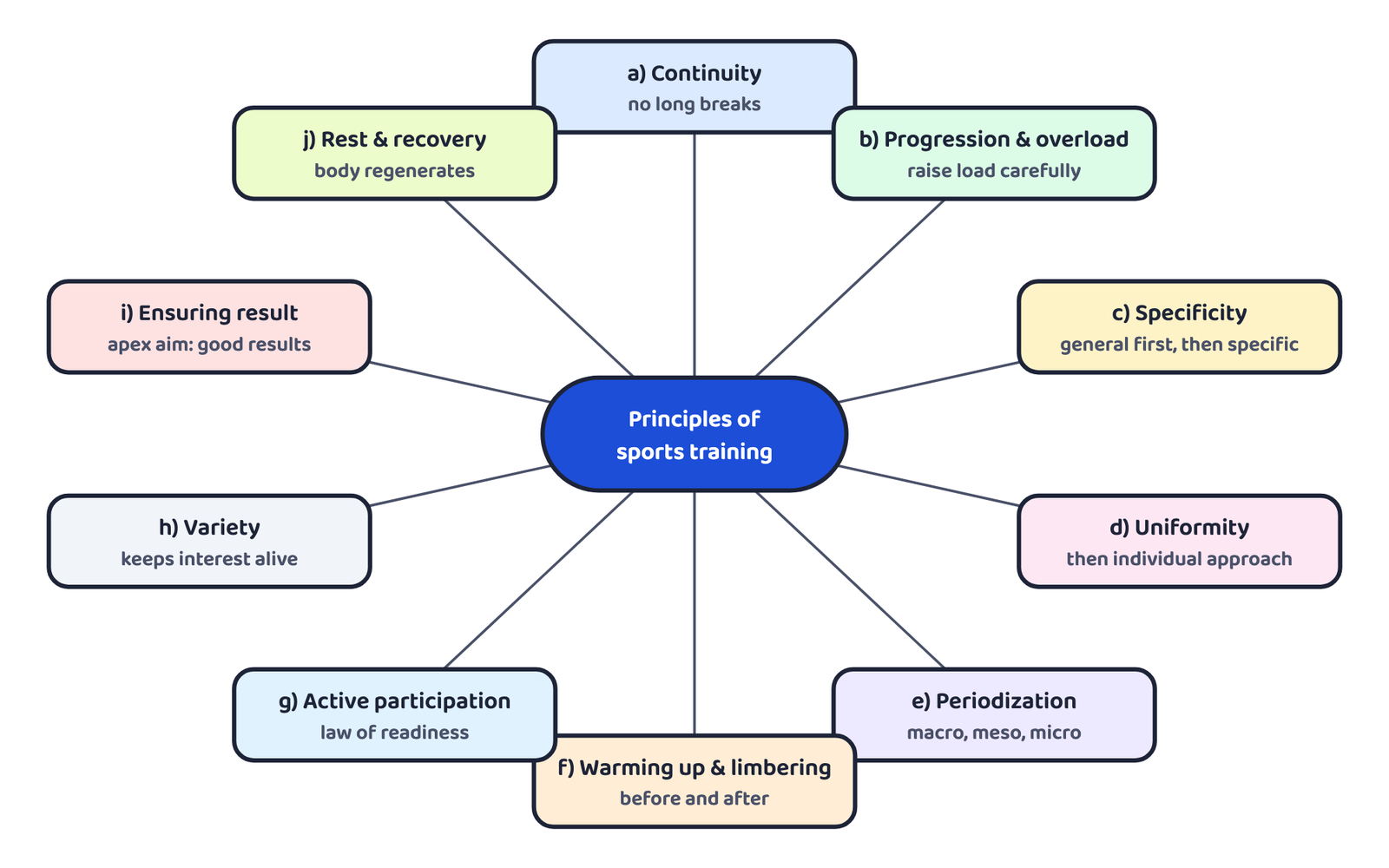
| Principle | What it says |
|---|---|
| (a) Continuity | Training must be a continuous, regular process with no breaks. If there are long intervals between sessions, fitness decreases and the body adapts to the reduced load. |
| (b) Progression load and overloading | There should be greater than the average load on the body for training adaptation, so the load is increased to improve performance. The load must be given carefully: if too much load is given constantly, performance may decline. |
| (c) Specificity | General and specific training are equally important. General training comes first, to develop all components of fitness; the proportion of specific training is then increased gradually. Speed improved through running also helps football; all athletes need general fitness, but throwers need more strength training. |
| (d) Uniformity | At first training is uniform for all players, but with time it should become individual. The coach considers (i) sex, (ii) age, (iii) psychological difference and (iv) training level. |
| (e) Periodization | Planning training in three phases to peak for a particular competition (see 2.1 and Figure 2). |
| (f) Warming up and limbering down | Warming up is a must before every session; it prevents muscle soreness and injury. After the session, gradual cooling down (limbering down) returns the body to its normal level. |
| (g) Active participation | The player follows the law of readiness, which is very important for good results at all levels of competition. Both the player and the teacher take part actively. |
| (h) Variety | Training is long and can become boring for athlete and coach, so a good coach plans variety by changing the nature of the exercise, the time of day, the training group and the environment. This keeps interest and motivation. |
| (i) Ensuring result | The apex (highest) aim of training is good results in competition. It cannot be achieved without the other principles, so the coach stresses all of them. |
| (j) Rest and recovery | Plan proper rest, because the body regenerates during rest and becomes better and stronger than before. |
2.1 Periodization and its three cycles
Periodization is the principle of training that prepares the sportsperson to give her or his best performance in a particular competition. It has three phases: the macro-cycle, meso-cycle and micro-cycle.
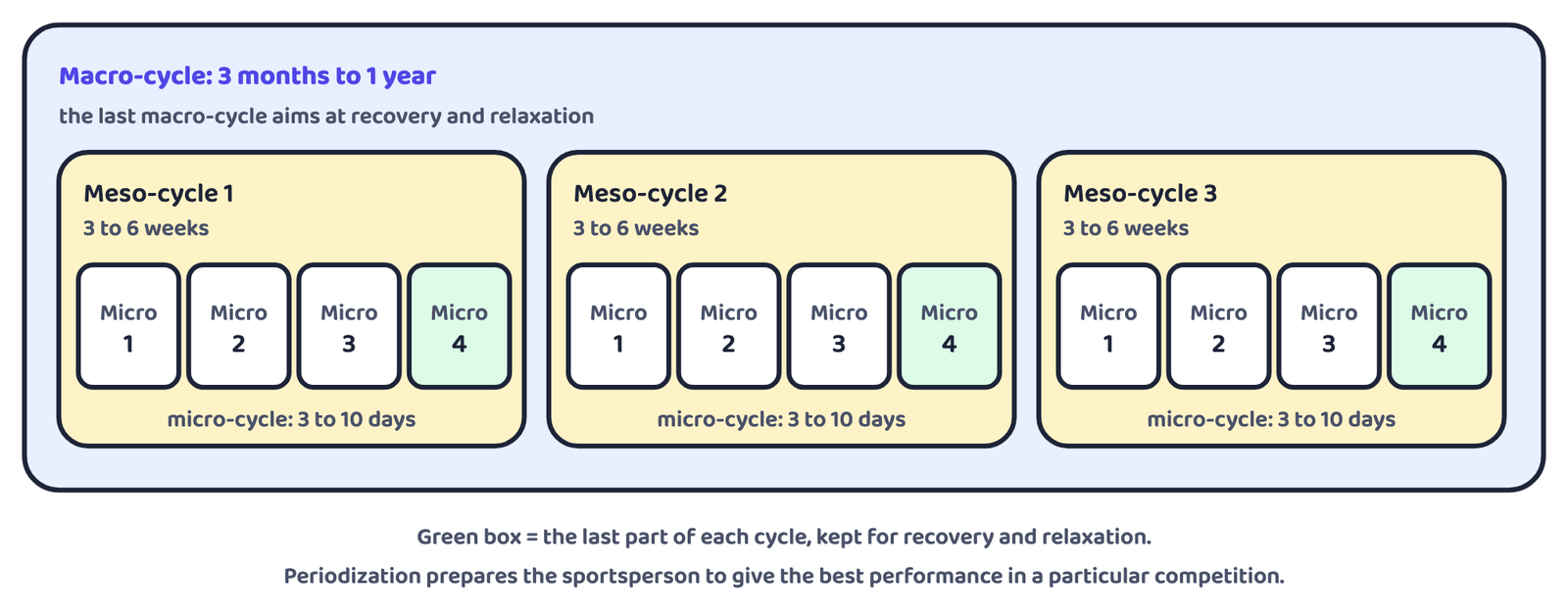
“Macro = Months, Meso = weeks, Micro = days”
Macro is the biggest (months to a year), meso is middle (weeks), micro is the smallest (days).
3 Training Load
Training involves activities and movements that lead to fatigue. Fatigue is the direct product of load, and it is essential for improving a sportsperson’s performance capacity. So training load is of central importance in sports training. Load, overload and recovery are also critical issues for team physicians.
Training load is the physiological and psychological demand placed on the individual through motor stimulus (movement), resulting in the improvement and maintenance of performance capacity.
Load is an inevitable result of conditioning, training and competition. It creates a demand or stress, both physiological and psychological, and has internal and external components. Load that is safely managed may improve athletic capacity and performance and reduce the risk of injury and illness. Training load is of two types: outer load and inner load.
3.1 Outer load and inner load

Outer load
- The work given from outside: what the athlete does
- Features: quality of movement, physical exercise, intensity of load (intensity and density of stimulus) and volume of load (duration and frequency of stimulus)
Inner load
- How the body responds inside
- Seen as symptoms: sweating, colour of skin, visible fatigue, quality of movement, lack of concentration and loss of co-ordination
Training monitoring keeps track of what athletes do in training. Heart rate (HR) measurement moved from interval training to index workouts. Later HR, lactate, VO2 and power output were used, but they need laboratory testing and give too much information too slowly for coaches. The mathematically complex TRIMP concept was also introduced. Today wearable sensors give high-resolution data on the external load.
4 Overload
The normal development of a sportsperson’s training state is disturbed when the physical and psychic (mental) daily load of life exceeds her or his loading capacity. Overloads given over a long period decrease performance capacity.
Modern sports scientists see overloading as a disturbance in regular nervous activity. Performance depends not only on muscular metabolic efficiency but, to a large extent, on the efficiency of the nervous system. When the nervous system is disturbed, the use of energy and metabolic processes is disturbed too, and other body systems cannot work at their best.
An excessive load causes incomplete adaptation: the sportsperson has trouble recovering from the training stimulus, and these problems can add up when loading is repeatedly too heavy or too closely spaced. The decline in performance caused by incomplete adaptation is one of the most apparent symptoms of overtraining. The coach must then allow time for proper recovery and evaluate and reduce the training loads. Identifying and modifying load and minimizing overload are central parts of strategies for optimal performance and for preventing injury and illness.
Overload is a load that is excessive, or a load that is not well managed. It results in anatomical, physiological and psychosocial conditions that show up as altered performance, injury and illness.
4.1 What “overload” means for each physical characteristic
The coach’s definition of overload depends on the physical characteristic to be developed:
| Characteristic | Overload means |
|---|---|
| Strength | Increasing the resistance, in kilograms and so on |
| Strength endurance | Increasing repetitions with resistance, from own bodyweight to weighted belts, light and sub-maximal loads; the lactic anaerobic energy pathway is highly involved |
| Aerobic / heart endurance | Increasing the time a person can continue low-intensity work in a steady state; the aerobic energy pathway is involved exclusively |
| Speed endurance | Increasing the number of high-quality repetitions per unit of time, or increasing the quality of repetition while keeping the number at or above a fixed threshold; the alactic energy pathway has critical high involvement |
| Speed | Performing a given task faster |
| Elastic strength / power | Increasing the resistance without loss of speed, or increasing the speed of moving a fixed sub-maximal to maximal resistance |
| Mobility | Taking effective joint action beyond its present limit |
4.2 Two types of overloading
(a) Dominance of excitation process
- Occurs when the training load is suddenly increased
- Without adequate preparation
(b) Dominance of relaxation process
- Results when an overdose of training load is given
- Continuously over an extended period
4.3 Causes of overloading
Faulty training method
(a) recovery neglected; (b) rapid increase in load, so no adaptation; (c) high volume with maximum or sub-maximum intensity; (d) forced technical training of complicated movements without rest; (e) excess of competitions with high demands; (f) one-sided training.
Life factors
(a) insufficient night’s rest; (b) irregular daily routine; (c) luxurious daily routine; (d) alcohol and nicotine; (e) bad living conditions; (f) faulty leisure-time activity; (g) quarrel in the family or community.
Social factors
(a) excess of engagements; (b) friction in the family; (c) dissatisfaction with profession or studies; (d) misunderstanding with colleagues; (e) overload in work or studies; (f) family unfriendly towards sports; (g) excess of entertainment programmes.
Health factors
The sportsperson may be suffering from (a) fever, (b) bad stomach, (c) infectious disease or (d) injuries.
4.4 Symptoms of overload
The symptoms fall into three groups and appear in this same order: psychological first, then performance, then somatic-functional (body functions).
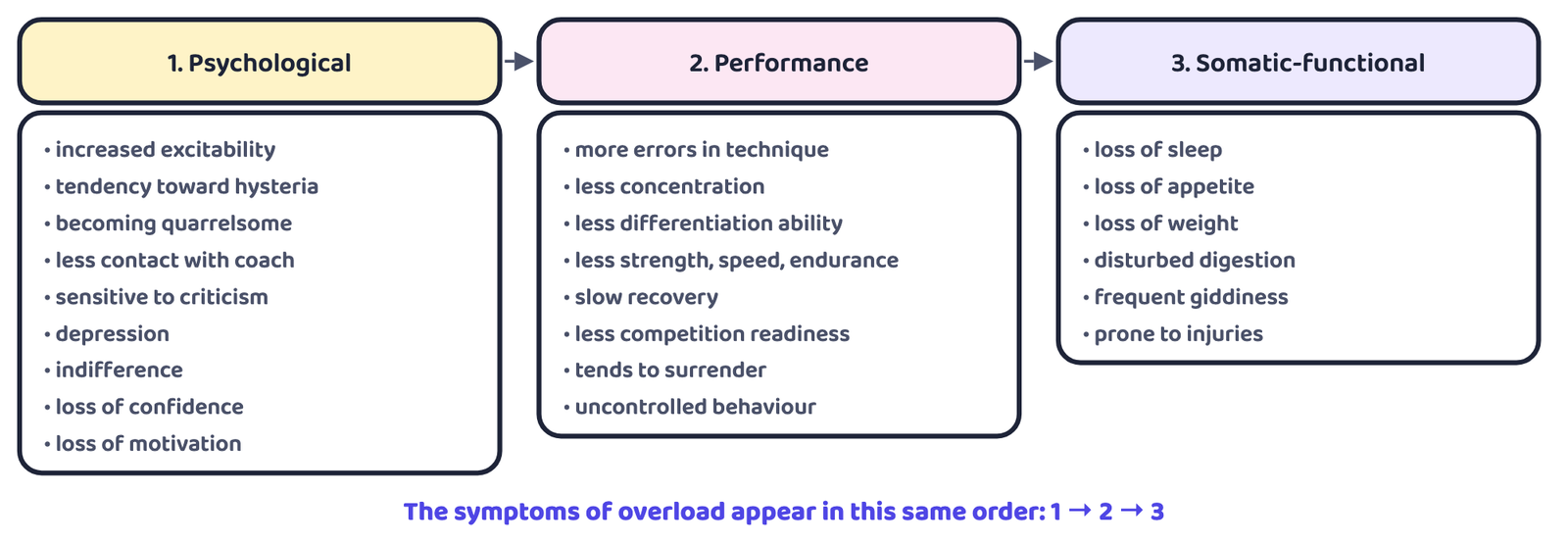
The book asks you to “draw a flow chart of symptoms of overload”. Draw three boxes joined by arrows (Psychological → Performance → Somatic-functional) and write three or four symptoms under each.
4.5 Rating of Perceived Exertion
The book’s activity asks athletes to rate how hard each session felt, on this scale:
| Scale | Exertion felt | Scale | Exertion felt |
|---|---|---|---|
| 0 | Nothing at all | 4 | Somewhat severe |
| 0.5 | Very, very slight, just noticeable | 5 | Severe |
| 1 | Very slight | 6-7 | Very severe |
| 2 | Slight | 8-9 | Very, very severe |
| 3 | Moderate | 10 | Maximum |
5 Adaptation
Literally, adaptation means “to get adjusted”. The human body adjusts to its environment and changes when conditions change. In training, the body moves to a new state of performance efficiency because of the external load, so load and adaptation go side by side. The book says this process is biochemical and applies to improving conditional abilities (strength, speed, endurance) only.
Homeostasis is the internal balance of the body.
Adaptation is the structural and metabolic change the body makes when its homeostasis is disturbed again and again by training load for a certain period, so that it can withstand the load more efficiently.
5.1 Three conditions for adaptation to the training load
- The training load must be as per the loading capacity of the sportsperson.
- The recovery period should be in proportion to the training load.
- The loading and recovery process must be repeated for a certain period (10 to 20 days).
5.2 Conditions of adaptation (for every training unit)
Individual basis
Adaptation is maximum when load is given on an individual performance basis, keeping in mind the specific character of each person.
Intensity and volume
There should be a correct proportion between intensity and volume. Intensity of stimulus has an inverse relationship with volume: when one goes up, the other comes down.
Load and recovery
Adaptation results from the correct proportion between the phases of load and recovery.
6 Recovery
Both training and competition loads improve performance. Over the years the load is increased gradually. A beginner adapts faster; with higher training age, higher loads are needed and performance grows more slowly. Very high loads cannot be handled unless proper means are used to speed up recovery; good recovery lets the sportsperson take loads more often.
Recovery is the period and process during which the body responds to load. Adequate recovery may give positive adaptations in athletic capacity and performance and lower injury and illness risk; inadequate recovery may cause maladaptation (wrong adaptation).
6.1 Load and recovery relationship
The book’s figure shows what happens to the performance level (PL) when load and recovery are balanced or not. With the right balance, recovery takes the body slightly above its old level, a phase of super compensation; the next load is given at that moment, so performance rises step by step to a new, higher level.

| Relationship | Result |
|---|---|
| Proper load and recovery | Phase of super compensation; gradual increase in performance; new performance level |
| Improper: longer recovery than required | The gain is lost before the next load; gradual decline in performance |
| Improper: very high load and short recovery | The body never gets back to normal; gradual decline in performance |
6.2 Three stages of recovery
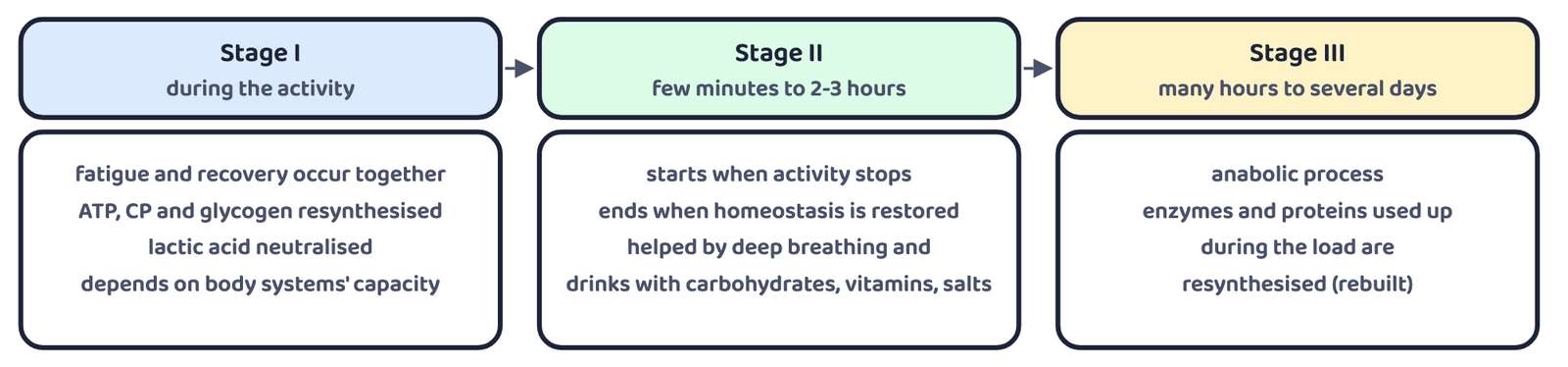
| Stage | When and how long | What happens |
|---|---|---|
| Stage I | During the training or competition itself | Fatigue and recovery occur together, through resynthesis of adenosine triphosphate (ATP), creatine phosphate (CP) and glycogen and neutralization of lactic acid. Important in long-duration activities; depends on the functional capacity of body systems and organs. |
| Stage II | From the end of the activity until homeostasis is restored: a few minutes to 2 to 3 hours | Made faster by active recovery means: (1) deep breathing exercises; (2) drinks containing carbohydrates, vitamins, salts and minerals. |
| Stage III | Many hours to several days | The anabolic (building-up) process helps recovery: enzymes and proteins used up during the load are resynthesized (rebuilt). |
6.3 Factors affecting the pace of recovery
Stimulus intensity and stimulus volume (the factors of load), and also:
Immediate (short-term) recovery
- Most common form
- Within hours after an exercise session or event
- Includes low-intensity exercise after working out and during the cool-down
Long-term recovery
- Recovery periods built into a seasonal training schedule
- May include days or weeks within an annual athletic programme
The book’s activity lists signs that a team is not recovering and adapting properly: fatigue, loss of motivation, irritability, restlessness, weight loss, lack of mental concentration, sore muscles, anxiety and being unrefreshed on awakening.
7 Warming Up
Warming up is heating the body’s muscles and preparing them to start work. It prepares the athlete physically, mentally and physiologically for training or competition. Muscles are warmed up by running, jogging and freehand exercises before the activity.
“Warming up is a process by which the human machine is brought to a condition at which it safely responds to the nerve impulses of the person for quick and efficient action.”
Other definitions in the book: “Warming-up raises the body temperature by running and performing exercises before the activity or competition”; it is also done to tone up the body for the activity that follows; “Warming up is a practice in itself”; “Warming up consists of a series of preparatory exercises either before a training session or competition.”
7.1 Types of warming up
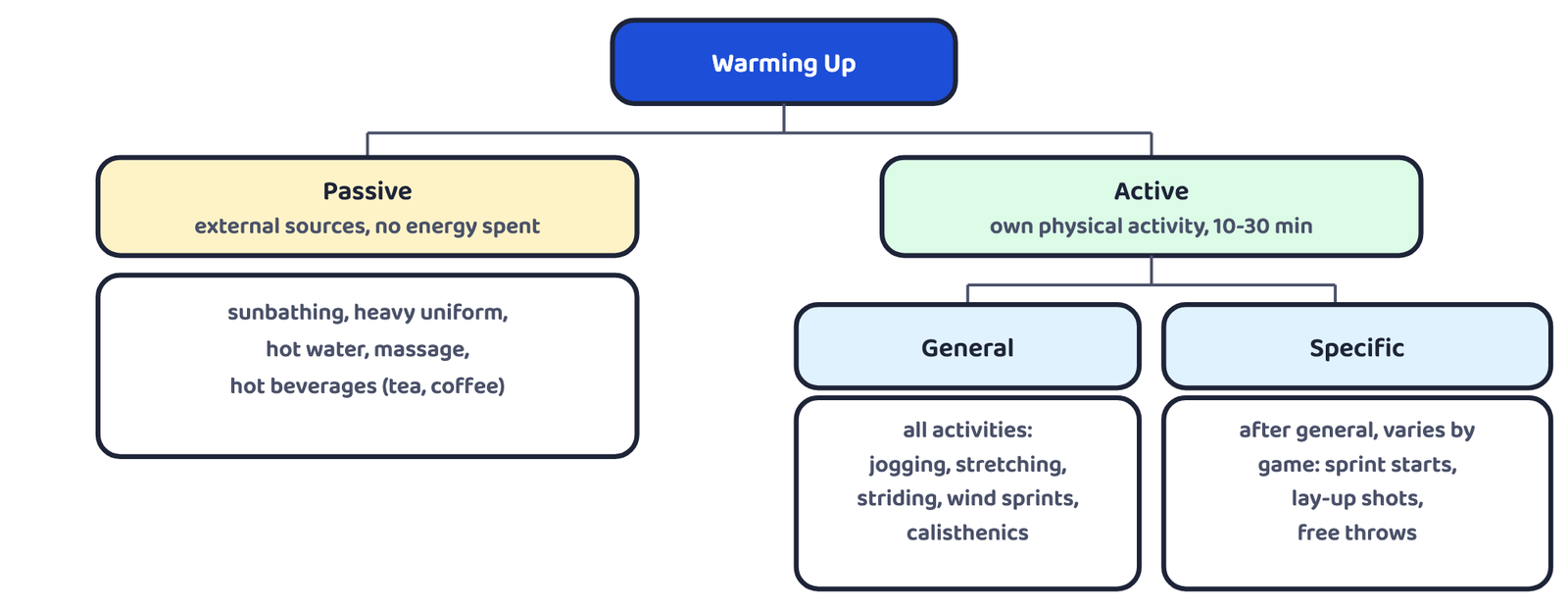
1. Passive warming up
- Body warmed through external sources, not by actual physical activity
- Sunbathing, heavy uniform, drinking hot water, massage, hot beverages (tea, coffee)
- Benefit: no energy is spent in warming up
2. Active warming up
- Body warmed through actual participation in physical activity
- Duration 10 to 30 minutes; done slowly without spending much energy, just before the workout
- Jogging and stretching; body temperature rises to the required level
General warming up
- Done in all types of activities
- Jogging, jumping-running, stretching, striding, wind sprints, calisthenics
- Increases mobility of all joints, coordination of body and mind, and muscle tone; prepares body and mind
- Its duration depends on the nature of the work
Specific warming up
- Done after general warming up
- Exercises vary from game to game; stress on practising the game’s skills
- Also increases joint mobility and coordination of body and mind
- Sprinter takes a few starts; basketball player practises lay-up shots or free throws
| Game | Specific warming up (from the book) |
|---|---|
| Basketball | Dribbling, shooting, shuttle run, lay-up shots, dodging, free throws |
| Cricket | Dummy bowling and batting, catching, fielding |
| Badminton | Tossing, high clear, low clear, smashing with jumps, dropping practice, court crafting |
| Tennis | Knocking, wall practice, volley, service practice, slice, lob, return |
| Shot put | Shifting the shot from hand to hand, standing throws, putting with both hands, gliding practice with or without the shot |
| Kho-kho | Dodging, zig-zag running, pole to pole running |
| Volleyball | Blocking, passing, smashing |
7.2 Methods of warming up
Physical activities
At slow pace and low intensity, to avoid fatigue before the event: (a) jogging, slowly for 5 to 10 minutes; (b) bending and stretching of shoulder, arm, clavicle, back, hip and leg muscles, with flexion, extension, abduction, adduction, circumduction and rotation; (c) striding, best before explosive events, 30 to 40 metres at sub-maximum intensity, 3-4 times with rest; (d) wind sprints, short sprints with spikes, moving from a walk or slow run to a faster run and back.
Massage
Increases and regulates blood flow and so raises body temperature. Techniques: effleurage, petrissage, kneading, friction, vibration and percussion.
Drinking hot beverages
Warm water, tea or coffee stimulate the body’s functions; take them in limited quantity to avoid discomfort.
Bath
Hot bath therapy is common in cold countries. Before the event it may improve blood flow, body temperature and muscle activation; after the event it may relieve muscle tension and relax the body.
7.3 Importance of warming up
| Point | How warming up helps |
|---|---|
| 1. Psychological preparedness | A routine before training or competition helps the athlete build competing readiness and give optimum output |
| 2. Reduces anxiety and tension | And raises the motivation level |
| 3. Optimum performance | Speeds up nerve impulses and metabolic rate, improving reaction time |
| 4. Prevents sports injuries | Prevents loosening and tearing of muscles and reduces muscle cramping |
| 5. Assists flexibility | Increases the range of motion so force can be exerted up to maximum reach |
| 6. Mechanical efficiency | Suppleness of muscles is increased |
| 7. Motor fitness components | Strength, endurance, flexibility, coordinative abilities and speed are enhanced |
| 8. Muscle temperature rises | Muscles contract more forcefully and relax more quickly; less risk of over-stretching; better muscle elasticity, speed and strength |
| 9. Blood temperature rises | With the build-up of lactic acid, the binding of oxygen to haemoglobin weakens, so more oxygen is available to working muscles, which may improve endurance |
| 10. Blood vessels dilate | Blood flow increases and stress on the heart reduces |
| 11. Range of motion | Large joints such as shoulders and knees reach their maximum movement potential |
8 Limbering Down (Cooling Down)
Limbering down, also called cooling down or warming down, is an easy exercise that lets the body shift gradually from an exertional (hard-working) state to a resting or near-resting state. It is necessary after training or competition.
Depending on how hard the exercise was, cooling down can be a slow jog or walk, or stretching at lower intensities. Players also take a cooling bath, ice bath or cryotherapy to relax their muscles.
8.1 Static stretches for cooling down

| Muscle | How to stretch (from the book) |
|---|---|
| Hamstrings | Lie on your back and raise one leg straight up above the hips. Holding the calf or thigh, press the heel towards the ceiling as you pull the leg back towards the chest. Repeat with the other leg. |
| Chest | Stand straight and interlace the fingers behind your back. As you straighten the arms, lift the chin towards the ceiling. |
| Glutes | Lie on your back and cross the right leg over the bent left knee. Bring the left knee to the chest, holding the back of the thigh, and gently press the right knee wide. |
| Quadriceps | Lie on your right side and pull the left leg in towards the left glute, feeling the stretch in front of the thigh. |
| Triceps / shoulders | Take one arm overhead, bend at the elbow and reach the palm down the centre of the back, gently pulling the elbow with the other hand. Then take the same arm across the chest and gently pull at the elbow to stretch the shoulder. |
Stretching keeps muscles flexible, strong and healthy, and keeps the joints’ range of motion. Without it muscles shorten and become tight, and then joint pain, strains and muscle damage become more likely.
8.2 Benefits of limbering down
Regulates heart rate
After exercise the heart beats faster than normal. Stopping suddenly can cause dizziness and light-headedness; slowing down gradually (walking after running) brings it back to normal.
Controls body temperature
Brings the raised body temperature back to normal.
Prevents injuries
Helps prevent injuries such as muscle tears. Skipping it slows muscle recovery and reduces the benefits of the workout.
Stress relief and relaxation
As the body slows down, the brain releases dopamine and serotonin, which make us feel good and less stressed.
Body restoration
Restores the body after the changes of a workout: more adrenaline, higher temperature, faster breathing.
Less lactic acid build-up
Lactic acid after hard workouts causes cramping and stiffness; cooling down speeds its release, so the body recovers faster.
Warming up
- Before training or competition
- Raises muscle and blood temperature; blood vessels dilate and blood flow increases
- Prepares body and mind; prevents injury
Limbering down
- After training or competition
- Brings heart rate and temperature back to normal
- Reduces lactic acid, relaxes, prevents injury
9 Skill, Technique, Tactics and Strategies
Skill, technique and style help an athlete perform at an optimum level. Some people are born with natural ability (speed, agility, coordination, flexibility, balance, reaction time), but they still need frequent practice to develop and perfect their skills.

9.1 Skill
Skill is a learned and practised ability that helps an athlete achieve the desired result with maximum certainty and efficiency. It can be defined as the capacity of the sportsman to realize the technique in actual motor action; skill is the automatization of motor action.
Skill is sport-specific: it exists in all sports, but each sport needs different skills. A skill is a coordinated action made of a group of movements, executed consistently and smoothly.
| Given by | Definition of skill |
|---|---|
| Galligan | “An organized, coordinated activity in relation to an object or situation, which involves a whole chain of sensory, central and motor mechanisms.” |
| Prof. G.P. Meredith | “Excellence of performance – the successful integration of a hierarchy of abilities appropriate to a task under given conditions.” |
Psychologist Anders Ericsson wrote that it takes 10,000 hours of practice to become an expert. An athlete training 5 hours a day, 7 days a week, all 365 days of the year would take about 5.5 years.
9.2 Technique
Technique is the way of performing a skill scientifically: a well-timed and coordinated sequence of muscle actions that gives the best performance with the least energy and the least risk of injury. “Technique is the most rational and effective form to perform exercises.” (Ozolin N.)
Technique is the mechanical model of doing a task: the athlete spends less energy and produces remarkable output. Techniques were developed through the experience of players and coaches and the analysis of sports science, and keep being refined. Good technique promotes high performance and reduces the risk of injury. Technique is the basic movement of any sport or event.
- A cricket bowler rolls the thumb over the ball to get extra spin.
- In the triple jump, several techniques are combined into one movement pattern: the run, then the hop, step and jump phases.
Style is the individual’s own way of adapting skill and technique to develop her or his performance in a smart way.
9.3 Tactics
Tactics are the intelligent or creative application of skills during the competition: the methods by which performers try to outwit (get the better of, beat) an opponent.
Tactics let a player or team use their skills and talent to the best possible advantage, through tactical actions and other measures taken before or during the competition. The book also says tactics are actions and strategies planned to achieve an overall objective, which in sport is mainly to win.
Tactical preparation uses specially organized physical exercises, trials, mental drills and modelling. Its aim is to inspire and encourage cognitive and competitive tactics, and it helps athletes make the most effective use of their motor and technical abilities in competition.
Opposition
Including their strengths and weaknesses
Players available
For selection
Importance of the match
How much the game or match matters
Weather
Possibly even the weather
The four cards above are the factors affecting tactics.
Tactical understanding: the book’s table takes two practice games, “toss onto target” and the “castle game”, and builds the principle of play in depth: consistency → placement and positioning → spin and power. Using space (where) comes first; then force (how) and time (when) follow naturally. Advanced players also think about self and other (team-mate or opponent). Players who use space, force and time well make the game unpredictable for their opponents.
| Component | Question the player asks (examples from the book’s table) |
|---|---|
| Space (where) | Where is the biggest target area? Where will the ball land? |
| Force (how) | How hard to send the ball to hit the target? How to use force to control the ball for accuracy? |
| Time (when) | When playing a shot, can you get to the next shot? When should you spin the ball and when use power? |
| Self (advanced) | In relation to the ball, how should you move to be ready for the next shot? |
| Other (advanced) | Can you send the ball where your opponent does not expect it to go? |
9.4 Strategy
Strategy is “a plan of action designed to achieve a long-term or overall aim.” It is laying down the goals and making a plan to get there.
Example: the goal is to win the season or the match; the plan includes developing an athlete’s power, working on comradery (team friendship) and selecting the right players.
SWOT analysis is the study of Strengths, Weaknesses, Opportunities and Threats. A coach uses it to plan a strategy: to use the team’s strengths, develop its weaknesses, and find the best approach against the opposition (for example, targeting the opponent’s weak tackler).
- Synchronicity: strategy aligns every member to the same end goal, so motivations combine and team morale improves; the team works as a unit.
- Individual performance: each player knows her or his aim and place in the team, is more confident about what is expected, and is more motivated.
- Game plan: in football, the basic strategy for a game is called a game plan. Teams prepare many diagrammed plays for set situations and adjust them during the game and at half time to the other team’s strategy (offensive or defensive strategy).
Strategy
- The overall plan for successful participation in a competition
- Plan for a long-term aim; adjusted during the game and at half time
- Example: game plan, SWOT
Tactics
- The actual realization of the strategy in practice
- Measures adopted before or during the competition
- Example: methods used to outwit (beat) an opponent in the match
Strategy and tactics should not be used interchangeably. Also, do not mix up skill and technique: shooting in football is a skill; the scientific way of performing it is the technique.
10 Concept of Doping
Doping refers to an athlete’s use of prohibited drugs or methods to improve training and sporting results.
Steroids come to mind first, but doping also includes other forbidden drugs (stimulants, hormones, diuretics, narcotics and marijuana), prohibited methods (blood transfusions or gene doping), and even refusing a drug test or trying to tamper with doping controls.
The International Olympic Committee (IOC) defines doping as “the use of any method or substance that might harm the athlete, in a quest to gain an unfair advantage, over his/her fellow competitors.”
In other words, doping is using substances or methods made to increase an athlete’s physical and mental abilities, and/or to cover up the use of such substances in training.
Training at altitude to increase the blood’s ability to carry oxygen is allowed, but using drugs such as EPO to get the same result is not.
The controversies in the Tour de France and the Atlanta games of 1996 showed that doping is widespread. It is not new: athletes in the ancient Olympic Games took plant extracts to beat their competitors.
Cheats were banned from the games, and their names were engraved on stone pedestals placed along the pathway to the stadium at Olympia, Greece, site of the ancient Olympics (776 BC-394 AD). Each pedestal carries the athlete’s name, his wrongdoing and the names of family members.
10.1 WADA’s definition: eight anti-doping rule violations
According to the World Anti-Doping Agency (WADA), “Doping is defined as the occurrence of one or more of the anti-doping rule violations set forth in Article 2.1 through Article 2.8 of the anti-doping code” (WADA code effective from 1 Jan 2021).
| No. | Anti-doping rule violation |
|---|---|
| I | Presence of a prohibited substance or method |
| II | Use or attempt to use a prohibited substance or method |
| III | Refusing to submit to sample collection after being notified |
| IV | Failure to file the athlete’s whereabouts after being notified |
| V | Tampering with any part of the doping control process |
| VI | Possession of a prohibited substance or method |
| VII | Trafficking a prohibited substance or method |
| VIII | Administering or attempting to administer a prohibited substance or method to an athlete |
So, under the anti-doping code, doping is not only using a prohibited substance or method to improve performance; it is breaking any of these rules. The book also quotes Katch et al. (2007): “The use of any support or practice that improves athletic performance or physical work capacity. It can be achieved through physical, pharmacological, psychological, nutritional or mechanical means.”
“Present, Use, Refuse, Whereabouts, Tamper, Possess, Traffic, Administer”
Two are about the athlete’s body (present, use), three about dodging control (refuse, whereabouts, tamper) and three about handling drugs (possess, traffic, administer).
10.2 WADA prohibited list (as given in the book)
The World Anti-Doping Code is the core document that brings anti-doping policies, rules and regulations into line across sports organizations and public authorities worldwide. It works with eight International Standards. The book gives the 2022 list:
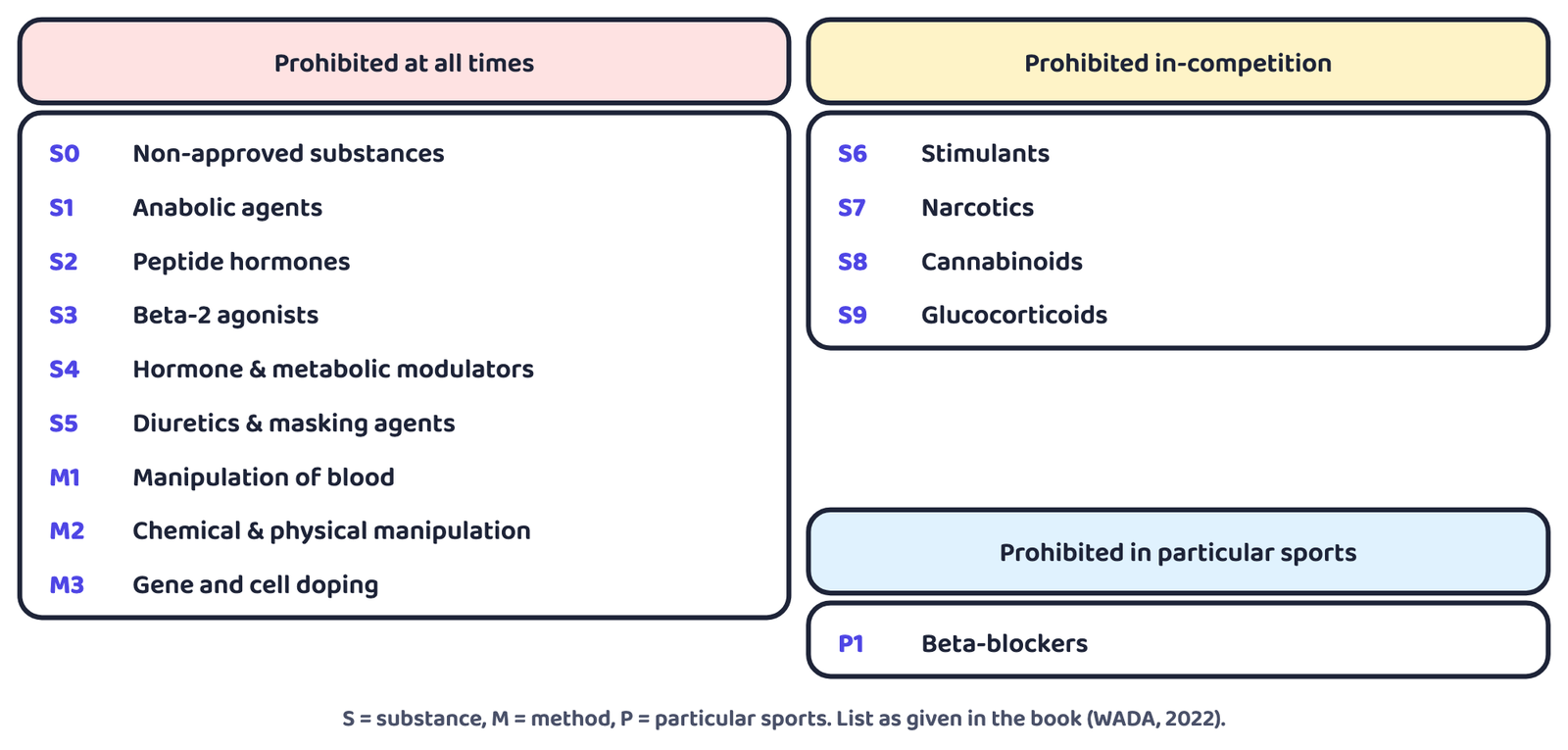
| Group | Classes |
|---|---|
| Substances and methods prohibited at all times | S0 Non-approved substances; S1 Anabolic agents; S2 Peptide hormones; S3 Beta-2 agonists; S4 Hormone and metabolic modulators; S5 Diuretics and masking agents; M1 Manipulation of blood and blood components; M2 Chemical and physical manipulation; M3 Gene and cell doping |
| Substances and methods prohibited in-competition | S6 Stimulants; S7 Narcotics; S8 Cannabinoids; S9 Glucocorticoids |
| Substances prohibited in particular sports | P1 Beta-blockers |

10.3 A case from the book: Lance Armstrong
Lance Armstrong (born 18 September 1971, Plano, Texas, U.S.), an American cyclist, was the only rider to win seven Tour de France titles (1999-2005), and was later stripped of all of them.
His cancer charity, the Lance Armstrong Foundation (famous for the yellow “Livestrong” bracelet), changed its name to the Livestrong Foundation, and he stepped down as its chairman. He wrote the memoirs It’s Not About the Bike: My Journey Back to Life (2000) and Every Second Counts (2003), both co-authored by Sally Jenkins.
11 Doping Substances, Methods and Their Side Effects
The disadvantages of doping are the side effects below, plus the loss of titles and bans that follow (as in Armstrong’s case), and the damage to fair play.
11.1 Anabolic steroids
Anabolic steroids (properly, anabolic-androgenic steroids) are steroidal androgens: natural ones like testosterone, the male sex hormone, and synthetic ones similar in structure and effect.
Why misused: they increase muscle mass and bone maturation and promote the production of creatine phosphate, which allows harder training; also more fat-free mass, strength and aggression, and better ability to sustain and recover from high-intensity workouts.
Side effects: (a) high blood pressure, (b) acne, (c) abnormal liver function, (d) changes in the menstrual cycle, (e) decline in sperm production, (f) impotence in men, (g) kidney failure and heart disease, (h) heightened aggression.
Testosterone was first synthesized in Germany in 1935 and used medically to treat depression. Misuse by athletes began at the 1954 Olympics, when Russian weightlifters were given testosterone.
11.2 Human growth hormone (hGH)
Human growth hormone (hGH), also called somatotrophin or somatotrophic hormone, is a hormone naturally produced in the body, made and released by cells of the anterior pituitary gland at the base of the brain.
Why misused: it stimulates the liver and other tissues to secrete insulin-like growth factor IGF-1, which stimulates cartilage cells (bone growth) and plays a key role in muscle and organ growth. All of these can boost performance.
Side effects: (a) diabetes in people prone to it, (b) worsening of heart disease and muscle, joint and bone pain, (c) hypertension, (d) cardiac deficiency, (e) abnormal growth of organs, (f) accelerated osteoarthritis, (g) enlargement of hands and feet.
11.3 Diuretics
Diuretics, sometimes called water pills, help rid the body of salt (sodium) and water and stop the kidneys from re-absorbing water.
Sodium released into the urine takes water out of the blood, so less fluid flows through veins and arteries and blood pressure falls. Why misused: (1) as a masking agent to prevent detection of another banned substance; (2) to lose weight quickly to qualify in a weight category (for example boxing and judo).
Side effects: (a) headaches, (b) muscle cramps, (c) dizziness, (d) high blood sugar, (e) abnormal heart rhythm, (f) fatigue.
11.4 Stimulants
Stimulants (“uppers”) are drugs that increase activity in the body by speeding up messages travelling between the brain and the body.
Why misused: they speed up mental and physical processes and raise dopamine in the brain, so the user feels more awake, alert, confident and energetic, with better focus. Long-term abuse has serious consequences. They are snorted, swallowed, smoked or injected; prescribed ones are taken orally.
Side effects: (a) anxiety, (b) tension, (c) increased body temperature, (d) nausea, (e) tremor, (f) seizures, (g) coma, (h) death.
11.5 Narcotics
Narcotics are drugs that change a person’s psychic and physical state, with effects ranging from sleep to euphoria and excitation. Their main effect is to reduce, eliminate and hide pain.
They are injected into the bloodstream, muscles or under the skin, or swallowed. Side effects: (a) nausea, (b) vomiting, (c) constipation, (d) sweating, (e) mental confusion and drowsiness, (f) effects on the cardiovascular, respiratory and central nervous systems.
11.6 Blood doping
Blood doping (“blood manipulation”) is a prohibited method of improving performance by artificially boosting the blood’s ability to bring more oxygen to the muscles.

| Type | What it is |
|---|---|
| (a) Blood transfusion | The most basic way to raise haemoglobin. Autologous: transfusion of one’s own blood, stored, refrigerated or frozen until needed. Homologous: transfusion of blood taken from another person with the same blood type. Its recent rise is probably because efficient EPO tests came in. |
| (b) Injections of erythropoietin (EPO) | EPO is a peptide hormone produced naturally, released from the kidneys; it acts on the bone marrow to make red blood cells. Athletes inject it to raise red blood cell count and aerobic capacity. |
| (c) Synthetic oxygen carriers | Chemicals that can carry oxygen, such as perfluorocarbons and haemoglobin-based oxygen carriers; they give the same extra oxygen to fuel muscles. |
Side effects of blood doping: (a) quick rise in blood pressure, (b) convulsions, (c) influenza-like symptoms, (d) higher cancer risk, (e) liver damage, (f) increased viscosity (thickness) of blood, (g) thickening of the blood, (h) HIV, (i) hepatitis B, (j) hepatitis C, (k) heart disease, stroke, and cerebral or pulmonary embolism.
Blood doping started in the late 1960s but was not outlawed until 1986. The first known case was at the 1980 Moscow Olympics, when Kaarlo Maaninka was transfused with two pints of blood before winning medals in the 5 and 10 km races; it was not against the rules then.
11.7 Gene doping
Gene doping is a form of drug abuse in sport in which genetic material is injected into the muscle to improve performance or make muscles grow stronger. According to WADA, it is the transfer of nucleic acids or nucleic acid sequences and the use of standard or genetically modified cells.
Advances in gene therapy for medical reasons mean cheats might try to modify their genes. Gene doping could be used to increase muscle growth, blood production, endurance, oxygen dispersal and pain perception.
Side effects: (a) cancer, (b) autoimmunization, (c) heart attack, (d) increased blood viscosity, (e) difficult laminar (smooth) blood flow through vessels, (f) severe immune response, (g) abnormal vision, (h) headache, (i) nausea, (j) vomiting.
- Growth hormone: first given to a human in 1956 (of bovine origin); isolated from the human pituitary in 1956 by Li and Papkoff (California) and Raben (Massachusetts); structure worked out in 1972; Raben’s first trial of human GH on growth in 1958; National Pituitary Agency (NPA) formed in 1960.
- Diuretics: modern history began in 1919, when a medical student at the University of Vienna found mercurial injections removed water; sulphonamide derivatives were later shown to be diuretic.
- Stimulants: amphetamine, the first synthetic stimulant, was isolated in 1887 and popularized in the 1930s in a nasal decongestant inhaler.
- Narcotics: opium from poppy was used since ancient Greek times; morphine was isolated by F.W.A. Sertürner in about 1804; the milder codeine was isolated from morphine.
- Blood transfusion: William Harvey discovered blood circulation (1628); earliest transfusions 1665; first human transfusion by Dr. Philip Syng Physick (1795); Dr. James Blundell treated haemorrhage by transfusion in London (1818); first blood bank in Leningrad (1932); first U.S. blood bank at Chicago’s Cook County Hospital (1937).
- EPO: isolated from the urine of anaemic patients in 1977; its gene isolated in 1983; cloned in Chinese hamster ovary (CHO) cells, giving recombinant human EPO (rHuEPO) as a drug.
- Artificial oxygen carriers: developed as “blood substitutes” in the 1980s and 1990s; two groups: haemoglobin-based (HBOCs) and perfluorocarbon-based (PFCs).
- Gene therapy: ideas arose in the 1960s and early 1970s; first clinical tests in the 1990s; set back in 1999 when Jesse Gelsinger died in a trial.
11.8 All substances and methods at a glance
| Substance / method | Why misused | Key side effects |
|---|---|---|
| Anabolic steroids | Muscle mass, strength, faster recovery | High BP, acne, liver problems, kidney failure, heart disease, aggression |
| hGH | Bone, muscle and organ growth via IGF-1 | Diabetes, hypertension, organ growth, osteoarthritis, large hands and feet |
| Diuretics | Masking agent; quick weight loss | Headache, cramps, dizziness, high blood sugar, abnormal heart rhythm, fatigue |
| Stimulants | Alertness, energy, confidence | Anxiety, tremor, seizures, coma, death |
| Narcotics | Reduce or hide pain | Nausea, vomiting, constipation, drowsiness, confusion |
| Blood doping | More oxygen to muscles | Thick blood, stroke, embolism, HIV, hepatitis B and C |
| Gene doping | Muscle growth, blood production, endurance | Cancer, heart attack, severe immune response |
12 Fair Play
Games and contests are chances to strive, with opponents, for excellence. Those who cheat or take performance-enhancing drugs do not really play the game. Fair play means more than just following the rules.
12.1 What a fair player does
✓ Fair play
- Respects the rules
- Respects the officials and accepts their decisions
- Respects opponents
- Gives everyone an equal chance to participate
- Maintains self-control at all times
✗ Against fair play
- Breaking rules
- Cheating or taking drugs (doping)
- Refusing a test or tampering with doping control
- Sports training: pedagogical process on scientific principles (Hardyal Singh); Matveyev, Mathew, Harre, Martin, Thiess and Schnabel, Todd Townes, P. Garrison
- Preparation: conditioning, technical, tactical, psychological
- 10 principles: continuity, progression load and overloading, specificity, uniformity, periodization, warming up and limbering down, active participation (law of readiness), variety, ensuring result, rest and recovery
- Periodization: macro 3 months to 1 year, meso 3 to 6 weeks, micro 3 to 10 days; last part of each = recovery
- Training load: demand through motor stimulus; outer load (quality of movement, exercise, intensity, volume) and inner load (sweating, skin colour, fatigue, concentration, co-ordination)
- Overload: load exceeds loading capacity; nervous disturbance; types: excitation (sudden increase), relaxation (overdose over long period)
- Causes: faulty training method, life, social, health factors; symptoms in order: psychological → performance → somatic-functional
- Adaptation: repeated disturbance of homeostasis → structural and metabolic change; 3 conditions (capacity, proportional recovery, 10 to 20 days)
- Recovery: Stage I during activity (ATP, CP, glycogen, lactic acid), Stage II up to 2-3 hours (deep breathing, drinks), Stage III hours to days (anabolic); super compensation
- Warm-up: passive (external), active 10-30 min (general, specific); methods: activities, massage, hot drinks, bath; 11 benefits
- Limbering down: gradual return to rest; stretches for hamstrings, chest, glutes, quadriceps, triceps; 6 benefits (heart rate, temperature, injuries, stress, restoration, lactic acid)
- Skill = learned ability (Galligan, Meredith); technique = scientific way (Ozolin; thumb spin, triple jump); style = own way; tactics = application to outwit; strategy = overall plan (SWOT, game plan)
- Doping: prohibited drugs or methods; IOC definition; WADA: 8 violations, Article 2.1 to 2.8; 2022 list S0-S9, M1-M3, P1
- Side effects: steroids, hGH, diuretics, stimulants, narcotics, blood doping (autologous, homologous, EPO, synthetic carriers), gene doping
- Can I write two definitions of sports training and explain all ten principles?
- Can I name the three cycles of periodization with their durations?
- Can I draw the training load chart and a flow chart of the symptoms of overload?
- Can I list the four groups of causes of overload with examples?
- Can I explain adaptation, its three conditions and the conditions of adaptation?
- Can I explain the three stages of recovery and the factors affecting it?
- Can I explain types, methods and importance of warming up and benefits of cooling down?
- Can I differentiate skill, technique, tactics and strategy with examples?
- Can I define doping, list WADA’s eight violations and its prohibited list?
- Can I write five side effects each of steroids, hGH, diuretics, stimulants, narcotics and blood doping?