
- define work, meaningful work, livelihood and career, and tell a job from a career
- explain the three perspectives of work and the state, problems and revival of India’s traditional occupations
- tell sex from gender, list the issues facing working women, and state their constitutional rights, the Acts and the government initiatives (including KGBV)
- explain quality of work life, a healthy work environment, the ten life skills and the essential soft skills
- write the aspects, pillars, need and benefits of ergonomics, and the characteristics of an entrepreneur
1 Work and Meaningful Work
1.1 Why choosing a career is not easy
- There are several career avenues to choose from
- A young person’s aptitude and talent are often yet to be identified and recognised
- In some cases, interests are very diverse
- To choose well, the youth must be exposed to the different possible options
1.2 What is work
Work is primarily an activity that all human beings have to perform. It can be described as essential activities undertaken for a purpose or out of necessity.
- Through work, each person “fits” into the world, creates new relations and uses his or her unique talents and skills
- Above all, a person learns and grows through work, developing an identity and a sense of belonging to society
- Work is central in all cultures, though every culture has its own values and perceptions about it; it makes up the bulk of daily life
- Most people work to acquire money, provide for their families, and earn leisure, recreation, play and free time
- Work can serve as a catalyst (something that speeds up a change) for developing personal identity and boosting self-esteem
- When we work, we contribute to ourselves (confidence, well-being, financial gain), to the organisation that employs us (better products, reputation, profits) and to the quality of life around us
What decides the type of work people do
Education, health, age, access to opportunities, globalisation, geographic location, financial returns and family background.
Work without money
Some people work ceaselessly for pleasure, intellectual stimulation or contribution to society, though they earn nothing, for example the work done by family members for the family, and by volunteers.
Work is the oil that lubricates the machine of society.
Saying quoted in the book (to lubricate = to keep a machine running smoothly)
- Not only human beings but all creatures and elements of nature are constantly “working”, contributing to life itself
- The collective work of humans and nature gives us our basic necessities, comforts and luxuries
- So work is not always about how much money a person earns; it is about whether one contributes to oneself, family, employers, society, nation or the world
1.3 The ways in which work may be viewed
| # | Work may be viewed as … |
|---|---|
| 1 | A “job” and a means of making a “living” |
| 2 | A task, or duty that entails a sense of obligation |
| 3 | A means of security of livelihood through securing job and income |
| 4 | “Dharma” or duty: an expression of one’s true Self and unique talents, which influences the quality of life of self and others |
| 5 | A part of spiritual practice |
| 6 | A vehicle for one’s creations |
| 7 | A source of joy and fulfilment |
| 8 | Working and earning a livelihood offers scope for hope, self-esteem and dignity |
| 9 | A symbol of status, power and control |
| 10 | A rewarding experience, a sort of mental or physical workout that can result in success |
| 11 | A means of self development and self-actualisation (reflecting values and aspirations) |
1.4 Meaningful work
Meaningful work is work that is useful to society or to others, is done responsibly and is enjoyable to the worker. It enables the worker to use his or her skills and judgment, and to showcase creativity or problem-solving ability.
- A person involved in meaningful work develops a sense of identity, worth and dignity
- Ideally, work should be done in an environment that builds positive professional relationships and brings recognition and/or rewards
- A meaningful or successful outcome contributes to personal growth, instils confidence and self-worth, and may lead to actualisation of full potential
- Work (as an employee or self-employed) that best suits one’s attributes, talents, aptitude, competence and skills paves the way for a lifelong career
- So everyone’s work life should ideally be an expression of his or her potentials and aspirations
- What are my special talents, traits and interests vis-a-vis an occupation?
- Is the work stimulating and challenging?
- Is the occupation likely to give me a sense of being useful?
- Does the job make me feel that I am contributing to society?
- Are the ethos (the usual way of working) and environment of the workplace likely to be suitable to me?
2 Job, Career and Livelihood
2.1 Job versus career
- For most people, earning a livelihood to meet the basic needs of self and family is imperative
- Work done mainly for earning money is conventionally called a job
- Many people go beyond a job and work steadily on a chosen career path; so a career is more than just a job
Job
- “An involvement in work for the sake of it”
- Main aim: earning money
- Satisfaction comes mainly from the income earned
Career
- “Driven by a deep desire to excel”
- “A passionate need to grow, develop and prove oneself within the chosen field of work”
- A steady, lifelong path
- The concept of career has changed: it is no longer sufficient just to get a job
- Success needs continual upgrading, learning newer skills, updating knowledge and building competencies
- So education should not stop in youth or early adulthood; it should continue into the middle career years and, if necessary, the later career years
- Many children follow in their parents’ footsteps; others choose careers different from what their parents planned
- One of the most important criteria for selecting an avenue: a sense of keen interest and desire for the chosen path
- A crucial aspect: one must find enjoyment in the job, particularly when one takes on financial responsibility for the family
2.2 Work, career and livelihood: the definitions
Work is a set of activities with an intended set of outcomes. It is not necessarily tied to paid employment; it may include entrepreneurship, consulting, volunteerism, contract, social work for community welfare and other professional activities.
Livelihood denotes the means and occupation by which a person supports oneself to meet basic needs and sustain one’s lifestyle. It involves the choice of occupation and career path and the design of a work lifestyle.
Careers are unique to each person and are dynamic, unfolding throughout life. Career is a life management concept.
- Growing in a career is a lifelong process: managing roles, balancing paid and unpaid work, learning, personal life roles
- It also means making transitions whenever or wherever necessary to move towards a personally determined future
- Whatever one chooses, in a holistic sense it should nourish body as well as mind and benefit self as well as others
| Webster dictionary definitions | |
|---|---|
| Career | “a field for or pursuit of consecutive progressive achievement especially in public, professional, or business life” |
| Work | “the labor, task, or duty that is one’s accustomed means of livelihood/profession or occupation chosen as one’s life’s work” |
2.3 The three perspectives of work
Work has several perspectives. By and large, its popular connotations (commonly understood meanings) are three:
| Perspective | How the person sees the work | Where satisfaction comes from |
|---|---|---|
| (i) Work as a job and livelihood | Mainly a source of income enabling desired outcomes, for instance doing a job to support one’s family | Primarily from the income earned |
| (ii) Work as a career | A path to ascend professionally to higher posts, status, pay and responsibility; the person gives a lot of time and energy, as these are temporary costs of future gain | From continuing advancement and achievements |
| (iii) Work as a calling | The person feels called to do the work by inner drives, feeling the work comes from an inner or higher direction | From the work itself |

- Three men were breaking boulders with strong hammers
- First man: “This is my job, I am breaking these rocks into smaller pieces”
- Second man: “This is my livelihood. I break rocks to make a living in order to feed my family”
- Third man: “I have a vision, to become a sculptor and therefore I am carving a statue out of this big stone”
- The third man saw that each hammer blow would help shape his career; the first two were focused on their job and livelihood
For a 3-mark “state any three perspectives of work” question, name all three separately and add one line on each saying where the person’s satisfaction comes from.
3 Traditional Occupations of India
- India is one of the richest countries in art and culture; few countries have such an ancient and diverse culture
- Despite diversity, there has been cultural and social cohesiveness (holding together) of an enduring nature
- This stability has come mainly through social and cultural practices, though foreign invasions and upheavals caused some disruptions
3.1 Agriculture and fishing
- Agriculture has been a major occupation, as the climate in most parts of India suits farming
- Almost 70 per cent of the population lives in rural areas, so farming is the largest source of employment for millions
- Many farm small plots of land, often not even owned by them, which gives only marginal production
- Such a poor yield may not be enough even for the family, leave alone sale for profit
- Some farmers grow cash crops for sale in urban markets
- In some areas tea, coffee, cardamom and rubber are of great economic importance because they bring in foreign exchange
- India is the largest producer of cashew nut, coconut, milk, ginger, turmeric and black pepper in the world
- It is one of the largest producers of fruits and vegetables, spices and condiments, and tea
- Fishing is another important traditional occupation because of India’s very long coastline
3.2 Handicrafts and weaving
- Handicrafts are a traditional occupation of Indian villages; many arts and crafts are now popular in the international market and give livelihood to rural folk
- Examples of crafts: wood craft, pottery, metal craft, jewellery making, ivory craft, comb craft, glass and paper craft, embroidery, weaving, dyeing and printing, shell craft, sculpture, terracotta (baked red-brown clay), sholapitha craft, dhurries, rugs and carpets, clay and iron items
- Weaving is a cottage industry in India; each state has typical woven fabrics, embroideries and traditional costumes suited to its climate and life style
- Indian hand-woven fabrics have won acclaim for centuries; some were made for daily use, others for decoration
- The modern economy has carried these craft items into the global market, earning the country considerable foreign exchange
- Pictured in the book: Shola craft of Odisha, Channapatna dolls of Karnataka, Stone Sculpture, Warli Painting of Maharashtra, Puppetry Craft, Coconut craft of Kerala, Bamboo craft of Assam
Transfer of knowledge
Processes, techniques and skills were handed from one generation to the next within the family. This was mainly home-based training, and the know-how and finer nuances were tightly guarded secrets within closed groups of an occupation.
Religion, caste and occupation
In India these have been tightly interwoven, along with a hierarchical (high-low) order of clusters within society.
Other traditional occupations
Hunting and trapping birds and animals, gathering and selling produce, garland making, salt making, tapping of neera or palm sap juice, mining, brick and tile making; inter-generational occupations such as priests, sweepers, scavengers and leather workers.
3.3 Cuisine
- Each region of India has a typical cuisine of local foods cooked with indigenous (local) ingredients and spices
- Indian cuisine is a source of livelihood for innumerable persons, from street food vendors to speciality restaurants and theme pavilions in 5-star hotels
- Many traditional foods, spice mixes and masalas are in demand in other countries
3.4 Visual arts of India
- India’s many visual arts have been practised for over four thousand years
- Historically, artists and artisans had two main categories of patrons (supporters): the larger Hindu temples and the princely rulers of various states
- The main visual arts arose in the context of religious worship
- Regional styles of architecture reflect Islam, Sikhism, Jainism, Christianity and Hinduism, which co-existed across the country
- Places of worship, mausoleums (burial chambers) and palaces carry images carved in stone, cast in bronze or silver, modelled in terra-cotta or wood, or painted; most are preserved in India’s heritage
- Today these arts are preserved and promoted by the government and several non-governmental organisations, opening occupations including entrepreneurship
3.5 Problems of traditional occupations and the way forward
Despite their rich heritage, these works of art are gradually losing out to mass-produced goods. Artisans are left with meagre income, and the aesthetic appreciation of fine arts is slowly eroding.
Major constraints
- Illiteracy
- General socio-economic backwardness
- Slow progress in implementing land reforms
- Inadequate or inefficient finance and marketing services
Also responsible: shrinkage of forests, depletion of the resource base and general environmental degradation
Areas where intervention is needed
- Design innovations
- Preservation and refinement strategies
- Use of eco-friendly raw materials
- Packaging
- Training facilities
- Conservation of traditional knowledge
- Protection of intellectual property rights (IPR)
- Youth and communities should be aware of the scope for careers here; such efforts will raise the income of rural folk
- The Government of India is making concerted efforts in this direction
- The need of the hour: maintain the diversity without the hierarchy or caste-based work divisions in a democratic milieu
4 Work, Age and Gender
- The age and sex of a workforce influence personal and professional lives, from the individual’s view (micro perspective) and from the view of society and nation (macro perspective)
- The health and development of children and women is at stake when they are forced into labour unsuited to their physiological and psychological state
- These groups, and the elder population, need attention from several perspectives
4.1 Gender issues in relation to work
Sex refers to the biological categorisation based on genetics, reproductive organs or similar things. Its external sign is the primary sexual organs, due to XX and XY or other chromosome combinations.
Gender is based on social identity. In every society, social and cultural practices decide how the genders are expected to behave and what work they do. Therefore it is said that gender is socially constructed.
Sex
- Biological difference
- Based on genetics and reproductive organs
- Male (boys, men) and female (girls, women)
Gender
- Social and cultural difference
- An identity built by society’s practices
- Decides roles, behaviour and type of work
- Human beings generally differentiate between two sexes, men and women
- Lately India’s Supreme Court has recognised transgender people as a third gender; they are also referred to as transsexual, cross dressers, etc.
- The terms sex and gender are often used interchangeably, but strictly they have different meanings
- Gender identity is built from an early age and goes on affecting a person’s growth and development
- Over time these norms become stereotyped (fixed, hard to change) and are taken as normal, expected behaviour
- The norms are not written down and there is no rule book; they are passed on from one generation to the next
- Any deviation becomes unconventional, non-traditional and sometimes even defiant
- Still, roles are evolving, giving “continuity with change”: the old roles of bread winner for men and home maker for women are in transition
Where women work
All along, women in India have been engaged in production, and in some societies in marketing; in rural India, intensively in agriculture and animal husbandry; in urban areas, in construction or as domestic labour. In many families women are the sole bread-earners.
Why they stay powerless
Despite earning and contributing to family resources, women are denied freedom to make decisions and independence. The need is to educate and empower them and give them their rightful voice and place in society.
Value of home work
A home maker’s work is rarely counted as an economic activity. But there is a saying: “money saved is money earned”. Her work helps other members perform their roles efficiently, so domestic work should be valued as an economic contribution and productive activity.
Double burden
Working outside the home has helped emancipate (free) women and improve family resources; many hold senior posts. But they are still expected to do most household chores and be the primary caregivers: this is the double burden.
For “How will women get recognition in the family and society?”, write both points: the work they do at home must be valued and treated as equivalent to paid work, and they must be educated, empowered and given their rightful voice.
| Issue | What happens |
|---|---|
| Need for skilled workers | Women’s chances in the labour market have declined and they have been marginalised; training facilities to develop skills must increase |
| Earnings seen as secondary | Men are taken as primary earners; women’s earnings are seen as supplementary, and even sole bread earners lack equal standing in the market |
| Stress and health | Stress and adverse effects on health |
| Safety at work | Security and safety at work places without gender discrimination |
| Motherhood and child care | Maternity benefits and social support for child care |
5 Constitutional Rights, Acts and State Initiatives
- The Constitution of India guarantees equality to both men and women in all walks of life
- It guarantees equal opportunity in employment and forbids discrimination in employment on grounds of caste, creed, colour, race or sex
- It stipulates just and humane conditions of work for women workers, protection from exploitation, and support for their educational and economic pursuits
- It empowers the State to make special provisions for women and children
Article 16 (1) of the Constitution of India guarantees equality of opportunity for all citizens in matters relating to employment and appointment to any office under the State.
These Acts safeguard the constitutional rights of women and protect them in various industrial sectors.
A crèche is a place at the workplace where young children are looked after while their mothers work.
5.1 State initiatives
| Initiative | By whom / for what |
|---|---|
| Women’s cells | Created in the Ministry of Labour to look at the problems of women workers |
| Equal Remuneration Act | Equal wages for the same work or work of a similar nature |
| National Plan of Action (NPA) for women | Taken up by the Department of Social Welfare to implement the Equal Remuneration Act |
| Working group on women’s employment | Constituted by the Planning Commission to raise employment opportunities for rural women and review labour laws on women’s work |
| Steering committee | Formed by the Planning Commission to build the data base on women’s work, particularly in rural areas |
There has been a paradigm shift (a basic change of approach) in women’s programmes over the years:
- It was realised that benefits cannot be reaped until women’s development programmes are in full swing, because women are part of the human resource
- Economically and financially women have a long road to equal partnership with men; the mindset, attitude and approach to gender issues must change
5.2 Kasturba Gandhi Balika Vidyalaya (KGBV)
| Point | Detail |
|---|---|
| Started | As a scheme of the Government of India under Sarva Shiksha Abhiyaan (SSA); now subsumed under Samagra Shiksha Abhiyaan, the umbrella programme for school education |
| For whom | Never-enrolled and dropout girls from rural, remote and disadvantaged sections of society |
| How | School education in residential schools, first till elementary level; now extended till Class XII |
| Entry level | Class VI |
| Bridge Course | All girls enrolled study the Bridge Course to prepare for the entry level |
| Where | In backward blocks of each district |
| Aim | Inclusive and equitable quality education; helps implement the Right to Education Act (RTE) |
5.3 Beti Bachao, Beti Padhao Yojana
The CBSE 2026-27 syllabus names this scheme, but the book does not describe it. Remember these well-established facts:
- Launched by the Government of India on 22 January 2015 at Panipat (Haryana)
- Reason: the falling child sex ratio (number of girls per 1000 boys in the 0-6 age group)
- A joint effort of three ministries: Women and Child Development; Health and Family Welfare; and Human Resource Development (now the Ministry of Education)
- Objectives: prevent gender-biased sex-selective elimination; ensure survival and protection of the girl child; ensure education and participation of the girl child
5.4 A woman entrepreneur and organised efforts for women
Kiran Mazumdar Shaw
A biotechnologist; Chairperson and Managing Director of Biocon India Ltd. She began as a trainee brewer at Carlton & United Beverages and in 1978 formed her own company, Biocon India Ltd., now an integrated biopharmaceutical company and India’s pioneering enterprise. Awards: ET Business Woman of the Year, Leading Exporter, Technology Pioneer, Best Woman Entrepreneur; Padmashri (1989) and Padma Bhushan (2005).
Shri Mahila Griha Udyog Lijjat Papad
An organisation of, by and for women; its aim is employment so women earn a decent and dignified livelihood. Started in 1959 with 7 members; registered in 1966 under the Bombay Public Trust and Societies Registration Act; recognised by Khadi and Village Industries (KVIC) as a “village industry”; later awarded “Best Village Industry”.
6 Attitudes to Work and Quality of Work Life
6.1 Attitudes and approaches to work
- Attitude is also about how a person sees his or her work situation and handles the demands of the job
- Job satisfaction or dissatisfaction depends greatly on attitude, not entirely on the job itself
- Comparing only one’s salary with another’s, ignoring that person’s responsibilities, qualifications, output, sincerity and dedication, leads to dissatisfaction
- A realistic look at all aspects (positive and negative) of one’s own job makes satisfaction and happiness more likely
- Work routines should go with good health practices: healthy balanced diets, enough sleep, proactive use of leisure
- People who see work as something to “do somehow or anyhow” cannot enjoy it; when work is seen as a source of energy, fulfilment and learning, job satisfaction is ensured
- Enjoying challenges, a positive outlook and chances to use one’s abilities add to personal happiness and the organisation’s “quality of working life”
6.2 Quality of Work Life (QWL)
Quality of Work Life (QWL) is an approach in which employees are considered to be “assets”, and it is believed that people perform better when they are satisfied with their work conditions. Satisfying employees’ social and psychological needs is taken to be as important as satisfying their economic needs.
What QWL takes in (not only work-based factors)
Job and career satisfaction; satisfaction with pay; relationships with work colleagues; absence of stress at work; opportunities for participative decision making; balance between work/career and home; general feelings of well-being.
Healthy work environment
A happy, healthy workplace, not only in the physical and social sense but also in the psychological, mental and emotional sense. A healthy work environment is a positive work environment.
6.3 How to create a healthy (positive) work environment
| # | Focus on | # | Focus on |
|---|---|---|---|
| 1 | Attention to each employee’s needs and expectations as well as the organisation’s | 8 | Matching the person to the task |
| 2 | Building a positive work climate | 9 | Delegating (handing over work) wherever necessary |
| 3 | Motivating individuals | 10 | Fostering team spirit and team responsibility |
| 4 | Being fair and treating people equally | 11 | Developing employees: training, confidence building, feedback, encouragement, praise, support, positive reinforcement and involvement |
| 5 | Ensuring and facilitating technical competence | 12 | Empowering employees, giving authority wherever appropriate |
| 6 | Providing an attractive and safe work environment | 13 | Sustained opportunities for self-development |
| 7 | Making the job interesting and challenging |
- All this helps the employer boost the morale of the workforce; a wise employer knows that people are assets and the ultimate valuable resource
- An environment where employees feel loyal to the organisation, and organisational development, matter as much as self-development
- Look at life holistically, not only the pay package: free time, family and friends, so you reach retirement without regret
7 Life Skills for Livelihood
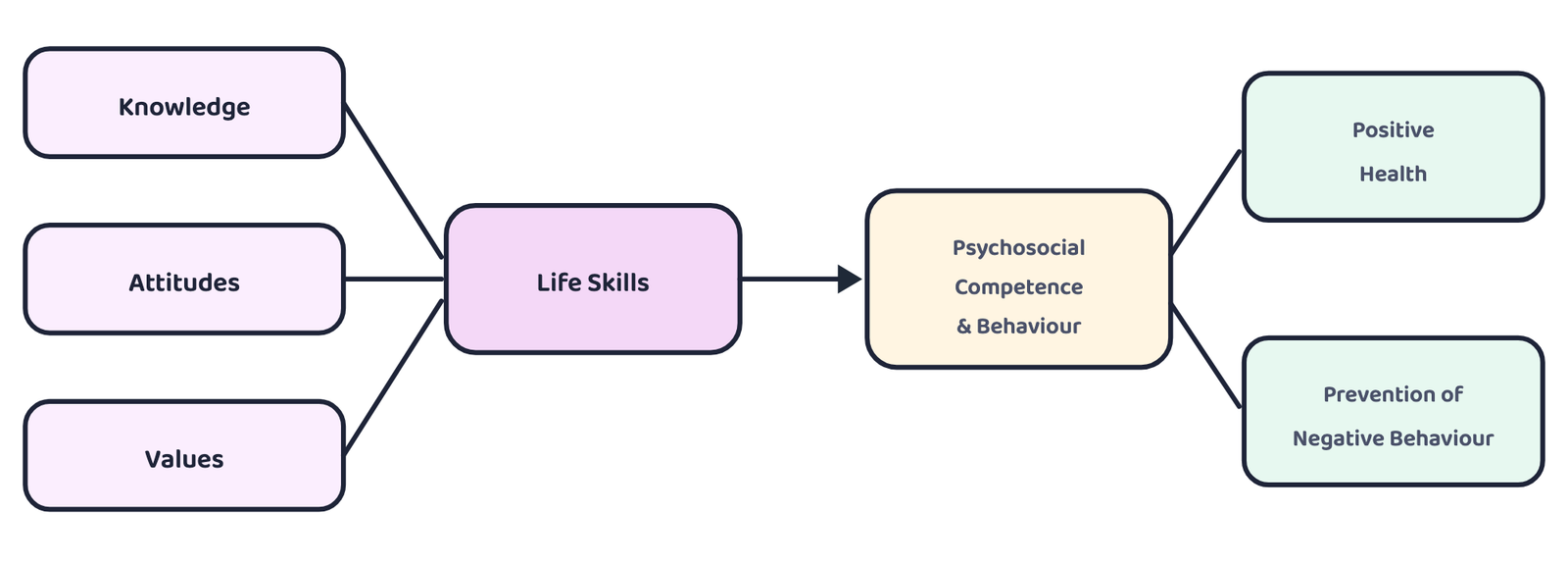
Life skills are abilities for adaptive and positive behaviour that enable individuals to deal effectively with the demands and challenges of everyday life.
Life skills are thinking, coping and social skills: abilities that can enhance people’s interactions with others and with the environment, and may even give rise to greater individual resilience (the power to bounce back) in situations of adversity.
- Why important: they apply across the life span and promote and protect life, health and well-being in all situations
- They help a person function effectively, with minimum stress and maximum productivity, in personal and professional life
- They enable healthy behaviour, especially in challenging situations, and prevent unhealthy or negative behaviour
- They help promote the health and development of the person and of the community he or she lives in
- They include personal and social skills; they cannot be taught in a classroom; experiential learning (learning by doing) helps people acquire them
| The ten core life skills identified by experts | |
|---|---|
| 1. Self-awareness | 2. Empathy (understanding another’s feelings from his or her side) |
| 3. Communication | 4. Interpersonal relationships |
| 5. Decision making | 6. Problem solving |
| 7. Creative thinking | 8. Critical thinking |
| 9. Coping with emotions | 10. Coping with stress |
7.1 Improving one’s own work life
Improving work life matters to the organisation, but it is even more vital for each person to consciously improve his or her own work life. This ensures job satisfaction and better quality and quantity of output. Look at your work as a source of energy, fulfilment and learning. The tips:
| Tip | What it means |
|---|---|
| Develop healthy personal habits | Care for body, mind and spirit: wholesome diet, adequate exercise, enough sleep; this helps face workplace pressures |
| Be empathetic and compassionate | Dealing with peers, subordinates and supervisors with empathy gives positive outcomes |
| Remember interdependence | We depend on each other personally, professionally and psychologically; positive behaviour builds goodwill; good communication and interpersonal skills are vital |
| Loyalty, commitment and ethics | Stay loyal and committed to the organisation and professionally ethical at all times |
| Partnerships and teamwork | Work as a team member, in collaboration with others, respecting and recognising their contributions and achievements |
| Be responsive, not reactive | When reprimanded by a senior, examine the situation calmly and realistically instead of reacting with justifications and outbursts; if the reprimand is deserved, correct yourself and apologise if necessary |
| Flexibility, adaptability, problem solving | Core abilities in the work arena, whether self-employed or working for others |
| Be a good citizen | Create a healthy community; people who follow these tips attract like-minded persons and together build a community that gets the job done while serving everybody’s needs; recognise others’ achievements; work with others to effect responsible change |
| Learn from the lessons of life | Turn day-to-day challenges, pressures and upsets into lessons that help you grow as a person and professional |
Balancing life and work is not easy, but the ability to adapt positively to social and environmental change is essential. Core abilities (essential workplace skills) cannot be taught as “academic lessons”; they are acquired and honed as one develops as a person.
7.2 Essential soft skills at workplace
Working productively
Applying effective work habits and attitudes; needs knowledge, skills, expertise and experience. Productivity is also influenced by enthusiasm, zeal and dynamism; involvement with the job and a sense of belonging matter.
Learning effectively
Skills in reading, writing and computing, acquiring information in the field and using learning tools and strategies; plus the motivation to work hard and keep pace with advances in the field.
Communicating clearly
Applying appropriate writing, speaking and listening skills to convey information, ideas and opinions precisely.
Working cooperatively
Working with others to complete tasks, solve problems, resolve conflicts, provide information and offer support; a sense of belonging to the organisation.
Thinking critically and creatively
Applying the principles and strategies of analytical thinking and critical evaluation, being innovative and creative.
Other skills required
Concentration, alertness, presence of mind, tactfulness, empathy, the ability to train, to delegate and to get others to do their work, forethought and vision, and the ability to multitask.
8 Work, Ethics and Dignity of Labour
This part is not in the CBSE 2026-27 syllabus; it is taught in UP Board and HBSE.
- Work, whether a paid job, unpaid work at home, caregiving or volunteering, is fundamental to human nature
- In modern times wealth is given more importance, but whatever the work, position or financial status, every person deserves respect
- The Universal Declaration of Human Rights states that all human beings are born free and equal in dignity and rights
- Every individual, through his or her share of work, big or small, contributes to the betterment of society
8.1 Dignity of labour
Dignity of labour means that the person takes pride in whatever she or he does.
Abraham Lincoln
The son of a farmer, he rose from a penniless boy to become the President of the United States of America.
Mahatma Gandhi
A shining example of the dignity of labour: he did sweeping, scavenging and cleaning in his Ashram in Wardha, and cleaned his own toilet to show the dignity of labour. He never felt degraded doing jobs some consider menial.
8.2 Values and ethics
Values are beliefs, preferences or assumptions about what is desirable or good for humans. Values affect how we practise.
The important values named in the book: service, social justice, dignity and worth of all persons, importance of human relationships, and integrity.
Ethics are a formal system or set of rules explicitly adopted by a group of people, for example professional ethics and medical ethics. Ethics can be defined as “the rules or standards governing the conduct of a person or the members of a profession”.
- Whatever a person does should be driven by values and ethics; together they provide behavioural rules
- Being ethical at all times earns the respect of colleagues and encourages them to be ethical too
- At the workplace, values and ethics reduce waste of time and money and increase employee morale, confidence and productivity
- Young workers/children, senior citizens and the female workforce are special groups; their presence at work has many implications for their quality of life and for society
9 Ergonomics
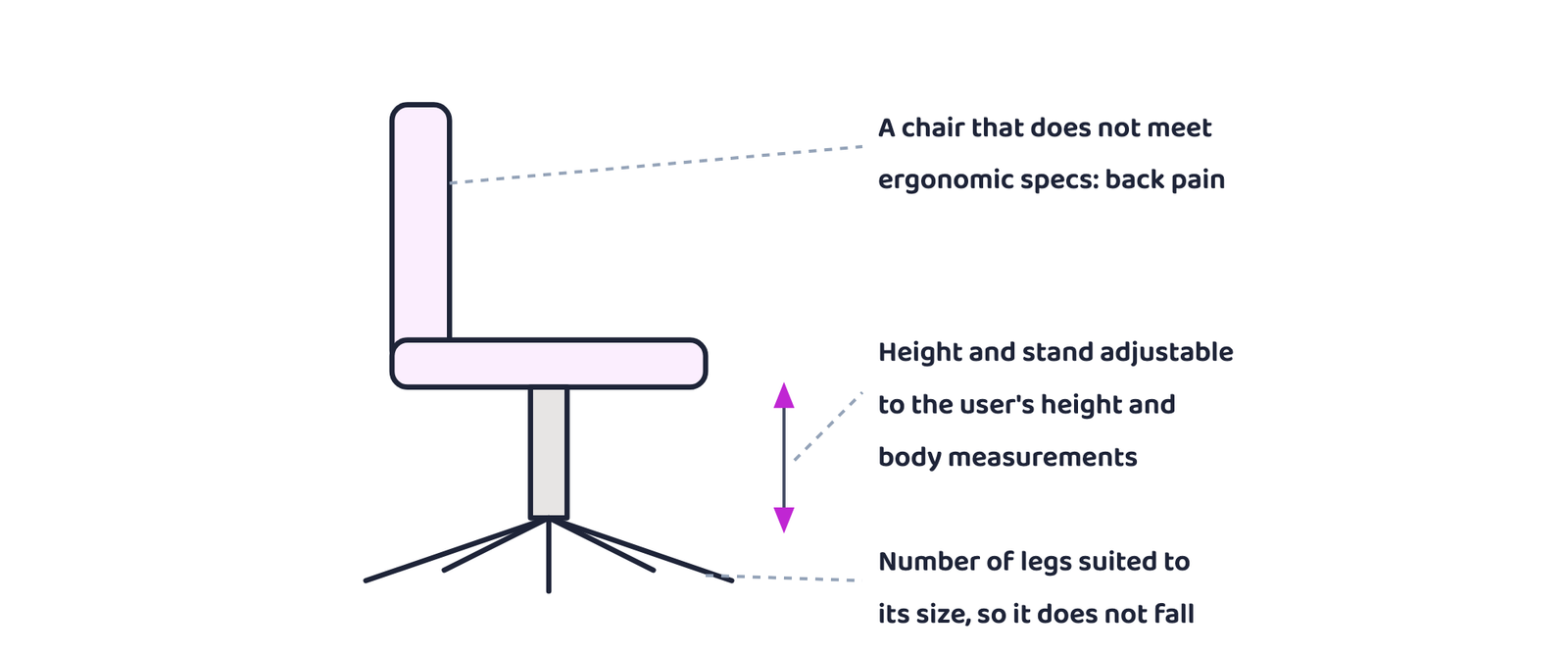
Ergonomics is the study of humans at work, in order to understand the complex interrelationships of people with their job requirements, methods of working, tools/equipment used and the environment. Its primary goal is to adapt the work environment to the worker.
- The word comes from two Greek words: “ergon” (work) and “nomics” (natural laws)
- It may also be called “Human Factors Engineering”
- Objective: working conditions that are not hazardous to health, are acceptable to the workers, and are optimal for work output and productivity
- Ergonomics is “Adjustment of human and Machine”. It applies human biological sciences together with engineering science; the benefit is measured in human efficiency and well-being
- Tools, machines and workstations are designed to fit the work, so that stress and health problems are reduced

| Aspect an ergonomist considers | What it includes |
|---|---|
| Worker capacity | Both physiological and psychological |
| Task demands | Nature and complexity, force required, duration, posture |
| Work environment | Noise, humidity, vibration, light, temperature |
The four pillars: anthropometry (body size and measurements), biomechanics (musculoskeletal activities and forces exerted), physiology and industrial psychology.
9.1 Need for ergonomics
Improving safety and health
- Reducing the number and severity of workplace injuries
- Reducing the possibility of accidents due to human error
Improving job effectiveness
- Increasing productivity
- Reducing errors
- Eliminating or reducing injuries
- Increasing job satisfaction through comfortable working conditions
It addresses matters related to: workplace / workstation design, task design / design of work methods, equipment design, facilities and environment.
9.2 Benefits of ergonomics
✓ Increases
- Productivity
- Efficiency
- Morale of workers
✗ Reduces
- Risk of injury and accidents
- Mistakes and the need to do the work again
- Absenteeism due to ill health, accidents or stress
- Every ergonomics intervention must be seen in the light of its effect on productivity; the best solutions often improve it
- Cutting unnecessary or awkward postures and exertions reduces the time a task takes, so productivity rises
- When a task is matched with the ability of the people doing it, they make fewer errors and produce less waste
- Creating a safe and productive work environment is critical for any workplace; employees are an organisation’s most important asset
- Ergonomic design influences employee productivity and retention (employees staying on)
For “The management decides to redesign their office with the help of an ergonomist. Mention any three aspects the ergonomist should consider”, write the three aspects (worker capacity, task demands, work environment), each with what it includes.
10 Entrepreneurship
Self-employment and innovative entrepreneurial ventures can be challenging, stimulating and highly rewarding, so they deserve attention as an avenue for satisfying careers.
Entrepreneurship is the act of creating a new and innovative enterprise, product or service.
An entrepreneur is a person who can take risks for converting a novel idea into reality. An entrepreneur is innovative, creative, organised and a risk taker.
- Function of entrepreneurs: to change the pattern of a production or design of a product through innovations or inventions, or new technological methods, to produce a new commodity or an old one in a new way
- The entrepreneur undertakes these changes in an enterprise or business, using acumen (sharp judgement) to assemble resources and finances
- This may create new organisations or help revitalise existing ones
- Indian examples: Mr. Narayan Murthy, JRD Tata, Dhirubhai Ambani
- Entrepreneurship ranges from small individual projects or micro units, sometimes part-time, to major undertakings giving jobs to many people
- Organisations that support entrepreneurs: government agencies, scientific institutes and organisations, financial institutions such as banks, and some voluntary organisations
- Entrepreneurs make things happen: a concept, product, policy or institution; they become champions of new processes, engineers of change
10.1 Characteristics of entrepreneurs
| # | Characteristic | # | Characteristic |
|---|---|---|---|
| 1 | Willingness to work hard | 8 | Being realistic and not expecting easy solutions |
| 2 | Knowledge and skills for planning and implementation | 9 | Ability to cope with set-backs, challenges and failures |
| 3 | Skills of management of finances, materials, personnel and time | 10 | Ability to develop partnerships, and able networking |
| 4 | Courage to take calculated risks (risks taken after thinking them through) | 11 | Ability to negotiate, strategise and prioritise |
| 5 | Ability and preparedness to handle many tasks simultaneously | 12 | Being flexible and able to handle crises |
| 6 | Ability to learn and acquire the skills needed for the tasks at hand | 13 | Good communication skills |
| 7 | Ability to deal with tough issues and find the solutions |
- In short, the entrepreneur must be innovative, creative and goal-oriented, ready to take direct action and seek more effective ways of doing things
- Recently entrepreneurship has come to be seen as a specific mindset, giving forms such as social entrepreneurship and knowledge entrepreneurship
10.2 Social entrepreneurship
Social entrepreneurship is not in the CBSE 2026-27 syllabus (CBSE keeps only the definition and characteristics of entrepreneurship); UP Board and HBSE teach the whole chapter.
Social entrepreneurship focuses on doing social good. The social entrepreneur aims to achieve large-scale benefits through entrepreneurship for a specific group or for society at large.
- Social entrepreneurs generally work for underserved, neglected and disadvantaged groups, or people without the money to achieve the benefit themselves
- They are “social catalysts”: visionaries who create basic social changes and sustainable improvements
- Fields: education, health care, economic development, the environment, the arts or any other social field
- Its success is judged less by profits and more by the social benefits and impact
11 Practical Work and Activities
The CBSE 2026-27 and UP Board practical lists have no practical for this unit. These activities from the book suit project and file work (how to do each one is in the NCERT Solutions post):
- Activity 3: a visit to local artisans, then a resource file on local traditional arts, crafts and cuisines
- Activity 4: an exhibition of local traditional arts and crafts
- Activity 5: a scrap book on organisations or individuals in your region helping women become empowered and self-reliant
- Activity 6: information on women in your region who have contributed significantly to society
- Activity 7: a power point presentation on distinguished women in science, technology, mathematics, sports, education, literature, medicine and other areas
- Activity 13: group discussion (6-8 children) on unemployment: its effects, causes, what the government does, and suggestions
Work, meaningful work, careers, livelihood, rest and recreation, standard of living, social responsibility, ethics, volunteerism, traditional occupations, age and gender, child labour, attitudes and approaches to work, life skills, work and dignity, quality of work life, job satisfaction, creativity and innovation, work environment, occupational health, entrepreneurship.
- Work = essential activities for a purpose or out of necessity; meaningful work = useful + responsible + enjoyable
- Livelihood = basic needs and lifestyle; career = unique, dynamic, life management concept
- Three perspectives: job and livelihood · career · calling (the three men breaking boulders)
- Almost 70 per cent rural; weaving a cottage industry; visual arts over 4,000 years old, patrons temples and princely rulers
- Sex = biological; gender = socially constructed; Supreme Court: transgender = third gender; double burden on women
- Article 16 (1); Factories 1948, Plantation Labour 1951, Mines 1952, Maternity Benefit 1961; Section 48: more than 30 women, crèche, children below 6; women’s cells in the Ministry of Labour
- KGBV: Samagra Shiksha, residential, entry Class VI, now till Class XII, backward blocks, Bridge Course
- QWL: employees are assets; ten life skills; WHO: thinking, coping, social skills; be responsive, not reactive
- Ergonomics: ergon + nomics; three aspects; four pillars (anthropometry, biomechanics, physiology, industrial psychology); six benefits
- Entrepreneur = takes risks to turn a novel idea into reality; main function: change the pattern of production; social entrepreneurs = social catalysts
- Can I write three differences between a job and a career?
- Can I name the five Acts for women (four with their years) and state Section 48?
- Can I list the ten life skills and the six groups of soft skills without looking?
- Can I write the three aspects, four pillars and six benefits of ergonomics?
- Can I write at least six characteristics of an entrepreneur?