
- Explain the significance of fashion design and merchandising in the garment industry
- Describe the fundamentals of fashion: the fashion terms, how fashion developed, and the fashion cycle
- Explain the knowledge and skills needed in the fashion business: merchandising, its levels, target market, market segmentation and retail organisations
- Discuss how a student can prepare for a career in the fashion industry, and its scope
1 Introduction: how fashion merchandising began
- Fashion design and merchandising are among the most exciting career options in today’s world
- In India, textile industries have been thriving for ages; the recent boom in fashion designing has opened new prospects in garment and accessory design
- The fashion industry satisfies both the creative urge and the materialistic needs of people
The book traces merchandising from its origin in five steps:
1.1 Significance of fashion design and merchandising
- It helps you understand how the fashion business works
- It includes all the processes of producing raw material, apparel and accessories, and the retail stores that sell fashion merchandise to the public
- You also learn about textiles: fabrics and the fibres used to make them
- It first responds to what, why and when a style becomes a fashion, then helps decide its suitability for a particular retail operation and for what length of time
- Simply put, it encompasses ‘planning, buying and selling’
Women did not start wearing jeans until the 1950s.
2 Basic concepts and fashion terminology
- Fashion today is a big business employing millions of people in design, manufacturing, distribution, marketing, retailing, advertising, communications, publishing and consulting
- To understand fashion design, one must understand the nature of fashion and how it works, the fundamentals of fashion, and the relationship between fashion and the factors that affect it
2.1 Fashion terminology
Four words are used again and again to discuss fashion. Each is a definition the exam asks.
Fashion is the style or styles most popular at a given time.
Style is any particular look or characteristic in apparel or accessories. A style may come and go in fashion but the specific style always remains.
Fads, or short lived fashions, can come and go in a single season. They lack the design strength to hold consumer attention for long.
Classics are styles that never become completely obsolete, but instead remain more or less accepted for an extended period.
Fad
- Examples: hot pants, baggy pants, unmatched buttons
Classic
- Marked by simplicity of design, which keeps it from being easily dated
- Examples: blazer jackets, polo shirts, Chanel suit
Do not mix up fashion and style. A style is a look (for example, a polo shirt) and it always remains a style. It becomes a fashion only while it is the most popular style at that time.
3 Fashion development
- To understand the working of the fashion industry, one must know the fashion fundamentals; first in the sequence is how the fashion business developed
- The history of fashion helps designers make decisions for present and future fashions; ideas from the past are often reinterpreted for today’s fashion
- Fashion, as we know it, is relatively new: in ancient and medieval times styles remained practically unchanged for a century at a time
- During the Renaissance, Western civilisation discovered different cultures, customs and costumes, which accelerated fashion change; new fabrics and ideas made people yearn for new things
3.1 France: the centre of fashion
- France’s dominance over international fashion began in the early 18th century
- Until the Industrial Revolution people belonged to two classes, wealthy and poor; only the wealthy could afford fashionable clothes
- By the turn of the 18th century, the members of King Louis XIV’s court became the trendsetters of taste, making Paris the fashion capital of Europe
- French cities supplied the court with silk fabrics, ribbons and laces
- Intricate seaming needed painstaking hand sewing; all clothes were hand made and custom made (made to fit the customer’s exact measurements)
(1) Support from the royal court and (2) the development of the silk industry there.
Couture (koo-tour’) was the term used for the art of dress making. A male designer was a couturier and his female counterpart was a couturiere.
3.2 From the Industrial Revolution to ready-to-wear
The major developments in fashion, in time order:
Prêt-à-porter (ready-to-wear) describes factory-made clothing that is sold in finished condition and in standardised sizes, as distinct from bespoke, made-to-measure haute couture.
- Yves Saint Laurent (YSL) is credited as being the first French haute couturier to come out with a full prêt-à-porter line
A one-mark question can ask why YSL is famous: he was the first French haute couturier with a full prêt-à-porter (ready-to-wear) line.
4 Fashion evolution: the fashion cycle
Fashion moves in a cycle. The way in which fashion changes is described as a fashion cycle. It is represented by a bell shaped curve of time and sales.
- Acceptance of a style is measured in sales volume
- The book’s figure divides the curve into three phases: introductory, acceptance and rejection
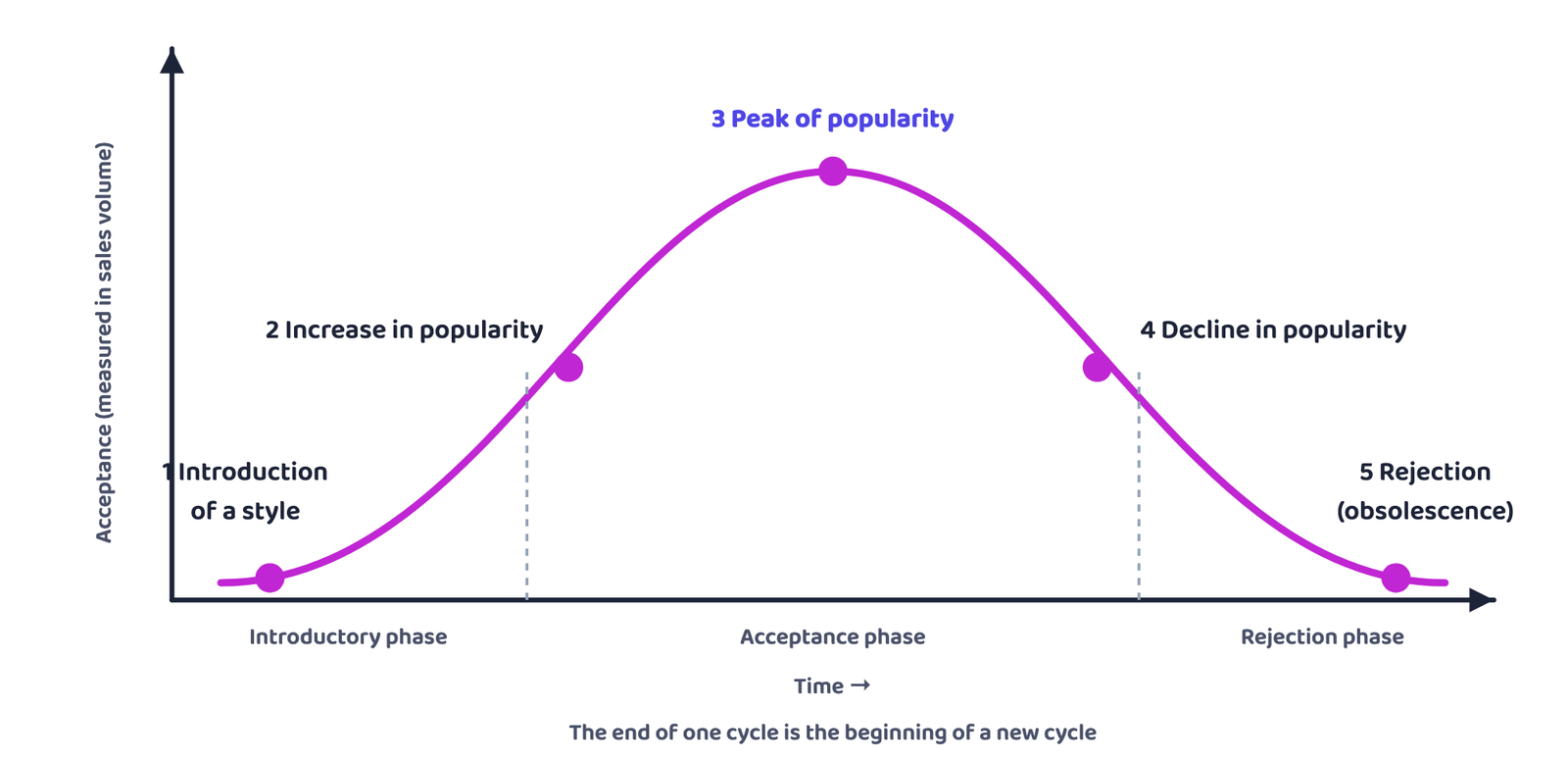
The stages of the fashion cycle, as listed in the book:
Introduction of a style
Designers turn their research and creative ideas into apparel and offer the new styles to the public. Designs are created by changing line, colour, shape, fabric and details, and their relationship to one another.
Increase in popularity
As the new fashion is purchased, worn and seen by many people, it may begin to rise in popularity.
Peak of popularity
At the height of its popularity it may be in such demand that many manufacturers copy it or produce adaptations at different price levels.
Decline in popularity
So many copies are mass produced that fashion-conscious people tire of the style and look for something new. Declining styles are put on sale racks.
Rejection of a style or obsolescence
In the last phase, some consumers have already turned to new looks, thus beginning a new cycle.
5 Fashion merchandising and the merchandiser
Fashion merchandising refers to the planning required to have the right merchandise, at the right time, at the right place, at the right price and with the right sales promotion. If all these conditions are planned, one can achieve maximum profits.
A Fashion Merchandiser is a person who facilitates conversion of inspiration into design, uses technology to conceptualise and address the planning, production, promotion and distribution of products in the fashion industry, to meet the needs and demands of a consumer.
The merchandiser plays a role in four areas: manufacturing, buying, promoting and selling.

5.1 Role in manufacturing
- Makes significant input on the types of fabrics used to make a piece of clothing
- A strong historical and socio-cultural understanding of fabrics helps change a designer’s vision into reality
- Using knowledge of fabric and clothing construction, finds the best way to manufacture the designer’s piece, keeping price and target market in mind
5.2 Role in buying
- Buys fashion items to be presented in a store
- Must know the target market and be well-versed in fashion trend analysis and forecasting, which allows more accurate ordering
- When working with a designer, again offers expertise on textiles and fabrics
5.3 Role in promoting
- When working for a designer, promoting the designer’s product to stores that may buy large quantities is the number one priority
- Needs a creative mind, strong visual merchandising skills and sharp production skills
- Promotes items through fashion shows, where creations and visual effects are exaggerated to catch potential buyers’ attention
- Seeks out the target market for a designer’s clothing, such as children’s clothing stores, department stores or discount retailers
5.4 Role in selling
- Selling is the final component of fashion merchandising
- A merchandiser working with a designer sells fashion items to stores, which then sell to consumers
- Uses forecasting and market trends to give recommendations on production of the item; creativity helps suggest how to display items in the store
- A merchandiser working for a retail store buys and presents fashion items within the store
6 Three levels of merchandising
| Level | What it is | Key work |
|---|---|---|
| 1. Retail organisation merchandising | A specialised management function; the business that moves fashion from the designers’ showroom to the retail sales floor and into consumers’ hands | Internal planning within the retail organisation; adequate merchandise on hand, sold at prices consumers will pay, for a profitable operation |
| 2. Buying agency merchandising | Provides goods buying consultancy; acts as a procurement office for the buyers | Identify vendors, negotiate costs, check in-process quality, pre-shipment quality inspection; regular control over quality during the production process; selling through buying agencies saves cost and time for exporters |
| 3. Export house merchandising | Two types of merchandisers work in an export house | Buyer merchandiser and production merchandiser (see Figure 3) |
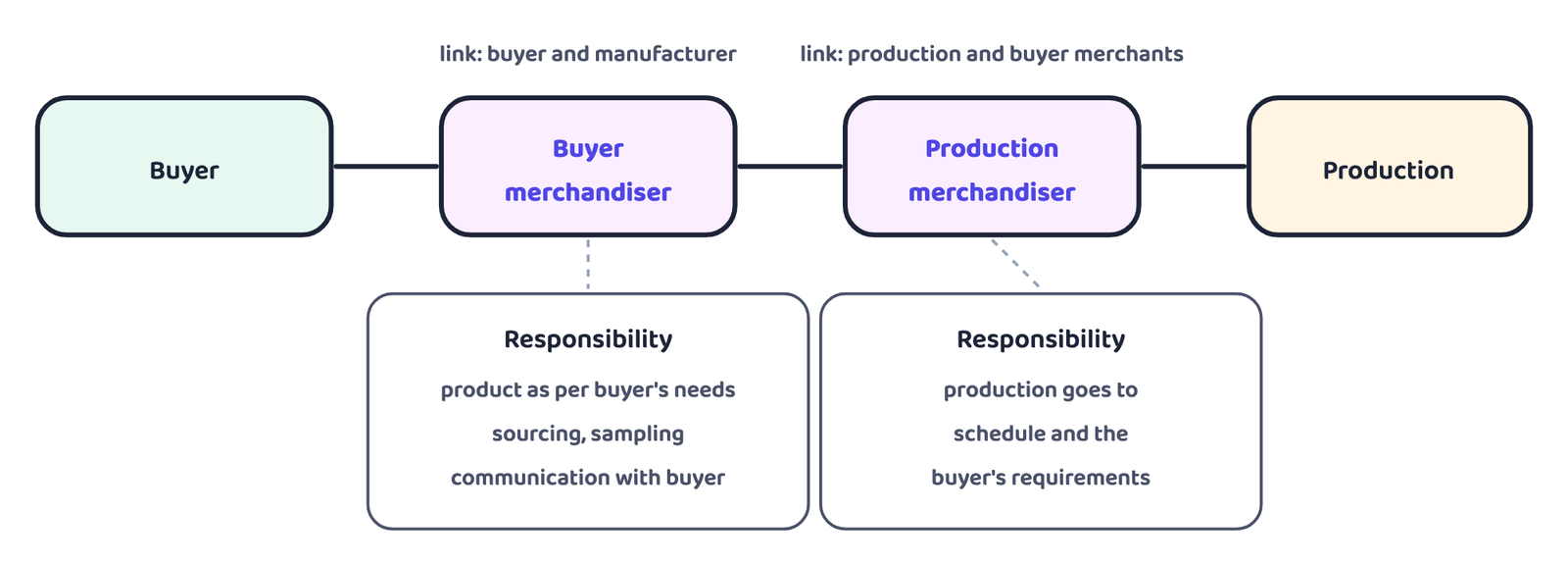
In short: the buyer merchandiser faces the buyer (sourcing, sampling, communication); the production merchandiser faces the factory (schedule and the buyer’s requirements).
7 Target market, market segmentation and merchandising rights
Target market is defined as the category of consumers one is targeting for selling the product.
- Knowing the target market lets the sales department focus on the consumers who are ‘most likely’ to purchase the offering
- It also ensures the highest return for marketing and sales expenditure
- The target market is found through market segmentation
Market segmentation is a strategy that involves dividing a larger market into subsets of consumers who have common needs and applications for the goods and services offered in the market.
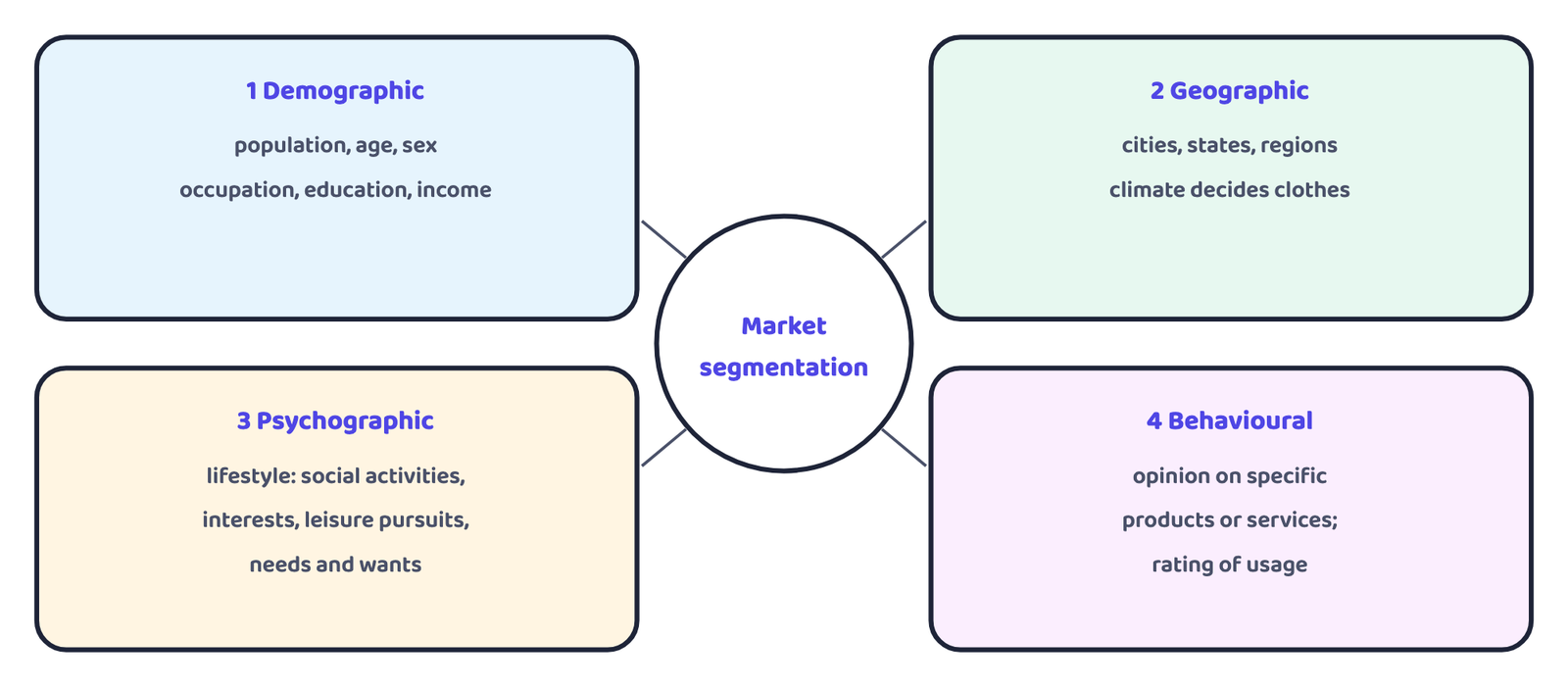
| Type | Basis |
|---|---|
| Demographic | Population, age, sex, occupation, education and income |
| Geographic | Cities, states and regions; climate varies by place and matters because the selection of clothes is climate dependent |
| Psychographic | Lifestyle: social activities, interests, leisure pursuits, needs and wants; people with similar lifestyles make up a target group |
| Behavioural | Opinion on specific products or services; rating of usage helps improve the product or service and make it different from others |
7.1 Interpreting consumer demand
- A merchandiser must also interpret consumer demand
- For this one must understand customers’ buying motivations (why they buy), together with the target market
7.2 Merchandising rights
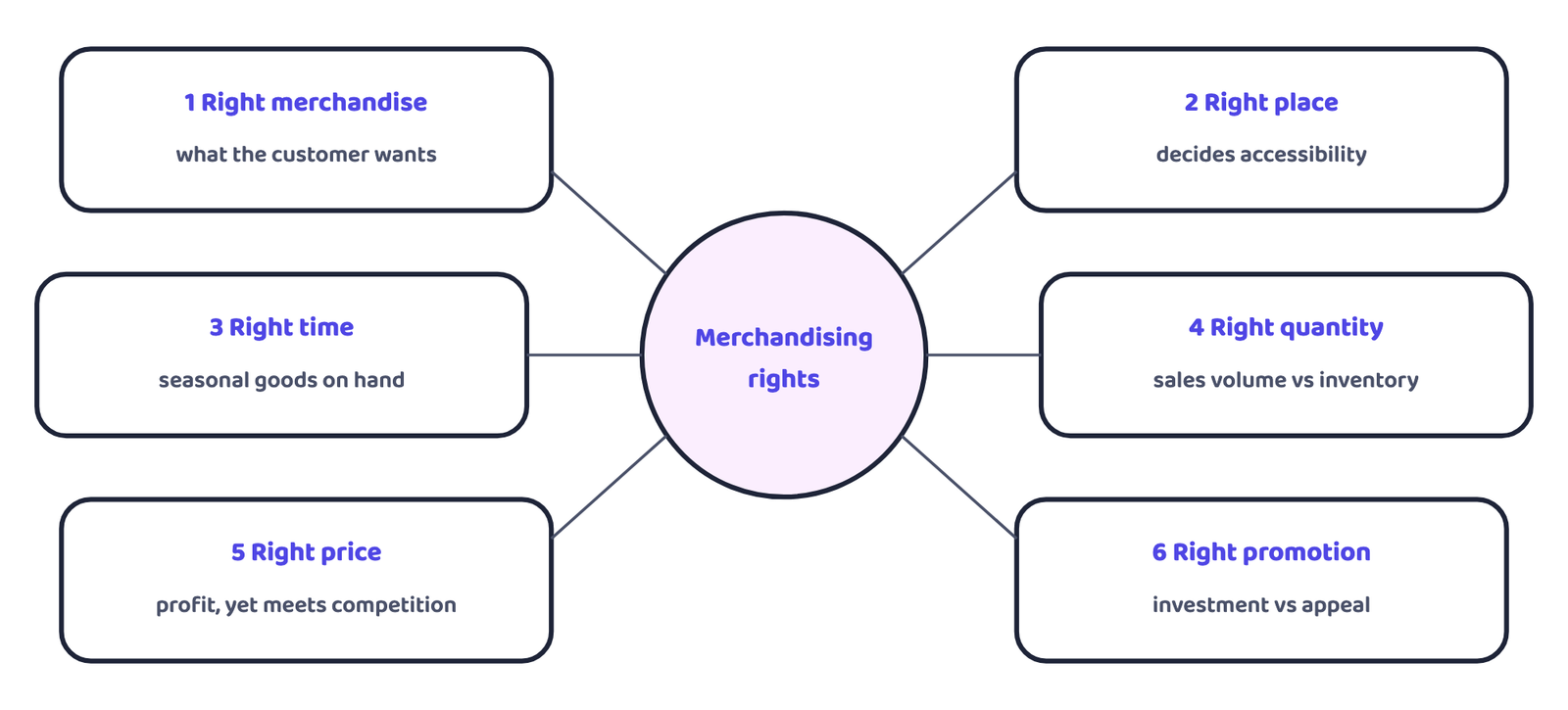
| Right | What it means |
|---|---|
| Right merchandise | Retailers must fill their shelves with the merchandise that the customer wants |
| At right place | The location of the merchandise is of prime importance since it decides accessibility |
| At right time | Much merchandise is seasonal and must be on hand when it is most needed |
| In right quantity | A profitable balance between volume of sales and amount of inventory |
| Right price | High enough to give the store profit, yet low enough to meet the competition and customers’ expectations |
| With right promotion | The right balance between investment and the appeal created for customers ensures successful promotion |
8 Fashion retail organisations
- Organisational structure includes a clear understanding of the authority and responsibility for each job to be done
- It differs with the type of merchandise, the size of the retail firm and the target customer
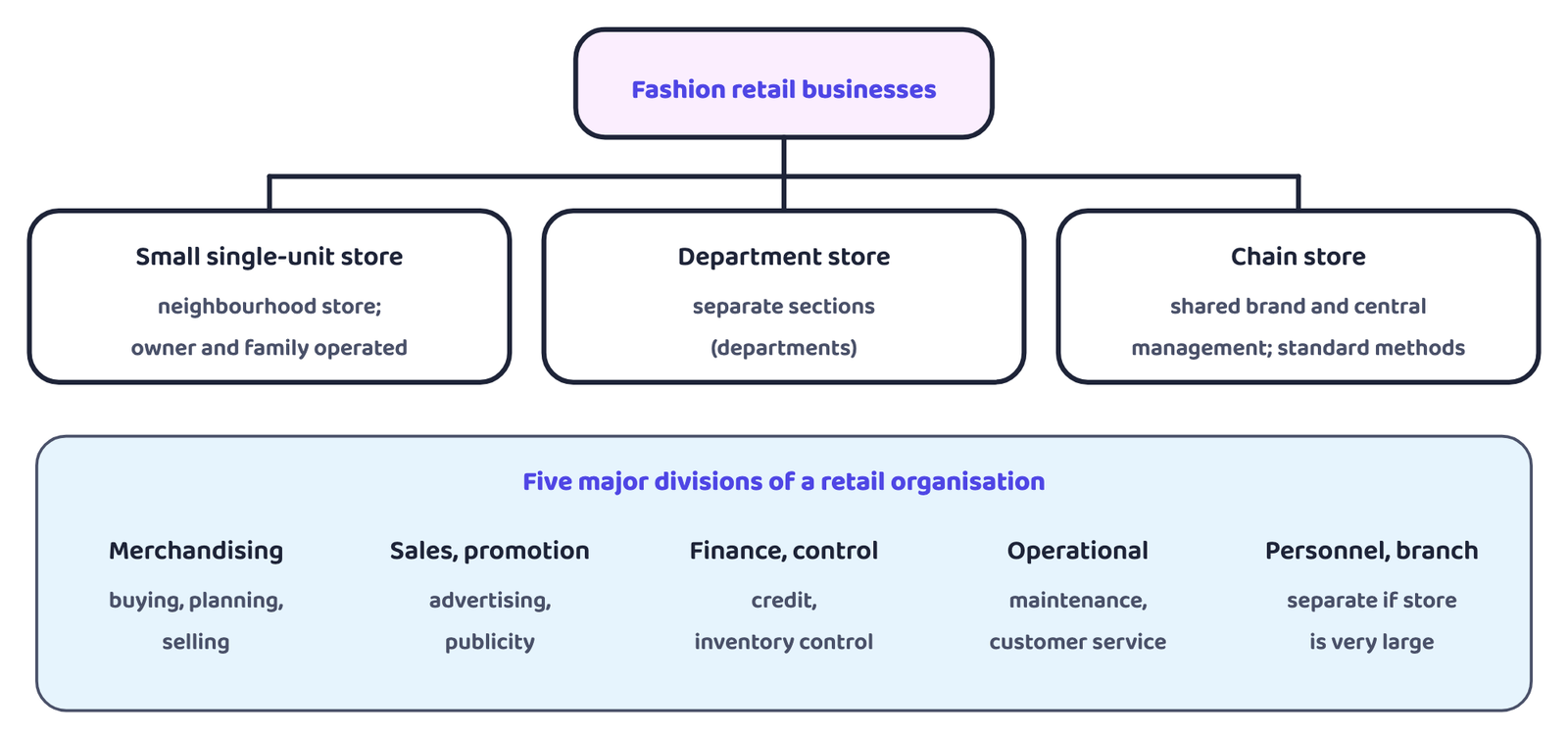
Small single-unit store
A neighbourhood store; owner and family operated single stores.
Department store
Separate sections, known as departments, such as clothing, sporting goods, automotive supplies, health and beauty products and electronics equipment; some may also sell food products.
Chain store
Retail outlets that share a brand and central management, and usually have standardised business methods and practices.
8.1 Major divisions of a retail organisation
| Division | Functions |
|---|---|
| Merchandising division | Buying, merchandise planning and control, selling, fashion coordination |
| Sales and promotion division | Advertising, visual merchandising, special events, publicity and public relations |
| Finance and control division | Credit, account payable and inventory control |
| Operational division | Maintenance of facilities, stores and merchandise protection, personnel, customer service, and receiving and marking of merchandise |
| Personnel and branch store division | May function separately if the store operations are very large |
9 Preparing for a career
- This career combines style with business sense, so a flair for fashion alone will not bring success
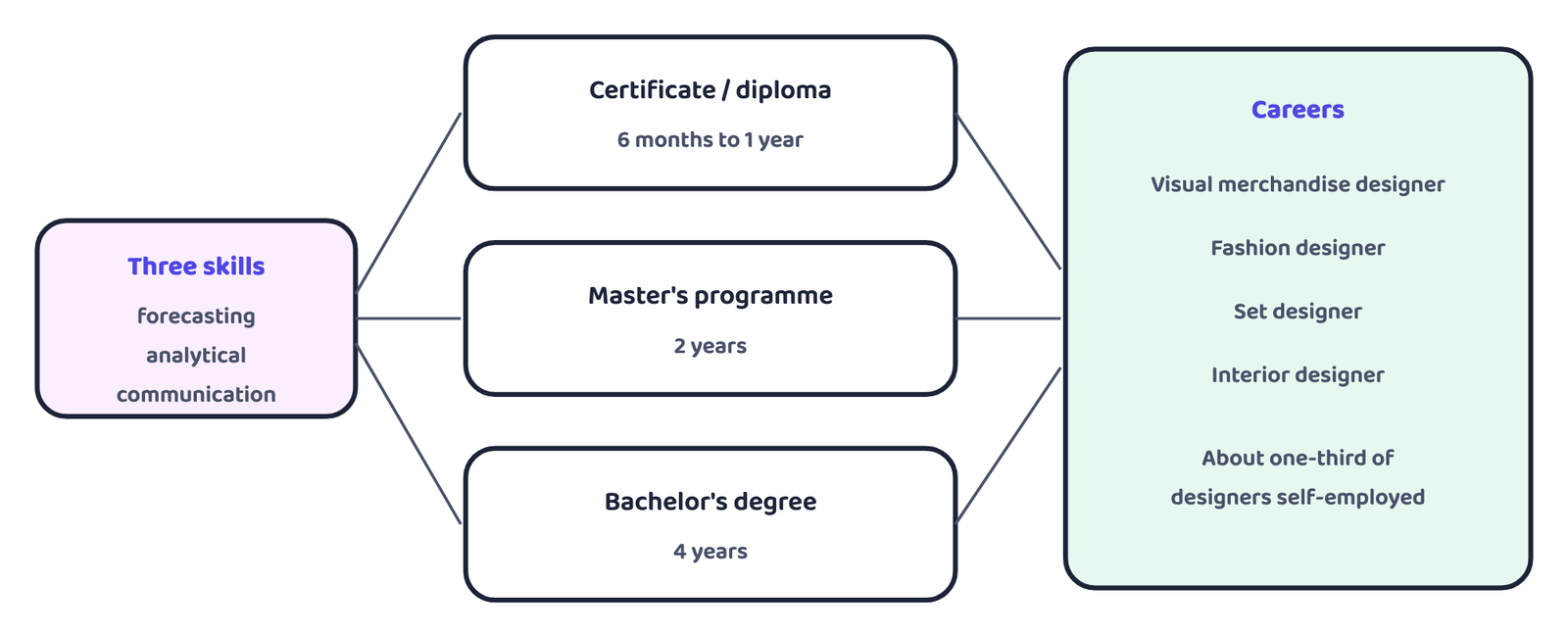
- A fashion designer, merchandiser and marketer must possess three primary (and divergent) skills
9.1 The three primary skills
Forecasting ability
Forecasting fashion trends is essential. It needs knowledge of past and current trends (shown by sometimes minute changes in the industry) and of how marketing an item contributes to trends. One must keep well ahead of trends to capitalise on them in time.
Analytical ability
Analysing the ‘dollars and sense’ part of the job: keeping abreast of the economy as a whole, the economy of one’s company, and how styles fit a consumer’s budget, juggling many factors to make a profit for the employer.
Communication ability
Negotiating prices with manufacturers and selling fashion choices to the public; frequently writing advertising copy, press releases and even personalised letters to consumers.
9.2 Degree programmes
- Fashion designers typically need an associate or a bachelor’s degree in fashion design
- Some combine a fashion design degree with a business, marketing or fashion merchandising degree, especially those who want to run their own business or retail store
- You can earn a certificate, a diploma, an associate’s or a bachelor’s degree; the choice depends on the unique qualities of each programme
| Programme | Duration | Feature |
|---|---|---|
| Certificate or diploma in fashion merchandising | 6 months to 1 year | Short because coursework focuses on the actual job; suits those without patience for long-term schooling who want to enter the field quickly |
| Fashion merchandising related degree (Master’s) | 2 years | Combines some liberal arts (general education) requirements with fashion and business courses |
| Bachelor’s degree in fashion design or merchandising | 4 years | A substantial amount of liberal arts with fashion and business courses; suits those wanting a broad education and promotional opportunities |
10 Scope
- Many are attracted by lucrative income opportunities and the idea that you can succeed on your own
- About one-third of professional fashion designers are self-employed
- Fashion designers have innate artistic and creative qualities and are in demand in a variety of industries
- Most focus on one specialised area, such as interior designing, merchandise displays, clothing/apparel or theatre sets
- Since market and fashion trends keep changing, you must always equip yourself with fresh and new ideas
10.1 Popular fashion design careers
| Career | Work |
|---|---|
| Visual merchandise designer | Designing window displays, arranging store merchandise, creating props and accents, organising clothing placement, styling mannequins and spearheading marketing campaigns |
| Fashion designer | Creating designs for clothing and apparel; some work with popular fashion designers, others manage their own fashion labels |
| Set designer | Conceptualising designs for movies, television and theatre, in line with the script or the director; some design sets for trade shows and museums |
| Interior designer | Combining form with function; interior concepts that increase the beauty, safety and functionality of a space; work in retail stores, homes, offices, hospitals, hotels and more |
11 Practical work and activity
The CBSE and UP practical lists name no practical for this chapter, so this box carries the book’s own Activity 1 and Practical 1.
Visit a market place. Observe, identify and list the various types of store in the market. Sort what you find into small single-unit stores, department stores and chain stores (Figure 6).
11.1 Practical 1: developing a female fashion figure (croquis)
- Theme: developing a female fashion figure. Task: to learn sketching of a fashion figure and proportions
- Purpose: to understand the proportions of body parts and create a form on which design ideas for apparel can be shown
- The fashion figure is called a croquis (an outline or rough sketch); it is built using the head as the unit of measurement
- A fashion figure is 8½ to 10 heads in full size; basic head measurements vary with the fashion look of the time
- Requirements: sketch file and pencils
Proportions
Shoulders are widest, waist is smallest, hips are in between. The figure is about ½ from top of head to bottom of torso, and ½ from end of torso to ankle.
Horizontal guidelines
Shoulderline, bustline, waistline, hip plane, end of torso.
Vertical guidelines
Centre front, armhole, princess.

Sketching steps:
- Draw a central line of 10 heads, where one head measures 1 inch. This is the centre front line
- Divide it into 10 parts
- Mark the levels: eye line ½ head; shoulder line 1½ heads; bust line just below 2; waist line just below 3; hip plane 3½ heads; end of torso a bit above 4½ heads; knees 6½ heads; ankles above or at 9
- Join the levels with a pencil and develop the form
- The croquis is ready for showing your design ideas; practise at least 5 croquis with different head measurements
Fashion, Style, Fad, Classic, Couture, mass production, Fashion Cycle, Fashion Merchandising, target market, buying houses/agencies, export houses, market segmentation and retail organisations.
- Barter → ‘what was available was saleable’ → 1920 ready-to-wear → fashion merchandising
- Fashion merchandising simply = ‘planning, buying and selling’ · women wore jeans only from the 1950s
- Fads: hot pants, baggy pants, unmatched buttons · Classics: blazer jackets, polo shirts, Chanel suit
- France: early 18th century, Louis XIV’s court, royal support + silk industry · couturier / couturiere
- Spinning jenny, power looms · 1849 Levi Strauss denims · 1859 Singer treadle · 1880s skirts and blouses
- 1960s prêt-à-porter; YSL first French haute couturier with a full prêt-à-porter line
- Fashion cycle: introduction, increase, peak, decline, rejection (obsolescence); bell curve of time and sales
- Merchandiser’s roles: manufacturing, buying, promoting, selling (final)
- Levels: retail organisation, buying agency, export house (buyer + production merchandiser)
- Segmentation: demographic, geographic, psychographic, behavioural
- Rights: merchandise, place, time, quantity, price, promotion
- Stores: small single-unit, department, chain · 5 divisions
- Skills: forecasting, analytical, communication · certificate 6 months to 1 year, Master’s 2, Bachelor’s 4
- About one-third of designers self-employed · careers: visual merchandise, fashion, set, interior designer
- Croquis: 8½ to 10 heads; shoulder 1½, hip 3½, knees 6½
- Can I define fashion, style, fad and classic, with examples?
- Can I outline the major developments in fashion in order?
- Can I draw the fashion cycle and explain its five stages?
- Can I explain the four roles of a merchandiser and the three levels of merchandising?
- Can I name the four types of market segmentation and the six merchandising rights?
- Can I list the three skills and the degree programmes for a fashion career?