
- Define a social institution and explain how institutions both constrain us and give us opportunities
- Compare the functionalist and conflict views of institutions, the family, the state and education
- Explain family forms, the gendered family, the sex ratio, forms of marriage, endogamy and exogamy and the kinship terms
- Define work, the informal economy and the division of labour, and trace how work was transformed (assembly line, flexible production)
- Distinguish power and authority, stateless and state societies, and the three kinds of citizenship rights
- Explain how sociology studies religion (sacred and profane, secularisation, Weber on Calvinism) and education (Durkheim, stratification)
| Board (2026-27) | Marks for this chapter | Paper |
|---|---|---|
| CBSE (039) | 12 marks (Unit 3, “Understanding Social Institutions”) | Theory 80 + project 20 |
| UP Board | 10 marks | One 100-mark theory paper, no project |
| Rajasthan Board (RBSE) | 10 marks | One 100-mark theory paper |
| MP Board | 8 marks | Theory 80 + project 20 |
Every board above examines the whole chapter. CBSE’s unit lists Family, Marriage and Kinship; Work and Economic Life; Political Institutions; Religion as a Social Institution; and Education as a Social Institution: that is every section of these notes.
1 Introduction: What Is a Social Institution?
Each of us has a status (a position in society) and one or more roles (the behaviour expected from that position). These are not simply what we choose. They are not like roles a film actor may or may not opt to do. Social institutions constrain and control, punish and reward.
- Large-scale, covering the whole society
- Example in the book: the state
- Small-scale, close to everyday life
- Example in the book: the family
The chapter gives a brief idea of five central areas where important social institutions are located:
Family, marriage and kinship
Who we live with, marry and call relatives
Politics
Power, authority and the state
Economics
Work and economic life
Religion
The sacred, rituals, believers
Education
The school as an institution
Institution (in the broadest sense): something that works according to rules established or at least acknowledged by law or by custom, and whose regular and continuous operation cannot be understood without taking those rules into account.
- Institutions impose constraints on individuals. They also provide him/her with opportunities.
- An institution can also be viewed as an end in itself. People have viewed family, religion, state or even education as an end in itself. Activity 1 asks for examples of how people sacrifice for family, for religion or for the state.
1.1 Two ways of understanding institutions
Chapter 2 introduced the functionalist and conflict perspectives and showed how differently they saw the same thing, for instance stratification or social control. Not surprisingly, they understand social institutions differently too.
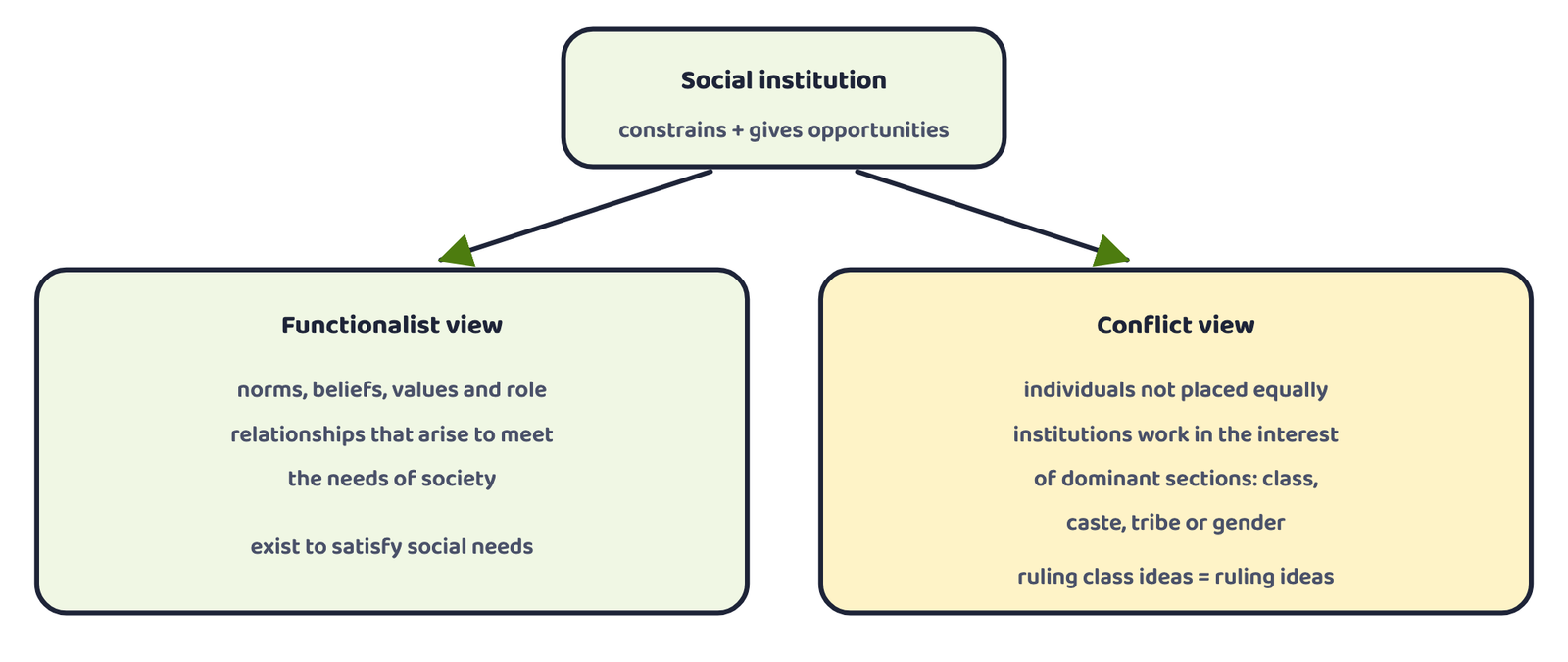
Functionalist view
- A social institution is a complex set of social norms, beliefs, values and role relationship that arise in response to the needs of society.
- Social institutions exist to satisfy social needs.
- So societies have informal social institutions (family, religion) and formal ones (law, (formal) education).
Conflict view
- All individuals are not placed equally in society.
- All institutions (familial, religious, political, economic, legal or educational) operate in the interest of the dominant sections, be it class, caste, tribe or gender.
- The dominant section dominates political and economic institutions and ensures that “the ruling class ideas become the ruling ideas of a society”.
- This is very different from the idea that there are general needs of a society.
How does the family constrain as well as provide opportunities to men and women? How do political or legal institutions affect the privileged and the dispossessed (people who own little or nothing)? Do institutions affect different sections of society unequally?
2 Family, Marriage and Kinship
Perhaps no other social entity appears more ‘natural’ than the family. We often assume all families are like ours, and no other institution appears more universal and unchanging. Sociology and social anthropology have done field research across cultures for many decades to show two things:
- Family, marriage and kinship are important in all societies, yet their character is different in different societies.
- The family (the private sphere) is linked to the economic, political, cultural and educational spheres (the public spheres). This is why disciplines need to share and borrow from each other (Chapter 1).
2.1 The functionalist view of the family, and why it is questioned
- Functionalists: the family performs important tasks which contribute to society’s basic needs and help perpetuate (keep going) social order.
- They argue that modern industrial societies function best if women look after the family and men earn the family livelihood.
- They see the nuclear family (parents and their children) as the unit best equipped to handle the demands of industrial society: one adult works outside the home, the other cares for the home and children.
- This specialisation of roles means the husband takes the ‘instrumental’ role as breadwinner (earner), and the wife the ‘affective’, emotional role in domestic settings (Giddens 2001).
- It is gender unjust.
- Empirical studies (studies based on observed facts; glossary: an empirical investigation is a factual enquiry carried out in any given area of sociological study) across cultures and history show that it is untrue. In contemporary industries like the garment export industry, women form a large part of the labour force.
- It suggests that men are necessarily the heads of households. This is not necessarily true (see the box on female headed households).
- In India, studies suggest that families need not become nuclear in an industrial pattern of economy (Singh 1993: 83). Trends based on the experience of one society cannot necessarily be generalised.
When men migrate to urban areas, women have to plough and manage the agricultural fields and often become the sole providers of their families. Such households are known as female headed households. They also arise through:
- Widowhood
- Men getting remarried and stopping remittances (money sent home) to their wives, children and other dependents
Among the Kolams, a tribal community in south-eastern Maharashtra and northern Andhra Pradesh, a female headed household is an accepted norm.
2.2 Variation in family forms
A central debate in India has been about the shift from nuclear family to joint families. Sociology questions common sense impressions here too:
- Nuclear families have always existed in India, particularly among deprived castes and classes.
- The sociologist A.M. Shah remarks that in post-independent India the joint family has steadily increased. The contributing factor, according to him, is the increasing life expectancy in India.
| Life expectancy (Shah) | 1941-50 | 1981-85 |
|---|---|---|
| Men | 32.5 years | 55.4 years |
| Women | 31.7 years | 55.7 years |
Consequently the proportion of aged people (60 years and above) in the population has increased. Shah asks:
“in what kind of household do these elderly people live? I submit, most of them live in joint household”
Shah 1998
The book calls this a broad generalisation. But in the spirit of the sociological perspective, it cautions us against blindly believing the common sense impression that the joint family is fast eroding, and alerts us to the need for careful comparative and empirical studies.
Matrilocal
- Rule of residence: the newly married couple stays with the woman’s parents
Patrilocal
- Rule of residence: the couple lives with the man’s parents
| Term | Meaning in the book |
|---|---|
| Patriarchal family structure | The men exercise authority and dominance |
| Matriarchy | The women play a major role in decision-making in the family |
| Key point | Matrilineal societies exist (descent traced through the mother), but the same cannot be claimed about matriarchal societies |
The book’s photographs here ask you to notice how families and residences are different, under the caption “Work and Home”.
We often see the family as separate from the economic or political spheres. In fact the family, the household, its structure and norms are closely linked to the rest of society.
During the post-unification period in the 1990s, Germany saw a rapid decline in marriage. The new German state withdrew all the protection and welfare schemes that families had before unification. With a growing sense of economic insecurity, people responded by refusing to marry. This is a case of unintended consequence (Chapter 1).
- Family and kinship change because of macro economic processes, but the direction of change need not be similar for all countries and regions.
- Change does not mean the complete erosion of previous norms and structure: change and continuity co-exist.
2.5 How gendered is the family?
Gender (glossary): social expectations about behaviour regarded as appropriate for the members of each sex. Gender is seen as a basic organising principle of society.
- The belief that the male child will support the parents in old age and the female child will leave on marriage leads families to invest more in a male child.
- Biologically a female baby has better chances of survival than a male baby. Yet the rate of infant mortality among female children is higher than among male children in the lower age group in India.
- Activity 2: a Telugu expression says, ‘Bringing up a daughter is like watering a plant in another’s courtyard’. Popular sayings reflect the social arrangement of a society.
- The incidence of female foeticide (killing a female child before birth) has led to a sudden decline in the sex ratio.
- The child sex ratio declined from 934 per thousand males in 1991 to 919 in 2011. The percentage of decline is more alarming.
- The situation of prosperous states like Punjab, Haryana, Maharashtra and Uttar Pradesh is all the more grave.
- In Punjab the child sex ratio has declined to 846 girls per 1,000 boys. In some districts of Haryana it has fallen below 800.
2.6 The institution of marriage and its forms
Historically marriage has existed in a wide variety of forms and has performed differing functions. The way marriage partners are arranged shows an astonishing variety of modes and customs (Activity 3: find out how different societies find marriage partners). Forms of marriage are identified on two bases: the number of partners and the rules governing who can marry whom.
Monogamy restricts the individual to one spouse at a time: at any given time a man can have only one wife and a woman only one husband. (Glossary: marriage that involves one husband and one wife alone.)
- Even where polygamy is permitted, in actual practice monogamy is more widely prevalent.
Serial monogamy: individuals are permitted to marry again, often on the death of the first spouse or after divorce, but they cannot have more than one spouse at one and the same time.
- Remarriage on the death of a wife has been a norm for men for the most part.
- The right was denied to upper caste Hindu widows; the campaign for widow remarriage was a major issue in the 19th century reform movements.
- Today in modern India nearly 10 per cent of all women and 55 per cent of women over fifty years are widows (Chen 2000: 353).
Polygamy: marriage to more than one mate at one time. It takes the form of polygyny (one husband with two or more wives) or polyandry (one wife with two or more husbands).
Usually where economic conditions are harsh, polyandry may be one response of society, since a single male cannot adequately support a wife and children. Also, extreme poverty pressurises a group to limit its population.
2.7 Arranging marriages: rules of endogamy and exogamy
In some societies parents/relatives decide on mate selection; in others individuals are relatively free to choose. Some societies have subtle restrictions, others define explicitly who can or cannot be married. Rules governing the eligibility or ineligibility of mates give two forms:
Endogamy
- An individual must marry within a culturally defined group of which he or she is already a member
- Example: caste
- Glossary: marriage within a specific caste, class or tribal group
Exogamy
- The reverse of endogamy: the individual must marry outside his/her own group
- Example: village exogamy in parts of north India
- Glossary: marriage outside a certain group of relations
Both rules are in reference to certain kinship units, such as clan, caste and racial, ethnic or religious groupings.
The book quotes two such songs. In the first a daughter says, “Father, we are like flocks of bird / We shall fly away” and the father offers to remove a brick so that her palanquin can pass (Chanana 1993: WS26). In the second, a stranger’s son has come to fetch the bride, and she calls her playmates to come with their toys and play one last time, “for I shall never play again” (Dube 2001: 94). Activity 4 asks you to collect wedding songs and see how they reflect the social dynamics of marriage and gender relations. Activity 5 asks you to study matrimonial advertisements: is endogamy still the prevalent norm, and what changes in society do they reflect?
2.8 Basic concepts: family, kinship and marriage
Family: a group of persons directly linked by kin connections, the adult members of which assume responsibility for caring for children.
Kinship ties: connections between individuals, established either through marriage or through the lines of descent that connect blood relatives (mothers, fathers, siblings, offspring, etc.).
Marriage: a socially acknowledged and approved sexual union between two adult individuals. When two people marry, they become kin to one another, and the marriage bond also connects a wider range of people.
| Term | Meaning |
|---|---|
| Family of orientation | The family of birth |
| Family of procreation | The family in which a person is married |
| Consanguineous kin | Kin related through “blood” |
| Affines | Kin related through marriage |
3 Work and Economic Life
3.1 What is work?
As children we imagine what ‘work’ we will do when we grow up; here ‘work’ means paid employment, the most widely understood sense of work in modern times. The book calls this an oversimplified view: many types of work do not fit the idea of paid employment.
Informal economy: transactions outside the sphere of regular employment, sometimes involving the exchange of cash for services provided, but also often involving the direct exchange of goods or services. Much of this work is not recorded in the official employment statistics.
Work, whether paid or unpaid: the carrying out of tasks requiring the expenditure of mental and physical effort, which has as its objective the production of goods and services that cater to human needs.
From the time she could hold her own cup, Tiny’s Granny worked at ‘odd jobs’ in people’s houses in return for two meals a day and cast-off clothes, anything from shaking the baby’s rattle to massaging the master’s head. The extract shows unpaid and poorly paid work, and child work, that “paid employment” leaves out. The book then asks you to find out more about the various kinds of ‘work’ from your own observation, literature or films.
3.2 Modern forms of work and division of labour
Pre-modern / traditional society
- Most people worked in the field or cared for livestock
- Non-agricultural work meant mastery of a craft, learned through a lengthy apprenticeship
- The worker carried out all aspects of production from beginning to end
- Most work took place at home, done collectively by all household members
Modern industrial society
- Only a tiny proportion works in agriculture; farming itself is industrialised (machines, not the human hand)
- A highly complex division of labour: work divided into an enormous number of occupations in which people specialise
- Machinery on electricity and coal separated work and home; factories owned by capitalist entrepreneurs became the focal point
- Workers trained for a specialised task, paid a wage; managers supervised to raise productivity and discipline
Division of labour (glossary): the specialisation of work tasks, by means of which different occupations are combined within a production system. All societies have at least some rudimentary (basic) form of it; with industrialism it becomes vastly more complex. In the modern world, the division of labour is international in scope.
- India: the larger share of the population is still in rural agricultural or other rural based occupations. Another trend is an expansion of the service sector. (Activities 6 and 7: the proportion of Indians in rural occupations; the shift to the service sector.)
- Service industries (glossary): industries concerned with the production of services rather than manufactured goods, such as the travel industry.
- Economic interdependence: one of the main features of modern societies. We depend on an immense number of other workers, stretching right across the world. The vast majority of people do not produce the food they eat, the houses they live in or the goods they consume (Activity 9). Activity 8 asks how long a master weaver takes to make one shawl.
3.3 Transformation of work
- The industry is part of a long supply chain, so the freedom of manufacturers is extremely limited: more than a hundred operations between the designer and the final consumer, of which only 15 are in the hands of the manufacturer.
- Any serious agitation for higher wages would lead manufacturers to shift their operations to other localities, beyond the reach of unionists.
- So the important thing is to enlist the support of the retailer to pressure the government and local agencies for a higher wage structure: the vision of an “international opinion forum”.
Lesson: the new organisation of production and a body of customers outside the country have altered both the economics and the politics of production. The book’s visuals contrast cloth production in a factory with threshing of paddy in a village.
4 Politics
Political institutions are concerned with the distribution of power in society. Two concepts are critical to understanding them: power and authority.
Power: the ability of individuals or groups to carry out their will even when opposed by others.
- Those who hold power do so at the cost of others.
- There is a fixed amount of power in a society: if some wield power, others do not.
- Power is never held in isolation; it is held in relation to others.
- The notion is inclusive: family elders assigning domestic duties, principals enforcing discipline, a General Manager distributing work among executives, political leaders regulating their parties’ programmes. The president of a party can expel a member. In each case power extends as far as others abide by one’s will.
Authority: that form of power which is accepted as legitimate, that is, as right and just. It is institutionalised because it is based on legitimacy. Power is exercised through authority.
- People accept the power of those in authority because they consider their control fair and justified.
- Often ideologies exist that help this process of legitimation.
Legitimacy (glossary): the belief that a particular political order is just and valid.
Ideology (glossary): shared ideas or beliefs which serve to justify the interests of dominant groups. Ideologies are found in all societies with systematic and engrained inequalities between groups. Ideology connects closely with power, since ideological systems serve to legitimise the differential power which groups hold.
Power
- Ability to carry out one’s will even against opposition
- May or may not be accepted
Authority
- Power accepted as legitimate (right and just)
- Institutionalised; people comply because they see it as fair
4.1 Stateless societies
Empirical studies of stateless societies by social anthropologists over sixty years ago showed how order is maintained without a modern governmental apparatus. Instead there was:
- the balanced opposition between parts;
- cross-cutting alliances based on kinship, marriage and residence;
- rites and ceremonies involving the participation of friends and foes.
The modern state has a fixed structure and formal procedures. The book asks: are some of these informal mechanisms not present in state societies too?
Stateless society
- Lacks formal institutions of government
State society
- Possesses a formal apparatus of government
4.2 The concept of the state
A state exists where there is a political apparatus of government (institutions like a parliament or congress, plus civil service officials) ruling over a given territory. Government authority is backed by a legal system and by the capacity to use military force to implement its policies.
Functionalist perspective
- The state represents the interests of all sections of society
Conflict perspective
- The state represents the dominant sections of society
Modern states differ greatly from traditional states. They are defined by sovereignty, citizenship and, most often, ideas of nationalism.
Sovereignty: the undisputed political rule of a state over a given territorial area.
The sovereign state at first did not give citizens rights of political participation. These were achieved largely through struggles which limited the power of monarchs, or actively overthrew them: the French Revolution and our own Indian independence struggle are two instances.
Citizen (glossary): a member of a political community, having both rights and duties associated with that membership.
4.3 Three kinds of citizenship rights
Civil rights
Freedom to live where one chooses; freedom of speech and religion; the right to own property; the right to equal justice before the law.
Political rights
The right to participate in elections and to stand for public office. Governments were reluctant to admit universal franchise: in the early years not only women but a large section of the male population was excluded, as holding a certain amount of property was an eligibility criterion; women had to wait longer for the vote.
Social rights
Every individual’s prerogative (right) to a certain minimum standard of economic welfare and security: health benefits, unemployment allowance, a minimum level of wages.
- The broadening of social or welfare rights led to the welfare state, established in Western societies since the Second World War.
- States of the erstwhile (former) socialist countries had far-reaching provision in this sector; in most developing countries it was virtually non-existent.
- All over the world today social rights are being attacked as liabilities on the state and hindrances to economic growth (Activity 11).
- Activity 10: why are women so inadequately represented despite the right to vote and stand for office? Does the division of labour within families affect women’s political participation? Why is there a demand for 33 per cent reservation for women in Parliament?
4.4 Nationalism
Nationalism: a set of symbols and beliefs providing the sense of being part of a single political community. Individuals feel pride and belonging in being ‘British’, ‘Indian’, ‘Indonesian’ or ‘French’.
- Probably people have always felt some identity with groups like their family, clan or religious community. But nationalism only appeared with the development of the modern state.
- The contemporary world is marked both by a rapid expansion of the global market and by intense nationalist feelings and conflicts (Activity 12).
4.5 How sociology studies power
Sociologists study power broadly, not just the formal apparatus of government:
- The distribution of power between parties, classes, castes, and communities based on race, language and religion.
- Not only political associations (state legislatures, town councils, political parties) but also schools, banks and religious institutions, whose aims are not primarily political.
- Its range extends from international movements (such as women or environmental) to village factions.
5 Religion
5.1 How the sociological study of religion is different
The sociological study of religion is different from a religious or theological study (study of God and religious doctrine) in three ways:
| # | What sociology does | Why it matters |
|---|---|---|
| 1 | Conducts empirical studies of how religions actually function in society and relate to other institutions | The sociologist has no judgemental approach to religious phenomena |
| 2 | Uses a comparative method | Brings all societies on a level with each other; helps study without bias and prejudice |
| 3 | Investigates religious beliefs, practices and institutions in relation to other aspects of society and culture | Religious life can be made intelligible only by relating it to domestic, economic and political life |
Religion exists in all known societies, although beliefs and practices vary from culture to culture. Characteristics that all religions seem to share:
Symbols
A set of symbols invoking feelings of reverence or awe
Rituals
Rituals or ceremonies
Believers
A community of believers
- Ritual acts include praying, chanting, singing, eating certain foods (or refraining from them), fasting on certain days.
- Because rituals are oriented towards religious symbols, they are usually seen as quite distinct from ordinary habits: lighting a candle or diya to honour the divine differs completely from lighting it to light a room.
- Rituals are done by individuals in everyday life, but all religions also have collective ceremonials, normally in special places: churches, mosques, temples, shrines.
5.3 The sacred and the profane
Religion is about the sacred realm. Before entering it, members of different religions cover or do not cover their head, take off shoes or wear particular clothes. What is common is the feeling of awe, recognition and respect for sacred places or situations.
Sacred
- The realm every society sets apart and treats with awe
- In most cases includes an element of the supernatural: a tree or temple is sacred because some supernatural force is believed to be behind it
Profane
- The ordinary, everyday world from which the sacred is distinguished
- Sociologists of religion, following Emile Durkheim, study how every society separates the sacred from the profane
Some religions, like early Buddhism and Confucianism, had no conception of the supernatural, but did allow sufficient reverence for things and persons they considered sacred.
5.4 Religion, power and secularisation
- Religion has had a very close relationship with power and politics: periodically there have been religious movements for social change, like anti-caste movements or movements against gender discrimination.
- Religion is not just private belief; it has a public character, and this public character bears on other institutions.
- Classical sociologists believed that as societies modernised, religion would become less influential over various spheres of life. The concept secularisation describes this process.
- But contemporary events suggest a persisting role of religion in various aspects of society.
5.5 Max Weber: Calvinism and capitalism
A pioneering work by Max Weber (1864-1920) shows how sociology looks at religion in relation to social and economic behaviour. Weber argues that Calvinism (a branch of Protestant Christianity) exerted an important influence on the emergence and growth of capitalism as a mode of economic organisation.
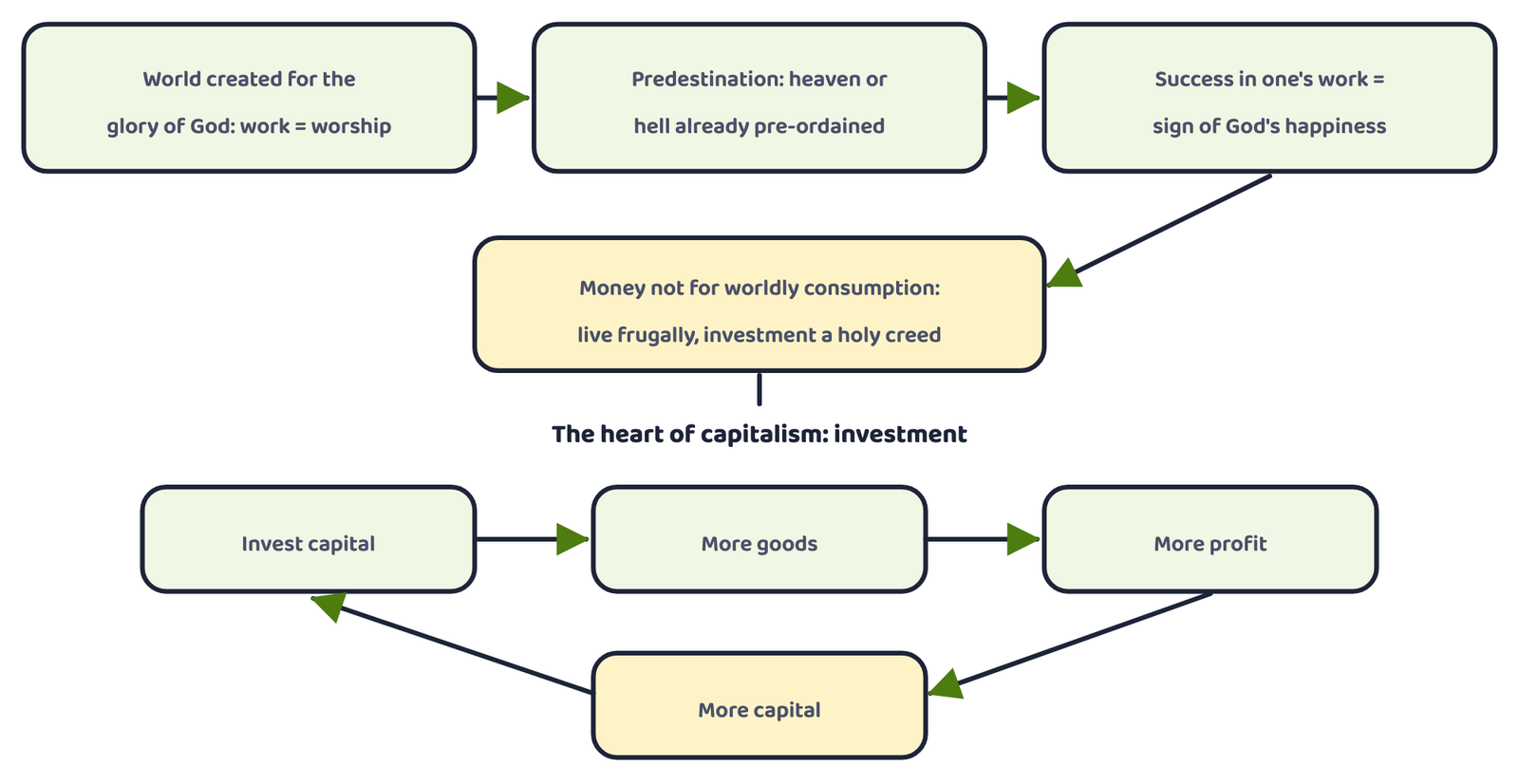
- Calvinists believed the world was created for the glory of God, so any work in this world had to be done for His glory, making even mundane works acts of worship.
- More importantly, they believed in predestination: whether one goes to heaven or hell was pre-ordained. Since there was no way of knowing, people looked for signs of God’s will in their own occupations.
- If a person was consistent and successful in his or her work, it was read as a sign of God’s happiness.
- Money earned was not for worldly consumption; the ethics of Calvinism was to live frugally (spend very little). So investment became something like a holy creed.
- At the heart of capitalism is investment: investing capital to make more goods, which create more profit, which creates more capital.
- Conclusion: Weber was able to argue that religion, in this case Calvinism, does have an influence on economic development.
5.6 Religion is tied to other parts of society
- Religion cannot be studied as a separate entity. Political debates, economic situations and gender norms always influence religious behaviour; conversely, religious norms influence and sometimes even determine social understanding.
- Women constitute half of the world’s population, so sociologically it is important to ask what relationship they have with religion.
- The task of sociologists is to unravel these interconnections. In traditional societies religion usually plays a central part, and religious symbols and rituals are often integrated with the material and artistic culture.
- After Independence, the growth of new employment and educational opportunities in Nasik changed the priests’ way of life fast: their sons and daughters are sent to school and trained for jobs other than traditional ones.
- Pilgrims took home the sacred water of the Godavari in a copper pot, supplied by coppersmiths; Nasik was long known for proficient craftsmen in brass, copper and silver.
- Since demand for their wares was intermittent and uncertain, not all adult males could be supported by this occupation; many craftsmen entered industry and business, small and large.
Lesson: religion is linked to education, the economy and occupations; changes in one institution change the others.
6 Education
Education is a life-long process, involving both formal and informal institutions of learning. The chapter confines itself to school education. For many it is a step towards higher education and employment; for some a way to acquire social skills. Common to all is a felt need for education.
Sociology understands this need for education as a process of transmission/communication of group heritage that is common to all societies.
Simple societies
- No need for formal schooling
- Children learnt customs and the broader way of life by participating in activities with their adults
- Depend on particularistic values, based on family, kin, tribe, caste or religion
Complex, modern societies
- Growing economic division of labour, separation of work from home, specialised learning, state systems, nations and complex symbols
- So education has to be formal and explicit
- Rest on abstract universalistic values; schools promote uniformity, standardised aspirations and universalistic values, e.g. uniform dress for school children
6.1 The functionalist view: Durkheim
No society can survive without a ‘common base-a certain number of ideas, sentiments and practices which education must inculcate in all children indiscriminately, to whatever social category they belong’.
Emile Durkheim (Durkheim 1956: 69)
- Education should prepare the child for a special occupation, and enable the child to internalise the core values of society.
- Functionalists speak of general social needs and social norms. For them education maintains and renews the social structure, and transmits and develops culture.
- The educational system is an important mechanism for the selection and allocation of individuals in their future roles; it is the ground for proving one’s ability, and so a selective agency for different status according to ability. (Social mobility, in the glossary, is movement from one status or occupation to another.) (recall the functionalist view of roles and stratification in Chapter 2).
6.2 The other view: education and inequality
The book’s photographs here ask you to discuss two types of schools, and a further visual of a working child.
Functionalists
- Education meets general social needs
- Selects and allocates people by ability
Sociologists who see society as unequally differentiated
- Education is a main stratifying agent (sorts people into unequal layers)
- And the inequality of educational opportunity is itself a product of social stratification
- We go to different kinds of schools depending on our socio-economic background, and so acquire different privileges and finally opportunities
- Some argue that schooling ‘intensifies the existing divide between the elite and the masses’: children in privileged schools learn to be confident, while children deprived of that may feel the opposite (Pathak 2002: 151).
- Many more children simply cannot attend school or drop out. A study reports that in the cultivation season there is almost zero attendance of SC and ST children; they take on household responsibilities while parents work, and girls of these communities seldom attend because they do domestic and income-generating work. A 10-year-old girl picks dry cow dung to sell (Pratichi 2002: 60).
- The report shows how gender and caste discrimination impinge upon the chances of education, just as Chapter 1 said a child’s chances of a good job are shaped by social factors.
A study of a kindergarten suggested that children learn that ‘work activities are more important than play activities’; ‘work includes any and all teacher-directed activities’; and ‘work is compulsory and free time activities are called play’. School teaches values and attitudes, not only subjects.
7 Institutions Interact
Every section of the chapter links one institution to the others. A quick map:
| Link | Example from the chapter |
|---|---|
| Family and economy | Men migrate for work, creating female headed households; German unification’s welfare cuts reduced marriages |
| Family and gender | More investment in sons; falling child sex ratio |
| Economy and politics | Bangalore garment workers seek retailers’ support to press the government for wages |
| Religion and economy | Weber: Calvinism and capitalism; Nasik craftsmen moving to industry |
| Religion and politics | Anti-caste movements; the public character of religion |
| Education and stratification | Different schools for different classes; SC/ST children and girls kept out of school |
8 Quick Revision
- Institutions work by rules of law or custom; they constrain and give opportunities. Functionalists: they meet social needs (formal and informal). Conflict view: they serve dominant sections.
- Family: functionalist instrumental/affective roles (Giddens) are gender unjust and untrue; Singh 1993; female headed households (Kolams); Shah: joint family increased with life expectancy.
- Matrilocal/patrilocal; patriarchy/matriarchy; matrilineal societies exist, matriarchal cannot be claimed. German unification: fewer marriages. Change and continuity co-exist.
- Gendered family: sons favoured; child sex ratio 934 (1991) to 919 (2011); Punjab 846.
- Marriage: monogamy, serial monogamy, polygamy (polygyny, polyandry); widows 10% of all women, 55% over fifty (Chen); endogamy and village exogamy; orientation/procreation; consanguineous/affines.
- Work: paid or unpaid; informal economy; division of labour; work separated from home; assembly line; flexible production (Bangalore garments, only 15 operations with the manufacturer).
- Politics: power vs authority (legitimacy); stateless societies; state, sovereignty; civil, political, social rights; welfare state; nationalism.
- Religion: empirical, comparative, related to other institutions; symbols, rituals, believers; sacred/profane (Durkheim); secularisation; Weber on Calvinism; Nasik box.
- Education: transmission of group heritage; simple vs complex societies; Durkheim’s common base; functionalist selection; stratifying agent (Pathak, Pratichi); kindergarten study (Apple).
- Can I contrast the functionalist and conflict views of institutions, the state and education?
- Can I explain why the functionalist view of the family is questioned, with two examples?
- Can I define the forms of marriage and endogamy/exogamy in the book’s words?
- Can I explain flexible production with the Bangalore case?
- Can I distinguish power and authority, and list the three kinds of citizenship rights?
- Can I write Weber’s Calvinism argument step by step?
- Can I explain how education both selects by ability and reproduces inequality?