
- How ideas about the earth’s birth changed from Kant’s Nebular Hypothesis to today’s Big Bang Theory
- The three stages by which the universe, then stars, then planets actually formed
- Why the earth is not solid rock all the way through, and how it split into layers of different density
- How today’s air and oceans built up in three separate stages, and where the oxygen actually came from
- How lifeless chemicals turned into the first living matter, and what the oldest fossils tell us
1Early Theories of the Earth’s Origin
Long before anyone could test an idea about the earth’s birth, philosophers and scientists still tried to explain it. One of the earliest and most popular arguments came from the German philosopher Immanuel Kant. In 1796, the mathematician Laplace revised Kant’s idea into a more complete form, known today as the Nebular Hypothesis.
The Nebular Hypothesis proposes that the planets formed out of a slowly rotating cloud (nebula) of material associated with a youthful sun.
The hypothesis did not stop with Laplace. In 1950, Otto Schmidt in Russia and Carl Weizsäcker in Germany revised the nebular hypothesis further, though the two scientists differed in some details. They pictured the young sun surrounded by a solar nebula made mostly of hydrogen and helium, with dust mixed in. The friction and collision of these particles flattened the nebula into a disc-shaped cloud, and the planets formed out of it through a process called accretion, meaning smaller particles gradually gathering and sticking together into larger bodies.
Scientists eventually stopped asking only “how was the earth formed?” and started asking the bigger question, “how was the whole universe formed?” That shift in the question is exactly what separates the early theories in this section from the modern theories that follow.
2Modern Theory: Origin of the Universe
The most widely accepted explanation for how the universe itself began is the Big Bang Theory.
The Big Bang Theory, also called the Expanding Universe Hypothesis, states that the universe began as an extremely hot and dense point that exploded and has been expanding ever since.
In 1920, the astronomer Edwin Hubble provided the key evidence: as time passes, galaxies keep moving further apart from each other. A simple way to picture this is a balloon with dots marked on its surface. As the balloon is inflated, every dot moves away from every other dot, exactly the way galaxies move apart as the universe expands. The comparison is only partly correct, though: on the balloon, the dots themselves also stretch and grow bigger, but real galaxies do not expand along with the space between them, only the distances between galaxies increase.
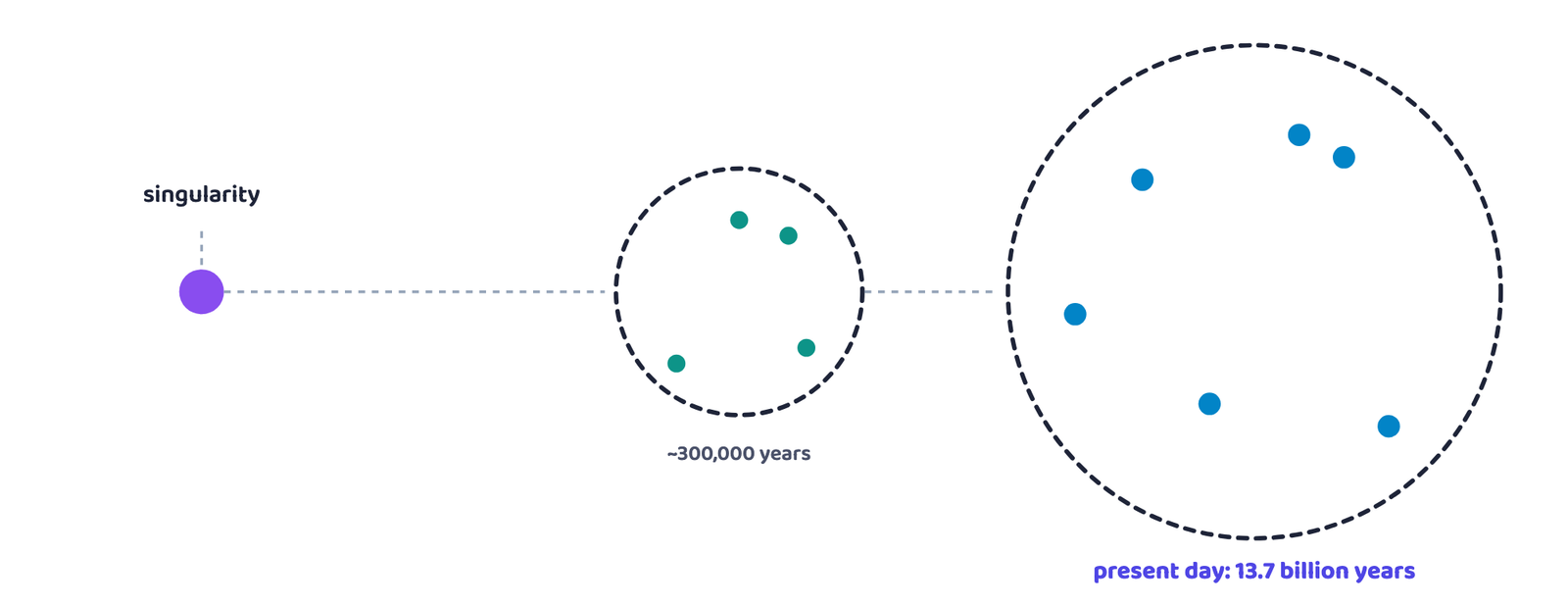
Singularity
All matter in the universe existed at one point, as a “tiny ball” of unimaginably small volume, infinite temperature and infinite density.
The explosion
The tiny ball exploded violently about 13.7 billion years ago. Expansion was fastest within the first fraction of a second, then slowed down. The first atom formed within the first three minutes.
Universe turns transparent
Within 300,000 years, the temperature dropped to 4,500 K, ordinary atomic matter formed, and the universe became transparent instead of a dense fog of radiation.
Big Bang Theory
- Universe began at a single point and is expanding
- Supported by Hubble’s 1920 observations
- The theory the scientific community favours today
Steady State Theory
- Proposed by Hoyle, as an alternative
- The universe looks roughly the same at any point in time
- Evidence for expansion has left this idea less favoured now
2.1 The Star Formation
Matter and energy were not spread evenly through the early universe. These early density differences created differences in gravitational pull, drawing matter together and giving galaxies their start. A galaxy is an enormous collection of stars, and individual galaxies range from 80,000 to 150,000 light years across. A galaxy begins as a huge cloud of hydrogen gas called a nebula. As the nebula keeps growing, it develops thicker clumps of gas, which keep growing denser until they become stars. Star formation is believed to have started 5 to 6 billion years ago.
A light year is a measure of distance, not time, equal to the distance light travels in one year: km, since light travels at 300,000 km every second.
The mean distance between the earth and the sun is 149,598,000 km. In terms of how long light takes to cross it, that is only 8.311 light-minutes, nowhere near a full light-year. The sun’s light reaching your eyes right now left the sun about eight minutes ago.
3Formation of the Planets
Once stars had begun forming inside a nebula, the leftover gas and dust around them went through three further stages to become planets.
Planetesimals are the large number of small, rounded bodies formed inside a gas cloud by cohesion; larger bodies later form when planetesimals collide and stick together under gravity.
Keep “accretion” (Section 1, particles joining into a disc-shaped cloud and then planets) and “planetesimals accreting into planets” (Section 3) straight. Both use the word accrete, but the first is about the sun’s whole disc, the second is about small bodies inside that disc joining into planets.
4Evolution of the Lithosphere
Do you know that the earth was initially a barren, rocky, hot object with only a thin hydrogen-helium atmosphere? That is far from the earth we know today, and it took real changes to get from one to the other. The earth has a layered structure: the material is not the same all the way from the outer edge of the atmosphere to the centre, and density keeps increasing as you go deeper.
The earth was mostly in a volatile state in its earliest, primordial stage. As density gradually increased, the temperature inside also rose, and the material inside began separating out by density. Heavier materials, like iron, sank towards the centre, while lighter materials rose towards the surface. As the earth cooled further over time, it solidified and shrank to a smaller size, and this cooling eventually produced an outer surface, the crust.
Differentiation is the process by which the earth’s material separated into layers of different density, heavier materials sinking towards the centre and lighter materials rising towards the surface.
The moon’s formation added a further twist. It is thought to have happened through a giant impact, a violent collision that further heated up the earth. It is through this process of differentiation that the earth’s material got separated into the layers we know today.
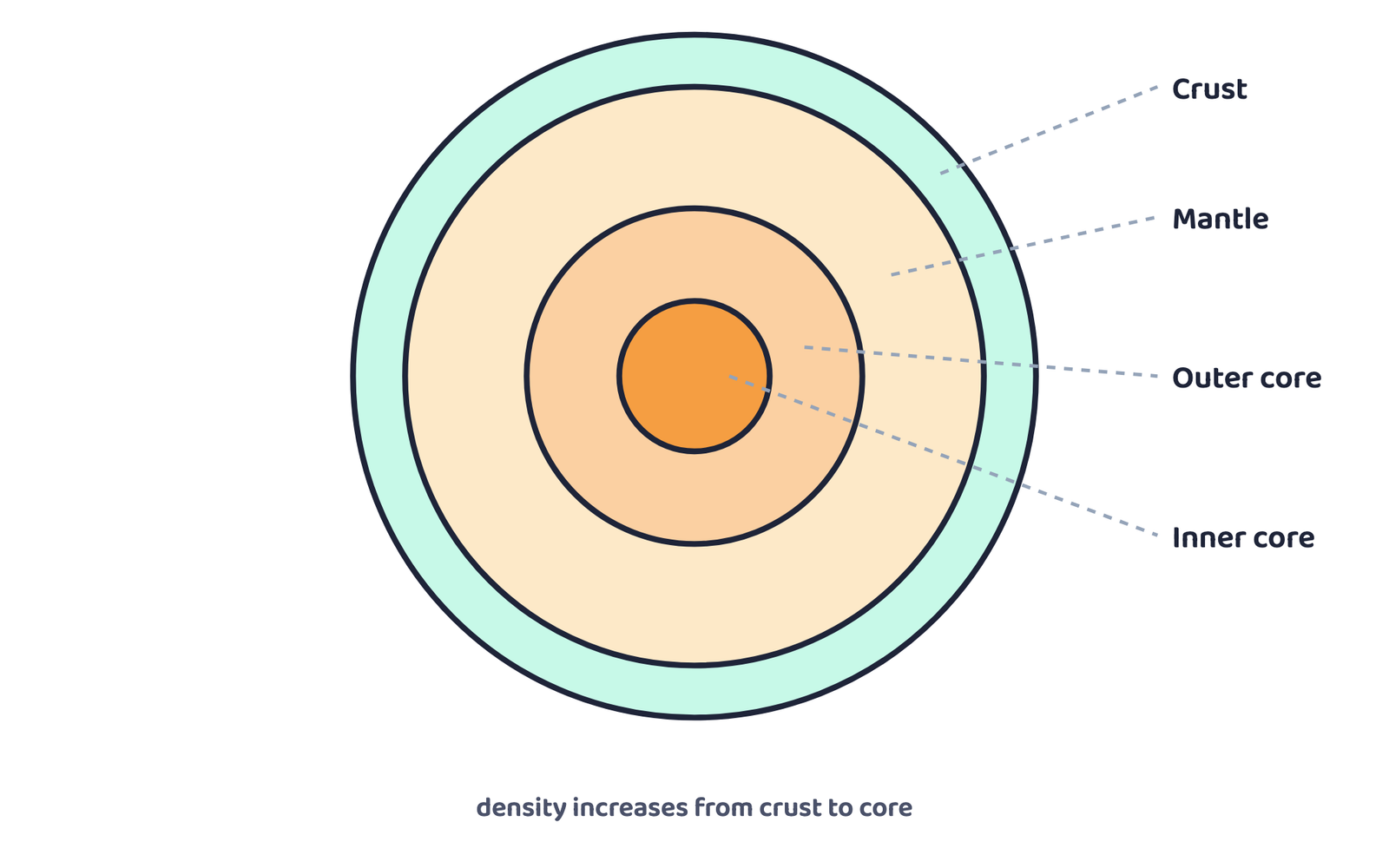
Chapter 9, Interior of the Earth, studies the crust, mantle, outer core and inner core in full detail, including how their depth, thickness and composition are actually measured.
5Evolution of Atmosphere and Hydrosphere
Today’s atmosphere is mostly nitrogen and oxygen; Chapter 13, Composition and Structure of the Atmosphere, covers its full composition and structure. Getting to that present-day atmosphere, and to the oceans, took three separate stages.
Loss of the primordial atmosphere
Solar winds stripped away the earth’s original thin hydrogen-helium atmosphere. The same thing happened to every terrestrial planet, not just the earth.
Degassing from a hot interior
As the hot earth cooled, gases and water vapour escaped from inside it, adding water vapour, nitrogen, carbon dioxide, methane and ammonia to the young atmosphere, with only a little free oxygen.
Modification by living things
Once life began, photosynthesis by living organisms steadily changed the atmosphere’s composition, eventually adding the oxygen we breathe today.
Degassing is the release of gases and water vapour from the earth’s hot interior, largely through continuous volcanic eruptions, which built up the earth’s early atmosphere.
As the earth kept cooling, the water vapour it had released began to condense, and carbon dioxide dissolved into the falling rainwater. That cooled the surface further, which caused still more condensation and rain, and the rainwater collecting in low-lying depressions is what gave rise to the oceans.
6Origin of Life
The last stage in the earth’s evolution is the origin and evolution of life itself. Neither the early earth nor its early atmosphere was fit to support life, so something had to change first. Modern scientists describe the origin of life as a kind of chemical reaction: complex organic molecules formed and came together, and this assemblage could copy itself, which is exactly what turned lifeless matter into living matter.
Life did not simply appear. It began the moment a chemical assemblage learned to copy itself, converting inanimate matter into a living one.
the one idea to take away from this chapter
The record of that early life survives as fossils in rock. Microscopic structures closely resembling today’s blue algae have been found in rocks more than 3,000 million years old, which is why life is believed to have begun evolving around 3,800 million years ago.
Find out about the “Stardust” project (as named in the NCERT textbook, at www.sci.edu/public.html and www.nasm.edu): (i) which agency launched it; (ii) why scientists are interested in collecting stardust; (iii) where the stardust is actually being collected from.
- Kant’s early idea was revised by Laplace in 1796 into the Nebular Hypothesis; Schmidt and Weizsäcker revised it further in 1950
- The Big Bang Theory (Expanding Universe Hypothesis) is the most accepted origin of the universe, supported by Hubble’s 1920 evidence; Hoyle’s Steady State idea is the rival, less-favoured alternative
- The Big Bang had three stages: singularity, explosion 13.7 billion years ago, and the universe turning transparent within 300,000 years
- Stars form inside nebulae; planets form in three stages: core and disc, planetesimals, then accretion into full planets
- The earth’s layers, crust, mantle, outer core, inner core, formed through differentiation; the moon’s giant impact heated the earth further
- The atmosphere evolved in three stages: loss of the primordial atmosphere, degassing from the hot interior, then modification by photosynthesis
- Oceans are about 4,000 million years old; life began about 3,800 million years ago; oxygen only flooded the atmosphere about 2,000 million years ago
- Can I name the Nebular Hypothesis’s original author and its 1796 reviser, without looking?
- Can I list all three stages of the Big Bang in order?
- Can I list the earth’s four layers from the surface to the centre?
- Can I explain the three stages of atmospheric evolution, and put the ocean-formation, life-origin, photosynthesis and oxygen-flooding dates in the right order?
- 1 markWhat is the Nebular Hypothesis?
- 1 markName the scientist who mathematically revised Kant’s hypothesis in 1796.
- 1 markWhat is the Big Bang Theory also called?
- 1 markIn which year did Edwin Hubble provide evidence for an expanding universe?
- 1 markWhat does a light year measure?
- 1 markDefine planetesimals in one line.
- 1 markWhat is accretion?
- 1 markName the earth’s four layers, from the surface to the centre.
- 1 markWhat is degassing?
- 1 markWho proposed the Steady State concept, as an alternative to the Big Bang Theory?
- 3 marksExplain the three stages of the Big Bang.
- 3 marksDistinguish between the Big Bang Theory and the Steady State concept.
- 3 marksExplain the three stages in the formation of planets.
- 3 marksWhat is differentiation? Explain how it produced the earth’s layered structure.
- 3 marksWhat role did the moon’s formation play in the earth’s evolution?
- 3 marksDescribe the three stages in the evolution of the earth’s atmosphere.
- 5 marksGive a detailed account of the Big Bang Theory, including its three stages and the evidence for an expanding universe.
- 5 marksDescribe the stages in the evolution of the earth, from its early volatile state to the layered planet it is today.
- 5 marksTrace the evolution of the earth’s atmosphere and hydrosphere, from the primordial atmosphere to the present-day composition.
- 5 marks“Life on earth could not have appeared without the exact sequence of events that shaped the earth’s atmosphere and oceans.” Discuss with reference to this chapter.
- 1 markWhich one of the following figures represents the age of the earth?
(a) 4.6 million years(b) 13.7 billion years(c) 4.6 billion years(d) 13.7 trillion years - 1 markWhich one of the following is NOT related to the formation or modification of the present atmosphere?
(a) Solar winds(b) Differentiation(c) Degassing(d) Photosynthesis - 1 markLife on the earth appeared around how many years before the present?
(a) 13.7 billion(b) 3.8 million(c) 4.6 billion(d) 3.8 billion - 1 markWho mathematically revised Kant’s hypothesis in 1796, giving the Nebular Hypothesis?
(a) Laplace(b) Edwin Hubble(c) Otto Schmidt(d) Fred Hoyle - 1 markThe Steady State concept, an alternative to the Big Bang Theory, was proposed by:
(a) Hubble(b) Kant(c) Hoyle(d) Weizsäcker - 1 markThe process by which the earth’s material separated into layers of different density is called:
(a) accretion(b) degassing(c) differentiation(d) condensation - 1 markThe small, rounded bodies that form by cohesion inside a gas cloud, and later collide and combine into planets, are called:
(a) nebulae(b) planetesimals(c) singularities(d) asteroids
- 1 mark
Assertion (A): According to the Big Bang Theory, the very early universe was extremely hot and dense.
Reason (R): In the beginning, all the matter that forms the universe existed at one place as a “tiny ball” of infinite temperature and density. - 1 mark
Assertion (A): Otto Schmidt and Carl Weizsäcker revised the Nebular Hypothesis in 1950.
Reason (R): The formation of stars is believed to have taken place 5 to 6 billion years ago. - 1 mark
Assertion (A): The earth’s atmosphere and oceans evolved through three separate stages after the earth’s formation.
Reason (R): The final stage in the evolution of the earth’s atmosphere was the loss of its primordial hydrogen-helium atmosphere due to solar winds. - 1 mark
Assertion (A): The moon’s formation took place before the earth had begun to differentiate into layers.
Reason (R): During the formation of the moon, due to the giant impact, the earth was further heated up.