
- What happens in both parts of the chapter: Saheb’s life as a ragpicker in Seemapuri, and Mukesh’s life as a boy from a bangle-making family in Firozabad
- One way to read the title “Lost Spring”, using the book’s subtitle, “Stories of Stolen Childhood”
- How to write a full character sketch of Saheb and of Mukesh
- The exact reasons the author gives for why poverty in both places refuses to go away
- How to spot hyperbole, metaphor and simile in the book’s own list of lines
- The book’s stated theme and sub-theme, and one reading of the chapter’s message, for a long answer
1About the Author
Anees Jung was born in 1944 in Rourkela, and grew up in Hyderabad. Both her parents were writers, and she went on to study in Hyderabad and in the United States. She began her career as a writer in India, and has been an editor and columnist for major newspapers in India and abroad. Lost Spring is an excerpt from her book “Lost Spring, Stories of Stolen Childhood”, in which, the book’s note says, she analyses “the grinding poverty and traditions which condemn these children to a life of exploitation.”
“Who is the author of Lost Spring, and what is the chapter an excerpt from?” Answer: Anees Jung; an excerpt from her book Lost Spring, Stories of Stolen Childhood.
2What the Chapter Is About
The chapter is built from two separate real-life sketches that Anees Jung, an editor and columnist for major newspapers, tells in the first person, from her own meetings and talks with poor children over many months. They are not one continuous story; they are two portraits joined by one theme.
“Sometimes I Find a Rupee in the Garbage”
About Saheb, a ragpicker boy in Seemapuri, on the edge of Delhi, who scrounges the garbage dumps for anything he can sell.
“I Want to Drive a Car”
About Mukesh, a boy from Firozabad, born into a family of bangle makers, who dreams of becoming a motor mechanic instead.
One reading of the title “Lost Spring” takes “spring” as a metaphor for childhood, the season of growth, play and hope; the book’s subtitle, “Stories of Stolen Childhood”, supports it. On this reading, the title means that the childhood of children like Saheb and Mukesh is lost to poverty and traditions of exploitation before it can ever properly bloom.
3Part I: “Sometimes I Find a Rupee in the Garbage”
3.1 Saheb-e-Alam: the boy in the garbage dumps
Every morning the author sees a boy called Saheb scrounging in the garbage dumps of her neighbourhood, “scrounging for gold”; sometimes, he says, he finds a rupee, even a ten-rupee note. When she asks him why he does this, he says simply, “I have nothing else to do.”
Saheb’s family used to live near Dhaka, in Bangladesh, amid green fields. Storms swept away their fields and homes again and again, so the family left, “looking for gold” in the big city of Delhi. This sentence suggests a key idea: for people this poor, even garbage can look like gold.
Saheb-e-Alam is the name the boy announces, and it means “lord of the universe.” Saheb himself does not know what it means; “If he knew its meaning … he would have a hard time believing it.” The book’s own exercise says the name “is directly in contrast to what Saheb is in reality”, which is irony: a boy with such a grand name has very little and no power over his own future.
One day the author half-jokingly asks Saheb, “If I start a school, will you come?” He says yes, delighted, and comes running back days later to ask if the school is ready. She has to admit that “it takes longer to build a school.” She admits that “promises like mine abound in every corner of his bleak world,” meaning such promises are common in his bleak world. She is “embarrassed at having made a promise that was not meant.”
Do not write that Saheb “goes to school.” The excerpt never shows Saheb at school; the school he was promised is not built. Do not invent an ending where he studies.
3.2 Why the ragpicker children go barefoot
The author notices that many of Saheb’s friends, an entire “army of barefoot boys,” walk without shoes. She asks a few of them why.
The author has travelled across the country and seen barefoot children everywhere, in cities and on village roads. One explanation she is given is that it is “not lack of money but a tradition to stay barefoot.” She does not fully accept this. She wonders if tradition is only “an excuse to explain away a perpetual state of poverty.”
A man once told the author that as a boy, on his way to school, he would stop at an old temple where his father was the priest and pray for a pair of shoes. Thirty years later, she visited the same town: the temple was now “drowned in an air of desolation,” but a young boy in a school uniform, wearing proper socks and shoes, arrived there. The author remembers another boy’s prayer, “Let me never lose them,” and says “The goddess had granted his prayer. Young boys like the son of the priest now wore shoes. But many others like the ragpickers in my neighbourhood remain shoeless.”
3.3 Seemapuri: home to ten thousand ragpickers
Saheb’s family lives in Seemapuri, a settlement on the edge of Delhi that the author calls “metaphorically” miles away from the city, even though it sits right at its border. The people here are squatters who came from Bangladesh back in 1971. “Wherever they find food, they pitch their tents that become transit homes. Children grow up in them, becoming partners in survival.”
| Fact about Seemapuri | What the chapter says |
|---|---|
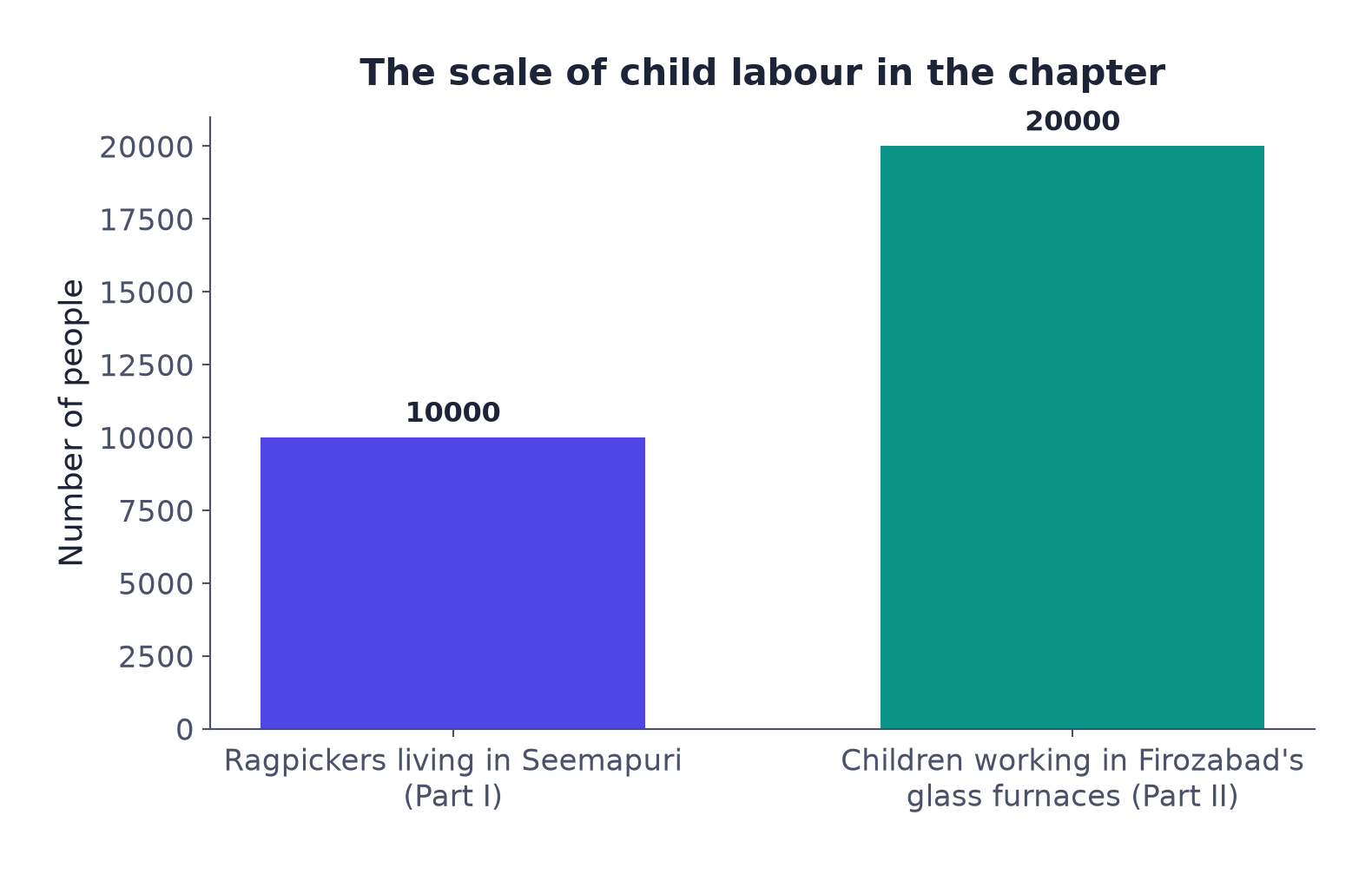
| Population | About 10,000 ragpickers |
| How long they have lived there | More than thirty years |
| Housing | Structures of mud, with roofs of tin and tarpaulin |
| Basic facilities | No sewage, no drainage, no running water |
| Legal status | No identity, no permits, but ration cards that get their names on voters’ lists |
| Why they stay anyway | “Food is more important for survival than an identity” |
Rag-picking is the work of sifting through garbage to collect anything that can be resold, such as scrap metal, plastic, glass or paper. In Seemapuri it has, in the author’s words, “acquired the proportions of a fine art,” meaning the ragpickers have become highly skilled at it.
For the elders of Seemapuri, garbage is “a means of survival,” their daily bread and even a roof over their heads. For the children, it is “wrapped in wonder,” because they might find a coin, even a ten-rupee note, in it. The same garbage means something completely different to a child and to a grown-up.
3.4 Saheb loses his freedom
Saheb spends time watching two young men play tennis at the fenced gate of a neighbourhood club, content to watch it “standing behind the fence.” He admits, “I go inside when no one is around,” and the gatekeeper lets him use the swing. He wears a pair of tennis shoes that someone gave him, discarded shoes of some rich boy, who perhaps refused to wear them because of a hole in one of them. For a boy who has walked barefoot all his life, “even shoes with a hole is a dream come true,” but the game he is watching so intently is “out of his reach.”
By the end of the sketch, Saheb has taken a job at a tea stall, carrying a steel canister and earning ₹800 and all his meals. This sounds like progress, but the author notices something has changed in him: the steel canister, which belongs to his employer, “seems heavier” than the plastic bag he used to carry over his shoulder, which was his own. The plastic bag was Saheb’s; the canister is not. The chapter’s final line for this sketch is blunt: “Saheb is no longer his own master!”
Practice question (the book’s in-text question): “Is Saheb happy working at the tea-stall? Explain.” The book’s cues point to No, even though the job pays a fixed wage: “His face, I see, has lost the carefree look”, and the canister “seems heavier” than the bag that “was his”. One reading: a small wage has cost Saheb the freedom he had as a ragpicker.
4Part II: “I Want to Drive a Car”
4.1 Mukesh: wanting to be his own master
Mukesh is the second child the author writes about. Unlike his family, who have only ever known bangle making, Mukesh insists, “I will be a motor mechanic,” and says he will learn to drive a car. When the author asks if he knows anything about cars, he answers, looking straight into her eyes, “I will learn to drive a car.” His dream “looms like a mirage” against the dusty streets of his own town, Firozabad, meaning it feels almost impossibly far away, like the shimmer of water that a thirsty traveller sees in a desert but can never actually reach.
4.2 Firozabad: the town that makes India’s bangles
Firozabad is the centre of India’s glass-blowing industry, and it is famous specifically for making bangles. “Every other family in Firozabad is engaged in making bangles,” and families have spent generations working around the furnaces; Mukesh’s family is among them.
It is illegal for children to work in the glass furnaces of Firozabad. The chapter says the law, “if enforced, could get him and all those 20,000 children out of the hot furnaces”, which implies it is not enforced. Do not write that there is “no law” against child labour here.
The children work “in the glass furnaces with high temperatures, in dingy cells without air and light,” where they slog their daylight hours, “often losing the brightness of their eyes.” In dark hutments, by the flames of flickering oil lamps, families weld glass into bangles; their eyes are “more adjusted to the dark than to the light outside. That is why they often end up losing their eyesight before they become adults.”
4.3 Inside Mukesh’s home
Mukesh proudly takes the author to his house, which he says “is being rebuilt”, through lanes choked with garbage, past homes with crumbling walls and no windows. What she finds inside, and among the bangle makers around it, shows how poverty repeats itself, generation after generation.
Mukesh’s father
Worked long years first as a tailor, then as a bangle maker. Despite a lifetime of hard labour, he has failed to renovate the house or send his two sons to school. All he could teach them was “the art of making bangles.”
Mukesh’s grandmother
Calls it “his karam, his destiny”, a fate she accepts, after her own husband went blind with the dust from polishing the glass of bangles. “Can a god-given lineage ever be broken?” she implies. One reading: the family accepts this life as fate rather than injustice.
Mukesh’s sister-in-law
His elder brother’s young wife, already “in charge of three men”: her husband, Mukesh and their father. As custom demands, she veils her face when the older man of the house enters the room.
Savita (not of Mukesh’s family)
A young girl in a drab pink dress who sits beside an elderly woman soldering pieces of glass, her hands moving “mechanically like the tongs of a machine.” The author wonders whether Savita knows the sanctity of the bangles she helps make; they symbolise suhaag, auspiciousness in marriage, and “It will dawn on her suddenly one day” when she becomes a bride.
Suhaag is the term the chapter uses for the sacred, auspicious status of marriage that glass bangles symbolise for an Indian woman. A bride’s hands are dyed with henna and her wrists are filled with red bangles on her wedding day. The author wonders whether girls like Savita know what the bangles mean while they work.
Near Savita sits an old woman who became a bride many years ago. She “still has bangles on her wrist, but no light in her eyes.” In her own words she says: “Ek waqt ser bhar khana bhi nahin khaya”, meaning she has not eaten even one full meal in her entire lifetime. Her husband, an old man with a flowing beard, says, “I know nothing except bangles. All I have done is make a house for the family to live in,” and the author wonders “if he has achieved what many have failed in their lifetime. He has a roof over his head!”
4.4 The vicious circle nobody can break
The author asks a group of young bangle makers why they don’t organise themselves into a cooperative; they “have fallen into the vicious circle of middlemen who trapped their fathers and forefathers.” Their answer is direct: “Even if we get organised, we are the ones who will be hauled up by the police, beaten and dragged to jail for doing something illegal.” There is no leader among them, “no one who could help them see things differently,” and “Their fathers are as tired as they are.”
The vicious circle in Firozabad is the trap made up of sahukars (local moneylenders), middlemen, policemen, the keepers of law, the bureaucrats and the politicians. “Together they have imposed the baggage on the child that he cannot put down.” The child accepts it “as naturally as his father”; “To do anything else would mean to dare. And daring is not part of his growing up.”
4.5 The ending: a small, safe dream
The author sees “a flash” of daring in Mukesh when he insists again, “I want to be a motor mechanic,” even though the garage where he would train is a long way from home. “I will walk,” he says. When she asks if he also dreams of flying a plane, he goes suddenly silent and says no, staring at the ground, with an embarrassment “that has not yet turned into regret.” “He is content to dream of cars that he sees hurtling down the streets of his town. Few airplanes fly over Firozabad,” the chapter ends. One reading is that even his dream is shaped by how little of the world he has seen.
5Character Sketches
Saheb
- A ragpicker boy from a family that left Dhaka after storms swept away their fields and homes
- Name “Saheb-e-Alam” (lord of the universe), “directly in contrast to what Saheb is in reality”
- Curious and hopeful early on: agrees eagerly to go to a school that is not built in the chapter
- Mostly watches: stands behind the club fence to watch tennis, a game “out of his reach”; slips inside only “when no one is around,” to use the swing
- By the end, trades his freedom for a fixed wage at the tea stall and stops being “his own master”
Mukesh
- A boy from a Firozabad family of bangle makers going back generations
- Refuses to accept his family’s trade as his own fate: “I will be a motor mechanic”
- Looks straight into the author’s eyes when he speaks, a small sign of self-belief
- Willing to walk a long way to the garage to learn a new trade
- “Content to dream of cars that he sees hurtling down the streets of his town”; says no to flying a plane. “Few airplanes fly over Firozabad.”
A character sketch is stronger when it uses the chapter’s own lines as evidence, e.g. “Saheb is no longer his own master!” for Saheb, and “I will be a motor mechanic” plus “Few airplanes fly over Firozabad” for Mukesh.
6Themes and a Reading of the Message
- Can I explain, in my own words, why Saheb’s new job makes him less happy, not more?
- Can I name every member of the “vicious circle” that traps the bangle makers?
- Can I explain why the title “Lost Spring” fits both Saheb’s and Mukesh’s stories?
7Literary Devices Used in the Chapter
The chapter turns real, sad events into something closer to literature by using three devices again and again. The book defines all three with its own examples.
Hyperbole is “a way of speaking or writing that makes something sound better or more exciting than it really is.” Book’s example: “Garbage to them is gold.”
A metaphor, in the book’s words, “compares two things or ideas that are not very similar. A metaphor describes a thing in terms of a single quality or feature of some other thing”; it “transfers” a quality of one thing to another, without “like” or “as”. Book’s example: “The road was a ribbon of light.”
A simile “is a word or phrase that compares one thing with another using the words ‘like’ or ‘as’.” Book’s example: “As white as snow.”
| Line from the chapter | Device | Why |
|---|---|---|
| Saheb-e-Alam means “lord of the universe,” directly against what Saheb is in reality | Irony | The grand meaning of the name is the exact opposite of Saheb’s real, powerless life |
| “Drowned in an air of desolation” | Metaphor | The temple’s emptiness is described as if it were literally drowning |
| Seemapuri, on the periphery of Delhi, yet miles away from it, “metaphorically” | Metaphor | The physical distance is small; the distance in opportunity and dignity is huge |
| “For the children it is wrapped in wonder; for the elders it is a means of survival” | Antithesis | Two opposite meanings of the same garbage are set side by side in balanced halves, for children and for elders |
| Her hands move “mechanically like the tongs of a machine” | Simile | Uses “like” to compare Savita’s practised hand movements to a machine |
| “She still has bangles on her wrist, but no light in her eyes” | Metaphor | “No light in her eyes” stands for lost joy and hope, set against the bangles still on her wrist |
| “Few airplanes fly over Firozabad” | Symbolism | Can be read as standing for how limited Mukesh’s world, and so his dream, is |
| “Web of poverty” | Metaphor | Poverty is pictured as a spider’s web that traps and holds its victims |
| “Scrounging for gold” (in the garbage) | Metaphor | Garbage is called “gold” to show how precious even scrap is to the very poor |
| Rag-picking has “acquired the proportions of a fine art” | Hyperbole | Exaggerates the skill of rag-picking to stress how expert the ragpickers have become out of necessity |
| The steel canister “seems heavier” than the plastic bag he carried lightly | Symbolism | Not about literal weight; the canister can be read as standing for lost freedom, the bag for the freedom he once had |
The book’s “Thinking about language” section lists these 11 phrases to identify by device (items 1-11); learn the table in that order.
8Glossary: Words the Book Asks You to Notice
“Saheb is no longer his own master!”
the line that sums up the cost of Saheb’s new job
- Lost Spring is an excerpt from Anees Jung’s book “Lost Spring, Stories of Stolen Childhood”; one reading of the title: childhood lost to poverty
- Part I, “Sometimes I Find a Rupee in the Garbage,” is about Saheb, a ragpicker in Seemapuri
- Seemapuri: about 10,000 ragpickers, squatters from Bangladesh since 1971, no sewage or running water, no identity but ration cards
- Saheb’s tea-stall job pays ₹800 and meals but costs him his freedom, shown by the canister-versus-bag contrast
- Part II, “I Want to Drive a Car,” is about Mukesh, born into a family of bangle makers in Firozabad
- Firozabad is India’s glass-blowing/bangle-making centre; child labour there is illegal, and the law, “if enforced”, could get “all those 20,000 children out of the hot furnaces”
- Mukesh’s family (grandmother, father, sister-in-law), and other bangle makers like Savita and the old couple beside her, show how poverty and tradition repeat across generations
- The “vicious circle”: sahukars, middlemen, policemen, keepers of law, bureaucrats and politicians; the young men say that if they organise, they will be “hauled up by the police”
- Mukesh “is content to dream of cars that he sees hurtling down the streets of his town. Few airplanes fly over Firozabad.”
- The chapter uses hyperbole, metaphor and simile throughout to turn real poverty into literature; learn all 11 identification examples