
- What makes a set of people a group, and how a group is different from a crowd, an audience or a mob
- Why people join groups, how groups form, and Tuckman’s five stages of group development
- The four building blocks of group structure: roles, norms, status and cohesiveness, and how extreme cohesiveness can turn into groupthink
- Three ways groups are classified: primary/secondary, formal/informal, ingroup/outgroup
- How a group changes an individual’s behaviour: social facilitation, social loafing and group polarisation
CBSE’s 2026-27 Psychology paper (Code 037) carries 70 marks of theory across 7 chapters and 30 marks of Practical work (a practical file and case profile, five psychological tests administered and interpreted during the year, two tests in the practical examination, and a viva voce). This chapter, Unit VII, is worth 6 marks. These notes cover the theory portion in full; ask your teacher about the Practical file separately.
CBSE’s 2026-27 curriculum lists these topics for Unit VII: Introduction; Nature and Formation of Groups; Type of Groups; Influence of Group on Individual Behaviour (Social Loafing, Group Polarisation). These notes follow the 2026-27 reprint of the NCERT chapter, which covers exactly these sections.
1Introduction
Every day you move through several groups: your family in the morning, your classmates and teachers at school, your friends afterwards. Each one gives you support and comfort while also shaping your growth as a person. Think about it: if you were ever away from your family, school and friends together, something would clearly feel missing: that feeling is exactly how central group membership is to your life.
Because the groups we belong to shape us, it matters which groups we join: good groups help us become good citizens. And the influence is not one-way: while groups shape us, we as individuals are equally capable of shaping the people and society around us.
2Nature and Formation of Groups
2.1 What is a Group?
A group is an organised system of two or more individuals who are interacting and interdependent, who have common motives, have a set of role relationships among members, and have norms that regulate members’ behaviour.
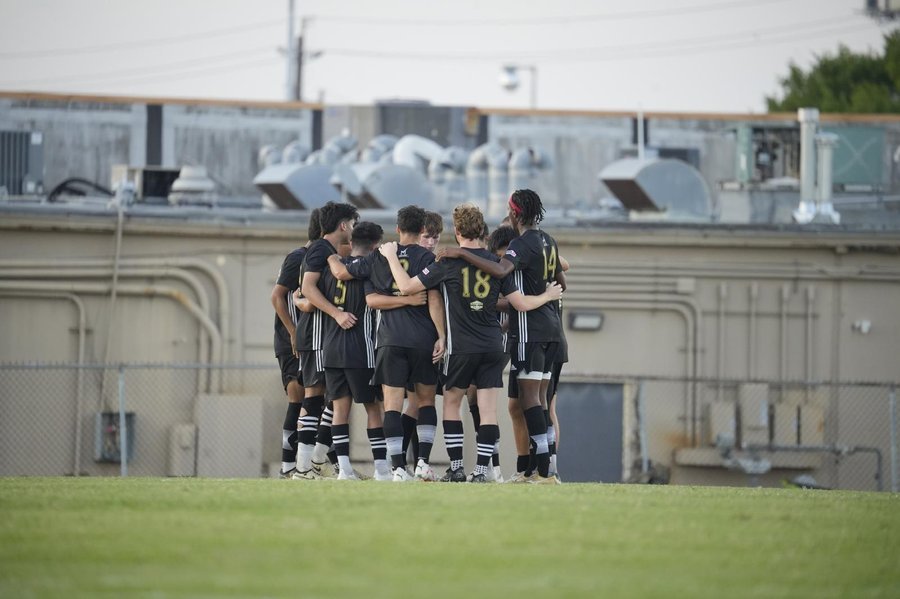
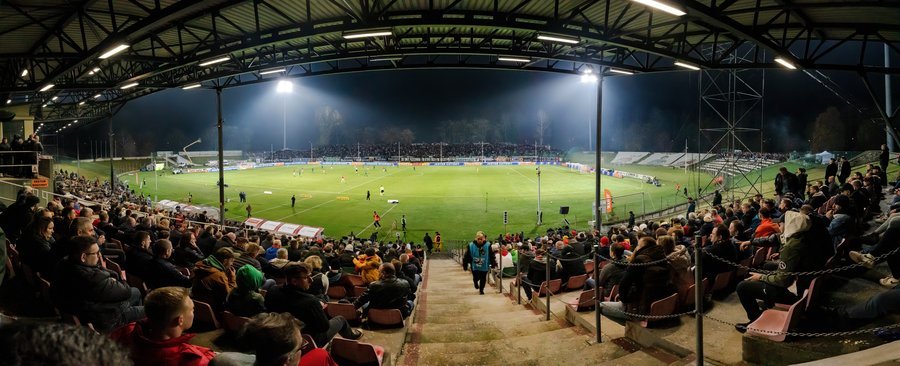
Not every collection of people at one place is a group. People who have assembled to watch a cricket match or your school function are at the same place, but they are not interdependent, have no defined roles or status, and have no expectations of each other: so they are not a group. Your family, class and playgroup ARE groups because there is mutual interdependence, defined roles, status differences, and expectations from each other.
Shared identity
A social unit of ≥2 people who see themselves as belonging together: gives the group its unique identity.
Common motives/goals
Members work toward a shared goal, or away from a shared threat.
Interdependence
What one member does affects the others, e.g. a fielder dropping a catch affects the whole cricket team.
Mutual influence
People satisfying a need through joint association also influence each other.
Interaction
Members gather and interact, directly or indirectly.
Structured by roles & norms
Members perform the same functions each time the group meets and follow group norms.
2.2 Groups, Crowds, Audiences and Mobs
| Type | What it is |
|---|---|
| Crowd | People present at a place by chance (e.g. gathering after a road accident). No structure, no feeling of belongingness; behaviour is irrational; no interdependence among members. |
| Audience | People assembled for a specific purpose, e.g. watching a cricket match or a movie. Generally passive. |
| Mob | An audience that turns into a frenzy, with a definite sense of purpose. Attention is polarised, actions move in one common direction. Marked by homogeneity of thought/behaviour and impulsivity. |
| Team | A special kind of group. Members have complementary skills, share commitment to a common goal, and are mutually accountable: coordinated effort creates positive synergy. |
2.3 Groups vs Teams: the book’s two differences
Group
- Performance depends on individual members’ contributions
- The leader/head holds responsibility for the work
Team
- Both individual contribution and teamwork matter
- Although there is a leader, members hold themselves responsible
2.4 Why Do People Join Groups?
We belong to several groups at once: family, class, friend circle: because different groups satisfy different needs. This can create competing demands, but most of the time we manage them. The book gives six reasons people join groups:
Security
Being alone feels insecure; groups reduce this, giving comfort and protection: people feel stronger and less vulnerable.
Status
Membership of a group others see as important brings recognition and a sense of power, e.g. winning an inter-institutional debate.
Self-esteem
Groups give feelings of self-worth and a positive social identity; prestigious groups boost self-concept.
Psychological & social needs
Groups satisfy belongingness, giving/receiving attention, love and a sense of power.
Goal achievement
Groups achieve what one person cannot alone: there is power in the majority.
Knowledge & information
Group membership broadens our view: groups supplement what one individual cannot know alone.
2.5 Group Formation: What Draws People Together
Basic to group formation is some contact and some form of interaction between people. This interaction is facilitated by three conditions: proximity, similarity, and common motives and goals.
| Condition | How it works |
|---|---|
| Proximity | Repeated interaction with the same people: same colony, school or playground: lets us learn their interests and attitudes. Common interests/attitudes/background are important determinants of liking your group members. |
| Similarity | Two explanations. (1) People prefer consistency and like relationships that are consonant; when two people are alike there is consonance between them, so they start liking each other (e.g. two students who both love football become friends). (2) Meeting someone with similar views reinforces and validates our own opinions and values, making us feel we are right, and we start liking that person (e.g. two people who share the view that too much TV violence is bad). |
| Common motives and goals | People who share a motive or goal come together to achieve it, something they could not do alone (e.g. forming a group of friends to teach slum children who cannot attend school). |
2.6 Stages of Group Formation: Tuckman’s Model
Groups develop like anything else in life: you do not become a group member the instant you meet other people. Groups usually pass through stages of formation, conflict, stabilisation, performance and dismissal, though not always in strict order: several stages can run together, groups can move back and forth, or skip a stage entirely. Tuckman proposed five developmental stages:
Always name all five stages in order: forming, storming, norming, performing, adjourning, and add the book’s caveat: groups do not always move through them in strict sequence; stages may run together, reverse, or be skipped.
Explore further (Activity 7.1, book): select 10 members of your class at random to form a committee that plans an open house, with full autonomy, while the rest of the class observes them. Do you see any of Tuckman’s stages emerging? Which ones, in what order, and which were skipped? Discuss in class.
2.7 Group Structure: Four Elements
As members interact over time, a group develops structure: regularities in how tasks are distributed, responsibilities assigned, and the relative status of members.
Roles
Socially defined behaviour expected of a person in a given situation, e.g. as a son/daughter you are expected to respect elders, listen to them, and be responsible about your studies.
Norms
Expected standards of behaviour and belief, established and enforced by group members: a group’s “unspoken rules,” a shared way of viewing the world.
Status
Relative social position given by others: either ascribed (e.g. by seniority) or achieved (by expertise/hard work). A cricket captain has higher status than teammates, though all are equally important to success.
Cohesiveness
Togetherness, binding and mutual attraction; members start to think, feel and act as one social unit. Hard to leave a cohesive group, or join a highly cohesive one. Extreme cohesiveness can sometimes work against the group’s own interest.
Teamwork is usually beneficial, but Irving Janis has suggested that cohesion can interfere with effective leadership and lead to disastrous decisions: a process he called groupthink: a group’s concern for unanimity overrides realistically appraising its options, leading to irrational, uncritical decisions.
Groupthink shows an appearance of consensus: every member believes everyone agrees, and no one voices dissent for fear of seeming unpopular or hurting the group’s cohesion. Such groups develop an exaggerated sense of their own power and start ignoring real-world danger signs to preserve internal harmony.
Conditions that favour groupthink: socially homogeneous, cohesive groups; isolated from outsiders; with no tradition of considering alternatives; facing a decision with high costs or failures.
Named example: the Vietnam War. From 1964 to 1967, President Lyndon Johnson and his advisors escalated the war believing it would force North Vietnam to the peace table, despite warnings. The miscalculation cost 56,000 American and more than one million Vietnamese lives and created huge budget deficits.
Four ways to counter groupthink: (i) encourage and reward critical thinking and disagreement (ii) encourage the group to present alternative courses of action (iii) invite outside experts to evaluate the group’s decisions (iv) encourage members to seek feedback from trusted others.
3Type of Groups
Groups vary in size (a country vs a family), lifespan (a short-lived committee vs a religious group), and organisation (highly organised, like the army/police, vs informally organised, like match spectators). The chapter groups these differences into three classifications.
3.1 Primary and Secondary Groups
Primary Group
- Pre-existing, usually given to the individual (family, caste, religion)
- Face-to-face interaction, close physical proximity, warm emotional bonds
- Central to a person’s functioning; major role in shaping values/ideals in early development
- Boundaries less permeable: little choice over membership
Secondary Group
- Joined by choice (e.g. membership of a political party)
- Relationships more impersonal, indirect and less frequent
- Easier to leave and join another group
3.2 Formal and Informal Groups
Formal Group
- Functions/roles explicitly and formally stated
- Formed on specific rules or laws; norms establish order
- Book’s example: a university
Informal Group
- Not based on rules or laws
- Close relationships among members
3.3 Ingroup and Outgroup
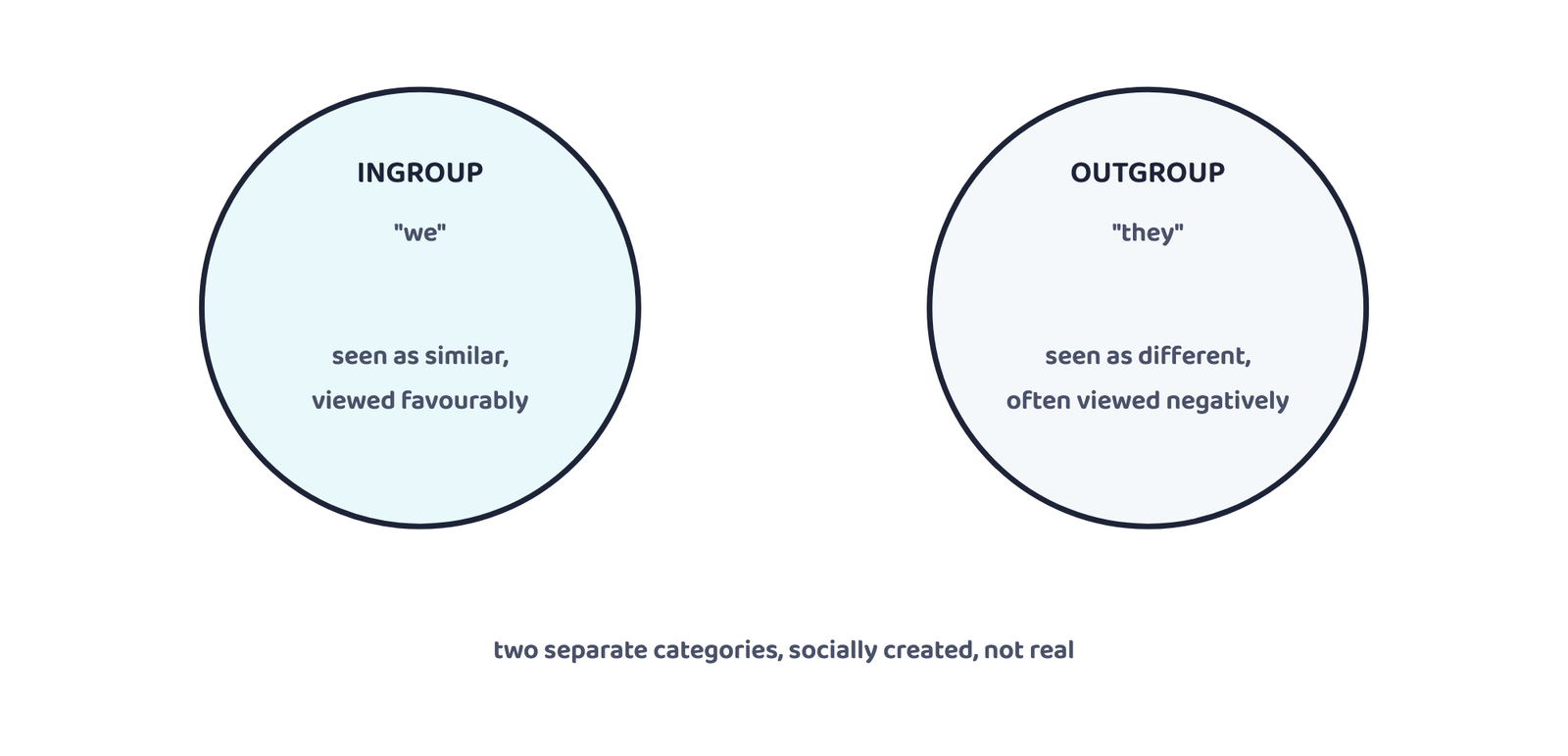
Ingroup refers to one’s own group (“we”); outgroup refers to another group (“they”). Ingroup members are generally seen as similar, viewed favourably, and seen as having desirable traits; outgroup members are viewed differently and are often perceived negatively.
Although it is common to make these categorisations, these categories are not real and are created by us. In some cultures, plurality is celebrated, as has been the case in India. India’s unique composite culture is reflected not only in how people live but also in art, architecture and music.
Explore further (Activity 7.2, book): think of a recent inter-institutional competition. Ask friends to write a paragraph about your school and its students, and about the other school and its students; list the behaviour and characteristics given for each on the board. Observe the ingroup-outgroup differences, and discuss any similarities too.
Tajfel and colleagues wanted to know the minimal conditions needed for intergroup behaviour. British schoolboys were told they were in a decision-making experiment and chose which of two artists’ paintings they preferred: Vassily Kandinsky or Paul Klee, and so were sorted into a “Kandinsky group” or “Klee group.” Other members’ identities were hidden behind code numbers. The children then distributed money between recipients, knowing only their code number and group membership. Each column of the sample distribution matrix pairs an amount for an ingroup member with an amount for an outgroup member.
| Recipient | Paired options offered (choose one column) |
|---|---|
| Ingroup member gets | 7, 8, 9, 10, 11, 12, 13, 14, 15, 16, 17, 18, 19 |
| Outgroup member gets | 1, 3, 5, 7, 9, 11, 13, 15, 17, 19, 21, 23, 25 |
Conclusion: even though the groups were created on a flimsy criterion (painting preference) with no past history or future, the results showed that the children favoured their own group.
4Influence of Group on Individual Behaviour
Groups are powerful because they can change how an individual behaves. The chapter discusses two situations: an individual performing alone in the presence of others (social facilitation: presence of others creates arousal that can enhance performance on a task the person is already good at, when effort is individually evaluated), and an individual performing as part of a larger group, where efforts are pooled (social loafing). A second influence, group polarisation, covers how groups make decisions.
4.1 Social Loafing
Social loafing is a reduction in individual effort when working on a collective task: one where a person’s output is pooled with other group members’ output.
Example: tug-of-war. You cannot identify how much force each team member is exerting, so such tasks let members relax and become free riders.
Latané and associates asked male students to clap or cheer as loudly as possible; the experimenters were interested in knowing how much noise people make in social settings. Group size varied: alone, or groups of 2, 4, and 6. Result: the total noise rose as group size increased, but the noise produced by each participant dropped: each person put in less effort as the group grew larger.
- Members feel less responsible for the overall task
- Motivation drops: individual contribution won’t be evaluated separately
- The group’s performance is not compared with other groups
- Improper coordination (or none) among members
- Group membership is not important to members: it is just an aggregate, not a real group
How to reduce it
- Make each person’s effort identifiable
- Increase the pressure to work hard (commit members to successful performance)
- Increase the task’s apparent importance or value
- Make people feel their individual contribution matters
- Strengthen group cohesiveness: raises motivation for a successful outcome
4.2 Group Polarisation
Group polarisation is the strengthening of a group’s initial position as a result of interaction and discussion within the group: groups are more likely to take extreme decisions than individuals acting alone.
Important decisions (e.g. whether to build a school in a village) are usually made by groups, not individuals. Book’s own worked example: an employee is caught taking a bribe; colleagues deciding the punishment may let them go completely scot-free OR decide to terminate their services: an extreme outcome, rather than a punishment that actually matches the offence. A second example: if you already favour capital punishment and then discuss the issue with like-minded people, your views may become stronger.
Explore further (Activity 7.3, book): the teacher gives the class a short 5-item attitude scale on capital punishment and divides it into a pro group and an anti group. Each group, in a separate room, discusses a recent case in which a court gave a death sentence; the scale is then given again. Check whether both groups’ positions have hardened compared with where they started.
Pick a recent India Test cricket series. Collect newspapers from that period and compare Indian and rival commentators’ reviews of the matches. Do their comments differ? (An open-ended project for class work.)
- Group = organised system of ≥2 interdependent people with common motives, roles, norms; different from a crowd/audience/mob (Fig 7.1: football team = group, its audience = a mere collection)
- Groups vs teams: teams need both individual + team contribution, and members hold themselves responsible (not just the leader)
- 6 reasons to join groups: security, status, self-esteem, psychological/social needs, goal achievement, knowledge and information
- 3 group-formation conditions: proximity, similarity (2 explanations), common motives/goals
- Tuckman’s 5 stages, in order: forming → storming → norming → performing → adjourning (not always strictly sequential)
- 4 elements of group structure: roles, norms, status (ascribed/achieved), cohesiveness
- Groupthink (Irving Janis): cohesion can interfere with effective leadership → irrational decisions; Vietnam War 1964-67, Lyndon Johnson, 56,000 American + 1 million+ Vietnamese lives lost; 4 remedies
- Primary vs secondary groups; formal vs informal groups; ingroup vs outgroup (Tajfel’s Minimal Group Paradigm: even a flimsy criterion produces ingroup favouritism)
- Social loafing: pooled-task effort drops (tug-of-war; Latané’s clap experiment, group sizes 2/4/6); 5 causes, 5 remedies
- Group polarisation: group’s initial position gets stronger after discussion; 3 reasons: new supporting arguments, bandwagon validation, ingroup identification/conformity
- Can I state the book’s own definition of a group and list all 6 characteristics?
- Can I distinguish groups from crowds, audiences and mobs?
- Can I name all 5 of Tuckman’s stages, in order, and the one caveat about sequence?
- Can I name all 4 elements of group structure and give an example of each?
- Can I explain groupthink with the Vietnam War numbers and all 4 remedies?
- Can I compare primary/secondary, formal/informal, and ingroup/outgroup groups?
- Can I state Tajfel’s Minimal Group Paradigm experiment and its conclusion?
- Can I define social loafing and group polarisation, each with the book’s own example, and list their causes/reasons?