
1 What Is Social Science?
Every day you live inside systems that other people built. The house you sleep in used materials brought from far away. The food on your plate was grown, transported and sold by many hands. The road you walk on was planned by public authorities, and the electricity in your home travels from a distant power station through a huge network. None of this happens by chance, and Social Science is the subject that explains how and why.
Social Science is the systematic study of human society. It explains why events happen, how people live together, how the environment shapes life, how governments function, how economies work, and how the past and present together shape the world.
Physics, Chemistry and Biology study the natural world around us. Social Science studies something different: society itself, its institutions, its cultures, and how humans interact with one another.
Natural Sciences
- Study the natural world
- Physics, Chemistry, Biology
- Ask “how does matter and energy behave?”
Social Science
- Studies human society
- Geography, History, Political Science, Economics and more
- Ask “how and why do people live the way they do?”
Society does not function by chance. It is shaped by history, geography, institutions, resources and human choices.
Why we study Social Science
A common question asks you to pick a change in your own area (a new road, a new school, a phone network) and explain it using Social Science thinking: what was it like before, what changed, why did it change, and who was affected. Practise this with any local example.
2 Roots in India’s Knowledge Traditions
Society has not always looked the way it does today. Early human groups depended completely on nature. Over time they learnt to grow crops, keep animals, build settlements, make tools, and trade with each other, and they slowly organised systems of government.
India’s own knowledge traditions valued questioning, observation and reasoning long before Social Science existed as a school subject.
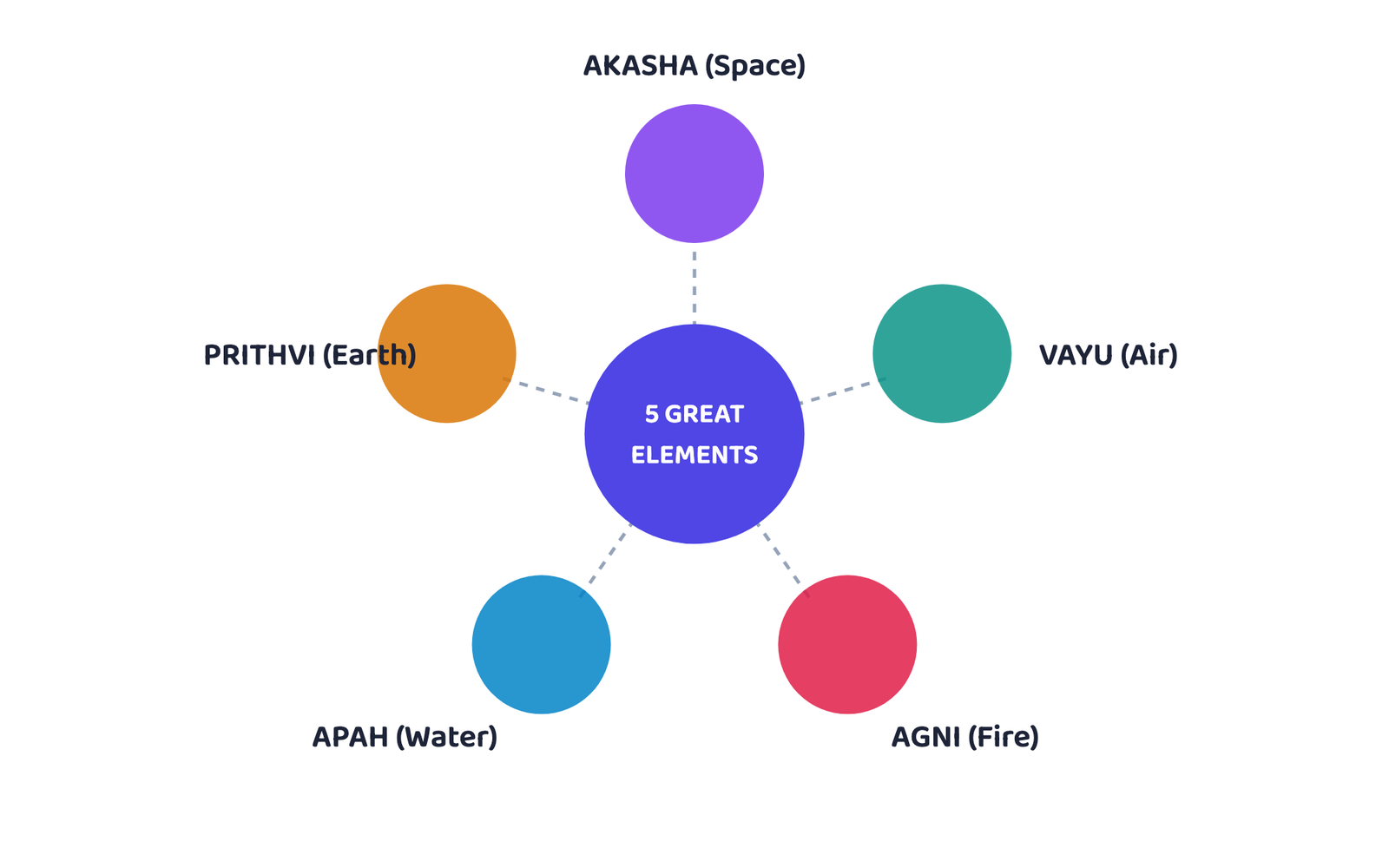
Pañchamahābhūtas (five great elements) is an idea from Indian philosophy that explains the world as made of five elements: earth (Pṛithvī), water (Āpaḥ), fire (Agni), air (Vāyu) and space (Ākāśha). It is an early attempt to understand nature, the human body, and the environment as one connected system.
Vasudhaiva Kutumbakam means “the world is one family.” It expresses how human societies across regions and cultures are all interconnected, an idea at the core of what Social Science studies today.
Indian thinkers also studied governance closely. The Arthaśhāstra, attributed to Kauṭilya and composed about 2,300 years ago, examined administration, economic management, taxation, and the duties of rulers towards their people. Works like this show that careful, systematic thinking about society existed long before modern Social Science.
Modern social scientists continue this tradition using organised methods.
3 A Family of Disciplines
Human society is too complex for one subject to explain fully. Think of a drought: it damages crops (environment), cuts farmers’ incomes (economy), triggers government relief measures (politics), pushes people to migrate to cities (society), and changes traditional ways of coping with scarcity (culture). One event, five different lenses. That is why Social Science is not a single subject but a family of related disciplines.
These four are the core disciplines you study in Grades 9–10. Sociology, Philosophy, Anthropology and Psychology are also part of the wider Social Science family, and you will meet them in higher grades.
4 Geography: Where and Why
Geography studies the location and distribution of places, people and resources, and the relationship between human societies and their surroundings. It looks at both the Earth’s physical features and the people who live there.
Geography asks where things are, why they are there, and how places affect each other, near or far. It combines a spatial view (location) with a temporal view (change over time), and it draws on both natural sciences and social sciences. For example, geography explains why India’s long coastline made it a historical hub of contact with Africa, Europe and Southeast Asia.
NCERT’s School Bhuvan portal lets you map your own village or city online using real satellite data.
5 History: The Study of the Past
History is the study of the human past. It helps us understand people’s experiences, values and how societies changed over time.
One of Bharat’s oldest ways of preserving cultural memory is the itihāsa-purāṇa tradition, which uses stories to pass on both events and their meaning. Different cultures record the past differently: some stress moral and philosophical lessons, others prefer documentary proof. Modern historians rely on empirical evidence and scientific tools such as carbon-14 dating and archaeology.
Empirical evidence is information collected through actual observation or experimentation, not guesswork.
Historians reconstruct the past using four main types of sources.
| Type of source | What it means | Examples from the chapter |
|---|---|---|
| Literary | Written or oral traditions: travelogues, memoirs, letters, folklore, revenue records, genealogical records | The Sāmaveda manuscript; a palm-leaf Tirukkuṟaḷ manuscript |
| Archaeological | Physical remains: monuments, structures, excavated sites, artefacts, sculptures, paintings | A terracotta figurine from the Sindhu-Sarasvatī Civilisation; a 12th-century Viṣhṇu sculpture |
| Epigraphic | Texts, decrees or records inscribed on stone, metal plates or rock surfaces | A Brahmi inscription of the Gupta period; a Kannada inscription of Krishnadevaraya |
| Numismatic | Coins, currency or medals; help study economy, chronology, rulers and trade | A coin of Samudragupta; a Mughal coin of Jahangir |
Genealogical records are documents that trace family lineage and ancestry by recording births, marriages, deaths and relationships between generations.
Epigraphic source: a historical source made up of texts, decrees or records inscribed on durable materials like stone or metal, giving direct evidence about past events and rulers. Numismatic source: a historical source consisting of coins, currency or medals.
6 Political Science: Governance and Power
Political Science is the study of governance: how and why power is distributed, decisions are made, and policies are implemented. It studies constitutions, governments and institutions of the State.
In India’s villages, the Panchayati Raj system gives citizens a direct voice in local development, showing that political power lives not just in formal institutions but also in social relationships and customs.
Political thinking in India is very old. Early texts linked politics to dharma (moral duty), artha (economic well-being) and rājadharma (the duties of a ruler). The Vedas, Upaniṣads and Purāṇas discussed justice and authority, and the Mahābhārata and Śhukranīti addressed governance and ethics. The Arthaśhāstra stands out as a foundational text detailing how a state should be governed, how taxes should be collected, and how rulers should ensure people’s welfare. Power, in this tradition, was seen as a responsibility, not a privilege.
7 Economics: Managing Resources
Economics studies how individuals and societies use limited resources to meet their needs, and how goods and services are produced, exchanged and distributed.
Consumers
Decide what to buy
Producers
Decide what and how much to produce
Governments
Frame policies balancing growth, stability, efficiency and fairness
8 Why Social Science Matters, and What’s Ahead
Understand everyday systems
How your house, water, roads, school and markets actually work
Understand diversity
Why regions differ in language and custom, and how India’s unity holds this diversity together
Be an informed citizen
Understand laws, rights and responsibilities to take part in democratic life
Face future challenges
Think clearly about climate change, urban growth and the responsible use of new technology
Social Science connects the past, present and future. Over the next two years, each discipline builds on what you learnt here.
| Discipline | What you will study in Grades 9–10 |
|---|---|
| Geography | Landforms, atmosphere and climate, oceans, biomes, India’s biosphere reserves, geospatial technology |
| History | Early human history, India from its earliest civilisation to the present, the Greco-Roman world, the Renaissance and Industrial Revolution, colonialism and anti-colonial struggles |
| Political Science | Democracy, elections, authority, civil society, governance and public policy, national security |
| Economics | Foundations of the Indian economy, markets and prices, entrepreneurship, economic growth and GDP, international trade, the Union Budget |
GHPE: Geography, History, Political Science, Economics
The four core disciplines of Grade 9–10 Social Science, in the order the textbook introduces them.
- Social Science is the systematic study of human society, unlike natural sciences which study the natural world
- Indian traditions like the Pañchamahābhūtas, Vasudhaiva Kutumbakam and the Arthaśhāstra show society was studied here long ago
- Social Science is a family of disciplines: Geography, History, Political Science and Economics are the four studied in Grades 9–10
- Geography studies location and the human-environment relationship, using spatial and temporal perspectives
- History studies the human past through literary, archaeological, epigraphic and numismatic sources
- Political Science studies governance and how power is distributed, exercised and shared
- Economics studies how limited resources are produced, exchanged and distributed to meet needs
- Social Science helps us understand everyday systems, appreciate diversity, act as informed citizens and face future challenges
- 1 markDefine Social Science in one sentence.
- 1 markName the four core disciplines of Social Science studied in Grades 9–10.
- 1 markWhat does Vasudhaiva Kutumbakam mean?
- 1 markWho wrote the Arthaśhāstra, and roughly how old is it?
- 1 markDefine empirical evidence.
- 1 markGive one example of a numismatic source.
- 1 markWhat does the Panchayati Raj system show us about political power?
- 1 markName any two disciplines from the wider Social Science family besides the four core ones.
- 2 marksHow is Social Science different from natural sciences like Physics and Chemistry?
- 3 marksExplain the Pañchamahābhūtas and what this idea tells us about ancient Indian thinking on nature.
- 3 marksList and briefly explain the four types of historical sources, with one example of each.
- 2 marksWhat is the difference between an epigraphic source and a numismatic source?
- 3 marksExplain, with the drought example, why Social Science needs many disciplines and not just one.
- 2 marksWhat do dharma, artha and rājadharma mean in the context of early Indian political thought?
- 3 marksDescribe the three main groups of decision-makers Economics studies, and what each one decides.
- 2 marksName two ways a modern social scientist gathers information to build an evidence-based explanation.
- 5 marks“Social Science is not one subject but a family of disciplines.” Explain this statement with examples of what each of the four core disciplines studies.
- 5 marksDescribe how India’s economy changed from ancient times through the colonial period to today. What challenges remain?
- 5 marksExplain how Indian traditions like the Arthaśhāstra and the itihāsa-purāṇa tradition show that systematic thinking about society existed long before modern Social Science.
- 5 marksWhy should we study Social Science? Explain any four reasons with examples from your own life.
- 1 markSocial Science is best described as:
(a) the study of numbers and formulas(b) the systematic study of human society
(c) the study of plants and animals(d) the study of chemical reactions - 1 markWhich is NOT one of the four core Social Science disciplines in Grades 9–10?
(a) Geography(b) History
(c) Psychology(d) Economics - 1 markThe Arthaśhāstra is attributed to:
(a) Kauṭilya(b) Kālidāsa
(c) Āryabhaṭa(d) Patañjali - 1 markA coin issued by King Samudragupta is an example of a:
(a) literary source(b) epigraphic source
(c) numismatic source(d) genealogical record - 1 markVasudhaiva Kutumbakam means:
(a) the ruler is supreme(b) the world is one family
(c) knowledge is power(d) truth alone triumphs - 1 markGeography combines a spatial perspective with which other perspective?
(a) numerical(b) political
(c) temporal(d) literary - 1 markWhich system is described as embodying grassroots democracy in India’s villages?
(a) Panchayati Raj(b) Rajya Sabha
(c) Union Budget(d) Lok Adalat
Reason (R): Human society is complex, and no single field of study can fully explain it.
Reason (R): Modern historiography increasingly uses empirical evidence and scientific tools such as carbon-14 dating.
Reason (R): It details how a state should be governed, how taxes should be collected, and how rulers should ensure public welfare.