
Exam-useful questions from this chapter, grouped by marks, each with a full model answer. Try writing the answer yourself first, then check it against this one.
1 1-Mark Questions
Q. Define the principal focus of a concave mirror.
Answer: The principal focus of a concave mirror is the point on the principal axis where rays of light travelling parallel to the principal axis meet after reflection from the mirror.
Q. What is the SI unit of the power of a lens?
Answer: The dioptre (D); 1 D = 1 m-1, the power of a lens whose focal length is exactly 1 metre.
Q. State the relation between the radius of curvature and the focal length of a spherical mirror.
Answer: R = 2f: the radius of curvature of a spherical mirror is twice its focal length.
Q. What does it mean to say that the refractive index of a medium is 1.5?
Answer: It means light travels 1.5 times as fast in vacuum (or air) as it does in that medium.
Q. Name the mirror that always forms a virtual, erect and diminished image, whatever the position of the object.
Answer: A convex mirror.
Q. What is the aperture of a spherical mirror or lens?
Answer: The diameter of the circular reflecting (or refracting) surface of the mirror or lens.
Q. What does a negative value of magnification indicate about the image formed by a mirror?
Answer: A negative magnification means the image is real and inverted.
Q. What is the sign of the focal length of a concave lens, according to the New Cartesian Sign Convention?
Answer: Negative.
2 2-Mark Questions
Q. State the two laws of reflection of light.
Answer: (i) The angle of incidence is equal to the angle of reflection. (ii) The incident ray, the normal to the mirror at the point of incidence, and the reflected ray all lie in the same plane.
Q. Why does a ray of light bend towards the normal when it passes from air into glass?
Answer: Glass is optically denser than air (higher refractive index), so the speed of light decreases on entering it. Whenever light slows down while crossing into a denser medium, it bends towards the normal.
Q. State any two uses of a concave mirror.
Answer: Any two: (i) in torches, search-lights and vehicle headlights, to produce a powerful parallel beam of light; (ii) as a shaving mirror, to see an enlarged image of the face; (iii) by dentists, to see an enlarged image of a patient’s teeth; (iv) in solar furnaces, to concentrate sunlight and produce heat.
Q. Distinguish between the mirror formula and the lens formula.
Answer: The mirror formula is 1/v + 1/u = 1/f (a plus sign), while the lens formula is 1/v – 1/u = 1/f (a minus sign). Correspondingly, mirror magnification is m = -v/u (with a minus sign) while lens magnification is m = v/u (with no minus sign).
Q. Why is kerosene said to be optically denser than water, even though its mass density is lower?
Answer: Optical density is decided by refractive index, not by mass density. Kerosene’s refractive index (1.44) is higher than water’s (1.33), so kerosene is optically denser, even though kerosene’s mass density is actually lower than water’s (which is why kerosene floats on water).
Q. State the two laws of refraction of light.
Answer: (i) The incident ray, the refracted ray, and the normal to the interface at the point of incidence all lie in the same plane. (ii) The ratio of the sine of the angle of incidence to the sine of the angle of refraction is a constant for a given pair of media and a given colour of light: Snell’s law.
Q. A lens has a power of -2.5 D. What is its focal length, and what type of lens is it?
Answer: f = 1/P = 1/(-2.5) = -0.40 m. The negative focal length shows it is a concave lens.
Q. Why does a convex mirror always give an erect image, however far the object is placed?
Answer: Rays reflected by a convex mirror always diverge outward and never actually cross in front of the mirror; they only appear to meet at a point behind it. Since the rays never truly converge, the image is always virtual, and a virtual image formed this way is always erect, whatever the object’s distance.
Q. What is meant by lateral inversion of an image formed by a plane mirror? Give one everyday example where it is noticeable.
Answer: Lateral inversion means the image’s left and right sides are swapped compared with the object, even though top and bottom stay the same. A common example: the word “AMBULANCE” is printed mirror-reversed on the front of an ambulance so that a driver looking in their rear-view mirror sees it the right way round, readable as “AMBULANCE”.
3 4-Mark Questions
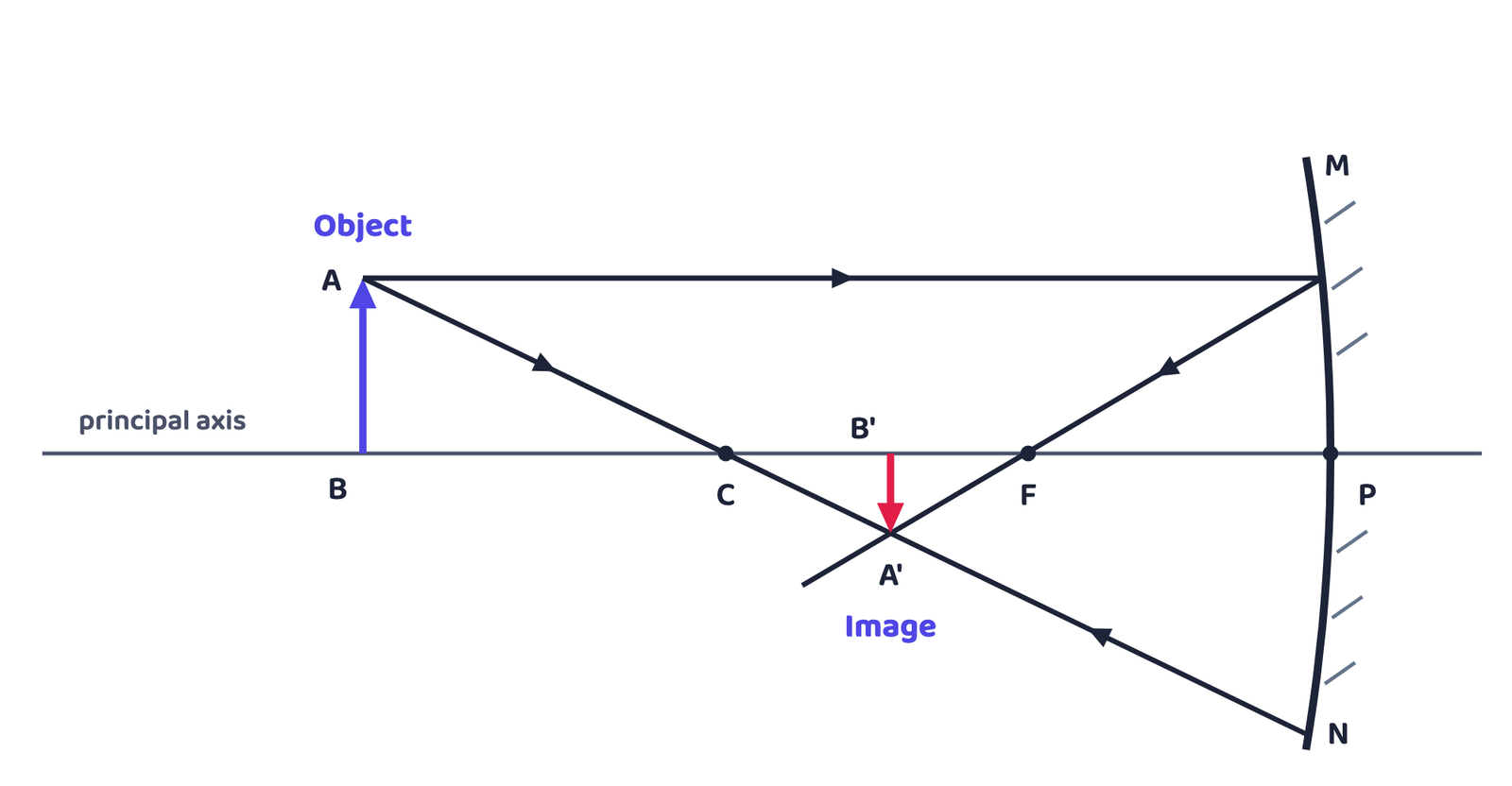
Q. With the help of a ray diagram, describe how a concave mirror forms a real, diminished image of an object placed beyond its centre of curvature.
Answer: Take two rays from the top of the object: one parallel to the principal axis, which passes through the focus F after reflection; and one passing through the centre of curvature C, which reflects straight back along the same path (since it strikes the mirror along the normal). The two reflected rays actually cross at a point between F and C, on the same side as the object. This crossing point is real (light rays genuinely meet there), and since it lies below the principal axis while the object’s top is above it, the image is inverted. Because the object is farther from the mirror than C, this image forms closer to the mirror than the object and is diminished.
Q. A concave mirror produces three times magnified (enlarged) real image of an object placed at 10 cm in front of it. Find the position of the image.
Answer: A real image has negative magnification, so m = -v/u = -3. With u = -10 cm: -v/(-10) = -3, giving v = -30 cm. The image is formed 30 cm in front of the mirror (real).
Q. Use the mirror formula to find the focal length of a concave mirror that forms a real image at 20 cm of an object placed at 40 cm from it.
Answer: A real image means both u and v are negative: u = -40 cm, v = -20 cm. Using 1/v + 1/u = 1/f: 1/f = 1/(-20) + 1/(-40) = (-2-1)/40 = -3/40, so f = -13.3 cm. The mirror’s focal length is 13.3 cm (concave, since f is negative).
Q. Explain why the image of a distant object seen in a convex mirror looks smaller than in a plane mirror of the same size, yet the convex mirror shows more of the surroundings.
Answer: A convex mirror’s outward curve means each part of its surface is angled slightly differently, so it can gather and reflect light coming from a much wider range of directions than a flat mirror of the same size can. This wider field of view is exactly why the convex mirror shows more of the surroundings in one glance. Because those reflected rays diverge more strongly, the image they form is diminished (smaller) compared to a plane mirror, which reflects light without changing the angle of the rays at all. This is precisely why convex mirrors are used as rear-view/wing mirrors: a diminished image is an acceptable trade-off for seeing a much wider area of the road behind.
Q. Describe, step by step, what happens to a ray of light incident obliquely on a rectangular glass slab as it crosses the slab and re-emerges into air.
Answer: Step 1: the incident ray strikes the first face of the slab (air to glass, rarer to denser) and bends towards the normal, becoming the refracted ray. Step 2: inside the uniform glass, the ray travels in a straight line to the second face. Step 3: at the second face (glass to air, denser to rarer) it bends away from the normal by an equal angle, becoming the emergent ray. Step 4: because the two faces of the slab are parallel, the two bendings are equal and opposite, so the emergent ray travels exactly parallel to the original incident ray: only shifted sideways (laterally displaced).
Q. An object of height 4 cm is placed 20 cm from a convex lens of focal length 10 cm. Using the lens formula, find the position, nature and size of the image.
Answer: u = -20 cm, f = +10 cm. 1/v = 1/f + 1/u = 1/10 + 1/(-20) = (2-1)/20 = 1/20, so v = +20 cm. Magnification m = v/u = 20/(-20) = -1. Image height h’ = m x h = -1 x 4 = -4 cm. The image is real, inverted, and the same size as the object (4 cm), formed 20 cm on the other side of the lens: consistent with the object being at 2F1, which always gives an image at 2F2 of the same size.
Q. Explain, using the concept of power, why an optician can simply add the powers of two lenses placed in contact instead of recalculating focal lengths from scratch. Illustrate with the chapter’s own example.
Answer: The power of a single lens is P = 1/f. When two or more thin lenses are placed in contact, their combined power is simply the algebraic sum of their individual powers: P = P1 + P2 + P3 + …. This additive property means an optician, while testing eyes, can combine several trial lenses of known power inside the testing frame and just add up their powers to find the total power needed, without converting back and forth through focal lengths each time. The chapter’s own example: a +2.0 D lens and a +0.25 D lens held together act exactly like one single lens of power +2.0 + 0.25 = +2.25 D.
Q. With the help of a ray diagram, show how a convex lens forms a real, diminished image of an object placed beyond 2F1.
Answer: Take two rays from the top of the object: one parallel to the principal axis, which bends at the lens and passes through the focus F2 on the far side; and one passing straight through the optical centre O without any bending at all. The two refracted rays cross at a point between F2 and 2F2, on the far side of the lens from the object. This crossing point is real, and since it lies below the principal axis while the object’s top is above it, the image is inverted. Because the object is farther from the lens than 2F1, this image forms closer to the lens than 2F2 and is diminished, exactly how a camera lens forms a small, real, inverted image on the sensor of a distant scene.

Q. With the help of a ray diagram, show how a concave lens forms an image of an object placed between infinity and its optical centre, and state the nature of this image.
Answer: Take two rays from the top of the object: one parallel to the principal axis, which after refraction spreads away from the axis as if it had come from the focus F1 on the SAME side as the object; and one passing straight through the optical centre O without bending. These two refracted rays diverge and never actually meet on the far side of the lens, so only their backward extensions (traced back through the lens, on the object’s own side) cross, at a point between F1 and O. Since the crossing point is only an apparent one, the image is virtual; since it lies on the same side of the axis as the object’s top, the image is erect; and since the backward-extended rays cross closer to the lens than the object, the image is diminished. This matches the conclusion already stated for a concave lens: virtual, erect and diminished for every object position.

4 6-Mark Questions
Q. State the New Cartesian Sign Convention for spherical mirrors. Using it, find the position and nature of the image formed by a concave mirror of focal length 15 cm when an object is placed (a) 30 cm and (b) 10 cm in front of it.
Answer: New Cartesian Sign Convention: the pole of the mirror is the origin and the principal axis is the x-axis; the object is always placed to the left of the mirror; distances measured to the right of the pole are positive and to the left are negative; distances measured above the principal axis are positive and below are negative.
(a) u = -30 cm, f = -15 cm. 1/v = 1/f – 1/u = 1/(-15) – 1/(-30) = (-2+1)/30 = -1/30, so v = -30 cm. m = -v/u = -(-30)/(-30) = -1. The image forms at 30 cm in front of the mirror (at C), real, inverted, and the same size as the object.
(b) u = -10 cm, f = -15 cm. 1/v = 1/f – 1/u = 1/(-15) – 1/(-10) = (-2+3)/30 = 1/30, so v = +30 cm. The positive v means the image forms behind the mirror. m = -v/u = -(30)/(-10) = +3. The image is virtual, erect, and enlarged 3 times, formed 30 cm behind the mirror.
Q. Distinguish between a convex lens and a concave lens under the following heads: shape, action on light rays, sign of focal length, sign of power, and the nature of image formed for an object at infinity.
Answer: Shape: a convex lens is thicker at the middle than at the edges; a concave lens is thicker at the edges than at the middle.
Action on rays: a convex lens converges (brings together) parallel rays of light; a concave lens diverges (spreads out) parallel rays.
Sign of focal length: convex lens f is positive; concave lens f is negative.
Sign of power: convex lens power P is positive; concave lens power P is negative.
Image for object at infinity: a convex lens forms a real, inverted, highly diminished (point-sized) image at its focus F2; a concave lens forms a virtual, erect, highly diminished (point-sized) image at its focus F1, on the same side as the object.
Common name: a convex lens is also called a converging lens; a concave lens is also called a diverging lens.
Q. A 5 cm tall object is placed 15 cm from (a) a concave mirror and (b) a convex lens, both of focal length 10 cm. Calculate the position, nature and size of the image formed in each case, and compare the two results.
Answer: (a) Concave mirror: u = -15 cm, f = -10 cm. 1/v = 1/f – 1/u = 1/(-10) – 1/(-15) = (-3+2)/30 = -1/30, so v = -30 cm. m = -v/u = -(-30)/(-15) = -2. h’ = m x h = -2 x 5 = -10 cm. Image: real, inverted, enlarged 2 times, 30 cm in FRONT of the mirror (same side as the object).
(b) Convex lens: u = -15 cm, f = +10 cm. 1/v = 1/f + 1/u = 1/10 + 1/(-15) = (3-2)/30 = 1/30, so v = +30 cm. m = v/u = 30/(-15) = -2. h’ = -10 cm. Image: real, inverted, enlarged 2 times, 30 cm on the OTHER side of the lens (opposite side from the object).
Comparison: with the same object distance and the same magnitude of focal length, both devices give an identical magnification (-2) and identical image size (10 cm), but the concave mirror’s image forms on the SAME side as the object, while the convex lens’s image forms on the OPPOSITE side, because a mirror works by reflection and a lens by refraction (light actually passes through it).
Q. Explain the phenomenon of refraction of light using the everyday observations described in the chapter (the raised pond bottom, letters appearing raised under a glass slab, the displaced pencil, and the enlarged lemon). Then state the two laws of refraction and explain Snell’s law.
Answer: All four observations happen because light changes direction when it passes obliquely from one transparent medium into another (refraction), due to a change in the speed of light. A pond’s bottom appears raised because light coming from the bottom bends as it leaves water and enters air, making the bottom seem closer to the surface than it really is. Printed letters appear raised under a thick glass slab for the same reason. A pencil partly dipped in water appears bent or displaced at the surface because light from the submerged part reaches the eye along a different path (bent at the water-air interface) than light from the part above water. A lemon in a glass of water looks bigger than it actually is when viewed from the side, because refraction at the curved glass and water surfaces spreads the rays apart before they reach the eye, making the lemon appear magnified.
Laws of refraction: (i) the incident ray, the refracted ray and the normal to the interface at the point of incidence all lie in the same plane; (ii) the ratio of the sine of the angle of incidence to the sine of the angle of refraction is a constant for a given pair of media and colour of light: this is Snell’s law, sin i / sin r = constant. This constant value is called the refractive index of the second medium with respect to the first, and it tells us how strongly that pair of media bends light passing between them.
5 Case Studies
(A) 1 mark What is the name of the point where the bright spot of light forms on the paper?
Answer: The principal focus of the concave mirror.
(B) 1 mark Why does the paper begin to smoke at this spot?
Answer: The concave mirror converges the Sun’s parallel rays to this one point, concentrating their heat there until the paper’s temperature rises enough to smoke and then catch fire.
(C) 2 marks If the paper is moved slightly away from this exact position, will the spot of light remain sharp? Explain.
Answer: No. Only at the exact focus do all the reflected rays cross at a single point. Moving the paper closer or farther means the rays have not yet fully converged, or have already started to cross and spread apart again, so the spot becomes a blurred, dimmer patch of light rather than a sharp point.
(D) 2 marks Using the measured focal length of 12 cm, calculate the radius of curvature of this mirror.
Answer: R = 2f = 2 x 12 cm = 24 cm.
(A) 1 mark At which two points does the ray of light change direction in this setup?
Answer: At O, where it enters the glass through face AB, and at O’, where it leaves the glass through face CD.
(B) 2 marks Between O and O’, does the light ray travel in a straight line or a curved path? Justify your answer.
Answer: It travels in a straight line. Refraction only bends light at the boundary between two media of different optical density; inside the uniform glass, with no change in medium, the ray continues straight until it reaches the next surface.
(C) 2 marks Name the phenomenon responsible for the sideways displacement between the original direction of EF (extended) and the emergent ray O’H.
Answer: Refraction at the two parallel faces of the glass slab: since the bending at AB and at CD are equal and opposite, the ray’s final direction is unchanged, but it is shifted sideways. This sideways shift is called lateral displacement (or lateral shift).