
Complete solutions to all 14 in-text questions and all 17 end-of-chapter exercise questions from NCERT Science, Chapter 9 “Light – Reflection and Refraction”, in the English edition’s own wording. Try working out the answer yourself first, then check it against this one.
A In-text Questions
The question boxes printed inside the chapter, after the sections they test, answered first in book order. The end-of-chapter exercises follow below.
Questions after Section 9.2.2
Q. Define the principal focus of a concave mirror.
Answer: The principal focus of a concave mirror is the point on its principal axis at which rays of light, incident on the mirror parallel to the principal axis, meet (converge) after reflection from the mirror.
Q. The radius of curvature of a spherical mirror is 20 cm. What is its focal length?
Answer: For a spherical mirror of small aperture, the focal length is half the radius of curvature: f = R/2 = 20 cm ÷ 2 = 10 cm.
Q. Name a mirror that can give an erect and enlarged image of an object.
Answer: A concave mirror, when the object is placed between its pole (P) and principal focus (F). The image is then virtual, erect and enlarged, formed behind the mirror.
Q. Why do we prefer a convex mirror as a rear-view mirror in vehicles?
Answer: A convex mirror always gives an erect, though diminished, image of objects behind the vehicle. Being curved outwards, it also has a wider field of view than a plane mirror of the same size, so the driver can see a much larger area of the traffic behind.
Questions after Section 9.2.4
Q. Find the focal length of a convex mirror whose radius of curvature is 32 cm.
Answer: For a convex mirror, R = +32 cm (measured behind the mirror). f = R/2 = +32 cm ÷ 2 = +16 cm. The focal length is 16 cm (positive, as for every convex mirror).
Q. A concave mirror produces three times magnified (enlarged) real image of an object placed at 10 cm in front of it. Where is the image located?
Answer: Object distance u = −10 cm. The image is real, so it is inverted and the magnification is negative: m = −3. Using m = −v/u: −3 = −v/(−10), so v = −30 cm. The image is formed 30 cm in front of the mirror (on the same side as the object).
Questions after Section 9.3.2
Q. A ray of light travelling in air enters obliquely into water. Does the light ray bend towards the normal or away from the normal? Why?
Answer: It bends towards the normal. Water is optically denser than air (its refractive index, 1.33, is greater than that of air), so light slows down on entering water. A ray going from a rarer to a denser medium bends towards the normal.
Q. Light enters from air to glass having refractive index 1.50. What is the speed of light in the glass? The speed of light in vacuum is 3 × 10⁸ m s⁻¹.
Answer: Refractive index n = c/v, so v = c/n = (3 × 10⁸ m s⁻¹) ÷ 1.50 = 2 × 10⁸ m s⁻¹. The speed of light in the glass is 2 × 10⁸ m s⁻¹.
Q. Find out, from Table 9.3, the medium having highest optical density. Also find the medium with lowest optical density.
Answer: Highest optical density: diamond, which has the highest refractive index in the table (2.42). Lowest optical density: air, which has the lowest refractive index (1.0003).
Q. You are given kerosene, turpentine and water. In which of these does the light travel fastest? Use the information given in Table 9.3.
Answer: In water. From Table 9.3, the refractive indices are: water 1.33, kerosene 1.44, turpentine oil 1.47. Since v = c/n, light travels fastest in the medium with the lowest refractive index, which is water.
Q. The refractive index of diamond is 2.42. What is the meaning of this statement?
Answer: It means that the ratio of the speed of light in vacuum (or air) to the speed of light in diamond is 2.42; that is, light travels 2.42 times slower in diamond than in vacuum. The speed of light in diamond is c/2.42 = (3 × 10⁸) ÷ 2.42 ≈ 1.24 × 10⁸ m s⁻¹.
Questions after Section 9.3.8
Q. Define 1 dioptre of power of a lens.
Answer: 1 dioptre is the power of a lens whose focal length is 1 metre. 1 D = 1 m⁻¹.
Q. A convex lens forms a real and inverted image of a needle at a distance of 50 cm from it. Where is the needle placed in front of the convex lens if the image is equal to the size of the object? Also, find the power of the lens.
Answer: A convex lens forms a real, inverted image of the same size only when the object is at 2F₁; the image is then at 2F₂. So v = +50 cm and u = −50 cm: the needle is placed 50 cm in front of the lens. Lens formula: 1/f = 1/v − 1/u = 1/50 − 1/(−50) = 2/50, so f = +25 cm = +0.25 m. Power P = 1/f = 1/0.25 m = +4 D.
Q. Find the power of a concave lens of focal length 2 m.
Answer: For a concave lens the focal length is negative: f = −2 m. P = 1/f = 1/(−2 m) = −0.5 D.
B End-of-chapter Exercises
1. Which one of the following materials cannot be used to make a lens?
(a) Water (b) Glass (c) Plastic (d) Clay
Answer: (d) Clay. A lens must be made of a transparent material, so that light can pass through and be refracted by its curved surfaces. Water, glass and plastic are all transparent; clay is opaque, so it cannot be used to make a lens.
2. The image formed by a concave mirror is observed to be virtual, erect and larger than the object
Where should be the position of the object? (a) Between the principal focus and the centre of curvature (b) At the centre of curvature (c) Beyond the centre of curvature (d) Between the pole of the mirror and its principal focus
Answer: (d) Between the pole of the mirror and its principal focus. From Table 9.1, only this object position gives a virtual, erect, enlarged image; every other position listed gives a real, inverted image.
3. Where should an object be placed in front of a convex lens to get a real image of the size of the object?
(a) At the principal focus of the lens (b) At twice the focal length (c) At infinity (d) Between the optical centre of the lens and its principal focus
Answer: (b) At twice the focal length. From Table 9.4, an object at 2F1 forms a real, inverted image at 2F2, the same size as the object.
4. A spherical mirror and a thin spherical lens have each a focal length of −15 cm
The mirror and the lens are likely to be: (a) both concave (b) both convex (c) the mirror is concave and the lens is convex (d) the mirror is convex, but the lens is concave
Answer: (a) both concave. By the sign convention, a negative focal length means a concave mirror (focus in front, same side as the object) AND a concave lens (focal length always taken negative for a concave lens).
5. No matter how far you stand from a mirror, your image appears erect
The mirror is likely to be: (a) only plane (b) only concave (c) only convex (d) either plane or convex
Answer: (d) either plane or convex. A plane mirror always gives an erect image, and so does a convex mirror (Table 9.2), for every object distance. A concave mirror only gives an erect image when the object is very close (between P and F), not “no matter how far.”
6. Which of the following lenses would you prefer to use while reading small letters found in a dictionary?
(a) A convex lens of focal length 50 cm (b) A concave lens of focal length 50 cm (c) A convex lens of focal length 5 cm (d) A concave lens of focal length 5 cm
Answer: (c) A convex lens of focal length 5 cm. Reading small print needs a magnifying glass, a convex lens with a short focal length, which gives the largest magnified, virtual image when held very close to the page. A concave lens can never magnify, since it always gives a diminished image.
7. Erect image using a concave mirror of focal length 15 cm
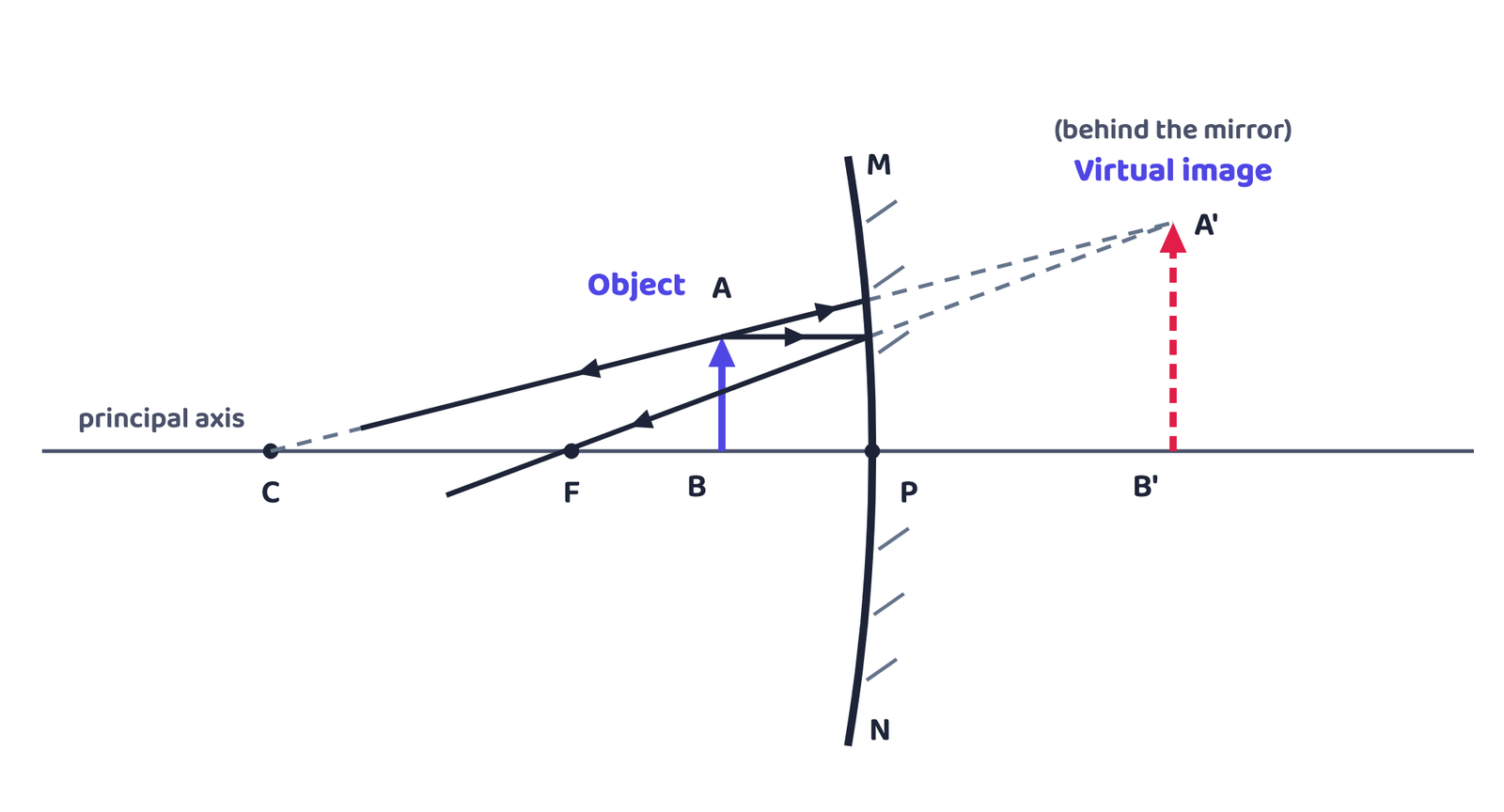
We wish to obtain an erect image of an object, using a concave mirror of focal length 15 cm. What should be the range of distance of the object from the mirror? What is the nature of the image? Is the image larger or smaller than the object? Draw a ray diagram to show the image formation in this case.
Answer: A concave mirror gives an erect image only when the object is placed between the pole (P) and the focus (F), so the object distance must be between 0 and 15 cm from the mirror. The image formed is virtual, erect and enlarged (larger than the object). Ray diagram: from the top of the object, a ray parallel to the principal axis reflects through F, and a ray travelling along the line from C strikes the mirror along the normal and returns along its own path. The two reflected rays diverge, so they never meet in front of the mirror; extended backward (dashed), they meet behind the mirror, where the virtual, erect, enlarged image forms.
8. Name the type of mirror used in the following situations
(a) Headlights of a car (b) Side/rear-view mirror of a vehicle (c) Solar furnace. Support your answer with reason.
Answer: (a) Concave mirror: with the bulb placed at its focus, it reflects the light as a strong, powerful parallel beam. (b) Convex mirror: it always gives an erect image and, being curved outward, gives a much wider field of view than a plane mirror of the same size, letting the driver see more of the traffic behind. (c) Concave mirror: a large one converges the parallel rays of sunlight to a single point (its focus), concentrating the Sun’s heat there to generate very high temperatures.
9. One-half of a convex lens is covered with a black paper.
Will this lens produce a complete image of the object? Verify your answer experimentally. Explain your observations.
Answer: Yes, the lens will still produce a complete image of the object, though it will be less bright (lower intensity) than before. This is because every point on the object sends out light rays in all directions, and rays from every point of the object still reach the uncovered half of the lens, which alone is enough to bring all the rays together and form the full image. Covering half the lens only reduces the number of rays reaching the lens (hence a dimmer image), not the completeness of the image. This can be verified by actually covering half of a convex lens with black paper and observing a candle’s image on a screen: the same complete flame shape still appears, only fainter.
10. Object 5 cm long, 25 cm from a converging lens of focal length 10 cm
An object 5 cm in length is held 25 cm away from a converging lens of focal length 10 cm. Draw the ray diagram and find the position, size and the nature of the image formed.
Given: , , (converging = convex lens)
Step 1:
Step 2:
Step 3: ;
Answer: The image is real, inverted and diminished (3.3 cm), formed 16.7 cm on the other side of the lens, since the object lies beyond 2F₁ (2f = 20 cm). Ray diagram (drawn to scale): a ray from the top of the object parallel to the principal axis refracts through F₂, and a ray through the optical centre O goes straight on; the two refracted rays cross between F₂ and 2F₂, 16.7 cm from the lens, where the real, inverted image, two-thirds the size of the object, forms.

11. Concave lens of focal length 15 cm forms an image 10 cm from the lens
A concave lens of focal length 15 cm forms an image 10 cm from the lens. How far is the object placed from the lens? Draw the ray diagram.
Given: , (concave lens image is always virtual, on the same side as the object)
Step 1:
Step 2:
Answer: The object is placed 30 cm from the lens. Ray diagram (drawn to scale): a ray from the top of the object parallel to the principal axis diverges after refraction as if it came from F₁ (its backward extension, dashed, passes through F₁); a ray through the optical centre O goes straight on. The two rays appear to meet 10 cm from the lens on the object’s side, between F₁ and O, where the virtual, erect, diminished image (one-third the size of the object) forms.

12. Object 10 cm from a convex mirror of focal length 15 cm
An object is placed at a distance of 10 cm from a convex mirror of focal length 15 cm. Find the position and nature of the image.
Given: , (convex mirror)
Step 1:
Step 2: (behind the mirror)
Step 3:
Answer: The image is formed 6 cm behind the mirror. It is virtual, erect, and diminished (0.6 times the object’s size).
13. Magnification produced by a plane mirror is +1
The magnification produced by a plane mirror is +1. What does this mean?
Answer: A magnification of exactly +1 means two things together: the magnitude, 1, shows the image is exactly the same size as the object; and the positive sign shows the image is virtual and erect (upright, not inverted); which matches exactly what we already know about a plane mirror’s image.
14. Object 5.0 cm, 20 cm from a convex mirror of radius of curvature 30 cm
An object 5.0 cm in length is placed at a distance of 20 cm in front of a convex mirror of radius of curvature 30 cm. Find the position of the image, its nature and size.
Given: , , so
Step 1:
Step 2: (behind the mirror)
Step 3: ;
Answer: The image forms 8.6 cm behind the mirror. It is virtual, erect, and diminished, 2.1 cm tall.
15. Object 7.0 cm, 27 cm in front of a concave mirror of focal length 18 cm
An object of size 7.0 cm is placed at 27 cm in front of a concave mirror of focal length 18 cm. At what distance from the mirror should a screen be placed, so that a sharp focussed image can be obtained? Find the size and the nature of the image.
Given: , ,
Step 1:
Step 2: ; the screen should be placed 54 cm in front of the mirror
Step 3: ;
Answer: The screen should be placed 54 cm in front of the mirror. The image is real, inverted, and enlarged (magnified twice), 14 cm tall.
16. Lens of power −2.0 D
Find the focal length of a lens of power −2.0 D. What type of lens is this?
Step 1: (i.e. )
Answer: The negative focal length shows this is a concave (diverging) lens, of focal length 50 cm.
17. Corrective lens of power +1.5 D
A doctor has prescribed a corrective lens of power +1.5 D. Find the focal length of the lens. Is the prescribed lens diverging or converging?
Step 1: (i.e. )
Answer: The positive focal length shows this is a convex (converging) lens, of focal length about 66.7 cm.