
1 Scientific Models
A real system is too complicated to study in full, so science studies a simplified version of it instead.
A model is a simplified way of looking at a real system, which keeps only the details that matter for the question being asked and deliberately leaves out the rest.
Leaving details out is a deliberate choice, not a mistake: ignoring air resistance on a falling stone makes the problem solvable without changing the answer you need.
| Branch | How it models things |
|---|---|
| Physics | A moving car as a single point |
| Chemistry | Atoms and molecules as spheres joined by bonds |
| Biology | A cell as a labelled diagram of its key parts |
| Earth Science | The Earth as a smooth sphere of layers |
Q. Modelling a ball hit for a six: what matters, what doesn’t?
Keep: mass of the ball, speed and direction it was hit.
Ignore: bat brand, ball colour, grass on the field. Air resistance and spin have smaller effects: ignored in a simple model, added back for more accuracy.
To explain starlight, Saha ignored the individual atoms and reactions inside a star and treated its matter as a simple hot gas: focusing only on temperature, pressure and ionisation. That one simplification explained why stars of different colours have different temperatures.
2 The Language of Science
Everyday words like force, work and cell have one exact meaning in science, so results can be compared anywhere in the world. Quantities get fixed symbols and standard units.
Symbols come from history, not convenience: the speed of light is from the Latin celeritas (“speed”), fixed at exactly . Mathematics works the same way: an equation like is a compact statement of how quantities relate, not just a calculation.
- 2 marksWhich two units were confused, and how would SI units have prevented this?
3 Laws, Theories and Principles
Three words for three different kinds of idea: the most commonly asked distinction in this chapter.
A law is a regular pattern seen in nature, described in words or as a mathematical relationship.
A theory explains why that pattern happens, based on evidence gathered over time.
A principle is a broad idea used to make sense of a situation.
| Term | The textbook’s own example |
|---|---|
| Law | Newton’s laws of motion: the jerk you feel when a bus stops |
| Theory | Atomic theory: how atoms join to form molecules |
| Principle | Conservation of energy: climbing a flight of stairs |
A scientific theory is not “just a guess.” It is an explanation built on careful testing and evidence. It stays open to improvement: and that is exactly what makes it reliable.
4 Prediction, and Why Science Corrects Itself
A prediction is a reasoned expectation based on evidence and careful thinking, not a guess. Science can predict how far a football will travel, how much gas a reaction gives, or how breathing changes while running.
Q. Varsha says “it will rain because the clouds look dark.” Is this scientific?
A. No: “clouds look dark” is an impression, not measurable evidence. It becomes testable by asking for measurements and past patterns: today’s humidity (was it above 80% last time it rained?), wind speed and direction, whether temperature is dropping as it did before earlier rains.
When a prediction matches observation, confidence grows. When it doesn’t, scientists re-examine the assumptions, models or measurements: they change their minds on evidence, never opinion. Even successful theories have limits, and no theory is ever beyond question. That openness is science’s greatest strength, not a weakness.
Weather forecasts depend on many changing factors, and tiny differences grow over days: reliable for hours, uncertain further out.
Checking a viral claim: “food becomes harmful during an eclipse”: an eclipse is only a shadow, so ask what physical, chemical or biological mechanism could possibly cause it. There is none.
No scientific theory is ever final, and none is beyond question.
: the one idea to carry out of this chapter
5 Estimation
A rough answer is often enough to tell whether a result is sensible. Method: understand the question → identify the quantities that matter → estimate with round numbers → check the answer isn’t absurd.
Method 1. About 12–15 breaths a minute × 1,440 minutes ≈ 20,000 breaths a day. One breath ≈ 0.5 L (4–5 breaths fill a 2 L balloon) → about 10,000 litres a day.
Method 2 (cross-check). 3 balloons/min × 2 L × 1,440 min ≈ 8,640 L/day.
The point: two rough methods landing close together is what gives an estimate its confidence: you are checking that the reasoning makes sense, not chasing an exact number.
6 The Branches of Science Are Not Separate
Physics, chemistry, biology and earth science are divided only to organise study: nature has no such boundaries. Real problems need several at once.
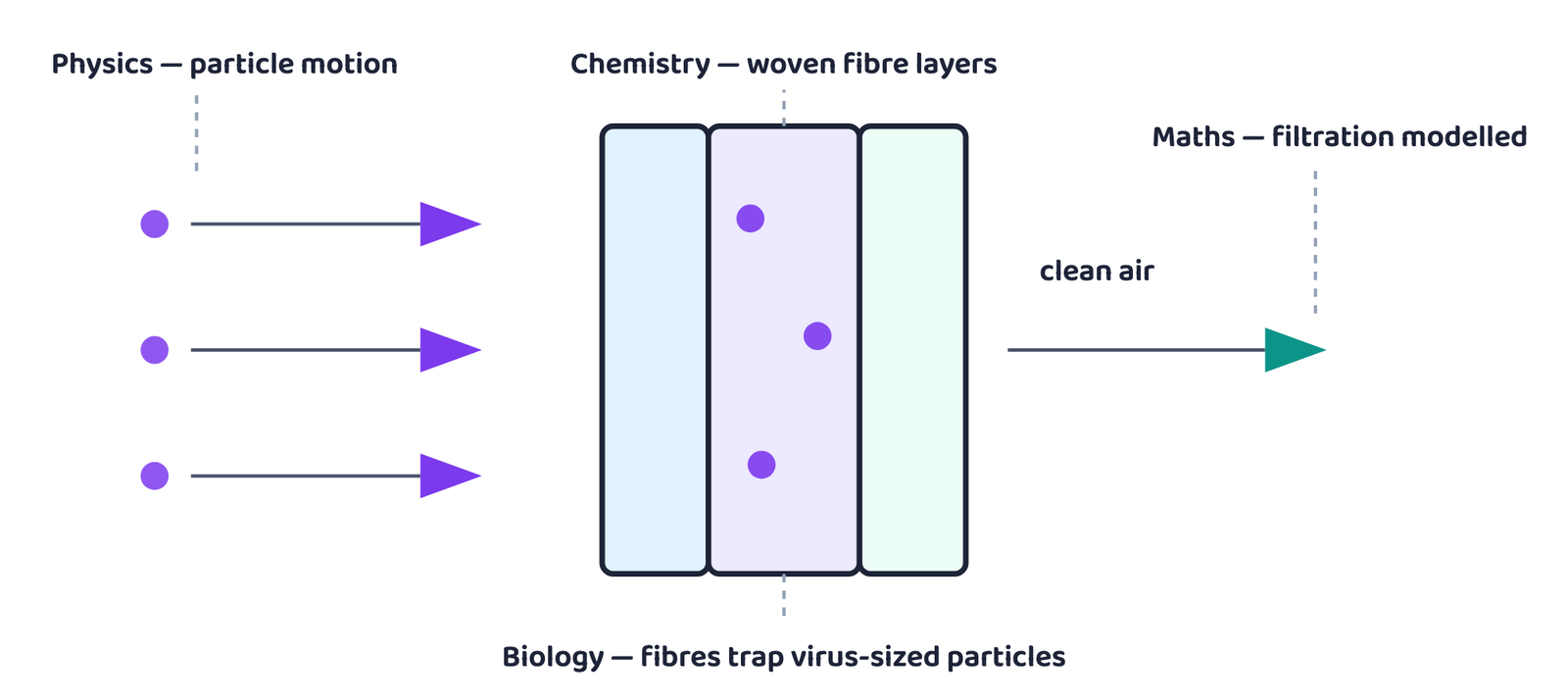
Finally, science is a human activity: built on curiosity, creativity, collaboration and questioning, across generations and cultures. Even if you stop studying science after Class 10, scientific thinking helps you judge information critically for life.
- A model keeps only what the question needs and ignores the rest, on purpose
- SI units let results be compared anywhere: the aircraft fuel error shows the cost of not using them
- Law describes a pattern · theory explains why · principle applies a broad idea
- A theory is evidence-based and testable, never “just a guess”
- A prediction is reasoned and testable; scientists change their minds on evidence, not opinion
- An estimate is confirmed by a second rough method agreeing with the first
- The branches of science are a convenience: real problems cross them
- 1 markDefine a scientific model.
- 1 markDefine a scientific law.
- 1 markDefine a theory.
- 1 markDefine a principle.
- 1 markDefine a scientific prediction.
- 1 markWrite the symbol and SI unit for velocity and for electric current.
- 1 markWhy is the speed of light written as , and what is its exact value?
- 1 markName the four branches science is usually divided into after Class 10.
- 2 marksWhy is ignoring air resistance when studying a falling stone a deliberate choice rather than a mistake?
- 2 marksHow did Meghnad Saha simplify a star in order to explain its colour?
- 2 marksWhy must a kilogram mean the same amount in every country?
- 3 marksDistinguish between a law, a theory and a principle, with one example of each.
- 3 marksWhy do scientists treat a theory’s ability to be proven wrong as a strength rather than a weakness?
- 3 marksWhat makes a prediction scientific rather than a guess? Use the rain example to explain.
- 3 marksWhy do weather forecasts become less reliable the further ahead they look?
- 3 marksA message claims food becomes harmful during an eclipse. How would you test this claim scientifically?
- 5 marksExplain, with an example for each, how the idea of a “model” is used in physics, chemistry, biology and earth science.
- 5 marksEstimate the litres of air you breathe in a day by two different methods, and explain why agreement between the two matters.
- 5 marksUsing the example of a surgical mask, explain why the branches of science are not really separate from each other.
- 5 marks“Science is a human activity.” Explain this statement, and say why scientific thinking is useful even to someone who stops studying science after Class 10.
- 1 markA model in science is:
(a) an exact copy of the real system(b) a simplified picture keeping only what the question needs(c) a guess with no evidence(d) a photograph of the system - 1 markMeghnad Saha explained the colour of stars by:
(a) tracking every atom in the star(b) treating the star’s matter as a simple hot gas(c) measuring the star’s exact size(d) ignoring temperature - 1 markNewton’s laws of motion are an example of a:
(a) theory(b) principle(c) law(d) prediction - 1 markAtomic theory explaining how atoms form molecules is an example of a:
(a) law(b) theory(c) principle(d) model - 1 markThe SI unit of electric current is:
(a) N(b) m/s(c) A(d) kg - 1 markThe aircraft in the case study ran short of fuel because the crew confused:
(a) litres and gallons(b) pounds and kilograms(c) metres and feet(d) newtons and kilograms - 1 markRoughly how many litres of air does a person breathe in a day?
(a) about 100 L(b) about 1,000 L(c) about 10,000 L(d) about 1,00,000 L - 1 markIn science, a theory is best described as:
(a) an untested guess(b) an explanation built on evidence, open to improvement(c) a fact that can never change(d) a mathematical formula
Choose: (a) both true, R explains A · (b) both true, R does not explain A · (c) A true, R false · (d) A false, R true.
- 1 mark
Assertion (A): A scientific theory can be changed or replaced.
Reason (R): A theory is only ever a guess, so it carries no real evidence. - 1 mark
Assertion (A): Air resistance is often ignored when modelling a falling stone.
Reason (R): Ignoring a small effect can make a problem solvable without changing the answer needed. - 1 mark
Assertion (A): Standard SI units are used across the world.
Reason (R): Standard units let results be compared and remove error-prone conversions.