
- The complete poem, line for line as the book prints it, and who wrote it
- Who speaks each of the three stanzas, and what the two speakers disagree about
- What “honey-coloured ramparts” means, and why young men fall into despair
- Why the young woman talks of dyeing her hair, and how the old religious man settles the argument
- The devices the poem really uses, with the exact words, and short answers to the book’s questions
1Meet the Poet and the Poem
The name printed under the poem is William Butler Yeats. The book’s note on him tells us that he lived from 1865 to 1939, was an Irish nationalist, studied in London and Dublin, loved folklore and mythology, and won the Nobel Prize for Literature in 1923.
The book tells us the poem is a conversation between a young man and a young woman, and asks us to work out what they are arguing about. The short answer: whether anyone can ever love her for the person she is, and not for her lovely yellow hair.
The poem has two speakers. The young man speaks the first and third stanzas; the young woman answers in the second. The title tells us the poem is written for Anne Gregory, so the young woman is usually taken to be Anne herself (the poem never says her name inside the lines).
2The Poem, in Full
The lines below follow the book’s own line breaks, capitals and punctuation (book page 118).
“Never shall a young man,
Thrown into despair
By those great honey-coloured
Ramparts at your ear,
Love you for yourself alone
And not your yellow hair.”
“But I can get a hair-dye
And set such colour there,
Brown, or black, or carrot,
That young men in despair
May love me for myself alone
And not my yellow hair.”
“I heard an old religious man
But yesternight declare
That he had found a text to prove
That only God, my dear,
Could love you for yourself alone
And not your yellow hair.”
Words to know (the book’s glossary)
| Word | Meaning, as the book’s glossary explains it |
|---|---|
| ramparts | the high, wide walls around a castle or fort, for example, the ramparts of the Red Fort |
A few more words
| Word | Meaning here |
|---|---|
| despair | a state of having lost all hope |
| honey-coloured | golden-yellow, the shade of honey |
| hair-dye | a colouring that changes the shade of hair |
| carrot | here, a bright orange-red hair colour |
| yesternight | an old word for “last night” |
| declare | to say something openly and firmly |
| text | here, a passage from a holy or religious book |
3Stanza-by-Stanza Meaning
The poem is a short argument in three turns: he speaks, she replies, he has the last word.
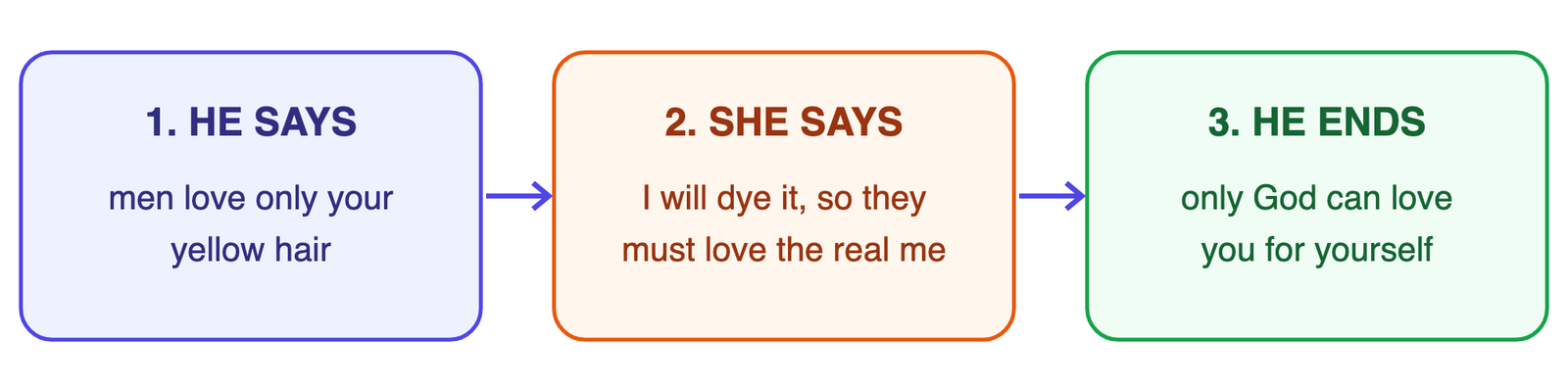
The young woman does not want to dye her hair to look prettier. She wants to remove the attraction of her golden hair, so that anyone who loves her must love her for who she is.
4Key Ideas, Explained
Two views of love
The young woman believes
- Her hair is only a colour, and colour can be changed
- Take away the golden hair and men will see her as a person
- Love for her own self is possible between people
The young man believes
- Looks always pull human love towards them
- Men are “thrown into despair” by her beauty
- Only God can love someone for herself alone
- Why “ramparts”? Ramparts are the tall, broad walls that guard a fort. Her heavy golden hair, falling at the sides of her face over her ears, looks just as grand. Like a fort wall, it also stands in front of her: a man’s eyes stop at it and never reach the person behind it.
- Why are the young men “thrown into despair”? They are struck by her beauty but feel sure she will never be theirs; that loss of hope is despair.
- Why does the yellow hair matter so much? It stands for all outward beauty. Every stanza ends by setting “yourself alone” against the “yellow hair”: the person against her looks.
- Who wins the argument? The young man has the last word. By calling on an old religious man and a holy text, he suggests that complete, selfless love, which looks past the body entirely, belongs to God and not to people.
The poem asks whether a person can be loved for herself alone, apart from her looks. A young man tells a beautiful young woman that men will always love her yellow hair, not her. She answers that she will dye it so that they must love the real her. He ends by saying that only God can love someone purely for herself: human love is always drawn, at least partly, by outward beauty.
5Poetic Devices Used
Only devices the poem really uses are listed. Learn each with its quoted words.
| Device | Exact words | What it does |
|---|---|---|
| Metaphor | “those great honey-coloured / Ramparts at your ear” | Her thick golden hair is called the walls of a fort: grand, strong, and standing between her and the onlooker |
| Imagery | “honey-coloured” | Lets us see the warm golden shade of her hair |
| Refrain | “for yourself alone / And not your yellow hair” (and “for myself alone / And not my yellow hair”) | The closing pair returns in all three stanzas, keeping the main question in front of us |
| Alliteration | “Brown, or black” | The repeated b sound gives the list of colours a quick beat |
| Alliteration | “young man … yourself … yellow” | The y sound links the young man’s words together |
| Symbolism | “yellow hair” | Stands for outward beauty as a whole, set against the inner person |
| Hyperbole | “Never shall a young man … Love you for yourself alone” | An overstatement: not a single young man, ever |
| Inversion | “Never shall a young man” | Normal word order is turned round, giving the lines an old-fashioned, formal sound |
| Enjambment | “those great honey-coloured / Ramparts at your ear” | The sentence runs on over the line break, as in natural speech |
| Rhyme scheme | there / despair / hair (stanza 2) | The 2nd, 4th and 6th lines of each stanza rhyme or nearly rhyme (abcbdb), and every stanza ends on “hair” |
A metaphor calls one thing another, without “like” or “as”. The poet calls the young woman’s hair “Ramparts”, the great walls of a fort.
A refrain is a line or group of lines that comes back at the end of each stanza. Here every stanza closes with “… alone / And not … yellow hair.”
6Tone and Title
Tone
Light, affectionate and gently teasing, like a friendly debate. Under the play lies a serious thought about how people really love. The young man’s “my dear” shows warmth, not unkindness.
Title
“For Anne Gregory” means the poem is written to, or for, a real young woman named Anne Gregory. The lines never use her name, but the title tells us who the beautiful girl with yellow hair is meant to be.
7The Book’s Questions: Short Answers
What does the young man mean by “great honey-coloured / Ramparts at your ear”? Why are young men “thrown into despair” by them?
He means her thick, golden hair that falls over her ears, as grand and protective-looking as a fort’s high walls. Any young man who sees that hair is swept off his feet, yet feels sure he can never win her, and that hopeless feeling is his despair.
What colour is her hair? What can she change it to, and why?
Her hair is yellow (golden, honey-coloured). She says a dye could make it brown, black or carrot. She would do it so that men stop being won over by its colour and instead care for her as a person.
Which qualities make one object more desirable than another? What would you stress when selling one?
We choose things for usefulness, quality, how long they last, price and appearance. A phone wins with a good camera, long battery life and a smart look. Selling it, I would stress what it does well, its value for money and its reliability.
Do we love people for their qualities, or can we love someone “for themselves alone”?
Some love does not depend on qualities: a parent loves a newborn, or a child with special needs, simply because the child is theirs; a pet and its owner love each other without conditions. The public’s love for a film star, player or politician mostly depends on talent, fame or work. Love for friends, brothers and sisters mixes both: it begins with shared time and grows into care for the person.
Can “the person” be separated from how they look, sound and walk? Has a relationship changed as someone changed?
Not completely: the way someone looks, speaks and moves is part of how we know them, just as a dancer cannot be pulled apart from the dance. Yet a close relationship usually survives such changes. A grandparent may grow older and slower, but our love stays, and may even grow deeper with understanding.
8The Poem at a Glance
| Point | Detail |
|---|---|
| Poet | William Butler Yeats (1865-1939), Irish, Nobel Prize for Literature 1923 |
| Form | 3 stanzas of 6 lines; a dialogue; rhyme scheme abcbdb |
| Speakers | Young man (stanzas 1 and 3); young woman (stanza 2) |
| Glossary | ramparts: high, wide walls around a castle or fort |
| Theme | Outward beauty versus the real person; only God loves a person for herself alone |
| Key devices | Metaphor (ramparts), refrain, alliteration, symbolism, inversion |
| Tone | Light, teasing, affectionate, with a serious idea beneath |
- Poet: W.B. Yeats; Irish nationalist; Nobel Prize 1923; 3 stanzas of 6 lines
- Stanza 1 (young man): her honey-coloured hair, like ramparts, drives young men to despair; none will love her for herself
- Stanza 2 (young woman): she can dye it brown, black or carrot so men love her for herself
- Stanza 3 (young man): an old religious man found a text proving only God can love her for herself
- Glossary: ramparts = high, wide walls of a castle or fort
- Theme: outer beauty against the real person; perfect love is God’s
- Can I say who speaks each stanza?
- Can I explain the “ramparts” metaphor and the glossary meaning?
- Can I list the three colours she names?
- Can I quote the refrain?
- Can I say who has the last word, and what he claims?