
- Who Valli is, and how one small wish grew into a careful secret plan
- Every fact she collected: distance, fare, time, and how she saved sixty paise
- The ride itself: the joking conductor, the elderly man and woman, the sights on the way
- The young cow, once funny and then found dead: Valli’s first meeting with death
- Valli’s character, the themes, key lines and the words the book glosses
- Short answers to every “Oral Comprehension Check” and “Thinking about the Text” question
1Getting Ready for the Chapter
1.1 Author and Background
The contents page names the writer as Vallikkannan. A note at the end of the story says it was translated from the Tamil by K. S. Sundaram and that the pictures are by R. K. Laxman. So this is a Tamil story that we read in English.
An eight-year-old girl takes her first bus journey into the world outside her village. The trip also becomes her first lesson in the mystery of life and death. She sees the gap between knowing that death exists and understanding it. Keep this idea in mind: the whole story leads up to it.
The two warm-up activities ask you to tick bus phrases you expect to find (“a roar and a rattle”, “slowing down to a crawl”, “Tickets, please” and so on) and to talk about the scenes you see from a fast bus: rivers, fields, shops, trains, crowds, animals.
1.2 The Story in Four Parts
2Summary, Part by Part
2.1 Part I: A Wish Grows into a Plan
The heroine is Valliammai, called Valli. She is eight and full of curiosity. Nobody of her age lives on her street, so she has no playmates. Her best way of passing time is to stand in the front doorway and watch the street. To her this is as much fun as any clever game other children play, because the street keeps showing her new things.
The thing she loves watching most is the bus that runs between her village and the nearest town. It passes every hour, once each way, carrying a new set of passengers each time. That sight gives her “unending joy”.
Here is everything she found out:
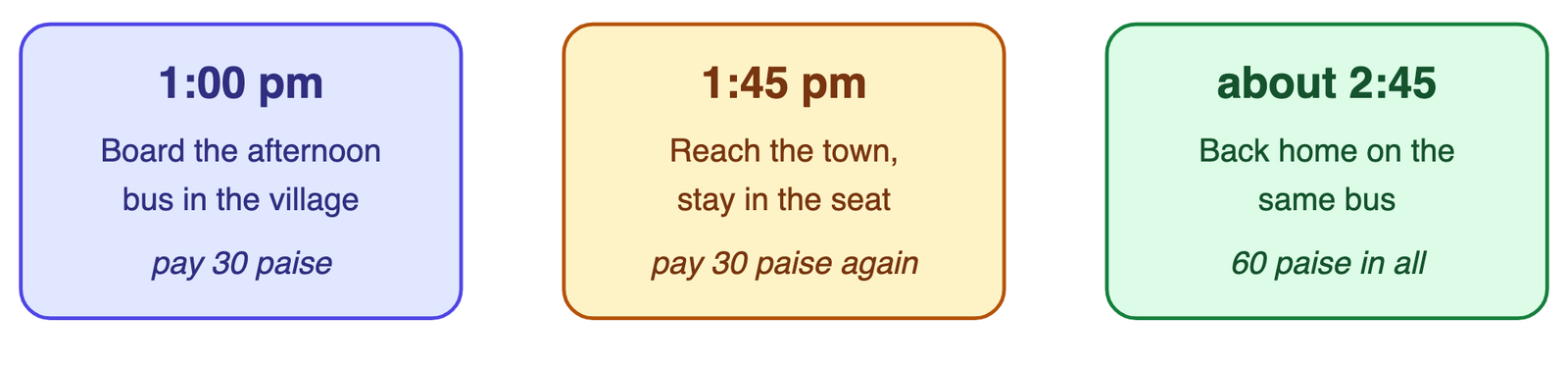
A well-dressed man called thirty paise “almost nothing at all”. For Valli, who hardly saw that much money in a month, it seemed a fortune. Her timetable:
- Standing in the front doorway of her house and watching what went on in the street.
- Joy: the sight of the village-to-town bus with fresh passengers every time. Desire: to ride that bus, even once.
- Town six miles off; 30 paise one way; 45 minutes; for another 30 paise she could stay seated and return. She learnt this by listening to neighbours and regular riders and by asking a few careful questions.
- To slip away secretly on the 1 pm bus, go to town and come straight back on the same bus.
2.2 Part II: “Madam” Gets on the Bus
On a fine spring day, as the afternoon bus is about to turn onto the main highway, a small voice cries, “Stop the bus! Stop the bus!” and a tiny hand is raised commandingly. The bus slows to a crawl. Valli shows her coins and announces that she simply has to go to town.
The conductor is a jolly man who loves a joke. He holds out a hand to help her up, but she refuses: “I can get on by myself. You don’t have to help me.” So he starts calling her “madam”: “my fine madam”, “make way for madam”, “May we start now, madam?”
- It is the slack time of day (a time with little work), so there are only six or seven passengers. They all laugh with the conductor, and Valli, suddenly shy, hurries to an empty seat without looking at anyone.
- The conductor blows his whistle twice and the bus moves off with a roar.
The new bus, through Valli’s eyes
| Part of the bus | What she notices |
|---|---|
| Outside | Shining white paint with green stripes along the sides |
| Overhead bars | They shine like silver |
| Above the windshield | A beautiful clock, right in front of her |
| Seats | Soft and luxurious |
She “devoured everything with her eyes”, meaning she looked at everything hungrily. A canvas blind covers the lower half of her window, so she stands on the seat to look over it.
One side of the narrow road
- A canal
- Palm trees and grassland beyond it
- Distant mountains
- The “blue, blue sky”
The other side
- A deep ditch
- Acres and acres of green fields
- “green, green, green”, as far as she can see
Three grown-ups, three reactions
The elderly man
Truly worried for her, he says, “Listen, child … Sit down.” She is annoyed and replies haughtily (proudly): “There’s nobody here who’s a child … I’ve paid my thirty paise like everyone else.”
The conductor
He teases: could “a mere girl” pay her own fare and travel alone? Valli glares, says she is not a madam, and reminds him he owes her a ticket. He copies her tone, everyone laughs, and soon she laughs too. When he warns that she may fall on a sharp turn, she insists, “I’m not a child … I’m eight years old.”
The elderly woman
She sits beside Valli and asks if she is alone. Valli finds her repulsive (causing strong dislike): big holes in her ear lobes, ugly earrings, the smell of betel nut and betel juice about to spill. Valli answers curtly and, to her questions about the street and house number, says, “I can take care of myself.”
Valli finally sits down only when new passengers get on, because she is afraid of losing her seat.
- Because the little girl acts like a grown lady: she pays her own fare, refuses his hand and speaks with authority. He says it as a friendly joke.
- A canvas blind blocks the lower part of her window. Standing up, she sees the canal, palm trees, grassland, faraway mountains and blue sky on one side, and a ditch and endless green fields on the other.
- That nobody on the bus is a child, since she has paid thirty paise like everyone else.
- She was put off by the woman’s looks and habits (large ear-lobe holes, ugly earrings, chewing betel nut) and disliked being questioned.
2.3 Part III: How She Saved, and What She Saw
The story now looks back at the planning. The journey had needed “careful, painstaking, elaborate plans”.
The journey to town
- The bus passes bare land, tiny hamlets and roadside shops. It seems about to “gobble up” an oncoming vehicle or a person crossing, yet passes everything safely.
- Trees seem to run towards the bus, stand helpless for a moment, then rush away the other way. (This is how a moving child sees still trees.)
- A young cow, tail high, gallops in the middle of the road right in front of the bus. The more the driver honks, the more scared it gets and the faster it runs. Valli claps and laughs until tears come. The conductor calls out, “Hey, lady, haven’t you laughed enough? Better save some for tomorrow.”
- At a railroad crossing a “speck of a train” grows bigger and rushes past with a roar and rattle that shakes the bus.
- In town: a well-planned shopping street, then a wider thoroughfare (busy public road), big bright shops, glittering merchandise (things for sale), crowds. “Struck dumb with wonder”, Valli gapes at it all.
At the town bus stop
| The conductor says | Valli answers |
|---|---|
| Aren’t you getting off? Your thirty paise takes you only this far. | No, she is going back on the same bus, and she hands over another thirty paise. |
| Is something wrong? | Nothing; she just felt like a bus ride. |
| Won’t you look at the sights? | “All by myself? Oh, I’d be much too afraid.” |
| Then have a drink at that stall. | She cannot; she does not have enough money. |
| Let me bring you a cold drink, my treat. | “No, no … please, no”, said firmly. |
- She kept every loose coin and gave up sweets, toys, balloons and even a merry-go-round ride at the fair, collecting sixty paise. It was not easy; the fair was especially hard.
- A young cow running madly ahead of the bus, getting faster with every honk.
- Her plan was only to ride the bus there and back, and she was too scared to explore the town alone.
- She had no money to spare, and she would not accept a treat from a stranger. It shows she is self-respecting, independent and careful.
2.4 Part IV: The Return Journey and the Dead Cow
Handing her the return ticket, the conductor asks if her mother will be looking for her. “No, no one will be looking for me,” she says. On the way back she enjoys every sight with the same excitement as before.
Then she sees a young cow lying dead by the roadside, hit by some fast vehicle. She asks if it is the same cow that ran in front of the bus, and the conductor nods.
The cow on the way to town
- Alive, galloping, tail in the air
- Funny to Valli; she laughs till she cries
- A “lovable, beautiful creature”
The cow on the way back
- Dead, legs spreadeagled (spread out), a fixed stare, blood all over
- Horrible and frightening to Valli
- It has lost “its charm and its life”
The memory haunts her (keeps coming back to her mind) and dampens her joy. She no longer wants to look out and stays “glued to her seat” until the bus reaches the village at three forty. She tells the conductor, “Well, sir, I hope to see you again.” He replies, “Okay, madam … And don’t forget to bring your fare.” She laughs, jumps down and runs home.
Back home: the secret is safe
- Her mother is awake, talking to Valli’s aunt from South Street, a real chatterbox.
- The aunt asks, “And where have you been?” casually, not expecting an answer. Valli only smiles.
- Her mother is saying there are so many things in our midst and in the world outside; we cannot know them all, and even what we know we often cannot understand completely.
- Valli breathes, “Oh, yes!” and explains she was agreeing about “things happening without our knowledge”.
- The aunt calls her “Just a chit of a girl” who pokes her nose into grown-ups’ talk “as though she were a grown lady”.
- Valli smiles to herself. She does not want them to understand her smile, and there is little chance they will.
The mother is chatting about everyday matters, but her words fit Valli’s day exactly. Her trip happened without her mother’s knowledge, and she has just seen death without fully understanding it. Her quiet smile shows she has grown a little wiser, while the adults still see “a chit of a girl”.
3Valli’s Character
3.1 Valli in Her Own Words
Thinking about the Text Q3 asks you to fill in her own words. These blanks are the clues to her nature:
| Sentence from the book | Missing words | What it shows |
|---|---|---|
| A tiny hand was raised ___. | commandingly | Bold, confident |
| “Yes, I ___ go to town” | simply have to | Determined |
| “There’s nobody here ___” | who’s a child | Wants to be treated as grown-up |
| “I can ___. You don’t have to help me.” | get on by myself | Independent |
| “I’m not a child, I tell you,” she said ___. | irritably | Proud, easily annoyed when treated as small |
| “You needn’t bother about me. I ___” | can take care of myself | Self-reliant |
| “Well, sir, I hope ___.” | to see you again | Polite, friendly by the end |
Curious and observant
Watches the street for hours; notices the clock, the silver bars, every field.
A careful planner
Gathers facts for months, works out the timetable, uses her mother’s nap time.
Self-controlled and thrifty
Gives up treats, even the merry-go-round, to save sixty paise; refuses the free drink.
Still a child at heart
Stands on the seat, laughs at the cow till she cries, is too scared to see the town alone, and is shaken by the dead cow.
3.2 Other Characters
| Character | Role and traits |
|---|---|
| The conductor | Jolly, teasing but kind; calls her “madam”, offers a free drink, invites her to ride again |
| The elderly man | Honestly concerned for her safety; asks her to sit down |
| The elderly woman | Chews betel nut; asks prying questions about where she is going |
| Valli’s mother | Naps from about one to four; never learns of the trip |
| The aunt from South Street | A chatterbox; calls Valli “a chit of a girl” |
4Themes, Message and Key Lines
4.1 Themes
- Growing up: a child’s longing to be treated as an adult, and her first real step into the wider world.
- Life and death: the same cow, alive on the way to town and dead on the way back, gives Valli her first glimpse of how sudden death is.
- Knowing versus understanding: we may know a thing, like death, and still not grasp it fully.
- A child’s eye view: trees that run, a bus that “gobbles”, a train that is a “speck”; the world is seen as an eight-year-old sees it.
- Planning and self-control: a dream comes true through patience and saving.
The eyes through which a story is shown. Here events are described as an eight-year-old girl sees and feels them, even though a narrator tells the story.
Life is full of joy and wonder, but also of sorrow that can come without warning. Some experiences cannot be fully understood even when we know about them; growing up means meeting such truths for the first time.
4.2 Key Lines and Their Meaning
| Line from the book | Meaning |
|---|---|
| “Proud! proud!” | Children’s slang to show disapproval when a friend boasts about the town. |
| “which is almost nothing at all” | A rich man’s view of 30 paise; for Valli it was a fortune. |
| “Valli devoured everything with her eyes.” | She looked at everything eagerly, as if hungry for it. |
| “Better save some for tomorrow.” | The conductor’s joke: don’t use up all your laughter today. |
| “Struck dumb with wonder” | So amazed by the town that she could not speak. |
| “glued to her seat” | Sitting still, no longer moving about or looking out. |
| “Just a chit of a girl” | The aunt means: only a small, unimportant girl. |
5Thinking about the Text: Short Answers
- Deepest desire: to ride the bus to town. Clues: “a tiny wish crept into her head”, “stronger and stronger”, “an overwhelming desire”, “stare wistfully”.
- Her plan: she listened and asked careful questions for months, learnt the distance (6 miles), fare (30 paise each way) and time (45 minutes), chose the 1 pm bus during her mother’s nap, and saved sixty paise by giving up sweets, toys and the fair’s merry-go-round.
- Fill in the blanks: see the table in section 3: commandingly, simply have to, who’s a child, get on by myself, irritably, can take care of myself, to see you again. Together they show a bold, independent girl who wants to be treated as grown-up.
- “Madam”: she acts with an adult’s confidence and independence, so the conductor teases her with a grown-up title.
- Enjoying the ride: “Valli devoured everything with her eyes”; “Oh, it was all so wonderful!”; she “clapped her hands with glee”, laughed “until there were tears in her eyes”, and was “Struck dumb with wonder”.
- Not looking out on the way back: the dead cow kept coming back to her mind and took away her excitement.
- “Things happening without our knowledge”: on the surface she agrees with her mother; secretly she means her own trip, of which her mother knows nothing, and the death she has seen but cannot fully grasp.
- Child’s point of view: trees that come “running towards them” and then stand “helpless”; the bus “gobbling up” vehicles; a “speck of a train” growing bigger; finding the cow’s flight hilarious; the woman’s earrings found “repulsive”.
Speaking and writing tasks: the book asks you to act out a conversation like those in the story, and to write about three paragraphs on a plan you made alone, a memorable journey, or road safety. The story gives ideas for the last one: the cow killed by a fast vehicle shows how speeding endangers animals and people.
6Words to Know
| Word / phrase | Meaning (book’s glossary) |
|---|---|
| wistfully | longingly |
| kindle | set alight (a fire); here, feelings |
| a slang expression | informal words, often used within a close group |
| discreet questions | careful questions |
| slack time | a time when there is not much work |
| haughtily | proudly |
| mimicking | copying |
| repulsive | causing strong dislike |
| curtly | showing displeasure |
| drivel | silly nonsense |
| thriftily | spend money carefully |
| resolutely stifled | suppressed / controlled with determination |
| ventured out | went cautiously, courageously |
| thoroughfare | a busy public road |
| merchandise | things for sale |
| spreadeagled | spread out |
| haunted | returned repeatedly to her mind; was impossible to forget |
| pokes her nose | takes an interest in something that doesn’t concern her |
- Vallikkannan; translated from Tamil by K. S. Sundaram; pictures by R. K. Laxman
- Valliammai (Valli), 8, no playmates; watches the street from the front doorway
- Bus every hour; wish becomes “an overwhelming desire”; “Proud! proud!”
- Facts: 6 miles, 30 paise one way, 45 minutes; plan 1:00 to 1:45 and back about 2:45
- Saved 60 paise; gave up peppermints, toys, balloons, merry-go-round
- Mother naps about one to four
- Spring afternoon; 6 or 7 passengers; conductor calls her “madam”
- New bus: white with green stripes, silver-like bars, clock, soft seats
- Stands on seat over a canvas blind: canal, palms, mountains; ditch, green fields
- Elderly man: “child”, she: “nobody here who’s a child”; elderly woman: repulsive, betel nut
- Young cow runs ahead of the bus: she laughs till she cries
- Town: stays on, pays 30 paise more; too afraid to go alone; refuses free drink
- Return: same cow dead by the road; joy gone; home at three forty
- Mother and chatterbox aunt from South Street; “things happening without our knowledge”; Valli smiles to herself
- Can I list the facts Valli collected and how she collected them?
- Can I explain why the conductor calls her “madam”?
- Can I say what Valli sees when she stands on the seat?
- Can I describe how she treats the elderly man and the elderly woman?
- Can I explain how she saved the fare and slipped out?
- Can I contrast the cow on the way to town with the cow on the way back?
- Can I explain the meaning of Valli’s smile at the end?
- Can I give three examples of the child’s point of view?