
Pattern: CBSE 2026-27 official Sample Question Paper (SQP) design · Maximum marks: 80 · Time: 3 hours. Solve the paper first, then open the marking scheme at the end to check your answers.
English Language and Literature (Code No. 184)
General Instructions:
- This question paper has 11 questions. All questions are compulsory.
- This question paper contains three sections:
• Section A: Reading Skills (20 marks)
• Section B: Writing Skills and Grammar (20 marks)
• Section C: Literature Textbook (40 marks) - Attempt every question according to the instructions given with it. Where a question offers a choice, attempt only the required number of parts or alternatives. Write the correct question and part number in your answer-book.
- Keep to the word limits: reading answers and 2-mark extract answers 30-40 words; literature short answers (Q8, Q9) 40-50 words; letter, analytical paragraph and long answers 100-120 words.
- Note: The figures in the chart of Question 2 are also given in the text of the passage, and Question 5 (A) has a text alternative to the graph, so that Visually Impaired candidates can attempt every part.
All the names and addresses used in the questions are fictitious. Resemblance, if any, is purely coincidental.
1.When the zip on a school bag breaks today, most families do not think twice. The bag is thrown away and a new one is ordered, often arriving the next morning. A generation ago, the same bag would have gone to the tailor at the corner of the market, who would have fixed it in ten minutes for the price of a cup of tea. Somewhere between these two pictures, we lost a habit that once seemed as natural as breathing: the habit of mending.
2.Part of the change is economic. Many goods are now so cheap to make that buying a new one can cost less than repairing the old. Part of it is design. Phones are glued shut, screws come in unusual shapes, and spare parts are hard to find, as though the makers would rather we did not look inside. And part of it is simply attitude. We have come to see a broken object as finished, rather than as something waiting to be fixed.
3.The cost of this attitude is hidden but large. Every discarded mixer, fan or phone adds to a growing mountain of electronic waste, much of which ends up in landfills or is burnt in the open, releasing harmful smoke. Making a replacement uses fresh metals, plastics and energy. A single repaired phone may seem a small thing, but multiplied across millions of homes, the habit of mending could make a real difference to the planet.
4.Repair also does something for the person who does it. Opening a broken torch and finding the loose wire teaches patience and careful observation. It builds a quiet confidence: the feeling that one can understand the world and act upon it, instead of merely buying and throwing away. Many people who learn to sew on a button or replace a fuse describe a surprising sense of pride.
5.Encouragingly, the habit is returning in new forms. In several cities, volunteers run ‘repair cafés’ where residents bring broken toasters, torn clothes and wobbly chairs, and learn to fix them alongside skilled helpers. Some countries are debating laws that would require companies to sell spare parts and publish repair manuals. Online videos now teach millions of people how to replace a cracked screen or a worn-out battery.
6.None of this means that we must keep every old object forever. Some things truly reach the end of their lives. But before we throw something away, it is worth asking a simple question: can this be mended? The answer, more often than we think, is yes, and saying yes may be one of the easiest ways to live a little more lightly on the earth.
Answer the following questions, based on the passage above.
When the writer says that phones are ‘glued shut’ and screws ‘come in unusual shapes’, the writer suggests that ______.
Which of the following is an example of this hidden cost?
Repair cafés are places where broken household items are collected and sold at low prices.
cheap goods : buying new :: ______ : ______
- Some countries are debating laws on spare parts and repair manuals.
- Mending is one of the easiest ways to live more lightly on the earth.
- Making a replacement product uses fresh metals, plastics and energy.
- Learning to sew on a button gives a deeply satisfying sense of pride.
- Volunteers run repair cafés in several cities.
1.In 2026, a district education office in Odisha surveyed 800 students of Classes 9 and 10 from twelve schools to understand where young people get their news. The results, shown in the chart, reveal how sharply habits have changed since the days when the morning newspaper arrived with the milk.
2.Social media was the main source of news for 41 per cent of the students, far ahead of television at 22 per cent. Printed newspapers came third at 16 per cent, followed by news apps and websites at 13 per cent. Only 8 per cent depended mainly on radio and podcasts.
3.The survey also asked students how often they checked whether a story was true before sharing it. Just under a third said they usually checked, while the rest admitted that they rarely or never did. Teachers who studied the results were worried that the most popular source was also the one where rumours spread fastest.
4.Students who read a printed newspaper at least three times a week scored higher on a short current affairs quiz than those who relied only on social media. The office has now proposed a weekly ‘news hour’ in schools, in which students compare how the same event is reported by different sources.
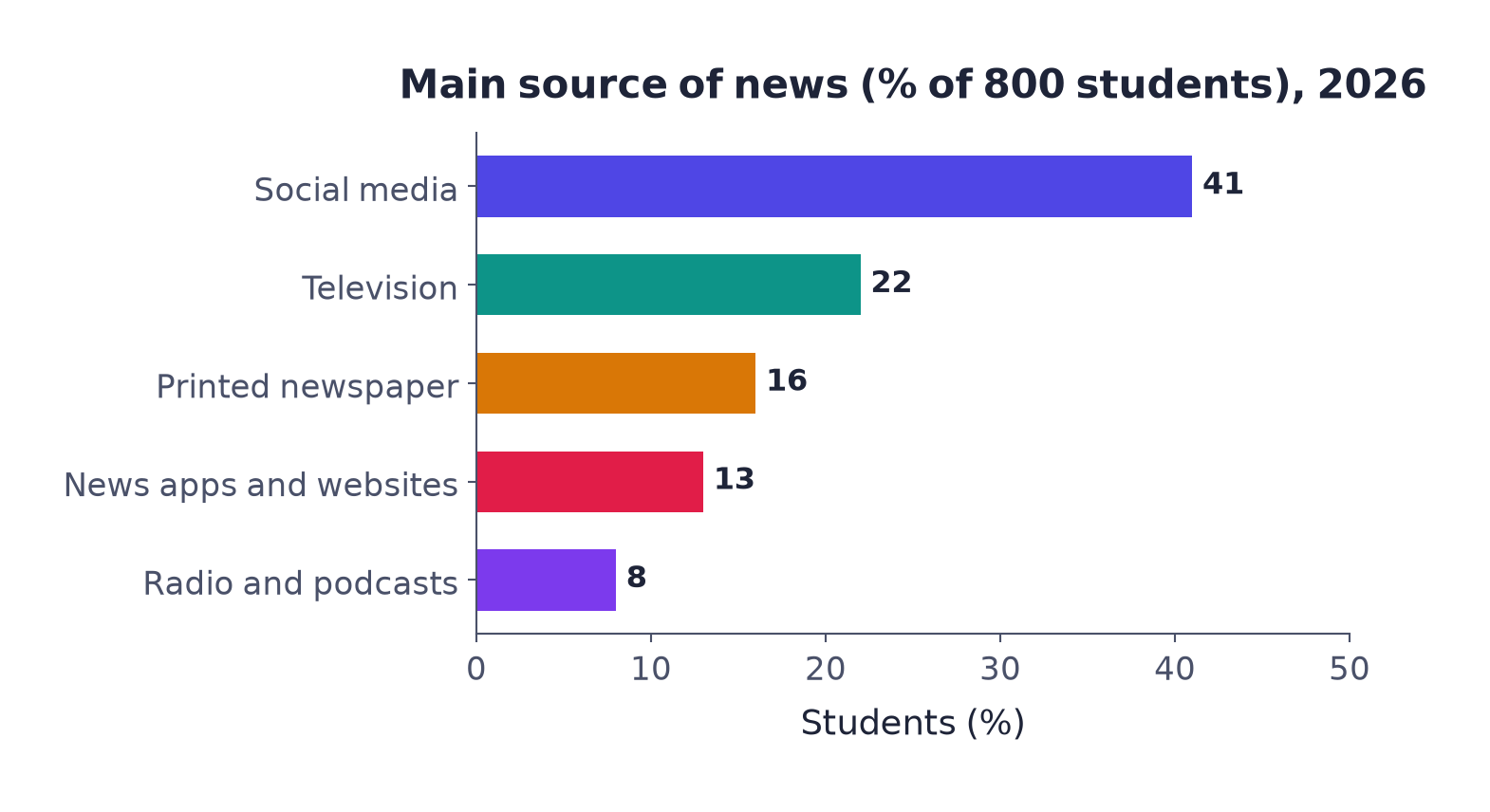
Answer the following questions, based on the passage above.
The phrase ‘the morning newspaper arrived with the milk’ in paragraph 1 suggests that newspapers were once ______. (a regular part of the daily routine / delivered late and irregularly)
Assertion: Social media is the main source of news for the largest share of the students surveyed.
Reason: Most of the students check whether a story is true before sharing it.
All of the following are stated in the passage EXCEPT ______.
Students who read a printed newspaper regularly probably did better in the quiz because ______.
Dear Mr Rao,
Thank you for your order. The books you asked for ______ to your address yesterday by courier.
Coach: “Do not leave the ground until the match is over.”
There is hardly ______ milk left in the jug, so please buy a packet on your way home.
“I have finished my project and I will submit it tomorrow.”
Report Arjun’s statement by completing the following sentence:
Arjun told his mother that ______.
The quality of the mangoes sold in these shops are excellent this season.
| Error | Correction |
|---|---|
The doctor says that although the athlete has injured her knee, she ______ run again by next month.
Everyone in the hostel were asked to switch off the lights by ten o’clock.
“Have you returned the book you borrowed last week?”
Report it correctly to complete the following sentence.
The librarian asked Meena ______.
By the time the fire brigade arrived, the neighbours ______ (put) out most of the fire.
______ of the two roads leads to the railway station, so you may take whichever is less crowded.
You ______ carry an umbrella today; the forecast says it will be sunny all day. (need not / must not)
Bread and butter ______ (be) still the most popular breakfast in many homes.
NOTE: All details in the writing tasks are imaginary and created for assessment purposes.
| Factor | School bus | Bicycle |
|---|---|---|
| Cost | ₹1,800 a month | ₹6,000 once, to buy the cycle |
| Time taken | 35 minutes (many stops) | 18 minutes |
| Exercise | None | About 40 minutes a day |
| Safety | Supervised by an attendant | Busy junction near school; no cycle lane |
| Weather | Comfortable in rain and heat | Difficult in heavy rain |
| Environment | Shared diesel bus | No fuel, no smoke |
It was only when I began to learn that my boyhood freedom was an illusion, when I discovered as a young man that my freedom had already been taken from me, that I began to hunger for it. At first, as a student, I wanted freedom only for myself, the transitory freedoms of being able to stay out at night, read what I pleased and go where I chose.
The freedoms the narrator wanted as a student are called ‘transitory’ because they ______.
Kisa Gotami became weary and hopeless, and sat down at the wayside watching the lights of the city, as they flickered up and were extinguished again. At last the darkness of the night reigned everywhere. And she considered the fate of men, that their lives flicker up and are extinguished again. And she thought to herself, “How selfish am I in my grief! Death is common to all; yet in this valley of desolation there is a path that leads him to immortality who has surrendered all selfishness.”
The people’s reply, ‘the living are few, but the dead are many’, shows that ______.
Kisa Gotami’s words, ‘How selfish am I in my grief!’, mark a moment of ______. (self-realisation / self-pity)
His strength behind bars,
Stalking the length of his cage,
Ignoring visitors.
He hears the last voice at night,
The patrolling cars,
And stares with his brilliant eyes
At the brilliant stars.
The words ‘concrete cell’ make the tiger’s cage sound like ______.
The phrase ‘Ignoring visitors’ suggests that the tiger ______.
‘His strength behind bars’ suggests that the tiger’s great power is ______ in the zoo.
Some say in ice.
From what I’ve tasted of desire
I hold with those who favour fire.
But if it had to perish twice,
I think I know enough of hate
To say that for destruction ice
Is also great
And would suffice.
The line ‘From what I’ve tasted of desire’ shows that the speaker’s view is based on ______.
By saying that ice ‘would suffice’, the poet means that ice ______.
In the poem, ‘ice’ stands for ______.
Marking Scheme / अंकन योजना (उत्तर देखें)
English Language and Literature (Code No. 184)
For examiners and students:
- For multiple-choice items both the option letter and the answer are given.
- For other items value points are given. Any other relevant answer in the candidate’s own words, supported by the passage or the text, is to be accepted.
- If a candidate attempts an extra question or alternative, the answer that earns more marks is kept and the other is scored out as ‘Extra Question’.
- For multiple-choice items, no mark is given if more than one option is written.
- Writing tasks (Q4, Q5) are marked as shown under each task; the points listed are suggestions, not a model answer to be matched word for word.
- Literature short answers (Q8, Q9): Content 2, Expression 1, deduct up to 1 for inaccuracy. Long answers (Q10, Q11): Content 3, Expression 2, Accuracy 1.
- It emphasises how cheap, quick and easy repair used to be, compared with buying a new bag today.
- (a) makers often design products in ways that discourage repair
- Paragraph 3 argues from the environment; paragraph 4 adds the benefit to the person who repairs. (1)
- Repair teaches patience and careful observation and builds confidence and pride: the feeling that one can understand and act upon the world instead of only buying and throwing away. (1)
- False (residents bring broken items and learn to fix them alongside skilled helpers).
- (a) repair manuals : fixing at home
- [Just as cheap goods lead people to buy new things, repair manuals lead people to fix things at home.]
- Attitude: balanced and practical, not extreme; the writer accepts that some things truly reach the end of their lives. (1)
- Purpose: to make readers pause and reflect before throwing things away, and to encourage a small, easy habit that helps the planet. (1)
- a regular part of the daily routine
- Students now rely far more on social media than on traditional sources such as television (also accept: they prefer quick, on-demand news on their phones).
- Social media, where rumours spread fastest, is the main news source for the largest group (41 per cent). (1)
- Yet more than two-thirds of the students rarely or never check whether a story is true before sharing it, so false news can easily reach and mislead them and be passed on. (1)
- a newspaper gives fuller, checked and organised coverage of events, so regular readers build a wider and more accurate knowledge of current affairs (any one valid reason)
- admitted
- By comparing how the same event is reported by different sources, he would learn to check a story against reliable sources before believing or sharing it.
- It captures the main finding: most students now get their news by scrolling on phones (social media), not from newspapers or television.
- The coach told/ordered/instructed the players not to leave the ground until the match was over.
- he had finished his project and (that he) would submit it the next day / the following day.
- Error: are Correction: is (the subject is ‘the quality’)
- whether/if she had returned the book she had borrowed the previous week / the week before.
- had put
- need not
- is
- Format: 14, Lake View Road, Bhopal; date; The Commissioner, Municipal Corporation, Bhopal; subject (waterlogging and blocked drains near the school); Sir/Madam; Yours faithfully; Ritika Sharma.
- Problem: blocked and broken drains; knee-deep water on the road outside the school after every shower.
- Effects: students wade through dirty water, slip and fall, reach school late or miss classes; risk of water-borne diseases, mosquitoes, damage to vehicles and homes.
- Steps requested: clear and repair the drains before the monsoon, cover open drains, regular cleaning, a complaint helpline; temporary pumps on flooded days.
- Conclusion: request for early action; thanks.
- Format: 7, Civil Lines, Kanpur; date; The Editor, name of the newspaper and address; subject (noise pollution from loudspeakers during the examination season); Sir/Madam; Yours faithfully; Aman Verma.
- Issue: loudspeakers at functions and processions playing till late night, close to the board examinations.
- Effects: students cannot concentrate or sleep; stress and poor performance; harm to the elderly, the sick and infants (headaches, high blood pressure, disturbed sleep).
- Measures: enforce the night-time ban and permitted sound levels, permissions with time limits, strict action by the police, awareness among residents and organisers.
- Appeal: request the newspaper to highlight the issue and the authorities to act at once.
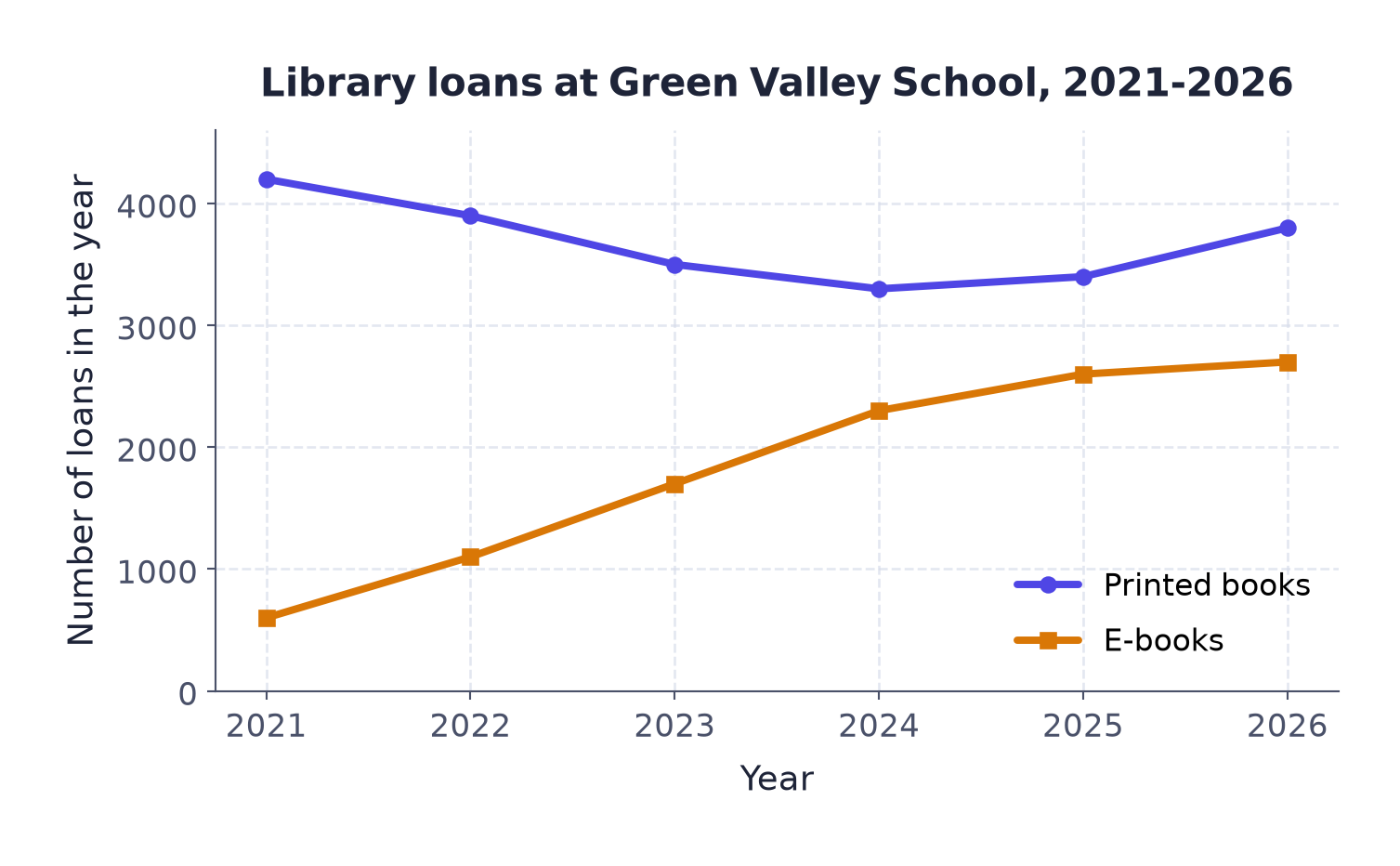
- Introduction: the graph compares yearly loans of printed books and e-books at Green Valley School, 2021-2026.
- Printed books: fell steadily from 4,200 (2021) to a low of 3,300 (2024), then recovered to 3,800 (2026).
- E-books: rose more than fourfold, from 600 to 2,700; growth was fastest up to 2024 and slowed after that (2,300 to 2,600 to 2,700).
- Analysis: total borrowing grew from 4,800 to 6,500; e-books did not simply replace printed books, since both rose after 2024. Possible reasons: easier access on devices, a digital library, renewed interest in printed books (for example, reading campaigns).
- Conclusion: reading in the school is growing, with the two formats now complementing each other.
- Introduction: Riya must weigh the school bus against a bicycle for a 4 km journey.
- Cost and time: the bus costs Rs 1,800 a month while the cycle is a one-time Rs 6,000 (recovered in under four months); the cycle saves about 17 minutes each way.
- Health and environment: cycling gives about 40 minutes of exercise daily and causes no pollution; the bus offers none of this.
- Drawbacks of cycling: the busy junction without a cycle lane and heavy rain make it less safe and less comfortable; the bus is supervised and weather-proof.
- Conclusion: a reasoned choice, for example, cycle on most days if a safe route can be found, and use the bus in the monsoon (any well-supported conclusion is acceptable).
- (a) It conveys the joy and innocence of a carefree village childhood.
- were temporary, personal pleasures (staying out at night, reading what he pleased, going where he chose) and not lasting freedoms
- As a boy he felt naturally free, as long as he obeyed his father and the customs of his tribe. (1)
- As a young man he learnt that this freedom was an illusion and began to hunger for it consciously, wanting personal freedoms as a student. (1)
- death had touched every family; loss and grief are universal
- The lights that flicker up and go out are like human lives, which begin and end. (1)
- Watching them, she sees that every life must end, that death is common to all, and that her grief has been selfish. (1)
- self-realisation
- a prison in which a criminal is locked up (a bare, lifeless place of punishment)
- wasted / caged / confined / imprisoned (any one)
- It links the tiger’s eyes with the stars: both are bright, wild and free by nature. (1)
- The tiger can only stare at the free, distant sky from his cage, so the repetition brings out his longing for freedom and creates a sad, helpless mood. (1)
- his own personal experience of desire (greed, passion)
- hatred / hate (also accept: coldness, indifference)
- The lines are brief, calm and understated, as if destruction were an ordinary matter. (1)
- This cool understatement, with the rhyme ice/twice/suffice, makes the warning about hatred more chilling and leaves a lasting, ironic final note. (1)
- For ‘Quack, Quack, Quack, Said Mistress Chatterbox’, she wrote a poem, with Sanne’s help, about a mother duck, a father swan and three ducklings bitten to death for quacking too much. (1)
- Mr Keesing took the joke the right way, read it to several classes, and let her talk without extra homework. (1)
- It shows her wit, creativity and confidence: she made sure ‘the joke was on him’. (1)
- Their descent is linked to Alexander’s Greek army, or to the Arabs; the kuppia worn by the Kodavus resembles the kuffia of the Arabs and the Kurds. (1)
- They have a martial tradition: the Coorg Regiment is one of the most decorated, and General Cariappa, the first Chief of the Indian Army, was a Coorgi. (1)
- They are the only people in India permitted to carry firearms without a licence, and are known for hospitality. (1)
- The pilot was guided safely through the storm by a black aeroplane, yet the control centre said no other plane was flying; his was the only one on the radar. (1)
- The questions ‘who helped me’ and ‘who was the pilot’ leave the mystery unsolved. (1)
- This keeps the reader thinking and allows many readings (a guardian angel, a hallucination, help from beyond), so the story stays in the mind. (1)
- He gives absurd ‘rules’ that one can apply only when it is too late: you know the Asian Lion ‘as you’re dyin” and the Bengal Tiger if he eats you. (1)
- He uses wordplay: the Bear’s crushing hug is a ‘caress’; Hyenas ‘come with merry smiles’ but Crocodiles weep. (1)
- Deliberate misspellings (‘lept’, ‘lep’) and a light rhyme turn danger into fun (any two examples with comment). (1)
- The text says that only God could love Anne for herself alone and not her yellow hair. (1)
- This suggests that human love is drawn by outer beauty, and that no young man can fully separate the person from her looks; changing the hair colour will not change this. (1)
- Love for the inner self alone is divine, and rare among human beings. (1)
- Tricki was ill only from overeating and lack of exercise, caused by Mrs Pumphrey’s over-indulgence. (1)
- Herriot kept him at his surgery for a fortnight: two days with no food but plenty of water, then ordinary meals and play with the other dogs; he had no medicinal treatment of any kind. (1)
- Yet Mrs Pumphrey sees it as a triumph of surgery; the title gently mocks her blind pampering. (1)
- He made himself invisible by swallowing rare drugs, a great scientific achievement. (1)
- But he used invisibility for lawless acts: he set fire to his landlord’s house, attacked and robbed a shopkeeper in Drury Lane and stole money from the clergyman’s desk. (1)
- His violence and bad temper turned everyone against him and made him a fugitive, feared and chased by all; misused science ruined him. (1)
- His mother was his companion; she encouraged his interest in learning and gave him books and equipment such as a telescope and a microscope. (1)
- She got him ‘The Travels of Monarch X’, which drew him to monarch butterflies and to Dr Urquhart. (1)
- Dr Urquhart had him tag monarchs and later sent him ideas for research projects, which led to his prize-winning work (any three points across both). (1)
- Faith: after the hailstorm destroys his crop, Lencho writes to God for a hundred pesos, sure that help will come.
- Kindness: the postmaster, moved by his faith, collects money from his employees, himself and his friends and sends seventy pesos, signed ‘God’, so as not to shake the writer’s faith.
- Irony: Lencho shows no surprise at the money but is angry that it is less; he calls the post-office employees ‘a bunch of crooks’, the very people who helped him.
- Message: blind faith can make a person ungrateful and suspicious of fellow human beings; true goodness often works through ordinary people, unseen and unthanked.
- Marriage as business: Lomov proposes because he is 35, ‘a critical age’, and Natalya is ‘an excellent housekeeper, not bad-looking, well-educated’; Chubukov is glad to marry off his daughter.
- Quarrel over the Oxen Meadows: worth perhaps 300 roubles, yet both claim them fiercely, forgetting the proposal.
- Quarrel over the dogs, Guess and Squeezer: petty pride over who paid more and whose dog is better.
- Satire: possessions and pride matter more than love; even after the engagement they go on quarrelling. Chekhov exposes the greed, pettiness and hypocrisy of the wealthy class through farce.
- Early life: scarred by small-pox and slow to speak, Bholi was neglected and treated as a burden at home.
- Kindness: her teacher spoke to her softly and encouraged her to say her name; she told Bholi to put the fear out of her heart, and gave her hope and self-belief.
- Education: learning gave her knowledge, words and confidence, and a way to earn her living.
- Turning point: when Bishamber, an old, lame grocer, demanded five thousand rupees as dowry, she refused to marry such a ‘mean, greedy and contemptible coward’ and chose to look after her parents and teach in the school.
- Message: education and kindness can give dignity and a voice to the neglected.
- Horace, a respected locksmith, steals one safe a year to buy rare books; he plans the Shotover Grange robbery for weeks.
- Trust misplaced: a young lady in red lets him believe she belongs to the family and talks pleasantly to him; eager to please her, he takes off his gloves and opens the safe for her jewels.
- Irony: she is a thief herself; Horace is arrested for the jewel robbery because his fingerprints were found.
- The careful thief is cheated by trusting another thief; now an assistant librarian in prison, he gets very angry when anyone talks about ‘honour among thieves’.
- Message: crime does not pay; misplaced trust and vanity lead to downfall.