
Pattern: CBSE 2026-27 official Sample Question Paper (SQP) design · Maximum marks: 80 · Time: 3 hours. Solve the paper first, then open the marking scheme at the end to check your answers.
English Language and Literature (Code No. 184)
General Instructions:
- This question paper has 11 questions. All questions are compulsory.
- This question paper contains three sections:
• Section A: Reading Skills (20 marks)
• Section B: Writing Skills and Grammar (20 marks)
• Section C: Literature Textbook (40 marks) - Attempt every question according to the instructions given with it. Where a question offers a choice, attempt only the required number of parts or alternatives. Write the correct question and part number in your answer-book.
- Keep to the word limits: 2-mark reading and extract answers 30-40 words; literature short answers (Q8, Q9) 40-50 words; letter, analytical paragraph and long answers 100-120 words.
- Note: The figures in the chart of Question 2 are also given in the text of the passage, and Question 5 (A) has a text alternative to the graph, so that Visually Impaired candidates can attempt every part.
All the names and addresses used in the questions are fictitious. Resemblance, if any, is purely coincidental.
1.Ask a child today what she did during the long summer holidays, and you are likely to hear a list: a coding course, swimming lessons, a family trip, extra tuition in mathematics. What you will rarely hear is, ‘Nothing much. I was bored.’ Boredom has become something to be avoided at all costs, a gap to be filled the moment it appears, usually with a screen.
2.Parents can hardly be blamed. A child who complains of having nothing to do seems to be asking for help, and the easiest help is a phone, a cartoon or one more activity class. Schools, too, pack every hour with lessons and events, as though an empty afternoon were a sign of failure. Yet psychologists who study the mind are beginning to suggest that this constant filling may come at a price.
3.When the mind has nothing outside to hold its attention, it begins to wander inward. It replays the day, imagines what might happen tomorrow and links ideas that once seemed unconnected. In one well-known experiment, adults who first spent fifteen minutes on a dull task, copying numbers from a telephone directory, later came up with more creative uses for a pair of plastic cups than those who had not been bored. Boredom, it seems, pushes the brain to make its own entertainment.
4.Many inventions and stories have begun in such idle moments. Writers speak of ideas arriving while they stared out of a train window; scientists recall solving problems on long, uneventful walks. A child lying on the floor on a slow afternoon may invent a game with bottle caps, build a fort from cushions or write a story about the lizard on the wall. None of this would happen if a screen were switched on the moment the child sighed.
5.Boredom also teaches a quieter lesson: that we can manage our own feelings. A child who learns to sit with a dull hour, and to find something to do with it, is practising patience and self-reliance. A child who is always rescued from boredom may grow into an adult who cannot wait in a queue without reaching for a phone, and who feels restless whenever life slows down.
6.This does not mean that children should be left with endless empty days, or that every activity class is harmful. Too much boredom can turn into loneliness or mischief, and some children need guidance to use free time well. The point is balance. Perhaps the best gift we can give the young is not one more scheduled hour, but a little unplanned time, and the trust that they will know what to do with it.
Answer the following questions, based on the passage above.
When the writer says that schools treat ‘an empty afternoon’ as ‘a sign of failure’, the writer suggests that schools ______.
The telephone-directory experiment in paragraph 3 shows that ______.
According to the writer, a child who is always rescued from boredom may later find it hard to wait patiently.
1.In January 2026, the eco-club of a large school in Pune set out to find how much food was being wasted in its canteen. For five working days, club members weighed the leftovers scraped from plates after lunch and sorted them by type.
2.In all, 182 kilograms of food was thrown away in a single week, an average of about 36 kilograms a day. Rice made up the largest share of the waste at 38 per cent, followed by chapatis at 21 per cent and vegetables at 18 per cent. Dal accounted for 15 per cent, and fruit for just 8 per cent.
3.When the club spoke to students, the most common reason given was that the serving was larger than they could eat. Many said they disliked certain vegetables, and some admitted that they hurried through lunch to get more time to play.
4.The club has suggested three changes: letting students take a smaller first helping and come back for more, offering a taste of new dishes before a full serving, and putting up a weekly ‘waste board’ that shows how many kilograms were saved. The canteen manager has agreed to try the plan for a month.
5.Leftovers that cannot be avoided will go to the school’s compost pit, which supplies manure for the kitchen garden.
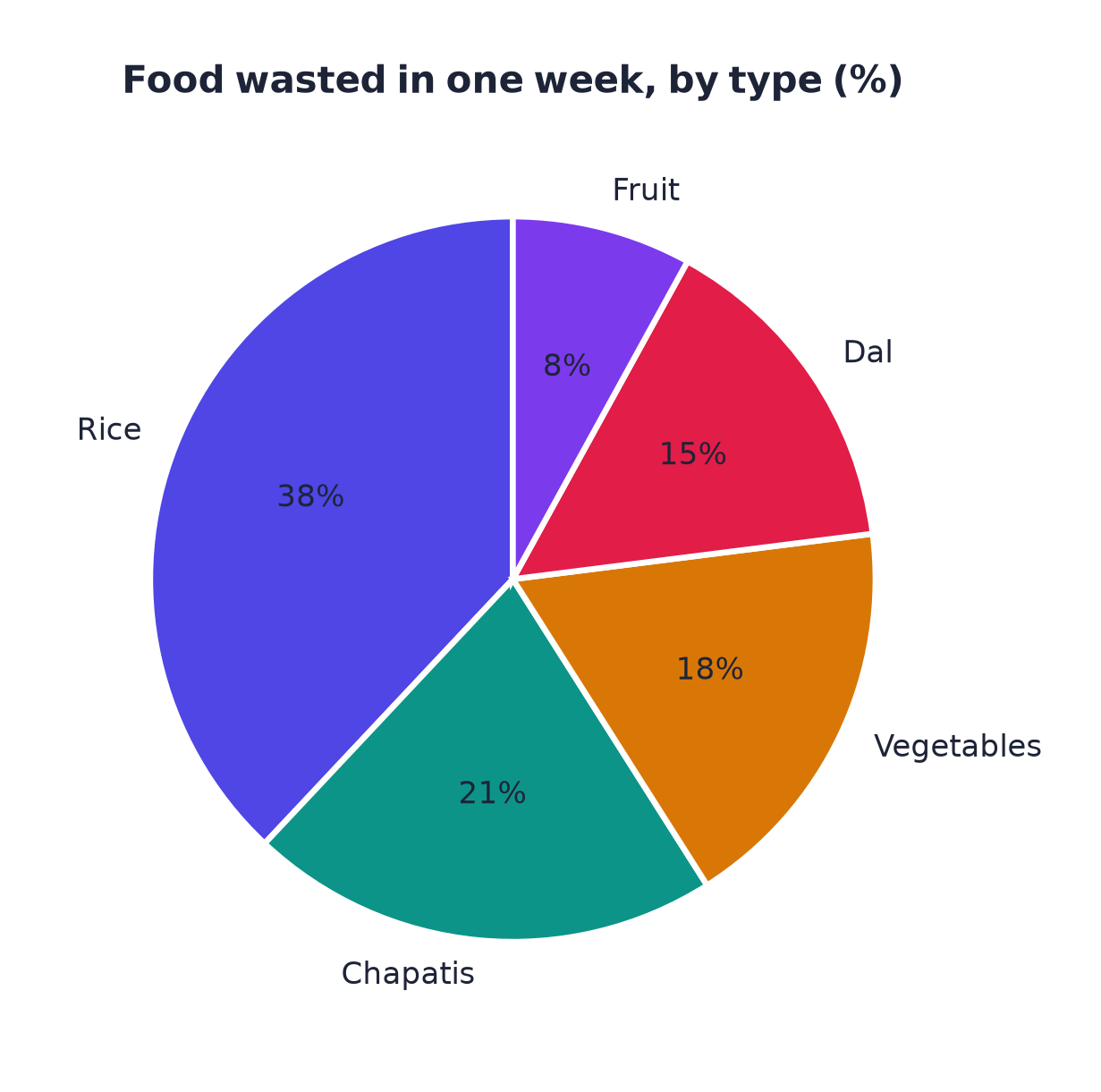
Answer the following questions, based on the passage above.
The eco-club weighed and sorted the leftovers because it wanted ______. (to measure the problem accurately / to find out which students wasted food)
Assertion: Chapatis made up the largest share of the food wasted in the canteen.
Reason: Many students said that the serving was larger than they could eat.
All of the following were reasons given by the students for leaving food EXCEPT that ______.
The weekly ‘waste board’ is likely to work because ______.
Residents are informed that at this time tomorrow our workers ______ the main pipeline, so there will be no water supply from 9 a.m. to 1 p.m.
Teacher: “Please submit your science journals by Friday.”
We still have ______ time before the bus leaves, so let us buy some water for the journey.
“I am feeling much better today and I can play the match.”
Report Nisha’s statement by completing the following sentence:
Nisha told her coach that ______.
The news about the floods in the hill districts were shown on every channel last night.
| Error | Correction |
|---|---|
“______ I take this atlas home for the weekend, ma’am?”
The number of students who come to school by bus have increased this year.
“Which size do you want, medium or large?”
Report it correctly to complete the following sentence.
The shopkeeper asked Ravi ______.
Scientists ______ (study) this glacier for over twenty years, and they say it is shrinking faster than ever.
______ student in the class has been given a sapling to plant in the school garden.
It was your mistake, so you ______ apologise to your friend at once. (should / may)
Ten kilometres ______ (be) too long a distance to walk in this heat, so we hired a cycle rickshaw.
NOTE: All details in the writing tasks are imaginary and created for assessment purposes.
- Electric scooters registered in the city: about 3,000 (2022), about 21,000 (2026)
- Running cost: about 25 paise per km, against about ₹2.50 per km for a petrol scooter
- Help from the government: purchase subsidy and lower road tax
- Public charging points: 40 (2022), 310 (2026)
- Concerns of buyers: high purchase price, cost of replacing the battery, long charging time, few charging points in the older parts of the city
I returned to my seat. I was craning my neck trying to follow the hunt when suddenly I heard from my feet a distressed chitter of recognition and welcome, and Mij bounded on to my knee and began to nuzzle my face and my neck.
The narrator found his ‘face covered in curry’ because ______.
“No,” Valli said, “I’m going back on this same bus.” She took another thirty paise from her pocket and handed the coins to the conductor.
“Why, is something the matter?”
“No, nothing’s the matter. I just felt like having a bus ride, that’s all.”
“Don’t you want to have a look at the sights, now that you’re here?”
“All by myself? Oh, I’d be much too afraid.”
Greatly amused by the girl’s way of speaking, the conductor said, “But you weren’t afraid to come in the bus.”
“Nothing to be afraid of about that,” she answered.
“Well, then, why not go to that stall over there and have something to drink? Nothing to be afraid of about that either.”
“Oh, no, I couldn’t do that.”
“Well, then, let me bring you a cold drink.”
“No, I don’t have enough money. Just give me my ticket, that’s all.”
“It’ll be my treat and not cost you anything.”
“No, no,” she said firmly, “please, no.”
Valli handed the conductor another thirty paise instead of getting off because ______.
Valli’s firm reply, ‘No, no… please, no’, shows her ______. (determination / rudeness)
An ultimate shaking grief fixes the boy
As he stands rigid, trembling, staring down
All his young days into the harbour where
His ball went. I would not intrude on him;
A dime, another ball, is worthless. Now
He senses first responsibility
In a world of possessions.
It is ‘No use to say “O there are other balls”’ because ______.
The words ‘rigid, trembling, staring’ suggest that the boy is ______.
The poet does not ‘intrude’ because he feels the boy must learn to face his loss ______.
But Mustard fled with a terrified yelp,
Ink trickled down to the bottom of the household,
And little mouse Blink strategically mouseholed.
But up jumped Custard, snorting like an engine,
Clashed his tail like irons in a dungeon,
With a clatter and a clank and a jangling squirm,
He went at the pirate like a robin at a worm.
The phrase ‘strategically mouseholed’ is humorous because ______.
The first stanza of the extract shows that the characters described as brave ______.
The simile ‘like a robin at a worm’ suggests that Custard attacked the pirate ______.
Marking Scheme / अंकन योजना (उत्तर देखें)
English Language and Literature (Code No. 184)
For examiners and students:
- For multiple-choice items both the option letter and the answer are given.
- For other items value points are given. Any other relevant answer in the candidate’s own words, supported by the passage or the text, is to be accepted.
- If a candidate attempts an extra question or alternative, the answer that earns more marks is kept and the other is scored out as ‘Extra Question’.
- For multiple-choice items, no mark is given if more than one option is written.
- Writing tasks (Q4, Q5) are marked as shown under each task; the points listed are suggestions, not a model answer to be matched word for word.
- Literature short answers (Q8, Q9): Content 2, Expression 1, deduct up to 1 for inaccuracy. Long answers (Q10, Q11): Content 3, Expression 2, Accuracy 1.
- Children’s holidays are now fully scheduled with organised activities, leaving them little or no free, unplanned time.
- (a) believe that every hour of a child’s day must be filled with planned work
- Paragraph 3 ends with the idea that boredom pushes the brain to make its own entertainment. (1)
- Paragraph 4 gives examples: writers get ideas staring out of train windows, scientists solve problems on walks, and a bored child invents games, builds forts or writes stories. (1)
- True (such a child may grow into an adult who cannot wait in a queue without reaching for a phone).
- self-reliance
- Unplanned time lets children use their imagination and learn patience and self-reliance, the benefits of boredom argued in paragraphs 3 to 5. (1)
- It also keeps the balance of paragraph 6: not endless empty days, but a little free time and trust in children, so it sums up the whole argument. (1)
- to measure the problem accurately
- Rice (38 per cent) and chapatis (21 per cent): 59 per cent together.
- A smaller first helping, with the choice to come back for more, answers the complaint that servings were larger than students could eat. (1)
- A taste of new dishes before a full serving helps students who dislike certain vegetables avoid taking food they will not eat; the waste board makes students who rush through lunch aware of the waste and motivates them to save food (any two links, 1 mark each). (1)
- students can see in kilograms how much food they have saved, which makes progress visible and motivates them (also accept: creates healthy competition and awareness)
- scraped
- The waste comes from students’ own plates: they take more than they can eat, leave vegetables they dislike or rush through lunch, so students too must change their habits.
- Unavoidable leftovers will be turned into compost in the school’s pit, and the manure will be used in the kitchen garden.
- The teacher requested/asked the students to submit their science journals by Friday.
- she was feeling much better that day and (that she) could play the match.
- Error: were Correction: was (‘news’ is singular)
- which size he wanted, medium or large.
- have been studying
- should
- is
- Format: 22, Gandhi Nagar, Coimbatore; date; The Director, Clay Corner Art Studio, Race Course Road, Coimbatore; subject (enquiry about the summer pottery course); Sir/Madam; Yours faithfully; Kavya Iyer.
- Opening: reference to the advertisement, the newspaper and the date; interest in joining the course.
- Details sought: days and timings of the classes; fee and mode of payment; whether clay, tools and aprons are provided; number of learners in a batch; qualifications of the trainers.
- Further queries: certificate at the end, a final exhibition, last date and procedure for registration.
- Conclusion: request for an early reply or a brochure; thanks.
- Format: 9, Model Town, Ludhiana; date; The Customer Care Manager, Pure Drop Appliances, Ferozepur Road, Ludhiana; subject (complaint about a defective water purifier); Sir/Madam; Yours faithfully; Harsh Malhotra.
- Purchase details: date of purchase, model, bill or invoice number, warranty (copies enclosed).
- Defects: water leaks from the base and wets the kitchen floor; purified water tastes salty; no technician visited despite two complaints (complaint numbers).
- Effects: no safe drinking water at home; family forced to buy bottled water; inconvenience and extra cost.
- Demand: prompt repair by a technician or replacement within a week, under warranty; otherwise further action (consumer forum). Expectation of an early response.
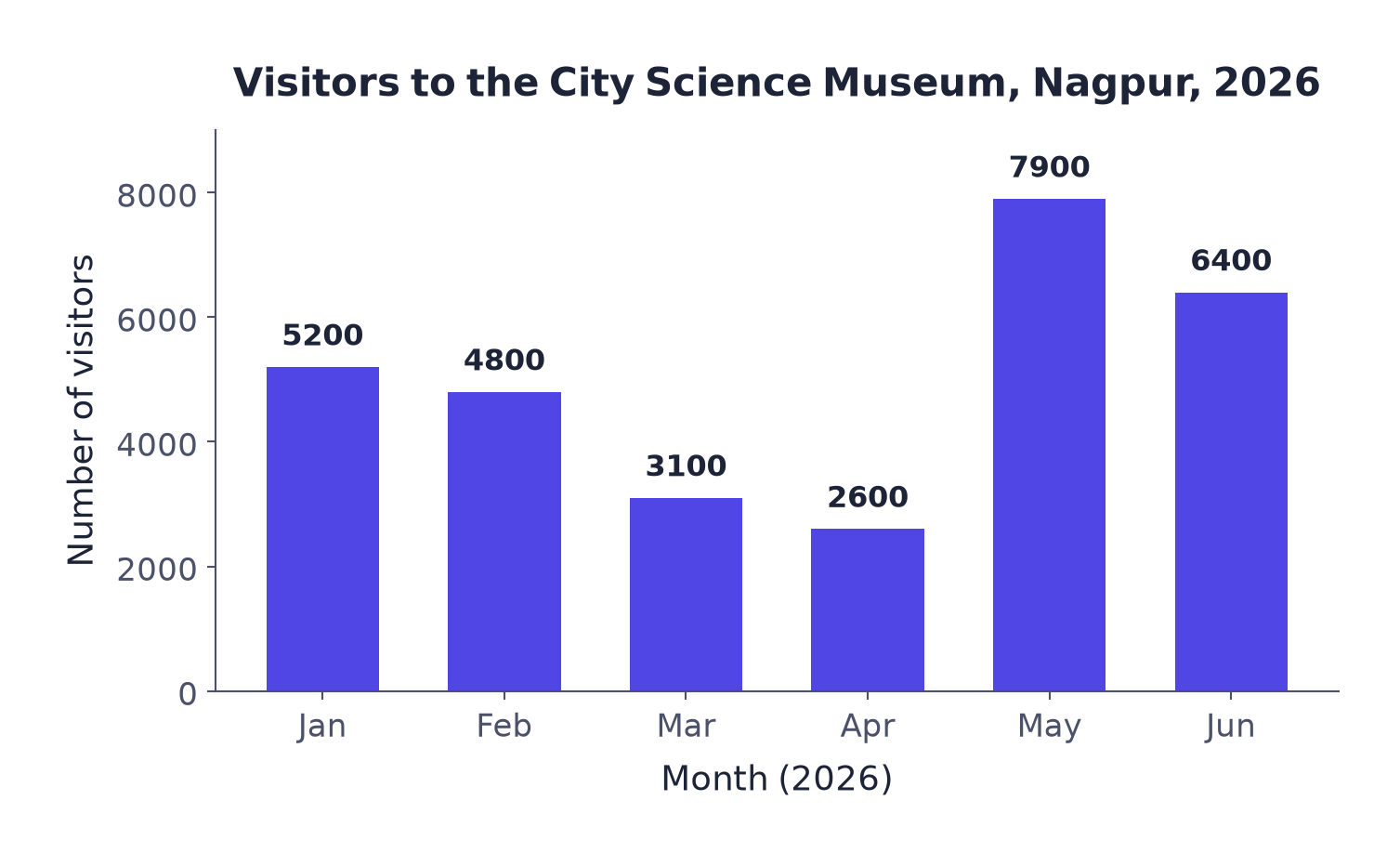
- Introduction: the graph shows monthly visitors to the City Science Museum, Nagpur, from January to June 2026.
- Decline: visitors fell from 5,200 in January to 4,800 in February and then sharply to a low of 2,600 in April, about half the January figure.
- Peak: numbers rose steeply to the highest figure, 7,900, in May (about three times April’s) and stayed high at 6,400 in June.
- Analysis and reasons: the March-April dip matches the examination season, when students and families stay at home; the May-June rise matches summer vacations, school trips and families looking for indoor outings in the heat (any sensible reasons).
- Conclusion: visits depend closely on the school calendar; the museum could plan special events during the quieter months.
- Introduction: electric scooters have spread rapidly in Indore between 2022 and 2026.
- Growth: registrations rose about sevenfold, from about 3,000 to about 21,000; charging points grew from 40 to 310, almost eight times.
- Reasons: very low running cost (about 25 paise per km against about Rs 2.50 for petrol, roughly a tenth); purchase subsidy and lower road tax; more charging points make owning one practical.
- Challenges: high purchase price, costly battery replacement, long charging time and uneven spread of charging points, especially in the older parts of the city.
- Conclusion: a reasoned view, for example, the trend is likely to continue if prices fall and charging points reach every area (any well-supported conclusion).
- (a) A rare, tame otter is mistaken for a common rat, and a whole aircraft is thrown into panic.
- he dived for Mij’s tail under a passenger’s legs, missed it, and landed in the passenger’s food
- Mij was frightened and upset (‘distressed’) by the noise and the chase in the strange aircraft. (1)
- Yet he recognised and sought out his master, bounding on to his knee and nuzzling his face: he trusted the narrator and felt safe and loved with him. (1)
- she had come only for the bus ride itself and wanted to go back home on the same bus
- She is cautious and sensible: she will not wander alone in a strange town, where she knows no one. (1)
- She is self-respecting and independent: she will not accept a treat from a stranger or be obliged to anyone, and pays her own way. (1)
- determination
- the boy’s grief is not about the price of the ball; the lost ball held his memories and cannot be replaced by another
- alone / himself / independently (any one)
- He begins to understand that possessions can be lost and that money cannot buy back what is lost. (1)
- His responsibility is to accept the loss and learn to bear it with courage: a first step towards growing up. (1)
- it makes Blink’s cowardly hiding in a mousehole sound like a clever military plan (a made-up verb)
- eagerly / easily / swiftly / fearlessly (any one)
- The onomatopoeia and alliteration fill the stanza with noise and energy, like a mock-heroic battle. (1)
- They mark the sudden change in Custard from coward to hero, in contrast with the frightened cries and flight of the others, and add to the humour of the ballad. (1)
- Left alone and starving on the ledge, he saw his mother bring a piece of fish close to him and stop just out of reach. (1)
- Maddened by hunger, he dived at the fish with a scream, fell outwards and downwards, and then his wings spread and he flew. (1)
- Fear is overcome by acting, often when need or a loving push leaves no choice; confidence follows the first attempt. (1)
- One obligation is to his family: his parents, wife and children. (1)
- The other is to his people, his community and his country. (1)
- Under apartheid, a man of colour who attempted to live as a human being was punished and isolated, and a man who tried to fulfil his duty to his people was inevitably ripped from his family, as Mandela was. (1)
- The crow is often seen as a bad omen and the hemlock is a poisonous tree; both suggest sorrow. (1)
- Yet the crow shook down a dust of snow from the hemlock on the poet, and this small act changed his mood and saved some part of a day he had rued. (1)
- The choice shows that joy can come even from ordinary or unlikely sources in nature. (1)
- The adult keeps giving orders and scolding her about manners, homework, her room, shoes and chocolate. (1)
- In her daydreams she is a mermaid in a languid sea, an orphan roaming freely, Rapunzel in a tranquil tower: all images of freedom and peace. (1)
- She feels nagged and controlled, longs for freedom, and escapes into her imagination; she is sulking, not listening. (1)
- The trees are kept inside the house, so the forest has no trees: no bird can sit, no insect hide, no sun bury its feet in shadow. (1)
- All night the roots, leaves, twigs and boughs struggle to break free and move out into the forest. (1)
- The poet suggests that nature, confined by human beings, longs to be free and will reclaim its place (also accept: a reading about the freedom of women). (1)
- Anil gave Hari a key and let him come and go as he pleased; he was careless about money. (1)
- Hari felt it is easy to rob a greedy man but hard to rob a careless one, who may not even notice; it takes the pleasure out of the work. (1)
- Anil taught him to write his name and promised to teach whole sentences and to add numbers: an education and the chance of an honest, respectable life. (1)
- Ausable is very fat, wheezes and speaks with an American accent; there is no romance or mystery about him. (1)
- Fowler had expected a dashing secret agent, with mysterious messages and beautiful spies. (1)
- Yet Ausable outwits the armed Max through quick thinking and calm, inventing the story of the balcony; appearances can be deceptive. (1)
- He does not blame her directly; he says Tricki must be hospitalised for about a fortnight to be kept under observation. (1)
- At the surgery he gives Tricki no food for two days and then plain meals and play with the other dogs, while he and his partners enjoy the eggs, wine and brandy she sends. (1)
- He returns a healthy Tricki and lets her call it ‘a triumph of surgery’, sparing her feelings. (1)
- Tradition: the Portuguese may have gone, but the makers of their loaves remain; the thud and jingle of the baker’s bamboo can still be heard in some places.
- Childhood joy: the jingling thud woke the children, who ran to meet him and chose the bread-bangles.
- Festivals and occasions: marriage gifts are meaningless without the sweet bread bol; cakes and bolinhas are a must for Christmas and other festivals; the lady of the house prepares sandwiches for her daughter’s engagement.
- His distinct identity: the long frock called the kabai, later a shirt and knee-length trousers; monthly accounts recorded in pencil on a wall; a plump, prosperous look.
- Conclusion: the baker was a friend, companion and guide, a living link with Goa’s culture and history.
- Need: though she had loving parents, a sister, about thirty friends and a good home, she had no true friend to whom she could open her heart; she felt alone.
- The diary as a friend: she named it ‘Kitty’ and decided to confide in it the things she could not tell anyone; she believed no one would ever read it.
- What it reveals: she was thoughtful, sensitive and mature for a thirteen-year-old, honest about her feelings and a keen observer of people.
- She also had humour and confidence, as seen in her account of her family and of her teachers at school.
- Conclusion: writing gave her comfort and a voice; paper ‘listened’ when people did not.
- Before: married to a clerk, she was unhappy and dreamt of a life of luxury; she borrowed a diamond necklace from Madame Forestier for the ball.
- The loss: the replacement cost thirty-six thousand francs; Loisel used the eighteen thousand his father had left him and borrowed the rest.
- Hardship: they dismissed the servant, moved to rooms in an attic; she did the heavy housework, washed clothes and bargained at the shops; for ten years they worked to pay every debt.
- Change: she became ‘the crude woman of the poor household’, strong and hard, old in looks, but showed courage, honesty and endurance, playing her part ‘heroically’.
- Final irony: the lost necklace was false, worth not more than five hundred francs; she grew in strength, but at a terrible, needless cost.
- Tact: Noodle always flatters Think-Tank (‘your Brilliance’, ‘your Cleverness’) and offers each correction as an ‘insignificant bit of data’ or a ‘cloudy piece of information’.
- Humour: when Noodle points out that the Earthlings did not eat the ‘sandwiches’ but used them as a communication device, Think-Tank at once claims the idea as his own: ‘Think-Tank is never wrong.’ Later, when Noodle recalls that Earthlings opened and watched them, Think-Tank ‘clarifies’ that they are for eye communication.
- Contrast: the boastful leader makes absurd mistakes about books and nursery rhymes, while the quiet apprentice is sensible and humble.
- Ending: Think-Tank flees in panic from ‘Humpty Dumpty’; the Historian says that by the twenty-fifth century the wise and wonderful Noodle had replaced him.
- Message: true wisdom is modest; arrogance makes even the powerful foolish.