
Pattern: CBSE 2026-27 official Sample Question Paper (SQP) design · Maximum marks: 80 · Time: 3 hours. Solve the paper first, then open the marking scheme at the end to check your answers.
English Language and Literature (Code No. 184)
General Instructions:
- This question paper has 11 questions. All questions are compulsory.
- This question paper contains three sections:
• Section A: Reading Skills (20 marks)
• Section B: Writing Skills and Grammar (20 marks)
• Section C: Literature Textbook (40 marks) - Attempt every question according to the instructions given with it. Where a question offers a choice, attempt only the required number of parts or alternatives. Write the correct question and part number in your answer-book.
- Keep to the word limits: 2-mark reading and extract answers 30-40 words; literature short answers (Q8, Q9) 40-50 words; letter, analytical paragraph and long answers 100-120 words.
- Note: The figures in the chart of Question 2 are also given in the text of the passage, and Question 5 (A) has a text alternative to the graph, so that Visually Impaired candidates can attempt every part.
All the names and addresses used in the questions are fictitious. Resemblance, if any, is purely coincidental.
1.In many classrooms today, the scratch of pens is giving way to the soft tapping of keys. Notes are typed on laptops, homework is submitted online and even greeting cards arrive as messages on a phone. It is easy to conclude that handwriting, like the typewriter, belongs to the past. Yet a growing body of research suggests that we may be giving up something valuable without noticing.
2.Consider what happens when a student takes notes. A fast typist can record a lecture almost word for word, without thinking much about what is being said. Someone writing by hand cannot keep up, and so must choose: which points matter, how they connect, how they can be put in fewer words. In studies comparing the two groups, students who wrote by hand often remembered ideas better and answered questions about concepts more successfully, even though they had written less.
3.The reason seems to lie in the effort itself. Forming each letter requires the hand and the brain to work together, and this slower, more deliberate process leaves a deeper trace in memory. Scans of children’s brains show that areas linked with reading and learning become more active when they write letters by hand than when they simply press them on a keyboard. For young learners, the pencil may be a tool for thinking as much as for writing.
4.Handwriting also carries something personal that print cannot. A letter from a grandparent, with its familiar loops and slants, says more than its words; the shaky signature of an old friend tells its own story. Many families keep handwritten diaries or recipe books for decades, while emails from the same years lie forgotten in crowded inboxes.
5.None of this means that typing is the enemy. Keyboards are faster, neater and easier to edit, and for long reports, or for students who find writing physically difficult, they are a blessing. A world without digital tools is neither possible nor desirable, and no one is asking schools to throw away their computers.
6.The wiser path is to keep both skills alive. Schools might ask students to draft ideas and take class notes by hand, and to type their final pieces of work. In this way the pen can do what it does best, slowing us down enough to think, while the keyboard does the rest. A child who can do both will be better prepared than one who can do only one of them.
Answer the following questions, based on the passage above.
When the writer says that a fast typist records a lecture ‘without thinking much about what is being said’, the writer means that typing notes ______.
According to paragraph 3, writing by hand helps learning mainly because ______.
Brain scans show that areas linked with reading become more active when children press letters on a keyboard than when they write them by hand.
1.Every February, volunteers gather at Neel Sarovar, a wetland on the edge of Jabalpur, for the annual bird count. In 2026, 64 volunteers, most of them school students, walked fixed routes around the lake on the same weekend as in earlier years and recorded every bird they saw or heard.
2.The results were worrying. The volunteers counted 4,120 birds of 58 species, against 5,300 birds of 66 species in 2021. The total has fallen every year: 5,300 in 2021, 5,050 in 2022, 4,800 in 2023, 4,610 in 2024, 4,350 in 2025 and 4,120 in 2026. The flocks of ducks that once covered the open water are dwindling.
3.The volunteers have noted three likely causes. Water hyacinth now covers almost half the lake’s surface, leaving little open water for diving birds. Wastewater from new housing colonies flows into the lake untreated, and a road built along the eastern bank in 2022 has brought traffic and noise to the water’s edge.
4.There is some good news. Bar-headed geese, winter visitors that fly in from Central Asia, still arrive in large numbers, and purple herons have increased on the northern side, where the reed beds were fenced off in 2023.
5.The municipal corporation has promised to clear the hyacinth and to treat the wastewater before it enters the lake. The volunteers will put up signboards asking visitors not to feed or chase the birds. The next count, in February 2027, will show whether these steps are working.
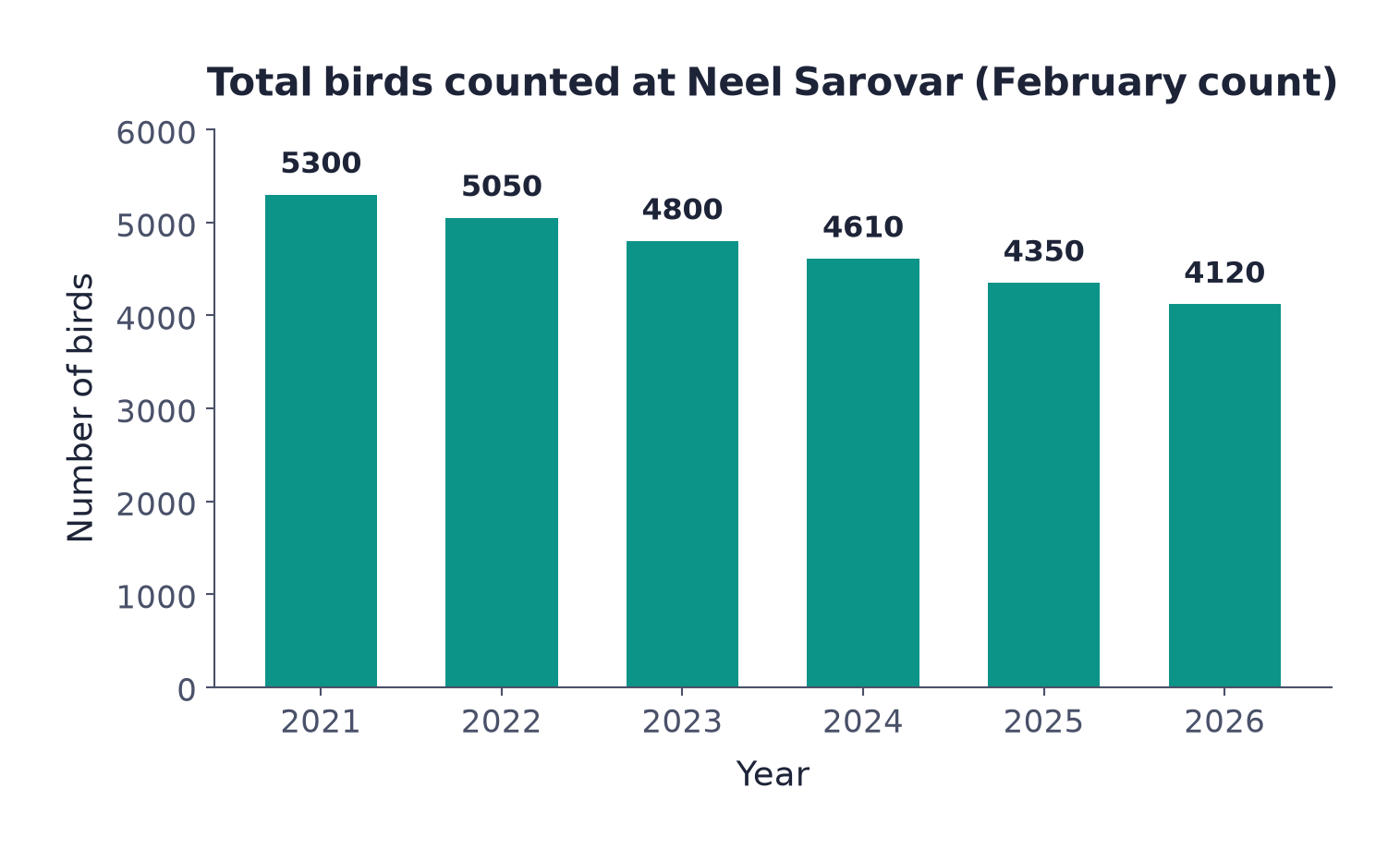
Answer the following questions, based on the passage above.
The volunteers walked fixed routes on the same weekend every year so that ______. (the results of different years could be compared fairly / the students would not miss their classes)
Assertion: The total number of birds counted at Neel Sarovar has fallen every year since 2021.
Reason: No winter visitors came to the lake in 2026.
All of the following are given as likely causes of the fall in bird numbers EXCEPT ______.
The volunteers’ plan to put up signboards suggests that ______.
We ______ along the beach at sunset when we suddenly spotted a group of dolphins close to the shore.
Doctor: “Take this medicine twice a day after meals.”
Meera did not have ______ money left after buying the gifts, so she walked home from the market.
“I visited this temple when I was a little girl.”
Report Grandmother’s statement by completing the following sentence:
Grandmother told Anu that ______.
One of the players in our school team have been selected for the state coaching camp.
| Error | Correction |
|---|---|
Visitors ______ not touch the paintings, as they are very old and delicate.
Neither the principal nor the teachers was present at the meeting yesterday.
“Do you have an appointment with the dentist?”
Report it correctly to complete the following sentence.
The receptionist asked the visitor ______.
At sea level, pure water ______ (boil) at 100 degrees Celsius.
We need ______ more chairs for the guests; five or six will be enough.
Take your raincoat with you; the sky is cloudy and it ______ rain this evening. (might / must)
The scissors you were looking for ______ (be) on the top shelf of the cupboard.
NOTE: All details in the writing tasks are imaginary and created for assessment purposes.
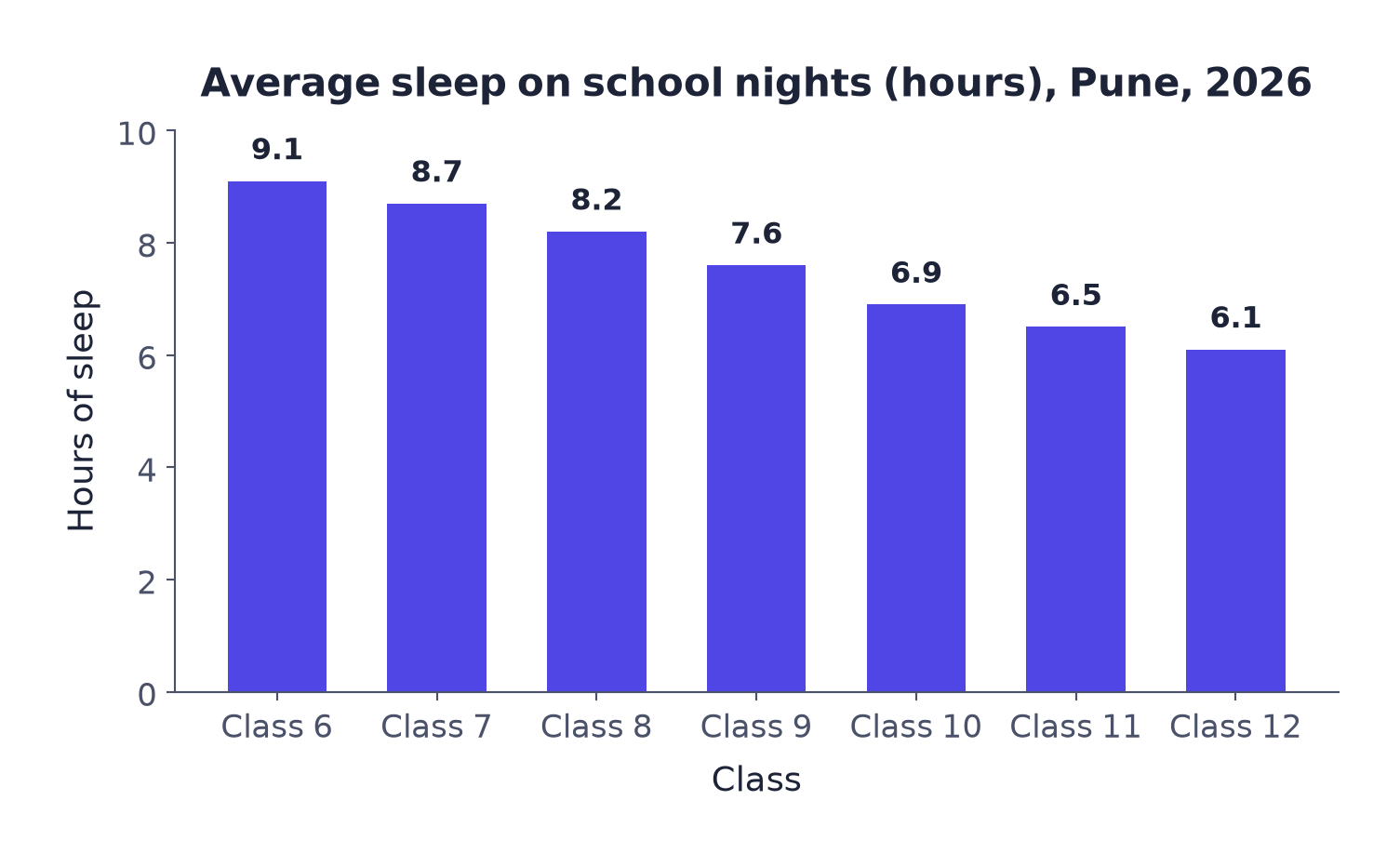
- Cost: a tablet costs about ₹12,000 and lasts about 3 years; printed books cost about ₹4,500 per student every year
- Benefits: lighter school bags (about 6.5 kg now, about 2 kg with a tablet); videos, quizzes and up-to-date lessons
- Concerns: eye strain and less outdoor time; distraction by games; need for charging points and Wi-Fi; repair costs; some homes have no internet
- Survey: 58% of teachers and 41% of parents in favour
Already the competitive spirit that drives Richard Ebright was appearing. “I knew that for the next year’s fair I would have to do a real experiment,” he said. “The subject I knew most about was the insect work I’d been doing in the past several years.”
So he wrote to Dr Urquhart for ideas, and back came a stack of suggestions for experiments. Those kept Ebright busy all through high school and led to prize projects in county and international science fairs.
Ebright chose insect work for his next experiment because ______.
My hand slid under the mattress, searching for the notes. When I found them, I drew them out without a sound. Anil sighed in his sleep and turned on his side, towards me. I was startled and quickly crawled out of the room.
When I was on the road, I began to run. I had the notes at my waist, held there by the string of my pyjamas. I slowed down to a walk and counted the notes: 600 rupees in fifties! I could live like an oil-rich Arab for a week or two.
By saying that the moonlight ‘stepped over the balcony’, the writer makes it seem ______.
The words ‘I could live like an oil-rich Arab’ show Hari’s ______. (exaggerated idea of wealth / careful plan to save money)
A novice might nonplus,
The Crocodile you always may
Tell from the Hyena thus:
Hyenas come with merry smiles;
But if they weep they’re Crocodiles.
The true Chameleon is small,
A lizard sort of thing;
He hasn’t any ears at all,
And not a single wing.
If there is nothing on the tree,
’Tis the chameleon you see.
The poet writes ‘A novice might nonplus’ instead of the usual form ‘might be nonplussed’ because ______.
The lines ‘If there is nothing on the tree, / ’Tis the chameleon you see’ are funny because ______.
By describing the chameleon through what it does not have (‘any ears’, ‘a single wing’), the poet gives the stanza a ______ tone.
writing long letters
in which I scarcely mention the departure
of the forest from the house.
The night is fresh, the whole moon shines
in a sky still open
the smell of leaves and lichen
still reaches like a voice into the rooms.
My head is full of whispers
which tomorrow will be silent.
The speaker ‘scarcely’ mentions the departure of the forest in her letters, perhaps because ______.
The simile ‘the smell of leaves and lichen / still reaches like a voice into the rooms’ suggests that ______.
The ‘whispers’ in the speaker’s head will be silent tomorrow because by then the trees will have ______.
Marking Scheme / अंकन योजना (उत्तर देखें)
English Language and Literature (Code No. 184)
For examiners and students:
- For multiple-choice items both the option letter and the answer are given.
- For other items value points are given. Any other relevant answer in the candidate’s own words, supported by the passage or the text, is to be accepted.
- If a candidate attempts an extra question or alternative, the answer that earns more marks is kept and the other is scored out as ‘Extra Question’.
- For multiple-choice items, no mark is given if more than one option is written.
- Writing tasks (Q4, Q5) are marked as shown under each task; the points listed are suggestions, not a model answer to be matched word for word.
- Literature short answers (Q8, Q9): Content 2, Expression 1, deduct up to 1 for inaccuracy. Long answers (Q10, Q11): Content 3, Expression 2, Accuracy 1.
- Writing by hand is steadily being replaced by typing on digital devices in schools.
- (a) can turn into mechanical copying instead of understanding
- A typist copies the lecture almost word for word without thinking about it. (1)
- A hand-writer cannot keep up, so must select, connect and summarise the ideas; this active processing helps them remember ideas and answer questions on concepts better. (1)
- False (the areas become more active when children write letters by hand).
- deliberate
- Handwriting is used for the stages where thinking and memory matter (notes, drafts). (1)
- Typing is used for final work, where its speed, neatness and ease of editing (paragraph 5) help; so the suggestion combines the strengths of both skills. (1)
- the results of different years could be compared fairly
- By 1,180 birds (from 5,300 to 4,120).
- The herons increased on the northern side, where the reed beds were fenced off in 2023, so protecting the habitat has worked. (1)
- This suggests that if the other causes (hyacinth, wastewater, disturbance) are also dealt with, bird numbers across the lake can recover. (1)
- visitors who feed or chase the birds also disturb them, and making people aware can reduce this harm
- dwindling
- Some kinds of birds have stopped coming to the lake altogether, so the wetland is losing its variety of bird life (biodiversity), not just numbers.
- It will show whether clearing the hyacinth, treating the wastewater and the signboards have helped the birds return.
- The doctor advised/told the patient to take that medicine twice a day after meals.
- she had visited that temple when she was a little girl.
- Error: have Correction: has (the subject is ‘One’)
- if/whether he/she had an appointment with the dentist.
- boils
- might
- are
- Format: 31, Sector 15, Chandigarh; date; The Editor, The Morning Mirror, Chandigarh; subject (noise pollution from loudspeakers late at night); Sir/Madam; Yours faithfully/truly; Simran Kaur.
- Opening: request to publish the letter in the newspaper; the problem stated (loudspeakers and music systems at full volume till past midnight).
- Effects: students preparing for the board examinations cannot study or sleep; the elderly, patients and small children are disturbed; headaches, stress, loss of sleep.
- Suggestions: police to enforce the time limit; permission for functions only with sound limits; helpline for complaints; residents’ welfare associations to create awareness. Hope for prompt action.
- Format: Green Valley Public School, Siliguri; date; The Sales Manager, Champion Sports, Hill Cart Road, Siliguri; subject (order for sports equipment); Sir/Madam; Yours faithfully; Rahul Bose, Sports Secretary.
- Order: a clear list of items with quantities and brand or size, for example footballs (10), cricket bats (6), badminton rackets (12 pairs), shuttlecocks (10 boxes), skipping ropes (20).
- Terms: discount for schools; mode of payment; delivery at the school by a given date; goods to be checked on arrival.
- Conditions: damaged or defective items to be replaced free of cost; request for the bill and an early confirmation of the order.
- Trend: sleep falls steadily with every class, from 9.1 hours in Class 6 to 6.1 hours in Class 12, a drop of 3 hours.
- Comparison with the norm: Classes 6 to 8 get the recommended 8-10 hours; from Class 9 onwards students sleep less than 8 hours, and Class 12 is about 2 hours short.
- Analysis and reasons: heavier syllabus, board examinations, coaching classes and homework; late-night screen use; early school timings (any sensible reasons).
- Conclusion: older students are short of sleep at the very age when they need it for study and health; schools and parents should plan time-tables and screen limits.
- Cost: about Rs 12,000 for a tablet lasting about 3 years (about Rs 4,000 a year) against about Rs 4,500 a year for printed books, so the running cost is slightly lower, though the initial cost is high.
- Benefits: school bags lighter by about 4.5 kg; videos, quizzes and updated lessons make learning lively.
- Concerns: health (eye strain, less outdoor time), distraction, infrastructure (charging, Wi-Fi), repairs and the digital divide for homes without internet; parents (41%) are less convinced than teachers (58%).
- Conclusion: a reasoned view, for example, a pilot in one class with screen-time limits and support for families without internet before a full change (any well-supported conclusion).
- (a) He saw that science means doing real experiments, not just making a neat display.
- it was the subject he knew most about, after several years of work with butterflies
- He did not lose heart: he thought about why he lost and learnt that real experiments matter. (1)
- He sought expert help (wrote to Dr Urquhart) and worked steadily on the suggestions through high school: curiosity, determination and a will to learn, which led to prize projects. (1)
- to move quietly like a person or a thief, which adds to the hushed, tense mood of the night (personification)
- He is a practised thief: he moves silently, knows where the money is and draws out the notes without a sound. (1)
- Yet he is nervous: he is startled when Anil sighs and turns towards him, and crawls out quickly, a hint of unease about robbing a man who trusts him. (1)
- exaggerated idea of wealth
- the shorter form keeps the rhyme with ‘thus’ and the regular rhythm (poetic licence)
- humorous / playful / light-hearted (any one)
- A real guide gives clear, safe signs; here the ‘rules’ are absurd and useless, depending on a creature’s behaviour at the worst moment or on seeing nothing at all. (1)
- The confident tone (‘you always may’, ‘The true Chameleon’) and the neat rhymes mock serious nature guides, so the advice becomes comic nonsense. (1)
- the event is so strange and unexpected that she cannot or does not want to speak about it (also accept: she is absorbed in her own life and unaware of its importance)
- left / gone / departed (any one)
- The speaker sits peacefully writing, doors open, on a fresh moonlit night, while the trees struggle all night to break free of the house. (1)
- The contrast suggests that people are often unaware of, or silent about, nature’s struggle to be free (also accept: the speaker’s own quiet longing for freedom). (1)
- He first laughed at the letter, then was moved by Lencho’s faith (‘I wish I had the faith of the man who wrote this letter’). (1)
- So as not to shake the writer’s faith in God, he collected money from his employees, gave part of his own salary and asked friends to help, and signed the reply ‘God’. (1)
- He was kind, generous and humble: he helped a stranger and took no credit for it. (1)
- She listened to conversations about the town and asked careful questions to learn the fare (thirty paise each way) and the time the journey took (forty-five minutes). (1)
- She saved every stray coin, resisting peppermints, toys and balloons, until she had sixty paise, and planned to go and return while her mother had her afternoon nap. (1)
- She is determined, patient, self-reliant and a good planner. (1)
- Shielded from suffering, at about twenty-five, while out hunting, he came upon a sick man, an aged man, a funeral procession and a monk begging for alms. (1)
- These sights moved him to go out into the world to seek enlightenment; he wandered for seven years. (1)
- He sat under a peepal tree, vowing to stay until enlightenment came; enlightened after seven days, he renamed it the Bodhi Tree and became known as the Buddha, the Awakened. (1)
- When Lomov arrives in evening dress, Chubukov suspects he has come to borrow money and decides not to give him any. (1)
- On hearing of the proposal he embraces and kisses him, as the match suits his interests; but in the quarrel over the Meadows and the dogs he calls him a ‘pettifogger’ and an ‘intriguer’. (1)
- He is selfish, hot-tempered and fickle; his warmth depends on what he stands to gain (a comment on materialism). (1)
- He should be lurking in shadow, sliding through long grass near the water hole where plump deer pass. (1)
- He should be snarling around houses at the jungle’s edge, baring his fangs and claws, terrorising the village. (1)
- This free, powerful life makes his zoo life, a few steps of a cage and ‘quiet rage’, seem even more cruel and unnatural. (1)
- Bishamber was well-to-do (a big shop, a house of his own, money in the bank) and was not asking for any dowry. (1)
- He was from another village and did not know about her pock-marks and ‘lack of sense’; her mother feared she might otherwise remain unmarried all her life. (1)
- Bholi was seen as a burden to be married off; her parents never asked her wishes and her mother called her ‘a dumb cow’. (1)
- He gave her the four hundred francs he had saved to buy a gun, so that she could buy a dress for the ball. (1)
- After the loss, he searched the streets, went to the police and the cab offices, used the eighteen thousand francs his father had left him, borrowed the rest, and worked evenings and nights copying at five sous a page. (1)
- He was loving, self-sacrificing, patient and honest. (1)
- She looks back on the twentieth century as the ‘Era of the Book’, when there were books about everything, and so sets the scene and time. (1)
- She raises curiosity by asking whether the audience has heard of the Martian invasion of 2040, which never happened because a single book stopped it. (1)
- Looking back from the future adds humour and suspense: we know the Earth is saved but not how, which leads into the flashback. (1)
- The decision: flying his old Dakota from France to England, he met huge storm clouds ‘like black mountains’; he could not fly over them and did not have enough fuel to fly around them.
- Not wise: he knew he ought to go back to Paris but wanted to get home to his family and his ‘big English breakfast’; personal comfort outweighed safety.
- Results: inside the storm everything went black; the compass, the other instruments and the radio went dead; he was lost, with fuel for only five or ten minutes more.
- Rescue: a black aeroplane without lights appeared; its pilot waved ‘Follow me’; he followed ‘like an obedient child’ and came out of the clouds over a runway.
- Conclusion: the woman in the control centre said no other aeroplane was flying; he was saved by a mystery, not by his own judgement, so the story warns against rash risks (any reasoned view).
- The young man’s view: no young man, ‘thrown into despair’ by her ‘honey-coloured ramparts’, will love her for herself alone and not her yellow hair.
- Anne’s reply: she can dye her hair brown, black or carrot so that young men will love her for herself; she wants to be valued for her inner self.
- The answer: an old religious man found a text to prove that only God could love her for herself alone; human love is drawn by outward beauty, so dyeing the hair would only shift the attraction.
- Today: advertisements, social media and beauty products still judge people by appearance; true worth lies in character, kindness and talent.
- Conclusion: a reasoned view, for example, Anne’s wish is noble but her plan is naive; lasting love must go beyond looks (accept a well-argued different view).
- Mrs Hall’s furniture: the clothes and bandages lie about the empty room; a sniff close to her ear, then the bedroom chair springs into the air and pushes her and her husband out; she thinks the room is haunted by spirits (‘My poor mother used to sit in that chair’).
- The clergyman’s study: woken by noises, the clergyman and his wife hear money being taken from the desk but find no one; ‘Extraordinary affair!’
- The arrest: Griffin throws off his bandages, whiskers, spectacles and nose; the constable Jaffers is surprised to find he must arrest a man without a head, and is finally knocked unconscious.
- Griffin: a brilliant scientist, but bad-tempered, rude, secretive and lawless; he uses invisibility to steal and to frighten people.
- Conclusion: comedy keeps the story light while showing that a great discovery in the wrong hands becomes a danger.
- Ausable: very fat, wheezy, with nothing romantic about him, yet calm, quick-witted and full of presence of mind; he shows no fear when he sees the pistol.
- Max: slender, armed with a small automatic pistol, confident at first; but he believes Ausable’s story without checking and loses his nerve when he hears the knocking.
- Suspense: the pistol, the secret report on new missiles, Fowler’s first ‘authentic thrill’, and the knocking that is repeated and grows louder while Ausable says ‘That will be the police’.
- Surprise: Max drops from the window sill and screams; Henry the waiter enters with the drinks; there were no police, and there is no balcony.
- Conclusion: brains and calm triumph over force; appearances can be deceptive.