Name a polynomial as linear, quadratic or cubic just by looking at its degree
Find the value of a polynomial at a number, and check whether that number is a zero
Read the number of zeroes straight off a graph
Find the zeroes of a quadratic and verify the sum and product formulas
Build a quadratic polynomial when the sum and product of its zeroes are given
degreelinearquadraticcubiczero of a polynomialparabolacoefficientsum and product of zeroes
1 Polynomials and Their Degree
You met polynomials in one variable in Class IX. A variable is a letter, such as x, that stands for any number. A polynomial is built only from a variable raised to whole-number powers (x0,x1,x2,…), multiplied by numbers and added together. We name a polynomial in x as p(x), read “p of x”: the p is just its name, and the (x) tells you the variable. The words below are used all through this chapter.
Word
Meaning
In p(x)=5x3−4x2+x−7
Term
Each part joined by + or −
5x3, −4x2, x, −7
Coefficient
The number multiplying a power of x
coefficient of x3 is 5, of x2 is −4, of x is 1
Constant term
The term with no x in it
−7
The constant term is also counted as a coefficient (it is the coefficient of x0=1). The most important thing about a polynomial is its degree.
Learn by heartDefinition 1
If p(x) is a polynomial in x, the highest power of x in p(x) is called the degree of the polynomial p(x).
Expression
Variable
Degree
4x+2
x
1
2y2−3y+4
y
2
5x3−4x2+x−2
x
3
7u6−23u4+4u2+u−8
u
6
Common Mistake
x−11, x+2 and x2+2x+31 are not polynomials. x is x to the power 21, and a variable in the denominator gives a negative power (for example x1=x−1). Neither is a whole-number power, so none of the three is a polynomial.
Polynomials of degree 1, 2 and 3 get their own names, and these three types are the focus of this chapter. In each general form below, a, b, c, d stand for fixed real numbers (any numbers on the number line, fractions and roots like 2 included), while x is the variable.
Learn by heartDefinition 2
A polynomial of degree 1 is called a linear polynomial. Its general form is ax+b, where a and b are real numbers and a=0.
Learn by heartDefinition 3
A polynomial of degree 2 is called a quadratic polynomial. Any quadratic polynomial in x is of the form ax2+bx+c, where a, b, c are real numbers and a=0.
Learn by heartDefinition 4
A polynomial of degree 3 is called a cubic polynomial. Its general form is ax3+bx2+cx+d, where a, b, c, d are real numbers and a=0.
The name “quadratic” comes from the word “quadrate”, which means “square”. A quadratic polynomial is one whose highest power is a square, x2.
Exam Tip
Always write the condition a=0 with a general form. If a=0, the term with the highest power disappears and the degree changes, so the polynomial is no longer of that type. Careful: 2x+5−x2 and x3+1 look short and simple, but they are not linear, because their degrees are 2 and 3.
2 Value of a Polynomial and Its Zeroes
Learn by heartDefinition 5
If p(x) is a polynomial in x and k is any real number, the value obtained by replacing x by k in p(x) is called the value of p(x) at x=k, and is written p(k).
In simple words: put k in place of x and work the answer out.
At x=−1 and x=4 the polynomial becomes zero. Such numbers have a special name.
Learn by heartDefinition 6
A real number k is said to be a zero of a polynomialp(x) if p(k)=0. So −1 and 4 are the zeroes of x2−3x−4.
2.1 The zero of a linear polynomial
For p(x)=2x+3: if k is a zero, then 2k+3=0, so k=−23. The same steps work for any linear polynomial.
p(k)=ak+b=0k is a zero, so the value is 0
ak=−bmove b to the other side
k=−abdivide by a (allowed, since a=0)
Formula
Zero of ax+b=a−b=Coefficient of x−(Constant term)
So the zero of a linear polynomial is decided entirely by its coefficients.
Common Mistake
Writing the zero of ax+b as ab. The minus sign is part of the formula: the zero of 2x+3 is −23, not 23. Check by substituting: 2(−23)+3=0.
Are the zeroes of quadratic and cubic polynomials also linked to their coefficients? Yes, and Section 4 shows how. First, Section 3 shows what a zero looks like on a graph.
Syllabus note
NCERT’s introduction still says “We will also study the division algorithm for polynomials”. This reprint of the book has no section and no exercise on it (dividing one polynomial by another), so it is not covered in these notes.
3 Geometrical Meaning of the Zeroes
To draw the graph of y=p(x), we plot the point (x,p(x)) for many values of x. On every graph, O is the origin, the point (0,0) where the two axes cross, and the x-coordinate of a point is its first number. The key idea: the zeroes of p(x) are exactly the x-coordinates of the points where the graph of y=p(x) meets the x-axis. We check this for linear, quadratic and cubic polynomials in turn.
3.1 Linear polynomial: a straight line, exactly one zero
The graph of y=ax+b is a straight line. For y=2x+3 two points are enough: x=−2 gives y=−1, and x=2 gives y=7.
Graph 1 (NCERT Fig. 2.1): the line y=2x+3 passes through (−2,−1) and (2,7). It meets the x-axis mid-way between x=−1 and x=−2, at (−23,0). And −23 is exactly the zero of 2x+3.
In general, the line y=ax+b (a=0) meets the x-axis at exactly one point, (−ab,0). So a linear polynomial has exactly one zero.
3.2 Quadratic polynomial: a parabola
Take y=x2−3x−4 and work out y for a few values of x (NCERT Table 2.1):
x
−2
−1
0
1
2
3
4
5
y=x2−3x−4
6
0
−4
−6
−6
−4
0
6
Plotting these points gives a U-shaped curve. For any quadratic ax2+bx+c, the graph opens upwards (a U shape, like Graph 2 below) if a>0 and downwards (an upside-down U) if a<0.
Learn by heartDefinition 7
The U-shaped (or upside-down U) graph of y=ax2+bx+c (a=0) is called a parabola. It opens upwards when a>0 and downwards when a<0.
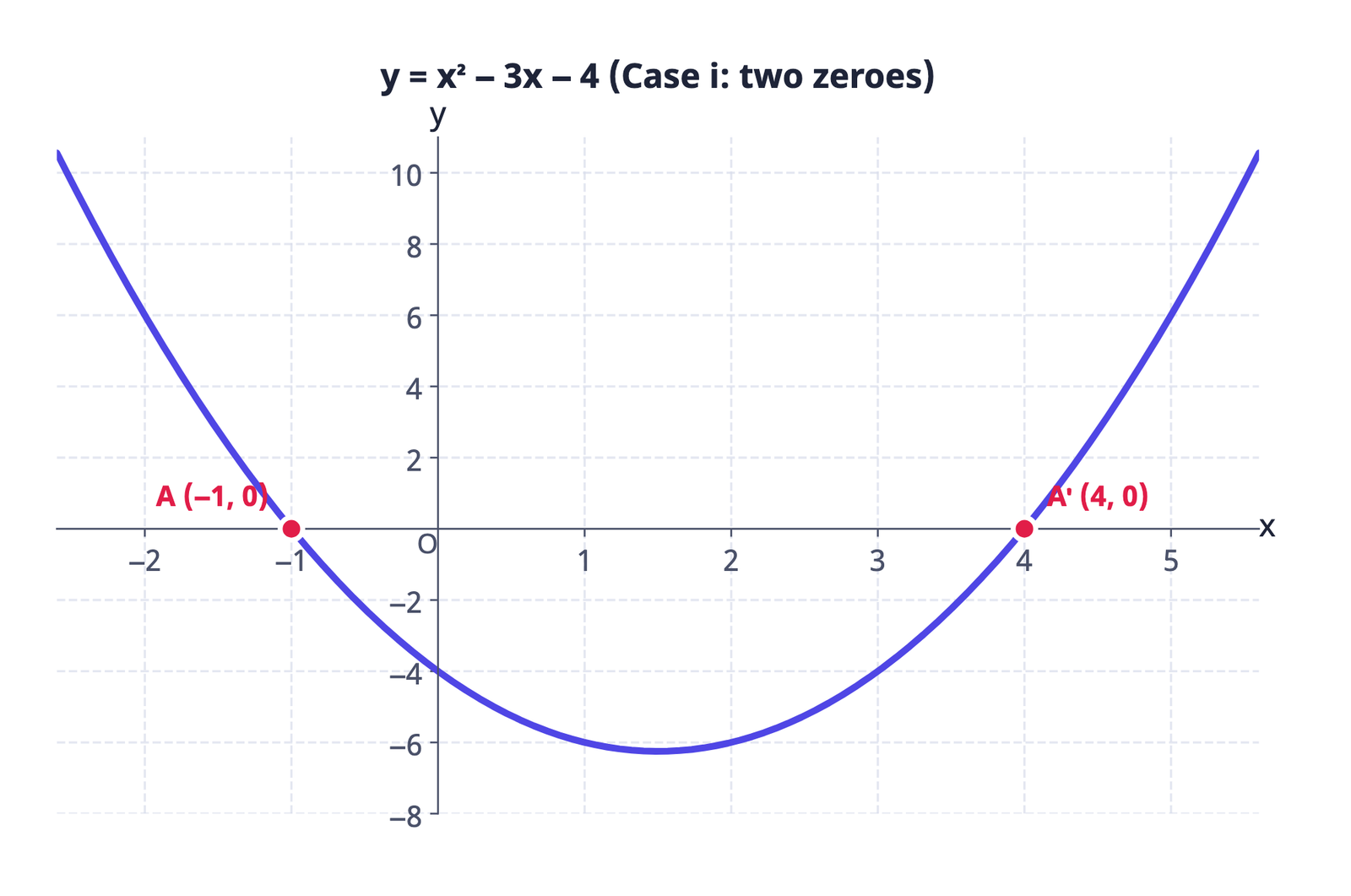
The table shows y=0 at x=−1 and x=4, and these are exactly the points where the parabola crosses the x-axis. This is true for every quadratic: its zeroes are precisely the x-coordinates of the points where its parabola meets the x-axis. A parabola can meet the x-axis in only three ways.
i
Cuts at two points
The graph cuts the x-axis at two different (distinct) points, named A and A′. Their x-coordinates are the two zeroes.
ii
Touches at one point
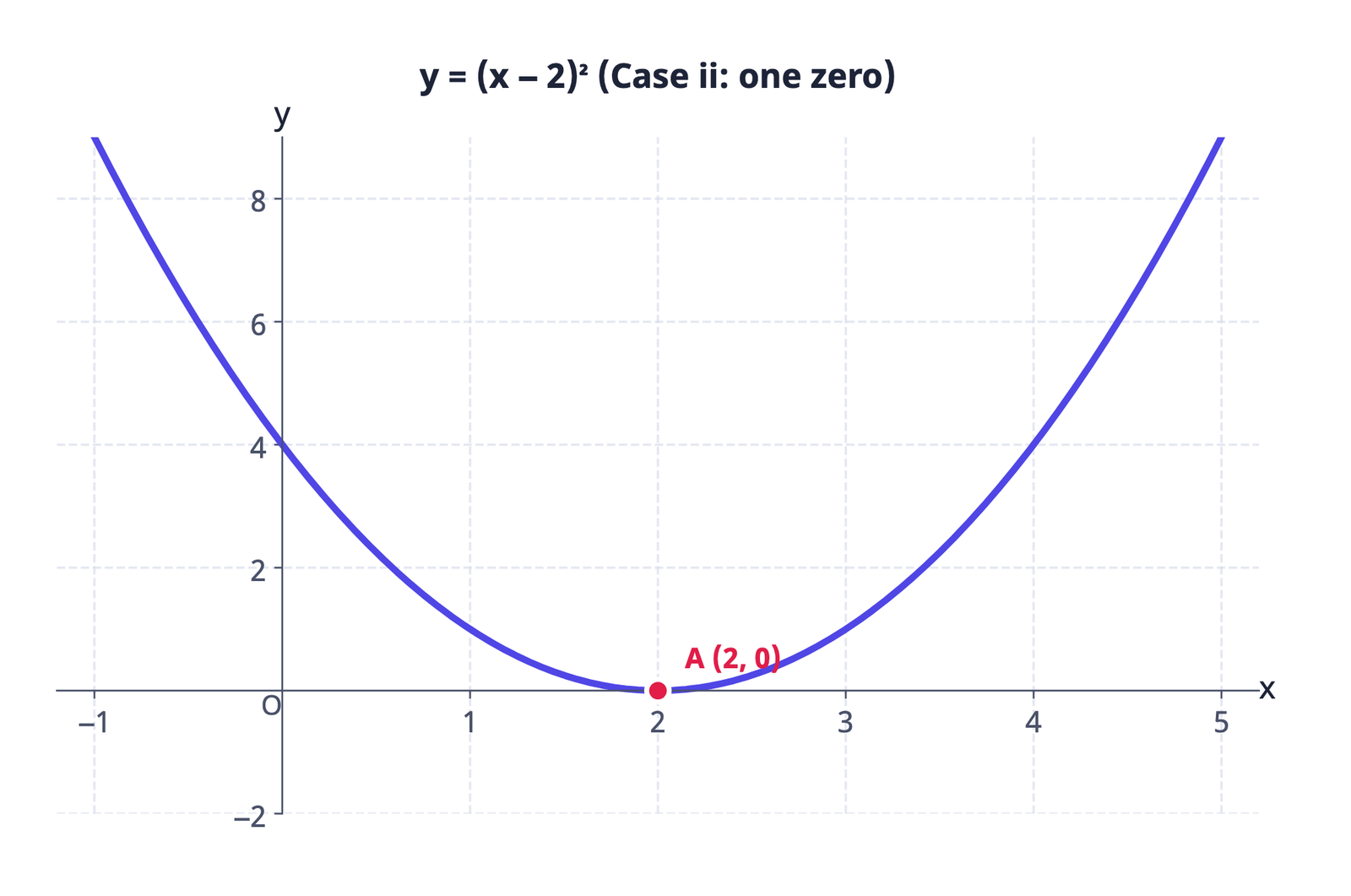
A and A′ come together and sit on top of each other (NCERT calls them “coincident” points), so the graph just touches the x-axis at one point A. The two zeroes are equal: in NCERT’s words, “two equal zeroes (i.e., one zero)”.
iii
Never meets it
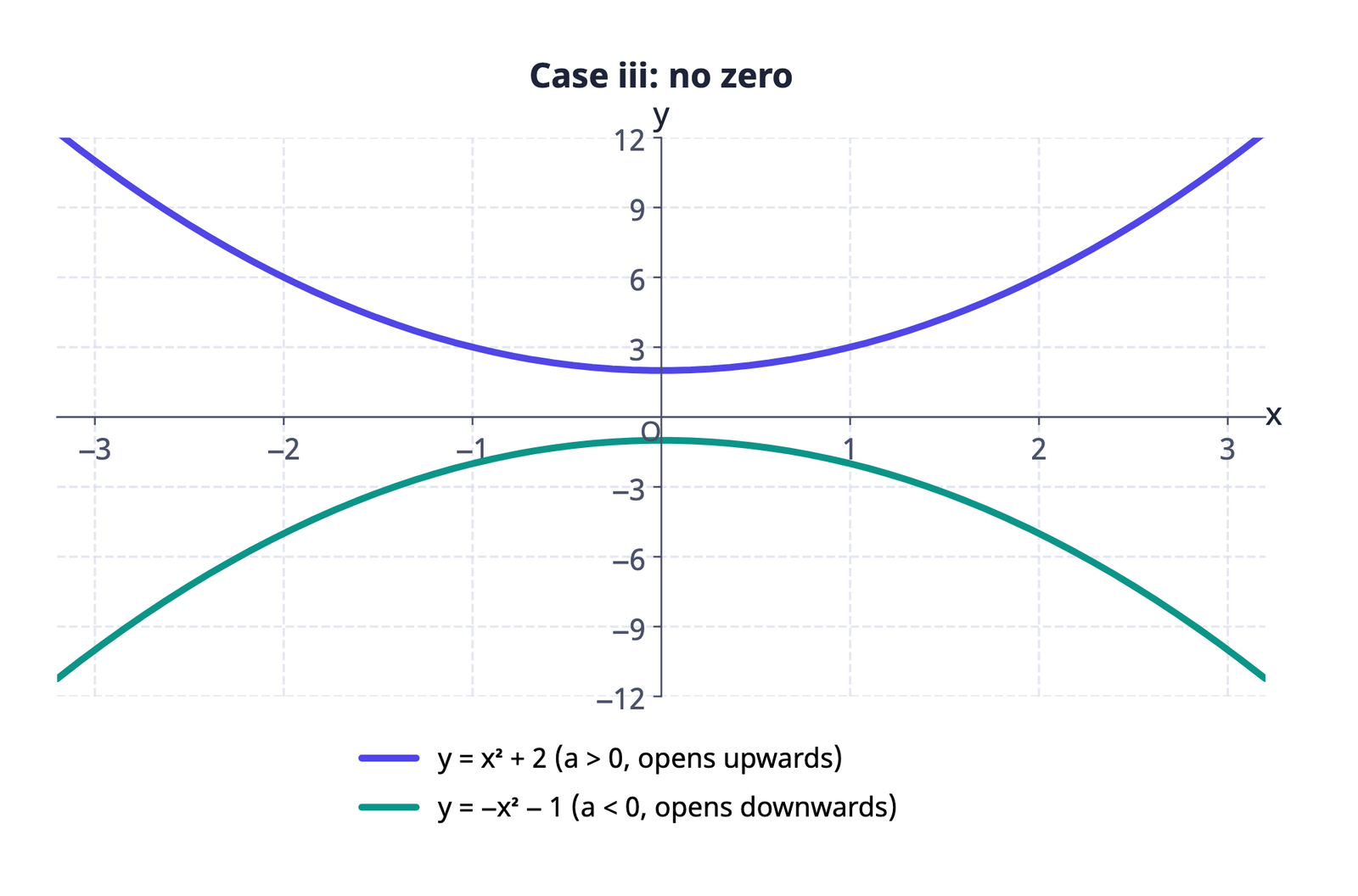
The graph is completely above or completely below the x-axis. There is no zero.
Graph 2 (NCERT Fig. 2.2), Case (i):y=x2−3x−4 cuts the x-axis at A(−1,0) and A′(4,0), so its two zeroes are −1 and 4Graph 3, Case (ii):y=(x−2)2 just touches the x-axis at A(2,0), so its only zero is 2 (an extra example, not in NCERT)Graph 4, Case (iii):y=x2+2 (completely above the x-axis) and y=−x2−1 (completely below it) never meet the x-axis, so neither has a zero (extra examples, not in NCERT)
Memory Trick
Cuts: 2 · Touches: 1 · Misses: 0
These are the only three possibilities, so a polynomial of degree 2 has at most two zeroes.
Exam Tip
NCERT’s own footnote: plotting graphs of quadratic or cubic polynomials is not meant to be done by students and is not evaluated. What you do need is to read a given graph: count where it meets the x-axis.
3.3 Cubic polynomial: at most three zeroes
For y=x3−4x (NCERT Table 2.2):
x
−2
−1
0
1
2
y=x3−4x
0
3
0
−3
0
Graph 5 (NCERT Fig. 2.6):y=x3−4x meets the x-axis only at (−2,0), (0,0) and (2,0), so its zeroes are −2, 0 and 2Graph 6 (NCERT Figs. 2.7 and 2.8):y=x3 meets the x-axis only at the origin (one zero, 0), while y=x3−x2=x2(x−1) touches the x-axis at x=0 and crosses it at x=1, so it has two different zeroes, 0 and 1
Cubic polynomial
Zeroes
Number of zeroes
x3−4x
−2,0,2
3
x3
0
1
x3−x2=x2(x−1)
0,1
2
So a cubic can have 1, 2 or 3 zeroes, but never more: any polynomial of degree 3 has at most three zeroes. The pattern extends to every degree.
In general, given a polynomial p(x) of degree n, the graph of y=p(x) intersects the x-axis at atmost n points. Therefore, a polynomial p(x) of degree n has at most n zeroes.
Remark in the NCERT textbook, Section 2.2
3.4 Reading the number of zeroes from a graph
NCERT practises this skill in its Example 1 (Fig. 2.9) and in Exercise 2.1 (Fig. 2.10); each figure has six graphs. Count the points where the curve meets the x-axis, whether it crosses there or only touches.
Graph 7: six extra graphs of y=p(x) for counting practice (not from NCERT); (a) y=2 is a constant polynomial (2=2x0, degree 0), and (e), (f) have degrees 4 and 5; the red dots mark every point where the curve meets the x-axis, giving 0, 1, 3, 2, 4 and 3 zeroes
✓ Count these
Every point where the curve crosses the x-axis
A point where the curve only touches the x-axis and turns back, counted once (like (f) above)
✗ Never count these
The point where the curve crosses the y-axis
A horizontal line above or below the x-axis: it has no zero at all (like (a) above)
Exam Tip
A question can show a graph and ask “the number of zeroes of p(x) is”. In NCERT’s Example 1 the six graphs have 1, 2, 3, 1, 1 and 4 zeroes; a graph with 4 zeroes must belong to a polynomial of degree at least 4.
4 Relationship between Zeroes and Coefficients
We saw that the zero of ax+b is −ab. Now we find a similar link for quadratics. First, two examples solved by splitting the middle term (the Class IX method): for ax2+bx+c, break bx into two terms whose product is ax2×c and whose sum is bx, then take out common factors.
4.1 Two quadratics worked out
Solved Example
Q. Find the zeroes of p(x)=2x2−8x+6 and compare them with the coefficients.
Step 1: Split −8x into two terms whose product is 6×2x2=12x2 and whose sum is −8x: these are −6x and −2x. Step 2:2x2−6x−2x+6=2x(x−3)−2(x−3)=(2x−2)(x−3)=2(x−1)(x−3) Step 3:p(x)=0 when x=1 or x=3. Zeroes: 1 and 3. Compare with the coefficients (a=2, b=−8, c=6): sum =1+3=4=2−(−8); product =1×3=3=26.
Solved Example
Q. Find the zeroes of p(x)=3x2+5x−2 and compare them with the coefficients.
3x2+6x−x−2=3x(x+2)−1(x+2)=(3x−1)(x+2). Zeroes: 31 and −2. Compare: sum =31+(−2)=−35=3−(5); product =31×(−2)=−32=3−2.
In both, the sum of zeroes is coefficient of x2−(coefficient of x) and the product is coefficient of x2constant term. Here is why this is always true.
4.2 The general result for a quadratic
We name the zeroes with Greek letters: α (alpha) and β (beta). If α and β are the zeroes of ax2+bx+c, then (x−α) and (x−β) are its factors (expressions that multiply together to give it). You saw this in the first example above: zeroes 1 and 3 came from the factors (x−1) and (x−3).
ax2+bx+c=k(x−α)(x−β)k is a constant, a fixed number
=k[x2−(α+β)x+αβ]multiply out the brackets
=kx2−k(α+β)x+kαβmultiply by k
a=k,b=−k(α+β),c=kαβboth sides are the same polynomial, so the numbers in front of x2, of x, and the constant terms must match
α+β=a−b,αβ=acput k=a and divide
Formula
α+β=a−b=Coefficient of x2−(Coefficient of x)αβ=ac=Coefficient of x2Constant term
α, β are the zeroes of the quadratic polynomial ax2+bx+c, a=0
What the symbols mean
αalpha: the first zero1st
βbeta: the second zero2nd
γgamma: the third zero, used for cubics3rd
NCERT Example 2
Q. Find the zeroes of x2+7x+10 and verify the relationship between the zeroes and the coefficients.
x2+7x+10=(x+2)(x+5), so the zeroes are −2 and −5.
Sum =−2+(−5)=−7=1−(7) ✓ Product =(−2)×(−5)=10=110 ✓
NCERT Example 3
Q. Find the zeroes of x2−3 and verify the relationship.
Using A2−B2=(A−B)(A+B): x2−3=(x−3)(x+3), so the zeroes are 3 and −3.
Sum =3−3=0, and there is no x term, so b=0 and a−b=0 ✓ Product =(3)(−3)=−3=1−3 ✓
4.3 Building a quadratic from the sum and product of its zeroes
Dividing ax2+bx+c by a gives x2+abx+ac=x2−(α+β)x+αβ. So one quadratic with given sum S and product P of zeroes is x2−Sx+P.
NCERT Example 4
Q. Find a quadratic polynomial, the sum and product of whose zeroes are −3 and 2, respectively.
Let the polynomial be ax2+bx+c with zeroes α, β. Then α+β=−3=a−b and αβ=2=ac.
Taking a=1: b=3 and c=2. So one such polynomial is x2+3x+2.
Any other quadratic that fits is of the form k(x2+3x+2), where k is real (and k=0, or it would not be a quadratic).
Exercise 2.2 practises both skills: Question 1 is “find the zeroes and verify” (section 4.2) and Question 2 is “find the polynomial from the sum and product” (this section).
Common Mistake
Writing x2+Sx+P. The middle term takes the opposite sign of the sum: sum −3 gives +3x. When S or P is a fraction, multiply every term by a suitable k to clear the fractions; the zeroes do not change. For example, S=41, P=−1 gives x2−41x−1, and multiplying by 4 gives 4x2−x−4.
Exam-style application (extra, not in NCERT)
Q. If α, β are the zeroes of x2−5x+6, find α2+β2 and α1+β1 without finding the zeroes.
α+β=5, αβ=6. α2+β2=(α+β)2−2αβ=25−12=13 α1+β1=αβα+β=65 Answer:α2+β2=13 and α1+β1=65
Check: the zeroes are 2 and 3, and 4+9=13, 21+31=65 ✓
4.4 Cubic polynomials: three relationships
Take p(x)=2x3−5x2−14x+8. You can check that p(x)=0 for x=4, −2 and 21; for example p(4)=128−80−56+8=0. A cubic has three relationships. The middle one uses the “sum of the products of the zeroes taken two at a time”: multiply the zeroes in pairs (αβ, βγ, γα) and add the three products. Since a cubic has at most three zeroes, these are all of them.
Quantity
Working
From the coefficients
Sum of zeroes
4+(−2)+21=25
2−(−5)=coeff. of x3−(coeff. of x2)
Sum of the products of the zeroes taken two at a time
4(−2)+(−2)(21)+21(4)=−8−1+2=−7
2−14=coeff. of x3coeff. of x
Product of zeroes
4×(−2)×21=−4
2−8=coeff. of x3−(constant term)
Formula
α+β+γ=a−bαβ+βγ+γα=acαβγ=a−d
α, β, γ are the zeroes of the cubic polynomial ax3+bx2+cx+d, a=0
Memory Trick
Signs go minus, plus, minus
Read the coefficients b,c,d in order and divide each by a: the three results take the signs −, +, −. For a quadratic only the first two apply: −ab, +ac.
NCERT Example 5 (marked by NCERT “not from the examination point of view”)
Q. Verify that 3, −1, −31 are the zeroes of p(x)=3x3−5x2−11x−3, and then verify the relationship between the zeroes and the coefficients.
Here a=3, b=−5, c=−11, d=−3. p(3)=81−45−33−3=0; p(−1)=−3−5+11−3=0; p(−31)=−91−95+311−3=0.
Sum =3−1−31=35=a−b ✓; sum of the products taken two at a time =−3+31−1=−311=ac ✓; product =1=3−(−3)=a−d ✓
Read it once for understanding; the three cubic formulas themselves are in NCERT’s Summary and can be asked.
Quick Revision: read this the night before the exam
Zero of ax+b is −ab: exactly one zero, the line meets the x-axis once
Zeroes of p(x) = x-coordinates of the points where y=p(x) meets the x-axis
Quadratic: 2, 1 or 0 zeroes (cuts, touches, misses), at most 2
Cubic: at most 3 zeroes; degree n: at most n zeroes
Quadratic: α+β=−ab, αβ=ac
From sum S and product P: k(x2−Sx+P), k=0
Cubic: α+β+γ=−ab, αβ+βγ+γα=ac, αβγ=−ad
Not examined: plotting quadratic/cubic graphs, NCERT Example 5; the division algorithm (dividing polynomials) has no section or exercise in this reprint