
- What a quadratic equation is, and how to write it in standard form
- How to turn a word problem (area, numbers, ages, speed, cost) into a quadratic equation
- How to find the roots by factorisation (splitting the middle term)
- The quadratic formula, and how the discriminant tells you the nature of the roots without solving
1 Introduction: from polynomial to equation
In Chapter 2 you met the quadratic polynomial (with ): a polynomial whose highest power of is 2 (its degree is 2). When we put this polynomial equal to zero, we get a quadratic equation. Such equations turn up naturally in real-life problems.
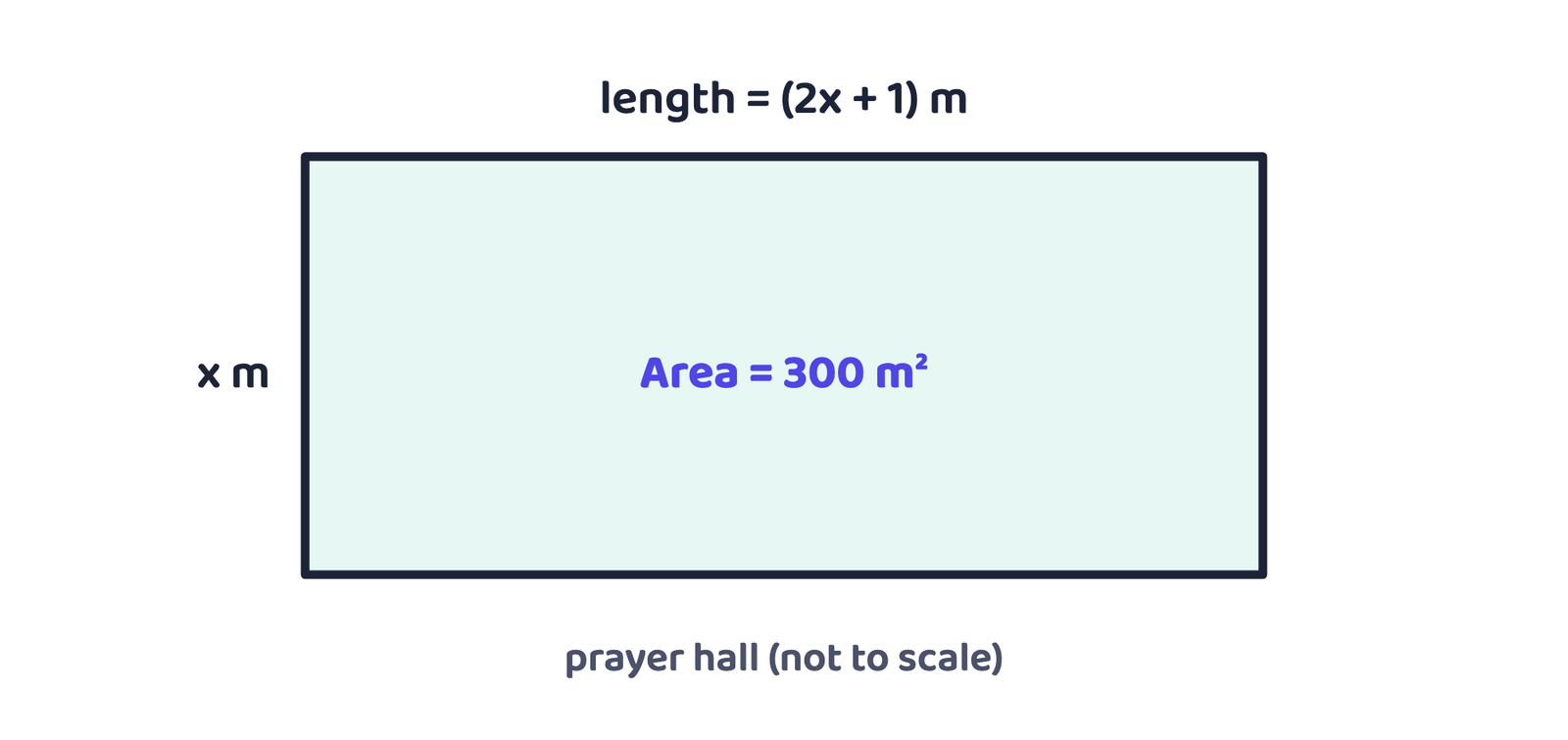
A charity trust wants to build a prayer hall with a carpet area (floor area) of 300 m², whose length is one metre more than twice its breadth. If the breadth is m, the length is m, so
2 Quadratic equation and its standard form
A quadratic equation in the variable is an equation of the form , where are real numbers and .
Any equation , where is a polynomial of degree 2, is a quadratic equation. When its terms are written in descending order of their degrees (the term first, then the term, then the number), we get the standard form , .
So , and are all quadratic equations. The second one in standard form is , so there , , .
Do not decide by looks. Simplify both sides first (the book notes that often we need to simplify the given equation before deciding whether it is quadratic), then check whether an term is left and no higher power remains.
| Equation (NCERT Example 2) | After simplifying | Quadratic? |
|---|---|---|
| Yes | ||
| , so | No: the cancels, it only looked quadratic | |
| Yes | ||
| , so , i.e. | Yes: the cancels, it only looked cubic (degree 3) |
3 Turning a situation into a quadratic equation
Q. John and Jivanti together have 45 marbles. Both lost 5 marbles each, and the product of the numbers they now have is 124. Represent this as a quadratic equation.
Solution: Let John have marbles. Then Jivanti has . After losing 5 each: John , Jivanti .
Q. A cottage industry (a small business run from home) makes some toys in a day. The cost of each toy (in ₹) is 55 minus the number of toys made that day. On one day the total cost was ₹750. Form the equation.
Solution: Let toys be made. Cost of each toy , so total cost .
The same four steps handle these common types. Here is how the unknown and the condition look in each:
| Type | Let be | Condition used | Equation |
|---|---|---|---|
| Area (plot of 528 m², length breadth ) | breadth | length × breadth = area | |
| Consecutive integers (one after the other, like 17 and 18) with product 306 | smaller integer | ||
| Consecutive integers with sum of squares 365 | smaller integer | (13 and 14) | |
| Right triangle: altitude 7 cm less than the base, hypotenuse 13 cm | base in cm (altitude ) | Pythagoras: | (base 12 cm, altitude 5 cm) |
| Ages: a mother is 26 years older than her son; 3 years from now the product of their ages will be 360 | son’s present age (mother’s is ) | after 3 years: | |
| Speed: a train covers 480 km; if it went 8 km/h slower, it would take 3 hours more | speed in km/h |
In speed problems use time = distance ÷ speed. The slower journey takes MORE time, so write (slower time) − (usual time) = extra hours. Then multiply both sides by to clear the fractions.
4 Roots of a quadratic equation
A real number (read “alpha”) is called a root of the quadratic equation , , if . We also say that is a solution of the equation, or that satisfies it.
For example, putting in gives , so 1 is a root of . It is also a zero of the polynomial , that is, a value of that makes the polynomial equal to 0.
- Roots = zeroes: the zeroes of the polynomial and the roots of the equation are the same.
- At most two roots: a quadratic polynomial has at most two zeroes (Chapter 2), so a quadratic equation has at most two roots.
5 Solving by factorisation
In Class IX you factorised quadratic polynomials by splitting the middle term. The same skill finds the roots: factorise into two linear factors (factors of degree 1, such as ), then put each factor equal to zero.
Q. Find the roots of by factorisation.
Solution: and , so use and (product 6, sum ):
So or . The roots are and .
Q. Find the roots of .
Solution: , : use and .
The roots are and .
Q. Find the roots of .
Solution: , so split as (product 6, sum ). Since :
Both factors are the same, so comes twice, once for each repeated factor. The roots are .
Q. Find the dimensions of the prayer hall from Section 1.
Solution: The breadth satisfies . Here , : use and .
So or . A breadth cannot be negative, so the breadth is 12 m and the length is 25 m.
Both roots may be algebraically correct, but only one may fit the situation. Length, age, speed and number of items can never be negative, and a number of items must be a whole number. Write one line saying which root you reject and why, as the book does for the hall: “Since is the breadth of the hall, it cannot be negative.”
6 The quadratic formula
Factorisation is quick when the roots are neat numbers. When they are not (for example , where no two integers have product and sum ), use the formula. It works for every quadratic equation whose roots are real numbers (Section 7 shows how to check this first).
Q. Solve .
Solution: , , . So and .
The roots are and .
Taking the sign of wrongly. In , , so and . Write , , with their signs before substituting.
Older books and guides have a section on solving by completing the square (rewriting using a perfect square such as ), which is how the formula is derived. The current NCERT book does not teach this method: it states the quadratic formula without deriving it. You must know and use the formula; you do not need to derive it or solve by completing the square.
7 Discriminant and nature of roots
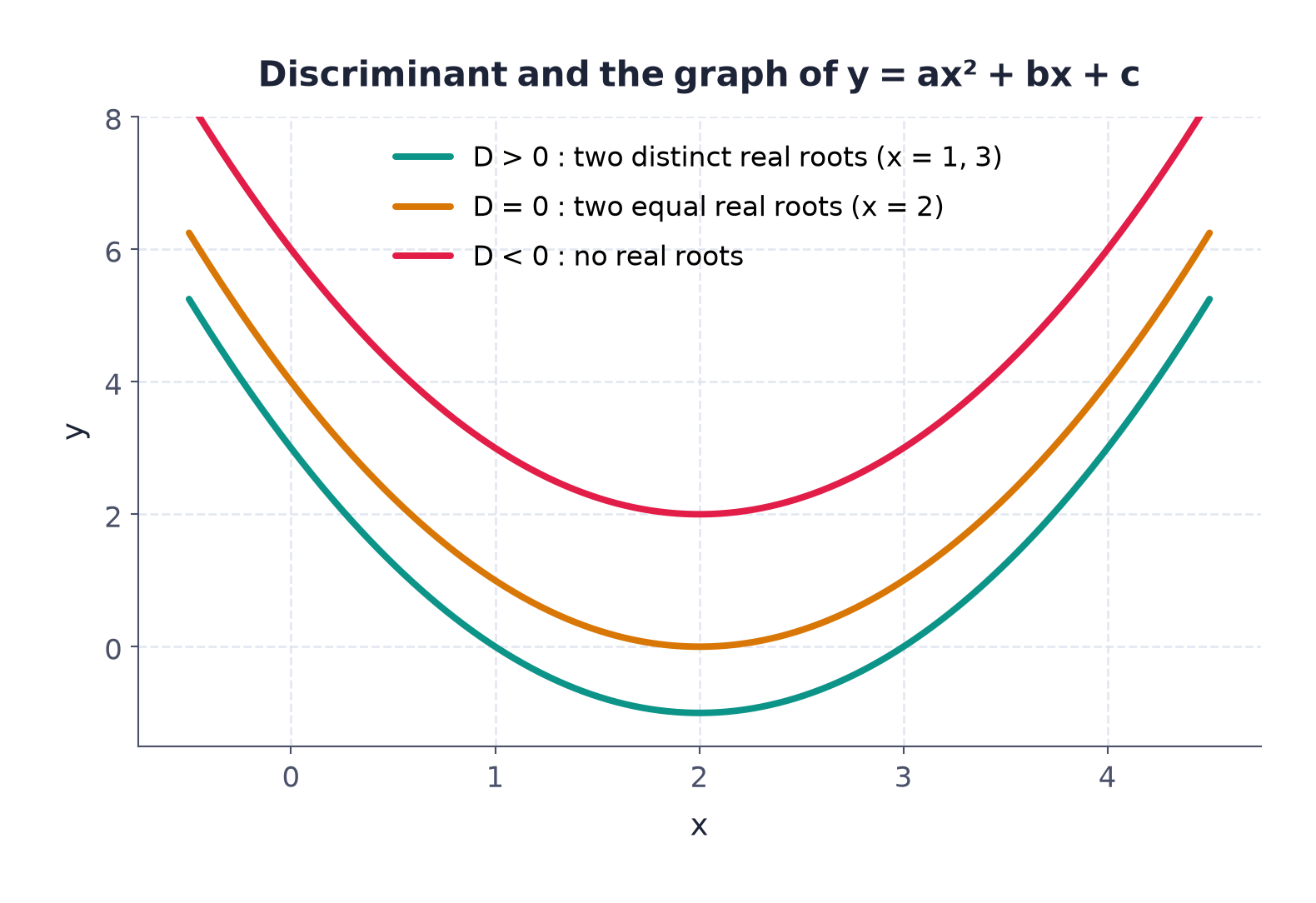
For , the quantity is called the discriminant, because it decides whether the equation has real roots or not. In these notes we write it as .
| Value of | Nature of roots | The roots |
|---|---|---|
| two distinct real roots | and | |
| two equal real roots (coincident roots) | both equal to | |
| no real roots | no real number has a negative square |
Q. Find the discriminant of and hence the nature of its roots.
Solution: , , . . So the equation has no real roots.
Q. Find the discriminant of , the nature of its roots, and the roots if they are real.
Solution: , so there are two equal real roots, each , i.e. .
Q. Find so that has two equal roots.
Solution: Equal roots means : , so and . (If an answer ever came out as , reject it: then the term vanishes and the equation is no longer quadratic.)
“Find the nature of the roots” needs only the sign of , not the roots. “Is it possible to …?” questions work the same way: form the equation, find . If the situation is not possible. If the equation has real roots; then solve it and keep only a root that fits the situation (a positive length, age or count), as the book does in NCERT Example 8, where is ignored and is kept. NCERT asks this about a mango grove (a garden of mango trees), the ages of two friends, and a park. For a park of perimeter 80 m and area 400 m², length + breadth m, so gives with , so it is possible: a 20 m by 20 m square.
8 Pole in a circular park: Pythagoras meets the discriminant
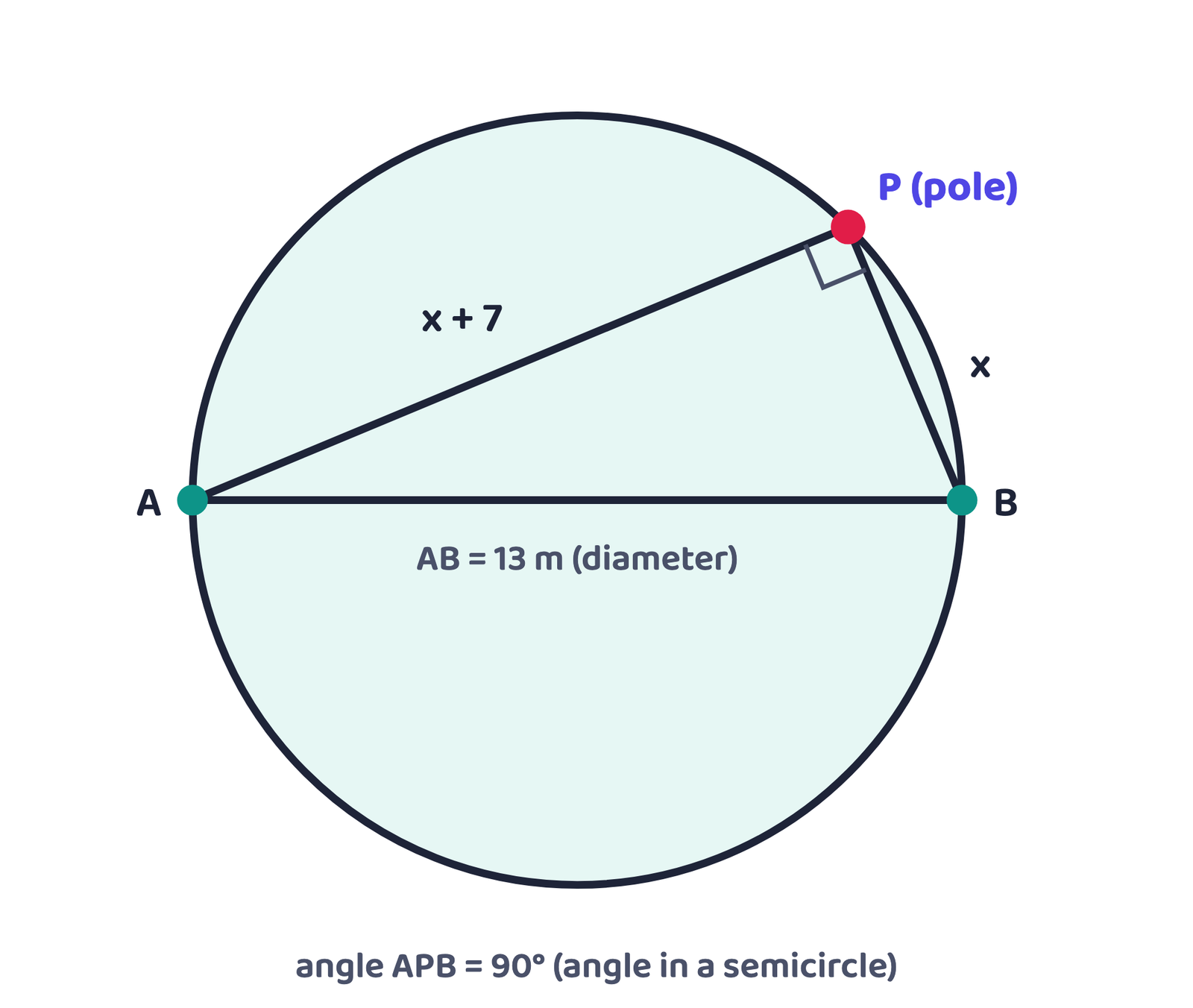
Q. A pole has to be erected (set up) at a point on the boundary of a circular park of diameter 13 m so that the difference of its distances from two diametrically opposite gates A and B (gates at the two ends of a diameter) is 7 m. Is it possible? If yes, how far from each gate?
Solution: Let P be the pole and m. Then m. Since AB is a diameter, (angle in a semicircle: a diameter always makes a right angle at any point on the circle). By Pythagoras theorem:
, so real roots exist and the pole can be erected. By the formula:
A distance cannot be negative, so . The pole is 5 m from gate B and 12 m from gate A.
Many people believe the Babylonians were the first to solve quadratic equations. The Greek mathematician Euclid found such answers using geometry. In India, Brahmagupta (C.E. 598-665; C.E. means Common Era, the same years as A.D.) gave a clear formula for , and Sridharacharya (C.E. 1025) derived what we now call the quadratic formula, as quoted by Bhaskara II. The Arab mathematician Al-Khwarizmi (about C.E. 800) also studied these equations. In Europe, Abraham bar Hiyya Ha-Nasi gave complete solutions in his book Liber embadorum (C.E. 1145).
- Quadratic equation: , real, ; simplify first, then decide
- Root : ; roots of the equation = zeroes of the polynomial; at most two roots
- Factorisation: split using two numbers with product and sum ; each factor
- Quadratic formula: , provided
- : two distinct real roots; two equal roots ; no real roots
- Equal roots / find : put ; reject any that makes
- In word problems reject a negative length, age, speed or count, and say why
- 1 markFind the discriminant of .
- 2 marksIs a quadratic equation? Give a reason.
- 3 marksSolve by factorisation.
- 3 marksFind the values of for which has two equal roots, and find the roots in each case.