line of sightangle of elevationangle of depressionhorizontalalternate angles
1 Line of Sight, Angle of Elevation, Angle of Depression
You cannot take a measuring tape to the top of a minar or a flying kite. But from the
ground you can measure a distance and an angle of elevation, and you know your own eye height; trigonometry gives the rest. That is
the whole chapter: heights and distances found from known angles and lengths.
Learn by heartDefinition 1
The line of sight is the line drawn from the eye of an observer to the point in
the object viewed by the observer.
Figure 1: Like NCERT Figs 9.1 and 9.2: the student (eye A) looks up at the top C of the minar. The line of sight AC rises above the horizontal AB, so angle BAC is an angle of elevation. D is the foot of the minar and E the student’s feet.
Learn by heartDefinition 2
The angle of elevation of the point viewed is the angle formed by the line of sight
with the horizontal when the point being viewed is above the horizontal level, i.e., the
case when we raise our head to look at the object.
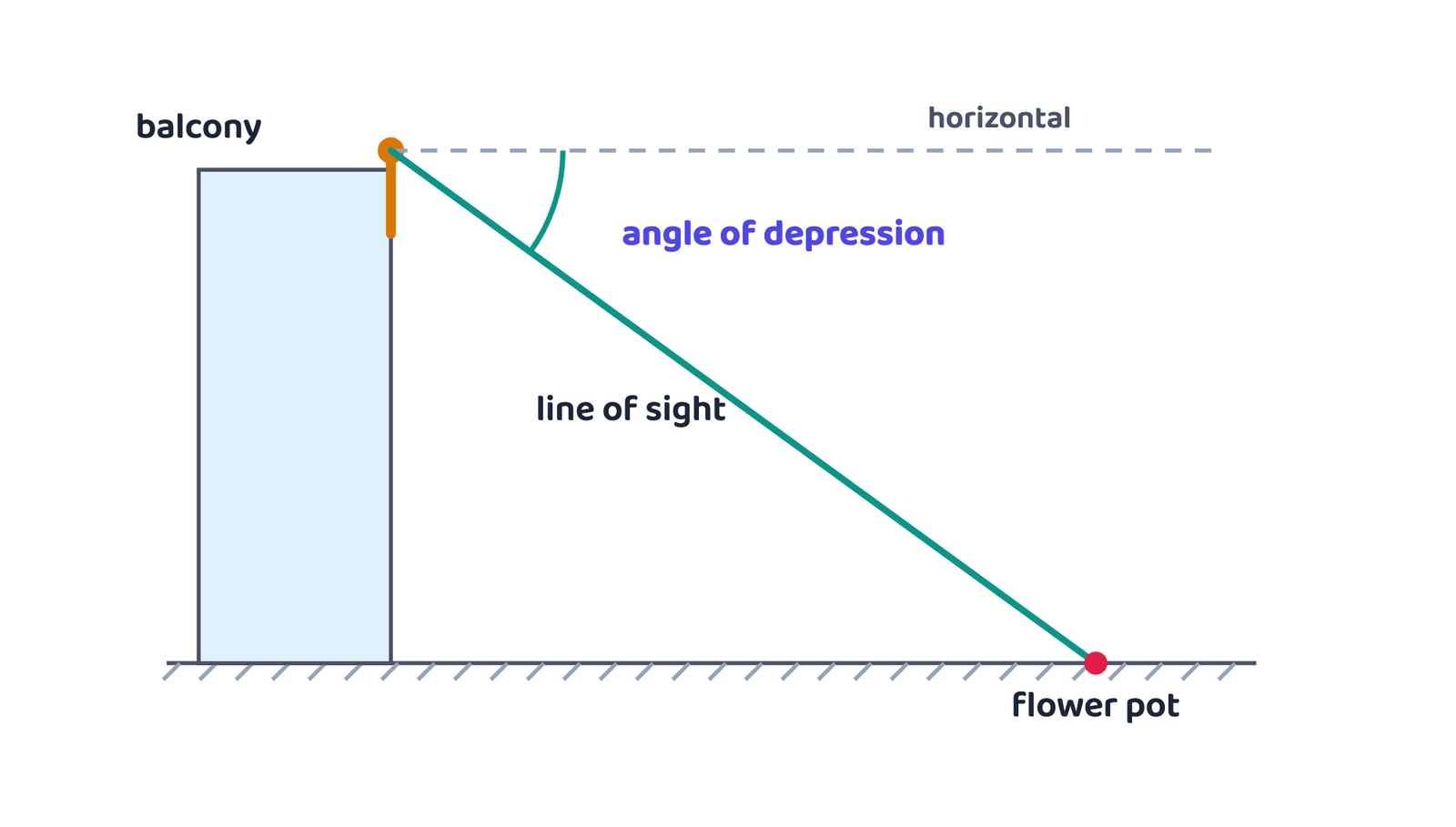
Figure 2: Like NCERT Fig. 9.3: the girl on the balcony looks down at a flower pot. The line of sight falls below the horizontal, so the angle between them is an angle of depression.
Learn by heartDefinition 3
The angle of depression of a point on the object being viewed is the angle formed by
the line of sight with the horizontal when the point is below the horizontal level, i.e.,
the case when we lower our head to look at the point being viewed.
Common Mistake
Both angles are measured from the horizontal line through the observer’s eye,
never from the vertical tower, wall or building. For depression, draw the horizontal line
through the eye first (shown dashed) and mark the angle below it. The angle between the
vertical and the line of sight is a different
angle and gives a wrong answer.
1.1 Elevation from A = depression from B
Say A is on the ground and B is higher up. The angle of elevation of B seen from A is
measured up from the horizontal at A. The angle of depression of A seen from B is
measured down from the horizontal at B. These two horizontal lines are parallel, and
the line AB cuts both of them (a line that cuts two parallel lines is called a transversal). The two angles lie between the parallel lines, on opposite sides of AB:
such a pair is called alternate angles. Because the two horizontal lines are parallel, these alternate angles are equal.
So the angle of elevation of B from A equals the angle of depression of A from B
(Figure 3). You will use this in Examples 6 and 7.
Figure 3: The angle of elevation of B from A equals the angle of depression of A from B, because the two horizontals are parallel.
2 What You Need to Find a Height
Go back to the student looking at the minar (Figure 1). Say A is the student’s eye, AE is the student’s height, D is the foot of the minar and C its top. The horizontal
line from the eye meets the minar at B. To find the height CD without climbing it,
you need three things:
1
Distance
The distance DE of the student from the foot of the minar.
2
Angle
The angle of elevation ∠BAC of the top of the minar.
3
Eye height
The height AE of the student.
AB and ED are horizontal and AE and BD are vertical, so ABDE is a rectangle: BD=AE (the student’s height) and AB=DE (her distance).
Then CD=CB+BD. To get CB, use the right triangle ABC: BC is the side across from
(opposite) the known angle A (that is, ∠BAC) and AB is the side next to it (adjacent), so use tanA=ABBC (or cotA=BCAB; both ratios are recalled in
Section 3.1). Finally add AE to BC.
3 The Method: Word Problem to Right Triangle
Some questions come with a figure (Exercise 9.1 Q1, Q11 and Q14 refer to Figs 9.11, 9.12 and 9.13); read it first. When no figure is given, draw one yourself. The
object standing on the ground (tower, pole, building) is vertical and the ground is
horizontal, so the object meets the ground at a right angle.
Step 1Draw the ground (horizontal) and the object (vertical). Right angle at the foot.
↓
Step 2Mark the observer and draw the line of sight.
↓
Step 3Mark the angle from the horizontal (for depression, draw the horizontal first).
↓
Step 4Pick the ratio linking the known and unknown sides, solve, add the observer’s height if needed.
3.1 Choosing the ratio
In a right triangle, for an angle θ (“theta”, just a name for the angle): the side across from it is the opposite side, the other side touching it (not the longest one) is the adjacent side (in these problems it is usually the horizontal distance, also called the base), and the longest side is the hypotenuse. Then sinθ=hypotenuseopposite, cosθ=hypotenuseadjacent, tanθ=adjacentopposite, and the three upside-down
ratios are cotθ=tanθ1, cosecθ=sinθ1, secθ=cosθ1.
You know / need
Use
Typical question
Height and horizontal distance
tanθ or cotθ
Tower, building, shadow
Height and a slanting length
sinθ or cosecθ
Ladder, rope, kite string, slide
Horizontal distance and a slanting length
cosθ or secθ
Foot of a ladder from its length
3.2 Standard values you must know without looking
θ
30°
45°
60°
sinθ
21
21
23
cosθ
23
21
21
tanθ
31
1
3
Leave 3 in the answer (for example 153 m) unless the question gives a value
for it. If it does, use exactly that value: NCERT’s Example 2 says 3=1.73, Example 4 says 3=1.732. To rationalise means to remove the root from the bottom of a fraction,
by multiplying top and bottom by 3: 330=3×330×3=3303=103.
Memory Trick
tan = height ÷ distance
At 45° the height equals the distance. At 60° the height is 3 times the
distance (a steep line of sight). At 30° the distance is 3 times the height (a flat line of sight).
4 Solved Examples (NCERT)
Here are all seven textbook examples, each with its figure. Every one follows the same four steps from Section 3.
4.1 Example 1: Tower, one angle
Example 1
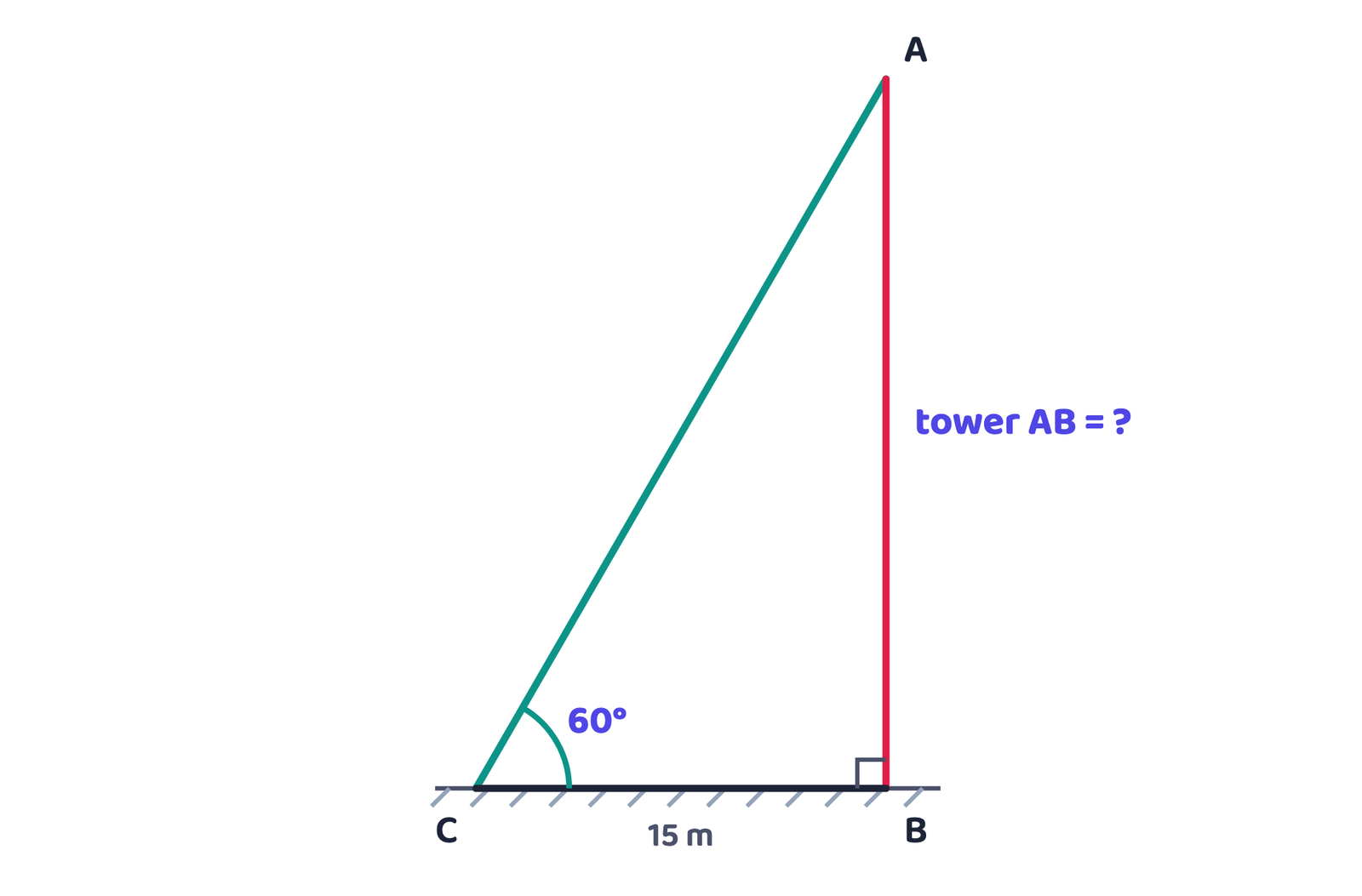
Q. From a point 15 m from the foot of a vertical tower, the angle of elevation of its top is 60°. Find the height of the tower.
Figure 4: Example 1 (NCERT Fig. 9.4): tower AB, CB = 15 m, elevation 60°.
CB=15 m, ∠ACB=60°, right angle at Bgiven; we need height AB of the tower
tan60°=BCABAB opposite, BC adjacent to the 60° angle
3=15ABtan60°=3
AB=153multiply both sides by 15
Answer
The height of the tower is 153 m (about 25.98 m).
4.2 Example 2: Electrician’s ladder
Example 2
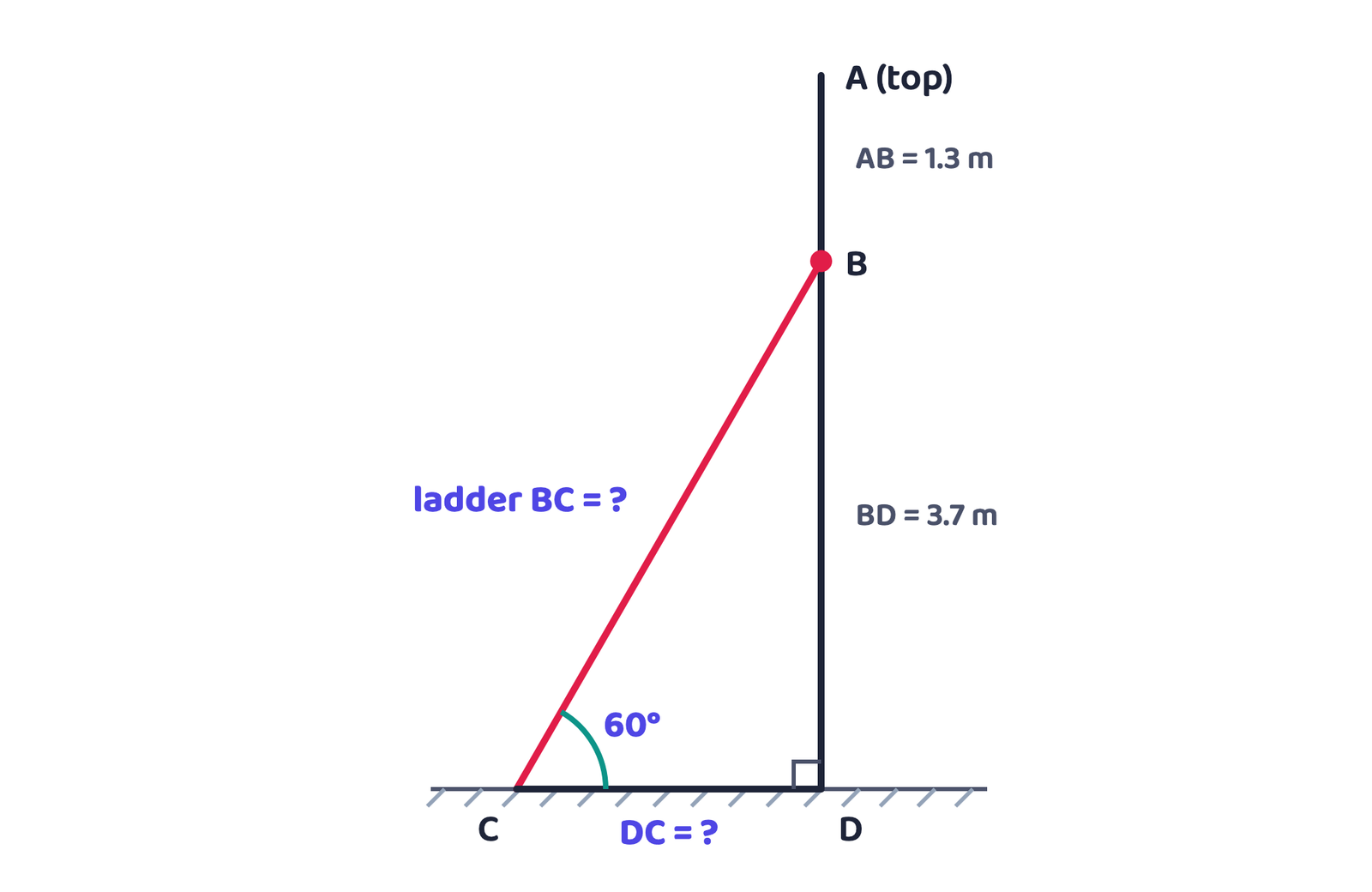
Q. An electrician must reach a point 1.3 m below the top of a 5 m pole with a ladder inclined (slanting) at 60° to the horizontal. Find the length of the ladder and how far from the pole its foot should be. (Take 3=1.73)
Figure 5: Example 2 (NCERT Fig. 9.5): pole AD = 5 m, AB = 1.3 m, ladder BC at 60°.
AD=5 m, AB=1.3 m, so BD=5−1.3=3.7 m; ladder at 60°given; we need ladder BC and distance DC
BCBD=sin60°BC is the hypotenuse, BD is opposite
BC3.7=23⇒BC=1.733.7×2=4.28 m (approx.)cross-multiply, use 3=1.73
BDDC=cot60°=31DC adjacent, BD opposite
DC=1.733.7=2.14 m (approx.)
Answer
The ladder should be 4.28 m long and its foot should be 2.14 m from the pole.
4.3 Example 3: Chimney, observer’s height
Example 3
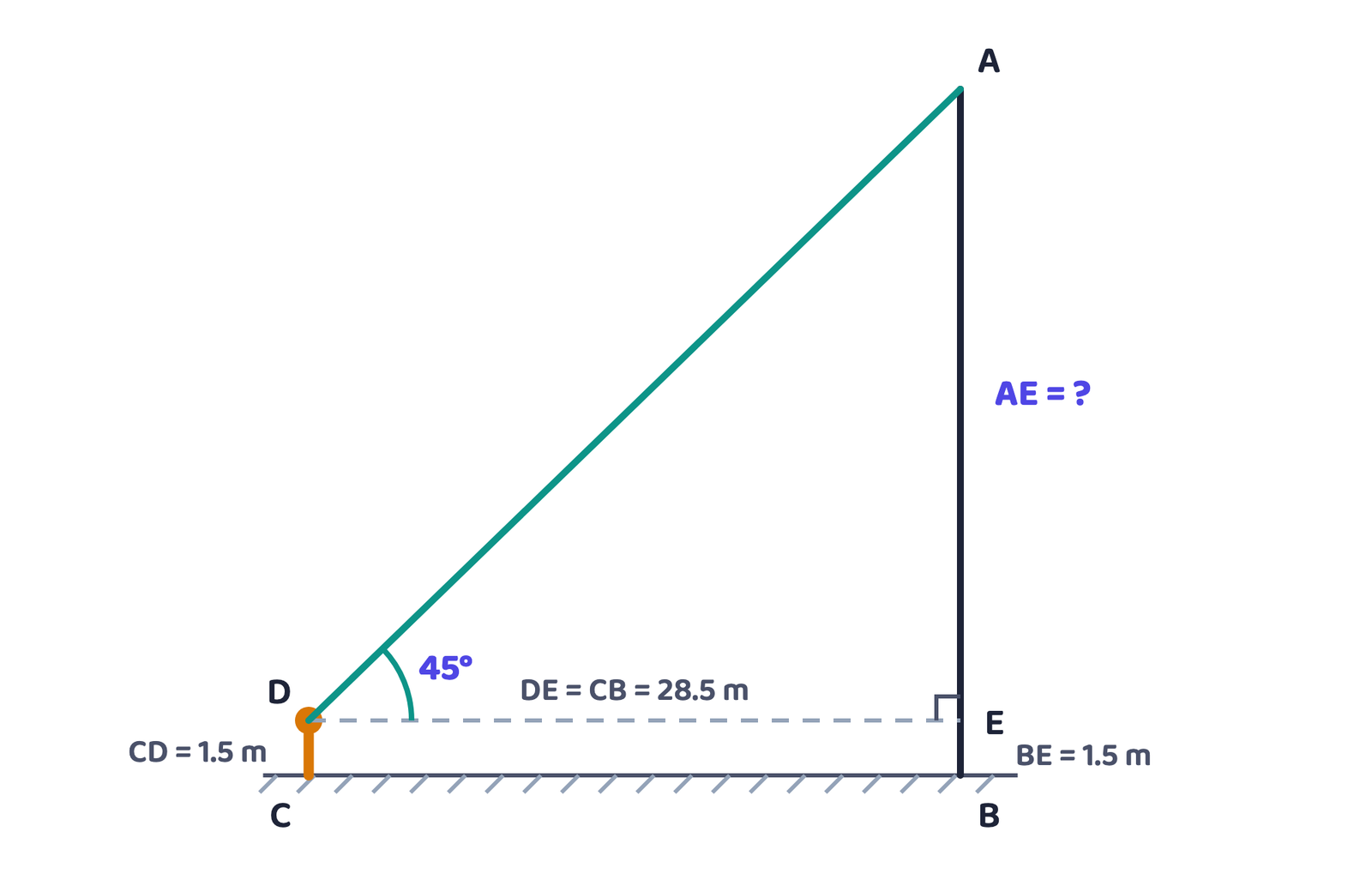
Q. An observer 1.5 m tall is 28.5 m away from a chimney. The angle of elevation of the top of the chimney from her eyes is 45°. What is the height of the chimney?
Figure 6: Example 3 (NCERT Fig. 9.6): chimney AB, observer CD = 1.5 m, angle ADE = 45°.
BCDE is a rectangle, so BE=CD=1.5 m and DE=CB=28.5 m; ∠ADE=45°given; we need height AB of the chimney
AB=AE+BE=AE+1.5the angle is measured from the eye, not the ground
tan45°=DEAE⇒1=28.5AEtan45°=1
AE=28.5 m
AB=28.5+1.5=30 madd the observer’s height
Answer
The height of the chimney is 30 m.
4.4 Example 4: Building and flagstaff (the pole that carries a flag)
Example 4
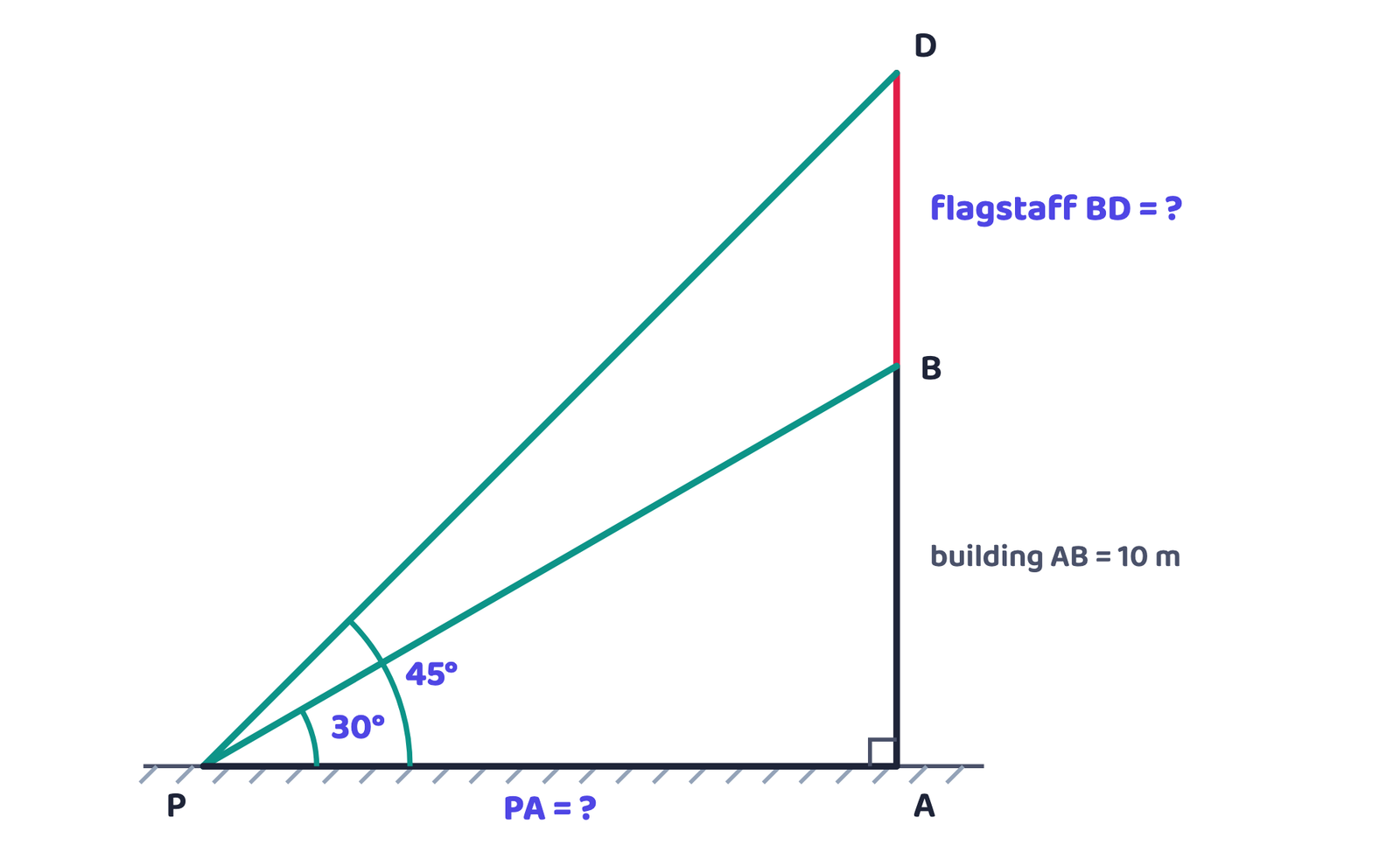
Q. From a point P on the ground, the angle of elevation of the top of a 10 m building is 30°, and of the top of a flagstaff on it is 45°. Find the length of the flagstaff and the distance of the building from P. (Take 3=1.732)
Figure 7: Example 4 (NCERT Fig. 9.7): building AB = 10 m, flagstaff BD, angles 30° and 45° at P.
AB=10 m, ∠APB=30°, ∠APD=45°given; we need flagstaff DB and distance PA
In right △PAB: tan30°=APAB⇒31=AP10start with the triangle whose height is known
AP=103=17.32 muse 3=1.732
Let DB=x m, so AD=(10+x) m
In right △PAD: tan45°=10310+x⇒1=10310+xsame base AP in both triangles
x=103−10=10(3−1)=7.32
Answer
The flagstaff is 7.32 m long and the building is 103 m = 17.32 m from P.
4.5 Example 5: Shadow at two altitudes of the Sun (altitude = angle of elevation of the Sun)
Example 5
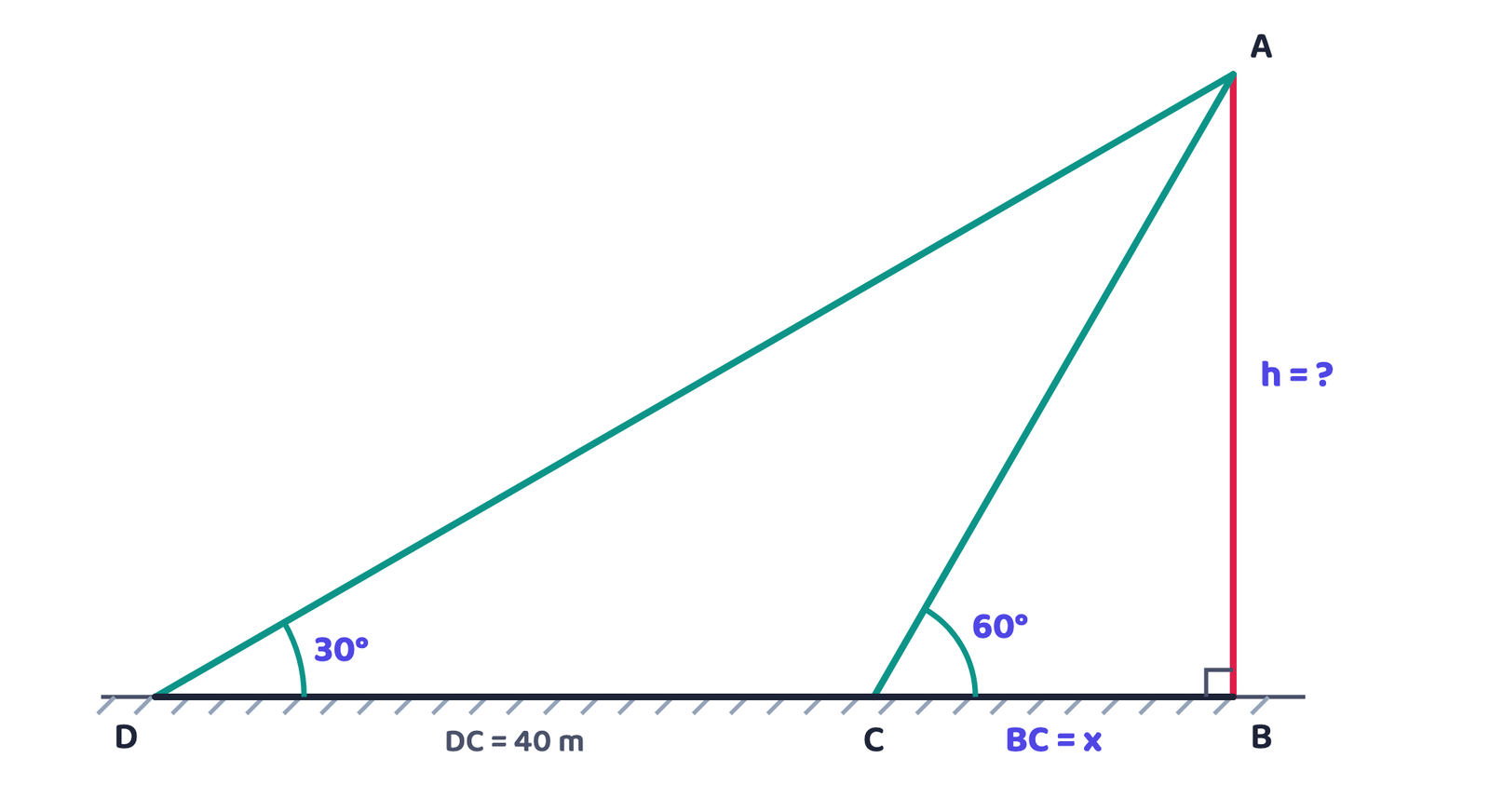
Q. The shadow of a tower standing on a level ground is found to be 40 m longer when the Sun’s altitude is 30° than when it is 60°. Find the height of the tower.
Figure 8: Example 5 (NCERT Fig. 9.8): tower AB, shadows BC (60°) and DB (30°), DC = 40 m.
The Sun’s ray just passes the top A and lands at the tip of the shadow, so the Sun’s altitude is the angle of elevation of A from the tip of the shadow. BC=x m, DB=(x+40) mgiven; we need height AB=h m
In △ABC: tan60°=xh⇒h=x3(1)
In △ABD: tan30°=x+40h⇒31=x+40h(2)
From (2): h3=x+40. Put h=x3: x3⋅3=x+40⇒3x=x+40cross-multiply, then use (1)
x=20, so h=203from (1)
Answer
The height of the tower is 203 m (about 34.64 m).
4.6 Example 6: Two buildings, angles of depression
Example 6
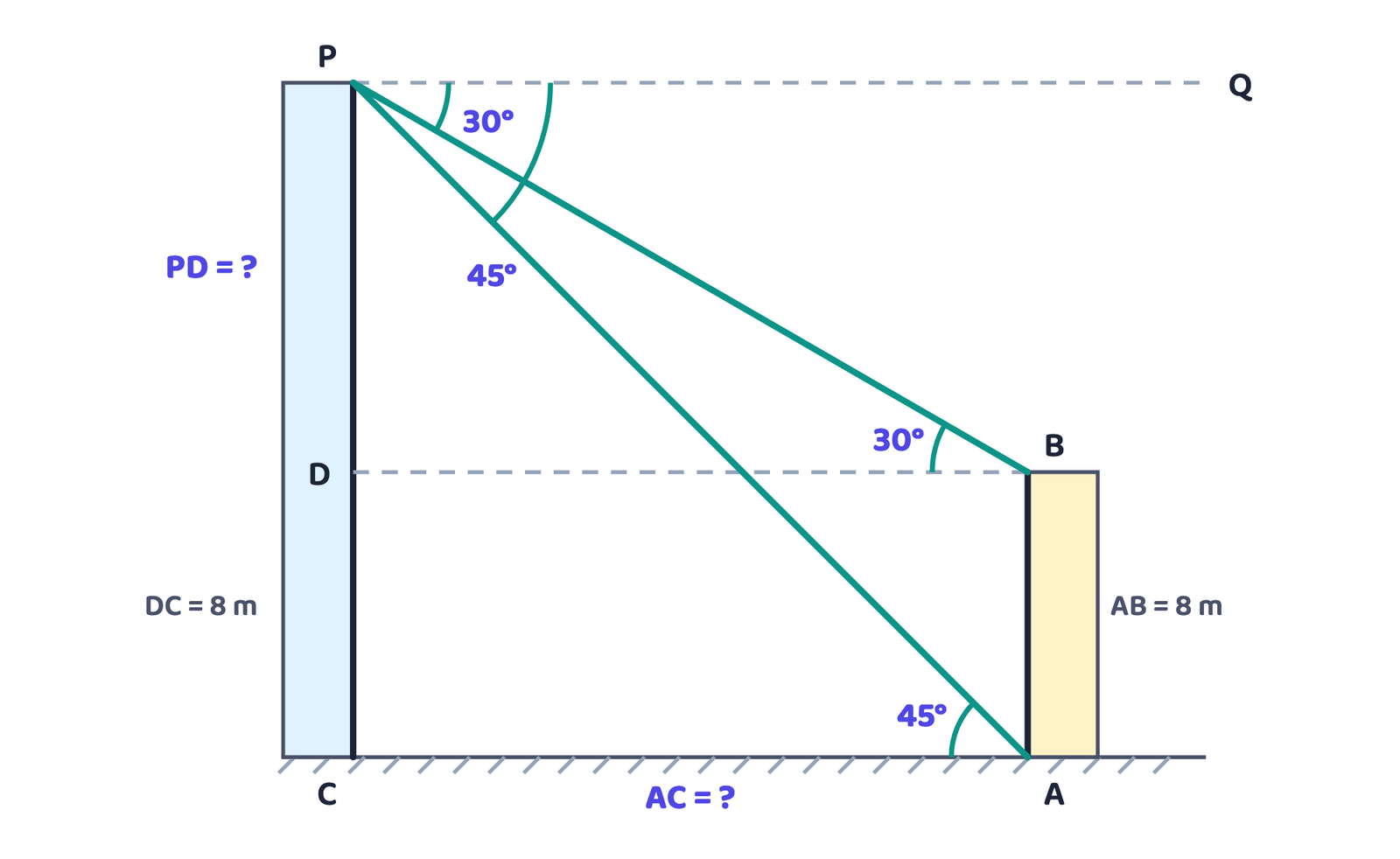
Q. The angles of depression of the top and the bottom of an 8 m tall building from the top of a multi-storeyed building are 30° and 45°, respectively. Find the height of the multi-storeyed building and the distance between the two buildings.
Figure 9: Example 6 (NCERT Fig. 9.9): buildings PC and AB = 8 m; angles of depression 30° (to B) and 45° (to A) from P.
AB=8 m (B top, A bottom). PQ is the horizontal through P; D is the point on PC level with B, so BD is horizontal. ∠QPB=30°, ∠QPA=45°given; we need height PC and distance AC
PB is a transversal to the parallel lines PQ and BD, so ∠PBD=∠QPB=30°alternate angles
In the same way (PQ is parallel to the ground AC and PA is a transversal), ∠PAC=∠QPA=45°alternate angles
In right △PBD: BDPD=tan30°=31⇒BD=PD3
In right △PAC: ACPC=tan45°=1⇒PC=AC
ABDC is a rectangle, so AC=BD and DC=AB=8. Then PC=PD+8 and PC=AC=BD=PD3, so PD+8=PD3equate the two expressions for PC
PD=3−18=(3−1)(3+1)8(3+1)=4(3+1) mrationalise: multiply top and bottom by 3+1; (3−1)(3+1)=3−1=2
PC=4(3+1)+8=4(3+3) m
Answer
The multi-storeyed building is 4(3+3) m high (about 18.93 m), and the distance between the buildings is also 4(3+3) m.
4.7 Example 7: Width of a river from a bridge
Example 7
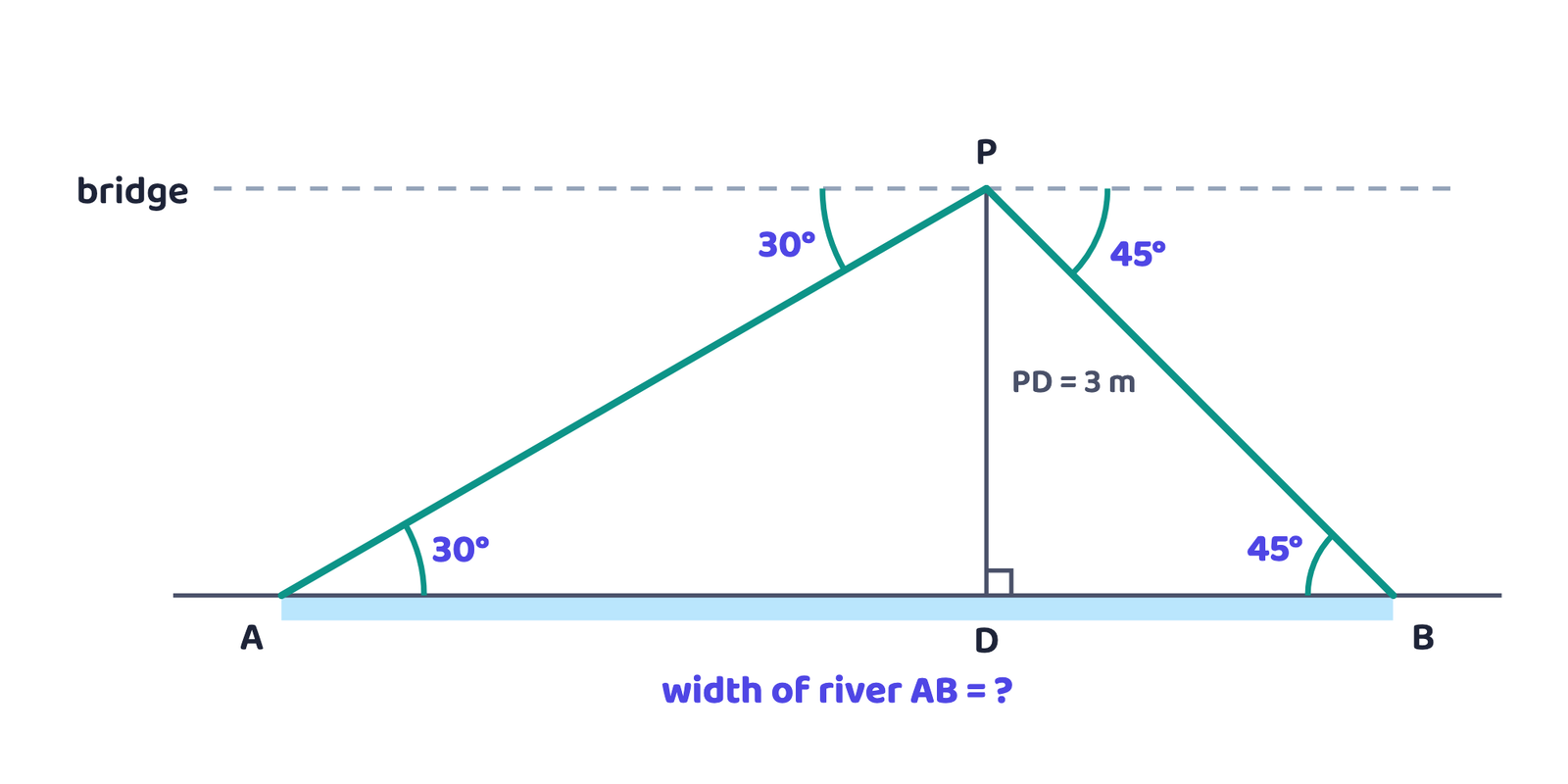
Q. From a point on a bridge 3 m above the banks, the angles of depression of the banks on opposite sides of the river are 30° and 45°. Find the width of the river.
Figure 10: Example 7 (NCERT Fig. 9.10): bridge point P, PD = 3 m, depressions 30° and 45°.
D is the point on the ground directly below P; PD=3 m. By alternate angles (Section 1.1), ∠A=30°, ∠B=45°given; we need width AB=AD+DB
In right △APD: tan30°=ADPD⇒31=AD3
AD=33 m
In right △PBD: ∠B=45°, so BD=PD=3 mtan45°=1
AB=33+3=3(3+1) m
Answer
The width of the river is 3(3+1) m (about 8.20 m).
5 Problem Types at a Glance
Every question in NCERT’s Exercise 9.1 (Q1 to Q15) is one of these shapes. Spot the shape first.
Shape
What to do
Seen in
One triangle, one angle
One ratio, one step
Ex 1, 2; Q1, Q2, Q3, Q4, Q5
Observer’s height given
Work above eye level, add the height at the end
Ex 3; Q6, Q14
One object standing on another (flagstaff on a building), two angles from one point
Two triangles sharing the same base
Ex 4; Q7, Q8
Two points on one line (the shadow grows, or the observer walks)
Call the short base x, the long base x + (the extra distance)
Ex 5; Q6, Q11, Q14, Q15
Angles of depression from a height
Draw the horizontal, copy the angle down (alternate angles)
Ex 6, 7; Q12, Q13, Q15
Point between two objects, or above two banks
The two distances add up to the total (x and total −x)
Ex 7; Q10
Two objects, each seen from the foot of the other
Same distance, two heights
Q9
6 Summary
Quick Revision: read this the night before the exam
Line of sight: from the observer’s eye to the point viewed
Angle of elevation: object above the horizontal, head raised
Angle of depression: object below the horizontal, head lowered
Both are measured from the horizontal through the eye
Elevation of B from A = depression of A from B (alternate angles)
Heights, lengths and distances that cannot be measured directly are found with the help of trigonometric ratios
tan (or cot) for height and distance; sin (or cosec) for height and a slanting length; cos (or sec) for distance and a slanting length
Two angles means two right triangles sharing a side: write both equations and solve together