
Complete solutions to all 4 in-text questions and all 12 exercise questions from the NCERT textbook Science, Chapter 10
“The Human Eye and the Colourful World”, English edition. Try answering each question yourself
first, then check it against these.
A In-text Questions
The question boxes printed inside the chapter, after the sections they test, answered first in book order. The end-of-chapter exercises follow below.
Questions after Section 10.2
Q. What is meant by power of accommodation of the eye?
Answer: It is the ability of the eye lens to adjust its focal length (with the help of the ciliary muscles) so that both near and distant objects can be focused clearly on the retina.
Q. A person with a myopic eye cannot see objects beyond 1.2 m distinctly. What should be the type of the corrective lens used to restore proper vision?
Answer: A concave (diverging) lens of suitable power. It must form the image of a distant object at the person’s far point, 1.2 m, so its focal length is f = −1.2 m and its power is P = 1/f = 1/(−1.2) ≈ −0.83 D.
Q. What is the far point and near point of the human eye with normal vision?
Answer: For a young adult with normal vision, the near point is about 25 cm from the eye, and the far point is at infinity.
Q. A student has difficulty reading the blackboard while sitting in the last row. What could be the defect the child is suffering from? How can it be corrected?
Answer: The student cannot see distant objects clearly, so the defect is myopia (near-sightedness). It can be corrected by using a concave lens of suitable power, which brings the image of the blackboard back onto the retina.
B End-of-chapter Exercises
1The human eye can focus on objects at different distances by adjusting the focal length of the eye lens. This is due to
Q. (a) presbyopia. (b) accommodation. (c) near-sightedness. (d) far-sightedness.
Answer: (b) Accommodation. This is the eye lens’s own ability to adjust its focal length;
presbyopia is a defect that reduces this ability with age, not the ability itself.
2The human eye forms the image of an object at its
Q. (a) cornea. (b) iris. (c) pupil. (d) retina.
Answer: (d) Retina. The eye lens forms an inverted, real image of the object on the
retina, the light-sensitive screen at the back of the eye.
3The least distance of distinct vision for a young adult with normal vision is about
Q. (a) 25 m. (b) 2.5 cm. (c) 25 cm. (d) 2.5 m.
Answer: (c) 25 cm. This is the near point of a normal young adult eye.
4The change in focal length of an eye lens is caused by the action of the
Q. (a) pupil. (b) retina. (c) ciliary muscles. (d) iris.
Answer: (c) Ciliary muscles. They change the curvature of the eye lens, which changes
its focal length.
5A person needs a lens of power −5.5 dioptres for correcting his distant vision. For correcting his near vision he needs a lens of power +1.5 dioptre. What is the focal length of the lens required for correcting (i) distant vision, and (ii) near vision?
Given
(distant vision), (near vision)
Find
and
Answer: Using :
(i) , about (a concave lens, for distant vision).
(ii) , about (a convex lens, for near vision).
6The far point of a myopic person is 80 cm in front of the eye. What is the nature and power of the lens required to correct the problem?
Given
Far point = 80 cm = (myopic eye)
Find
Nature and power of the corrective lens
Answer: A concave lens is needed. To form the image of a distant object () at
the far point, , so .
(a concave lens).
7Make a diagram to show how hypermetropia is corrected. The near point of a hypermetropic eye is 1 m. What is the power of the lens required to correct this defect? Assume that the near point of the normal eye is 25 cm.
Given
Near point of the hypermetropic eye = 1 m; normal near point = 25 cm =
Find
Power of the corrective lens
Answer: The labelled diagram below shows hypermetropia and its correction with a convex lens.
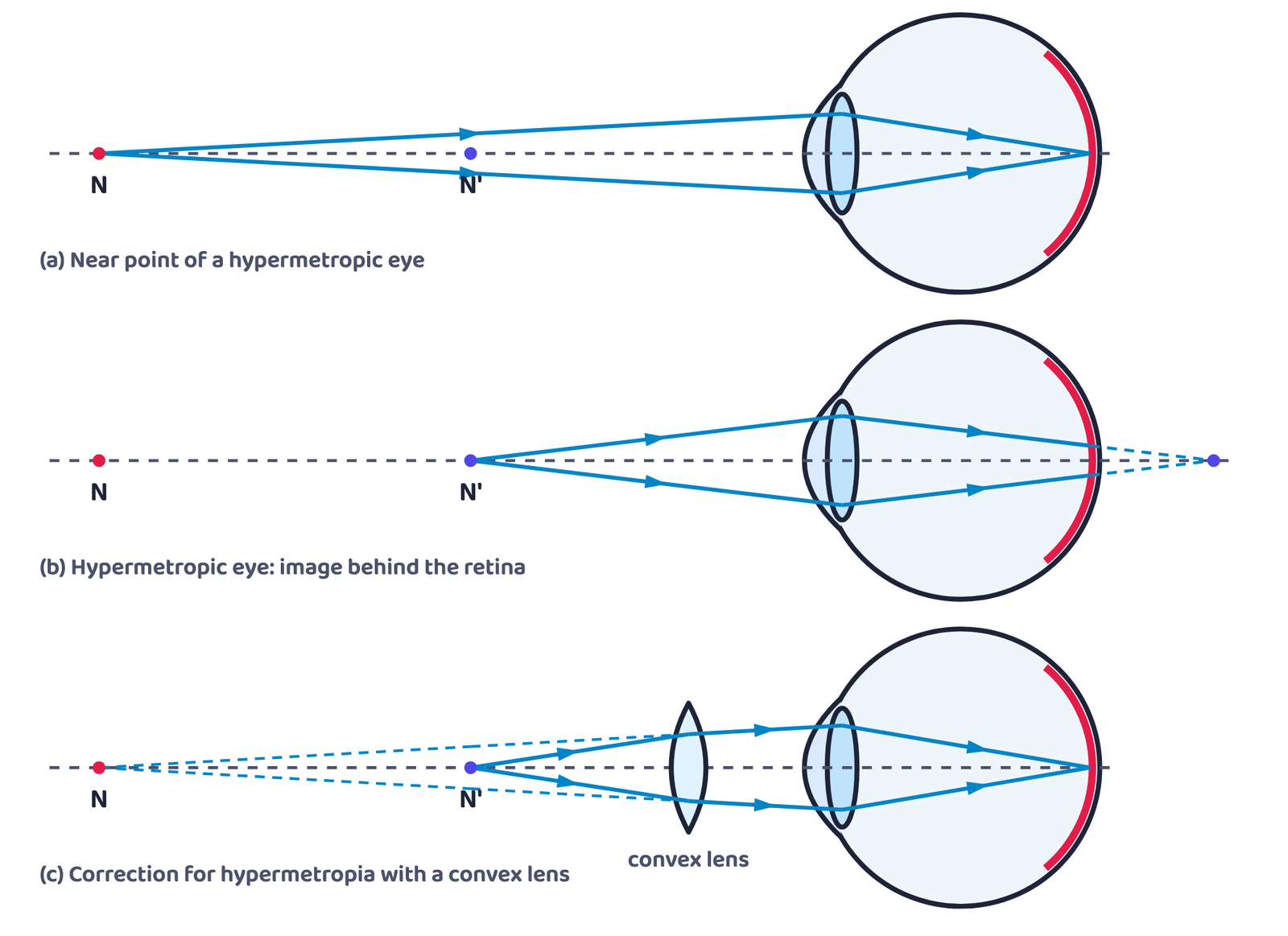
An object at the normal near point () must appear to be at the person’s own
near point ():
, so (a convex lens).
8Why is a normal eye not able to see clearly the objects placed closer than 25 cm?
Answer: The ciliary muscles can only increase the curvature of the eye lens up to a
certain maximum, which sets a minimum limit on the eye lens’s focal length. An object closer than
25 cm would need the lens to curve even more than this maximum to bring its image onto the retina,
which the eye cannot do. So objects closer than 25 cm appear blurred, or cause the eyes to strain.
9What happens to the image distance in the eye when we increase the distance of an object from the eye?
Answer: The image distance, the fixed distance from the eye lens to the retina, does not
change, because the shape of the eyeball itself does not change. Instead, the ciliary muscles
adjust the curvature, and so the focal length, of the eye lens (accommodation), so that the image
keeps forming exactly on the retina however far away the object is.
10Why do stars twinkle?
Answer: Starlight is continuously refracted as it travels down through the Earth’s
atmosphere, a medium whose refractive index keeps changing. Since the atmosphere bends the light
towards the normal, the star’s apparent position keeps shifting slightly, and because stars are so
distant that they act as point-sized sources, this makes both their apparent position and their
brightness fluctuate, seen by us as twinkling.
11Explain why the planets do not twinkle.
Answer: Planets are much closer to the Earth than stars, so they are seen as extended
sources, effectively a large collection of point-sized sources of light bundled together. The
brightness fluctuations from all of these individual points, caused by atmospheric refraction,
average out to nearly zero across the whole planet’s disc, so the net twinkling effect disappears.
12Why does the sky appear dark instead of blue to an astronaut?
Answer: The blue colour of the sky is caused entirely by the scattering of sunlight by
fine particles in the Earth’s atmosphere. An astronaut is far above almost all of the atmosphere,
so there are very few particles left to scatter light towards their eyes, and the sky appears
dark instead of blue.