
- How a neuron is built, and how it carries a signal from one end to the other
- What a reflex action is, and why the body uses a reflex arc instead of waiting for the brain
- The three main parts of the human brain, what each one controls, and how the nervous tissue is protected
- How plants respond to touch, light, gravity and water without any nerves or muscles at all
- The four plant hormones, what each one does, and how auxin actually makes a shoot bend towards light
- The major human endocrine glands, the hormone each one releases, and how a feedback mechanism keeps hormone levels correct
central nervous systemperipheral nervous systemfore-brainhind-brain
cerebellummedullatropismphototropismgeotropism
auxingibberellincytokininabscisic acidhormone
endocrine glandadrenalinethyroxingoitreinsulin
feedback mechanism
1 The Nervous System in Animals
Every living thing has to react to a change around it: a bright light, a hot object, a sound, a smell. This is called control and coordination. It has to be controlled carefully, because the right response depends on exactly what happened. You whisper to a friend sitting next to you in class, but you would shout to someone standing far away: the situation decides the response. In animals, this job is done by two systems working together: the nervous system (this section) and hormones (Section 3). Multicellular organisms use specialised tissue for this, in the same way they use specialised tissue for digestion or breathing.
1.1 How the Body Detects a Change: Receptors
Before the body can respond to anything, it first has to detect it. Every piece of information from outside, light, sound, smell, taste, touch, is picked up by specialised tips of nerve cells called receptors. Receptors are usually found in our sense organs: the eyes, the inner ear, the nose, the tongue and the skin. Different receptors are built to detect different things: gustatory receptors (on the tongue) detect taste, and olfactory receptors (in the nose) detect smell.
Put some sugar in your mouth and notice the taste. Now hold your nose shut between your finger and thumb and taste the sugar again. Most students find the taste is much weaker, or even that they cannot tell it is sugar at all. Try the same thing while eating your lunch.
This happens because taste and smell work together: a lot of what we call “taste” is actually the nose’s olfactory receptors picking up smell from the food. Block the nose, and only the tongue’s gustatory receptors are left working, so the taste seems duller. This is also why food tastes bland when you have a bad cold.
1.2 The Neuron: the Nervous System’s Building Block
A neuron (nerve cell) is the basic structural and functional unit of the nervous system. It is specialised to carry information as an electrical impulse from one part of the body to another.

The same kind of gap exists where a neuron’s axon meets a muscle or a gland instead of another neuron. This is called a neuromuscular junction, and it works the same way: a chemical crosses the gap and sets off the muscle’s own response.
A synapse is the tiny gap between the axon end of one neuron and the dendrite of the next neuron (or a muscle/gland). Information crosses this gap as a chemical, not as an electrical impulse.
“What happens at the synapse between two neurons?” is one of the book’s own end-of-section questions. Answer in order: the electrical impulse reaches the end of the axon, this releases a chemical, the chemical crosses the synapse, and it starts a new electrical impulse in the dendrite of the next neuron.
1.3 Reflex Actions and the Reflex Arc
We use the word “reflex” for something we do without thinking: pulling a hand back from a flame, jumping out of the way of a bus, or a hungry mouth watering at the smell of food.
A reflex action is a sudden, automatic response to a change in the environment, made without conscious thought.
Why can’t we simply think our way through danger instead? Thinking needs a dense, complicated network of neurons, and that takes time. Even a fraction of a second’s delay could mean a burn. The body’s solution is to connect the nerve that detects the danger directly to the nerve that moves the muscle, at the closest possible point, which is the spinal cord, rather than routing the signal all the way up to the brain and back.
A reflex arc is the pathway along which a nerve impulse travels during a reflex action: from the receptor, through a sensory neuron, into the spinal cord, and out through a motor neuron to the effector (muscle or gland). It does not wait for the brain to respond, though the same information also travels on to the brain.
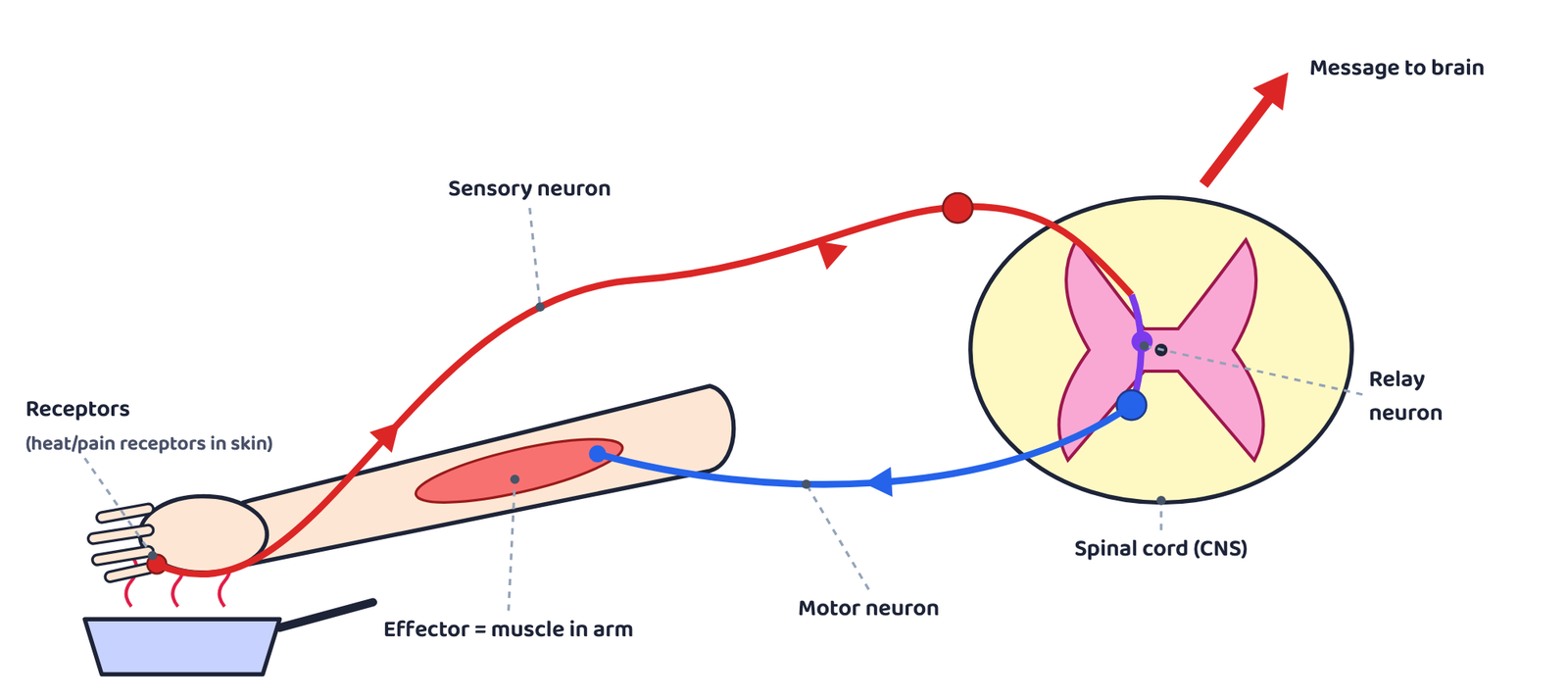
Receptor to Effector, five stops on the way
Receptor, sensory neuron, spinal cord, motor neuron, effector, in that order, every single time. If a question asks you to trace a reflex, write these five words in order and you have the full answer.
Reflex arcs almost certainly evolved before complex thinking did: many animals have very little of the neuron network needed for real thought, and even in animals (like us) that do have that network, reflexes are still faster and are kept for emergencies.
1.4 The Human Brain: the Coordinating Centre
The central nervous system (CNS) is made up of the brain and the spinal cord. It receives information from the whole body and decides how to respond.
The peripheral nervous system (PNS) connects the CNS to the rest of the body. It has two parts: cranial nerves coming out of the brain, and spinal nerves coming out of the spinal cord.
The brain does more than run reflexes: it lets us think and decide, for example while writing, talking, moving a chair or clapping. These are voluntary actions, based on a decision. The brain has three major regions, each doing a different part of this job.
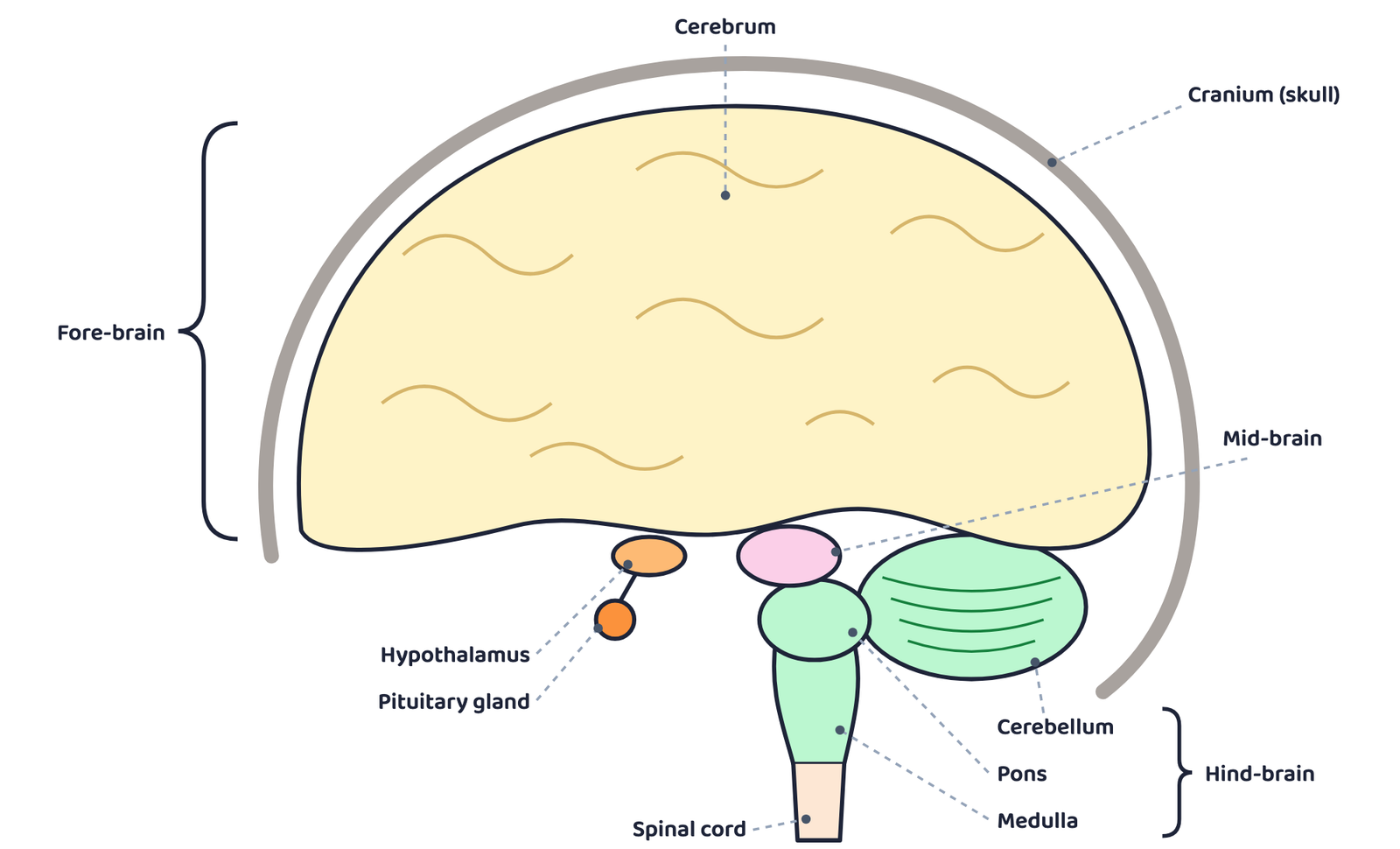
| Brain region | What it does |
|---|---|
| Fore-brain | The main thinking part. Has separate sensory areas for hearing, smell and sight; “association areas” that combine this sensory information with memory to interpret it; motor areas that send instructions to voluntary muscles; and a separate hunger centre that tells you when you have eaten enough. |
| Mid-brain and hind-brain (medulla) | Control involuntary actions you do not consciously think about: blood pressure, salivation and vomiting. |
| Hind-brain (cerebellum) | Keeps voluntary movements precise and maintains posture and balance, for example walking in a straight line, riding a bicycle or picking up a pencil. |
Involuntary actions. Our mouth waters when we see food we like, and our heart beats, without our meaning to; we cannot easily control these actions by thinking about them. So, in between simple reflex actions like the change in the size of the pupil and thought-out actions such as moving a chair, there is another set of muscle movements over which we have no thinking control. Many of these involuntary actions are controlled by the mid-brain and hind-brain; all those including blood pressure, salivation and vomiting are controlled by the medulla in the hind-brain.
Do not mix up the CNS and the PNS. The CNS (brain + spinal cord) is where information is processed and decisions are made. The PNS (cranial + spinal nerves) is only the wiring that carries signals between the CNS and the rest of the body; it does not itself decide anything.
1.5 Protecting the Nervous Tissue
The brain and spinal cord are extremely delicate but essential, so the body protects them carefully.
The skull
A hard bony box that encloses and shields the brain from outside knocks.
Cushioning fluid
Inside the skull, the brain sits in a fluid-filled balloon that absorbs shocks, like packing material around something fragile.
The vertebral column
The backbone, the hard bumpy structure you can feel running down the middle of your back, encloses and protects the spinal cord.
1.6 How Muscles Move: Nervous Tissue Causes Action
Detecting a signal and deciding what to do about it is only half the job; muscles then have to actually carry out the movement. When a nerve impulse reaches a muscle fibre, special proteins inside the muscle cell change both their shape and their arrangement. This new arrangement makes the muscle cell shorter, which is what we feel as the muscle contracting.
| Feature | Reflex action | Voluntary action | Involuntary action |
|---|---|---|---|
| Controlled by | Spinal cord (arc), signal also reaches the brain | Fore-brain (a conscious decision) | Mid-brain and hind-brain (medulla) |
| Under our conscious control? | No, automatic | Yes, we decide to do it | No, happens on its own |
| Speed | Very fast | Slower, thinking takes time | Continuous, ongoing |
| Example | Pulling a hand back from a flame; change in the size of the pupil | Writing, talking, moving a chair | Heartbeat, blood pressure, salivation, vomiting |
Whatever the trigger, the same basic route is followed: a receptor detects it, a nerve or nerves carry the message, and a muscle or gland finally acts on it.
Section 1 in one line
2 Coordination in Plants
Plants have no nervous system and no muscles at all, yet they clearly respond to their surroundings: a touched sensitive plant folds its leaves, and a growing seedling sends its root down and its stem up. How do they manage this without a single nerve cell?
2.1 Two Kinds of Movement in Plants
Not connected to growth
- Fast and reversible
- Example: the sensitive plant folding its leaves on touch
- No growth is involved in this movement
Caused by growth
- Slow and directional
- Example: a seedling’s root going down, stem coming up
- If the plant is prevented from growing, it shows no movement
2.2 Immediate Response to Stimulus: the Sensitive Plant
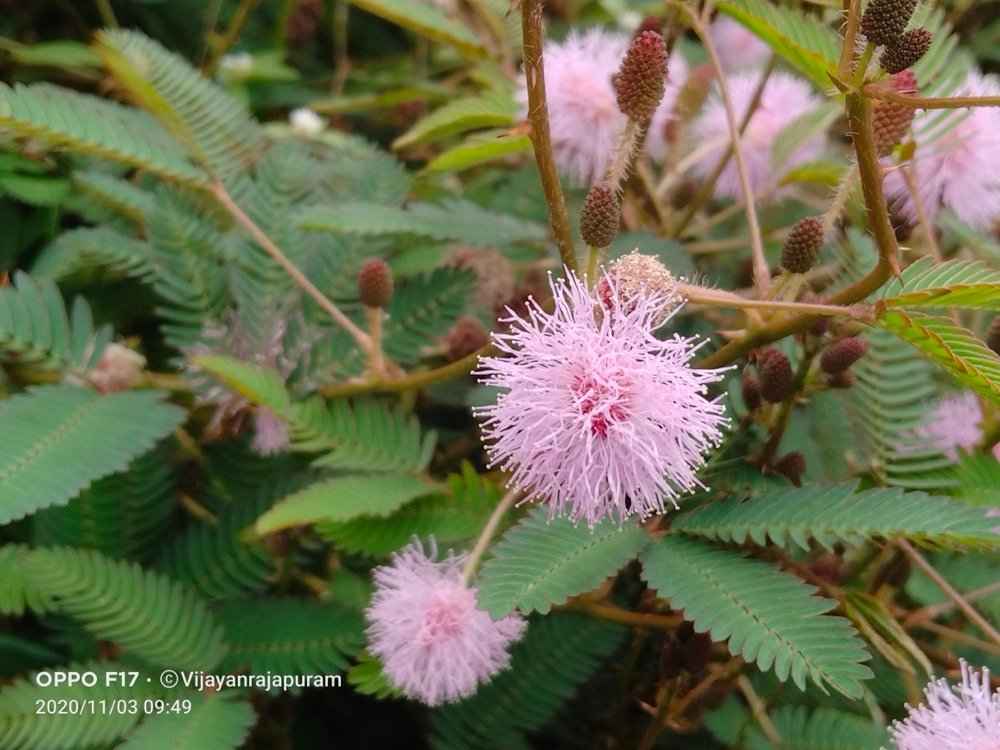
The point where the plant moves is not the same as the point where it was touched, so the information has to travel there first. Plants pass this information from cell to cell using a signal that is partly electrical and partly chemical, the same basic idea as a nerve impulse crossing a synapse, but unlike animals, they have no specialised tissue built for carrying it. And instead of the special proteins that change shape and arrangement in animal muscle cells (Section 1.6), plant cells change shape by changing how much water they hold: taking in water makes a cell swell, and losing water makes it shrink. This swelling and shrinking of cells at the base of the leaf is what folds the leaves of the sensitive plant.
2.3 Movement Due to Growth: Climbing Tendrils
A pea plant climbs a support using tendrils that are sensitive to touch. When a tendril touches a support, the side of the tendril touching the support grows more slowly than the side away from it. This uneven growth makes the tendril curl around the support and cling to it. This is a growth movement, not an instant one like the sensitive plant’s leaves.
2.4 Tropisms: Directional Growth Movements
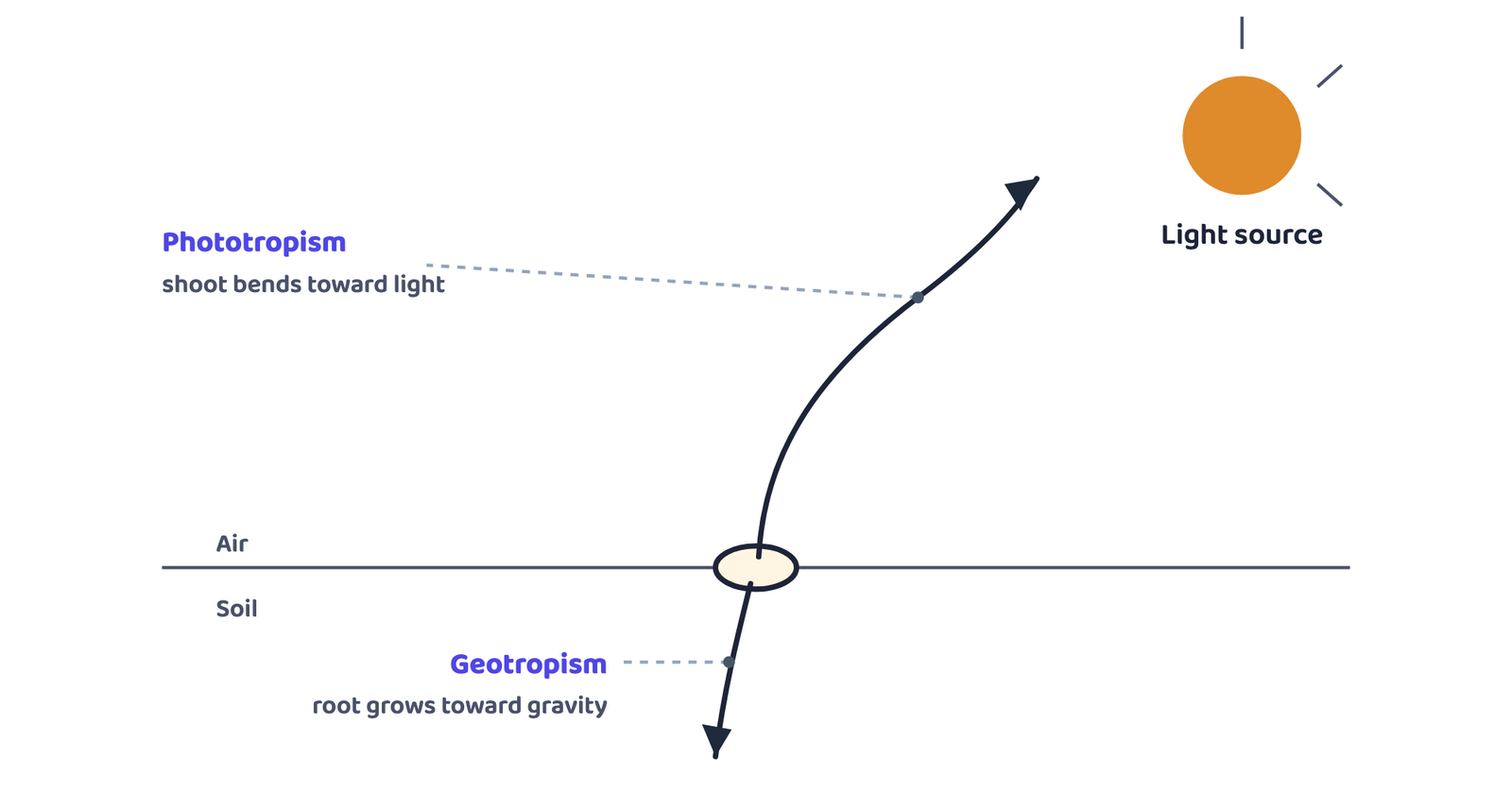
A conical flask is filled with water and its neck covered with a wire mesh. Two or three freshly germinated bean seeds are kept on the mesh, and the flask is placed inside a cardboard box that is open on one side, with the open side facing light coming from a window. After two or three days: the shoots bend towards the light and the roots bend away from it. The flask is then turned so that the shoots face away from the light and the roots towards it, and left undisturbed for a few days. Result: the old parts of the shoot and root do not change direction, but the new growth bends again, the shoot towards the light and the root away from it. Conclusion: light is an environmental trigger that changes the direction in which plant parts grow (phototropism), and this response happens through growth.
A tropism is the directional growth of a plant part, towards a stimulus or away from it, in response to something in the environment such as light, gravity or water.
2.5 Plant Hormones
A hormone is a chemical substance produced in one part of an organism and transported to another part, where it produces an effect. Plant hormones are synthesised at places away from where they act and simply diffuse to the area of action.
Auxin is the hormone behind phototropism, and it is worth following the mechanism closely because “how does phototropism occur” is one of the chapter’s own exercise questions.
| Plant hormone | What the book says about where it is found | Effect |
|---|---|---|
| Auxin | Synthesised at the shoot tip; diffuses towards the shady side | Helps cells grow longer; causes the shoot to bend towards light (phototropism); the book also asks how auxins promote the growth of a tendril around a support |
| Gibberellin | Not specified (it acts on the stem) | Helps in the growth of the stem, like auxin |
| Cytokinin | Present in greater concentration in areas of rapid cell division, such as fruits and seeds | Promotes cell division |
| Abscisic acid | Not specified | Inhibits growth; its effects include wilting of leaves |
3 hormones say “grow”, 1 hormone says “stop”
Auxin, gibberellin and cytokinin all promote growth in some way. Abscisic acid is the odd one out: it is the growth inhibitor, and the one to name whenever a question asks about a hormone that stops or slows growth.
3 Hormones in Animals: the Endocrine System
Imagine a squirrel that suddenly spots a predator. Its whole body has to prepare to fight or run, at the same time, in many different tissues at once. Nerve impulses alone cannot do this well, because they only reach cells that are directly wired up by nervous tissue. This is where a chemical signal, a hormone, has the advantage: released into the blood, it can reach every single cell in the body.
3.1 Electrical Signals vs Chemical Signals
Nervous (electrical) signal
- Very fast
- Reaches only cells connected by nervous tissue
- A cell needs a short recovery time before it can send another impulse, so it cannot keep signalling non-stop
Hormonal (chemical) signal
- Slower
- Can reach every cell of the body, through the blood
- Can act steadily and persistently
3.2 Adrenaline: the Fight-or-Flight Hormone
An endocrine gland is a gland that releases its hormone directly into the blood, rather than through a duct. Endocrine glands, taken together, make up the endocrine system, which is the body’s second system of control and coordination alongside the nervous system.
Adrenaline is secreted directly into the blood by the adrenal glands. It prepares the whole body for an emergency.
Heart
Beats faster, sending more oxygen to the muscles.
Digestion and skin
Blood flow to these is reduced, freeing up blood for the muscles instead.
Breathing
Rate increases, because the diaphragm (the sheet of muscle below the lungs that helps you breathe) and the rib muscles contract more.

3.3 The Major Endocrine Glands and Their Hormones
| Hormone | Endocrine gland | Function |
|---|---|---|
| Growth hormone | Pituitary gland | Stimulates growth in all organs of the body |
| Thyroxin | Thyroid gland | Regulates carbohydrate, protein and fat metabolism for the best balance of growth |
| Insulin | Pancreas | Regulates blood sugar level |
| Testosterone | Testes | Brings about the physical changes of puberty in males |
| Oestrogen | Ovaries | Development of female sex organs; regulates the menstrual cycle |
| Adrenaline | Adrenal gland | Prepares the body for an emergency: faster heartbeat, more blood to the muscles, faster breathing |
| Releasing hormones | Hypothalamus (part of the brain) | Stimulate the pituitary gland to release its own hormones |
Iodine is needed by the thyroid gland to make thyroxin, which is why we use iodised salt. A diet short of iodine can lead to goitre, a disease with a swollen neck as one of its symptoms, because the thyroid gland enlarges while trying to make enough thyroxin.
The hypothalamus (part of the brain) plays a big role in releasing many hormones. For example, when growth hormone in the blood is low, the hypothalamus releases a “growth hormone releasing factor” that tells the pituitary gland to release more growth hormone. This is a hormone that controls the release of another hormone.
The pituitary’s growth hormone regulates the growth and development of the whole body. A deficiency of this hormone in childhood leads to dwarfism (unusually short height); too much of it leads to unusually tall height. Around 10 to 12 years of age, testosterone (in males) and oestrogen (in females) bring about the physical changes of puberty. Insulin, from the pancreas, keeps blood sugar under control; if it is not made in the right amount, blood sugar rises, which is diabetes, sometimes treated with insulin injections.
3.4 The Feedback Mechanism
A feedback mechanism is how the body keeps a hormone’s timing and amount correct: a change in the body is detected, the right amount of hormone is released to fix it, and the release is adjusted again once the change is corrected.
Q. A student eats a large, sugary meal. Trace what happens to insulin secretion right after the meal, and again a couple of hours later.
Right after the meal: blood sugar rises sharply as sugar is absorbed into the blood. Cells of the pancreas detect this rise and respond by secreting more insulin, which brings the blood sugar level back down.
A couple of hours later: blood sugar has fallen back close to normal. The pancreas detects this fall and reduces its insulin secretion accordingly.
Answer: insulin secretion rises just after the meal, then falls again as blood sugar returns to normal, exactly the feedback mechanism described above.
A “compare nervous and hormonal coordination” question (asked directly in this chapter’s exercises) is really asking for two lists: nervous is electrical, very fast, short-lived and reaches only connected cells; hormonal is chemical, slower, longer-lasting and reaches the whole body through the blood. Write both sides, don’t just describe one.
Nerves handle anything that has to happen right now; hormones handle anything that has to happen everywhere, and keep happening.
This chapter in one line
- Can I label a neuron’s dendrite, cell body, axon and synapse without looking?
- Can I list the five parts of a reflex arc, in order?
- Can I name the three brain regions and one function of each?
- Can I explain, step by step, how auxin makes a shoot bend towards light?
- Can I name all four plant hormones and say which one stops growth?
- Can I fill in every row of the hormone-gland-function table from memory?
- Can I explain the blood-sugar feedback mechanism in my own words?
- A neuron carries an impulse: dendrite receives it, cell body and axon pass it on, synapse hands it to the next cell as a chemical
- A reflex arc (receptor, sensory neuron, spinal cord, motor neuron, effector) is faster than waiting for the brain to decide
- Fore-brain thinks and senses; mid-brain and the medulla (hind-brain) run involuntary actions; the cerebellum (hind-brain) manages balance
- The skull, a fluid cushion and the vertebral column protect the brain and spinal cord
- Plants have no nerves or muscles; the sensitive plant moves by changing water content in its cells, not by contracting proteins
- Tropisms are directional growth: phototropism (light), geotropism (gravity), hydrotropism (water), chemotropism (chemicals)
- Auxin makes a shoot bend towards light by making the shady-side cells grow longer; gibberellin and cytokinin also promote growth, abscisic acid inhibits it
- The endocrine system is the body’s second control system: adrenaline (fight-or-flight), thyroxin (metabolism), insulin (blood sugar), growth hormone, testosterone/oestrogen (puberty)
- A feedback mechanism keeps hormone release correct, as shown by blood sugar and insulin regulating each other