
Complete solutions to all 12 in-text questions, the questions asked in Activities 7.1 to 7.7 and in the running text, and all 11 end-of-chapter exercise questions from NCERT Science, Chapter 7 “How do Organisms Reproduce?”, in the English edition’s own wording. Try working out the answer yourself first, then check it against this one.
A In-text Questions
The question boxes printed inside the chapter, the questions asked in the activities, and the questions the running text puts to the reader, answered first in book order. The end-of-chapter exercises follow below.
Questions after Section 7.1
Q. What is the importance of DNA copying in reproduction?
Answer: The DNA in the nucleus carries the information for making proteins, and this information decides the body design of the organism. So the basic event in reproduction is the creation of a DNA copy: each new cell or offspring must receive a copy of the DNA, along with additional cellular apparatus, so that it can have the same body design as the parent and function independently. DNA copying is never absolutely accurate, and the small variations it produces are the basis for the evolution of species.
Q. Why is variation beneficial to the species but not necessarily for the individual?
Answer: If the niche (environment) of a population changes drastically, for example because of a rise in water temperature, a population whose members are all identical could be wiped out completely. If there are variations, some individuals (for example, bacteria that can resist heat) may survive and continue the species, so variation helps the species to survive over time. For an individual, however, a variation may be of no use, or may even be harmful (a variation that is too drastic may not let the cell survive at all), so variation does not necessarily benefit the individual.
Section 7.2: Activities 7.1 to 7.6 and in-text prompts
Q. Compare and contrast the ways in which yeast grows in the first case, and how mould grows in the second.
Answer: Yeast (Activity 7.1) is a single-celled organism. In the warm sugar solution each yeast cell puts out small buds that separate and grow further into new yeast cells, so the slide shows separate single cells, some with buds still attached. Bread mould (Activity 7.2) is a simple multicellular organism. Over the week, thread-like structures (hyphae) spread over the bread, and tiny blob-on-a-stick structures appear. The blobs are sporangia, which contain spores that can develop into new Rhizopus individuals; the hyphae themselves are not reproductive parts.
Similarity: both arise from a single parent, so both are asexual reproduction. Difference: yeast multiplies by budding of single cells, while the mould spreads by hyphae and reproduces through spores formed in sporangia.
Q. Observe a permanent slide of Amoeba, and another permanent slide of Amoeba showing binary fission. Now, compare the observations of both the slides.
Answer: The first slide shows a single Amoeba cell with one nucleus. The second shows the same kind of cell dividing: the nucleus divides and then the cell splits, so one parent cell gives two daughter Amoebae (Figure 7.1(a)). This is binary fission. In Amoeba the splitting of the two cells can take place in any plane.
Q. (i) Can you identify different tissues in the Spirogyra filaments? (ii) Spirogyra simply breaks up into smaller pieces upon maturation, and these fragments grow into new individuals. Can we work out the reason for this, based on what we saw in Activity 7.4?
Answer: (i) No. A Spirogyra filament is a simple chain of similar cells; it has no different tissues. (ii) Because every cell of the filament is alike and there are no tissues or organs that have to be placed at definite positions in the body, any fragment already has all that the organism needs. So each fragment can simply grow into a complete new filament. This is fragmentation. It would not work in organisms whose specialised cells are organised into tissues and organs.
Q. (i) Take a potato and observe its surface. Can notches be seen? (ii) Which are the potato pieces that give rise to fresh green shoots and roots?
Answer: (i) Yes. The surface of a potato has small notches, each with a bud in it. (ii) Only the pieces that contain a notch (bud) give rise to fresh green shoots and roots; the pieces without a notch do not. So it is the bud that develops into a new plant. This is vegetative propagation. In the same way, buds produced in the notches along the leaf margin of Bryophyllum fall on the soil and develop into new plants.
Q. (i) Which ones grow and give rise to fresh leaves? (ii) What can you conclude from your observations?
Answer: (i) The money-plant pieces that contain at least one leaf grow and give rise to fresh leaves (and roots). The portions cut from between two leaves do not grow. (ii) A new money-plant can grow from a stem piece only if the piece carries a leaf, with the bud at its base; a bare piece of stem from between two leaves cannot. So money-plant can be propagated vegetatively, by stem cuttings that carry a leaf.
Questions after Section 7.2
Q. How does binary fission differ from multiple fission?
Answer: In binary fission, the parent cell divides into two daughter cells, for example in Amoeba and Leishmania (and many bacteria). In multiple fission, the parent cell divides into many daughter cells at the same time, for example in the malarial parasite Plasmodium.
Q. How will an organism be benefited if it reproduces through spores?
Answer: Spores are produced in large numbers inside sporangia, so many new individuals can arise from one parent. Each spore is covered by a thick wall that protects it until it comes in contact with a moist surface, where it can begin to grow. Spores are also small and light, so they are easily spread to new places.
Q. Can you think of reasons why more complex organisms cannot give rise to new individuals through regeneration?
Answer: In complex organisms, cells are organised into tissues, tissues into organs and organs into organ systems, placed at definite positions in the body, and the cells are highly specialised. Regeneration needs specialised cells that can multiply and then change into all the different cell types and tissues needed to rebuild a complete body in the right arrangement. Complex organisms do not have such cells for the whole body, so a cut piece cannot develop into a complete new individual.
Q. Why is vegetative propagation practised for growing some types of plants?
Answer: (i) Some plants, such as banana, orange, rose and jasmine, have lost the capacity to produce seeds, so they can be grown only by vegetative propagation. (ii) Plants raised by vegetative propagation can bear flowers and fruits earlier than those produced from seeds. (iii) All plants produced this way are genetically similar enough to the parent plant to have all its characteristics, so desirable features are kept.
Q. Why is DNA copying an essential part of the process of reproduction?
Answer: Reproduction creates new individuals with the same body design as the parents, and the information for body design is carried in the DNA. Therefore, when a cell reproduces, it must make a copy of its DNA so that each daughter cell gets a complete set of this information (along with the additional cellular apparatus). Without DNA copying, the new cells would not have the instructions they need to function and to grow into the same kind of organism.
Section 7.3: in-text prompts and Activity 7.7
Q. If each new generation is the combination of the DNA copies from two pre-existing individuals, each new generation will end up having twice the amount of DNA that the previous generation had. How many ways can we think of for solving this difficulty?
Answer: The difficulty is solved only if the amount of DNA is halved at some stage, so that fusion restores, and does not double, the original amount. The solution that many multicellular organisms have found is to have special lineages of cells in specialised organs which have only half the number of chromosomes and half the amount of DNA of the non-reproductive body cells. These germ-cells are made by a cell division called meiosis. When the germ-cells from two individuals combine during sexual reproduction, the number of chromosomes and the DNA content are re-established in the new generation.
Q. What possible functions could the petals and sepals serve?
Answer: Petals and sepals carry no germ-cells, so they are not reproductive parts, but they help reproduction. Sepals, usually green, cover and protect the flower while it is still a bud. Petals surround and protect the stamens and pistil, and in many flowers they are brightly coloured or scented, which attracts insects and birds. These animals then carry pollen from one flower to another (cross-pollination).
Q. After fertilisation, the petals, sepals, stamens, style and stigma may shrivel and fall off. Have you ever observed any flower part still persisting in the fruit?
Answer: Yes. In some fruits the sepals do not fall off. For example, the green sepals stay attached at the stalk end of a tomato and a brinjal, and the dried remains of sepals can be seen at the top end of a guava or a pomegranate.
Q. Try and work out the advantages of seed-formation for the plant.
Answer: (i) The seed contains the future plant, the embryo, which develops into a seedling under appropriate conditions (germination). (ii) The tough seed coat protects the embryo. (iii) The seed carries stored food (in the cotyledons) for the young plant until it can make its own food. (iv) Seeds can wait through unfavourable conditions and germinate later, when conditions are right. (v) Seeds can be carried to new places, so the new plants do not all grow next to the parent. (vi) Seeds form after fertilisation, so each seed carries a new combination of variations from two parents.
Q. Cut open soaked seeds of Bengal gram (chana) carefully and observe the different parts. Compare your observations with Fig. 7.9 and see if you can identify all the parts.
Answer: Yes. Inside the seed coat we can identify: (i) the two cotyledons, the thick seed leaves that store food; (ii) the plumule, the future shoot; and (iii) the radicle, the future root. Plumule and radicle together form the embryo, which grows into a seedling during germination.
Q. If we look around us, what can we identify as the most important reason(s) for poor living standards?
Answer: The book points to two possible reasons. (i) Population size: an expanding population makes it harder to improve everybody’s standard of living. (ii) Inequality in society: if inequality is the main reason for poor living standards for many people, the size of the population is relatively unimportant. Looking around us, we see families with the same number of members living very differently because of unequal income, land, education and healthcare. So inequality is often the more important reason, while a fast-growing population adds to the difficulty. (This is an open question; a well-argued answer with examples from your own surroundings is what is expected.)
Questions after Section 7.3
Q. How is the process of pollination different from fertilisation?
Answer: Pollination is the transfer of pollen grains from the anther (stamen) to the stigma of a flower; it may be self-pollination (same flower) or cross-pollination (another flower), carried out by agents such as wind, water or animals. Fertilisation takes place after pollination: a pollen tube grows from the pollen grain through the style to the ovule, and the male germ-cell fuses with the female germ-cell (egg) in the ovule to form a zygote.
Q. What is the role of the seminal vesicles and the prostate gland?
Answer: The seminal vesicles and the prostate gland add their secretions to the sperms along their path. As a result the sperms are in a fluid, which makes their transport easier, and this fluid also provides nutrition to the sperms.
Q. What are the changes seen in girls at the time of puberty?
Answer: The size of the breasts begins to increase, with darkening of the skin of the nipples at the tip of the breasts; girls begin to menstruate at around this time. Thick hair grows in new parts of the body such as the armpits and the genital area between the thighs, thinner hair appears on the legs, arms and face, the skin often becomes oily and pimples may appear. These changes are brought about by hormones as the reproductive tissues mature.
Q. How does the embryo get nourishment inside the mother’s body?
Answer: The embryo gets nutrition from the mother’s blood with the help of a special tissue called the placenta. The placenta is a disc embedded in the uterine wall. It has villi on the embryo’s side, and on the mother’s side there are blood spaces that surround the villi. This gives a large surface area for glucose and oxygen to pass from the mother to the embryo. Waste substances produced by the embryo are removed by transferring them into the mother’s blood through the placenta.
Q. If a woman is using a copper-T, will it help in protecting her from sexually transmitted diseases?
Answer: No. A copper-T is an intrauterine device placed in the uterus to prevent pregnancy. It does not stop the contact between the partners or the transfer of body fluids during the sexual act, so it gives no protection against sexually transmitted diseases. Only barrier methods such as the condom help to prevent the transmission of many such infections to some extent.
B End-of-chapter Exercises
1. Asexual reproduction takes place through budding in
Q. (a) Amoeba. (b) Yeast. (c) Plasmodium. (d) Leishmania.
Answer: (b) Yeast. Yeast puts out small buds that separate and grow further into new
individuals; Amoeba and Leishmania reproduce by binary fission, and Plasmodium by multiple
fission.
2. Which of the following is not a part of the female reproductive system in human beings?
Q. (a) Ovary. (b) Uterus. (c) Vas deferens. (d) Fallopian tube.
Answer: (c) Vas deferens. The vas deferens carries sperm in the male reproductive system;
the ovary, uterus and fallopian tube are all parts of the female reproductive system.
3. The anther contains
Q. (a) sepals. (b) ovules. (c) pistil. (d) pollen grains.
Answer: (d) Pollen grains. The anther is the pollen-producing part of the stamen, the
male reproductive part of the flower.
4. What are the advantages of sexual reproduction over asexual reproduction?
Answer: Sexual reproduction combines DNA from two different individuals, each already
carrying its own accumulated variations, so it produces far more variation in the population than
asexual reproduction (which mainly relies on the small, slow variation that comes from imperfect
DNA copying alone). This variation is useful for a species: if the environment (niche) changes,
a population with more variation has a better chance that some individuals survive the change,
keeping the species going.
5. What are the functions performed by the testis in human beings?
Answer: The testis performs two functions: (i) it produces sperm, the male germ-cells,
and (ii) it secretes the hormone testosterone, which regulates the formation of sperm and also
brings about the physical changes seen in boys at puberty.
6. Why does menstruation occur?
Answer: Every month, one of the ovaries releases an egg, and the uterus lining thickens
and becomes richly supplied with blood to prepare to receive and nourish a fertilised egg. If the
egg released that month is not fertilised, it survives for only about a day, and the thickened
lining is no longer needed. So the lining breaks down and comes out through the vagina as blood
and mucus – this monthly shedding is menstruation.
7. Draw a labelled diagram of the longitudinal section of a flower
Answer: The labelled diagram is given below. To draw it, show a flower cut lengthwise through its middle (the book’s Figure 7.7). Draw the pistil in the centre, the stamens on either side of it, and the petals and then the sepals on the outside. Label these parts:
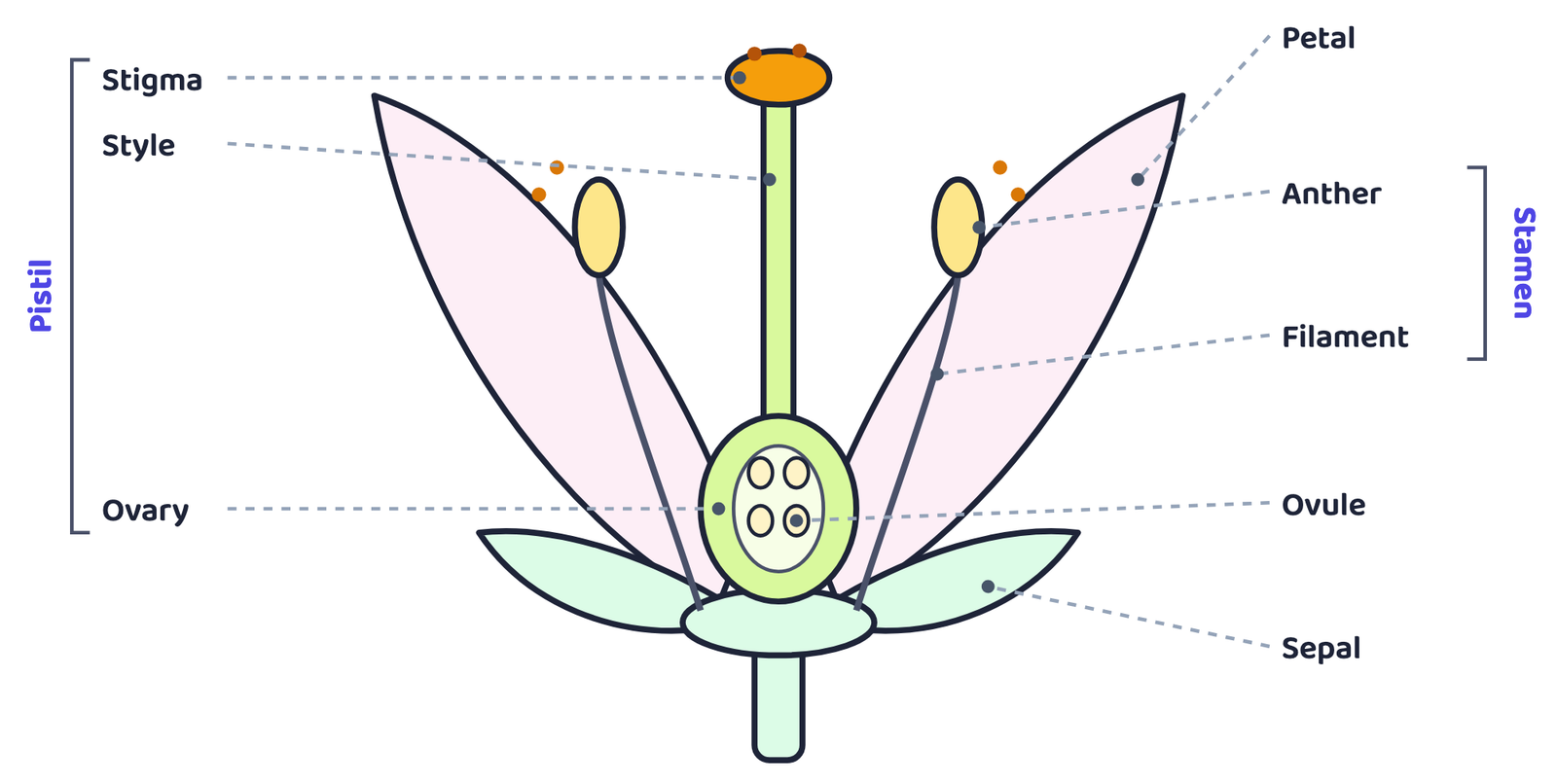
| Label | Where to draw it | Role |
|---|---|---|
| Sepal | outermost, small green leaf-like parts at the base | protects the bud |
| Petal | inside the sepals, large and often coloured | protects the reproductive parts, attracts insects |
| Stamen: filament | thin stalk of each stamen | holds up the anther |
| Stamen: anther | swollen top of each stamen | produces pollen grains (male part) |
| Pistil: stigma | top of the pistil, may be sticky | receives pollen |
| Pistil: style | middle, elongated part of the pistil | pollen tube grows through it |
| Pistil: ovary | swollen bottom part of the pistil | contains the ovules (female part) |
| Ovule | small round bodies inside the ovary | each has an egg cell |
Stamen = male reproductive part; pistil (stigma + style + ovary) = female reproductive part. A neat, fully labelled diagram scores the marks; colour is not needed.
8. What are the different methods of contraception?
Answer: The chapter groups contraceptive methods into four categories: (i)
mechanical barrier methods, such as a condom on the penis or a similar covering worn in
the vagina, which stop sperm from reaching the egg; (ii) hormonal methods, such as oral
pills, which change the body’s hormone balance so eggs are not released; (iii)
intrauterine devices (IUDs), such as the loop or copper-T, placed in the uterus; and (iv)
surgical methods, which block the vas deferens in the male or the fallopian tube in the
female so fertilisation cannot take place.
9. How are the modes for reproduction different in unicellular and multicellular organisms?
Answer: In unicellular organisms, cell division itself creates new individuals – by
binary fission (splitting into two, as in Amoeba and Leishmania) or multiple fission (splitting
into many at once, as in Plasmodium). Simple multicellular organisms with a basic body plan can
still reproduce by fragmentation (Spirogyra), since any piece can regrow into a whole individual.
But in more complex multicellular organisms, cells are organised into tissues and tissues into
organs, fixed at definite positions in the body, so cell-by-cell division would not work. These
organisms instead rely on a specific reproductive cell type and, in many cases, on the more
organised modes such as vegetative propagation or sexual reproduction.
10. How does reproduction help in providing stability to populations of species?
Answer: Reproduction lets a population of organisms keep filling the same well-defined
niche in the ecosystem, because DNA copying during reproduction keeps the body-design features
that suit that niche largely consistent from one generation to the next. At the same time,
reproduction is never perfectly exact, so it introduces some variation – and if the niche changes
for reasons beyond the organisms’ control (a change in temperature, water level, or even a
meteorite hit), that variation gives some individuals in the population a chance to survive the
change, so the population, and the species, is not simply wiped out.
11. What could be the reasons for adopting contraceptive methods?
Answer: The sexual act always carries the possibility of pregnancy, which makes major
demands on a woman’s body and mind – so contraception lets a couple choose when, and whether, to
have a child, rather than leaving it to chance. Some contraceptive methods (such as a condom) also
give some protection against sexually transmitted infections. On a larger scale, since population
size is set by the balance of birth and death rates, controlling births through contraception is
also one of the ways a fast-growing population can be managed. The chapter adds, though, that if
inequality in society is the main reason for poor living standards, the size of the population is
relatively unimportant.