Pattern: CBSE 2026-27 official Sample Question Paper (SQP) design · Maximum marks: 80 · Time: 3 hours. Solve the paper first, then open the marking scheme at the end to check your answers.
ANSHUL ACADEMY · anshulacademy.in
Science (086)
Sample Paper 1
Class X (2026-27) · English Medium
Time Allowed: 3 hoursMaximum Marks: 80
General Instructions:
This question paper has 39 questions in three sections. All questions are compulsory.
Section A is Biology (Q1 to Q16, 30 marks), Section B is Chemistry (Q17 to Q29, 25 marks) and Section C is Physics (Q30 to Q39, 25 marks).
Each section has objective questions (multiple-choice and Assertion-Reason, 1 mark each), short answer questions (2 marks and 3 marks), one case-based question (4 marks) and one long answer question (5 marks).
There is no overall choice. An internal choice is given in some questions, and in some sub-parts of the case-based questions; attempt only one of the alternatives in such questions.
Questions printed under For visually impaired students replace questions that use a figure or graph. Only visually impaired candidates should attempt them.
Draw neat, labelled diagrams wherever a question asks for one.
Section A: Biology (30 marks)
Q. No.
Marks
1
1 mark
A person’s stomach secretes much less hydrochloric acid than normal. Which step of digestion in the stomach is directly affected?
(A) Emulsification of fats into small globules
(B) Action of the enzyme pepsin on proteins
(C) Breakdown of starch by salivary amylase
(D) Absorption of digested food into the blood
1
2
1 mark
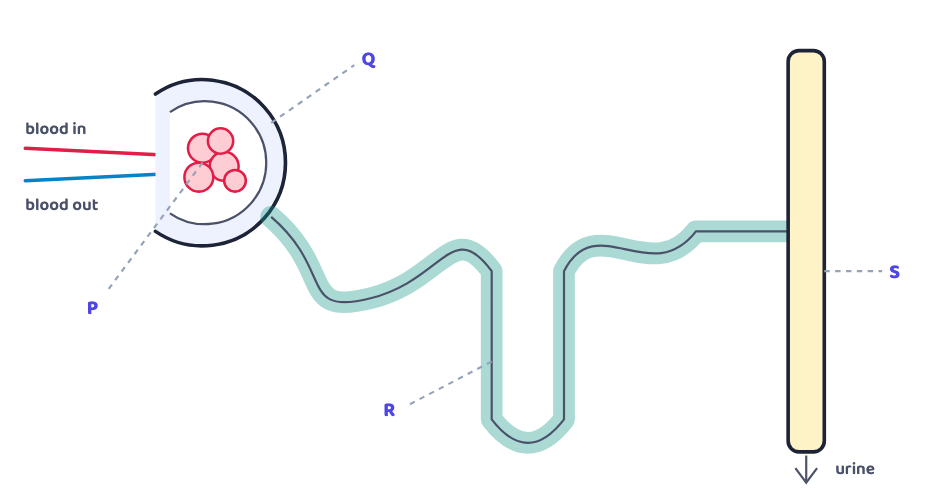
A urine test shows glucose in the urine of a person. Glucose is normally taken back into the blood as the filtrate flows through the nephron shown below. In which labelled part does this selective re-absorption of glucose normally take place?
Figure for Q2: a nephron (schematic)
(A) P
(B) Q
(C) R
(D) S
For visually impaired students (in place of Q2): In a nephron, the cup-shaped structure that collects the filtrate from the blood is the
(A) collecting duct
(B) urinary bladder
(C) ureter
(D) Bowman’s capsule
1
3
1 mark
A child’s height is far below normal for his age. The doctor finds that he has dwarfism, caused by the deficiency in childhood of a hormone that regulates growth and development. Which gland and hormone are involved?
(A) Pituitary gland, growth hormone
(B) Thyroid gland, thyroxin
(C) Adrenal gland, adrenaline
(D) Pancreas, insulin
1
4
1 mark
A gardener places a few leaves of Bryophyllum on moist soil. After some days, small new plants grow along the edges of the leaves. Which statement best explains this?
(A) The leaves contain seeds that germinate in moist soil.
(B) The leaves break into fragments and each fragment grows into a plant.
(C) The leaves produce spores, as in Rhizopus.
(D) Buds produced in the notches along the leaf margin develop into new plants.
1
5
1 mark
Which of the following statements about the copper-T is correct?
(A) It prevents the release of eggs by changing the hormonal balance of the body.
(B) It is placed in the vas deferens to block the transfer of sperms.
(C) It is placed in the uterus to prevent pregnancy, and it can cause side effects due to irritation of the uterus.
(D) It creates a mechanical barrier so that sperms do not reach the vagina.
1
6
1 mark
A couple already has two daughters. What is the chance that their third child will be a son?
(A) 0%
(B) 50%
(C) 75%
(D) 100%
1
7
1 mark
In the food chain grass → grasshopper → frog → snake, a disease kills most of the frogs. What is the most likely immediate effect?
(A) Both the grasshoppers and the snakes will increase in number.
(B) The grasshoppers will decrease and the grass will increase.
(C) The grasshoppers will increase and the snakes will decrease.
(D) There will be no change at any other trophic level.
1
The following question has two statements, Assertion (A) and Reason (R). Answer it by choosing the correct option from those given below.
(A) Both A and R are true, and R is the correct explanation of A.
(B) Both A and R are true, but R is not the correct explanation of A.
(C) A is true, but R is false.
(D) A is false, but R is true.
8
1 mark
Assertion (A): In birds and mammals, the right side and the left side of the heart are kept separate so that oxygenated and de-oxygenated blood do not mix. Reason (R): Such separation allows a highly efficient supply of oxygen to the body, which is useful for animals that need a lot of energy to maintain their body temperature.
1
9
1 mark
Assertion (A): Ozone at the higher levels of the atmosphere is harmful to life on the earth. Reason (R): Ozone at the higher levels of the atmosphere shields the surface of the earth from the ultraviolet (UV) radiation of the Sun.
1
10
2 marks
A. Why do the ventricles of the human heart have thicker muscular walls than the atria? (1) B. Valves are present between the atria and the ventricles. What would happen to the flow of blood if these valves stopped working? (1)
2
11A
2 marks
Students to attempt either option A or B.
A potted plant kept near a window bends towards the window after a few days. Name the plant hormone responsible and explain how it causes the shoot to bend towards light.
2
OR
11B
2 marks
What is meant by a feedback mechanism in hormonal control? Explain it with the example of insulin and blood sugar.
2
12
2 marks
Distinguish between self-pollination and cross-pollination. Name any two agents that bring about cross-pollination.
2
13
3 marks
You touch a very hot plate by mistake and pull your hand back at once, even before you feel the pain clearly.
A. Name this kind of action. (1) B. Write, in the correct order, the path followed by the message from the skin to the muscles of the arm in this action. (1) C. Why is it useful that this connection is made in the spinal cord rather than in the brain? (1)
3
14
3 marks
The waste collected from a school canteen in one day contains fruit peels, plastic cups, paper plates and glass bottles.
A. Classify these four items as biodegradable or non-biodegradable. (1) B. What are biodegradable substances? Name the organisms that break them down. (1) C. State one harmful effect of non-biodegradable substances on the environment. (1)
3
15
4 marks
Riya crossed a pure-breeding pea plant having round, yellow seeds (RRYY) with a pea plant having wrinkled, green seeds (rryy). All the F1 plants had round, yellow seeds. She then allowed the F1 plants to self-pollinate and collected 1600 seeds of the F2 generation.
A.
Which seed shape and which seed colour are dominant? Give a reason from the F1 result.
(1)
B.
About how many of the 1600 F2 seeds are expected to be wrinkled and green?
(1)
Attempt either sub-part C or D.
C.
Some F2 seeds were round and green, a combination not present in either parent. What does this show about the inheritance of seed shape and seed colour? Write the possible genotype(s) of these round, green seeds.
(2)
OR
D.
If Riya had studied only seed shape and self-pollinated an F1 plant (Rr), what ratio of round to wrinkled seeds would she get? Show the genotype ratio as well.
(2)
4
16A
5 marks
Attempt either option A or B.
Observe the figures X and Y of the same part of a leaf surface and answer the questions.
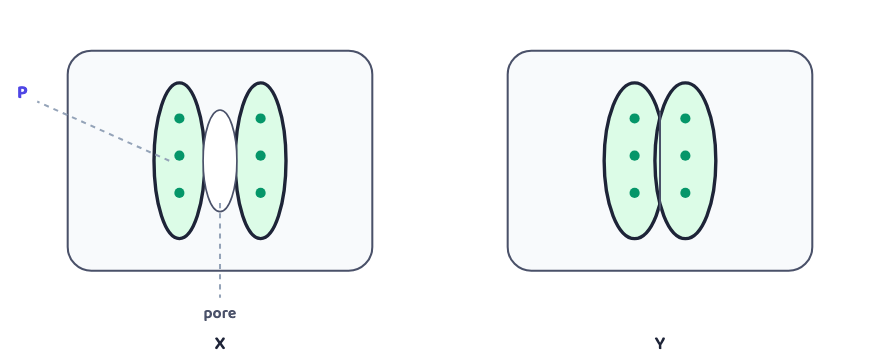
Figure for Q16 A: a part of the leaf surface at two different times
I. Name the cells labelled P. In which figure, X or Y, is the pore open? (1) II. How do the cells labelled P open and close the pore? (2) III. Desert plants keep these pores closed during the day. Why do they do so, and how are they still able to carry out photosynthesis? (2)
For visually impaired students (in place of Q16A): I. Name the cells that surround a stomatal pore and give one function of stomata. (1) II. How do these cells open and close the pore? (2) III. Desert plants keep their stomata closed during the day. Why do they do so, and how are they still able to carry out photosynthesis? (2)
5
OR
16B
5 marks
I. Describe the changes that take place in a flower after fertilisation, leading to the formation of the seed and the fruit. (3) II. How does the developing human embryo get its nutrition inside the mother’s body? Describe the structure that makes this possible. (2)
5
Section B: Chemistry (25 marks)
Q. No.
Marks
17
1 mark
Consider the reaction ZnO+CZn+CO. Which statement about it is correct?
(A) Zinc oxide is oxidised and carbon is reduced.
(B) Zinc oxide is reduced and carbon is oxidised.
(C) Both zinc oxide and carbon are oxidised.
(D) It is a decomposition reaction, so nothing is oxidised or reduced.
1
18
1 mark
Four colourless solutions P, Q, R and S give pH values of 2, 7, 10 and 13 respectively with a universal indicator. Which option lists them in increasing order of hydroxide ion concentration?
(A) S, R, Q, P
(B) Q, P, R, S
(C) R, S, Q, P
(D) P, Q, R, S
1
19
1 mark
A cake made with baking powder turns out soft and spongy. Which of the following explains this?
(A) Carbon dioxide is produced when the sodium hydrogencarbonate in it reacts with the mild edible acid on heating or mixing with water.
(B) Hydrogen gas is produced when the sodium hydrogencarbonate reacts with water.
(C) Sodium hydroxide is formed, which makes the dough rise.
(D) Water of crystallisation is released from the baking powder on heating.
1
20
1 mark
Metal X reacts violently with cold water and catches fire. Metal Y does not react with water at all, not even with steam. Metal Z does not react with cold or hot water but reacts with steam. Which is the correct order of reactivity?
(A) Y > Z > X
(B) Z > X > Y
(C) X > Z > Y
(D) X > Y > Z
1
21
1 mark
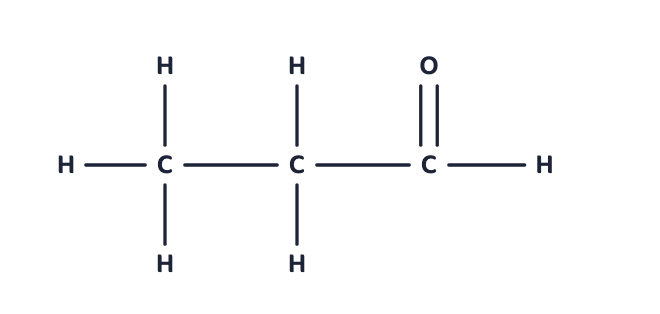
Study the structural formula given below. The compound is
Figure for Q21
(A) propanone
(B) propanal
(C) propanol
(D) propanoic acid
For visually impaired students (in place of Q21): The compound with the formula CHX3COCHX3 is named
(A) propanal
(B) propanol
(C) propanone
(D) propanoic acid
1
22
1 mark
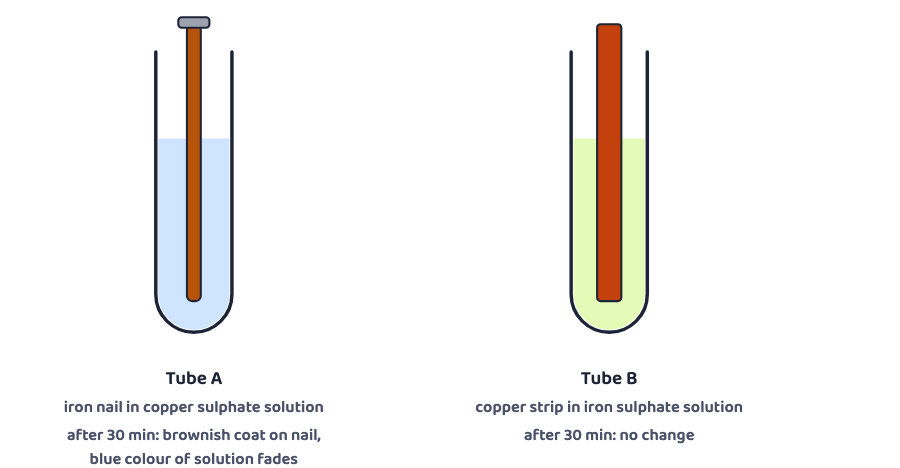
A student set up the two test tubes shown below and observed them after 30 minutes. Which statement correctly explains the observations?
Figure for Q22
(A) Iron displaces copper from copper sulphate solution because iron is more reactive than copper; copper cannot displace iron.
(B) Copper displaces iron from iron sulphate solution because copper is more reactive than iron.
(C) Both tubes show double displacement reactions.
(D) Copper sulphate decomposes on standing, so the blue colour fades.
For visually impaired students (in place of Q22): An iron nail is dipped in copper sulphate solution for about 20 minutes. What is observed?
(A) The nail becomes brownish and the blue colour of the solution fades.
(B) The nail becomes silvery white and the solution turns deep blue.
(C) There is no change because iron is less reactive than copper.
(D) The solution turns milky white.
1
23
1 mark
Zinc is extracted from its carbonate ore. Which sequence of steps is correct?
(A) Roasting of the ore, then electrolysis of the molten oxide
(B) Calcination of the ore, then electrolytic reduction of the molten oxide
(C) Roasting of the ore, then reduction with carbon
(D) Calcination of the ore, then reduction of the oxide with carbon
1
The following question has two statements, Assertion (A) and Reason (R). Answer it by choosing the correct option from those given below.
(A) Both A and R are true, and R is the correct explanation of A.
(B) Both A and R are true, but R is not the correct explanation of A.
(C) A is true, but R is false.
(D) A is false, but R is true.
24
1 mark
Assertion (A): Most carbon compounds are poor conductors of electricity. Reason (R): A carbon atom has four electrons in its outermost shell.
1
25
2 marks
A. Draw the structures of the two different compounds that have the molecular formula CX4HX10. (1) B. What are such compounds called? Define the term. (1)
2
26A
3 marks
Attempt either option A or B.
(i) Draw the electron dot structure of methane, CHX4. (1) (ii) Methane reacts with chlorine in the presence of sunlight. Write the equation for the first step and name the type of reaction. (1) (iii) While cooking on a gas stove, the bottoms of the vessels are getting blackened. What does this indicate? (1)
For visually impaired students (in place of Q26A): (i) How many single covalent bonds are present in a molecule of methane, CHX4, and how many shared pairs of electrons are there? (1) (ii) and (iii) as in option A above.
3
OR
26B
3 marks
(i) Write the balanced equation for the reaction of sodium with ethanol, and name the gas evolved. (1) (ii) How would you test for this gas? (1) (iii) Ethanol is converted to ethanoic acid by heating with alkaline potassium permanganate. Why is potassium permanganate called an oxidising agent here? (1)
3
27
3 marks
Give reasons for the following:
A. Sodium metal is stored immersed in kerosene oil. (1) B. Ionic compounds conduct electricity in the molten state but not in the solid state. (1) C. A copper vessel left in moist air for a long time develops a green coating. (1)
3
28
4 marks
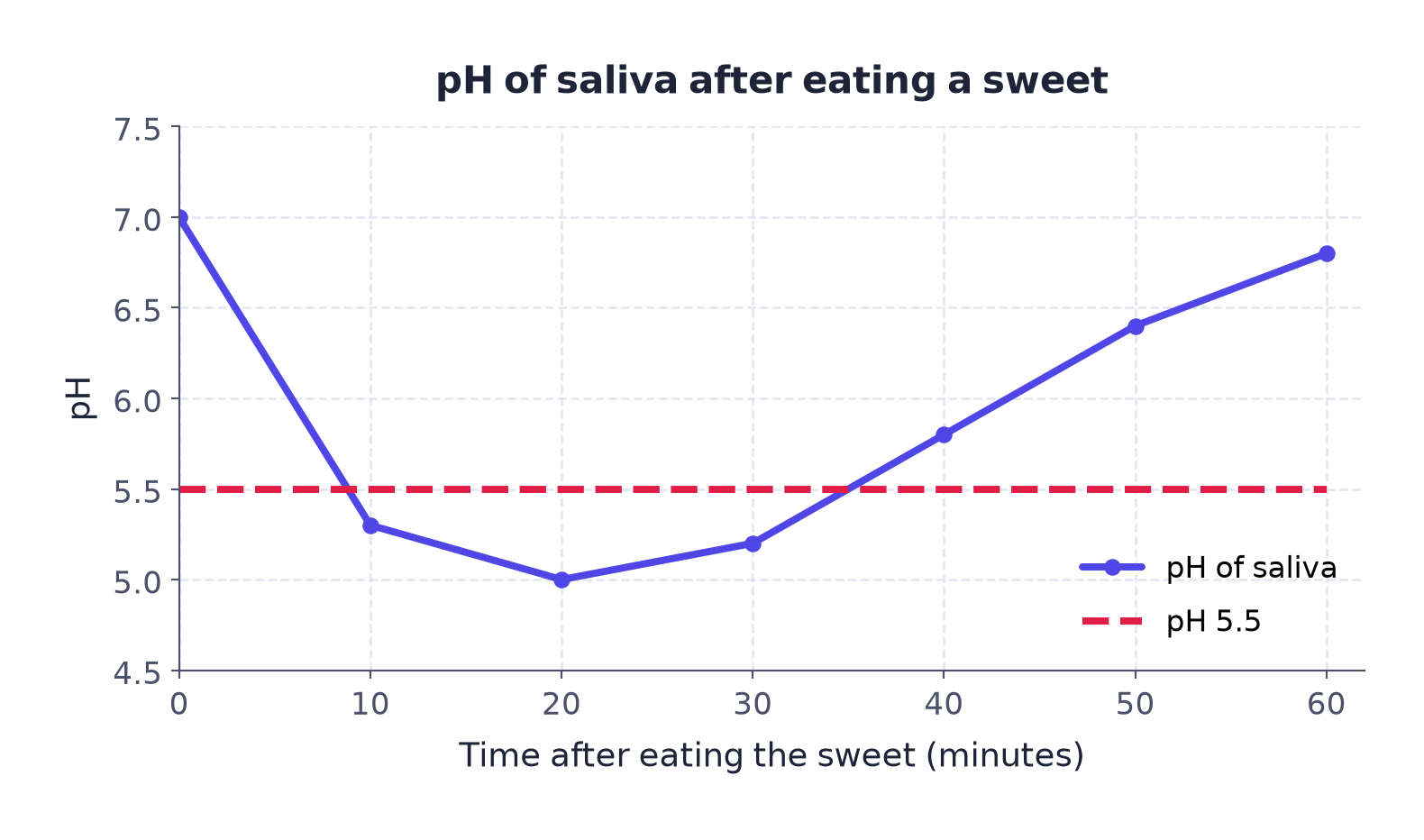
Kabir ate a sweet and then measured the pH of his saliva every 10 minutes for one hour using pH paper. His readings are shown in the graph. (The dashed line marks pH 5.5.)
Figure for Q28 (data written for this paper)
A.
At which of the recorded times was Kabir’s tooth enamel at risk of being corroded? Give a reason.
(1)
B.
Why did the pH of the saliva fall after eating the sweet?
(1)
Attempt either sub-part C or D.
C.
Kabir’s dentist advises him to clean his teeth with toothpaste after eating. Explain how this helps, naming the nature of toothpaste.
(2)
OR
D.
Name the substance that tooth enamel is made of. How does enamel behave in water, and how does it behave when the pH in the mouth falls below 5.5?
(2)
For visually impaired students (in place of Q28): Kabir ate a sweet and then measured the pH of his saliva every 10 minutes. The readings were: 0 min, pH 7.0; 10 min, pH 5.3; 20 min, pH 5.0; 30 min, pH 5.2; 40 min, pH 5.8; 50 min, pH 6.4; 60 min, pH 6.8. Answer parts A, B and C or D given above using these readings.
4
29A
5 marks
Attempt either option A or B.
I. Solutions of barium chloride and sodium sulphate are mixed. A white insoluble substance is formed. Write the balanced chemical equation with state symbols, and name the type of reaction. (2) II. A shiny brown metal X is heated in air in a china dish and its surface turns black. When hydrogen gas is passed over the heated black substance, the brown colour returns. Identify X and the black substance. Write the equations for both changes, and in the second change name the substance oxidised and the substance reduced. (3)
5
OR
29B
5 marks
I. Mercury is obtained from its ore cinnabar (HgS). Write the two chemical equations involved. (2) II. Describe the electrolytic refining of copper. Name the anode, the cathode and the electrolyte, and state what happens at each electrode. (3)
5
Section C: Physics (25 marks)
Q. No.
Marks
30
1 mark
A dentist wants to see a large, erect image of a patient’s tooth. Which mirror should be used, and where should the tooth be placed?
(A) A concave mirror, with the tooth between its pole and principal focus
(B) A concave mirror, with the tooth beyond its centre of curvature
(C) A convex mirror, with the tooth at any distance
(D) A plane mirror, with the tooth very close to it
1
31
1 mark
Resistors of 4Ω and 12Ω are connected in parallel across a 6 V battery. What current is drawn from the battery?
(A) 0.375 A
(B) 0.5 A
(C) 1.5 A
(D) 2 A
1
The following question has two statements, Assertion (A) and Reason (R). Answer it by choosing the correct option from those given below.
(A) Both A and R are true, and R is the correct explanation of A.
(B) Both A and R are true, but R is not the correct explanation of A.
(C) A is true, but R is false.
(D) A is false, but R is true.
32
1 mark
Assertion (A): Red light is used for danger (stop) signal lights. Reason (R): Red light is scattered the most by fog or smoke.
1
33
2 marks
A ray of light passes obliquely from air into water (refractive index 1.33).
A. Will the ray bend towards or away from the normal? Give a reason. (1) B. Calculate the speed of light in water. (Speed of light in air =3×10⁸ m s−1) (1)
2
34A
2 marks
Attempt either option A or B.
An electric iron rated 1000 W is used for 30 minutes every day. Calculate the electrical energy it uses in 30 days in kilowatt hours, and the cost of this energy at ₹ 8 per kW h.
2
OR
34B
2 marks
The heating elements of electric toasters and electric irons are made of an alloy rather than a pure metal. Give two reasons.
2
35
3 marks
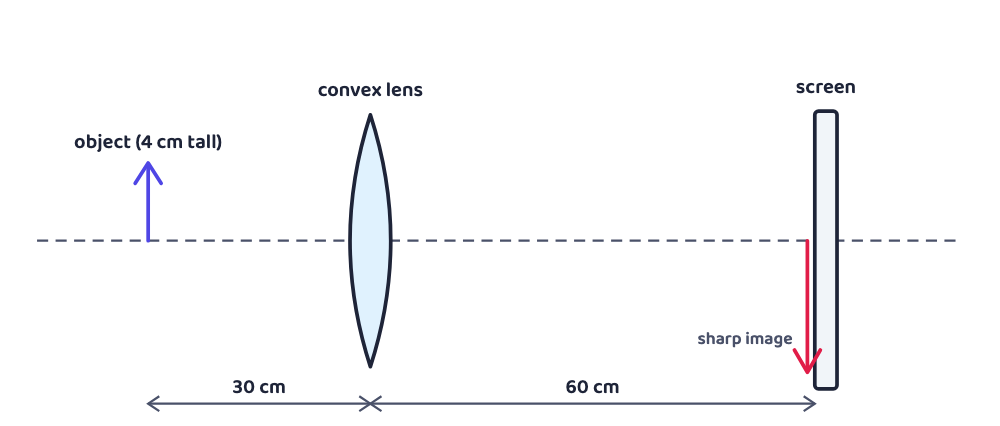
In the set-up shown, a sharp image of a 4 cm tall object placed 30 cm in front of a convex lens is obtained on a screen 60 cm behind the lens.
Figure for Q35
A. Find the focal length of the lens. (1) B. Find the size of the image and state its nature. (1) C. Find the power of the lens. (1)
For visually impaired students (in place of Q35): An object 4 cm tall is placed 30 cm in front of a convex lens of focal length 20 cm. Find the position of the image, its size and its nature.
3
36
3 marks
Answer the following about domestic electric circuits:
A. Why is the metallic body of an electric iron connected to the earth wire? (1) B. What is overloading? Give one cause of it. (1) C. How does an electric fuse protect the circuit and the appliances? (1)
3
37
3 marks
Study the circuit shown and answer the questions.
Figure for Q37
A. Find the total resistance of the circuit. (1) B. Find the current drawn from the battery. (1) C. Find the current through the 6Ω resistor. (1)
For visually impaired students (in place of Q37): A 4Ω resistor is connected in series with a combination of 6Ω and 3Ω resistors joined in parallel, and the whole arrangement is connected to a 12 V battery. Find (A) the total resistance, (B) the current drawn from the battery, (C) the current through the 6Ω resistor.
3
38
4 marks
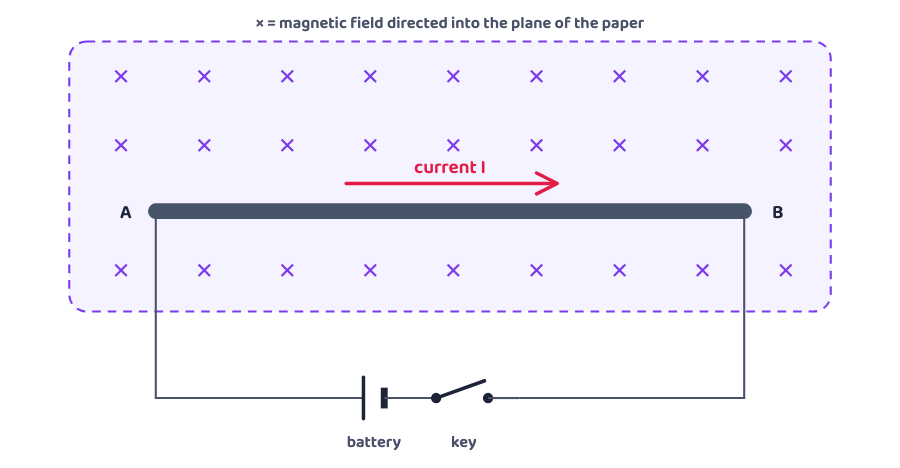
A light aluminium rod AB is placed in a uniform magnetic field directed into the plane of the paper, at right angles to the field, and connected to a battery through a key. When the key is closed, a current flows through the rod from A to B, as shown.
Figure for Q38
A.
Name the rule used to find the direction of the force on the rod.
(1)
B.
In which direction, with respect to the page, will the rod be pushed?
(1)
Attempt either sub-part C or D.
C.
In which direction will the rod move if (i) only the direction of the current is reversed, and (ii) the directions of both the current and the magnetic field are reversed? Give reasons.
(2)
OR
D.
The rod is now placed so that the current in it is no longer at right angles to the magnetic field. How will the force on it change? In which position is the displacement of the rod the largest?
(2)
For visually impaired students (in place of Q38): A straight aluminium rod is placed at right angles to a uniform magnetic field and a current is passed through it. The rod is pushed sideways. A. Name the rule used to find the direction of the force on the rod. (1) B. State the rule. (1) C. What happens to the direction of the force if (i) only the current is reversed, (ii) both the current and the field are reversed? (2) OR D. How does the force change when the rod is placed so that the current is no longer at right angles to the field, and when is the displacement largest? (2)
4
39A
5 marks
Attempt either option A or B.
A student sitting in the last row of the class cannot read the writing on the blackboard clearly, but can read his book without difficulty.
I. Name the defect of vision and give two possible causes of it. (2) II. Draw ray diagrams to show (a) the image formation of a distant object in his eye and (b) the correction of this defect. (2) III. Name the type of corrective lens and state the sign of its power. (1)
For visually impaired students (in place of Q39A): I. Name the defect of vision in which a person can see nearby objects clearly but not distant objects, and give two possible causes. (2) II. Where is the image of a distant object formed in such an eye, and how does the corrective lens bring it onto the retina? (2) III. Name the type of corrective lens and state the sign of its power. (1)
5
OR
39B
5 marks
I. What is meant by dispersion of white light? Why does it occur when white light passes through a glass prism? (2) II. Draw a labelled diagram of the arrangement of two identical glass prisms, one inverted with respect to the other, used to recombine the spectrum of white light. (2) III. Which colour of light bends the most when white light passes through a prism? (1)
For visually impaired students (in place of Q39B): I. as in option B above. (2) II. What did Newton observe when he placed a second identical prism in an inverted position after the first prism, and what did he conclude? (2) III. as in option B above. (1)
5
End of Question Paper
Marking Scheme / अंकन योजना (उत्तर देखें)
ANSHUL ACADEMY · anshulacademy.in
Science (086)
Sample Paper 1: Marking Scheme
Class X (2026-27) · English Medium
Time Allowed: 3 hoursMaximum Marks: 80
For examiners and students:
For objective questions, the correct option letter and the answer are both given.
For descriptive questions, value points are given with the marks for each (shown in brackets). Award marks for each correct value point.
Any other correct answer based on the NCERT textbook, and correct alternative methods in numericals, may be given full credit.
Where a question has an internal choice (OR), the answers to both alternatives are given.
Section A: Biology (30 marks)
Q. No.
Answers / Value points
Marks
1
1 mark
(B) Action of the enzyme pepsin on proteins. Hydrochloric acid creates the acidic medium that helps pepsin act on proteins; less acid means pepsin works poorly.
1
2
1 mark
(C) R, the tubular part of the nephron. Some substances in the initial filtrate, such as glucose, amino acids, salts and much of the water, are selectively re-absorbed as the urine flows along the tube.
For visually impaired students: (D) Bowman’s capsule
1
3
1 mark
(A) Pituitary gland, growth hormone. Growth hormone from the pituitary regulates growth and development; its deficiency in childhood leads to dwarfism.
1
4
1 mark
(D) Buds produced in the notches along the leaf margin develop into new plants. This is vegetative propagation.
1
5
1 mark
(C) The loop or the copper-T is placed in the uterus to prevent pregnancy; it can cause side effects due to irritation of the uterus. Options A, B and D describe other methods (oral pills, vasectomy and barrier methods).
1
6
1 mark
(B) 50%. Every egg carries an X chromosome; half the sperms carry X and half carry Y, so each child has an equal chance of being a boy or a girl, whatever the earlier children were.
1
7
1 mark
(C) The grasshoppers will increase (their predator is gone) and the snakes will decrease (their food is reduced).
1
8
1 mark
(A) Both A and R are true, and R is the correct explanation of A.
1
9
1 mark
(D) A is false, but R is true. Ozone at ground level is a deadly poison, but at the higher levels it performs an essential function by shielding the earth from UV radiation.
1
10
2 marks
A. Ventricles pump blood out to the various organs of the body (and to the lungs), so they need thicker muscular walls than the atria, which only receive blood. (1)
B. Valves ensure that blood does not flow backwards when the atria or ventricles contract; without them blood would flow back into the atria and the heart would pump inefficiently. (1)
2
11A
2 marks
Hormone: auxin, synthesised at the tip of the shoot. (½)
When light comes from one side, auxin diffuses towards the shady side of the shoot. (½)
This concentration of auxin stimulates the cells on the side away from light to grow longer, so the shoot bends towards light. (1)
2
OR
11B
2 marks
In a feedback mechanism, the level of the substance a hormone controls itself regulates the timing and amount of that hormone released, so that the hormone is secreted in precise quantities. (1)
If the sugar level in blood rises, it is detected by the cells of the pancreas, which produce more insulin; as the blood sugar level falls, insulin secretion is reduced. (1)
2
12
2 marks
Self-pollination: transfer of pollen to the stigma of the same flower. Cross-pollination: transfer of pollen from one flower to another. (½ + ½)
Agents: wind, water or animals (any two). (½ + ½)
2
13
3 marks
A. Reflex action. (1)
B. Receptor (heat-sensing nerve endings in the skin) → sensory nerve → spinal cord (relay/connection) → motor nerve → effector (muscles of the arm). (1)
C. The thinking process of the brain is not fast enough; the reflex arc in the spinal cord gives a quick response, which protects the body from harm (the information also reaches the brain later). (1)
3
14
3 marks
A. Biodegradable: fruit peels, paper plates; non-biodegradable: plastic cups, glass bottles. (½ + ½)
B. Substances that are broken down by biological processes are biodegradable (½); they are broken down by the action of bacteria and other saprophytes (decomposers) (½).
C. They are not broken down by bacteria or other saprophytes, so they may persist in the environment for a long time or harm the various members of the ecosystem (any one valid effect). (1)
3
15
4 marks
A.
Round shape and yellow colour are dominant, because only these traits appear in the F1 plants. (1)
(1)
B.
F2 ratio 9 : 3 : 3 : 1, so wrinkled green = 1/16 of 1600 = 100 seeds. (1)
(1)
C.
Seed shape and seed colour are inherited independently of each other (new combinations of traits appear in F2). (1)
II. The guard cells swell when water flows into them, causing the stomatal pore to open. (1)
II. The pore closes if the guard cells shrink (lose water). (1)
III. Large amounts of water can be lost through stomata, so keeping them closed in the hot day reduces water loss. (1)
III. Desert plants take up carbon dioxide at night and prepare an intermediate, which is acted upon by the energy absorbed by chlorophyll during the day. (1)
For visually impaired students: I. Guard cells (½); stomata allow exchange of gases / loss of water (transpiration) (½). II and III as in option A above.
5
OR
16B
5 marks
I. The zygote divides several times to form an embryo within the ovule. (1)
I. The ovule develops a tough coat and is gradually converted into a seed. (1)
I. The ovary grows rapidly and ripens to form a fruit; meanwhile the petals, sepals, stamens, style and stigma may shrivel and fall off. (1)
II. The embryo gets nutrition from the mother’s blood with the help of a special tissue called the placenta, a disc embedded in the uterine wall. (1)
II. It has villi on the embryo’s side and blood spaces on the mother’s side, which give a large surface area for glucose and oxygen to pass from the mother to the embryo (wastes pass back the other way). (1)
5
Section B: Chemistry (25 marks)
Q. No.
Answers / Value points
Marks
17
1 mark
(B) Zinc oxide loses oxygen (reduced) and carbon gains oxygen to form CO (oxidised); it is a redox reaction.
1
18
1 mark
(D) P, Q, R, S. The higher the pH, the greater the hydroxide ion concentration (pH 2 < 7 < 10 < 13).
1
19
1 mark
(A) Baking powder is baking soda plus a mild edible acid such as tartaric acid; on heating or with water it gives carbon dioxide, which makes the cake rise and become soft and spongy.
1
20
1 mark
(C) X > Z > Y. Metals like sodium and potassium react violently with cold water; metals like aluminium, iron and zinc react only with steam; metals like lead, copper, silver and gold do not react with water at all.
1
21
1 mark
(B) propanal (CHX3CHX2CHO). Three carbon atoms (propane) and an aldehyde group (−CHO) at the end of the chain.
For visually impaired students: (C) propanone (ketone group within a three-carbon chain)
1
22
1 mark
(A) Iron is more reactive than copper, so in tube A iron displaces copper (brown coat on the nail; blue colour fades as iron sulphate forms). In tube B, the less reactive copper cannot displace iron, so there is no change.
For visually impaired students: (A) The iron nail becomes brownish (copper deposits on it) and the blue colour of copper sulphate solution fades.
1
23
1 mark
(D) Carbonate ores are changed into oxides by heating strongly in limited air (calcination): ZnCOX3ZnO+COX2; the oxide is then reduced with carbon: ZnO+CZn+CO. (Roasting is used for sulphide ores.)
1
24
1 mark
(B) Both A and R are true, but R is not the correct explanation of A. Carbon compounds are poor conductors because the bonding in them (covalent bonding) does not give rise to any ions; the four valence electrons only explain why carbon shares electrons.
1
25
2 marks
A. Straight chain: CHX3−CHX2−CHX2−CHX3 (butane); branched chain: CHX3−CH(CHX3)−CHX3 (½ + ½; full structures with all H atoms also accepted).
B. Structural isomers: compounds with identical molecular formula but different structures. (½ + ½)
2
26A
3 marks
(i) Carbon in the centre sharing one electron pair with each of four hydrogen atoms (four shared pairs, no lone pairs). (1)
(iii) The air holes of the stove are blocked, so combustion is incomplete and fuel is getting wasted. (1)
For visually impaired students: (i) Four single covalent bonds; four shared pairs of electrons (carbon shares its four valence electrons, one with each hydrogen atom). (ii) and (iii) as in option A.
II. Copper oxide loses oxygen and is reduced; hydrogen gains oxygen and is oxidised. (½ + ½)
5
OR
29B
5 marks
I. On heating in air, cinnabar first changes to mercuric oxide: 2HgS+3OX2heat2HgO+2SOX2 (1)
I. Mercuric oxide is then reduced to mercury on further heating: 2HgOheat2Hg+OX2 (1)
II. Anode: impure copper; cathode: a thin strip of pure copper; electrolyte: a solution of acidified copper sulphate. (1)
II. On passing current, the impure metal from the anode dissolves into the electrolyte, and an equal amount of pure metal from the electrolyte is deposited on the cathode. (1)
II. Soluble impurities go into the solution, and insoluble impurities settle down at the bottom of the anode as anode mud. (1)
5
Section C: Physics (25 marks)
Q. No.
Answers / Value points
Marks
30
1 mark
(A) A concave mirror forms an enlarged, virtual and erect image when the object is between P and F; dentists use concave mirrors to see large images of teeth.
1
31
1 mark
(D) 2 A. R1=41+121=124, so R=3Ω and I=V/R=6/3=2 A.
1
32
1 mark
(C) A is true, but R is false. Red light is the least scattered by fog or smoke, so it can be seen in the same colour at a distance.
1
33
2 marks
A. Towards the normal, because light goes from an optically rarer medium (air) to an optically denser medium (water), where its speed is lower. (½ + ½)
B.n=c/v, so v=1.333×10⁸≈2.26×10⁸ m s−1 (accept 2.25 × 10⁸). (½ formula + ½ answer)
2
34A
2 marks
Energy per day = 1 kW × 0.5 h = 0.5 kW h; in 30 days = 0.5 × 30 = 15 kW h. (1)
Cost = 15 × ₹ 8 = ₹ 120. (1)
2
OR
34B
2 marks
The resistivity of an alloy is generally higher than that of its constituent metals, so more heat is produced. (1)
Alloys do not oxidise (burn) readily at high temperatures. (1)
2
35
3 marks
A.u=−30 cm, v=+60 cm; f1=v1−u1=601+301=603, so f=+20 cm. (1)
B.m=uv=−3060=−2; image height =−2×4=−8 cm: the image is 8 cm tall, real and inverted. (½ + ½)
C.P=f(in m)1=0.201=+5 D. (1)
For visually impaired students:v1=f1+u1=201−301=601, so v=+60 cm (1); m=v/u=−2, image height 8 cm (1); real and inverted, on the other side of the lens (1).
3
36
3 marks
A. The earth wire provides a low-resistance conducting path, so any leakage of current to the metallic body keeps its potential equal to that of the earth and the user does not get a severe electric shock. (1)
B. Overloading is the flow of an unduly high current in a circuit; it can be caused by connecting too many appliances to a single socket, an accidental hike in supply voltage, or short-circuiting, when the live and neutral wires come into direct contact (any one). (½ + ½)
C. When an unduly high current flows, the Joule heating in the fuse wire melts it and breaks the circuit, stopping the current. (1)
3
37
3 marks
A.6Ω and 3Ω in parallel: Rp1=61+31=21, so Rp=2Ω; total R=4+2=6Ω. (1)
B.I=V/R=12/6=2 A. (1)
C. Potential difference across the parallel pair =2×2=4 V; current through 6Ω=4/6=32 A ≈0.67 A. (1)
For visually impaired students: Same as the main question: 6Ω, 2 A, 32 A.
3
38
4 marks
A.
Fleming’s left-hand rule. (1)
(1)
B.
Towards the top of the page (upwards in the plane of the paper), perpendicular to both the current and the field. (1)
(1)
C.
(i) Towards the bottom of the page: reversing the current reverses the direction of the force. (1)
(ii) Towards the top of the page again: reversing both reverses the force twice, so it is unchanged. (1)
(2)
OR
D.
The force (and the displacement) decreases; it becomes zero if the current is along the field. (1)
The displacement is largest (force is highest) when the current is at right angles to the magnetic field. (1)
(2)
For visually impaired students: A. Fleming’s left-hand rule. B. Stretch the thumb, forefinger and middle finger of the left hand mutually perpendicular; if the forefinger points along the magnetic field and the middle finger along the current, the thumb points in the direction of motion or force on the conductor. C (i) the force is reversed; (ii) the force is unchanged. D. The force decreases (zero if the current is along the field); largest when the current is at right angles to the field.
4
39A
5 marks
I. Myopia (near-sightedness). (1)
I. Causes: (i) excessive curvature of the eye lens, or (ii) elongation of the eyeball. (½ + ½)
II. (a) Rays from a distant object meet in front of the retina. (1)
II. (b) A concave lens placed before the eye diverges the rays so that the image is formed on the retina. (1)
III. Concave (diverging) lens of suitable power; its power is negative. (½ + ½)
For visually impaired students: I. Myopia; excessive curvature of the eye lens or elongation of the eyeball. II. In front of the retina; a concave lens diverges the rays so that they meet on the retina. III. Concave lens; negative power.
5
OR
39B
5 marks
I. Dispersion is the splitting of white light into its component colours (a band called the spectrum). (1)
I. Different colours of light bend through different angles with respect to the incident beam as they pass through the prism. (1)
II. Diagram: first prism forms the spectrum; the second identical prism, placed inverted, recombines all the colours into a beam of white light emerging from the other side. (2: arrangement 1, labels 1)
III. Violet. (1)
For visually impaired students: II. All the colours recombined and a beam of white light emerged from the other side of the second prism; this showed that sunlight is made up of seven colours.