Pattern: CBSE 2026-27 official Sample Question Paper (SQP) design · Maximum marks: 80 · Time: 3 hours. Solve the paper first, then open the marking scheme at the end to check your answers.
ANSHUL ACADEMY · anshulacademy.in
Science (086)
Sample Paper 2
Class X (2026-27) · English Medium
Time Allowed: 3 hoursMaximum Marks: 80
General Instructions:
This question paper has 39 questions in three sections. All questions are compulsory.
Section A is Biology (Q1 to Q16, 30 marks), Section B is Chemistry (Q17 to Q29, 25 marks) and Section C is Physics (Q30 to Q39, 25 marks).
Each section has objective questions (multiple-choice and Assertion-Reason, 1 mark each), short answer questions (2 marks and 3 marks), one case-based question (4 marks) and one long answer question (5 marks).
There is no overall choice. An internal choice is given in some questions, and in some sub-parts of the case-based questions; attempt only one of the alternatives in such questions.
Questions printed under For visually impaired students replace questions that use a figure or graph. Only visually impaired candidates should attempt them.
Draw neat, labelled diagrams wherever a question asks for one.
Section A: Biology (30 marks)
Q. No.
Marks
1
1 mark
Riya cuts her finger while chopping vegetables. After a short while, the bleeding stops on its own. Which component of blood is mainly responsible for this?
(A) Red blood corpuscles
(B) Lymph
(C) Platelets
(D) Plasma
1
2
1 mark
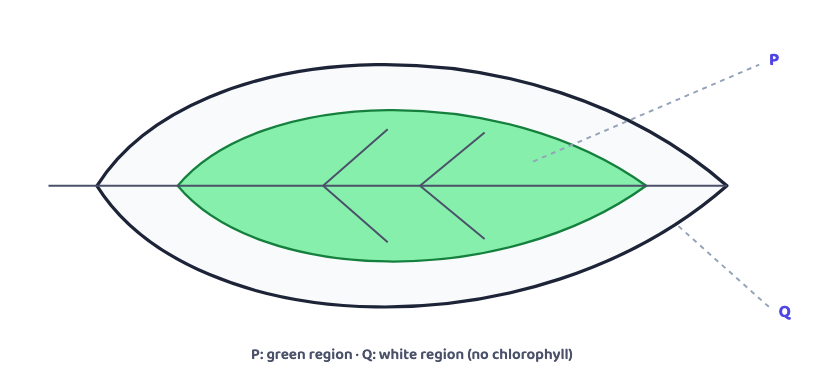
A potted plant with variegated leaves (leaves with green and white regions) was kept in the dark for three days and then in sunlight for about six hours. One leaf was then boiled in alcohol and tested with dilute iodine solution. Which region of the leaf shown below turns blue-black, and what does the result show?
Figure for Q2: a variegated leaf (schematic)
(A) Only Q; light alone is enough for photosynthesis
(B) Only P; chlorophyll is needed for photosynthesis
(C) Both P and Q; chlorophyll is not needed for photosynthesis
(D) Neither P nor Q; starch is not formed in leaves
For visually impaired students (in place of Q2): A variegated leaf has a green region and a white region. The plant is kept in the dark for three days and then in sunlight for about six hours, after which the leaf is tested for starch with iodine solution. Which statement is correct?
(A) Both regions turn blue-black.
(B) Neither region turns blue-black.
(C) Only the white region turns blue-black.
(D) Only the green region turns blue-black.
1
3
1 mark
After an injury to the back of his head, a man is unable to walk in a straight line or ride a bicycle, although he can think and speak normally. Which part of his brain is most likely to be damaged?
(A) Cerebrum
(B) Medulla
(C) Pons
(D) Cerebellum
1
4
1 mark
Inside a human red blood cell, the malarial parasite divides into many daughter cells at the same time. This mode of reproduction is
(A) multiple fission
(B) binary fission
(C) budding
(D) fragmentation
1
5
1 mark
A tall pea plant with the genotype Tt is crossed with a short pea plant (tt). What percentage of the plants in the next generation are expected to be short?
(A) 25%
(B) 50%
(C) 75%
(D) 0%
1
6
1 mark
Which plant hormone inhibits growth, and has effects that include the wilting of leaves?
(A) Auxin
(B) Gibberellin
(C) Abscisic acid
(D) Cytokinin
1
7
1 mark
An aquarium has to be cleaned once in a while, but we do not clean a natural pond in the same way. Which is the best explanation?
(A) Fish living in a pond do not produce any waste.
(B) Rain water washes all the waste out of a pond every day.
(C) A pond has no producers, so no dead plant matter collects in it.
(D) A pond has a natural community of decomposers that break down dead remains and wastes, while a small aquarium lacks enough of them.
1
The following question has two statements, Assertion (A) and Reason (R). Answer it by choosing the correct option from those given below.
(A) Both A and R are true, and R is the correct explanation of A.
(B) Both A and R are true, but R is not the correct explanation of A.
(C) A is true, but R is false.
(D) A is false, but R is true.
8
1 mark
Assertion (A): All plants produced by vegetative propagation are genetically similar enough to the parent plant to have all its characteristics. Reason (R): Vegetative propagation is used to grow plants such as banana, orange, rose and jasmine, which have lost the capacity to produce seeds.
1
9
1 mark
Assertion (A): Arteries have thick, elastic walls. Reason (R): Arteries carry blood that emerges from the heart under high pressure.
1
10
2 marks
How is the equal genetic contribution of the male and the female parent ensured in the progeny?
2
11A
2 marks
Attempt either option A or B.
Why is variation beneficial to the species but not necessarily to the individual?
2
OR
11B
2 marks
How is water moved up from the roots to the leaves in a tall tree? Which force is more important during the day, and which at night?
2
12
2 marks
A doctor advises families in a hilly area to use iodised salt in their food. Why is this advisable? Name the disease that may result from a lack of iodine in the diet.
2
13
3 marks
Food that leaves the stomach is acidic. In the small intestine it is acted upon by juices from the liver and the pancreas.
A. Bile juice from the liver contains no enzyme. How, then, does it help in digestion? (1) B. Name the enzymes of the pancreatic juice that act on proteins and on emulsified fats. (1) C. How is the inner lining of the small intestine suited to the absorption of digested food? (1)
3
14
3 marks
Answer the following about human reproduction:
A. Why are the testes located outside the abdominal cavity, in the scrotum? (1) B. What is the role of the secretions of the seminal vesicles and the prostate gland? (1) C. What happens to the thick, spongy lining of the uterus if the egg released from the ovary is not fertilised? (1)
3
15
4 marks
A pond near some farms has the food chain: phytoplankton → zooplankton → small fish → large fish → fish-eating bird. The producers capture 20,000 kJ of energy from sunlight in a season. A pesticide sprayed on the farms is washed into the pond by rain. Scientists measured the concentration of the pesticide in each organism: phytoplankton 0.04 ppm, zooplankton 0.3 ppm, small fish 1.5 ppm, large fish 4 ppm and fish-eating bird 25 ppm. (ppm: parts per million) (Written for this paper.)
A.
Using the 10% rule, how much energy is available to the small fish?
(1)
B.
Name the phenomenon shown by the pesticide readings.
(1)
Attempt either sub-part C or D.
C.
Why is the concentration of the pesticide highest in the fish-eating bird? Why should this concern human beings?
(2)
OR
D.
Using the energy values, explain why this food chain is unlikely to have any further trophic level above the bird.
(2)
4
16A
5 marks
Attempt either option A or B.
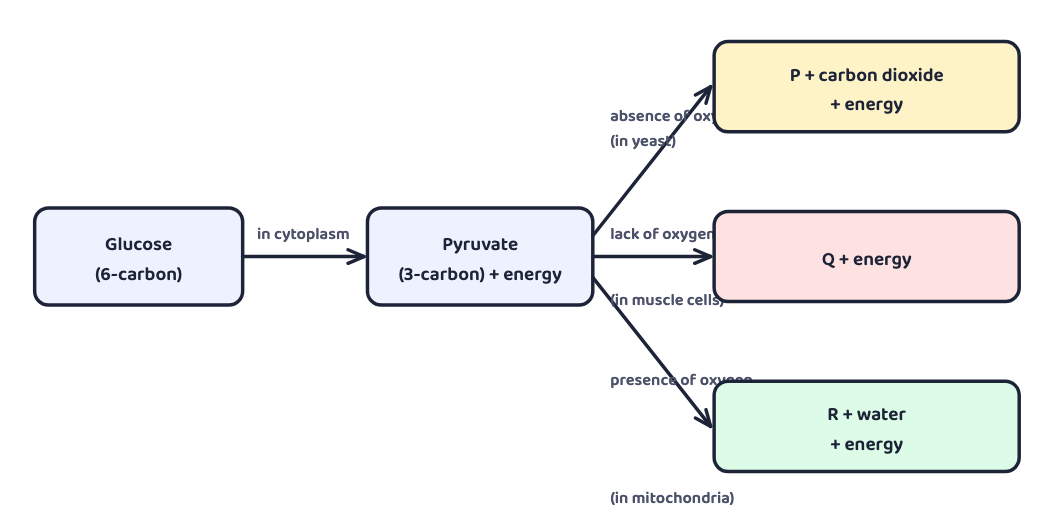
The flow chart shows the breakdown of glucose by different pathways. Study it and answer the questions.
Figure for Q16 A: pathways of the breakdown of glucose
I. Identify P, Q and R. Where in the cell is glucose broken down into pyruvate? (2) II. Why do we sometimes get cramps in our leg muscles after running very fast for a long time? (1) III. Which of the three pathways releases the most energy? Name the molecule in which the energy released during respiration is stored in the cell, and give one use of this energy in the body. (2)
For visually impaired students (in place of Q16A): I. Glucose is first broken down into pyruvate. Name the product formed from pyruvate (a) in yeast in the absence of oxygen, (b) in our muscle cells when there is a lack of oxygen, and (c) the gas formed with water in the presence of oxygen. Where in the cell is glucose broken down into pyruvate? (2) II. and III. as in option A above. (3)
5
OR
16B
5 marks
I. How is the movement of the leaves of the sensitive plant (touch-me-not) different from the movement of a shoot towards light? (2) II. A boy walking home sees a large dog running towards him. His heart starts beating faster and he breathes faster. Name the hormone and the gland responsible, and explain how the changes in his body prepare him to deal with the situation. (3)
5
Section B: Chemistry (25 marks)
Q. No.
Marks
17
1 mark
A student adds water slowly to a small amount of quicklime in a beaker and finds that the beaker becomes hot. Which option correctly describes this reaction?
(A) Decomposition reaction; endothermic
(B) Displacement reaction; exothermic
(C) Combination reaction; exothermic
(D) Double displacement reaction; endothermic
1
18
1 mark
Blue crystals of copper sulphate turn white when heated in a dry boiling tube. When a few drops of water are added to the white residue, the blue colour returns. Which statement explains these observations?
(A) The crystals lose their water of crystallisation on heating and regain it when water is added.
(B) Copper sulphate decomposes into copper and sulphur dioxide on heating.
(C) Copper sulphate is oxidised on heating and reduced by water.
(D) The heat changes the copper in the crystals into a different metal.
1
19
1 mark
Iron pipes used for water supply are coated with a thin layer of zinc to protect them from rusting. This method is called
(A) electrolytic refining
(B) alloying
(C) calcination
(D) galvanisation
1
20
1 mark
Which of the following pairs are successive members of the same homologous series?
(A) CHX4 and CX2HX4
(B) CX2HX5OH and CX3HX7OH
(C) CX2HX6 and CX2HX4
(D) CHX3OH and CHX3CHO
1
21
1 mark
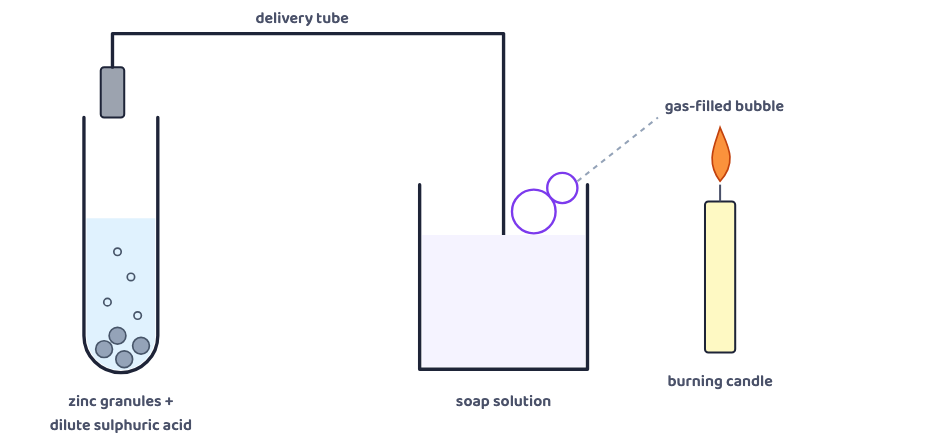
In the set-up shown, the gas formed in the test tube is passed through soap solution. A burning candle is brought near a bubble filled with the gas. Which option correctly names the gas and the observation?
Figure for Q21
(A) Carbon dioxide; the candle goes out
(B) Oxygen; the candle burns more brightly
(C) Hydrogen; the gas burns with a pop sound
(D) Chlorine; the bubble turns yellowish green
For visually impaired students (in place of Q21): Zinc granules react with dilute sulphuric acid. When a burning candle is brought near the gas formed,
(A) the gas burns with a pop sound, as it is hydrogen.
(B) the candle goes out, as the gas is carbon dioxide.
(C) the candle burns more brightly, as the gas is oxygen.
(D) nothing happens, as no gas is formed.
1
22
1 mark
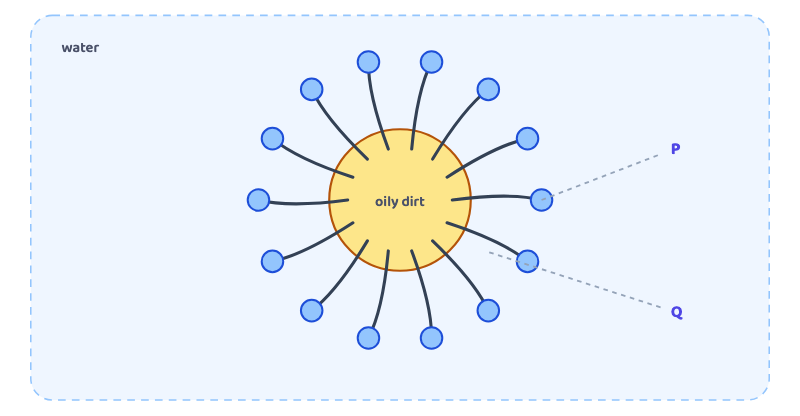
The figure shows soap molecules arranged around a drop of oily dirt in water. Which statement about the parts labelled P and Q is correct?
Figure for Q22 (schematic)
(A) P is the hydrocarbon tail, which dissolves in water.
(B) Q is the ionic end, which dissolves in the oil.
(C) P and Q both dissolve in the oil, so the dirt sinks.
(D) P is the ionic end, which faces the water; Q is the hydrocarbon tail, which is inside the oil.
For visually impaired students (in place of Q22): In a soap micelle formed around oily dirt in water, the ionic ends of the soap molecules
(A) point inward, into the oil
(B) face outward, towards the water
(C) lie flat on the surface of the oil drop
(D) break off from the hydrocarbon tails
1
23
1 mark
White silver chloride kept in a china dish in sunlight turns grey after some time. Which statement explains this?
(A) Silver chloride decomposes into silver and chlorine in the presence of light.
(B) Silver chloride combines with oxygen of the air to form silver oxide.
(C) Silver chloride absorbs moisture from the air.
(D) Silver chloride is displaced by a more reactive metal in the dish.
1
The following question has two statements, Assertion (A) and Reason (R). Answer it by choosing the correct option from those given below.
(A) Both A and R are true, and R is the correct explanation of A.
(B) Both A and R are true, but R is not the correct explanation of A.
(C) A is true, but R is false.
(D) A is false, but R is true.
24
1 mark
Assertion (A): Aluminium oxide is an amphoteric oxide. Reason (R): Aluminium oxide reacts only with acids to produce a salt and water.
1
25
2 marks
A packet of potato chips left open for a few days tastes and smells unpleasant.
A. Name this change and state what causes it. (1) B. Give two ways in which manufacturers prevent this change. (1)
2
26A
3 marks
Attempt either option A or B.
(i) Show the formation of magnesium oxide (MgO) by the transfer of electrons, using electron dot structures. (Atomic numbers: Mg = 12, O = 8) (1) (ii) Name the cation and the anion in MgO and write the electronic configuration of each. (1) (iii) Ionic compounds such as MgO have high melting points. Why? (1)
For visually impaired students (in place of Q26A): (i) In the formation of magnesium oxide, how many electrons does a magnesium atom lose and an oxygen atom gain? (Atomic numbers: Mg = 12, O = 8) (1) (ii) and (iii) as in option A above.
3
OR
26B
3 marks
(i) Write the balanced chemical equation for the reaction of iron(III) oxide with aluminium. (1) (ii) Why is this reaction used to join railway tracks or cracked machine parts? (1) (iii) What does this reaction tell you about the reactivity of aluminium compared with that of iron? (1)
3
27
3 marks
Answer the following about ethanoic acid:
A. Write the chemical equation for the reaction of ethanoic acid with sodium carbonate, and name the gas formed. (1) B. Write the equation for the reaction of ethanoic acid with ethanol in the presence of an acid catalyst. Give one use of the type of product formed. (1) C. Why is pure ethanoic acid called glacial acetic acid? (1)
3
28
4 marks
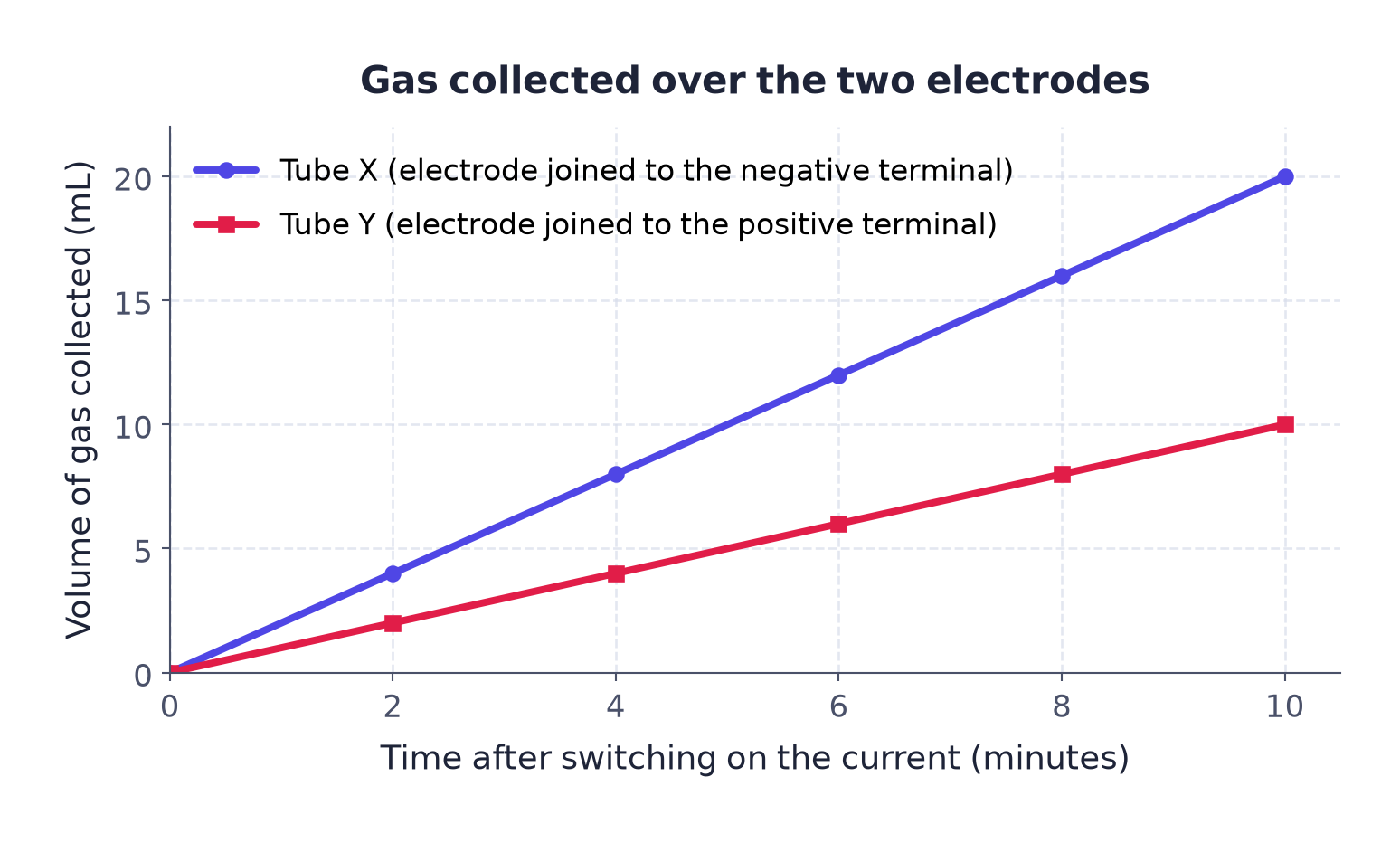
A student set up the electrolysis of water using carbon electrodes, a 6 V battery and water with a few drops of dilute sulphuric acid. Two test tubes, X and Y, filled with water, were inverted over the electrodes. Test tube X was over the electrode joined to the negative terminal of the battery. The student recorded the volume of gas in each tube every two minutes, as shown in the graph.
Figure for Q28 (data written for this paper)
A.
Name the gas collected in test tube X. How does the graph support your answer?
(1)
B.
Name the type of chemical reaction taking place, and the form of energy that brings it about.
(1)
Attempt either sub-part C or D.
C.
Write the balanced chemical equation for the reaction. Using the graph, predict the volume of gas in tube Y when tube X has collected 30 mL of gas.
(2)
OR
D.
When the tubes are full, they are removed carefully and a burning candle is brought close to the mouth of each tube, one by one. What will be observed with each gas?
(2)
For visually impaired students (in place of Q28): A student carried out the electrolysis of water. Tube X was over the electrode joined to the negative terminal and tube Y over the electrode joined to the positive terminal. The volumes of gas collected at 2, 4, 6, 8 and 10 minutes were: tube X 4, 8, 12, 16 and 20 mL; tube Y 2, 4, 6, 8 and 10 mL. Answer parts A, B and C or D given above using these readings.
4
29A
5 marks
Attempt either option A or B.
I. How is bleaching powder prepared? Write the chemical equation and give two uses of bleaching powder. (2) II. A white powder X is used by doctors to support fractured bones in the right position. When mixed with water, it changes into a hard solid mass Y. Identify X and Y and write the equation for the change. Why should X be stored in a moisture-proof container? (3)
5
OR
29B
5 marks
I. Ethanol is heated at 443 K with excess concentrated sulphuric acid. Write the chemical equation for the reaction and state the role of the sulphuric acid. (2) II. Vegetable oils are converted into vegetable ghee by heating them with hydrogen. Name this type of reaction and the catalyst used, and show the change in a general equation for the carbon-carbon bond. (2) III. What is a catalyst? Name the catalyst commonly used in the hydrogenation of vegetable oils. (1)
5
Section C: Physics (25 marks)
Q. No.
Marks
30
1 mark
A student reading a book looks up at a tree far away and still sees it clearly. Which change in her eyes makes this possible?
(A) The ciliary muscles contract, the lens becomes thinner and its focal length increases.
(B) The ciliary muscles relax, the lens becomes thinner and its focal length increases.
(C) The ciliary muscles relax, the lens becomes thicker and its focal length decreases.
(D) The ciliary muscles contract, the lens becomes thicker and its focal length increases.
1
31
1 mark
A straight vertical wire passes through a horizontal sheet of cardboard. A current flows upward through the wire. Seen from above, the magnetic field lines on the cardboard are
(A) straight lines pointing away from the wire
(B) straight lines parallel to the wire
(C) concentric circles in the clockwise direction
(D) concentric circles in the anticlockwise direction
1
The following question has two statements, Assertion (A) and Reason (R). Answer it by choosing the correct option from those given below.
(A) Both A and R are true, and R is the correct explanation of A.
(B) Both A and R are true, but R is not the correct explanation of A.
(C) A is true, but R is false.
(D) A is false, but R is true.
32
1 mark
Assertion (A): Convex mirrors are commonly used as rear-view (wing) mirrors in vehicles. Reason (R): A convex mirror always gives an erect, though diminished, image and has a wider field of view because it is curved outwards.
1
33
2 marks
A. Why does the clear sky appear blue to us on the earth? (1) B. Why does the sky appear dark to passengers flying at very high altitudes? (1)
2
34A
2 marks
Attempt either option A or B.
A. Why do two magnetic field lines never intersect each other? (1) B. What does the closeness of magnetic field lines show? Where is the field the strongest around a bar magnet? (1)
2
OR
34B
2 marks
A. Describe the magnetic field inside a long straight solenoid carrying a current. (1) B. How can such a solenoid be used to make an electromagnet? (1)
2
35
3 marks
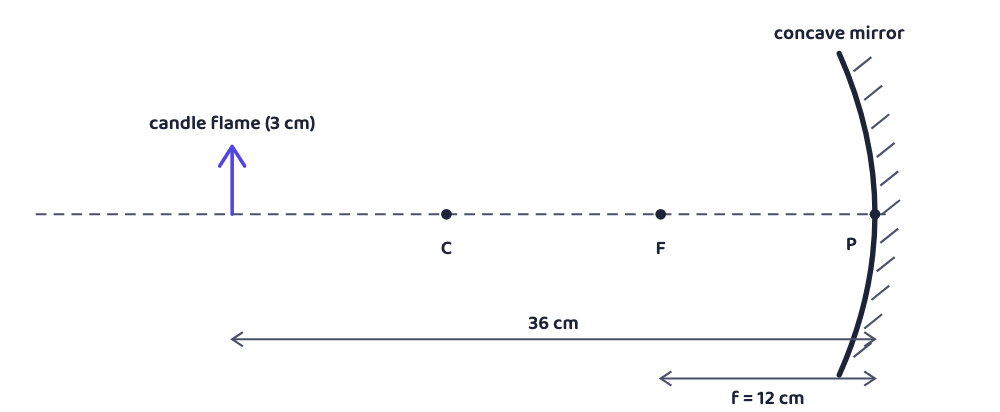
A 3 cm high candle flame stands 36 cm from the pole of a concave mirror whose focal length is 12 cm, as shown.
Figure for Q35 (not to scale)
A. Use the mirror formula to locate the image. (1) B. How tall is the image? Is it real or virtual, erect or inverted, magnified or diminished? (1) C. If the object is moved to the centre of curvature C, where will its image be formed and what will be its size? (1)
For visually impaired students (in place of Q35): An object 3 cm tall is placed 36 cm in front of a concave mirror of focal length 12 cm. (A) Find the position of the image. (B) Find its size and state its nature. (C) Where will the image be formed, and of what size, if the object is placed at the centre of curvature?
3
36
3 marks
A wire 1 m long has a cross-sectional area of 2×10⁻⁷ m2 and a resistance of 0.5 Ω.
A. Calculate the resistivity of the material of the wire. (1) B. A second wire of the same material is 2 m long and has a cross-sectional area of 4×10⁻⁷ m2. What is its resistance? Give a reason. (1) C. Why are copper and aluminium generally used for electrical transmission lines? (1)
3
37
3 marks
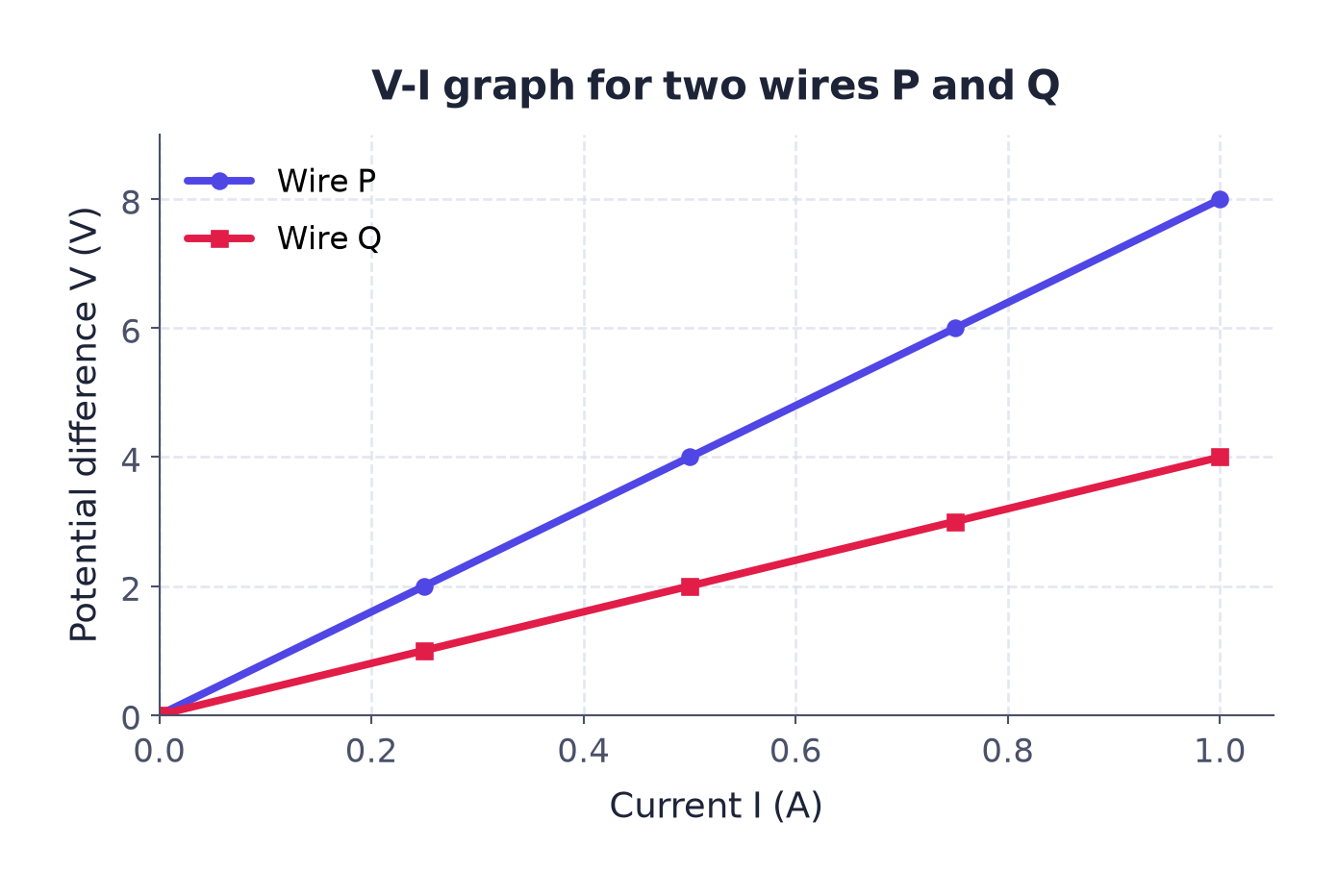
A student studied two wires, P and Q, and plotted the V-I graph shown below.
Figure for Q37 (data written for this paper)
A. Which wire has the greater resistance? Give a reason from the graph. (1) B. Calculate the resistance of each wire. (1) C. The two wires are joined in series and connected to a 6 V battery. Find the current in the circuit. (1)
For visually impaired students (in place of Q37): A student measured the potential difference V across two wires P and Q for different currents I. For currents of 0.25 A, 0.5 A, 0.75 A and 1.0 A, V across P was 2 V, 4 V, 6 V and 8 V, and V across Q was 1 V, 2 V, 3 V and 4 V. (A) Which wire has the greater resistance? Give a reason. (B) Calculate the resistance of each wire. (C) The wires are joined in series to a 6 V battery. Find the current.
3
38
4 marks
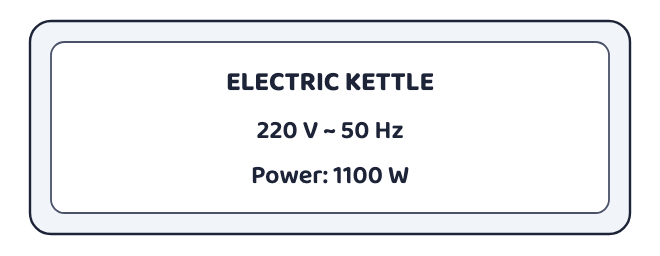
Meera’s family bought an electric kettle. Its rating plate is shown below. The kettle is used on the 220 V supply at home.
Figure for Q38
A.
Calculate the current drawn by the kettle.
(1)
B.
Calculate the resistance of its heating element when it is in use.
(1)
Attempt either sub-part C or D.
C.
How much heat does the kettle produce in 5 minutes? The cord connecting the kettle carries the same current as the element, but it hardly gets warm. Why?
(2)
OR
D.
The kettle and a 1000 W electric iron are switched on at the same time on a 220 V line protected by an 8 A fuse. Will the fuse melt? Show your calculation.
(2)
For visually impaired students (in place of Q38): Meera’s electric kettle is rated 220 V, 1100 W, and is used on the 220 V supply at home. Answer parts A, B and C or D given above using this rating.
4
39A
5 marks
Attempt either option A or B.
I. With a ray diagram, show how a converging lens forms the image of an object kept between F1 and 2F1. Where is the image formed, and what are its size and nature? (2) II. A diverging lens has a focal length of 15 cm. A pencil stands upright 10 cm from it. Locate the image of the pencil and calculate the magnification. (2) III. Calculate the power of this diverging lens in dioptres. (1)
For visually impaired students (in place of Q39A): I. An object is placed between F1 and 2F1 of a convex lens. State the position, size and nature of the image, and describe the path of a ray that passes through the optical centre of the lens. (2) II. and III. as in option A above. (3)
5
OR
39B
5 marks
I. State the function of each of the following parts of the human eye: (a) cornea, (b) iris, (c) pupil, (d) retina. (2) II. What are the near point and the far point of a normal human eye? Give their values for a young adult with normal vision. (2) III. A 12-year-old boy can see distant objects clearly but cannot read a book held at a normal distance. Name this defect and the type of lens used to correct it. (1)
5
End of Question Paper
Marking Scheme / अंकन योजना (उत्तर देखें)
ANSHUL ACADEMY · anshulacademy.in
Science (086)
Sample Paper 2: Marking Scheme
Class X (2026-27) · English Medium
Time Allowed: 3 hoursMaximum Marks: 80
For examiners and students:
For objective questions, the correct option letter and the answer are both given.
For descriptive questions, value points are given with the marks for each (shown in brackets). Award marks for each correct value point.
Any other correct answer based on the NCERT textbook, and correct alternative methods in numericals, may be given full credit.
Where a question has an internal choice (OR), the answers to both alternatives are given.
Section A: Biology (30 marks)
Q. No.
Answers / Value points
Marks
1
1 mark
(C) Platelets. Platelet cells circulate around the body and plug leaks at the site of an injury by helping the blood to clot.
1
2
1 mark
(B) Only P, the green region, turns blue-black, because starch is formed only where chlorophyll is present. This shows that chlorophyll is essential for photosynthesis.
For visually impaired students: (D) Only the green region turns blue-black, showing that chlorophyll is needed for photosynthesis.
1
3
1 mark
(D) Cerebellum. It is responsible for the precision of voluntary actions and for maintaining the posture and balance of the body.
1
4
1 mark
(A) Multiple fission. Single-celled organisms such as Plasmodium, the malarial parasite, divide into many daughter cells simultaneously.
1
5
1 mark
(B) 50%. Tt × tt gives Tt and tt in equal numbers, so half the plants are tall (Tt) and half are short (tt).
1
6
1 mark
(C) Abscisic acid is a hormone that inhibits growth; its effects include wilting of leaves.
1
7
1 mark
(D) In a natural pond, micro-organisms (bacteria and fungi) act as decomposers and break down dead remains and wastes, so materials are recycled; a small human-made aquarium does not have enough of them, so wastes collect.
1
8
1 mark
(B) Both A and R are true, but R is not the correct explanation of A. The plants are similar to the parent because they come from a part of a single parent plant without the fusion of gametes; R only states one advantage of the method.
1
9
1 mark
(A) Both A and R are true, and R is the correct explanation of A. Since blood leaves the heart under high pressure, the arteries that carry it away to the organs need thick, elastic walls.
1
10
2 marks
Each germ cell (egg or sperm) has only one set of genes, that is, one copy of each gene, since each pair of chromosomes is separated when germ cells are made. (1)
When a male and a female germ cell fuse, the zygote gets one set from each parent, so both parents contribute equally to the genetic material of the progeny and the normal number of chromosomes is restored. (1)
2
11A
2 marks
If the environment changes drastically (for example, the water temperature rises), most individuals of a population may die; a few variants that can survive the change keep the species going. (1)
A particular variation helps the individual only if it suits the conditions it lives in; otherwise it may be of no use or even harmful to that individual. (1)
2
OR
11B
2 marks
Root cells take up ions from the soil, creating a difference in ion concentration that makes water move into the root xylem (root pressure); loss of water vapour through the stomata of leaves (transpiration) creates a suction that pulls water up through the xylem. (1)
Transpiration pull is the major driving force during the day; root pressure is more important at night. (½ + ½)
2
12
2 marks
Iodine is necessary for the thyroid gland to make thyroxin, the hormone that regulates carbohydrate, protein and fat metabolism in the body for the best balance for growth. (1)
Deficiency of iodine may cause goitre (a swollen neck). (1)
2
13
3 marks
A. Bile makes the acidic food alkaline so that pancreatic enzymes can act (½); bile salts break the large fat globules into smaller globules, increasing the efficiency of enzyme action (½).
B. Trypsin for digesting proteins (½) and lipase for breaking down emulsified fats (½).
C. The inner lining has numerous finger-like projections called villi, which increase the surface area for absorption; they are richly supplied with blood vessels that take the absorbed food to every cell of the body. (1)
3
14
3 marks
A. Sperm formation requires a lower temperature than the normal body temperature. (1)
B. Their secretions make the transport of sperms easier and also provide nutrition to the sperms. (½ + ½)
C. The lining is not needed, so it slowly breaks and comes out through the vagina as blood and mucus; this is called menstruation (it lasts for about two to eight days every month). (1)
3
15
4 marks
A.
Phytoplankton 20,000 kJ → zooplankton 2,000 kJ → small fish 200 kJ. (½ for steps + ½ for answer)
(1)
B.
Biological magnification. (1)
(1)
C.
The pesticide is not degradable, so it enters the food chain and accumulates progressively at each trophic level; the bird is at the top level, so the maximum concentration gets accumulated in it. (1)
Human beings occupy the top level in many food chains, so the maximum concentration of such chemicals gets accumulated in our bodies; our food grains, vegetables, fruits and meat contain pesticide residues that cannot always be removed by washing. (1)
(2)
OR
D.
Only about 10% of the organic matter (energy) at one level reaches the next; the large fish gets about 20 kJ and the bird only about 2 kJ of the original 20,000 kJ. (1)
Since so little usable energy remains after four or five steps, there is not enough energy to support further trophic levels; food chains generally consist of only three or four steps. (1)
(2)
4
16A
5 marks
I. P: ethanol; Q: lactic acid; R: carbon dioxide. Glucose is broken into pyruvate in the cytoplasm. (½ × 4)
II. During vigorous activity there is a lack of oxygen in muscle cells, so pyruvate is converted into lactic acid; the build-up of lactic acid causes cramps. (1)
III. The pathway in the presence of oxygen (aerobic respiration in mitochondria) releases much more energy than the others. (1)
III. ATP; it is used, for example, for the contraction of muscles, the making of proteins or the conduction of nerve impulses (any one). (½ + ½)
For visually impaired students: I. (a) Ethanol (with carbon dioxide), (b) lactic acid, (c) carbon dioxide; cytoplasm. II and III as in option A.
5
OR
16B
5 marks
I. The leaves of the sensitive plant fold up quickly in response to touch; this movement is not connected with growth (cells change shape by changing the amount of water in them). (1)
I. The bending of a shoot towards light is a slow, directional growth movement (phototropism) caused by unequal growth, controlled by auxin. (1)
II. Adrenaline, secreted by the adrenal glands directly into the blood. (½ + ½)
II. The heart beats faster, resulting in the supply of more oxygen to the muscles; blood to the digestive system and skin is reduced (muscles around small arteries contract), diverting blood to the skeletal muscles. (1)
II. The breathing rate increases because of the contractions of the diaphragm and the rib muscles; together these prepare the body to deal with the situation. (1)
5
Section B: Chemistry (25 marks)
Q. No.
Answers / Value points
Marks
17
1 mark
(C) Combination reaction; exothermic. CaO(s)+HX2O(l)Ca(OH)X2(aq) + heat: two substances combine to form a single product, and heat is given out.
1
18
1 mark
(A) Each formula unit of copper sulphate contains five water molecules (CuSOX4⋅5HX2O); heating removes this water of crystallisation (the salt turns white), and adding water restores the blue colour.
1
19
1 mark
(D) Galvanisation is a method of protecting steel and iron from rusting by coating them with a thin layer of zinc.
1
20
1 mark
(B) CX2HX5OH and CX3HX7OH have the same functional group (the -OH group of alcohols) and differ by one −CHX2− unit (14 u).
1
21
1 mark
(C) Hydrogen; it burns with a pop sound. Zn+HX2SOX4ZnSOX4+HX2: the acid reacts with the metal to give a salt and hydrogen gas.
For visually impaired students: (A) The gas burns with a pop sound, as it is hydrogen.
1
22
1 mark
(D) In a micelle, the ionic ends (P) of the soap molecules face the water (they are water-soluble), while the long hydrocarbon tails (Q) stay inside, in the oily dirt; the dirt is thus held in the centre and can be rinsed away.
For visually impaired students: (B) The ionic ends face outward, towards the water; the hydrocarbon tails stick into the oil.
1
23
1 mark
(A) 2AgCl(s)sunlight2Ag(s)+ClX2(g). It is a decomposition reaction brought about by light; the grey colour is due to silver.
1
24
1 mark
(C) A is true, but R is false. Aluminium oxide reacts with both acids and bases to produce salts and water; that is why it is called amphoteric.
1
25
2 marks
A. Rancidity; the fats and oils in the chips are oxidised by the oxygen of the air. (½ + ½)
B. Adding antioxidants to foods containing fats and oil; flushing the bags of chips with an unreactive gas such as nitrogen; keeping food in air-tight containers (any two). (½ + ½)
2
26A
3 marks
(i) Mg (2, 8, 2) loses its two outer electrons to O (2, 6): Mg with two outer electrons (shown as ×) and O with six outer electrons (shown as dots); the two electrons move from Mg to O, giving Mg2+ and an oxide ion with eight outer electrons in brackets with charge 2−: Mg2+ [O]2−. (1)
(iii) A considerable amount of energy is required to break the strong inter-ionic attraction between the oppositely charged ions. (1)
For visually impaired students: (i) Magnesium loses two electrons and oxygen gains two electrons, so both attain the electronic configuration 2, 8. (ii) and (iii) as in option A.
B.CHX3COOH+CHX3CHX2OHacidCHX3COOCHX2CHX3+HX2O (½); esters are sweet-smelling and are used in making perfumes and as flavouring agents (½).
C. The melting point of pure ethanoic acid is 290 K, so it often freezes during winters in cold climates. (1)
3
28
4 marks
A.
Hydrogen (½); at every reading the volume in X is double the volume in Y, and water gives two volumes of hydrogen for one volume of oxygen (½).
(1)
B.
Decomposition reaction (½), brought about by electricity (½).
(1)
C.
2HX2O(l)electricity2HX2(g)+OX2(g) (1)
Hydrogen and oxygen are formed in the ratio 2 : 1 by volume, so Y has 15 mL of oxygen. (1)
(2)
OR
D.
Tube X (hydrogen): the gas burns with a pop sound. (1)
Tube Y (oxygen): the candle burns more brightly, since oxygen supports burning. (1)
(2)
For visually impaired students: Same answers as for the main question.
4
29A
5 marks
I. Bleaching powder is produced by the action of chlorine on dry slaked lime: Ca(OH)X2+ClX2CaOClX2+HX2O (1)
I. Uses: bleaching cotton and linen in the textile industry or wood pulp in paper factories; bleaching washed clothes in laundry; as an oxidising agent in chemical industries; disinfecting drinking water (any two). (½ + ½)
II. X: plaster of Paris, calcium sulphate hemihydrate CaSOX4⋅21HX2O; Y: gypsum, CaSOX4⋅2HX2O. (½ + ½)
II.CaSOX4⋅21HX2O+23HX2OCaSOX4⋅2HX2O (1)
II. Plaster of Paris absorbs moisture from the air and sets into a hard mass (gypsum), so it would become useless if not kept dry. (1)
5
OR
29B
5 marks
I.CHX3−CHX2OHHotconc⋅HX2SOX4CHX2=CHX2+HX2O (1); concentrated sulphuric acid acts as a dehydrating agent, removing water from ethanol (1).
II. Addition reaction (hydrogenation) (½), in the presence of a catalyst such as nickel or palladium (½).
II.RX2C=CRX2+HX2NicatalystRX2CH−CHRX2, an unsaturated compound becoming saturated. (1)
III. A catalyst is a substance that causes a reaction to occur or proceed at a different rate without the reaction itself being affected (½); nickel (½).
5
Section C: Physics (25 marks)
Q. No.
Answers / Value points
Marks
30
1 mark
(B) When the ciliary muscles are relaxed, the lens becomes thin and its focal length increases, enabling us to see distant objects clearly.
1
31
1 mark
(D) By the right-hand thumb rule, with the thumb pointing upward along the current, the fingers curl anticlockwise when viewed from above; the field lines are concentric circles around the wire.
1
32
1 mark
(A) Both A and R are true, and R is the correct explanation of A. Convex mirrors enable the driver to view a much larger area than a plane mirror would.
1
33
2 marks
A. The molecules of air and other fine particles in the atmosphere are smaller than the wavelength of visible light; they scatter light of shorter wavelengths (the blue end) much more strongly than red, and this scattered blue light enters our eyes. (1)
B. At such heights scattering is not prominent (there is hardly any air to scatter sunlight), so very little scattered light reaches the eyes and the sky looks dark. (1)
2
34A
2 marks
A. If they did, there would be two directions of the field at the point of intersection, which is not possible, since a compass needle can point in only one direction. (1)
B. The relative strength of the field: the field is stronger where the lines are crowded (½); it is the strongest near the poles, where the lines are closest (½).
2
OR
34B
2 marks
A. The field lines inside the solenoid are parallel straight lines, showing that the magnetic field is the same at all points inside it (uniform). (1)
B. A strong magnetic field inside the solenoid magnetises a piece of magnetic material, such as soft iron, placed inside the coil; the magnet so formed is an electromagnet. (1)
2
35
3 marks
A.u=−36 cm, f=−12 cm; v1=f1−u1=−121+361=−362, so v=−18 cm: the image is 18 cm in front of the mirror. (1)
B.m=−uv=−−36−18=−0.5; image height =−0.5×3=−1.5 cm: 1.5 cm tall, real, inverted and diminished. (½ + ½)
C. At C itself (24 cm in front of the mirror); same size as the object, 3 cm (real and inverted). (½ + ½)
For visually impaired students: Same as the main question: 18 cm in front of the mirror; 1.5 cm, real, inverted and diminished; at C (24 cm), 3 cm.
3
36
3 marks
A.ρ=lRA=10.5×2×10−7=1×10⁻⁷Ω m. (½ formula + ½ answer)
B. 0.5 Ω. R∝Al: doubling the length doubles R and doubling the area halves it, so R is unchanged. (½ + ½)
C. They have low electrical resistivity, so they are good conductors and less energy is lost as heat. (1)
3
37
3 marks
A. Wire P; its graph is steeper, so for the same current the potential difference across it is greater (V/I is larger). (½ + ½)
B.RP=1A8V=8Ω; RQ=1A4V=4Ω. (½ + ½)
C.Rs=8+4=12Ω; I=RV=126=0.5 A. (½ + ½)
For visually impaired students: Same as the main question: P (V/I larger); RP=8Ω, RQ=4Ω; I=0.5 A.
3
38
4 marks
A.
I=VP=2201100=5 A. (½ formula + ½ answer)
(1)
B.
R=IV=5220=44Ω (or R=PV2). (1)
(1)
C.
H=Pt=1100×300=3.3×10⁵ J. (1)
By Joule’s law, H=I2Rt; the copper cord has a very low resistance compared with the element, so very little heat is produced in it. (1)
(2)
OR
D.
Total power =1100+1000=2100 W; total current =2202100≈9.5 A. (1)
This is more than 8 A, so the fuse wire will melt and break the circuit, protecting the appliances. (1)
(2)
For visually impaired students: Same answers as for the main question.
4
39A
5 marks
I. Correct ray diagram with two rays (one parallel to the axis passing through F2, one through the optical centre undeviated). (1)
I. Image beyond 2F2; enlarged; real and inverted. (1)
II. Concave lens: u=−10 cm, f=−15 cm; v1=f1+u1=−151−101=−305, so v=−6 cm (on the same side as the object). (1)
II.m=uv=−10−6=+0.6: virtual, erect and diminished. (1)
III.P=f(in m)1=−0.151≈−6.7 D. (1)
For visually impaired students: I. Beyond 2F2; enlarged; real and inverted (1); a ray through the optical centre passes without any deviation (1). II and III as in option A.
5
OR
39B
5 marks
I. (a) Cornea: most of the refraction of light rays entering the eye occurs at its outer surface. (b) Iris: controls the size of the pupil. (c) Pupil: regulates and controls the amount of light entering the eye. (d) Retina: a light-sensitive screen on which the image is formed. (½ × 4)
II. Near point: the minimum distance at which objects can be seen most distinctly without strain; about 25 cm. (½ + ½)
II. Far point: the farthest point up to which the eye can see objects clearly; infinity for a normal eye. (½ + ½)
III. Hypermetropia (far-sightedness); corrected with a convex (converging) lens of suitable power. (½ + ½)