
Pattern: CBSE 2026-27 official Sample Question Paper (SQP) design · Maximum marks: 80 · Time: 3 hours. Solve the paper first, then open the marking scheme at the end to check your answers.
Science (086)
General Instructions:
- This question paper has 39 questions in three sections. All questions are compulsory.
- Section A is Biology (Q1 to Q16, 30 marks), Section B is Chemistry (Q17 to Q29, 25 marks) and Section C is Physics (Q30 to Q39, 25 marks).
- Each section has objective questions (multiple-choice and Assertion-Reason, 1 mark each), short answer questions (2 marks and 3 marks), one case-based question (4 marks) and one long answer question (5 marks).
- There is no overall choice. An internal choice is given in some questions, and in some sub-parts of the case-based questions; attempt only one of the alternatives in such questions.
- Questions printed under the heading “For visually impaired students” replace questions that use a figure or graph. Only visually impaired candidates should attempt them.
- Draw neat, labelled diagrams wherever a question asks for one.
(i) Excess water is got rid of by transpiration.
(ii) Many waste products are stored in cellular vacuoles or in leaves that later fall off.
(iii) Some waste products are stored as resins and gums, especially in old xylem.
(iv) All waste products are collected in the roots and removed only through them.
Which of the statements are correct?
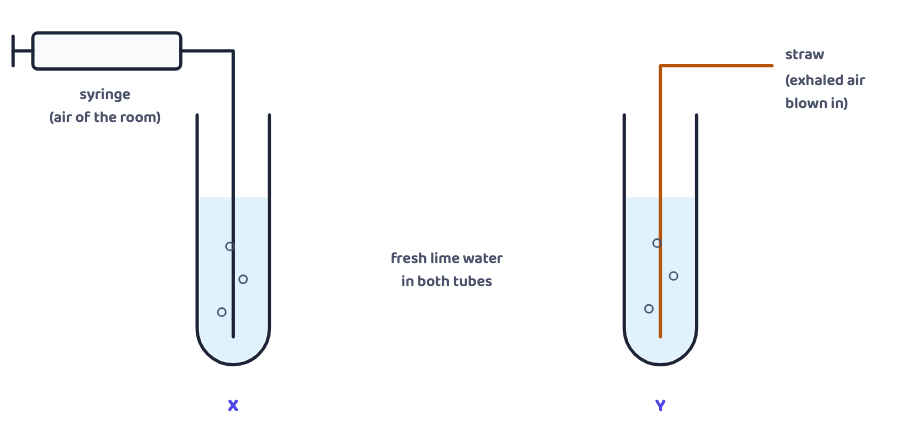
Fresh lime water is taken in two test tubes. Room air is pushed into the first tube with a syringe, and exhaled air is blown into the second through a straw. Which tube turns milky first?
Reason (R): Roots and shoots respond to the pull of the earth (gravity) in opposite ways; this response is called geotropism.
Reason (R): In complex multicellular organisms, the body is organised into tissues and organs placed at definite positions.
B. Besides these, a plant takes up nitrogen from the soil. In what form is it taken up, and what does the plant use it for? (1)
A. What are the tiny blob-on-a-stick structures seen in this growth, and what do they contain? (1)
B. How are the spores suited to help the mould survive and spread? (1)
A. What is the transport of soluble products of photosynthesis called, and which tissue carries it out? (1)
B. How is a material such as sucrose moved into this tissue? (1)
C. Why can this transport take place both upwards and downwards in the plant? (1)
A. In which part of a neuron is the information first acquired? (1)
B. Through which part does the information travel as an electrical impulse? (1)
C. How is the impulse passed on to the next neuron at the synapse? (1)
| Tube | Contents | Iodine added | Colour seen |
|---|---|---|---|
| A | starch + saliva | after 30 min | no blue-black colour |
| B | starch + water | after 30 min | blue-black |
| C | starch + saliva | at once | blue-black |
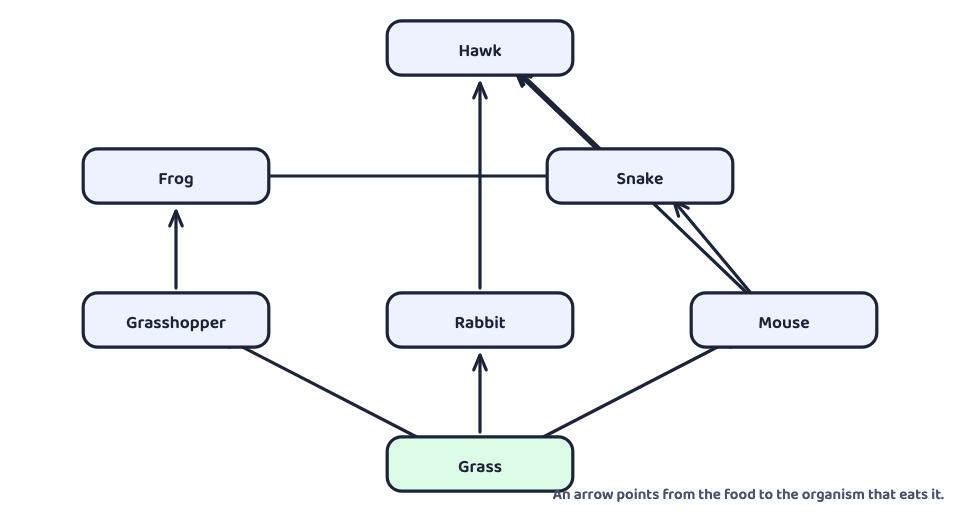
I. Name the producer and any two herbivores in this food web. Write one food chain from it that has four trophic levels. (2)
II. Why is the flow of energy in this food web said to be unidirectional? (1)
III. Bacteria and fungi are not shown in the web. What role do they play in this grassland, and what would happen if they were absent? (2)
I. In a grassland, grass is eaten by grasshoppers, rabbits and mice; frogs eat grasshoppers; snakes eat frogs and mice; hawks eat rabbits, mice and snakes. Name the producer and any two herbivores, and write one food chain of four trophic levels from this description. (2)
II. and III. as in option A above. (3)
I. How is ozone formed at the higher levels of the atmosphere? Write the two steps. Why is this ozone layer important for life on the earth? (2)
II. Which synthetic chemicals have been linked to the decrease of ozone since the 1980s, and what step was taken by the United Nations Environment Programme (UNEP) in 1987? (1)
III. Improvements in our lifestyle have led to far more waste. Explain how the way we live and the way goods are packed has made much of this waste non-biodegradable, and state one effect of this on the environment. (2)
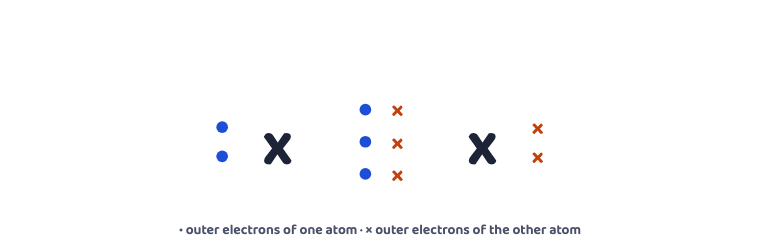
An element X has atomic number 7. When two atoms of X combine to form a molecule X2, the bond between them is

Iron nails are kept in three corked test tubes: tube A has some ordinary water, tube B has boiled distilled water with a layer of oil on it, and tube C has anhydrous calcium chloride. After a few days, rust is seen in
Reason (R): When acid rain flows into rivers, it lowers the pH of the river water and makes the survival of aquatic life difficult.
B. Copper wires are used in electrical circuits, but the joints between wires are welded with solder. Name the metals present in solder, and the property that makes it suitable for this use. (1)
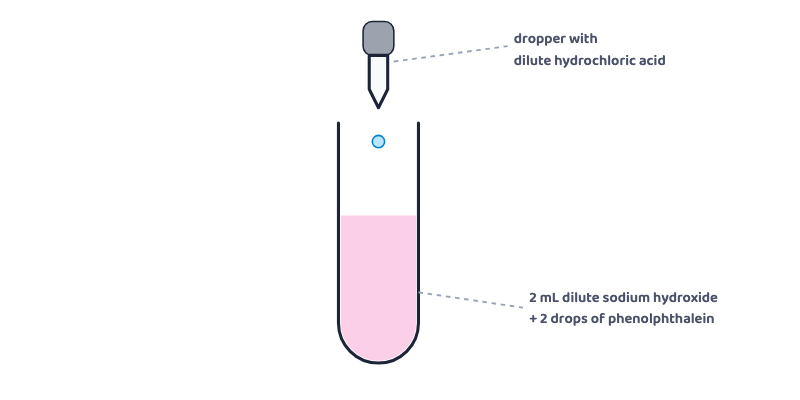
(i) What is the colour of the solution before the acid is added, and what happens to it as the acid is added? (1)
(ii) Write the chemical equation for the reaction and name the type of reaction. (1)
(iii) A few drops of sodium hydroxide are now added to the final mixture. What will be seen, and why? (1)
(i) Two drops of phenolphthalein are added to 2 mL of dilute sodium hydroxide solution, and dilute hydrochloric acid is then added drop by drop. State the colour of the solution before the acid is added and what happens as the acid is added. (1)
(ii) and (iii) as in option A above.
(i) Potassium sulphate, (1)
(ii) Ammonium chloride, (1)
(iii) Sodium carbonate, (1)
A. Identify the brown gas released. What kind of reaction is this? (1)
B. Write the balanced chemical equation for the reaction. (1)
C. Calcium carbonate also breaks down on heating. Write the equation and give one use of the solid product. (1)

A student added 2 g each of powdered magnesium, zinc, iron and copper to four beakers of the same dilute hydrochloric acid. After 5 minutes the temperature had risen by 14 °C with magnesium, 6 °C with zinc, 3 °C with iron and 0 °C with copper. Answer parts A, B and C or D given above using these readings.
I. Two test tubes hold 10 mL each of distilled water and of hard water. Five drops of soap solution are added to each and the tubes are shaken equally. In which tube is more foam formed? What is seen in the other tube, and why? (2)
II. Why are detergents effective in hard water while soaps are not? (1)
III. Draw the structural formulae of (a) butanone and (b) propyne. Name the functional group present in butanone. (2)
I. In the reaction , identify the substance oxidised and the substance reduced. Define oxidation and reduction in terms of oxygen and hydrogen. (2)
II. A clean strip of lead is dipped in copper(II) chloride solution, and the reaction takes place. Name the type of reaction, and state what it tells you about the reactivity of lead compared with copper. Would a copper strip react with lead chloride solution? (2)
III. Why is respiration considered an exothermic reaction? (1)
Reason (R): The magnetic field produced by a current-carrying wire becomes weaker when the current through it is increased.
B. The refractive index of crown glass is 1.52. What does this tell you about the speed of light in it? (1)
B. A spherical mirror has a radius of curvature of 30 cm. What is its focal length? State the relation you used. (1)
B. In which direction with respect to the Sun is a rainbow always seen? (1)
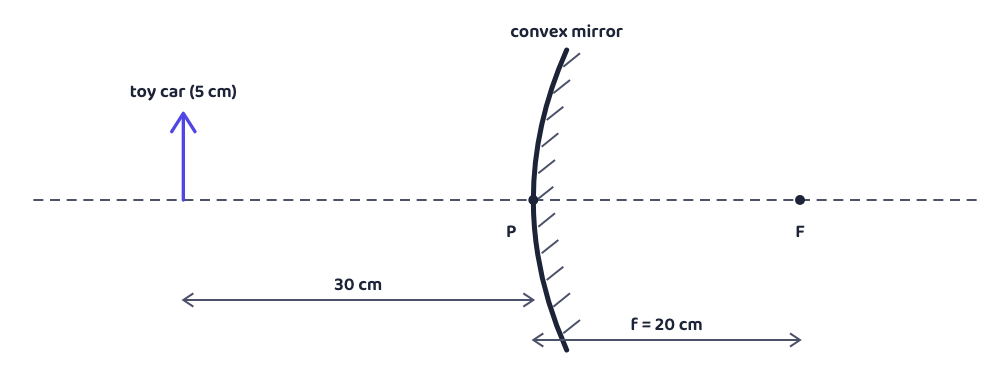
A. Use the mirror formula to find the position of the image. (1)
B. Find the magnification and the height of the image, and state its nature. (1)
C. The car is now moved slowly towards the mirror. How do the position and the size of its image change? (1)
A toy car 5 cm tall is placed 30 cm in front of a convex mirror of focal length 20 cm. A. Find the position of the image. B. Find the magnification and the height of the image, and state its nature. C. How do the position and size of the image change as the car is moved towards the mirror?
A. What do the magnetic field lines look like at the centre of the loop? (1)
B. Why do all parts of the loop add to the field inside it, instead of cancelling one another? (1)
C. The single loop is replaced by a circular coil of 50 turns carrying the same current. How does the field at its centre compare with that of the single loop? Give a reason. (1)
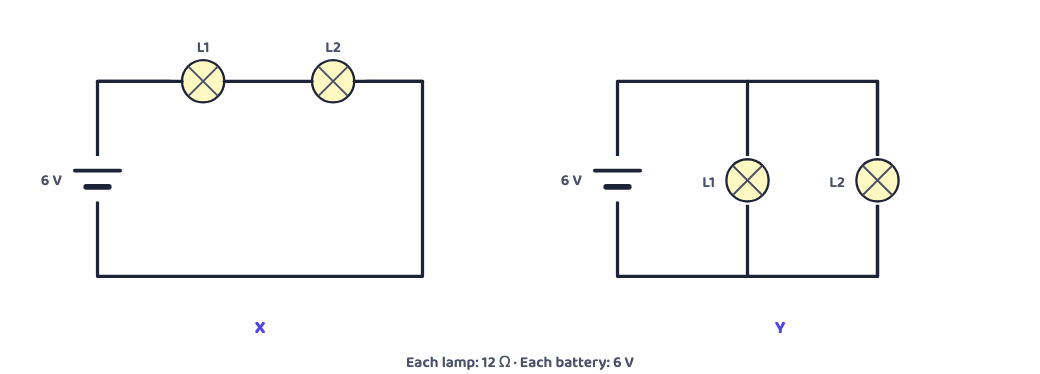
A. Calculate the equivalent resistance of arrangement X and of arrangement Y. (1)
B. How much current flows out of the battery in each arrangement? (1)
C. In which arrangement do the lamps glow more brightly? Support your answer by finding the power of one lamp in each case. (1)
Two identical lamps, each of resistance 12 Ω, are connected to a 6 V battery, first in series (arrangement X) and then in parallel (arrangement Y). (A) Find the total resistance in X and in Y. (B) Find the current drawn from the battery in each case. (C) In which arrangement do the lamps glow more brightly? Support your answer by finding the power of one lamp in each case.
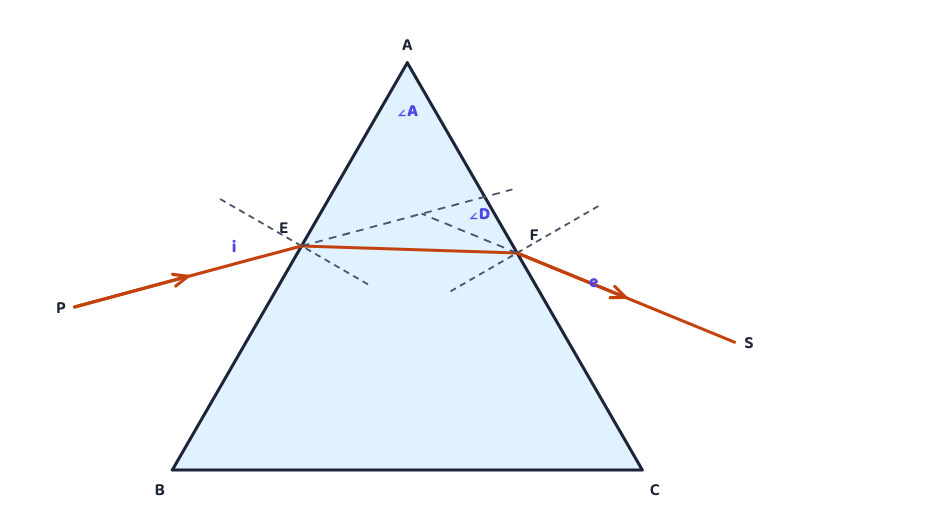
Asha traced the path of a ray of light through a triangular glass prism: the ray enters through one face, travels inside the glass and leaves through the other face. A. Name the angle between the two refracting faces of the prism and the angle between the incident ray and the emergent ray. (1) B. Why does the ray bend away from the normal as it leaves the prism? (1) Then answer C or D given above.
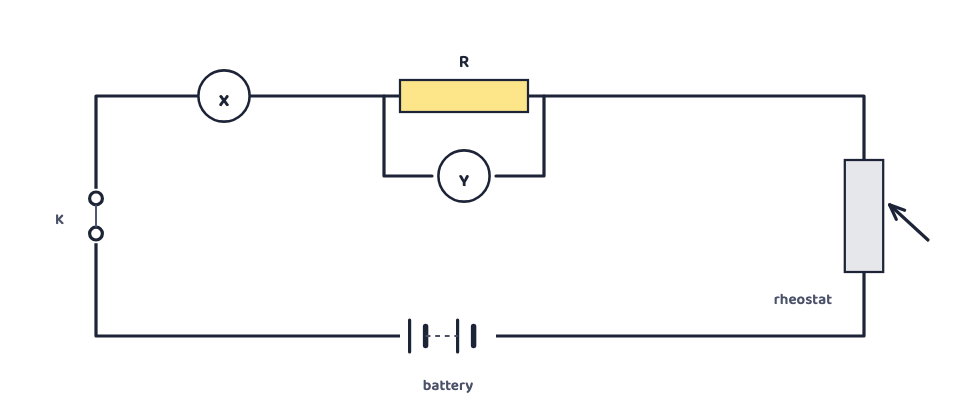
I. Identify the meters X and Y. How is each connected with respect to R, and why? (2)
II. State Ohm’s law. What will the graph of V against I look like for R? (1)
III. When Y reads 3 V, X reads 0.3 A. Find the resistance of R. If R is replaced by a wire of the same material and thickness but twice as long, what will X read when Y reads 3 V? (2)
I. In an experiment to verify Ohm’s law, an ammeter and a voltmeter are used with a resistor R. How should each meter be connected with respect to R, and why? (2)
II. and III. as in option A above, where the voltmeter reads 3 V and the ammeter 0.3 A. (3)
I. State Fleming’s left-hand rule. (1)
II. A positively charged particle (alpha particle) projected towards the west is deflected towards the north by a magnetic field. What is the direction of the magnetic field? (1)
III. The mains supply reaches our homes through two wires. Name these wires and the colours of their insulation. What is the potential difference between them in India? (2)
IV. Houses usually have two separate circuits, one of 15 A current rating and one of 5 A. Which appliances are connected to each? (1)
Marking Scheme / अंकन योजना (उत्तर देखें)
Science (086)
For examiners and students:
- For objective questions, the correct option letter and the answer are both given.
- For descriptive questions, value points are given with the marks for each (shown in brackets). Award marks for each correct value point.
- Any other correct answer based on the NCERT textbook, and correct alternative methods in numericals, may be given full credit.
- Where a question has an internal choice (OR), the answers to both alternatives are given.
- A. Carbon dioxide from the air, taken in through the stomata (½); water from the soil, absorbed by the roots (½).
- B. As inorganic nitrates or nitrites (or as organic compounds made by bacteria from atmospheric nitrogen) (½); it is used to make proteins and other compounds (½).
- A dominant trait is the one that is expressed even when only one copy of its gene is present; a recessive trait is expressed only when both copies are of the recessive form (it stays hidden in the F1). (½ + ½)
- Violet flower colour is dominant, since it is the only trait that appears in the F1. (1)
- Cellular DNA is the information source for making proteins; a section of DNA that provides information for one protein is the gene for that protein. Plant height depends on the amount of a growth hormone, which is made with the help of an enzyme (a protein). (1)
- If the gene for this enzyme makes it work efficiently, a lot of hormone is made and the plant is tall; if the gene has an alteration that makes the enzyme less efficient, less hormone is made and the plant is short. (1)
- A. They are sporangia, the reproductive parts; they contain cells, the spores, that can develop into new Rhizopus individuals. (½ + ½)
- B. Spores are covered by thick walls that protect them until they come into contact with another moist surface, where they can begin to grow. (1)
- A. Translocation; it occurs in the phloem. (½ + ½)
- B. Sucrose is transferred into the phloem tissue using energy from ATP; this raises the osmotic pressure of the tissue, causing water to move into it. (1)
- C. The pressure moves the material in the phloem to tissues which have less pressure, so food is moved according to the plant’s needs, for example to the storage organs of roots, fruits and seeds, or to growing buds. (1)
- A. At the end of the dendritic tip of the nerve cell (the dendrites). (1)
- B. It travels from the dendrite to the cell body and then along the axon to its end. (1)
- C. At the end of the axon, the electrical impulse sets off the release of some chemicals; these cross the gap (synapse) and start a similar electrical impulse in a dendrite of the next neuron. (1)
- Tube A (½); iodine gives a blue-black colour with starch, and no blue-black colour appears in A, so no starch is left (½).
- Salivary amylase (½); it breaks down starch into simple sugar (½).
- In C, iodine was added at once, before the enzyme had time to act, so the starch was still present. (1)
- B (no saliva) shows that saliva is needed for the breakdown of starch (½); C shows that the enzyme needs time to break down the starch (½).
- Chewing crushes the food into small particles of the same texture, and saliva wets it so that it passes smoothly down the soft lining of the canal. (1)
- While chewing, the tongue mixes the food thoroughly with saliva, so salivary amylase can begin breaking down starch into simple sugar. (1)
- I. Producer: grass (½); herbivores: any two of grasshopper, rabbit and mouse (½).
- I. Grass → grasshopper → frog → snake (or grass → mouse → snake → hawk). (1)
- II. The energy captured by the grass (autotrophs) does not revert to the solar input, and the energy passed on to the herbivores does not come back to the autotrophs; it moves progressively through the trophic levels and is no longer available to the previous level. (1)
- III. They are decomposers: they break down the complex organic substances in dead remains and wastes into simple inorganic substances that go into the soil and are used up again by plants. (1)
- III. Without them, dead bodies and wastes would pile up and the nutrients locked in them would not be returned to the soil, so the replenishment of the soil and the growth of grass would suffer. (1)
- I. High-energy UV radiation splits some oxygen molecules into free oxygen atoms: ; the atoms combine with oxygen molecules: . (½ + ½)
- I. The ozone layer shields the surface of the earth from the ultraviolet radiation of the Sun, which is highly damaging to organisms (for example, it causes skin cancer in human beings). (1)
- II. Chlorofluorocarbons (CFCs), used as refrigerants and in fire extinguishers (½); UNEP forged an agreement to freeze CFC production at 1986 levels (½).
- III. More and more things we use have become disposable, and changes in packaging mean that much of what we throw away is made of materials such as plastics that are not broken down by biological processes. (1)
- III. Such substances persist for a long time and may harm the various members of the ecosystem (for example, they pile up in the surroundings and pollute soil and water). (1)
- A. An alloy is a homogeneous mixture of two or more metals, or of a metal and a non-metal (½); it is prepared by melting the primary metal and dissolving the other elements in it in definite proportions, then cooling (½).
- B. Lead and tin (½); solder has a low melting point (½).
- (i) Pink, since phenolphthalein turns pink in a base (½); it becomes colourless once enough acid has been added to neutralise the base (½).
- (ii) (½); neutralisation reaction (½).
- (iii) The pink colour reappears, because the solution becomes basic again (½ + ½).
- (i) Sulphuric acid and potassium hydroxide (½); neutral, being the salt of a strong acid and a strong base (½).
- (ii) Hydrochloric acid and ammonium hydroxide (½); acidic, being the salt of a strong acid and a weak base (½).
- (iii) Carbonic acid and sodium hydroxide (½); basic, being the salt of a weak acid and a strong base (½).
- A. Nitrogen dioxide, (½); thermal decomposition reaction (½).
- B. (1)
- C. (½); calcium oxide (quicklime) is used in the manufacture of cement (½).
- Magnesium > zinc > iron > copper (½); the more reactive the metal, the faster it reacts and the more heat is given out in the same time (½).
- Copper is less reactive than hydrogen (it is below hydrogen in the reactivity series), so it cannot displace hydrogen from the acid and no reaction takes place. (1)
- Zinc in iron(II) sulphate reacts; iron in zinc sulphate does not, since the chart shows zinc is more reactive than iron and a more reactive metal displaces a less reactive one from its salt solution. (1)
- (1)
- Nitric acid is a strong oxidising agent: it oxidises the hydrogen produced to water and is itself reduced to an oxide of nitrogen. (1)
- Magnesium and manganese react with very dilute nitric acid to evolve hydrogen gas. (½ + ½)
- I. More foam forms in the distilled water (½); in hard water little foam forms and a white curdy precipitate (scum) appears (½).
- I. Soap reacts with the calcium and magnesium salts present in hard water to form an insoluble substance (scum), so more soap is needed for cleaning. (1)
- II. The charged ends of detergents do not form insoluble precipitates with the calcium and magnesium ions in hard water, so they stay effective. (1)
- III. (a) Butanone: , drawn with all bonds shown (C=O on the second carbon) (½ + ½ for correct structure); functional group: ketone (½).
- III. (b) Propyne: , drawn with a triple bond between the first two carbon atoms (½).
- I. HCl is oxidised (it loses hydrogen to form ) (½); is reduced (it loses oxygen) (½).
- I. Oxidation: gain of oxygen or loss of hydrogen by a substance; reduction: loss of oxygen or gain of hydrogen. (½ + ½)
- II. Displacement reaction (½); lead displaces copper from its salt solution, so lead is more reactive than copper (1); no, copper cannot displace the more reactive lead (½).
- III. During respiration, glucose combines with oxygen in the cells of our body and provides energy, so heat is released. (1)
- A. Light from the part of the pencil under water bends (is refracted) as it passes from water into air, so it seems to come from a different direction compared with the part above the water. (1)
- B. The speed of light in air (vacuum) is 1.52 times its speed in crown glass, so light travels more slowly in it; the ratio of the speed of light in air to that in glass is 1.52. (1)
- A. Rays of light parallel to the principal axis, after reflection from a concave mirror, meet (converge) at a point on the principal axis; this point is the principal focus. (1)
- B. cm, for spherical mirrors of small apertures (½ + ½).
- A. Tiny water droplets in the air act like small prisms: they refract and disperse the incident sunlight, reflect it internally, and refract it again as it comes out, so different colours reach the eye. (1)
- B. A rainbow is always formed in a direction opposite to that of the Sun (the Sun is behind the observer). (1)
- A. cm, cm; , so cm: the image is 12 cm behind the mirror. (1)
- B. ; image height cm (½ for m and height); virtual, erect and diminished (½).
- C. The image stays behind the mirror between P and F, moving closer to the mirror; it becomes larger but always remains smaller than the car (virtual and erect). (1)
- A. Near the wire they are concentric circles; as we move towards the centre they become larger, and at the centre they appear as straight lines. (1)
- B. By the right-hand thumb rule, every section of the wire contributes magnetic field lines in the same direction within the loop. (1)
- C. It is 50 times as large (½), because the current in each turn has the same direction, so the fields due to the turns add up (½).
- A. X (series): ; Y (parallel): , so . (½ + ½)
- B. X: A; Y: A. (½ + ½)
- C. In Y. Power of one lamp: X, W; Y, each lamp gets 6 V, W. (½ + ½)
- ∠A: the angle of the prism (½); D: the angle of deviation (½).
- At F the ray passes from glass (optically denser) into air (optically rarer), where light travels faster, so it bends away from the normal. (1)
- Dispersion of white light (½); red bends the least and violet the most (½).
- The different colours of light bend through different angles with respect to the incident ray as they pass through the prism, so they come out separated. (1)
- In the slab, the emergent ray is parallel to the incident ray (it is only shifted sideways). (1)
- The opposite faces of a slab are parallel, so the bending at the second face undoes the bending at the first; in a prism the two refracting faces are inclined at an angle, so the ray is deviated. (1)
- I. X is an ammeter, connected in series with R, so that the whole current through R passes through it (½ + ½).
- I. Y is a voltmeter, connected in parallel across the ends of R, so that it measures the potential difference between those two points (½ + ½).
- II. The potential difference across the ends of a metallic wire is directly proportional to the current through it, provided its temperature remains the same () (½); the V-I graph is a straight line passing through the origin (½).
- III. (1); resistance is directly proportional to length, so the new wire has and A (½ + ½).
- I. Stretch the thumb, forefinger and middle finger of the left hand so that they are mutually perpendicular; if the forefinger points in the direction of the magnetic field and the middle finger in the direction of the current, the thumb points in the direction of motion of (force on) the conductor. (1)
- II. The motion of a positive charge is the direction of current (west), the force is towards the north, so by Fleming’s left-hand rule the field is vertically upward. (1)
- III. The live wire (or positive), usually with red insulation (½ + ½), and the neutral wire (or negative), with black insulation (½); the potential difference between them is 220 V (½).
- IV. 15 A circuit: appliances with higher power ratings such as geysers and air coolers (½); 5 A circuit: bulbs, fans and the like (½).