
- The four types of farming practised in India, and why the same land can be farmed so differently in different places
- India’s three cropping seasons, rabi, kharif and zaid, and which crops belong to each
- The growing conditions and leading states for every major crop in the chapter, food grains, cash crops and non-food crops alike
- The technological and institutional reforms that have shaped Indian agriculture since Independence, including the Bhoodan-Gramdan movement
1Types of Farming
Agriculture is a primary activity: it produces most of the food that we consume and, besides food grains, raw material for various industries; some products like tea, coffee and spices are also exported. About two-thirds of India’s population is engaged in it. Farming methods, though, are not the same everywhere. They have changed over time depending on the physical environment, the technology available and local social customs, so at present India practises four distinct systems of farming side by side.
Primitive subsistence farming is practised on small patches of land, with primitive tools such as hoe, dao and digging sticks, using family or community labour. It depends on monsoon rainfall, the natural fertility of the soil and suitable environmental conditions. It is a “slash and burn” method: farmers clear and burn a patch, grow food crops until soil fertility falls, then shift to a fresh patch, letting nature replenish the old one.
This shifting cultivation is known by different regional names: Jhumming in Assam, Meghalaya, Mizoram, Nagaland and the North-east generally; Pamlou in Manipur; Dipa in Bastar district (Chhattisgarh) and in the Andaman & Nicobar Islands. Elsewhere in India it is called Bewar or Dahiya (Madhya Pradesh), Podu or Penda (Andhra Pradesh), Pama Dabi, Koman or Bringa (Odisha), Kumari (Western Ghats), Valre or Waltre (south-eastern Rajasthan), Khil (the Himalayan belt) and Kuruwa (Jharkhand). The same method has its own name in other countries too: Milpa in Mexico and Central America, Conuco in Venezuela, Roca in Brazil, Masole in Central Africa, Ladang in Indonesia and Ray in Vietnam.
Rinjha, a girl who lives near Diphu in Assam, helps her family irrigate their jhumming fields with water carried through a bamboo canal from a nearby spring. But the soil’s fertility is declining, and her family will have to search for a fresh patch of land in the next season. This is what “shifting cultivation” means in practice.
Intensive subsistence farming is practised in areas of high population pressure on land. It is labour-intensive, using high doses of biochemical inputs and irrigation to get higher production from a limited area. The right of inheritance has divided land among successive generations until landholdings became too small to be economical, yet farmers still try to take the maximum output from this limited land, since they have no alternative source of livelihood.
Commercial farming uses higher doses of modern inputs, high-yielding variety (HYV) seeds, chemical fertilisers, insecticides and pesticides, in order to obtain higher productivity. The degree of commercialisation varies from one region to another: rice, for example, is a commercial crop in Haryana and Punjab, but in Odisha it is a subsistence crop.
Plantation agriculture grows a single crop over a large area, an interface of agriculture and industry. It uses capital-intensive inputs and migrant labourers, and the entire produce is used as raw material in the linked industry, and since the production is mainly for market, a well-developed network of transport and communication connecting the plantation areas, processing industries and markets plays an important role in the development of plantations. Tea (Assam, North Bengal), coffee (Karnataka), rubber, sugarcane and banana are grown this way in India.
2Cropping Pattern
India’s physical diversity is reflected in its cropping patterns too. The country has three distinct cropping seasons.
| Season | Sown | Harvested | Main crops |
|---|---|---|---|
| Rabi | October-December | April-June | Wheat, barley, peas, gram, mustard |
| Kharif | With the onset of monsoon | September-October | Paddy, maize, jowar, bajra, tur (arhar), moong, urad, cotton, jute, groundnut, soyabean |
| Zaid | A short summer season between rabi and kharif | Watermelon, muskmelon, cucumber, vegetables, fodder crops | |
Rabi crops in the north and north-west (Punjab, Haryana, Himachal Pradesh, Jammu & Kashmir, Uttarakhand, Uttar Pradesh) benefit from winter rain brought by western temperate cyclones, and from the success of the Green Revolution in Punjab, Haryana, western Uttar Pradesh and parts of Rajasthan. In Assam, West Bengal and Odisha, three separate crops of paddy are grown in a single year: Aus, Aman and Boro.
“Name one staple crop of India and the regions where it is produced” and “Describe the geographical conditions required for the growth of rice” are NCERT exercise questions. Learn Table 1 above and the rice/wheat rows of the next table word for word.
3Major Food-Grain Crops
A variety of food and non-food crops are grown across the country, depending on differences in soil, climate and cultivation practices.
Millets: jowar, bajra and ragi are the important millets grown in India. Though they are known as coarse grains, they have very high nutritional value; ragi, for example, is very rich in iron, calcium, other micro nutrients and roughage.
| Crop | Season & conditions | Leading states |
|---|---|---|
| Rice staple food of the majority |
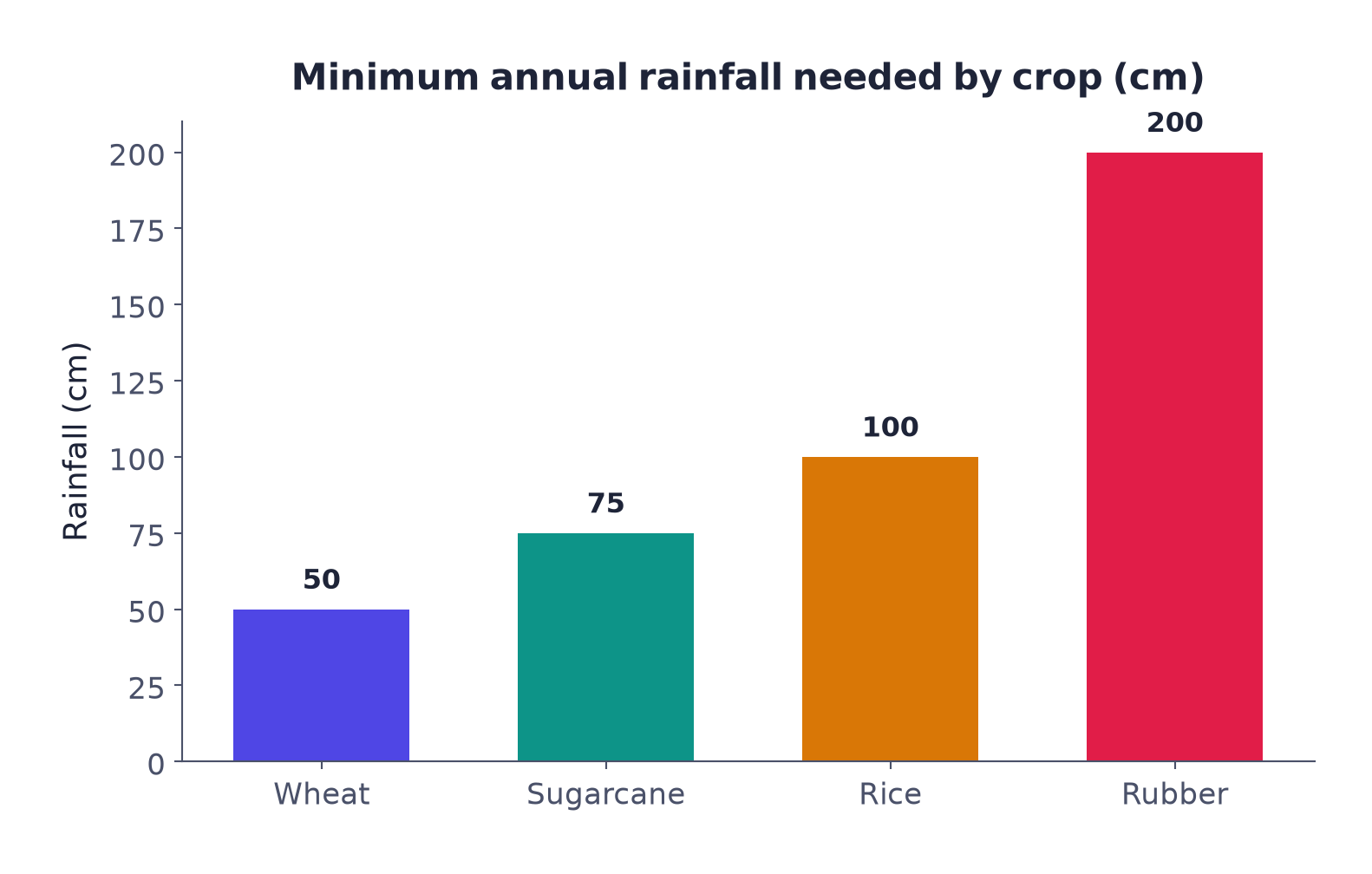
Kharif; needs >25°C, high humidity, >100cm rainfall (irrigation where rainfall is less) | Assam, West Bengal, coastal Odisha/Andhra Pradesh/Telangana, Tamil Nadu, Kerala, Maharashtra (Konkan coast), Uttar Pradesh, Bihar; recently Punjab and Haryana too, via canal irrigation and tubewells. India is the 2nd largest producer after China. |
| Wheat 2nd most important cereal |
Rabi; cool growing season, bright sunshine at ripening; 50-75cm rainfall, evenly distributed | Two zones: the Ganga-Satluj plains (north-west) and the black soil region of the Deccan. States: Punjab, Haryana, Uttar Pradesh, Madhya Pradesh, Bihar, Rajasthan. |
| Jowar one of the millets; 3rd most important food crop with respect to area and production |
Rain-fed, grown mostly in moist areas, hardly needs irrigation | Maharashtra, Karnataka, Andhra Pradesh, Madhya Pradesh |
| Bajra | Grows well on sandy soils and shallow black soil | Rajasthan, Uttar Pradesh, Maharashtra, Gujarat, Haryana |
| Ragi rich in iron, calcium, micronutrients, roughage |
A crop of dry regions; grows on red, black, sandy, loamy and shallow black soils | Karnataka, Tamil Nadu, Himachal Pradesh, Uttarakhand, Sikkim, Jharkhand, Arunachal Pradesh |
| Maize used as both food and fodder |
Kharif (also rabi in Bihar); 21-27°C; grows well in old alluvial soil; HYV seeds, fertilisers and irrigation have raised production | Karnataka, Madhya Pradesh, Uttar Pradesh, Bihar, Andhra Pradesh, Telangana |
| Pulses tur, urad, moong, masur, peas, gram |
Need less moisture, survive dry conditions; being leguminous, all except arhar help in restoring soil fertility by fixing nitrogen from the air, so they are mostly grown in rotation with other crops | Madhya Pradesh, Rajasthan, Maharashtra, Uttar Pradesh, Karnataka. India is the largest producer and consumer of pulses in the world. Pulses are the major source of protein in a vegetarian diet. |
Do not write that all pulses restore soil fertility. The chapter says all of them except arhar (tur) help in restoring soil fertility by fixing nitrogen from the air.
4Food Crops Other Than Grains
| Crop | Conditions | Leading states & facts |
|---|---|---|
| Sugarcane | Tropical/subtropical; 21-27°C; 75-100cm rainfall (irrigation where rainfall is low); needs manual labour from sowing to harvesting; takes almost a year to grow | Uttar Pradesh, Maharashtra, Karnataka, Tamil Nadu, Andhra Pradesh, Telangana, Bihar, Punjab, Haryana. 2nd largest producer after Brazil; gives sugar, gur (jaggery), khandsari and molasses. |
| Oil seeds groundnut, mustard, coconut, sesamum (til), soyabean, castor, cotton seed, linseed, sunflower |
Cover about 12% of India’s total cropped area; mostly edible/cooking oils, some used in soap, cosmetics and ointments | In 2020 India was the 2nd largest producer of groundnut in the world, after China. Groundnut is a kharif crop and about half of all major oilseeds produced; Gujarat was the largest producer in 2019-20, followed by Rajasthan and Tamil Nadu. Linseed and mustard: rabi. Sesamum: kharif in the north, rabi in the south. Castor: both rabi and kharif. |
| Tea plantation crop, introduced by the British; most tea plantations are now owned by Indians |
Tropical/subtropical climate, deep fertile well-drained soil rich in humus, warm moist frost-free climate all year, frequent showers; labour-intensive, processed inside the tea garden itself | Assam, Darjeeling & Jalpaiguri (West Bengal), Tamil Nadu, Kerala, Himachal Pradesh, Uttarakhand, Meghalaya, Andhra Pradesh, Tripura. In 2020, India was the 2nd largest tea producer after China. |
| Coffee the Arabica variety |
Originally brought from Yemen; Indian coffee is known in the world for its good quality, and this variety is in great demand all over the world | First introduced on the Baba Budan Hills; today confined to the Nilgiri in Karnataka, Kerala and Tamil Nadu |
| Horticulture crops | Both tropical and temperate fruits, plus vegetables | Mangoes (Maharashtra, Andhra Pradesh, Telangana, Uttar Pradesh, West Bengal), oranges (Nagpur, Cherrapunjee), bananas (Kerala, Mizoram, Maharashtra, Tamil Nadu), lichi & guava (Uttar Pradesh, Bihar), pineapples (Meghalaya), grapes (Andhra Pradesh, Telangana, Maharashtra), apples/pears/apricots/walnuts (Jammu & Kashmir, Himachal Pradesh); also a major producer of pea, cauliflower, onion, cabbage, tomato, brinjal and potato. In 2020, India was the 2nd largest producer of fruits and vegetables after China. |
5Non-Food Crops
Sericulture is the rearing of silkworms, fed on green mulberry leaves, for the production of silk fibre. Cotton, jute, hemp and natural silk are India’s four major fibre crops; the first three come from crops grown in the soil, while silk comes from the cocoons of silkworms.
| Crop | Conditions | Leading states |
|---|---|---|
| Rubber | An equatorial crop, also grown in tropical/subtropical areas under special conditions; needs >200cm rainfall and >25°C | Kerala, Tamil Nadu, Karnataka, Andaman & Nicobar Islands, Garo hills of Meghalaya. An important industrial raw material. |
| Cotton India is believed to be its original home; one of the main raw materials for the cotton textile industry |
High temperature, light rainfall or irrigation, 210 frost-free days, bright sunshine; kharif crop, takes 6-8 months to mature | Grows well on the black cotton soil of the Deccan plateau: Maharashtra, Gujarat, Madhya Pradesh, Karnataka, Andhra Pradesh, Telangana, Tamil Nadu, Punjab, Haryana, Uttar Pradesh. 2nd largest producer after China. |
| Jute “the golden fibre” |
Well-drained fertile soil in flood plains renewed every year; high temperature needed during growth | West Bengal, Bihar, Assam, Odisha, Meghalaya. Used for gunny bags, mats, ropes, yarn, carpets and other artefacts. |
6Technological and Institutional Reforms
Sustained use of land without matching changes in technology and institutions has slowed India’s agricultural development. Even where irrigation has expanded, most farmers in large parts of the country still depend on the monsoon and natural soil fertility. Agriculture provides a livelihood for more than 60% of India’s population, so it needed serious reform.
Further steps for farmers included crop insurance against drought, flood, cyclone, fire and disease; Grameen banks and cooperative societies/banks for lower-interest loans; the Kisan Credit Card (KCC) and Personal Accident Insurance Scheme (PAIS); special weather bulletins and agricultural programmes on radio and television; and the government announcing the minimum support price (MSP), remunerative and procurement prices for important crops, to check the exploitation of farmers by speculators and middlemen.
Bhoodan-Gramdan: Mahatma Gandhi declared Vinoba Bhave his spiritual heir. Bhave also took part in Satyagraha as one of the foremost satyagrahis. After Gandhi’s martyrdom, Bhave undertook a padyatra (foot march) across almost the whole country to spread Gandhi’s message of gram swarajya. While Bhave was speaking at Pochampally in Telangana, landless villagers asked him for land; he could not promise it immediately, but said he would approach the government if they took up cooperative farming. At that meeting, Shri Ram Chandra Reddy stood up and offered 80 acres of land to be distributed among 80 landless villagers, an act that became known as Bhoodan (land gift). Bhave then spread the idea across India, and some zamindars, owners of many villages, offered to distribute some villages among the landless, known as Gramdan (village gift). However, many land-owners gave some part of their land to poor farmers out of fear of the land ceiling act. This movement is also called the Blood-less Revolution.
- Can I name and define all four types of farming, without looking?
- Can I name the three cropping seasons and one crop from each?
- Can I state the growing conditions and one leading state for rice, wheat and cotton?
- Can I explain what Bhoodan and Gramdan each mean, and who started the movement?
- Agriculture is a primary activity engaging about two-thirds of India’s population
- Four types of farming: primitive subsistence, intensive subsistence, commercial, plantation
- Three cropping seasons: rabi (Oct-Dec sowing), kharif (with the monsoon), zaid (short summer season)
- Rice: kharif, >100cm rainfall, 2nd largest producer after China; Wheat: rabi, 50-75cm rainfall
- Pulses: India is the largest producer and consumer in the world; all except arhar help restore soil fertility by fixing nitrogen
- Sugarcane 2nd after Brazil; cotton 2nd after China; India 2nd in tea (2020) and fruit/veg (2020), all after China
- Green Revolution and White Revolution/Operation Flood: 1960s-70s reforms
- KCC and PAIS are government schemes for farmers; the government also announces the minimum support price (MSP); agriculture provides a livelihood for more than 60% of India’s population
- Bhoodan (Ram Chandra Reddy’s 80 acres to 80 villagers) and Gramdan, started by Vinoba Bhave, also called the Blood-less Revolution