Pattern: CBSE 2026-27 official Sample Question Paper (SQP) design · Maximum marks: 80 · Time: 3 hours. Solve the paper first, then open the marking scheme at the end to check your answers.
SOCIAL SCIENCE (087)
General Instructions:
- This question paper contains 38 questions. All questions are compulsory.
- The question paper has four sections and contains Multiple Choice Questions (MCQ), Very Short Answer (VSA), Short Answer (SA), Long Answer (LA) and Case/Source Based Questions (CBQ).
• Section A: History, 20 marks • Section B: Geography, 20 marks
• Section C: Political Science, 20 marks • Section D: Economics, 20 marks - Very Short Answer (VSA) questions carry 2 marks each. The answer to each should not exceed 40 words.
- Short Answer (SA) questions carry 3 marks each. The answer to each should not exceed 60 words.
- Long Answer (LA) questions carry 5 marks each. The answer to each should not exceed 120 words.
- Case/Source Based Questions (CBQ) have three sub-questions and carry 4 marks each. The answer to each should not exceed 100 words.
- The map-based questions carry 5 marks in two parts: Q. 9 in Section A, History (2 marks) and Q. 19 in Section B, Geography (3 marks).
- There is no overall choice in the question paper. However, an internal choice has been given in a few questions. Attempt only one of the choices in such questions.
- Note: a separate question has been given for Visually Impaired candidates in place of questions with visual inputs, maps etc. Such questions are to be attempted by Visually Impaired candidates only.
- The Bourbon dynasty, deposed during the French Revolution, was restored to power.
- France lost the territories it had annexed under Napoleon.
- The German Confederation of 39 states set up by Napoleon was dissolved.
- A series of states was set up on the boundaries of France to prevent French expansion in future.

To whom did Gandhiji send a letter stating eleven demands on 31 January 1930?
Assertion (A): The Roman Catholic Church began to maintain an Index of Prohibited Books from 1558.
Reason (R): The Church was troubled by the effects of popular readings and questionings of faith, such as the miller Menocchio’s reinterpretation of the Bible.
- The Frankfurt Parliament convened in the Church of St Paul.
- The Treaty of Constantinople recognised Greece as an independent nation.
- Victor Emmanuel II was proclaimed king of united Italy.
- The Prussian king, William I, was proclaimed German Emperor at Versailles.
Choose the correct option:
In a lecture delivered at the University of Sorbonne in 1882, the French philosopher Ernst Renan (1823-92) outlined his understanding of what makes a nation. The lecture was subsequently published as a famous essay entitled ‘Qu’est-ce qu’une nation?’ (‘What is a Nation?’). In this essay Renan criticises the notion suggested by others that a nation is formed by a common language, race, religion, or territory:
‘A nation is the culmination of a long past of endeavours, sacrifice and devotion. A heroic past, great men, glory, that is the social capital upon which one bases a national idea. To have common glories in the past, to have a common will in the present, to have performed great deeds together, to wish to perform still more, these are the essential conditions of being a people. A nation is therefore a large-scale solidarity … Its existence is a daily plebiscite … A province is its inhabitants; if anyone has the right to be consulted, it is the inhabitant. A nation never has any real interest in annexing or holding on to a country against its will. The existence of nations is a good thing, a necessity even. Their existence is a guarantee of liberty, which would be lost if the world had only one law and only one master.’
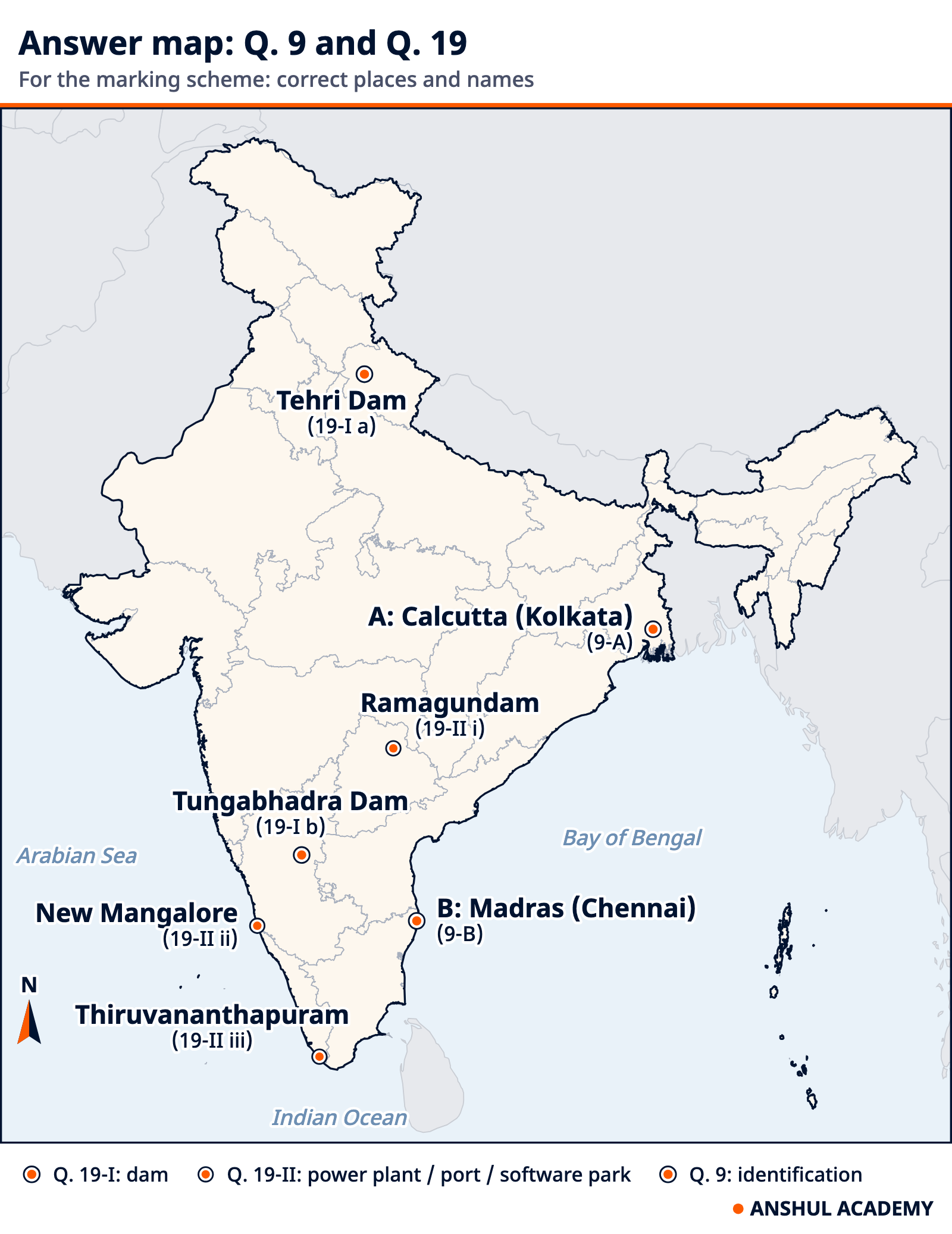
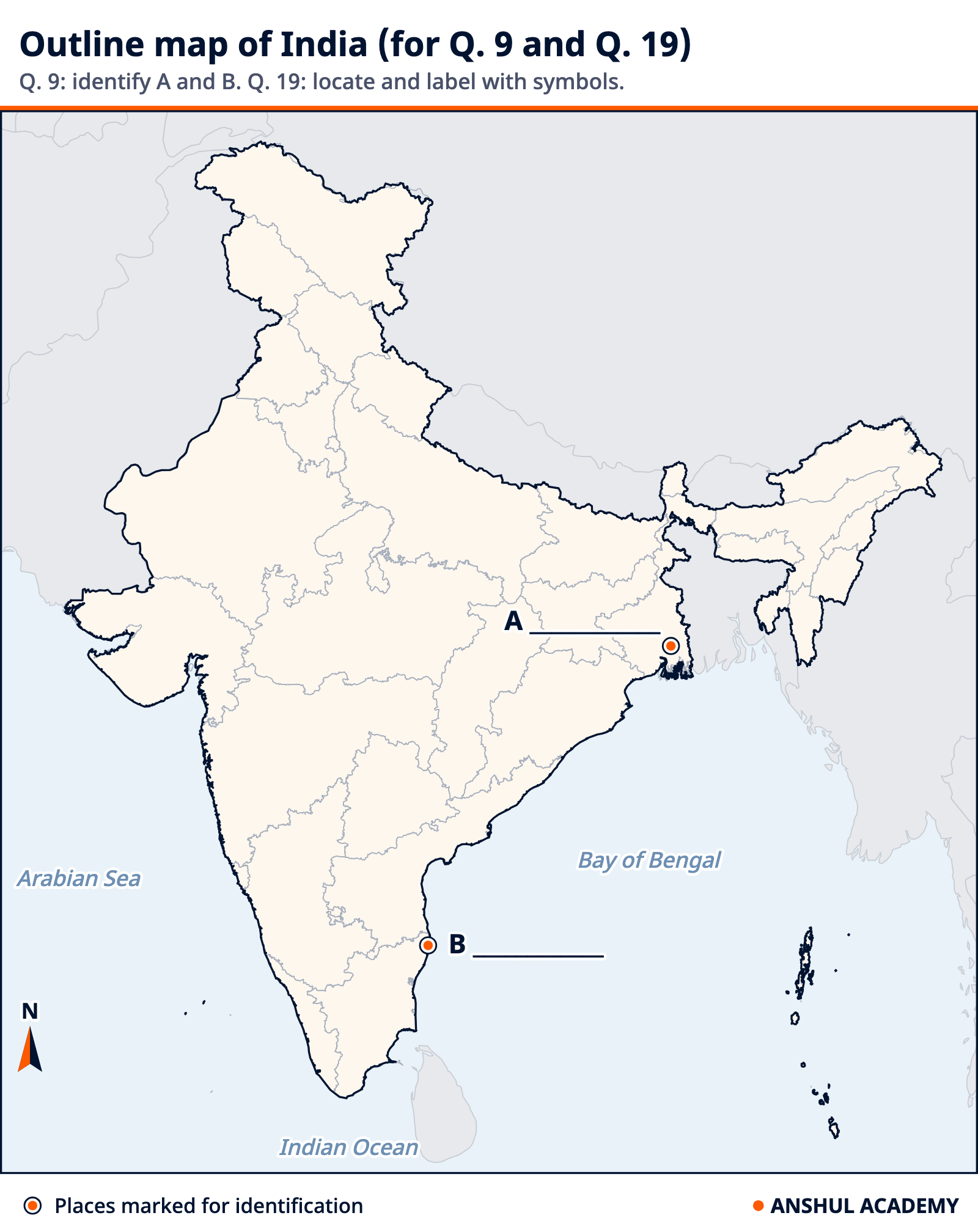
Two places A and B have been marked on the given outline map of India. Identify them and write their correct names on the lines drawn near them.
A. The city where the Congress session of September 1920 decided to start a non-cooperation movement in support of Khilafat as well as for swaraj.
B. The city where the Indian National Congress held its session in 1927.
A. Name the place where the Congress session of December 1920 adopted the Non-Cooperation programme.
B. Name the district of Gujarat where Gandhiji organised a satyagraha in 1917 to support peasants who could not pay the revenue because of crop failure and a plague epidemic.
- In Sariska Tiger Reserve, Rajasthan, villagers have fought against mining by citing the Wildlife Protection Act.
- The inhabitants of five villages in Alwar district have declared 1,200 hectares of forest as the Bhairodev Dakav ‘Sonchuri’.
- The Chipko movement began in the forests of the Western Ghats.
- Joint Forest Management has existed since 1988, when Odisha passed the first resolution for it.
Assertion (A): Some dams that were built to control floods have themselves triggered floods.
Reason (R): Dams increase the flow of silt onto the flood plains below them.
| Column I (Cropping season) | Column II (Feature) |
|---|---|
| 1. Rabi | X. Grown with the onset of monsoon and harvested in September-October; paddy, maize, cotton |
| 2. Kharif | Y. Sown in winter from October to December and harvested from April to June; wheat, gram, mustard |
| 3. Zaid | Z. A short season during the summer months between the two; watermelon, cucumber, fodder crops |
Choose the correct option:
In the semi-arid and arid regions of Rajasthan, particularly in Bikaner, Phalodi and Barmer, almost all the houses traditionally had underground tanks or tankas for storing drinking water. … The tankas were part of the well-developed rooftop rainwater harvesting system and were built inside the main house or the courtyard. They were connected to the sloping roofs of the houses through a pipe. Rain falling on the rooftops would travel down the pipe and was stored in these underground ‘tankas’. The first spell of rain was usually not collected as this would clean the roofs and the pipes. The rainwater from the subsequent showers was then collected. The rainwater can be stored in the tankas till the next rainfall making it an extremely reliable source of drinking water when all other sources are dried up, particularly in the summers. Rainwater, or palar pani, as commonly referred to in these parts, is considered the purest form of natural water.
On the given outline map of India, locate and label the following with suitable symbols:
I. (a) The dam built on the Bhagirathi river in Uttarakhand. 1
OR
(b) The dam on the Tungabhadra river in Karnataka.
II. Any two of the following: 1 × 2 = 2
(i) A thermal power plant in Telangana
(ii) A major sea port in Karnataka
(iii) The software technology park in the capital city of Kerala
Answer any three of the following:
(i) Name the dam built on the Bhagirathi river in Uttarakhand.
(ii) Name a thermal power plant located in Telangana.
(iii) Name the major sea port located in Karnataka.
(iv) In which city of Kerala is a software technology park located?
Assertion (A): The Parliament of India cannot on its own change the arrangement of power sharing between the Union and the State governments.
Reason (R): Any such change has to be passed by both Houses of Parliament with at least two-thirds majority and then ratified by the legislatures of at least half of the total States.
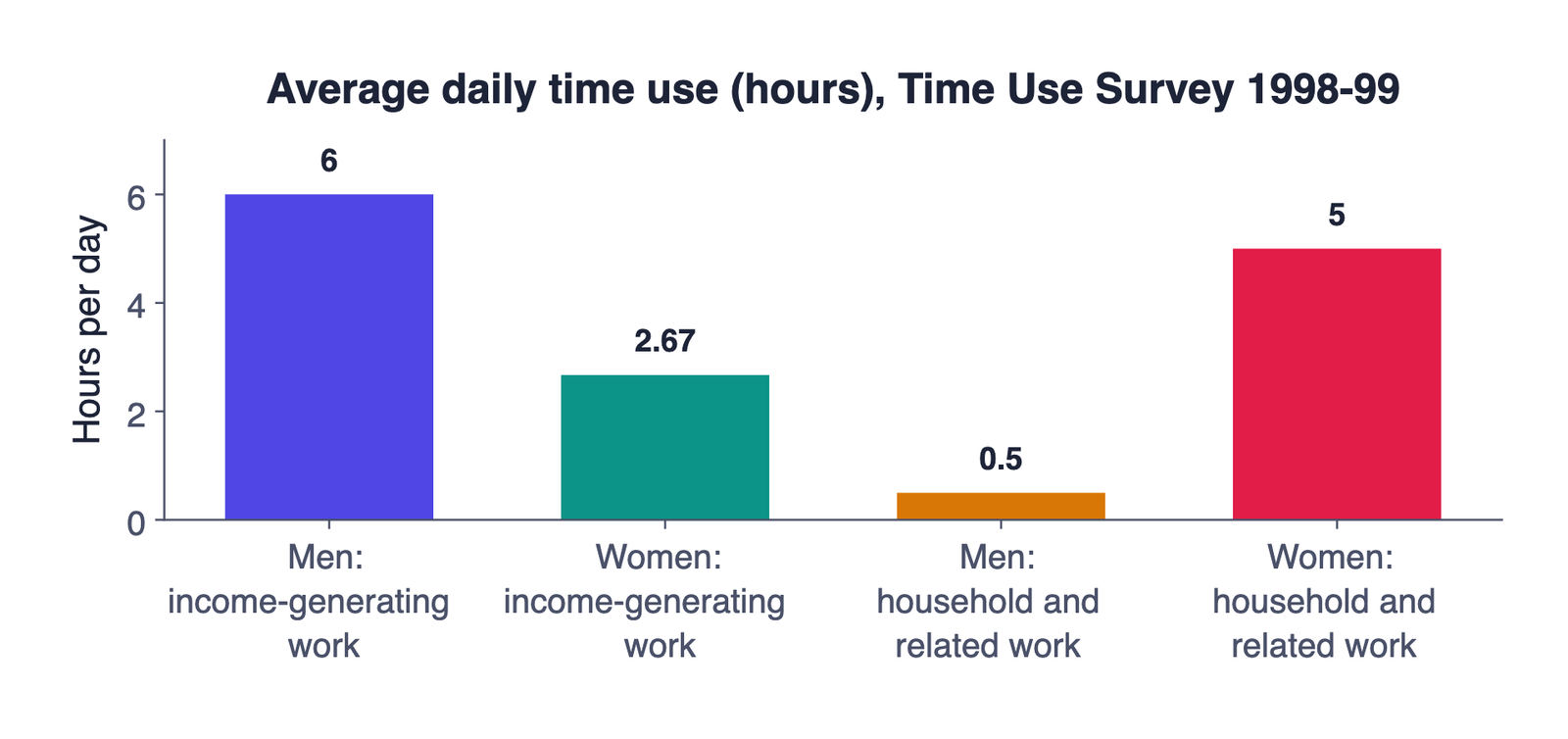
Which of the following is a constitutional provision that makes India a secular state?
When power is taken away from Central and State governments and given to local government, it is called decentralisation. The basic idea behind decentralisation is that there are a large number of problems and issues which are best settled at the local level. People have better knowledge of problems in their localities. They also have better ideas on where to spend money and how to manage things more efficiently. Besides, at the local level it is possible for the people to directly participate in decision making. This helps to inculcate a habit of democratic participation. Local government is the best way to realise one important principle of democracy, namely local self-government.
Statement I: Kerala has a low Infant Mortality Rate because it has adequate provision of basic health and educational facilities.
Statement II: The Human Development Report, which compares countries on educational levels, health status and per capita income, is published by the World Bank.
Assertion (A): In 2017-18 the tertiary sector emerged as the largest producing sector in India, replacing the primary sector.
Reason (R): The tertiary sector has also replaced the primary sector as the largest employer in India.
| State | Per capita income (₹ per year) | Infant Mortality Rate (per 1,000 live births) | Literacy rate (%) | Net Attendance Ratio, secondary stage (%) |
|---|---|---|---|---|
| P | 2,40,000 | 30 | 80 | 70 |
| Q | 1,60,000 | 8 | 95 | 92 |
| R | 60,000 | 32 | 62 | 60 |
(i) Which state has the highest per capita income, and which state has the best health and education indicators? 1
(ii) Explain with two reasons how a state with a higher per capita income can still lag behind in health and education. 2
(iii) Suggest two steps State R should take to improve its overall development. 2
(i) Which criterion does the World Bank use to classify countries in its World Development Reports? 1
(ii) State two limitations of this criterion. 2
(iii) How is the Human Development Index used by the UNDP a broader measure of development? Explain two points. 2
Map for Q. No. 9 (Section A) and Q. No. 19 (Section B)
Marking Scheme / अंकन योजना (उत्तर देखें)
SOCIAL SCIENCE (087)
For examiners and students:
- For objective questions, both the letter of the correct option and the answer are given.
- For descriptive questions, value points are given. ‘Any two/three/five’ means full marks for that many correct points from those listed.
- Any other relevant point based on the textbook is also accepted, where this is stated.
- Noodles are believed to have travelled west from China to become spaghetti; or perhaps Arab traders took pasta to fifth-century Sicily. Similar foods were also known in India and Japan.
- Many common foods such as potatoes, soya, groundnuts, maize, tomatoes, chillies and sweet potatoes were introduced in Europe and Asia only after Christopher Columbus accidentally discovered the Americas, about five centuries ago.
- Women’s reading increased enormously in middle-class homes; liberal husbands and fathers educated women at home and sent them to the women’s schools set up in towns after the mid-nineteenth century.
- Journals carried writings by women, explained why women should be educated and gave a syllabus and reading matter for home-based schooling; a large part of Hindi printing (from the 1870s) was devoted to women’s education.
- Some women defied conservative families: Rashsundari Debi learnt to read in secret in her kitchen and wrote Amar Jiban (1876), the first full-length autobiography in Bengali.
- Women wrote about their own lives: Kailashbashini Debi (from the 1860s) on how women were imprisoned at home and kept in ignorance; Tarabai Shinde and Pandita Ramabai (1880s) on the miserable lives of upper-caste Hindu women, especially widows.
- In 1517 Luther wrote his Ninety Five Theses criticising many practices and rituals of the Roman Catholic Church; a printed copy was posted on a church door in Wittenberg, challenging the Church to debate his ideas.
- Luther’s writings were immediately reproduced in vast numbers and read widely; his translation of the New Testament sold 5,000 copies within a few weeks and a second edition appeared within three months.
- This led to a division within the Church and the beginning of the Protestant Reformation; scholars think print created a new intellectual atmosphere that spread the ideas of the Reformation.
- Rich peasants: communities like the Patidars of Gujarat and the Jats of Uttar Pradesh, producers of commercial crops, were hard hit by the trade depression and falling prices and could not pay the revenue demand; the government’s refusal to reduce it caused resentment.
- Rich peasants: for them swaraj was a struggle against high revenues; they organised their communities for boycott, but were disappointed when the movement was called off in 1931 without revenue rates being revised, and many refused to join when it restarted in 1932.
- Poorer peasantry: many were small tenants who could not pay rent as cash incomes fell; they wanted unpaid rent to the landlord to be remitted and joined radical movements often led by Socialists and Communists.
- Poorer peasantry: the Congress, unwilling to upset rich peasants and landlords, did not support ‘no rent’ campaigns in most places, so their relationship with the Congress remained uncertain.
- Industrial workers: they did not participate in large numbers, except in the Nagpur region; some adopted ideas like the boycott of foreign goods in their own struggles against low wages and poor working conditions (railway strikes 1930, dockworkers 1932, Chotanagpur tin miners in Gandhi caps 1930).
- Industrial workers: the Congress was reluctant to include workers’ demands in its programme, fearing this would alienate industrialists and divide the anti-imperial forces.
- Defence expenditure rose sharply and was financed by war loans and higher taxes: customs duties were raised and income tax was introduced.
- Prices doubled between 1913 and 1918, causing extreme hardship; forced recruitment of soldiers in villages caused widespread anger; crops failed in 1918-19 and 1920-21, and famines and an influenza epidemic together killed 12 to 13 million people (census of 1921).
- The Rowlatt Act (1919) was hurriedly passed despite the united opposition of Indian members; it gave the government enormous powers to repress political activities and allowed detention of political prisoners without trial for two years.
- Gandhiji called a nationwide satyagraha starting with a hartal on 6 April; rallies, railway workshop strikes and shop closures followed, and the government picked up local leaders in Amritsar and barred Gandhiji from entering Delhi.
- On 13 April 1919 General Dyer blocked the exits of the enclosed Jallianwala Bagh and opened fire on a crowd, killing hundreds; as the news spread, crowds took to the streets in many north Indian towns and the government responded with brutal repression.
- The idea that a nation is formed by a common language, race, religion or territory.
- A plebiscite is a direct vote of all the people of a region; a nation exists only as long as its people keep willingly choosing to live together, so the will and consent of the inhabitants decide it.
- To have common glories in the past (a heroic past, great men, glory as the social capital of the national idea).
- To have a common will in the present.
- To have performed great deeds together.
- To wish to perform still more (great deeds) in the future.
- Biogas (gobar gas plant): cattle dung and farm waste produce gas of higher thermal efficiency than kerosene, dung cake and charcoal; it gives the farmer both energy and improved manure, and saves trees.
- Solar energy: India is a tropical country; photovoltaic technology converts sunlight directly into electricity, reducing dependence on firewood and dung cakes, which helps conserve the environment and leaves manure for farming.
- Institutional reforms such as collectivisation, consolidation of holdings, cooperation and abolition of zamindari were given priority; land reform was the main focus of the First Five Year Plan.
- In the 1960s and 1970s the Green Revolution based on package technology and the White Revolution (Operation Flood) were introduced.
- In the 1980s and 1990s a comprehensive land development programme included crop insurance against drought, flood, cyclone, fire and disease.
- Grameen banks, cooperative societies and banks were set up to give farmers loans at lower rates of interest; schemes like the Kisan Credit Card (KCC) and Personal Accident Insurance Scheme (PAIS) were introduced.
- Special weather bulletins and agricultural programmes for farmers were started on radio and television.
- The government announces minimum support price, remunerative and procurement prices for important crops to check exploitation by speculators and middlemen.
- Soil erosion is the denudation of the soil cover and its subsequent washing down. (1)
- Human causes: deforestation, over-grazing, construction, mining, and defective farming such as ploughing up and down the slope, which forms channels for the quick flow of water. (1)
- Natural forces: wind, glacier and water; running water cuts gullies (bad land, called ravines in the Chambal basin), sheet erosion washes away topsoil, and wind blows loose soil off flat or sloping land. (1)
- Hilly areas: contour ploughing slows the flow of water down the slopes; terrace cultivation (well developed in the western and central Himalayas) restricts erosion. (1)
- Arid and flat areas: strip cropping with strips of grass between crops breaks the force of the wind; shelter belts of trees stabilise sand dunes and the desert in western India. (1)
- Because the first rain cleaned the roofs and the pipes; only the water from the later showers was collected.
- Palar pani is the local name for rainwater; it is considered the purest form of natural water.
- Gendathur, a remote village in Mysuru, Karnataka: nearly 200 households have installed rooftop rainwater harvesting (rooftop water collected through PVC pipes, filtered and stored), and the village is known as rich in rainwater.
- Shillong, Meghalaya: though Cherapunjee and Mawsynram nearby get the highest rainfall in the world, the city faces water shortage; nearly every household has rooftop harvesting, meeting 15-25 per cent of its water needs.
- This feature is transparency: in a democracy decisions are based on norms and procedures, and citizens have the right and the means to examine the process of decision making. (1)
- It makes government accountable because citizens can check whether procedures were followed and hold the government to account through mechanisms such as regular, free and fair elections, open public debate on major policies and the right to information about the government and its functioning. (1)
- Lack of internal democracy: power is concentrated in one or a few leaders at the top; parties do not keep membership registers or hold regular internal elections.
- Dynastic succession: top positions are controlled by members of one family, so ordinary workers rarely rise to the top.
- Growing role of money and muscle power, especially during elections: parties nominate candidates who can raise lots of money.
- Lack of meaningful choice for voters, as the ideological differences among parties have reduced.
- Everyday beliefs: religious prejudices, stereotypes of religious communities and belief in the superiority of one’s religion over others.
- A quest for political dominance of one’s own religious community: majoritarian dominance for the majority, or a desire to form a separate political unit for a minority.
- Political mobilisation on religious lines, using sacred symbols, religious leaders, emotional appeal and plain fear; in elections, a special appeal to voters of one religion.
- Its ugliest form, communal violence, riots and massacre, as at the time of Partition.
- After independence in 1948, leaders of the Sinhala community sought to secure dominance over government by virtue of their majority; the elected government adopted majoritarian measures to establish Sinhala supremacy.
- In 1956 an Act recognised Sinhala as the only official language, disregarding Tamil.
- Preferential policies favoured Sinhala applicants for university positions and government jobs, and a new constitution stipulated that the state shall protect and foster Buddhism.
- These measures increased the alienation of Sri Lankan Tamils, who felt they were denied equal political rights and discriminated against in jobs and opportunities; relations between the communities became strained.
- Tamils launched parties and struggles for recognition of Tamil as an official language, regional autonomy and equality of opportunity in education and jobs, but their demand for more autonomy was repeatedly denied.
- By the 1980s political organisations demanded an independent Tamil Eelam (state) in the north and east, and the distrust turned into a civil war in which thousands were killed.
- Prudential reason: power sharing reduces the possibility of conflict between social groups; since social conflict often leads to violence and political instability, it is a good way to ensure the stability of the political order. (1)
- Prudential reason (example): imposing the will of the majority may look attractive in the short run but undermines the unity of the nation, as in Sri Lanka. (1)
- Moral reason: a democratic rule involves sharing power with those affected by its exercise; people have a right to be consulted on how they are to be governed, and a legitimate government is one where citizens acquire a stake in the system. (1)
- Forms (any two, 1 mark each): horizontal sharing among legislature, executive and judiciary (checks and balances); vertical sharing among governments at different levels (Union, State, local); sharing among social groups (community government in Belgium, reserved constituencies); sharing among political parties, pressure groups and movements (coalitions, competition). (2)
- People have better knowledge of the problems in their localities and better ideas on where to spend money and how to manage things efficiently.
- Local bodies were directly under the control of the State governments.
- Elections to these local governments were not held regularly.
- Local governments did not have any powers or resources of their own.
- Local self-government.
- Registration and rules: organised sector enterprises are registered by the government and follow laws such as the Factories Act and Minimum Wages Act; unorganised units are small, scattered and largely outside government control, and rules are not followed.
- Security of work: organised workers enjoy security of employment and fixed hours, with overtime pay; in the unorganised sector jobs are low-paid, often not regular, and people can be asked to leave without any reason.
- Benefits: organised workers get paid leave, payment during holidays, provident fund, gratuity, medical benefits and pensions; unorganised workers get no overtime, paid leave, holidays or sick leave.
- The formal sector still meets only about half of the total credit needs of rural people; the rest comes from informal sources.
- Most loans from informal lenders carry a very high interest rate and do little to increase the income of borrowers; they can push borrowers into a debt trap.
- At present the richer households receive formal credit while the poor depend on informal sources; formal credit must be distributed more equally so that the poor can benefit from cheaper loans.
- Cheap and affordable credit helps people grow crops, do business and set up small-scale industries, which is crucial for development.
- Telecommunication facilities (telephone including mobile phones, fax), aided by satellite communication, are used to contact one another around the world, to access information instantly and to communicate from remote areas.
- Computers and the Internet allow people to obtain and share information on almost anything, and to send instant e-mail and talk (voice-mail) across the world at negligible cost.
- Example: a news magazine for London readers is designed and printed in Delhi; the text is sent by Internet, design orders come by telecommunication, and payment from a London bank to a Delhi bank is made instantly through e-banking.
- (i) Highest per capita income: State P; best health and education indicators (lowest IMR, highest literacy and attendance): State Q. (1)
- (ii) Money in your pocket cannot buy all the goods and services needed to live well, such as a pollution-free environment, unadulterated medicines or protection from infectious diseases. (1)
- (ii) Many important things, like health care and schools, are best and most cheaply provided collectively as public facilities; a state with good public facilities can do better even with lower income. (1)
- (iii) Provide basic health care (for example, through public health centres) to bring down infant mortality. (1)
- (iii) Expand schools and educational facilities to raise literacy and attendance; strengthen the Public Distribution System to improve nutrition. (1)
- (i) Per capita income (average income: the total income of the country divided by its total population). (1)
- (ii) An average hides disparities; it does not tell us how income is distributed among people. (1)
- (ii) Income alone is not an adequate indicator of the goods and services citizens are able to use; it says nothing about health, education or other public facilities. (1)
- (iii) The Human Development Report compares countries on the educational levels of the people and their health status, along with per capita income. (1)
- (iii) Adding ‘human’ to development shows that what matters is what is happening to the people of the country, their well-being, not just income. (1)
Answers to Q. No. 9 and 19 (on the map)