
- What learning is, its features, and why fatigue, habituation and drugs do not count as learning
- The two kinds of conditioning (classical and operant), how they work and what speeds them up
- The key learning processes: reinforcement, extinction, generalisation, discrimination and spontaneous recovery
- Observational, cognitive (insight and latent), verbal and skill learning, with the experiments behind each
- General factors that help learning, and how to recognise learning disabilities
CBSE Class 11 Psychology (037) for 2026-27 has a 70-mark theory paper and a 30-mark practical (a project or small study plus experiments, and a viva). This chapter, Learning, carries 9 marks of the theory paper. The whole chapter is in the syllabus; nothing is deleted. These notes cover the NCERT theory text.
1Introduction: Why Learning Matters
A newborn baby can make only a few responses, and these happen reflexively (automatically) when the right stimulus is present. As the child grows, the list of things s/he can do keeps growing: recognising mother, father or grandfather, eating with a spoon, reading and writing letters and words, copying what others do, naming objects such as a book, an orange or a cow. Later the same person learns to drive a scooter, to talk to people well and to get along with others.
Even qualities like being hard working or lazy (indolent), socially knowledgeable, skilled or professionally competent come from learning. Every person manages life and solves problems because of this capacity to learn and adapt.
Learning preserves errors of the past as well as its wisdom.
A.N. Whitehead, quoted at the start of the chapter
2Nature of Learning
Almost everything we do is shaped by learning. The word covers a wide range of changes that our experiences bring about.
Learning may be defined as “any relatively permanent change in behaviour or behavioural potential produced by experience”. (the book’s definition)
Notice the words relatively permanent. Some changes in behaviour come from drugs or tiredness. They fade away, so they are not learning. Only changes caused by practice and experience that last are examples of learning.
2.1 Features of learning
Learning always involves experience
We see events happen in a certain order again and again. A hostel student learns that the bell after sunset means dinner is ready. Repeated satisfaction from doing something one way forms a habit. Sometimes one experience is enough: a child whose fingers get burnt by a matchstick learns to handle the matchbox carefully.
Changes are relatively permanent
Learned changes last. They must be told apart from temporary changes caused by fatigue, habituation and drugs, which are neither permanent nor learned.
It is a sequence of psychological events
Learning goes through steps inside the mind (see the experiment below), and we only infer it from performance.
| Temporary change (NOT learning) | Everyday example from the book | Why it is not learning |
|---|---|---|
| Fatigue | After reading or driving for a long time you feel tired and stop | Goes away after rest |
| Habituation | Noise from a marriage nearby disturbs you at first; your orienting reflexes (turning towards the sound) grow weaker and finally stop | Caused by continuous exposure to a stimulus, not by learning |
| Drugs | Behaviour of people on sedatives, drugs or alcohol changes | Disappears when the effect of the drug wears out |
2.2 Learning as a sequence of events: a word-list experiment
By comparing how many words the person knows now with the pre-test score, we infer that learning took place.
2.3 Learning vs performance
Learning
- An inferred process going on inside the person
- Cannot be seen directly
- Example: you have learned the poem
Performance
- A person’s observed behaviour, response or action
- Can be seen and measured
- Example: you recite the poem, and from this the teacher infers you have learned it
3Paradigms (Kinds) of Learning
Some methods explain how simple responses are learned; others explain complex responses. The simplest kind of learning is conditioning.
4Classical Conditioning
Classical conditioning was first investigated by Ivan P. Pavlov. He was mainly studying the physiology of digestion. He noticed that his dogs began to secrete saliva as soon as they saw the empty plate in which food was served. Salivation is normally a reflex to food in the mouth, so Pavlov designed an experiment to study this.
4.1 Pavlov’s experiment
Unconditioned Stimulus
Food: it produces salivation naturally, with no learning.
Unconditioned Response
Salivation that follows food.
Conditioned Stimulus
Sound of the bell, after conditioning.
Conditioned Response
Salivation to the bell alone.
| Stage of conditioning (Table 5.1) | Stimulus | Response |
|---|---|---|
| Before | Food (US) | Salivation (UR) |
| Sound of the bell | Alertness (no specific response) | |
| During | Sound of the bell (CS) + Food (US) | Salivation (UR) |
| After | Sound of the bell (CS) | Salivation (CR) |
Classical conditioning is learning in which an organism comes to associate two stimuli: a neutral stimulus (CS) that signals an unconditioned stimulus (US) begins to produce a response (CR) that anticipates and prepares the organism for the US. It is S-S learning: one stimulus becomes a signal for another.
Sweet dish: You have just finished lunch and feel full. You see a sweet dish served at the next table. It signals its taste and your mouth waters. This salivation is a CR.
Balloon: Small children are naturally afraid of loud noise. A balloon bursts in a child’s hands with a bang and the child is frightened. Next time a balloon is given, it acts as a cue for noise and brings out fear. Balloon = CS, loud noise = US, presented together (contiguously).
Activity 5.1: Show a few pieces of mango pickle to the class. Most students report that their mouth waters.
4.2 Determinants of classical conditioning
How quickly and how strongly a CR is acquired depends on three main factors.
(1) Time relations between stimuli. There are four procedures, based on when the CS and US begin. The first three are forward conditioning; the fourth is backward conditioning.
| Procedure | Arrangement of CS and US | Effectiveness |
|---|---|---|
| Simultaneous | CS and US presented together | Works, but needs more trials |
| Delayed | CS starts before the US and ends before the US ends | Most effective |
| Trace | CS starts and ends before the US begins, with a time gap between them | Works, but needs more trials |
| Backward | US starts before the CS | Acquisition is very rare |
(2) Type of unconditioned stimulus.
Appetitive US
- Brings out approach responses: eating, drinking, caressing
- Gives satisfaction and pleasure
- Conditioning is slower, needs more trials
Aversive US
- Noise, bitter taste, electric shock, painful injections
- Painful, harmful; brings out avoidance and escape
- Conditioning forms in one, two or three trials, depending on the intensity of the US
(3) Intensity of conditioned stimuli. A more intense CS speeds up acquisition: the more intense the CS, the fewer trials are needed. This holds for both appetitive and aversive conditioning.
5Operant / Instrumental Conditioning
This type of conditioning was first investigated by B.F. Skinner. He studied voluntary responses that an organism makes when it operates on the environment, and called them operants.
Operants are behaviours or responses that animals and human beings emit voluntarily and that are under their control. Conditioning of operant behaviour is called operant conditioning.
5.1 Skinner’s experiment
Skinner worked with rats and pigeons in a specially made chamber called the Skinner Box (Fig. 5.2). The rat could move about inside but not get out. A lever was connected to a food container on top; pressing it dropped a food pellet on a plate.
Lever pressing is the operant response and getting food is its consequence. Because the response is instrumental in getting food, this learning is also called instrumental conditioning.
Children find the jar where mother hides sweets and eat them when she is away; children learn to say ‘please’ to get favours; we learn to operate a radio, camera or T.V.; people learn short cuts to reach their goals.
5.2 Determinants of operant conditioning
In operant conditioning, behaviour is learned, kept up or changed through its consequences, which are called reinforcers.
A reinforcer is any stimulus or event which increases the probability of the occurrence of a (desired) response.
What decides the course of operant conditioning:
- Features of the reinforcer: its type (positive or negative), number or frequency, quality (superior or inferior) and schedule (continuous or intermittent/partial)
- The nature of the response or behaviour to be conditioned
- The interval (delay) between the response and the reinforcement
(a) Types of reinforcement
Positive reinforcement
- Stimuli with pleasant consequences
- Strengthen and maintain the response that brought them
- Satisfy needs: food, water, medals, praise, money, status, information
Negative reinforcement
- Involves unpleasant and painful stimuli
- Responses that get rid of, avoid or escape them are strengthened
- Leads to learning of avoidance and escape: woollen clothes, firewood or a heater against cold; seat belts to avoid injury or a traffic fine
Negative reinforcement is not punishment. Punishment reduces or suppresses a response; a negative reinforcer increases the probability of an avoidance or escape response.
What the book says about punishment:
- No punishment suppresses a response permanently
- Punishment that is mild or comes late does not work at all
- A harsher punishment holds the response down for a longer time, yet even then it returns
- Sometimes punishment has no effect at all, whatever its intensity; the punished person may develop dislike and hatred for the person who punishes
(b) Number of reinforcement and other features
| Feature | Meaning |
|---|---|
| Number | Number of trials on which the organism was reinforced or rewarded |
| Amount | How much reinforcing stimulus (food, water, or intensity of a pain-causing agent) is received on each trial |
| Quality | The kind of reinforcer: chickpeas or bread are inferior to raisins or cake |
Operant conditioning usually speeds up as the number, amount and quality of reinforcement increase.
(c) Schedules of reinforcement
A reinforcement schedule is the arrangement of the delivery of reinforcement during conditioning trials.
Continuous reinforcement
- The desired response is reinforced every time it occurs
Intermittent (partial) reinforcement
- Responses are reinforced sometimes, not always
- Produces greater resistance to extinction than continuous reinforcement
(d) Delayed reinforcement
Delay in giving reinforcement lowers its effectiveness and leads to poorer performance. Ask children to choose a reward for a chore: they prefer a small reward right away to a big one after a long gap.
6Classical vs Operant Conditioning (Box 5.1)
| Point | Classical conditioning | Operant conditioning |
|---|---|---|
| 1. Type of response | Reflexes, automatically elicited by stimuli (US elicits UR); hence Pavlovian conditioning is often called respondent conditioning | Voluntary responses (operants) under the organism’s control |
| 2. Stimuli | CS and US are well-defined | CS is not defined; it can be inferred but is not directly known |
| 3. Who controls | The experimenter controls the US; the organism stays passive | The organism controls whether the reinforcer comes; it must be active |
| 4. Terms | Uses the term US | What is called a reinforcer here is called the US in classical conditioning |
The US has two functions: at first it elicits the response, and it also reinforces the response so that the CS can later bring it out.
7Key Learning Processes
Whether learning is classical or operant, five processes occur in it.
7.1 Reinforcement
Reinforcement is the operation of administering a reinforcer by the experimenter.
Reinforced responses rise in rate; non-reinforced responses fall. A positive reinforcer raises the rate of the response that comes before its presentation; a negative reinforcer raises the rate of the response that comes before its removal or termination.
Primary reinforcer
- Biologically important: decides the organism’s survival
- Example: food for a hungry organism
Secondary reinforcer
- Gains its reinforcing power through the organism’s experience with the environment
- Examples: money, praise, grades
Shaping: a desired response that does not yet occur can be built up by systematically reinforcing successive approximations (closer and closer steps) to it.
7.2 Extinction
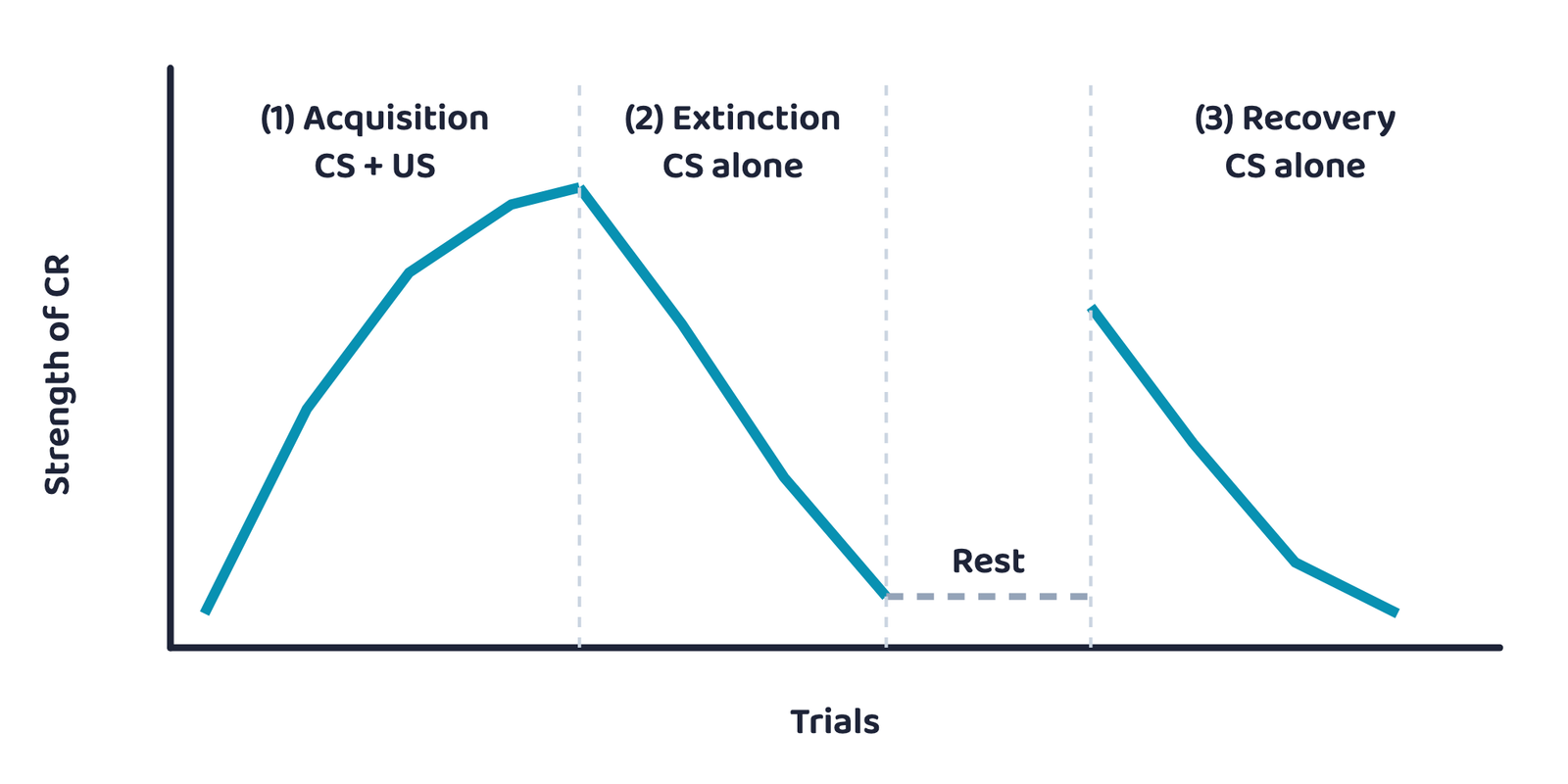
Extinction means disappearance of a learned response due to removal of reinforcement from the situation in which the response used to occur.
Example: if the CS-CR is no longer followed by the US, or lever pressing no longer brings food pellets, the learned behaviour weakens and finally disappears. But learning shows resistance to extinction: the response goes on for some time even without reinforcement.
| Condition during acquisition | Effect on resistance to extinction |
|---|---|
| More reinforced trials | Increases, until the response reaches its highest level and performance stabilises; beyond that, further reinforcement reduces it |
| Larger amount of reinforcement (more pellets) | Decreases |
| Delayed reinforcement | Increases |
| Reinforcement on every trial | Decreases (less resistant) |
| Intermittent or partial reinforcement | Increases (more resistant) |
7.3 Generalisation and discrimination
Both happen in all kinds of learning, but have been studied most in conditioning.
Generalisation: responding similarly to similar stimuli. When a learned response is elicited by a new stimulus, it is called generalisation.
Discrimination is the complementary process: a response due to difference, while generalisation is due to similarity.
| Example from the book | Process |
|---|---|
| A dog conditioned to salivate to a bell also salivates to a ringing telephone | Generalisation |
| A child who found sweets in one jar finds them in a jar of another size and shape kept elsewhere in the kitchen | Generalisation |
| A child afraid of a man with a long moustache in black clothes also fears a bearded man in black clothes | Generalisation |
| The same child shows no fear of a clean-shaven stranger in grey clothes | Discrimination |
The occurrence of generalisation means a failure of discrimination. A discriminative response depends on the organism’s capacity for discrimination, or discrimination learning.
7.4 Spontaneous recovery
Spontaneous recovery: after a learned response has been extinguished and considerable time has passed, the CR recovers on its own and occurs again to the CS.
The longer the time lapsed after the extinction session, the greater the recovery.
8Learned Helplessness (Box 5.2)
Learned helplessness results from an interaction of the two forms of conditioning, and psychologists link it with cases of depression. Seligman and Maier showed it in a study on dogs.
In humans: continuous failure in a set of tasks produces it. In experiments, subjects first get failure feedback regardless of how they perform, then are given a task. Learned helplessness is measured by the subject’s ability and persistence before giving up. Continuous failure leads to little persistence and poor performance. Many studies show that persistent depression is often caused by learned helplessness.
9Observational Learning
This form of learning takes place by observing others. Earlier it was called imitation. Bandura and his colleagues studied it in detail in a series of experiments. Because human beings learn social behaviours this way, it is also called social learning; and because people watch others and copy them when they do not know how to behave, it is called modeling.
Observational learning (imitation, modeling, social learning): we acquire knowledge by observing a model’s behaviour; the performance depends on whether the model’s behaviour is rewarded or punished.
Example: fashion designers use tall, smart, attractive young models to popularise clothes; people see them in fashion shows and advertisements and imitate them.
9.1 Bandura’s Bobo doll experiment
Observers acquire knowledge by watching the model, but their performance is influenced by whether the model was rewarded or punished.
In daily life: children act out adults in their games: marriage ceremonies, birthday parties, thief and policeman, housekeeping. How to dress, do one’s hair and behave in society are learned by observing others. Personality traits such as aggressiveness, pro-social behaviour, courtesy, politeness, diligence and indolence are also acquired this way. (Activity 5.2: show children two or three times how to fold a paper boat; most can then make one.)
10Cognitive Learning
Some psychologists explain learning by the cognitive processes behind it, instead of only S-R and S-S connections. In cognitive learning there is a change in what the learner knows rather than what s/he does. Its two forms are insight learning and latent learning.
10.1 Insight learning (Kohler)
Kohler did experiments with chimpanzees. Food (a banana) was kept out of reach in an enclosed play area with poles and boxes. The chimpanzees wandered for a while and then suddenly stood on a box or used a pole to bring the food closer. The learning came in sudden flashes of insight, not by trial and error and reinforcement.
Insight learning is “the process by which the solution to a problem suddenly becomes clear”. (the book’s definition)
Once found, the solution can be repeated immediately the next time. What is learned is a cognitive relationship between a means and an end, not a set of S-R links, so insight learning can be generalised to similar problems.
10.2 Latent learning (Tolman)
Latent learning: a new behaviour is learned but not demonstrated until reinforcement is provided for displaying it.
Group 1 rats
- Found food at the end of the maze
- Soon ran through the maze quickly
Group 2 rats
- Not rewarded; showed no apparent learning
- Later, when reinforced, ran the maze as efficiently as Group 1
Tolman argued that while simply wandering through the maze, the rats with no reward had already picked up its plan in their heads, a cognitive map: a mental representation of the spatial locations and directions needed to reach the goal.
11Verbal Learning
Verbal learning is different from conditioning and is limited to human beings. We know objects and events largely through words, and words come to be associated with one another. Materials used in experiments: nonsense syllables, familiar words, unfamiliar words, sentences and paragraphs (Table 5.2 gives samples such as YOL, RUV for nonsense syllables; ZILCH, PLUMB for unfamiliar words; BOAT, NOSE for familiar words).
11.1 Methods used in studying verbal learning
Paired-associates learning
Similar to S-S conditioning and S-R learning; used, for example, to learn foreign-language equivalents of mother-tongue words. A list of pairs is made: the first word is the stimulus term, the second the response term (Table 5.3: nonsense syllables of consonant-vowel-consonant form paired with English nouns, e.g. GEN-LOOT, BEM-TIME). The learner sees both, then tries to give the response word for each stimulus word; if wrong, the response word is shown. Trials go on until all responses are given without a single error. The number of trials to reach this criterion is the measure.
Serial learning
Finds out how lists are learned. The learner must produce the items in the same serial order. The first item is shown and the learner must give the second; if s/he fails, the experimenter shows it, and it becomes the stimulus for the third, and so on. This is the serial anticipation method. Trials go on until all items are anticipated correctly in order.
Free recall
A list (more than ten words, related or unrelated) is read and spoken aloud, each word for a fixed exposure time; the order changes from trial to trial. Right after, the learner recalls the words in any order. Used to study how people organise words for storage in memory. Items at the beginning and end of a list are easier to recall than those in the middle.
11.2 Determinants of verbal learning
The most important determinants are features of the material: the length of the list and the meaningfulness of the material. Meaningfulness is measured by:
- the number of associations a word brings out in a fixed time
- familiarity of the material and frequency of usage
- relations among the words in the list
- sequential dependence of each word on the words before it
Nonsense syllables are chosen from a list with the same association value. Learning time increases with a longer list, low association values, or a lack of relations among items. The more time it takes to learn, the stronger the learning.
Total time principle: a fixed amount of time is necessary to learn a fixed amount of material, regardless of the number of trials into which that time is divided.
Free recall is organisational. In free recall people recall words not in the order shown but in a new order of their own.
- Category clustering (Bousfield): a list of 60 words, 15 from each of four categories (names, animals, professions, vegetables), was shown in random order. Participants recalled words of each category together. This happened because of the nature of the list.
- Subjective organisation: free recall is always organised in each person’s own way, and they recall accordingly.
Intentional learning
- Verbal learning is usually deliberate
Incidental learning
- Some features are learned without trying: words that rhyme, start with the same letters, or have the same vowels
(Activity 5.3: read out 21 words such as book, law, bread, shirt, rice, curd, and ask people to write them in any order; check whether their recall shows grouping.)
12Skill Learning
A skill is defined as the ability to perform some complex task smoothly and efficiently.
Examples: car driving, airplane piloting, ship navigating, shorthand writing, writing and reading. Skills are learned by practice and exercise. A skill is a chain of perceptual motor responses, or a sequence of S-R associations.
Skill learning passes through qualitatively different phases; with each attempt, performance becomes smoother, less effortful and more automatic. When performance stands still during the move from one phase to the next, it is called a performance plateau; once the next phase begins, performance improves again.
12.1 Fitts’s three phases of skill acquisition
Practice is the only means of skill learning. Automatic, errorless performance is the hallmark of a skill, which is why it is said that “practice makes a man perfect”.
13Factors Facilitating Learning
Each kind of learning has its own specific determinants: contiguity of CS and US in classical conditioning; number, amount and delay of reinforcement in operant conditioning; status and attractiveness of models in observational learning; procedure in verbal learning; nature of rules and perceptual features of objects in concept learning. Besides these, some general factors matter.
13.1 Continuous vs partial reinforcement
Continuous
- Reinforcement after each target response
- High rate of responding
- Once reinforcement stops, responses drop quickly and tend to extinguish
- Since reinforcement comes every trial, its effectiveness is reduced
- Easy to tell when reinforcement has stopped
Partial / intermittent
- Some responses are not reinforced
- Often very high rates, especially when reinforced by ratio
- Hard to tell whether reinforcement has stopped or is only delayed
- Extinction is more difficult
Partial reinforcement effect: responses acquired under partial reinforcement are highly resistant to extinction.
13.2 Motivation
All living organisms have survival needs; human beings also have growth needs.
Motivation is a mental as well as a physiological state which arouses an organism to act for fulfilling the current need. It energises the organism to act vigorously until the goal is attained and the need is satisfied.
Motivation is a prerequisite for learning. A child searches the kitchen because s/he wants sweets, and in the process learns where the jar is. A hungry rat forages for food, presses the lever by chance, and learns to press it. You study psychology to pass with good marks: the more motivated you are, the harder you work.
Intrinsic motivation
- You learn something because you enjoy it
Extrinsic motivation
- You learn something because it is a means to another goal
13.3 Preparedness for learning
Species differ in sensory capacities, response abilities and the mechanisms for forming S-S or S-R associations. Species have biological constraints on learning: an organism easily learns the associations for which it is genetically prepared. Some associations are easy for apes or humans but very difficult, or impossible, for cats and rats.
So preparedness is best seen as a continuum: at one end tasks easy for a species, at the other end tasks it cannot learn at all, and in the middle tasks it can learn only with great difficulty.
14Learning Disabilities
Some children find school too difficult and drop out. Reasons include sensory impairment, intellectual disability, social and emotional disturbance, poor family economic conditions, cultural beliefs and other environmental influences. Another obstacle is learning disability, which makes acquiring knowledge and skills too difficult.
Learning disability is a general term. It refers to a heterogeneous group of disorders shown as difficulty in learning, reading, writing, speaking, reasoning and mathematical activities.
- The sources are inherent in the child, presumed to come from problems in the functioning of the central nervous system
- It may occur with or without physical handicaps, sensory impairment or intellectual disability
- It can be a distinct condition in children of average to superior intelligence, adequate sensory-motor systems and adequate learning opportunities
- If not remedied, it may last throughout life and affect self-esteem, vocation, social relations and daily living
14.1 Symptoms of learning disabilities
These show up in different combinations, whatever the child’s intelligence, motivation or hard work.
| # | Symptom | What it looks like |
|---|---|---|
| 1 | Reading, writing, speaking difficulties | Trouble writing letters, words and phrases, reading aloud and speaking; listening problems without any hearing defect; different from others in forming learning strategies |
| 2 | Disorders of attention | Easily distracted; often leads to hyperactivity (always moving, handling things) |
| 3 | Poor space orientation, poor sense of time | Get lost in new places; late or too early; confuse right, left, up and down |
| 4 | Poor motor coordination and manual dexterity | Poor balance; cannot sharpen a pencil or handle doorknobs; difficulty learning to ride a bicycle |
| 5 | Cannot follow oral directions | Fail to understand spoken instructions |
| 6 | Misjudge relationships | Cannot tell friendly from indifferent classmates; do not understand body language |
| 7 | Perceptual disorders | Visual, auditory, tactual and kinesthetic misperception; cannot tell a call-bell from a telephone ring, though their senses are sharp |
| 8 | Dyslexia | Fail to copy letters and words; confuse b and d, p and q, P and 9, was and saw, unclear and nuclear; cannot organise verbal material |
A learning disability can be treated. Educational psychologists have designed remedial teaching techniques that let such children learn and catch up with their classmates.
15Key Terms
16NCERT Review Questions: Short Answers
- What is learning? What are its distinguishing features? A relatively permanent change in behaviour or behavioural potential produced by experience. Features: it always involves experience; the change is relatively permanent (unlike fatigue, habituation, drugs); it is a sequence of psychological events and an inferred process, different from performance.
- How does classical conditioning demonstrate learning by association? In Pavlov’s study a bell (CS) paired again and again with food (US) came to produce salivation (CR) alone. The dog learned that one stimulus signals another: S-S learning by association.
- Define operant conditioning and the factors influencing it. Conditioning of voluntarily emitted responses (operants) through their consequences (Skinner). Factors: type of reinforcement (positive/negative), number, amount and quality, schedule (continuous/partial), delay of reinforcement, and the nature of the response.
- A good role model matters for a growing child. Which learning supports it? Observational learning (Bandura): children learn social behaviours and traits such as courtesy or aggressiveness by watching models; their performance depends on whether the model is rewarded or punished.
- Explain the procedures for studying verbal learning. Paired-associates learning (stimulus-response word pairs, trials to criterion), serial learning (serial anticipation method) and free recall (recall in any order).
- What is a skill? What are its stages? The ability to perform a complex task smoothly and efficiently. Fitts’s phases: cognitive, associative, autonomous.
- Generalisation vs discrimination? Generalisation is responding similarly to similar stimuli (due to similarity); discrimination is responding differently to different stimuli (due to difference). Generalisation means failure of discrimination.
- Why is motivation a prerequisite for learning? It arouses and energises the organism to act until its need is satisfied; the more motivated a learner, the harder s/he works (intrinsic or extrinsic).
- What does preparedness for learning mean? Species can easily learn only the associations they are genetically prepared for; tasks lie on a continuum from prepared to unprepared.
- Forms of cognitive learning? Insight learning (Kohler’s chimpanzees, sudden solution) and latent learning (Tolman’s rats, cognitive map).
- How can we identify students with learning disabilities? By the symptoms: reading/writing/speaking difficulty, attention problems and hyperactivity, poor sense of space and time, poor motor coordination, failure to follow oral directions, misjudging relationships, perceptual disorders, and dyslexia.
- Learning = relatively permanent change in behaviour or behavioural potential produced by experience; inferred, not the same as performance
- Pavlov: bell (CS) + food (US); salivation UR becomes CR; delayed conditioning most effective, backward very rare; aversive US conditions in 1-3 trials
- Skinner: operants, Skinner Box; positive and negative reinforcement; negative reinforcement is not punishment
- Five key processes: reinforcement, extinction, generalisation, discrimination, spontaneous recovery
- Partial reinforcement makes responses more resistant to extinction (partial reinforcement effect)
- Learned helplessness: Seligman and Maier, dogs; linked to depression
- Bandura: Bobo doll; observational learning = imitation, modeling, social learning
- Kohler: insight (chimpanzees); Tolman: latent learning and cognitive map (rats)
- Verbal learning: paired-associates, serial, free recall; total time principle; Bousfield’s category clustering
- Fitts: cognitive, associative, autonomous phases; performance plateau
- Motivation and preparedness facilitate learning; learning disabilities have 8 symptoms incl. dyslexia, and are not incurable
- Can I fill in Table 5.1 (before, during, after) with US, UR, CS and CR?
- Can I explain the four time-relation procedures and say which is most effective?
- Can I explain why negative reinforcement is not punishment, with an example?
- Can I describe the Bobo doll experiment and its result in four steps?
- Can I list the eight symptoms of learning disabilities?