
- What motivation is, and how a need turns into a drive and then into goal-directed behaviour
- The two types of motives: biological (hunger, thirst, sex) and psychosocial (affiliation, power, achievement, curiosity)
- Maslow’s hierarchy of needs and the idea of self-actualisation
- What emotions are, which emotions are called basic, and how we express them
- How culture shapes the way emotions are shown and named
- Practical ways to manage negative emotions (including exam anxiety and anger) and to build positive ones
In the CBSE 2026-27 Class 11 Psychology curriculum, the theory paper carries 70 marks and the practical carries 30 marks (a project or small study, experiments and a viva). This chapter is Unit VIII, Motivation and Emotion: 5 marks of the theory paper. Every section of the NCERT chapter is in the 2026-27 syllabus, so all of it is covered below.
1Introduction: Behaviour Has a Goal
Think of three students. Sunita, from a small town, studies 10-12 hours every day to clear engineering entrance exams. Hemant, who is physically challenged, trains hard at a mountaineering institute because he wants to join an expedition. Aman saves part of his scholarship to buy his mother a gift. In each case some motive lies behind the behaviour.
- Behaviour is goal-driven: it points at something the person wants.
- Goal-seeking behaviour keeps going until the goal is reached. To get there, people plan and carry out many activities.
- Motivation and emotion are linked: if Sunita fails after all that work she may feel sad; if Aman’s money is stolen he may feel angry.
2Nature of Motivation
The word motivation comes from the Latin word ‘movere’, which refers to movement of activity. So the study of motivation asks one question: what moves our behaviour?
The book’s summary defines motivation as “the process of persistent behaviour directed towards a specific goal, which results from certain driving forces”.
2.1 Why motives matter
They explain behaviour
Why do you go to school? To learn, to make friends, to earn a degree for a good job, to make your parents happy, or some mix of these. Everyday explanations are given in terms of motives.
They predict behaviour
A person with a very strong need for achievement will work hard in school, sports, business or music. Motives are general states that let us predict behaviour across many situations.
They determine behaviour
Motivation is one of the determinants of behaviour. Instincts, drives, needs, goals and incentives all fall under the broad cluster of motivation.
2.2 Need and drive
Book’s definition: a need is a lack or deficit of some necessity. The condition of need leads to drive.
Book’s definition: a drive is a state of tension or arousal produced by a need. It energises random activity.
When one of these random activities reaches the goal, the drive goes down, the organism stops being active and returns to a balanced state. Then, sooner or later, a new need arises and the whole sequence repeats. This repeating sequence is the motivational cycle (the book’s Fig. 8.1).
3Types of Motives
Motives are basically of two types.
Biological motives
- Also called physiological motives
- Guided mostly by the physiological mechanisms of the body
- Focus on innate, biological causes: hormones, neurotransmitters, brain structures (hypothalamus, limbic system)
- Examples: hunger, thirst, sex
- Mainly learned from the person’s interaction with the environment
- Focus on psychological, social and environmental factors and how they interact
- Examples: need for achievement, affiliation, power, curiosity and exploration, self-actualisation
The two types are interdependent. In some situations biological factors trigger a motive, in others psychosocial factors do. So no motive is absolutely biological or absolutely psychosocial; motives are aroused in a person by different combinations of both.
4Biological Motives
The biological (physiological) approach is the earliest attempt to explain the causes of behaviour, and later theories still carry traces of it. The approach built on the idea of the adaptive act says: organisms have needs (internal physiological imbalances) → these produce a drive → the drive pushes behaviour towards a goal → reaching the goal reduces the drive.
Instinct: inborn patterns of behaviour that are biologically determined rather than learned. Instincts are innate tendencies found in all members of a species and they direct behaviour in predictable ways.
- The earliest explanations of motivation rested on instinct.
- Common human instincts: curiosity, flight, repulsion, reproduction, parental care.
- An instinct is close to an urge to do something. It has an “impetus” (a push) that makes the organism act so as to reduce that impetus.
- Basic biological needs this approach explains: hunger, thirst and sex, which are essential for the individual’s sustenance.
4.1 Hunger
When we are hungry, the need for food dominates everything else. Many events inside and outside the body can start hunger or stop it.
No single signal alone makes you feel hungry; they work in combination with external factors. In short, how much we eat is controlled by two things working together: a complex feeding-satiety system (in the hypothalamus, the liver and other body parts) and the food cues around us.
4.2 Thirst
- After several hours without water, the mouth and throat become dry and body tissues get dehydrated.
- Drinking wets a dry mouth, but a dry mouth does not always lead to drinking. Processes within the body control thirst; water must reach the tissues to remove the dryness.
- Drinking is mainly triggered by two body conditions: loss of water from cells and reduction of blood volume.
- Loss of body fluid pulls water out of the cells. Special nerve cells, the osmoreceptors in the anterior hypothalamus, sense this cell dehydration and fire nerve impulses: that is the thirst signal.
4.3 Sex
The sex drive is one of the most powerful drives in animals and human beings. Yet it is far more than a biological motive. It differs from hunger and thirst in three ways:
Not needed for survival
Sexual activity is not necessary for an individual’s survival, unlike food and water.
Not homeostatic
Homeostasis is not the goal of sexual activity.
Develops with age
The sex drive develops as a person grows older.
Homeostasis is the tendency of the organism as a whole to maintain constancy, or to try to restore equilibrium if constancy is disturbed.
In lower animals the sex drive depends on many physiological conditions. In human beings it is so closely tied to other influences that it is sometimes very difficult to classify it purely as a biological drive.
Social motives are mostly learned or acquired. Social groups such as family, neighbourhood, friends and relatives contribute a lot to them. They are complex motives that come from the person’s interaction with her/his social environment.
5.1 Need for affiliation
Affiliation: seeking other human beings and wanting to be close to them, both physically and psychologically. It involves motivation for social contact.
- Nobody likes to stay alone all the time. People who see similarities or like each other form a group; group formation is an important feature of human life.
- When does affiliation switch on? In bad times (feeling threatened or helpless) and in good times too (when happy).
- People high on this need seek the company of others and keep friendly relationships.
5.2 Need for power
Need for power is an ability of a person to produce intended effects on the behaviour and emotions of another person.
Its goals: to influence, control, persuade, lead and charm others, and most importantly to enhance one’s own reputation in the eyes of others. David McClelland (1975) described four general ways in which the power motive is expressed:
In any one person one of these ways may dominate, but it changes with age and life experiences.
5.3 Need for achievement (n-Ach)
Achievement motivation refers to the desire of a person to meet standards of excellence. Need for achievement is also known as n-Ach.
- Example: students who work very hard and compete for good marks, because good marks open the way to higher studies and better jobs.
- n-Ach energises and directs behaviour and also influences how we perceive situations.
- Children acquire it in the formative years of social development, from parents, other role models and socio-cultural influences.
- High-n-Ach people tend to pick tasks that are neither too easy nor impossible (moderately difficult and challenging), and they are keen on feedback, which helps them reset their goals.
5.4 Curiosity and exploration
Curiosity describes behaviour whose main motive seems to lie in the activity itself: a motivational tendency to act without any specific, identifiable goal, for example seeking a novel experience or the pleasure of getting information.
- “What will happen if the sky falls on us?” Questions of the “what will happen if…” kind push thinkers to find answers.
- Animals show curiosity too, not only humans.
- The need for varied sensory stimulation is closely related to curiosity. It is the basic motive; exploration and curiosity are its expressions.
- Not knowing things around us pushes us to explore. Repetitive experiences bore us, so we look for something new.
- The motive is very strong in infants and small children: exploring makes them smile and babble, and they get distressed when exploration is discouraged.
Kabir joins the school debate team and argues hard to win the judges over: power (way 3). Meena chooses a tough but possible maths olympiad level and asks her teacher for marks after each test: achievement. During a cyclone warning, villagers gather in one shelter and stay together: affiliation (aroused when people feel threatened).
6Maslow’s Hierarchy of Needs
Of the many views on motivation, the best known comes from Abraham H. Maslow (1968; 1970), who placed human needs one above another in a hierarchy. Because of its theoretical and applied value, his view is popularly known as the “Theory of Self-actualisation”. It can be pictured as a pyramid (the book’s Fig. 8.3):
- The bottom holds basic physiological needs. Only when these are met does the need to be safe from danger arise; then belongingness; then esteem; then self-actualisation.
- Lower needs dominate as long as they are unsatisfied. Once they are adequately met, the higher needs take over the person’s attention and effort.
- Very few people reach the top, because most people stay concerned with lower-level needs.
Self-actualisation is a person’s motive towards the fullest development of her/his potential.
Traits of a self-actualised person, as the book lists them.
Soldiers, police officers and fire personnel risk their lives to protect others. This seems to go against the strong position of safety needs in the hierarchy. The activity asks you to discuss why real actions sometimes contradict the hierarchy.
7Nature of Emotions
Swati has topped her class and feels euphoric. Her friend Pranoy is sad because he did not do well. Some friends feel jealous of Swati. Jeevan, who did not meet his own expectations, is angry with himself and unhappy that his parents will be disappointed. Joy, sorrow, hope, love, excitement, anger and hate run through all our days.
7.1 Feeling, mood and emotion
| Term | What it means |
|---|---|
| Feeling | The pleasure or pain dimension of emotion; usually involves bodily functions |
| Mood | An affective state of long duration but lesser intensity than emotion |
| Emotion | The wider concept: both feeling and mood are narrower than emotion |
Emotions are a complex pattern of arousal, subjective feeling and cognitive interpretation. (Summary form: physiological activation, conscious awareness of feeling, and a specific cognitive label that describes the process.)
Emotions move us internally through both physiological and psychological reactions. Because emotion is a subjective feeling, the experience of an emotion varies from person to person.
7.2 Basic emotions: three views
| View | How many | Which emotions |
|---|---|---|
| Experienced and recognised everywhere | At least 6 | Anger, disgust, fear, happiness, sadness, surprise |
| Izard | 10 | Joy, surprise, anger, disgust, contempt, fear, shame, guilt, interest, excitement; their combinations give other emotional blends |
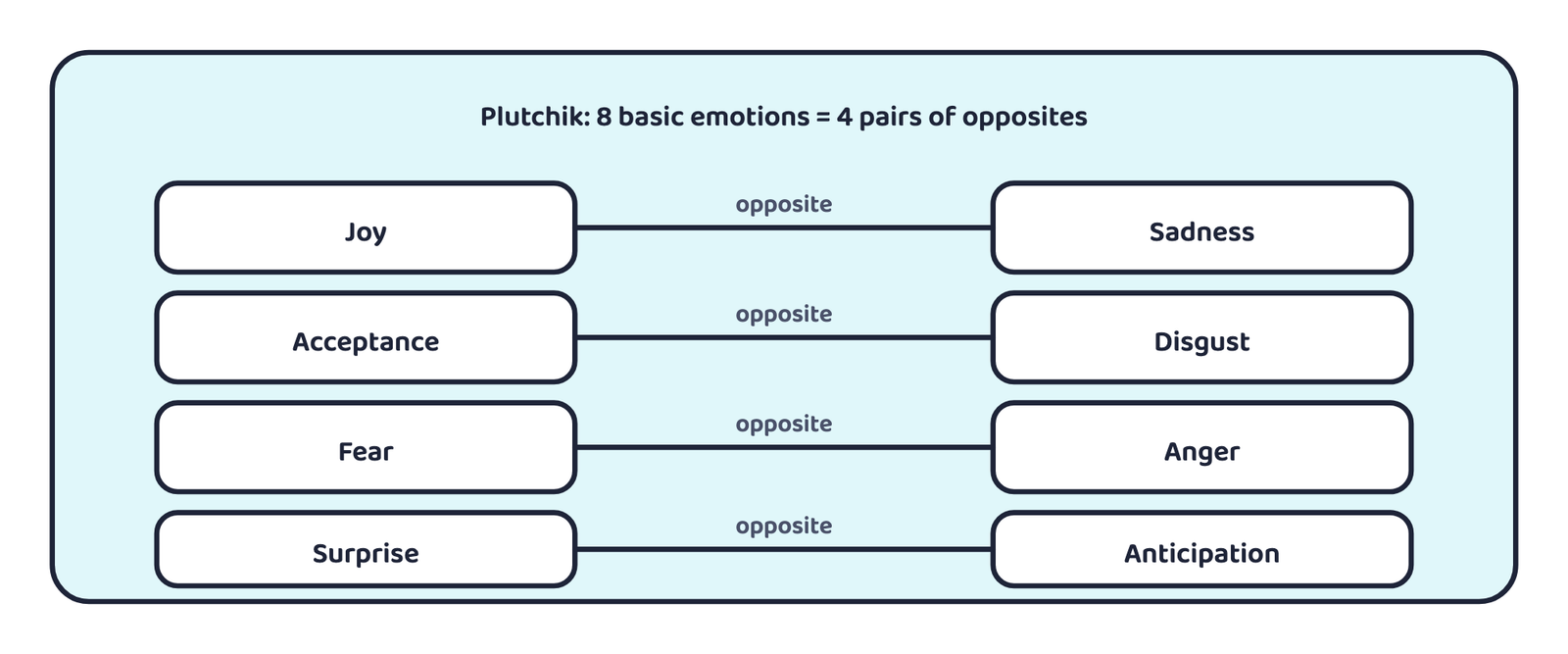
| Plutchik | 8 basic (primary) | Arranged in four pairs of opposites (figure below); all other emotions are mixtures of these |
7.3 How emotions vary
- Emotions vary in intensity (high, low) and quality (happiness, sadness, fear).
- Subjective factors and situational contexts affect how we experience them: gender, personality, and certain kinds of psychopathology.
- Gender: anger is the one emotion that men feel more strongly and more often; every other emotion is felt more intensely by women.
- This gender difference is attributed to social roles: competitiveness for men, affiliation and caring for women.
8Expression of Emotions
An emotion is an internal experience that others cannot observe directly. Others infer it from our verbal and non-verbal expressions. These expressions work as channels of communication: they let us show our emotions and understand the feelings of others.
8.1 Culture and emotional expression
Paralanguage: the non-verbal aspects of the voice and the temporal (timing) characteristics of speech.
- Facial expression is the most common channel, because the face is in full view of others. It shows both the intensity and the pleasantness or unpleasantness of a person’s emotional state (the book’s Fig. 8.4 sketches fear, anger, happy and sad faces).
- Some research supports Darwin’s view that facial expressions for basic emotions (joy, fear, anger, disgust, sadness, surprise) are inborn and universal.
- Body movements add to emotional communication: theatre and drama show this well. In Indian classical dances such as Bharatanatyam, Odissi, Kuchipudi and Kathak, dancers express joy, sorrow, love and anger through movements of the eyes, legs and fingers, after rigorous training in the grammar of body movement and non-verbal communication.
- Gaze differs across cultures: Latin Americans and Southern Europeans make direct eye contact while talking, whereas many Asians, especially Indians and Pakistanis, keep their eyes slightly off the other person: a peripheral gaze.
8.2 Culture and emotional labeling
Basic emotions also differ in how much they are elaborated and how many category labels (names) a culture gives them.
| Culture | What was found |
|---|---|
| Tahitian language | 46 labels for the English word anger |
| North American subjects (free labelling) | 40 responses for the face of anger; 81 for the face of contempt |
| Japanese | Happiness 10 labels, anger 8, disgust 6 |
| Ancient Chinese literature | 7 emotions: joy, anger, sadness, fear, love, dislike, liking |
| Ancient Indian literature | 8 emotions: love, mirth, energy, wonder, anger, grief, disgust, fear |
| Western literature | Happiness, sadness, fear, anger, disgust treated as basic; surprise, contempt, shame, guilt not accepted as basic to all |
Some basic emotions are expressed and understood by all people, whatever their culture or ethnic group; certain other emotions are specific to a particular culture.
9Managing Negative Emotions
Try to imagine one day without any emotion: it is hard even to picture. Emotions form the very fabric of our lives and relationships, and effective emotion management is the key to effective social functioning today. Tips for a healthy balance:
| Tip | What you actually do |
|---|---|
| Enhance self-awareness | Notice your own feelings and understand the ‘how’ and ‘why’ of them |
| Appraise the situation objectively | Emotion comes after we evaluate an event. If we judge it disturbing, the sympathetic nervous system is activated and we feel stressed; if not, there is no stress. So you decide whether to feel anxious or relaxed. |
| Do some self-monitoring | Regularly review your past accomplishments, emotional and physical states, real and vicarious experiences; a positive appraisal builds faith in yourself |
| Engage in self-modeling | Be your own ideal: watch the best parts of your past performance again and again and use them as inspiration |
| Perceptual reorganisation and cognitive restructuring | See the other side of the coin; restructure thoughts to strengthen reassuring feelings and remove negative thoughts |
| Be creative | Develop a hobby or interest that amuses you |
| Develop and nurture good relationships | Choose friends carefully; cheerful company makes you happier |
| Have empathy | Understand others’ feelings; give and seek support |
| Participate in community service | Help yourself by helping others, e.g. helping an intellectually challenged child learn an adaptive skill gives insight into your own difficulties |
9.1 Box 8.1: Post-Traumatic Stress Disorder (PTSD)
- A disaster seriously disrupts society and causes widespread material or environmental loss that existing resources cannot handle at once. It may be natural (earthquake, cyclone, tsunami) or man-made (war).
- The trauma may range from merely perceiving the event to actually facing it, which may be life-threatening. Either can lead to PTSD.
- In PTSD the person re-experiences the event through flashbacks and has overwhelming thoughts about it even long afterwards, stays emotionally disturbed and fails to use proper coping in daily activities.
- Emotions show up as maladaptive behaviour (like depression) and autonomic arousal.
9.2 Box 8.2: Management of examination anxiety
Any task where you know you will be evaluated causes anxiety. A certain level of anxiety is useful because it pushes us to do our best, but a high level blocks best performance, since the person is highly aroused physiologically and emotionally. Coping uses two strategies:
Monitoring (taking effective, direct action)
- Prepare well, well in advance; know the paper pattern and frequently asked questions: this gives predictability and control
- Have a rehearsal: a mock exam, a friend testing you, or visualising yourself writing the exam calmly and passing
- Inoculation: rehearsals and role-playing “vaccinate” you against stress
- Positive thinking: list worrying thoughts and deal with them one by one; stress your strengths
- Seek support from friends, parents, teachers or seniors
Blunting (avoiding the situation)
- Avoiding an exam is neither desirable nor possible, but two techniques help:
- Relaxation: sit or lie comfortably in a quiet place, relax the muscles, cut outside stimulation and the flow of thoughts, and focus
- Exercise: stress overactivates the sympathetic nervous system; light exercise or active sport channels the extra energy and helps concentration
9.3 Managing your anger
In anger the mind is “carried away” and we lose control over what we do, which is why it counts as a negative emotion. It mostly arises when a motive is blocked: frustration of motives is its major source. Anger is not a reflex; it is a result of our own thinking. It is neither automatic, nor uncontrollable, nor caused by others: it is a self-induced choice, so it can be controlled by our own thoughts.
✓ Do this
- Recognise the power of your thoughts
- Realise you alone can control it
- Find constructive ways to express anger; control its degree and duration
- Look inward, not outward, for anger control
- Give yourself time to change a habit
✗ Avoid this
- ‘Self-talk that burns’ and magnifying negative feelings
- Ascribing intentions and ulterior motives to others
- Irrational beliefs about people and events
Activity 8.2 asks you to recall an intense emotional experience, describe the sequence of events and how you dealt with it, and share it in class.
10Enhancing Positive Emotions
Emotions have a purpose: they help us adapt to a changing environment and are important for survival and well-being.
Negative emotions (fear, anger, disgust)
- Prepare us mentally and physically for immediate action against a threat; without fear we might pick up a poisonous snake
- But excessive or inappropriate use can harm the immune system and health
Positive emotions (hope, joy, optimism, contentment, gratitude)
- Energise us and improve emotional well-being
- Make us consider more actions and ideas, so we become proactive
- Help us cope with adversity, return to normal quickly, make long-term plans and form new relationships
In one study, people shown films of joy and contentment came up with more ideas about things they would like to do than people shown films that evoked anger and fear.
Six ways to enhance positive emotions
Positive traits
Optimism, hopefulness, happiness and positive self-regard
Positive meaning
Finding something positive even in dire circumstances
Quality connections
Supportive network of close relationships
Engaged work
Being absorbed in work and gaining mastery
Faith
One that gives social support, purpose and hope: a life of purpose
Positive reading of events
Interpreting most daily events positively
11Key Terms at a Glance
| Key term | Meaning in one line |
|---|---|
| Anxiety | Uneasy arousal before a task where we will be judged; some helps, too much harms performance |
| Arousal | The state of tension that a need produces (the drive) |
| Basic emotions | Emotions recognised everywhere, e.g. anger, disgust, fear, happiness, sadness, surprise |
| Biological needs | Hunger, thirst and sex, rooted in the body’s physiology |
| Esteem needs | Maslow’s fourth level: a sense of self-worth |
| Examination anxiety | Anxiety about being evaluated in an exam; handled by monitoring and blunting |
| Expression of emotions | Showing emotion through verbal and non-verbal channels |
| Hierarchy of needs | Maslow’s five-level pyramid from physiological needs to self-actualisation |
| Motivation / Motives | Forces that start and direct goal-seeking behaviour |
| Need | Lack or deficit of some necessity |
| Power motive | Wish to produce intended effects on others’ behaviour and emotions |
| Psychosocial motives | Learned motives such as affiliation, power, achievement, curiosity |
| Self-actualisation | Fullest development of one’s potential |
| Self-esteem | One’s sense of self-worth, the aim of esteem needs |
12Review Questions: Short Answers
12.1 The six NCERT Review Questions
Explain the concept of motivation.
From ‘movere’; persistent goal-directed behaviour caused by driving forces. A need (deficit) creates a drive (arousal), which leads to goal-directed behaviour; reaching the goal reduces the drive (motivational cycle). Motives explain and predict behaviour.
Biological bases of hunger and thirst?
Hunger: stomach contractions, low glucose, low protein, stored fat, liver impulses, plus food cues; regulated by the feeding-satiety system in the hypothalamus. Thirst: loss of water from cells and lower blood volume; osmoreceptors in the anterior hypothalamus fire on cell dehydration.
Achievement, affiliation, power in adolescents?
n-Ach: choosing challenging tasks, wanting feedback (preparing for competitions). Affiliation: joining friend groups, seeking company when worried or happy. Power: leading a club, arguing to win, admiring stars (McClelland’s four ways).
Basic idea of Maslow’s hierarchy?
Needs are arranged from physiological to safety, belongingness, esteem and self-actualisation; a higher need takes over only when lower ones are adequately met; few reach the top. E.g. a hungry person cares little for esteem.
How does culture influence expression?
Gaze (direct vs peripheral), body movement in classical dance, and labels (Tahitian 46 for anger; Chinese 7 and Indian 8 emotions). Some emotions are universal, others culture-specific.
Why and how manage negative emotions?
Excess harms health and relationships; management is key to social functioning. Ways: self-awareness, objective appraisal, self-monitoring, self-modeling, cognitive restructuring, creativity, good relationships, empathy, community service.
- Motivation (Latin ‘movere’): need → drive (arousal) → goal-directed behaviour → achievement → reduction of arousal
- Two types of motives, biological and psychosocial, always interdependent
- Hunger: feeding-satiety system in the hypothalamus; thirst: osmoreceptors in the anterior hypothalamus; sex: not needed for survival, not homeostatic, develops with age
- Affiliation (aroused when threatened and when happy), power (McClelland 1975, four ways), n-Ach (moderately difficult tasks, feedback), curiosity (sensory stimulation)
- Maslow (1968; 1970): physiological, safety, belongingness, esteem, self-actualisation; few reach the top
- Basic emotions: 6 everywhere; Izard 10; Plutchik 8 in 4 opposite pairs; women feel all but anger more intensely
- Channels: verbal, paralanguage, face (Darwin: inborn, universal), kinetic, proximal; Indians prefer peripheral gaze
- Labels: Tahitian 46 for anger; Japanese 10/8/6; Chinese 7; Indian 8
- Exam anxiety: monitoring (prepare, rehearse, inoculation, positive thinking, support) vs blunting (relaxation, exercise); anger comes from frustration of motives and is a self-induced choice
- Can I draw the motivational cycle in the right order?
- Can I name the two body conditions that trigger drinking, and where osmoreceptors are?
- Can I give McClelland’s four ways of expressing power with an example each?
- Can I draw Maslow’s pyramid from bottom to top without looking?
- Can I list Plutchik’s four pairs of opposite emotions?