
- What social change means, and how it is classified by pace, by nature and by causes
- The five sources of social change: environment, technology, economy, politics and culture, with the book’s examples
- What social order is, why societies resist change, and the two ways order is kept
- The chain power, domination, legitimacy, authority and law, and the meanings of contestation, crime and violence
- How a village, town and city are told apart, and what urbanisation means
- Social order and change in rural areas (dominant castes, land reform, MGNREGA) and in urban areas (space, slums, gated communities, transport, gentrification)
| Board (2026-27) | Marks for this chapter | Paper |
|---|---|---|
| CBSE (039) | 12 marks (Unit 7, “Social Change and Social Order in Rural and Urban Society”) | Theory 80 + project 20 |
| UP Board | 10 marks | One 100-mark theory paper, no project |
| Rajasthan Board (RBSE) | 10 marks | One 100-mark theory paper |
| MP Board | 8 marks | Theory 80 + project 20 |
Every board above examines the whole chapter. CBSE’s unit lists social change (types, causes and consequences), social order (domination, authority and law; contestation, crime and violence), the concepts of village, town and city, and social order and change in rural and urban areas: that is every section of these notes.
1 Introduction: Change Is the Only Unchanging Thing
It is often said that change is the only unchanging aspect of society. Constant change is among the most permanent features of modern society. In fact, sociology itself emerged as an effort to make sense of the rapid changes that Western European society experienced between the seventeenth and nineteenth centuries.
Yet rapid social change is, comparatively speaking, a very new and recent fact:
Because the speed of change keeps increasing, it is probably true that in the last hundred years change was faster in the last fifty than in the first fifty, and within the last fifty the world may have changed more in the last twenty years than in the first thirty.
1.1 Box: The Clock of Human History
The book quotes Anthony Giddens (2004, Sociology, 4th edition, p.40). Humans have existed for about half a million years; agriculture, the basis of fixed settlements, is only about twelve thousand years old; civilisations date back no more than about six thousand years. Squeeze the whole of human existence into one day, midnight to midnight:

The box ends: perhaps as much change has taken place in the last thirty seconds of this human day as in all the time leading up to it.
Ask your elders to list things that did not exist when your parents or grandparents were your age (black and white or colour TV, milk in plastic bags, zip fasteners, plastic buckets), and things that existed then but not now. The list shows change inside just two generations.
2 Social Change: Meaning and Types
“Social change” is such a general term that it is often used for almost any change not described by some other term, such as economic or political change. Sociologists had to work hard to narrow it so that it is useful for social theory.
Social change refers to changes that are significant, that is, changes which alter the “underlying structure of an object or situation over a period of time” (Giddens 2005:42). It includes only big changes which transform things fundamentally.
How is “bigness” measured? Not only by how much change it brings, but also by its scale, that is, how large a section of society it affects. So a change must be both intensive and extensive: a big impact spread over a large sector of society.
2.2 Three ways of classifying change
2.3 By pace: evolution and revolutionary change
Evolution
- Change that takes place slowly over a long period of time
- Made famous by the natural scientist Charles Darwin: living organisms evolve over several centuries or even millenia by adapting to natural circumstances
- Darwin’s idea of “the survival of the fittest”: only life forms best adapted to their environment survive; those unable to adapt, or too slow, die out
- Humans evolved from sea-borne life forms (varieties of fish) to land mammals, through monkeys and chimpanzees, to homo sapiens
- Adapted to the social world as social Darwinism, a theory stressing the importance of adaptive change
Revolutionary change
- Change that occurs comparatively quickly, even suddenly
- Used mainly in the political context: the power structure changes very rapidly through the overthrow of a former ruling class or group by its challengers
- Examples: the French revolution (1789-93) and the Soviet or Russian revolution of 1917
- Also used for sharp, sudden and total transformations of other kinds: “industrial revolution”, “telecommunications revolution”
Think of the French Revolution and the Industrial Revolution you have read about. Were their changes big enough to be “social change”? Fast and far-reaching enough to be “revolutionary change”? Which other changes in your books would not qualify, and why?
2.4 By nature or impact: structural change and change in values
Structural change refers to transformations in the structure of society, to its institutions or the rules by which these institutions are run.
Changes in ideas, values and beliefs can also cause social change. The book’s example is childhood:
2.5 By causes: the most common classification
Causes are sometimes pre-classified as internal (endogenous) and external (exogenous). The book names five broad types of sources or causes of social change:
Environmental
Nature, ecology, disasters, oil
Technological
Steam power, gunpowder, paper, textile machines
Economic
Plantations, tariffs and the WTO
Political
War, independence, universal adult franchise
Cultural
Religion, women’s position, sport
3 Sources of Change 1: Environment
Nature, ecology and the physical environment have always shaped society, especially in the past when humans could not control nature. People in a desert could not practise settled agriculture as in the plains or near rivers, so their food, clothes, livelihood and social interaction were largely set by physical and climatic conditions. The same was true of very cold climates, port towns, major trade routes, mountain passes and fertile river valleys.
- The environment’s influence has been decreasing as technology grows: technology helps us overcome or adapt to nature, reducing differences between societies.
- But technology also alters nature and our relationship with it. So it is perhaps more accurate to say that the effect of nature on society is changing rather than simply declining.
Destructive: natural disasters
- Earthquakes, volcanic eruptions, floods, tidal waves change societies drastically
- The tsunami of December 2004 hit Indonesia, Sri Lanka, the Andaman Islands and parts of Tamil Nadu
- Such changes are often irreversible: many whose livelihoods were destroyed may never get them back; coastal villages may have their social structure completely altered
Constructive: discovery of oil
- Oil in the desert regions of West Asia (the Middle East) completely transformed those societies
- Like the discovery of gold in California in the 19th century
- Saudi Arabia, Kuwait, the United Arab Emirates would be very different without their oil wealth
4 Sources of Change 2: Technology and Economy
Technology and economic change together have caused immense change, especially in the modern period. Technology helps us resist, control, adapt to or harness nature; combined with the very powerful institution of the market, its impact can be as big as a tsunami or the discovery of oil.
4.1 Steam power and the Industrial Revolution
4.2 Impact seen only later, and impact far away
- Retrospective impact: sometimes an invention lies “dormant” and its social impact is seen only later, when the economic context changes. Gunpowder and writing paper were discovered in China but had limited impact for centuries, until they entered modernising Western Europe. Then gunpowder transformed warfare and the paper-print revolution changed society forever.
- Textiles: new spinning and weaving machines in Britain, combined with market forces and imperial power, destroyed the handloom industry of the Indian subcontinent, until then the largest and most advanced in the world.
Think of the photocopying machine and the STD telephone booth: how did people manage before they became cheap and common? List other technologies with social effects in your own life.
4.3 Economic change that is not directly technological
- Plantation agriculture (growing single cash crops like sugarcane, tea or cotton on a large scale) created a heavy demand for labour. This helped establish slavery and the slave trade between Africa, Europe and the Americas between the 17th and 19th centuries.
- In India, the tea plantations of Assam involved the forced migration of labour from Eastern India, especially the Adivasi areas of Jharkhand and Chhattisgarh.
- Today, changes in customs duties or tariffs through international agreements and institutions like the World Trade Organisation can wipe out entire industries and occupations, or (less often) bring sudden booms to others.
Customs duties, tariffs: taxes imposed on goods entering or leaving a country, which increase its price and make it less competitive relative to domestically produced goods.
5 Sources of Change 3: Politics
Old histories made the actions of kings and queens look like the main force of change. We now know they represented larger political, social and economic trends: individuals had roles, but within a larger context. Political forces have surely been among the most important causes of change. The clearest examples come from warfare: sometimes the conquerors planted seeds of change; at other times the conquered changed the conquerors.
5.1 The United States and Japan
5.2 Political change at home
- The Indian independence movement did not only end British rule; it also decisively changed Indian society.
- A more recent instance: the Nepali people’s rejection of monarchy in 2006.
- In general, political changes bring social change through the redistribution of power across different social groups and classes.
5.3 Universal adult franchise
Universal adult franchise, the “one person, one vote” principle, is probably the single biggest political change in history.
| Before | After |
|---|---|
| Kings and queens claimed to rule by divine right and were not answerable to the common people | Elections became mandatory for exercising legitimate power |
| Even early democracies let only a small minority vote: those born into high-status groups of a particular race or ethnicity, or wealthy property-owning men | Through long struggles, universal adult franchise became a norm |
| All women, lower-class men, subordinated ethnicities and the poor and working people could not vote | Governments must now at least appear to seek the approval of the people to be considered legitimate |
It did not abolish all inequalities: not all countries are democratic, elections can be manipulated, and people can remain powerless. Still, it is a powerful norm that presses on every society and government, and has brought massive social change.
6 Sources of Change 4: Culture
Here “culture” is a short label for a very wide field of ideas, values and beliefs that matter to people and shape their lives. Change in them leads naturally to change in social life.
6.1 Religion
- Religion is the commonest example of a socio-cultural institution with enormous social impact; some scholars even define civilisations in religious terms and see history as the interaction between religions.
- But religion is contextual: it produces effects in some contexts but not in others.
- Max Weber’s “The Protestant Ethic and the Spirit of Capitalism” showed how the beliefs of some Christian Protestant sects helped establish the capitalist social system: one of the most famous examples of cultural values changing the economy and society.
- India: the impact of Buddhism on social and political life in ancient India, and of the Bhakti Movement on medieval social structure including the caste system.
6.2 The place of women
The Second World War
- Women in western countries worked in factories in jobs always done by men
- They built ships, operated heavy machinery and manufactured armaments
- This helped establish their claims to equality; without the war they would have had to struggle much longer
Consumer advertising
- In most urban societies women take most everyday decisions on what to buy for the household
- So a significant part of advertising expenditure is directed at women, which affects the media
- Ads now show women as decision-makers; in household appliances and consumer goods they address mainly women. The economic role of women starts a chain of changes
6.3 Sport: cricket
- No single factor or theory can account for social change.
- Causes may be internal or external, the result of deliberate actions or accidental events, and are often interrelated (economic and technological causes may have a cultural side; politics may be influenced by environment).
- Change is better understood retrospectively, after it has happened, but we must also be aware of it as it happens and prepare for it.
7 Social Order
Letters on a page are readable because they contrast with the background. In the same way, change makes sense only against continuity: some things must stay the same for comparison to be possible. So social change has to be understood together with social order.
Social order is the tendency within established social systems that resists and regulates change.
7.1 Why societies resist change
General reason: stability
- Every society must reproduce itself over time and maintain its stability
- Stability needs people to follow the same rules, similar actions to produce similar results, and individuals and institutions to behave predictably
- Activity 4 asks you to imagine a life where food, family and the rules of games changed every day, and where you would or would not want change
Concrete reason: stratification
- Societies are stratified unequally in economic resources, status and power
- Ruling or dominant groups have a vested interest in stability; subordinated or oppressed groups have a vested interest in change
- “Normal” conditions usually favour the rich and powerful, who can resist change
7.2 The positive meaning: two ways to order
Social order is not only resistance to change. It also means the active maintenance and reproduction of a particular pattern of social relations, values and norms. It is achieved in two ways, and every society uses a combination of both:
| Spontaneous consent | Compulsion |
|---|---|
| People spontaneously wish to abide by rules and norms | People are compelled in various ways to obey norms |
| Comes from shared values and norms internalised through socialisation | Modern societies depend on some form of power or coercion (force) |
| Limit: socialisation can never completely erase the will of the individual; it cannot turn people into programmed robots. We question old beliefs, drop them, sometimes return to them. So it is never enough by itself | Needed so that institutions and individuals conform to established norms |
7.3 Power and domination
Power is usually defined as the ability to make others do what you want regardless of what they themselves want.
Domination: when a relationship of power is stable and settled, and the parties have become accustomed to their relative positions, we have a situation of domination. A social entity (person, institution or group) routinely or habitually in a position of power is dominant.
Dominant groups are challenged only in abnormal or extraordinary times. In normal times domination can be quite “smooth”, without friction, though people are forced to do things they may not want. The book recalls “forced cooperation” from Chapter 1: why did women “consent” to the patriarchal norm and not claim their rights in their families of birth?
8 Domination, Authority and Law
Why does domination work without open confrontation? Partly because of power. But the deeper answer is legitimation.
Legitimacy refers to the degree of acceptance involved in power relations. Something legitimate is accepted as proper, just and fitting, acknowledged as part of the prevailing social contract. Legitimacy implies conformity to existing norms of right, propriety and justice.
Legitimation (glossary): the process of making legitimate, or the grounds on which something is considered legitimate, i.e., proper, just, right etc.
Power in itself is simply a fact: it can be legitimate or not.
Authority is defined by Max Weber as legitimate power, that is, power considered to be justified or proper.
| Holder | Authority comes from | Its domain |
|---|---|---|
| Judge | Official job description, written documents | The court room. Outside it the judge is like any citizen and must obey the police officer on the street |
| Police officer | Official job description | Public actions of all citizens (except superior officers) when on duty; no jurisdiction over private activities unless suspected of being unlawful |
| School teacher | Less strictly or explicitly defined | Pupils in the classroom; does not extend into the pupil’s home, where parents or guardians have authority |
Some authority is not strictly defined but still wins consent and cooperation: the leader of a sect or a less-institutionalised minor religious group; reputed scholars, artists, writers and other intellectuals in their fields; even a criminal gang leader, who may exercise absolute authority without any formal specification.
8.3 Law
Law is an explicitly codified norm or rule. It is usually written down, and there are laws that specify how laws are made or changed, or what is done if someone violates them.
- In a modern democracy laws are made by the legislature of elected representatives, in the name of the people.
- Laws apply to all citizens and are binding whether or not an individual agrees with them.
This does not exhaust power: some power is effective though illegitimate, or legitimate but not codified in law. The mix of legitimate, lawful authority and other kinds of power decides the nature of a social system and its dynamics.
9 Contestation, Crime and Violence
Domination, authority and law do not always meet obedience.
Contestation is a word for broad forms of insistent disagreement. Competition and conflict are more specific and leave out other forms of dissent.
| Form of contestation | Book’s example or point |
|---|---|
| “Counter cultures” or “youth rebellion” | Protest against or refusal to conform to prevalent norms: hairstyles, clothing fashions, language, lifestyle |
| Elections | A standard form: political competition |
| Dissent or protest against laws or lawful authorities | Open, democratic societies allow it to different degrees, within explicit and implicit boundaries; crossing them invites a reaction, usually from law enforcement |
Social order need not mean sameness or unanimity: political parties with different agendas respect the same Constitution; people who know the same traffic rules still argue on the road. How much dissent a society tolerates marks the boundary between the legitimate and the illegitimate, the legal and the illegal, the acceptable and the unacceptable.
Crime is an act that violates an existing law, nothing more, nothing less. It is going beyond the boundary of legitimate dissent as defined by the law.
The moral worth of an act is not decided only by whether it breaks the law. If a law is unjust, a person may break it for the highest moral reasons. In the Civil Disobedience campaign, when Mahatma Gandhi broke the salt law of the British government at Dandi, he committed a crime and was arrested, but he did it deliberately and proudly, and Indians were proud of him. Many other crimes cannot claim any such moral virtue.
9.1 Violence and the state
- A defining feature of the modern state: it has a monopoly over the use of legitimate violence within its jurisdiction. Only the state, through its authorised functionaries, may lawfully use violence (exceptions such as self defense in rare situations).
- So technically every act of violence is directed against the state: if I assault or murder someone, the state prosecutes me for violating its monopoly.
- Violence is the enemy of social order, an extreme form of contestation that breaks both the law and important social norms.
- It is the product of social tensions, shows serious problems, challenges the authority of the state, and marks the failure of the regime of legitimation and consent.
10 Village, Town and City
Most societies can be divided into rural and urban sectors, with very different conditions of life, social organisation, forms of social order and kinds of change. (For village studies, the book points to Chapter 5’s section on M.N. Srinivas.)
10.1 How villages emerged
10.2 Telling them apart
| Basis | Village | Town / City |
|---|---|---|
| Population density (persons per unit area, e.g. square km) | Low: smaller in absolute numbers, spread over a relatively larger area | Much higher density |
| Share of agriculture-related activities | Large: much of the population in agriculture-linked work, most products agricultural, most income from agriculture | Small |
| Size | Not always decisive: large villages and small towns are hard to separate by population alone | |
- Town vs city: much more a matter of administrative definition; basically the same sort of settlement, differentiated by size.
- Urban agglomeration (a Census term): a city along with its surrounding suburban areas and satellite settlements.
- Metropolitan area: more than one city, or a continuous urban settlement many times the size of a single city.
10.3 Urbanisation
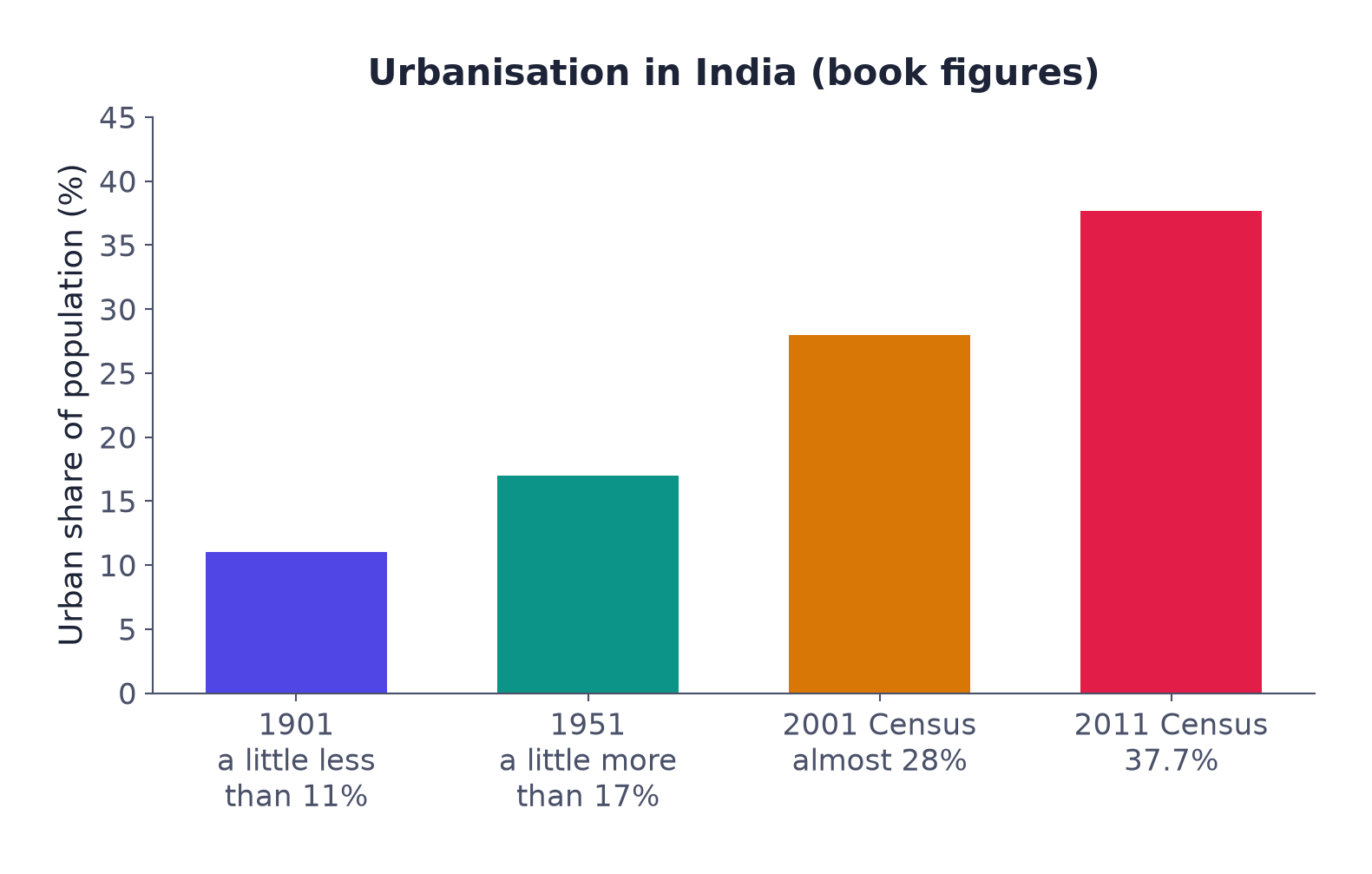
Urbanisation is the process by which a progressively larger proportion of a country’s population lives in urban rather than rural areas.
Most developed countries are now overwhelmingly urban; developing countries are urbanising too, faster or slower, unless special reasons block it. According to the United Nations report (2014), 54 per cent of the world’s population lives in urban areas, expected to rise to 66 per cent by 2050.
11 Social Order and Social Change in Rural Areas
Villages are small, so relationships are more personalised: members often know all or most others by sight. Their social structure is more traditional: caste, religion and customary practice are stronger. So, unless special circumstances exist, change is slower to arrive in villages than in towns.
11.1 Why the rural power structure is hard to shift
No anonymity
Lack of anonymity and distance: dissenters are easily identified and “taught a lesson” by the dominant sections
Control of resources
Dominant sections control most employment and resources; the poor depend on them, with no alternative support
Small numbers
Hard to gather large numbers; efforts cannot be hidden from the powerful and are quickly suppressed
So a strong power structure in a village is very hard to dislodge: shifts in power are slow and late because the rural social order is stronger and more resilient.
Other change is slow because villages are scattered and less connected. But the telephone and television have made the cultural “lag” between villages and towns much shorter or nonexistent, and better roads and rail mean few villages can really be called “isolated” or “remote”. This has accelerated change somewhat.
11.2 Land reform and the dominant castes
Dominant castes (term attributed to M.N. Srinivas): landowning intermediate castes that are numerically large and therefore enjoy political dominance in a given region.
11.3 Technology, prices and development programmes
- New labour-saving machinery or new cropping patterns can change the demand for labour and so the bargaining strength of landlords and labourers, setting off a chain of changes.
- Sudden fluctuations in agricultural prices, droughts or floods can cause havoc; the recent spate of farmer suicides in India is an example.
- Large development programmes for the rural poor have an enormous impact: the Mahatma Gandhi National Rural Employment Guarantee Act of 2005 (MGNREGA). Activity 5 asks you to find out its aims, why it is so important, its problems and what success would mean.
12 Social Order and Social Change in Urban Areas
The city itself is very old, but urbanism as a way of life for large parts of the population is modern.
12.1 What made old cities important
| Factor | Advantage | Indian examples in the book |
|---|---|---|
| Trade | Location on major trade routes, harbours and ports | Medieval trading towns: Tezpur on the Brahmaputra river in Assam; Kozhikode (formerly Calicut) on the Arabian Sea in northern Kerala |
| Warfare | Good location for military strategy | None named |
| Religion | Pilgrims supported an urban economy | Temple towns: Ajmer (Rajasthan), Varanasi (Benaras or Kashi, Uttar Pradesh), Madurai (Tamil Nadu) |
12.2 The city and the individual
The city as haven of the individual
- City life and modernity go together; each is an intimate expression of the other
- The city houses large, dense populations and has been known throughout history as the site for mass politics
- Combining anonymity with amenities that only large numbers can support, the city offers the individual boundless possibilities
- Unlike the village, which discourages individuality, the city nurtures the individual
The limits
- Freedom and opportunity are available only to a socially and economically privileged minority
- Most city people have only limited, relative freedoms within economic and social constraints
- The city fosters group identities (race, religion, ethnicity, caste, region, class); crowding intensifies them as strategies of survival, resistance and assertion
12.3 Space: the central question of urban order
High population density puts a great premium on space. The primary task of the urban social order is the spatial viability of the city: organising and managing
Housing
Housing and residential patterns
Mass transit
Moving large numbers of workers to and from work
Land use
Coexistence of residential, public and industrial zones
Public services
Public health, sanitation, policing, public safety, monitoring
Each is a huge task of planning, implementation and maintenance, made harder because divisions and tensions of class, ethnicity, religion and caste are present and active.
Mass transit: modes of fast city transport for large numbers of people.
12.4 Housing: slums and gated communities
Slums
- Housing shortage for the poor causes homelessness and “street people” (living on streets, footpaths, under bridges and flyovers, in abandoned buildings); it is the leading cause of slums
- Slum: a congested, overcrowded neighbourhood with no proper civic facilities (sanitation, water supply, electricity), homes of every material from plastic sheets and cardboard to multi-storeyed concrete
- No “settled” property rights, so a breeding ground for “dadas” and strongmen; control of slum territory leads to extra-legal activities, criminal and real estate gangs
Gated communities
- A worldwide phenomenon, also found in Indian cities
- Most have their own parallel civic facilities: water and electricity supply, policing and security
- Activity 6: when did the gates come up, who opposed them, why live there, and what effect on the city?
Gated communities: urban localities (usually upper class or affluent) sealed off from their surroundings by fences, walls and gates, with controlled entry and exit.
Ghetto: originally the locality where Jews lived in medieval European cities; today any neighbourhood with a concentration of people of a particular religion, ethnicity, caste or other common identity. Ghettoisation is the creation of ghettoes by converting mixed neighbourhoods into single-community ones.
12.5 Transport and commuting
- The urban transport system depends on where homes are relative to industrial and commercial workplaces. When they are far apart, an elaborate mass transit system is needed; commuting becomes a way of life and a constant source of possible disruption.
- Transport directly affects the “quality of life” of working people. Relying on private cars rather than buses causes traffic congestion and vehicular pollution.
- So the “simple” issue of distributing living space is a complex, multi-dimensional part of urban society.
- Daily long-distance commuters can become an influential political constituency and develop sub-cultures: on Mumbai’s suburban trains, the “locals”, commuters’ informal associations sing bhajans, celebrate festivals, chop vegetables, play card and board games (even tournaments), or just socialise.
12.6 Change in urban areas: the city centre and gentrification
Gentrification: the conversion of a previously lower class neighbourhood into a middle and upper class one.
As real estate prices rise, developers profit from such conversion; at some point it becomes self-fulfilling as rents rise and the locality gains enough prosperous businesses and residents. But it can also fail, and the neighbourhood slides back to its previous status. Activity 7 asks who benefits, who loses, and who decides about such “up-scaling”.
12.7 Mass transport and the main issue for Indian cities
- Affordable, efficient and safe public transport can shape a city’s social character as well as its economy. Scholars contrast cities based on public transport (London, New York) with car-based cities (Los Angeles).
- It “remains to be seen” whether the new Metro Rail in Delhi will significantly change social life there.
- The main issue in rapidly urbanising countries like India: how the city will cope with the constant increase in population as migrants keep streaming in, adding to its natural growth.
13 Rural and Urban Order Side by Side
| Point | Rural areas | Urban areas |
|---|---|---|
| Relationships | Personalised; people know each other by sight | Anonymity; the city nurtures the individual |
| Social structure | Traditional: caste, religion, custom stronger | Group identities of race, religion, ethnicity, caste, region, class, intensified by crowding |
| Pace of change | Slower; power shifts slow and late | Faster; change centres on space |
| Main issues | Land reform, dominant castes, farm technology, prices, droughts, development programmes | Housing, slums, gated communities, transport, land use, gentrification, migration |
14 Quick Revision
- Rapid change is recent: 500,000 years of humans, 6,000 of civilisation, 400 of rapid change, 100 of acceleration; on Giddens’s clock modern societies arrive at 11:59 and 30 seconds.
- Social change = big change in underlying structure; must be intensive and extensive. Classified by pace (evolution vs revolutionary), nature (structural vs values) and causes (endogenous/exogenous; five sources).
- Environment: desert life, tsunami 2004 (irreversible), oil in West Asia. Technology and economy: steam power, railways (India 1853), gunpowder and paper from China, handloom ruin, plantations and slavery, Assam tea, WTO tariffs.
- Politics: US and Japan, independence, Nepal 2006, universal adult franchise. Culture: Weber’s Protestant Ethic, Buddhism, Bhakti, women in war and advertising, cricket.
- Social order resists and regulates change; dominant groups have a vested interest in stability; order comes from consent (socialisation) and compulsion (power).
- Power → domination → legitimation → authority (Weber: legitimate power) → law (codified). Contestation, crime (breaks law; Gandhi at Dandi), violence (state monopoly of legitimate violence).
- Village vs urban: density and share of agriculture; town vs city by administrative definition; urban agglomeration, metropolitan area; urbanisation.
- Rural: slow change, no anonymity, dominant sections control resources; land reform created dominant castes (Srinivas); MGNREGA 2005. Urban: space, slums, gated communities, transport, Mumbai locals, gentrification, migration.
- Can I define social change and explain “intensive and extensive” in my own words?
- Can I name the five sources of change with one book example each?
- Can I tell power, domination, authority and law apart, with Weber’s definition of authority?
- Can I explain why Gandhi breaking the salt law at Dandi was a crime but not a moral wrong?
- Can I give the two bases for telling a village from a town, and define an urban agglomeration?
- Can I give three reasons why the rural power structure is hard to change?