
- Why sociology is called the child of the ‘age of revolution’, and what the Enlightenment, the French Revolution and the Industrial Revolution gave it
- Karl Marx: alienation, mode of production (base and superstructure), class, class struggle, class consciousness and ideology
- Emile Durkheim: moral facts, social facts, the ’emergent’ level, the study of Suicide, and mechanical vs organic solidarity
- Max Weber: interpretive sociology, social action, empathetic understanding, value neutrality, the ideal type, three types of authority and the five features of bureaucracy
| Board (2026-27) | Marks for this chapter | Paper |
|---|---|---|
| CBSE (039) | 12 marks (Unit 9, “Introducing Western Sociologists”) | Theory 80 + project 20 |
| UP Board | 10 marks | One 100-mark theory paper, no project |
| Rajasthan Board (RBSE) | 10 marks | One 100-mark theory paper |
| MP Board | 8 marks | Theory 80 + project 20 |
Every board above examines the whole chapter. CBSE’s unit lists four topics: the context of sociology, Karl Marx on class conflict, Emile Durkheim on the division of labour in society, and Max Weber on interpretive sociology, the ideal type and bureaucracy. That is every section of these notes.
1 Introduction: The Child of the ‘Age of Revolution’
Sociology is sometimes called the child of the ‘age of revolution’. It was born in 19th century Western Europe, after revolutionary changes in the preceding three centuries that decisively changed the way people lived.
These processes completely transformed not only European society, but also the rest of the world as it came into contact with Europe.
The chapter discusses the key ideas of three thinkers: Karl Marx, Emile Durkheim and Max Weber. As part of the classical tradition of sociology, they laid the foundation of the subject. Their ideas have remained relevant even today, though they have also been criticised and have undergone major modifications.
Ideas about society are themselves influenced by social conditions.
This is why the chapter begins with the context in which sociology emerged.
2 The Context of Sociology
The modern era in Europe, and the conditions of modernity (the features of modern life) that we take for granted today, were brought about by three major processes:
The Enlightenment
The dawning of the ‘age of reason’.
The French Revolution
The quest for political sovereignty (the right to rule oneself).
The Industrial Revolution
The system of mass manufacture (making goods in huge quantities).
These were discussed at length in Chapter 1 of Introducing Sociology. This chapter looks only at their intellectual consequences. Activity 1 asks you to revisit that chapter and list what sorts of changes these three processes were associated with.
2.1 The Enlightenment
During the late 17th and 18th centuries, Western Europe saw radically new ways of thinking about the world, referred to as ‘The Enlightenment’.
Enlightenment (glossary): a period in 18th century Europe when philosophers rejected the supremacy of religious doctrines, established reason as the means to truth, and the human being as the sole bearer of reason.
- These philosophies placed the human being at the centre of the universe, and rational thought as the central feature of the human being.
- The ability to think rationally and critically made the individual both the producer and the user of all knowledge: the ‘knowing subject’.
- The other side, in the Enlightenment’s own view: only persons who could think and reason were considered fully human. Those who could not, such as the natives of primitive societies or ‘savages’, were considered not fully evolved humans.
- Society, being the handiwork of humans, was open to rational analysis, and so could be understood by other humans.
- For reason to become the defining feature of the human world, nature, religion and the divine acts of gods had to be displaced from the central position they held earlier.
The Enlightenment was made possible by, and in turn helped to develop, attitudes of mind that we today call secular, scientific and humanistic (not based on religion, based on reason and evidence, and centred on human beings).
2.2 The French Revolution (1789)
The French Revolution announced the arrival of political sovereignty at the level of individuals as well as nation-states.
| What changed | How |
|---|---|
| Equality | The Declaration of Human Rights asserted the equality of all citizens and questioned privileges inherited by birth. |
| Freedom of the individual | Freed the individual from the oppressive rule of religious and feudal (landlord-based) institutions. |
| Peasants | Most were serfs (bonded labourers) tied to landed estates of the aristocracy; they were freed. Taxes paid to feudal lords and the church were cancelled. |
| Rights | As free citizens of the republic, sovereign individuals had rights and were equal before the law. |
| Public and private | The state had to respect the privacy of the individual, and its laws could not intrude upon the domestic life of the people. A separation grew between the public realm of the state and the private realm of the household. Religion and the family became more ‘private’; education (specially schooling) became more ‘public’. |
| Nation-state | Redefined as a sovereign entity with a centralised government. |
Liberty, Equality, Fraternity
The ideals of the French Revolution became the watchwords of the modern state.
2.3 The Industrial Revolution
The foundations of modern industry were laid by the Industrial Revolution, which began in Britain in the late 18th and early 19th centuries. It had two major aspects:
Aspect 1: Science and technology
- Systematic application of science and technology to industrial production
- Invention of new machines, e.g. the Spinning Jenny (greatly increased productivity of the textile industry)
- New sources of power, e.g. versions of the steam engine
Aspect 2: Organising labour and markets
- New ways of organising labour and markets on a scale larger than ever before
- The factory system and mass manufacture of goods
- Goods for distant markets; raw materials from all over the world
Modern large scale industry thus became a world wide phenomenon.
Changes in social life
From the outset sociology was concerned with the scientific analysis of industrial society, so observers have argued that it was the ‘science of the new industrial society’. Empirically informed scientific discussion about trends in social behaviour only became possible with the advent of modern industrial society. Scientific information that the state generated to monitor the health of its “social body” became the basis for reflection on society. Sociological theory was the result of this self-reflection.
3 Karl Marx (1818-1883)
- From Germany, but spent most of his productive years in exile in Britain. His radical political views got him exiled from Germany, France and Austria.
- He studied philosophy but was not a philosopher. He was a social thinker who advocated an end to oppression and exploitation.
- He believed scientific socialism (a society without exploitation, reached through a scientific study of how society changes) would achieve this goal. So he made a critical analysis of capitalist society to expose its weaknesses and bring about its downfall.
3.1 Stages of human society
3.2 Alienation in capitalist society
Alienation (glossary): a process in capitalist society by which human beings are separated and distanced from (or made strangers to) nature, other human beings, their work and its product, and their own nature or self.
Capitalist society was marked by an ever intensifying process of alienation, operating at several levels:
From nature
Humans are more alienated from nature than ever before.
From each other
Capitalism individualises earlier collective forms of social organisation; relationships become more and more market-mediated (people deal with each other mainly through buying and selling).
From the fruits of labour
Workers do not own the products they produce, and have no control over the work process. Skilled craftsmen once controlled their own labour; today management decides the factory worker’s day.
From themselves
As the combined result, people struggle to make life meaningful: more free, but also more alienated and less in control of their lives than before.
Capitalism was exploitative and oppressive, yet Marx saw it as a necessary and progressive stage of history, because it created the preconditions for an egalitarian future free from exploitation and poverty. It would be transformed by its victims, the working class, who would unite to overthrow it and set up a free and equal socialist society. (Egalitarian means based on equality.) To understand capitalism, Marx studied its political, social and specially its economic aspects.
4 Marx: Mode of Production, Base and Superstructure
Mode of production (glossary): a system of material production which persists over a long period of time. Each mode of production is distinguished by its means of production (e.g. technology and forms of production organisation) and the relations of production (e.g. slavery, serfdom, wage labour).
In simple words: the means of production (also called factors of production or productive forces) are the things used to produce, such as land, tools and energy. Serfdom is the system of serfs, bonded labourers tied to a lord’s land; wage labour is work done for a money wage.
In the chapter’s words, the mode of production stood for a broad system of production associated with an epoch (historical period). Primitive communism, slavery, feudalism and capitalism were all modes of production. At a general level it defines an entire way of life of an era. At a more specific level, it is like a building: a foundation (base) with something erected on top (superstructure).
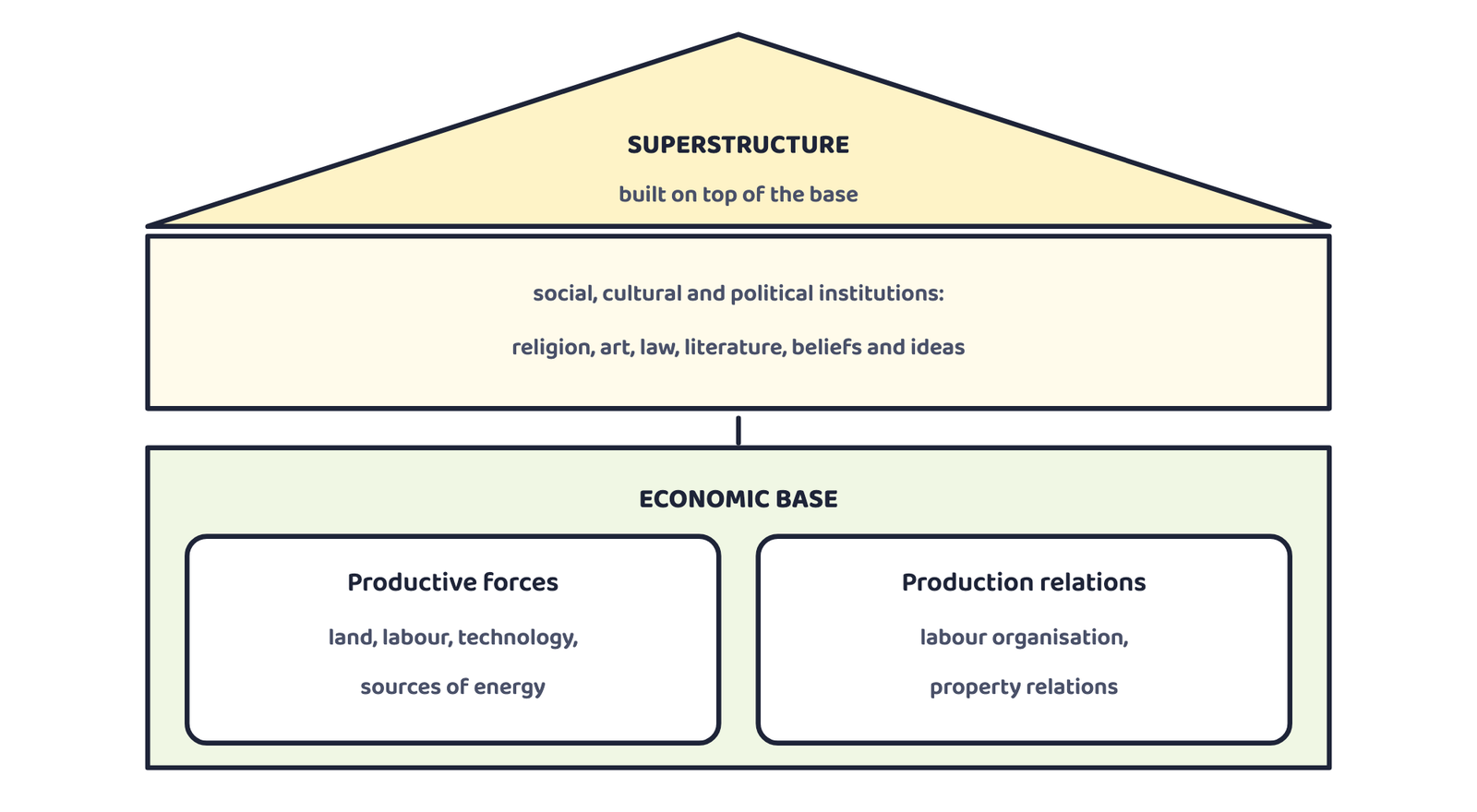
| Part | What it includes (the book’s own list) |
|---|---|
| Productive forces | All the means or factors of production: land, labour, technology, sources of energy (such as electricity, coal, petroleum and so on). |
| Production relations | All the economic relationships and forms of labour organisation involved in production. They are also property relations: relationships based on the ownership or control of the means of production. |
| Economic base | Productive forces + production relations. |
| Superstructure | All the social, cultural and political institutions that rest on the base: religion, art, law, literature, different forms of beliefs and ideas. |
Productive forces: mostly nature (forests, land, animals) with very rudimentary technology like simple stone tools and hunting weapons.
Production relations: based on community property, since individual private property did not yet exist; tribal forms of hunting or gathering were the forms of labour organisation.
Marx’s view
- People’s ideas and beliefs come from the economic system they are part of
- How people earned their livelihood decided how they thought
- Material life (how people produce and earn a living) shaped ideas, ideas did not shape material life
Dominant view of his time
- Human beings were free to think whatever they wanted
- Ideas shaped the world
Marx stressed economic structures because he believed they formed the foundations of every social system in human history. If we understand how the economy works and how it has changed, we can learn how to change society in the future. How? Marx’s answer: through class struggle.
5 Class Struggle
- For Marx, the most important way of classifying people into groups was with reference to the production process, not religion, language, nationality or similar identities.
- People who occupy the same position in the social production process will eventually form a class. They share the same interests and objectives, even if they do not recognise this immediately.
- Classes are formed through historical processes, shaped by changes in the forces of production and by conflicts between existing classes.
The capitalist mode of production creates the working class: a new urban, property-less group created by the destruction of the feudal agricultural system. Serfs and small peasants were thrown off their lands and lost their earlier sources of livelihood. They gathered in cities, and the pressure of the laws and police forced them to work in the new factories. This shared location within the production process makes workers into a class.
5.1 Class struggle: the driving force of change
Marx was a proponent (supporter) of class struggle. He believed class struggle was the major driving force of change in society. In The Communist Manifesto (which was also a programme of action), Marx and Engels set out their views clearly.
‘The history of all hitherto existing societies is the history of class struggle’.
The opening lines of The Communist Manifesto (Marx and Engels)
‘Freeman and slave, patrician and plebeian, lord and serf, guild master and journeyman, in a word, oppressor and oppressed, stood in constant opposition to one another, carried out an uninterrupted, now hidden, now open fight’.
Marx and Engels, on the oppressor and oppressed classes of each epoch
(Hitherto means ‘until now’. A patrician was a noble and a plebeian a common citizen of ancient Rome; a guild master was a master craftsman and a journeyman his paid worker.) Each stage of history had its own conflict between oppressor and oppressed classes, identified from the contradictions of the production process (the clash of interests built into the way production is organised).
Bourgeoisie (capitalists)
- Own all the means of production
- Investible capital, existing factories and machinery, land and so on
Working class
- Lost all the means of production it owned or had access to in the past
- No choice but to sell their labour for wages to survive
5.2 From class to revolution
In Marx’s theory, economic processes create contradictions, which generate class conflict. But economic processes do not automatically lead to revolution: social and political processes are also needed for a total transformation of society.
5.3 Ideology
- In every epoch, the ruling classes promote a dominant ideology: a way of seeing the world that tends to justify the domination of the ruling class and the existing social order.
- Example: it may make poor people believe they are poor not because the rich exploit them, but because of ‘fate’, or because of bad deeds in a previous life.
- Dominant ideologies are not always successful; they can be challenged by alternative worldviews or rival ideologies.
- As consciousness spreads unevenly among classes, how a class will act in a particular situation cannot be pre-determined.
According to Marx, economic processes generally tend to generate class conflicts, though this also depends on political and social conditions. Given favourable conditions, class conflicts culminate in revolutions.
Is your school class a “class” in the Marxian sense? Do factory workers and agricultural workers belong to the same class? Workers and managers in the same factory? A city industrialist with no land and a landless village labourer? A big landlord and a small peasant of the same village? The book’s hint: think of the interests they share and their position in relation to the production process.
6 Emile Durkheim (1858-1917)
- Durkheim may be considered the founder of sociology as a formal discipline, as he was the first to become a Professor of Sociology in Paris in 1913.
- Sent to a rabbinical school (a Jewish religious school); by the time he entered the Ecole Normale Superieure in 1876 he broke with religion and declared himself an agnostic (one who says we cannot know whether God exists). Yet his moral upbringing had an enduring influence on his thinking.
- For him, moral codes were the key characteristics of a society that determined individuals’ behaviour patterns.
- He cherished developing a secular understanding of religion, fulfilled in his last book, The Elementary Forms of the Religious Life.
6.1 Society as a moral community
For Durkheim the social was found in the codes of conduct imposed on individuals by collective agreement, seen in everyday life. His scientific study of society rested on recognising moral facts.
‘Moral facts are phenomena like others; they consist of rules of action recognizable by certain distinctive characteristics, it must then be possible to observe them, describe them, classify them and look for certain laws explaining them’.
Durkheim 1964: 32
- Moral codes were manifestations of particular social conditions, so the morality right for one society was wrong for another.
- So the prevailing social conditions could be deduced from the moral codes.
- This made sociology akin to the natural sciences, in keeping with his aim of making sociology a rigorous scientific discipline.
7 Durkheim’s Vision of Sociology
Durkheim’s vision of sociology as a new scientific discipline had two defining features.
7.1 Feature 1: the ’emergent’ level
The subject matter of sociology, the study of social facts, was different from the other sciences. Sociology studied the ’emergent’ level: the level of complex collective life where social phenomena can emerge.
- Examples of such phenomena: social institutions like religion or the family; social values like friendship or patriotism.
- They are possible only in a complex whole that is larger than and different from its parts.
- A football or cricket team is made entirely of individuals, but it is much more than a collection of eleven persons.
- Teams, political parties, street gangs, religious communities and nations belong to a different level of reality than individuals.
7.2 Feature 2: an empirical discipline
Like most natural sciences, sociology was to be empirical (based on observed evidence). This was a difficult claim, because social phenomena are abstract.
We can see directly
- A tree, a boy or a cloud
- The individuals who make up a family or a theatre group
We cannot see directly
- The Jain community; the Bengali (or Malayalam or Marathi) speaking community; the Nepalese or Egyptian national communities
- The collectivity itself
One of Durkheim’s most significant achievements: he showed that sociology, though it deals with abstract entities like social facts, could still be a science founded on observable, empirically verifiable evidence. Social facts are not directly observable, but are indirectly observable through patterns of behaviour.
Each case of suicide is specific to the individual and his/her circumstances. But the average rate of suicide, aggregated (added up) across hundreds of thousands of individuals in a community, is a social fact. So social facts can be observed via social behaviour, specially aggregated patterns of social behaviour.
Social fact (glossary): aspects of social reality that are related to collective patterns of behaviour and beliefs, which are not created by individuals but exert pressure on them and influence their behaviour.
Like things
Social facts are like things.
External, yet constraining
External to the individual, but they constrain behaviour. Institutions like law, education and religion are social facts.
Collective representations
Shared ideas and practices of a group; they emerge from the association of people.
General
Not particular to a person; general, independent of the individual. Beliefs, feelings or collective practices are examples.
8 Division of Labour in Society
In his first book, Division of Labour in Society, Durkheim used his method to explain the evolution of society from the primitive to the modern. He classified a society by the nature of its social solidarity (the ties that hold it together).

| Basis of comparison | Mechanical solidarity | Organic solidarity |
|---|---|---|
| Society | Primitive society | Modern society |
| Founded on | Similarity of its individual members | Heterogeneity (difference) of its members |
| Population | Small populations | Large populations |
| Groups | Different self-sufficient groups; each person in a group does similar activities or functions | Each group or unit is not self-sufficient but depends on others; interdependence is the essence |
| Relationships | Based on similarity and personal relationships | Most relationships necessarily impersonal; based on institutions |
| Attitude to difference | Not very tolerant of differences; violation of norms attracts harsh punishment | Celebrates individuals, allows them to be different, recognises multiple roles |
| Law | Repressive: designed to prevent deviation; punishes wrong doers, a sort of collective revenge | Restitutive: aims to repair or correct the wrong done by a criminal act |
| The individual | Totally submerged in the collectivity | Given some autonomy |
Do not swap the laws. Mechanical (primitive) = repressive law. Organic (modern) = restitutive law. Repressive law was harsh because the individual and the community were so tightly integrated that any violation of codes of conduct was feared to break up the community.
8.1 Life in modern society
- Individuals with similar goals come together voluntarily to form groups and associations. These are oriented to specific goals and do not take over the entire life of their members.
- So individuals have many different identities in different contexts, and emerge from the shadow of the community, known by the functions they perform and the roles they play.
- All depend on others for basic needs like food, clothing, shelter and education, so the intensity of interaction increases.
- Impersonal rules and regulations are needed, because personalised relations cannot be kept up in a large population.
Division of Labour in Society previews Durkheim’s enduring concerns: a new scientific discipline with a distinct subject that can be empirically validated. It treats the types of solidarity as social facts. His objective and secular analysis of social ties laid the foundation of sociology as the new science of society.
Both agree that as society evolves, production grows more complex, the division of labour becomes more detailed, and unavoidable interdependencies arise among groups. But Durkheim emphasises solidarity; Marx emphasises conflict. Marx may be wrong where people join together across class backgrounds; Durkheim may be wrong about more freedom, since mass communication (specially television) has tended to standardise fashion in clothes and music. The activity also asks what counter arguments could persuade someone that Marx may still have a point. The book’s lesson: sociology is not like mathematics; an answer may be right in one context and wrong in another.
9 Max Weber (1864-1920)
Almost all his famous works were translated and published in book form only after his death: The Protestant Ethic and the Spirit of Capitalism (1930), From Max Weber: Essays in Sociology (1946), Max Weber on the Methodology of the Social Sciences (1949), The Religion of India (1958) and Economy and Society (3 vols, 1968).
- One of the leading German social thinkers of his time; despite long periods of physical and mental ill health, he left a rich legacy of writing.
- He focused on developing an interpretive sociology of social action and of power and domination.
- Another major concern: the process of rationalisation (organising life more and more by calculation, rules and reason) in modern society, and how the various religions of the world related to it.
10 Max Weber and Interpretive Sociology
Weber argued that the overall objective of the social sciences was to develop an ‘interpretive understanding of social action’.
Natural sciences
- Aim to discover the objective ‘laws of nature’ of the physical world
Social sciences (Weber)
- Central concern is social action, and human actions involve subjective meanings
- So their methods of enquiry also had to be different
Social action (Weber): all human behaviour that is meaningful, that is, action to which actors attach a meaning.
In studying social action, the sociologist’s task is to recover the meanings attributed by the actor. To do this, the sociologist has to put themselves in the actor’s place and imagine what these meanings were or could have been.
Empathetic understanding: sociology as a systematic form of understanding based not on ‘feeling for’ (sympathy) but on ‘feeling with’ (empathy). It lets sociologists access the subjective meanings and motivations of social actors.
Sympathy
- ‘Feeling for’ another person
- Not what Weber asked of sociologists
Empathy
- ‘Feeling with’ another person, from their place
- The basis of Weber’s empathetic understanding
10.1 Objectivity and value neutrality
Weber was among the first to discuss the special and complex kind of ‘objectivity’ that the social sciences need.
Value neutrality: the sociologist must neutrally record subjective values without being affected by her/his own feelings or opinions about these values.
Weber knew this was very difficult, since social scientists are also members of society with their own beliefs and prejudices. They had to practise great self-discipline, an ‘iron will’ as he puts it, to stay value neutral when describing the values and worldviews of others.
11 The Ideal Type and Three Types of Authority
Apart from empathetic understanding, Weber suggested another methodological tool: the ‘ideal type’.
Ideal type: a logically consistent model of a social phenomenon that highlights its most significant characteristics.
An ideal type IS
- A conceptual tool designed to help analysis
- Allowed to exaggerate analytically important features and downplay others
- Broadly in line with reality
- Judged by how helpful it is for analysis and understanding
An ideal type is NOT
- An exact reproduction of reality
- Judged by how accurate or detailed a description it gives
Weber used the ideal type to analyse the relationship between the ethics of ‘world religions’ and the rationalisation of the social world in different civilisations. In this context he suggested that the ethics of certain Protestant sects within Christianity had a deep influence on the development of capitalism in Europe.
Weber again used the ideal type to define three types of authority:
12 Bureaucracy
Bureaucracy was a mode of organisation premised on the separation of the public from the domestic world. So behaviour in the public domain was regulated by explicit rules and regulations. As a public institution, bureaucracy also restricted the power of officials and did not give them absolute power.
Office (glossary): in the context of bureaucracy, a public post or position of impersonal and formal authority with specified powers and responsibilities; the office has a separate existence independent of the person appointed to it. (This differs from the other meaning of the word: an actual institution or its physical location, e.g. post office, panchayat office, Prime Minister’s office, my mother’s or father’s office.)
Functioning of Officials
Fixed areas of ‘official jurisdiction’ (the area of work an official is in charge of) governed by rules, laws and administrative regulations. Activities are distributed in a fixed way as official duties. Commands come from higher authorities and are carried out by subordinates in a stable way, but responsibilities are strictly delimited by the authority available. Only those with the requisite qualifications are employed. Positions are independent of the incumbent (the person holding the post) and continue beyond any occupant’s tenure (term in office).
Hierarchical Ordering of Positions
Authority and office are placed on a graded hierarchy: higher officials supervise lower ones. This allows scope of appeal to a higher official if one is unhappy with a lower official’s decision.
Reliance on Written Document
Management is carried out on the basis of written documents (the files), preserved as records. There is cumulation in the decision making of the ‘bureau’ or office: decisions build on the record of earlier decisions. This is part of the public domain, separate from the officials’ private life.
Office Management
A specialised and modern activity, so it needs trained and skilled personnel.
Conduct in Office
Official activity demands full time attention, whatever the delimited hours in office, so conduct is governed by exhaustive rules that separate public conduct from private behaviour. As these rules have legal recognition, officials can be held accountable.
F-H-W-O-C: “Five Heads Write Office Codes”
Functioning of officials, Hierarchy, Written documents, Office management, Conduct in office.

Weber’s bureaucracy is a modern form of political authority. The individual is recognised for her/his skills and training and given responsibilities with the requisite authority. The legal delimitation of tasks and authority constrained unbridled power and made officials accountable to their clients, as the work was done in the public domain.
To what extent do these involve bureaucratic authority in Weber’s sense: your class; your school; a football team; a panchayat samiti; a fan association of a film star; regular commuters on a train or bus route; a joint family; a village community; the crew of a ship; a criminal gang; the followers of a religious leader; a cinema audience? Test each against the five features (fixed jurisdiction, hierarchy, files, trained staff, rules of conduct) and give reasons for and against.
13 The Three Thinkers at a Glance
| Thinker | Key works named in the chapter | Key concepts |
|---|---|---|
| Karl Marx (1818-1883), Germany; exile in Britain | Manifesto of the Communist Party (with Engels), The Eighteenth Brumaire of Louis Bonaparte (1852), A Contribution to the Critique of Political Economy (1859), Capital, Vol. I (1867) | Scientific socialism, alienation, mode of production, base and superstructure, class, class struggle, class consciousness, ideology, revolution |
| Emile Durkheim (1858-1917), France | Division of Labour in Society (1893), Rules of Sociological Method (1895), Suicide (1897), The Elementary Forms of the Religious Life (1912) | Moral facts, social facts, the ’emergent’ level, mechanical and organic solidarity, repressive and restitutive law |
| Max Weber (1864-1920), Germany | The Protestant Ethic and the Spirit of Capitalism (1904), The Religion of India, Economy and Society | Interpretive sociology, social action, empathetic understanding, value neutrality, ideal type, three types of authority, bureaucracy, rationalisation |
Durkheim on the division of labour
- Emphasises solidarity
- Modern society held together by interdependence (organic solidarity)
Marx on the division of labour
- Emphasises conflict
- Classes opposed in the production process; class struggle drives change
14 Quick Revision
- Sociology, child of the ‘age of revolution’, was born in 19th century Western Europe from three revolutions: the Enlightenment, the French Revolution (1789) and the Industrial Revolution (Britain).
- Enlightenment: human being at the centre, reason, the ‘knowing subject’; secular, scientific and humanistic attitudes. French Revolution: sovereignty, equality, public vs private; liberty, equality, fraternity. Industrial Revolution: machines, factories, cities, slums; the state’s need for knowledge; sociology the ‘science of the new industrial society’.
- Marx: scientific socialism; stages from primitive communism to capitalism and then socialism; four levels of alienation; capitalism a necessary and progressive stage.
- Mode of production = base (productive forces + production relations) + superstructure (religion, art, law, literature, ideas). Material life shapes ideas.
- Class = same position in production; class struggle the driving force of change; class consciousness through political mobilisation; revolution; dominant ideology (‘fate’) and rival ideologies.
- Durkheim: first Professor of Sociology in Paris (1913); moral facts can be observed and classified; sociology studies the ’emergent’ level; social facts are like things, external, constraining, seen through aggregated patterns such as the suicide rate.
- Mechanical solidarity: similarity, small population, repressive law. Organic solidarity: heterogeneity, interdependence, restitutive law, individual autonomy.
- Weber: interpretive understanding of social action; empathetic understanding (‘feeling with’); value neutrality with an ‘iron will’; ideal type judged by usefulness; Protestant ethics and capitalism.
- Authority: traditional (custom), charismatic (‘gift of grace’), rational-legal (law, bureaucracy). Bureaucracy’s five features: functioning of officials, hierarchy, written documents, office management, conduct in office.
- Can I say what each of the three revolutions contributed to sociology?
- Can I draw Marx’s base and superstructure and name the parts of the base?
- Can I explain why objectively opposed classes do not automatically fight?
- Can I give four points of difference between mechanical and organic solidarity?
- Can I explain why the suicide rate is a social fact?
- Can I explain empathetic understanding and value neutrality in my own words?
- Can I list the five features of bureaucracy and the three types of authority?