Pattern: CBSE 2026-27 official Sample Question Paper (SQP) design · Maximum marks: 80 · Time: 3 hours. Solve the paper first, then open the marking scheme at the end to check your answers.
ANSHUL ACADEMY · anshulacademy.in
ECONOMICS (030)
Sample Question Paper 1
Class XII (2026-27) · English Medium
Time Allowed: 3 hoursMaximum Marks: 80
General Instructions:
Read the following instructions carefully and follow them:
This question paper contains 34 questions. All questions are compulsory.
The paper has two sections: Section A: Macroeconomics (Questions 1 to 17) and Section B: Indian Economic Development (Questions 18 to 34).
Questions 1 to 10 and 18 to 27 are Multiple Choice Type Questions of 1 mark each (20 questions).
Questions 11, 12, 28 and 29 are Short Answer Type Questions of 3 marks each. Answer each in 60 to 80 words.
Questions 13, 14, 15, 30, 31 and 32 are Short Answer Type Questions of 4 marks each. Answer each in 80 to 100 words.
Questions 16, 17, 33 and 34 are Long Answer Type Questions of 6 marks each. Answer each in 100 to 150 words.
There is no overall choice. However, internal choices are given in Questions 11, 13, 17, 29, 32 and 33. Attempt only one of the alternatives in such questions.
Questions 6 and 12 have separate alternatives for visually impaired candidates, printed below them.
SECTION A: MACROECONOMICS (40 marks)
Q. No.
Marks
1
1 mark
Identify which of the following are revenue receipts of the government. (Choose the correct option)
Dividends received from public sector undertakings
Proceeds from disinvestment of a public sector company
Goods and Services Tax (GST) collections
Borrowings from the public through government bonds
(A) (i) and (ii)
(B) (ii) and (iv)
(C) (i) and (iii)
(D) (iii) and (iv)
1
2
1 mark
Read the following statements carefully:
Statement 1: High powered money consists of the currency held by the public and the cash reserves of commercial banks.
Statement 2: Reverse repo rate is the rate at which the Reserve Bank of India lends money to commercial banks.
In the light of the given statements, choose the correct option from the following:
(A) Statement 1 is true and Statement 2 is false.
(B) Statement 1 is false and Statement 2 is true.
(C) Both Statements 1 and 2 are true.
(D) Both Statements 1 and 2 are false.
1
3
1 mark
Ceteris paribus, interest rates in India rise relative to interest rates abroad. Identify the sequence of effects in the foreign exchange market. (Choose the correct option)
Supply of foreign exchange in India rises
Foreign investors move more funds into Indian financial assets
The rupee appreciates against foreign currencies
(A) (i), (ii), (iii)
(B) (ii), (i), (iii)
(C) (iii), (i), (ii)
(D) (ii), (iii), (i)
1
4
1 mark
In a hypothetical economy, the primary deficit is ₹4,000 crore and interest payments are ₹2,500 crore. The fiscal deficit of the government is ₹ ________ crore. (Choose the correct option to fill up the blank)
(A) 1,500
(B) 2,500
(C) 4,000
(D) 6,500
1
5
1 mark
Prices in a country have been rising for several months. To bring them under control, the government decides to cut its own expenditure and raise income tax rates in the coming budget. Identify the objective of the government budget reflected in this decision. (Choose the correct option)
(A) Allocation function
(B) Redistribution function
(C) Stabilisation function
(D) Management of public enterprises
1
6
1 mark
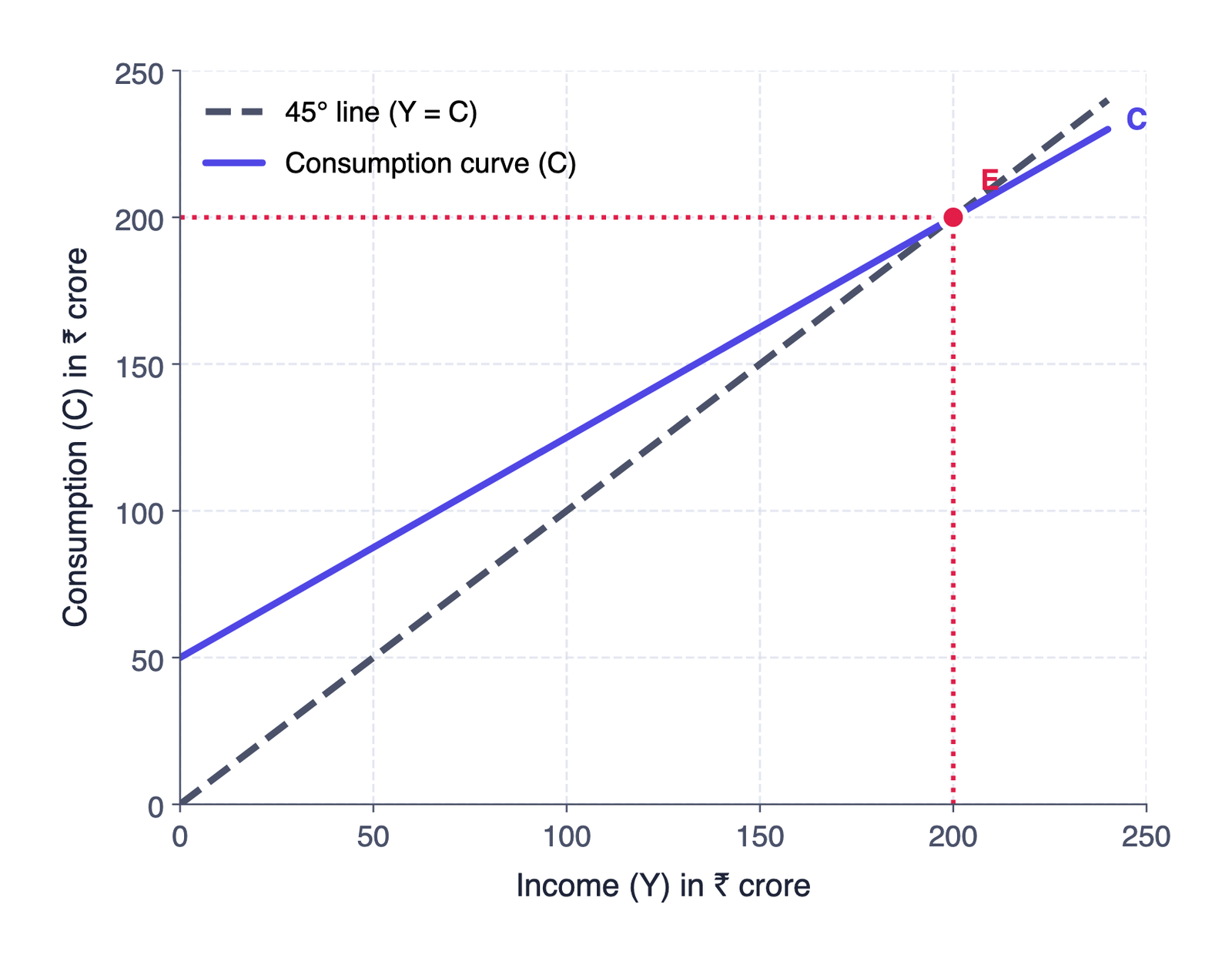
Refer to the given diagram of a hypothetical economy carefully. The consumption curve C meets the 45° line at point E.
Consumption curve (C) and the 45° line
The marginal propensity to save (MPS) in this economy is ______. (Choose the correct option to fill up the blank)
(A) 0.75
(B) 0.25
(C) 0.5
(D) 0.2
Note: The following question is for visually impaired candidates only, in lieu of Q. No. 6. In a hypothetical economy, autonomous consumption is ₹50 crore and the break-even level of income is ₹200 crore. The marginal propensity to save (MPS) is ______. (Choose the correct option to fill up the blank)
(A) 0.75
(B) 0.25
(C) 0.5
(D) 0.2
1
7
1 mark
Read the following statements: Assertion (A) and Reason (R). Choose the correct option from those given below:
Assertion (A): The net investment of an economy can be negative in a year.
Reason (R): Net investment is gross investment minus depreciation, and depreciation may exceed gross investment in that year.
(A) Both Assertion (A) and Reason (R) are true and Reason (R) is the correct explanation of Assertion (A).
(B) Both Assertion (A) and Reason (R) are true, but Reason (R) is not the correct explanation of Assertion (A).
(C) Assertion (A) is true, but Reason (R) is false.
(D) Assertion (A) is false, but Reason (R) is true.
1
8
1 mark
An Indian steel company raises a loan of 50 million US dollars from a bank in Singapore. This transaction will be recorded on the ______ side of the ______ account of India’s Balance of Payments. (Choose the correct option to fill up the blank)
(A) debit, capital
(B) credit, current
(C) debit, current
(D) credit, capital
1
9
1 mark
Currency notes and coins issued in India are called fiat money because they ______. (Choose the correct option to fill up the blank)
(A) are fully backed by gold kept with the Reserve Bank of India
(B) earn interest for the person who holds them
(C) have no intrinsic value and derive their value from the authority of the government
(D) can be refused by anyone in the settlement of a transaction
1
10
1 mark
At the current level of output, ex-ante aggregate demand in an economy is more than the output that firms have planned to produce. Identify the most likely result. (Choose the correct option)
(A) Unplanned inventories pile up and output falls
(B) Inventories fall below the planned level and firms raise output
(C) Prices fall at once and output stays the same
(D) The economy is already at equilibrium, so nothing changes
1
11A
3 marks
From the following data for a hypothetical economy, calculate: (a) Net Domestic Product at Factor Cost (b) Gross Domestic Product at Market Price (c) National Income
S. No.
Items
Amount (₹ crore)
(i)
Compensation of employees
800
(ii)
Operating surplus
500
(iii)
Mixed income of the self-employed
300
(iv)
Net indirect taxes
120
(v)
Consumption of fixed capital
80
(vi)
Net factor income from abroad
(−) 30
(vii)
Old-age pensions paid by the government
40
3
OR
11B
3 marks
Distinguish between final goods and intermediate goods, giving one example of each. Why is the value of intermediate goods not added separately while estimating GDP?
3
12
3 marks
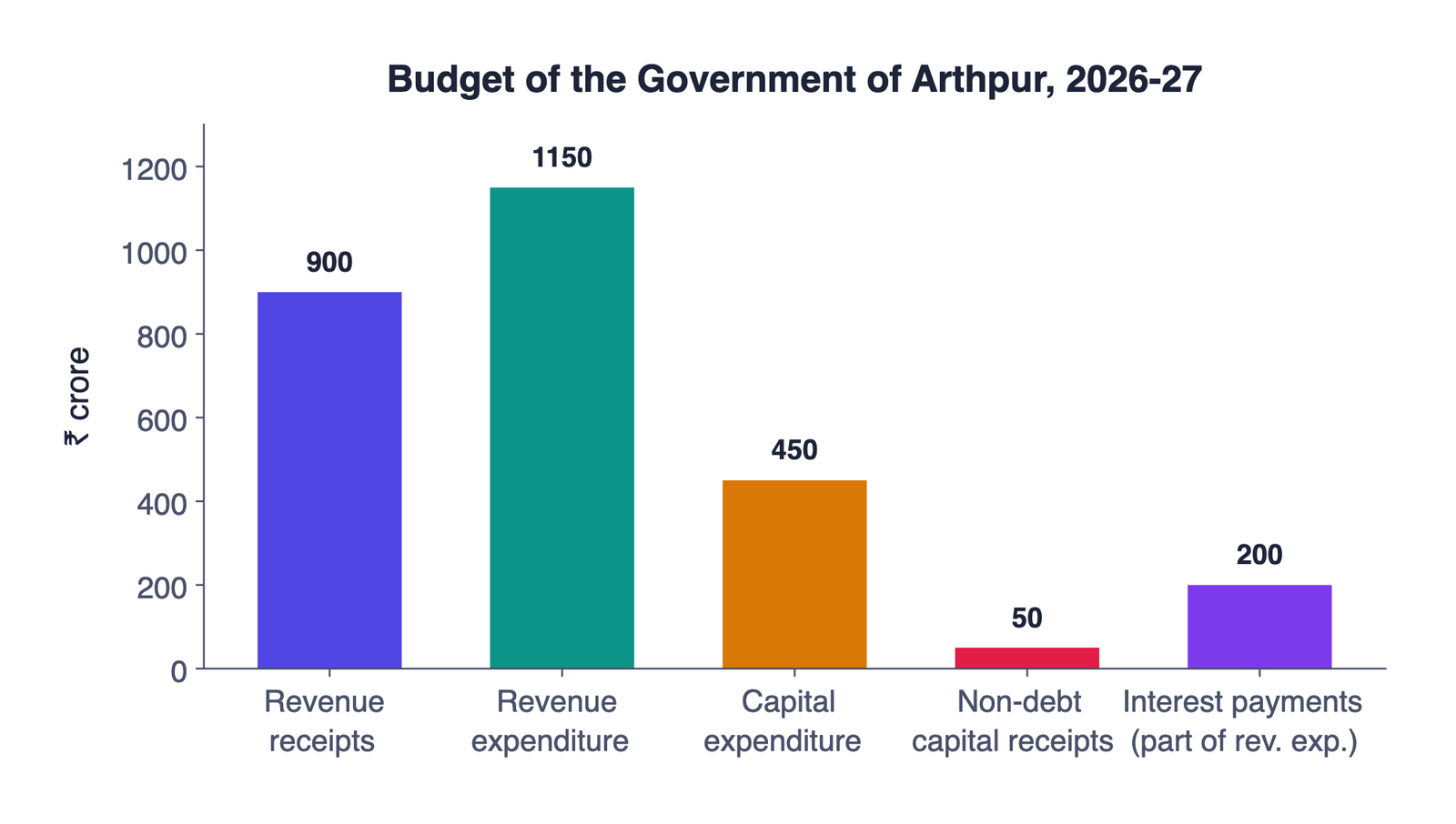
Refer to the given chart, which shows the budget of the Government of Arthpur (a hypothetical economy) for 2026-27.
Budget of the Government of Arthpur, 2026-27 (₹ crore). Interest payments are included in revenue expenditure.
(I)
Calculate the revenue deficit.
1
(II)
Calculate the fiscal deficit.
1
(III)
What does the revenue deficit of Arthpur indicate about the way its borrowing is being used?
1
Note: The following question is for visually impaired candidates only, in lieu of Q. No. 12. For a hypothetical economy, revenue receipts are ₹900 crore, revenue expenditure (including interest payments of ₹200 crore) is ₹1,150 crore, capital expenditure is ₹450 crore and non-debt capital receipts are ₹50 crore. (I) Calculate the revenue deficit. (1) (II) Calculate the fiscal deficit. (1) (III) What does the revenue deficit indicate about the way borrowing is being used? (1)
3
13A
4 marks
Suppose the Reserve Bank of India raises the repo rate by 50 basis points to bring down rising prices in the economy. Explain how this step is likely to affect (a) the lending by commercial banks and (b) aggregate demand in the economy.
4
OR
13B
4 marks
Assume that the banking system works as a single bank and all transactions pass through banks. Primary (initial) deposits are ₹5,000 crore and the legal reserve ratio (LRR) is 20%.
(I)
Calculate the money multiplier and the total deposits that can be created.
2
(II)
If the Reserve Bank of India raises the LRR to 25%, how much will the total deposits now be? Give a reason for the change.
2
4
14
4 marks
In a hypothetical economy called Rupavia, the market exchange rate of its currency, the Rupo, moves from 80 to 84 Rupos per US dollar after a sharp rise in the import of crude oil.
(I)
Has the Rupo appreciated or depreciated? Explain the likely effect of this change on Rupavia’s exports.
2
(II)
Rupavia’s central bank now sells US dollars from its reserves to stop the Rupo from falling further, although the rate is otherwise left to the market. Identify the exchange rate system and explain it.
2
4
15
4 marks
In a hypothetical economy, planned saving is given by S = −50 + 0.25Y, and planned investment (I) is ₹100 crore.
(I)
Find the level of income at which planned saving equals planned investment.
2
(II)
Investment now goes up by ₹50 crore. Work out the new income at which the economy settles and the consumption expenditure at that income.
2
4
16
6 marks
Read the following text carefully:
Sundarpur is a small hypothetical economy that produces only two goods, rice and cloth. Its planning office takes 2024-25 as the base year. In 2025-26, the quantity of rice produced rose from 100 to 110 units and its price rose from ₹10 to ₹12 per unit; the quantity of cloth rose from 50 to 60 units and its price from ₹20 to ₹24 per unit. A local newspaper reported, “GDP has jumped by 38 per cent in a single year. The people of Sundarpur are now 38 per cent better off.” The finance department replied that the newspaper had used the wrong measure of GDP.
Written for this paper
Good
Quantity 2024-25
Price 2024-25 (₹)
Quantity 2025-26
Price 2025-26 (₹)
Rice
100
10
110
12
Cloth
50
20
60
24
On the basis of the given text and common understanding, answer the following questions:
(I)
Define GDP deflator.
1
(II)
Calculate the nominal GDP and the real GDP of Sundarpur for 2025-26, and its GDP deflator.
3
(III)
Do you agree with the newspaper’s claim? Give valid reasons in support of your answer.
2
6
17A
6 marks
(I)
Explain the working of the investment multiplier, taking marginal propensity to consume (MPC) = 0.8 and an increase in investment of ₹100 crore.
3
(II)
Explain the meaning of deficient demand. How can changes in government spending and taxes help to correct it?
3
6
OR
17B
6 marks
(I)
State whether the following statements are true or false, giving valid reasons in support of your answer: (a) The value of marginal propensity to consume (MPC) can be greater than one. 2 (b) If the average propensity to consume (APC) falls from 0.9 to 0.8 as income rises, the average propensity to save (APS) must rise from 0.1 to 0.2. 2
4
(II)
Explain the meaning of involuntary unemployment. How is it different from full employment?
2
6
SECTION B: INDIAN ECONOMIC DEVELOPMENT (40 marks)
Q. No.
Marks
18
1 mark
Read the following statements carefully:
Statement 1: China introduced structural reforms in its economy in 1978.
Statement 2: Pakistan began its economic reforms only after India introduced the New Economic Policy in 1991.
In the light of the given statements, choose the correct option from the following:
(A) Statement 1 is true and Statement 2 is false.
(B) Statement 1 is false and Statement 2 is true.
(C) Both Statements 1 and 2 are true.
(D) Both Statements 1 and 2 are false.
1
19
1 mark
In a hypothetical state, 40 lakh people out of a total population of 100 lakh are engaged in productive activities. The worker-population ratio of the state is ______. (Choose the correct option to fill up the blank)
(A) 60
(B) 2.5
(C) 4
(D) 40
1
20
1 mark
Read the following statements: Assertion (A) and Reason (R). Choose the correct option from those given below:
Assertion (A): During British rule, India’s foreign trade generated a large export surplus.
Reason (R): This export surplus was used mainly to build India’s industries and import capital goods for them.
(A) Both Assertion (A) and Reason (R) are true and Reason (R) is the correct explanation of Assertion (A).
(B) Both Assertion (A) and Reason (R) are true, but Reason (R) is not the correct explanation of Assertion (A).
(C) Assertion (A) is true, but Reason (R) is false.
(D) Assertion (A) is false, but Reason (R) is true.
1
21
1 mark
Identify which of the following is not a source of human capital formation. (Choose the correct option)
(A) Expenditure on health
(B) On-the-job training
(C) Expenditure on migration
(D) Purchase of new machinery by a firm
1
22
1 mark
In the first phase of the Green Revolution (mid-1960s to mid-1970s), the use of high yielding variety (HYV) seeds was restricted mainly to the more affluent states such as ______. (Choose the correct option to fill up the blank)
(A) Bihar, Odisha and Assam
(B) Punjab, Andhra Pradesh and Tamil Nadu
(C) Kerala, West Bengal and Assam
(D) Rajasthan, Gujarat and Madhya Pradesh
1
23
1 mark
Arrange the following events in chronological order:
Great Leap Forward campaign launched in China
Pakistan announced its first five year plan (Medium Term Development Plan)
Structural reforms introduced in China
Economic reforms introduced in Pakistan
Choose the correct option:
(A) (ii) → (i) → (iii) → (iv)
(B) (i) → (ii) → (iii) → (iv)
(C) (ii) → (iii) → (i) → (iv)
(D) (i) → (ii) → (iv) → (iii)
1
24
1 mark
Identify which of the following was not a part of the financial sector reforms introduced since 1991. (Choose the correct option)
(A) Allowing the establishment of private sector banks, Indian as well as foreign
(B) Allowing Foreign Institutional Investors to invest in Indian financial markets
(C) Changing the role of the RBI from regulator to facilitator of the financial sector
(D) Nationalisation of commercial banks to bring them under government ownership
1
25
1 mark
Identify which of the following is not correct about organic farming. (Choose the correct option)
(A) It replaces costlier agro-inputs with locally produced organic inputs
(B) Its yields are higher than those of modern agricultural farming in the initial years
(C) It can generate income through exports, as organic food is in demand abroad
(D) Organic produce is free of chemicals and is environment friendly
1
26
1 mark
Which of the following were features of the Industrial Policy Resolution, 1956? (Choose the correct option)
Industries were classified into three categories.
Licences were given more easily to industrial units set up in economically backward areas.
All new industries were reserved for the public sector.
The private sector was kept under state control through a system of licences.
(A) (i), (ii) and (iv)
(B) (i) and (iii)
(C) (ii), (iii) and (iv)
(D) (iii) only
1
27
1 mark
Read the following statements carefully about India on the eve of independence:
Statement 1: The infant mortality rate was alarmingly high at about 218 per thousand.
Statement 2: Life expectancy was very low at about 32 years.
In the light of the given statements, choose the correct option from the following:
(A) Statement 1 is true and Statement 2 is false.
(B) Statement 1 is false and Statement 2 is true.
(C) Both Statements 1 and 2 are true.
(D) Both Statements 1 and 2 are false.
1
28
3 marks
Refer to the following text:
A bank based in the United States has shifted its customer-care calls, accounts processing and software maintenance to a firm in Bengaluru. The Bengaluru firm employs young graduates who handle the work at night, India time, and send it back over the internet.
Written for this paper
Answer the following questions in the light of the given text and common understanding:
(I)
Identify the outcome of globalisation highlighted in the text.
1
(II)
Explain any two reasons why India has become a favoured destination for such work.
2
3
29A
3 marks
Fifteen women of a village each save ₹100 every month in a common fund. From the pooled money, they give loans to needy members, which are repaid in small instalments at a reasonable rate of interest. No member has to pledge land or gold to get a loan.
(I)
Identify the institutional arrangement described above.
1
(II)
Explain any two ways in which such groups help the rural poor.
2
3
OR
29B
3 marks
What is meant by agricultural diversification? Explain any two reasons why it is needed in rural India.
3
30
4 marks
(I)
Explain any two goals of the Five Year Plans in India.
2
(II)
“Indian agriculture remained stagnant under colonial rule.” Justify the statement, giving any two reasons.
2
4
31
4 marks
Refer to the following data on the distribution of India’s workforce:
Trends in Employment Pattern (in %)
Item
1972-73
2023-24
Sector
Primary
74.3
46.1
Secondary
10.9
24.1
Services
14.8
29.8
Status
Self-employed
61.4
58.4
Regular salaried employees
15.4
21.7
Casual wage labourers
23.2
19.9
Source: NCERT, Indian Economic Development, Table 6.3
Analyse any two major changes in the employment pattern shown above, giving one reason for each.
4
32A
4 marks
Sunil, a mason from a village in Bihar, migrates to Pune, where masons earn much higher wages. His new employer sends him for a two-month course on operating modern construction machinery and pays for it. Identify and explain the two sources of human capital formation indicated in the text.
4
OR
32B
4 marks
Distinguish between physical capital and human capital on any four bases.
4
33A
6 marks
(I)
Refer to the following data carefully:
Sectoral Share of Employment and GVA (%) in 2022
Sector
Contribution to GVA
Distribution of Workforce
India
China
Pakistan
India
China
Pakistan
Agriculture
18
8
24
43
23
36
Industry
28
38
21
26
32
26
Services
54
54
55
31
45
38
Source: adapted from NCERT, Indian Economic Development, Table 8.3
Answer the following questions on the basis of the given data and common understanding: (a) Identify the country that has the largest share of its workforce in agriculture. 1 (b) Compare and critically examine the pattern of sectoral development of India and China. 3
4
(II)
Explain the commune system introduced in China under the Great Leap Forward campaign.
2
6
OR
33B
6 marks
(I)
Examine any three reasons for the slowdown of economic growth in Pakistan in recent decades.
3
(II)
Refer to the following data:
Select Demographic Indicators, 2021-23
Country
Annual growth of population (%)
Sex ratio
Fertility rate
Urbanisation (%)
India
0.81
930
2.0
36
China
−0.10
898
1.2
65
Source: NCERT, Indian Economic Development, Table 8.1
Compare India and China on the basis of any three of the given demographic indicators.
3
6
34
6 marks
Refer to the following text carefully:
In the early stages of development, the demand for environmental resources and services was much less than their supply, and the environment could easily absorb the wastes produced. Today the picture is reversed. A growing population and rising industrial output make heavy demands on forests, groundwater and fuels, while factories, vehicles and towns discharge more smoke, sewage and solid waste than air, rivers and land can absorb. In several regions groundwater tables are falling year after year, and many cities report poor air quality in winter. Economists warn that the costs of repairing this damage, from treating pollution-related illness to cleaning rivers, are rising faster than the benefits of the extra output.
Written for this paper
On the basis of the given text and common understanding, answer the following questions:
(I)
State the meaning of absorptive capacity of the environment.
1
(II)
State any two functions performed by the environment.
2
(III)
“Today the picture is reversed.” Explain this reversal and analyse its consequences for the economy.
3
6
~ End of Question Paper ~
Marking Scheme / अंकन योजना (उत्तर देखें)
ANSHUL ACADEMY · anshulacademy.in
ECONOMICS (030)
Sample Question Paper 1: Marking Scheme
Class XII (2026-27) · English Medium
Time Allowed: 3 hoursMaximum Marks: 80
For examiners and students:
For multiple choice questions, both the letter of the correct option and the answer are given.
For descriptive questions, value points are given. ‘Any two/three/four’ means that full marks are given for that many correct points from those listed.
In numerical questions, marks are given for the correct formula or method and for the correct value with its unit (₹ crore).
Any other relevant point based on the NCERT textbooks Introductory Macroeconomics and Indian Economic Development may also be accepted; application questions accept equivalent examples.
Word limits (3 marks: 60 to 80 words; 4 marks: 80 to 100 words; 6 marks: 100 to 150 words) guide the length of answers; do not deduct marks for a few words more or less.
SECTION A: MACROECONOMICS (40 marks)
Q. No.
Answer / value points
Marks
1
1 mark
(C) (i) and (iii). Dividends (non-tax revenue) and GST (tax revenue) neither create a liability nor reduce assets; disinvestment and borrowings are capital receipts.
1
2
1 mark
(A) Statement 1 is true and Statement 2 is false. Reverse repo rate is the rate at which the RBI borrows from (absorbs funds of) commercial banks; the rate at which it lends against securities is the repo rate.
1
3
1 mark
(B) (ii), (i), (iii). Higher returns attract foreign funds, which raises the supply of foreign exchange; the price of foreign exchange falls, so the rupee appreciates.
(C) Stabilisation function. The government reduces aggregate demand to control inflation (excess demand).
1
6
1 mark
(B) 0.25. Autonomous consumption = ₹50 crore; at E (break-even), C = Y = ₹200 crore. MPC = (200 − 50) ÷ 200 = 0.75, so MPS = 1 − 0.75 = 0.25.
For visually impaired candidates (in lieu of Q. No. 6): (B) 0.25. At break-even, 200 = 50 + MPC × 200, so MPC = 0.75 and MPS = 0.25.
1
7
1 mark
(A) Both A and R are true and R is the correct explanation of A. When the wear and tear of capital is more than the new capital added, the capital stock shrinks and net investment is negative.
1
8
1 mark
(D) credit, capital. External commercial borrowing brings foreign exchange into India and creates a liability, so it is a credit entry in the capital account.
1
9
1 mark
(C) They have no intrinsic value (unlike a gold or silver coin); their value comes from the authority and guarantee of the government. Being legal tender, they cannot be refused.
1
10
1 mark
(B) Demand is met from stocks, so inventories fall below the desired level; firms raise production until output equals ex-ante aggregate demand.
(c) National Income (NNPFC) = NDPFC + (vi) = 1,600 + (−30) = ₹1,570 crore
Old-age pensions (vii) are transfer payments and are not included.
1 mark for each correct answer (½ for the formula, ½ for the value). Deduct ½ if pensions are added.
3
OR
11B
3 marks
Final goods are goods bought for final use (consumption or investment) that do not undergo any further transformation in the production process within the year; e.g., bread bought by a household, a machine bought by a firm.
Intermediate goods are goods used up as raw material or inputs in the production of other goods during the same year; e.g., flour bought by a baker.
Their value is already included in the value of the final goods. Adding them separately would count the same value more than once (double counting) and overstate GDP.
1 mark for the distinction with examples of final goods, 1 mark for intermediate goods with example, 1 mark for the reason (double counting).
(Interest payments are not needed here; a candidate who also notes primary deficit = 650 − 200 = ₹450 crore is not penalised.)
1
(III)
About ₹250 crore of the ₹650 crore borrowed (nearly 38%) is used to meet current (consumption) expenditure, not to create assets. This dissaving reduces the government’s ability to repay loans and adds to future interest burden.
1
For visually impaired candidates (in lieu of Q. No. 12): Same answers as Q12: (I) ₹250 crore; (II) ₹650 crore; (III) part of the borrowing finances current (consumption) expenditure, which creates no assets.
3
13A
4 marks
(a) Repo rate is the rate at which the RBI lends to commercial banks against government securities; a rise makes borrowing from the RBI costlier for banks. Banks raise their own lending rates and borrow less from the RBI, so the availability of credit falls and banks lend less.
(b) Costlier loans discourage borrowing for investment and for consumption (houses, vehicles, durables).
As investment and consumption demand fall, aggregate demand falls, which helps to reduce excess demand and control inflation.
2 marks for (a) effect on bank lending, 2 marks for (b) effect on aggregate demand.
New multiplier = 1 ÷ 0.25 = 4; total deposits = 5,000 × 4 = ₹20,000 crore (a fall of ₹5,000 crore).
Reason: banks must now keep a larger part of every deposit as reserves, so less is available for lending in each round and credit creation falls.
1 + 1
2
4
14
4 marks
(I)
The price of a dollar has risen by 5% (from 80 to 84 Rupos), so the Rupo has depreciated.
Rupavia’s goods become cheaper for foreign buyers (a dollar now buys more Rupos), so the demand for its exports is likely to rise.
1 + 1
2
(II)
The system is managed floating (dirty floating).
The exchange rate is mainly determined by market demand and supply, but the central bank intervenes by buying or selling foreign currency to limit sharp movements in the rate.
1 + 1
2
4
15
4 marks
(I)
At equilibrium, S = I: −50 + 0.25Y = 100
0.25Y = 150, so Y = ₹600 crore
1 + 1
2
(II)
MPS = 0.25, so investment multiplier k = 1 ÷ MPS = 4; ΔY = 4 × 50 = 200.
New equilibrium income = 600 + 200 = ₹800 crore.
Saving at Y = 800: S = −50 + 0.25 × 800 = 150; Consumption = Y − S = 800 − 150 = ₹650 crore.
1 for new income, 1 for consumption
2
4
16
6 marks
(I)
GDP deflator is the ratio of nominal GDP to real GDP (usually × 100) for a year; it measures the change in the general price level of all goods and services produced in the economy.
Real GDP 2025-26 (at 2024-25 prices) = (110 × 10) + (60 × 20) = 1,100 + 1,200 = ₹2,300
GDP deflator = (2,760 ÷ 2,300) × 100 = 120
1 mark each
3
(III)
No. GDP in the base year was ₹2,000 (100 × 10 + 50 × 20). The 38% rise (2,000 to 2,760) is in nominal GDP, which includes the 20% rise in prices.
Real GDP rose only from 2,000 to 2,300, i.e., 15%, which is the true increase in output. Even real GDP may not show welfare fully, as it ignores how GDP is distributed, non-monetary exchanges and externalities.
1 for ‘disagree’ with the nominal/real reason, 1 for the 15% real growth or the welfare limitation
2
6
17A
6 marks
(I)
An increase in investment of ₹100 crore first raises income by ₹100 crore (round 1).
With MPC = 0.8, people spend ₹80 crore of this, which becomes income for others (round 2); they spend 0.8 × 80 = ₹64 crore (round 3), then ₹51.2 crore, and so on.
Total rise in income = 100 + 80 + 64 + … = 100 × 1 ÷ (1 − 0.8) = ₹500 crore; the multiplier k = 1 ÷ (1 − MPC) = 5.
1 mark for the first round, 1 for later rounds, 1 for the final value
3
(II)
Deficient demand is the situation in which aggregate demand is less than aggregate supply at the full employment level of output; it leads to involuntary unemployment (and a fall in prices in the long run).
Government spending: the government raises its expenditure (e.g., on public works), which directly raises aggregate demand and, through the multiplier, income and employment.
Taxes: lowering taxes raises disposable income, so consumption expenditure and aggregate demand rise.
1 + 1 + 1
3
6
OR
17B
6 marks
(I)
(a) False. MPC = ΔC ÷ ΔY. The change in consumption cannot be more than the change in income, as the rest of the change in income is saved; so 0 ≤ MPC ≤ 1.
(b) True. Income is either consumed or saved, so APC + APS = 1. If APC = 0.9, APS = 0.1; if APC = 0.8, APS = 0.2.
(a) 1 for ‘False’ with the formula, 1 for the reason; (b) 1 for ‘True’, 1 for APC + APS = 1
4
(II)
Involuntary unemployment is a situation in which people who are able and willing to work at the existing wage rate do not get work.
Full employment is the situation in which all those who are able and willing to work at the existing wage rate get work, i.e., the level of income at which all factors of production are fully employed (NCERT); there is no involuntary unemployment.
1 + 1
2
6
SECTION B: INDIAN ECONOMIC DEVELOPMENT (40 marks)
Q. No.
Answer / value points
Marks
18
1 mark
(A) Statement 1 is true and Statement 2 is false. Pakistan introduced economic reforms in 1988, before India (1991).
1
19
1 mark
(D) 40. Worker-population ratio = (Total workers ÷ Total population) × 100 = (40 ÷ 100) × 100 = 40.
1
20
1 mark
(C) A is true, but R is false. The export surplus was used to meet the expenses of the office set up by the colonial government in Britain, its war expenses and the import of invisible items; it led to a drain of India’s wealth.
1
21
1 mark
(D) Purchase of new machinery by a firm. It is physical capital formation; the other three raise the productive capacity of people.
1
22
1 mark
(B) Punjab, Andhra Pradesh and Tamil Nadu. In this phase HYV seeds also benefited mainly the wheat-growing regions.
1
23
1 mark
(A) (ii) → (i) → (iii) → (iv): Pakistan’s first plan 1956, Great Leap Forward 1958, China’s reforms 1978, Pakistan’s reforms 1988.
1
24
1 mark
(D) Nationalisation of commercial banks. It belongs to the period before 1991 (banks were nationalised in 1969); the reforms moved in the opposite direction.
1
25
1 mark
(B) Yields from organic farming are less than those of modern agricultural farming in the initial years; the other three are benefits of organic farming.
1
26
1 mark
(A) (i), (ii) and (iv). Under IPR 1956 the private sector could set up industries in the second and third categories, so not all new industries were reserved for the public sector.
1
27
1 mark
(C) Both Statements 1 and 2 are true (NCERT: infant mortality about 218 per thousand; life expectancy 32 years).
1
28
3 marks
(I)
Outsourcing: a company hires regular services from an external source, here a firm in another country.
1
(II)
Low wage rates in India compared with developed countries, which reduces the cost of the service.
Availability of skilled, English-speaking manpower.
The revolution in information technology (internet, telecom) makes it possible to send voice and data across countries quickly.
Any two, 1 mark each
2
3
29A
3 marks
(I)
A Self-Help Group (SHG); such credit provisions are called micro-credit programmes.
1
(II)
They fill the gap in the formal credit system: poor households without collateral, who were kept out of formal credit, get loans.
They promote thrift (saving) in small amounts through a minimum contribution from each member.
They help in the empowerment of women and reduce dependence on moneylenders.
Any two, 1 mark each
2
3
OR
29B
3 marks
Meaning: it has two aspects: a change in the cropping pattern (from foodgrains to other crops) and a shift of the workforce from agriculture to allied activities (livestock, poultry, fisheries) and the non-farm sector.
It reduces the risk of depending only on farming for a livelihood and provides sustainable livelihood options.
In areas with inadequate irrigation, there is little gainful work in the Rabi season; other activities provide employment and income.
Agriculture is already overcrowded, so non-farm work is needed to absorb the growing labour force.
1 mark for the meaning, any two reasons 1 mark each
3
30
4 marks
(I)
Growth: increase in the country’s capacity to produce goods and services (a rise in GDP).
Modernisation: adoption of new technology in production and change in social outlook (e.g., recognising women’s rights).
Self-reliance: avoiding imports of goods that could be produced in India, especially food.
Equity: ensuring that the benefits of growth reach the poor sections of society.
Any two, 1 mark each
2
(II)
Land settlement systems (zamindari): profits went to zamindars, who collected maximum rent and did little to improve agriculture.
Terms of revenue settlement: fixed dates for paying revenue, failing which zamindars lost their rights, so cultivators were exploited.
Low level of technology, lack of irrigation facilities and negligible use of fertilisers.
Any two, 1 mark each
2
4
31
4 marks
Shift away from the primary sector: its share fell from 74.3% to 46.1% (by 28.2 points). Reason: growth of industry and services and the search for better-paid non-farm work.
Rise of the secondary and service sectors: secondary rose from 10.9% to 24.1% and services from 14.8% to 29.8%. Reason: industrialisation, urbanisation and growth of trade, transport and IT services.
Self-employment is still the largest source of employment (58.4%), though its share fell slightly. Reason: many people work on their own farms and small enterprises.
Share of regular salaried employees rose (15.4% to 21.7%) while casual wage labour fell (23.2% to 19.9%), showing some movement towards more regular jobs in recent years.
Any two changes: 1 mark for the change read correctly from the data, 1 mark for the reason
4
32A
4 marks
Expenditure on migration: people migrate in search of jobs with higher salaries than in their native places. The cost of transport and of living in the city is justified because the higher earnings exceed these costs, so migration adds to human capital.
On-the-job training: firms spend on training their workers, here on operating new machinery. The firm insists that the worker works for it for some time, so it gets the benefit of the higher productivity of the trained worker.
½ for identifying + 1½ for explaining each source (2 × 2)
4
OR
32B
4 marks
Nature: physical capital is tangible (machines, buildings); human capital is intangible (skills, knowledge in a person).
Separation from owner: physical capital can be sold in the market and is separable from its owner; human capital is inseparable from its owner.
Mobility: physical capital is completely mobile between countries (except some immovable items); human capital is not perfectly mobile because of nationality and culture.
Formation: physical capital can be built even through imports and is an economic and technical process; human capital is formed through conscious policy and is a social process.
Depreciation: physical capital wears out with use; human capital depreciates with ageing but this can be reduced through continuous investment in education and health.
Any four bases, 1 mark each
4
33A
6 marks
(I)
(a) India: 43% of its workforce is in agriculture, which contributes only 18% of GVA.
(b) China has followed the normal course of development, shifting output and workforce from agriculture to industry and then to services; industry contributes 38% of GVA and employs 32% of its workforce.
In India, industry contributes only 28% of GVA and employs 26% of workers; the shift is taking place directly from agriculture to services (54% of GVA).
Services contribute the largest share of GVA in both, but India’s services employ only 31% of workers against 45% in China; with 43% of workers producing 18% of output, productivity in Indian agriculture is low.
(a) 1; (b) 1½ + 1½ for two well-argued comparisons
4
(II)
Under the commune system started in rural areas in 1958, people collectively cultivated lands.
By 1958 there were 26,000 communes covering almost all the farm population.
1 + 1
2
6
OR
33B
6 marks
(I)
Agricultural growth and food supply depended on good harvests rather than on an institutionalised process of technical change; when the harvest was bad, the economy slowed down.
Most foreign exchange came from remittances of workers in the Middle East and exports of highly volatile agricultural products, not from sustained exports of manufactured goods.
Growing dependence on foreign loans and difficulty in repaying them.
Political instability and a reform process that was not sustained.
Any three, 1 mark each
3
(II)
Population growth: India’s population is still growing (0.81% a year), while China’s is falling (−0.10%), a result of the one-child norm introduced in the late 1970s.
Sex ratio: low in both, but lower in China (898) than in India (930); the one-child norm is linked to the decline in China’s sex ratio.
Fertility rate: China’s fertility rate (1.2) is far lower than India’s (2.0).
Urbanisation: much higher in China (65%) than in India (36%).
Any three comparisons, 1 mark each (½ for the data, ½ for the inference)
3
6
34
6 marks
(I)
Absorptive capacity means the ability of the environment to absorb degradation (wastes and pollution).
1
(II)
It supplies renewable and non-renewable resources.
It assimilates waste.
It sustains life by providing genetic and biodiversity.
It provides aesthetic services like scenery.
Any two, 1 mark each
2
(III)
Supply-demand reversal: earlier the supply of environmental resources and services exceeded the demand for them; now, because of population growth and industrial expansion, demand is greater than supply (extraction exceeds regeneration and wastes exceed absorptive capacity).
Consequences: depletion of resources such as groundwater and forests, and pollution of air and water, which cause health problems.
The opportunity costs are high: large sums must be spent on health care and on cleaning up the environment, money which could otherwise be used for development; global warming and loss of biodiversity also threaten future growth.
1 for the reversal, 1 for consequences, 1 for the opportunity cost argument