Pattern: CBSE 2026-27 official Sample Question Paper (SQP) design · Maximum marks: 70 · Time: 3 hours. Solve the paper first, then open the marking scheme at the end to check your answers.
ANSHUL ACADEMY · anshulacademy.in
PHYSICAL EDUCATION (048)
Sample Question Paper 1
Class XII (2026-27) · English Medium
Time Allowed: 3 hoursMaximum Marks: 70
General Instructions:
Read the following instructions carefully and follow them:
This question paper contains 37 questions in five sections: A, B, C, D and E.
Section A: Questions 1 to 18 are multiple choice questions of 1 mark each. All of them are compulsory.
Section B: Questions 19 to 24 are very short answer questions of 2 marks each. Attempt any 5. Answer each in 60 to 90 words.
Section C: Questions 25 to 30 are short answer questions of 3 marks each. Attempt any 5. Answer each in 100 to 150 words.
Section D: Questions 31 to 33 are case studies of 4 marks each. There is an internal choice in Questions 31 and 33.
Section E: Questions 34 to 37 are long answer questions of 5 marks each. Attempt any 3. Answer each in 200 to 300 words.
Separate questions are given for Visually Impaired candidates in place of Questions 5, 31 and 33.
SECTION A (18 × 1 = 18 marks)
Q. No.
Marks
1
1 mark
Setting performance standards for a sports event, measuring the actual performance and comparing the two is done under which function of sports event management?
(A) Planning
(B) Organising
(C) Directing
(D) Controlling
1
2
1 mark
Two statements are given below, labelled Assertion (A) and Reason (R). Read them and select the most appropriate option:
Assertion (A): In a knock-out tournament of 21 teams, 11 byes are given.
Reason (R): Byes are given so that the number of teams in the second round becomes a power of two.
(A) Both Assertion (A) and Reason (R) are true, and Reason (R) is the correct explanation of Assertion (A).
(B) Both Assertion (A) and Reason (R) are true, but Reason (R) is not the correct explanation of Assertion (A).
(C) Assertion (A) is true, but Reason (R) is false.
(D) Assertion (A) is false, but Reason (R) is true.
1
3
1 mark
Match List I (postural deformity) with List II (a corrective measure) and choose the correct option.
List I
List II
(a) Flat foot
(i) Walking on the inner edge of the feet
(b) Knock knees
(ii) Horse riding
(c) Bow legs
(iii) Handclasp and wall stretches
(d) Round shoulders
(iv) Walking on the toes and heels, rope skipping
(A) (a)-(ii), (b)-(iv), (c)-(i), (d)-(iii)
(B) (a)-(iv), (b)-(ii), (c)-(i), (d)-(iii)
(C) (a)-(iv), (b)-(i), (c)-(ii), (d)-(iii)
(D) (a)-(iii), (b)-(ii), (c)-(iv), (d)-(i)
1
4
1 mark
Which vitamin is needed for proper clotting of blood?
(A) Vitamin A
(B) Vitamin D
(C) Vitamin K
(D) Vitamin C
1
5
1 mark
Identify the asana shown in the stick figure below.
Figure for Q5 (stick figure drawn by Anshul Academy)
(A) Dhanurasana
(B) Bhujangasana
(C) Shalabhasana
(D) Ushtrasana
Note: The following question is for Visually Impaired candidates only, in lieu of Q. No. 5. In which asana does the practitioner lie on the abdomen, fold the legs, hold the toes with the hands and raise the head, chest and legs so that the body takes the shape of a bow?
(A) Dhanurasana
(B) Halasana
(C) Matsyasana
(D) Makarasana
1
6
1 mark
In Surya Bhedana pranayama, every inhalation is done through the:
(A) Left nostril
(B) Right nostril
(C) Both nostrils
(D) Mouth
1
7
1 mark
The first Deaflympics, held in Paris in 1924, were known as the:
(A) Stoke Mandeville Games
(B) World Games for the Deaf
(C) Special Games
(D) International Silent Games
1
8
1 mark
Who was the first Indian woman to win a medal at the Olympic Games?
(A) P.T. Usha
(B) Saina Nehwal
(C) Karnam Malleswari
(D) Mary Kom
1
9
1 mark
Trans-fatty acids in food are mainly produced by the process of:
(A) Hydrogenation
(B) Fermentation
(C) Germination
(D) Pasteurisation
1
10
1 mark
The Plate Tapping Test of the SAI Khelo India Fitness Test measures:
(A) Static balance
(B) Flexibility of the lower back
(C) Upper body strength
(D) Speed and coordination of limb movement
1
11
1 mark
A fall in the resting heart rate because the heart has become more efficient through regular training is called:
(A) Tachycardia
(B) Bradycardia
(C) Hypertrophy
(D) Arrhythmia
1
12
1 mark
While cutting fruit at a training camp, an athlete’s finger is cut by a sharp, clean-edged knife. This soft tissue injury is:
(A) Abrasion
(B) Contusion
(C) Incision
(D) Laceration
1
13
1 mark
The friction that acts between the wheels of a skateboard and the ground is:
(A) Static friction
(B) Rolling friction
(C) Sliding friction
(D) Limiting friction
1
14
1 mark
A shot of mass 4 kg is given an acceleration of 15 m/s². The force applied on it is:
(A) 3.75 N
(B) 11 N
(C) 19 N
(D) 60 N
1
15
1 mark
In the OCEAN model of the Big Five theory of personality, the letter ‘N’ stands for:
(A) Neuroticism
(B) Nurturance
(C) Novelty
(D) Narcissism
1
16
1 mark
Two statements are given below, labelled Assertion (A) and Reason (R). Read them and select the most appropriate option:
Assertion (A): Hostile aggression is aimed at harming or injuring the opponent.
Reason (R): In hostile aggression, the primary goal is to win the game, and harm is only a means to that end.
(A) Both Assertion (A) and Reason (R) are true, and Reason (R) is the correct explanation of Assertion (A).
(B) Both Assertion (A) and Reason (R) are true, but Reason (R) is not the correct explanation of Assertion (A).
(C) Assertion (A) is true, but Reason (R) is false.
(D) Assertion (A) is false, but Reason (R) is true.
1
17
1 mark
Which type of endurance forms the base for all other types of endurance?
(A) Speed endurance
(B) Basic endurance
(C) Strength endurance
(D) Long time endurance
1
18
1 mark
Exercises done on specially designed machines, in which the muscles apply maximal force throughout the range of motion, are called:
(A) Isokinetic exercises
(B) Isometric exercises
(C) Isotonic exercises
(D) Ballistic exercises
1
SECTION B: Very Short Answer Type (attempt any 5 of 6; 5 × 2 = 10 marks)
Q. No.
Marks
19
1+1=2
Name the three original components of the female athlete triad and the three components of its revised form.
1+1=2
20
1+1=2
How is food intolerance different from a food allergy? Write any two differences.
1+1=2
21
1+1=2
What is Basal Metabolic Rate (BMR)? Name any two factors that affect it.
1+1=2
22
1+1=2
What is stroke volume? How does endurance training affect it?
1+1=2
23
1+1=2
Differentiate between internal imagery and external imagery, giving one example of each from sports.
1+1=2
24
1+1=2
What is the Fartlek method of training? How is it different from the variable pace method?
1+1=2
SECTION C: Short Answer Type (attempt any 5 of 6; 5 × 3 = 15 marks)
Q. No.
Marks
25
1+1+1=3
Explain the responsibilities of the Technical Committee before, during and after a sports event.
1+1+1=3
26
1+1+1=3
Write the WHO guidelines on physical activity for children and youth aged 5 to 17 years.
1+1+1=3
27
1+1+1=3
Your school is starting a daily physical activity period for children with special needs. Explain any three advantages these children will gain from it.
1+1+1=3
28
1+1+1=3
Riya wants to lose 6 kg before her school sports meet and plans to eat very little for two weeks. Point out any three pitfalls of such dieting.
1+1+1=3
29
1+2=3
Why does a volleyball or basketball defender stand with the feet spread apart and the knees bent? Explain with the principles of stability involved.
1+2=3
30
1+1+1=3
Explain the three types of goals that athletes set, with one example of each.
Study the knock-out fixture of 11 teams given below and answer the questions that follow.
Figure for Q31: knock-out fixture of 11 teams
(i)
How many byes have been given in this fixture?
(A) 3
(B) 4
(C) 5
(D) 6
1
(ii)
In how many rounds will the winner of this tournament be decided?
(A) 3
(B) 4
(C) 5
(D) 10
1
(iii)
If the same 11 teams played a single league tournament instead, how many matches would be played?
(A) 55
(B) 110
(C) 10
(D) 66
1
(iv)
According to the standard procedure, the first bye in this fixture is given to team number:
(A) 1
(B) 6
(C) 7
(D) 11
OR
How many matches are played in the first round of this fixture?
(A) 2
(B) 3
(C) 5
(D) 8
1
Note: The following question is for Visually Impaired candidates only, in lieu of Q. No. 31. The sports in-charge of a school is organising an inter-house kho-kho tournament on a knock-out basis. Nine houses have entered. She wants the tournament to be completed in the fewest matches and places the byes according to the standard procedure. Answer the following questions.
(i)
How many byes will be given?
(A) 5
(B) 7
(C) 8
(D) 9
1
(ii)
How many byes will be placed in the upper half?
(A) 3
(B) 4
(C) 2
(D) 7
1
(iii)
How many matches will be played in all?
(A) 9
(B) 7
(C) 8
(D) 16
1
(iv)
How many teams will be placed in the lower half?
(A) 5
(B) 3
(C) 6
(D) 4
OR
A tournament in which every house plays every other house once is called a:
(A) Knock-out tournament
(B) Single league tournament
(C) Double league tournament
(D) Consolation tournament
1
1×4=4
32
1×4=4
Read the passage given below and answer the questions that follow.
Meera, a Class XII student, volunteers every Saturday at a sports centre for children and adults with intellectual disabilities. The centre belongs to a worldwide movement that grew out of a summer day camp started in America in the 1960s. Before every event, the athletes recite a pledge which says that being brave matters more than winning. At the centre’s athletics meet, the athletes first run in preliminary trials; the officials then place them in groups of closely matched skill, so that every final is a fair race, and coaches remind the athletes to give their best in the trials. The centre also runs a programme in which students like Meera play in the same team as athletes with intellectual disabilities.
Written for this paper
(a)
Name the movement described in the passage, and the person who started the day camp from which it grew.
1
(b)
Write the athlete’s oath that the athletes recite.
1
(c)
What is the process of grouping athletes by their skill level called? Name the rule that asks athletes to give their best in the trials.
1
(d)
Name the programme in which Meera plays in the same team as the athletes.
1
1×4=4
33
1×4=4
Pictures P, Q, R and S show four long bones broken in different ways. Study them and answer the questions that follow.
Figure for Q33 (drawn by Anshul Academy)
(a)
Identify the type of fracture shown in picture P.
1
(b)
Which picture shows a bone broken, splintered or crushed into a number of pieces? Name this fracture.
1
(c)
How is the fracture in picture R different from the fracture in picture S?
1
(d)
Suggest any one way to prevent such fractures.
OR
Name the fracture that develops over time because of overuse, and state the usual recovery time for it.
1
Note: The following question is for Visually Impaired candidates only, in lieu of Q. No. 33. During a school football match, Kabir fell on his outstretched arm. His wrist became swollen and painful, and the bone looked out of place at the joint. The teacher kept his arm still in a sling and sent him to hospital, where an X-ray was taken. Answer the following questions.
(i)
An injury in which the ends of the bones at a joint are forced out of their normal position is called:
(A) Dislocation
(B) Contusion
(C) Strain
(D) Abrasion
1
(ii)
A partial dislocation of a joint is called:
(A) Luxation
(B) Subluxation
(C) Fracture
(D) Sprain
1
(iii)
If the X-ray had shown Kabir’s bone broken diagonally, the fracture would be called:
(A) Transverse
(B) Greenstick
(C) Oblique
(D) Impacted
1
(iv)
If the force of Kabir’s fall had jammed the broken ends of the bone together, the fracture would be called:
(A) Comminuted
(B) Stress
(C) Greenstick
(D) Impacted
OR
A sling or a splint is used for a fracture mainly to:
(A) Keep the broken bone in place and stop its sharp ends from moving
(B) Increase blood flow to the bone
(C) Lower the body temperature
(D) Straighten the bone permanently
1
1×4=4
SECTION E: Long Answer Type (attempt any 3 of 4; 3 × 5 = 15 marks)
Q. No.
Marks
34
1+1+2+1=5
Name any two asanas, other than Ushtrasana, that are helpful in preventing asthma. Draw a stick diagram of Ushtrasana, and write its procedure and any two contraindications.
1+1+2+1=5
35
3+2=5
Explain the procedure of the Harvard Step Test, with its purpose and equipment. A student could step only for 4 minutes, and her pulse count from 1 to 1½ minutes after the exercise was 64. Calculate her fitness index and give her rating.
3+2=5
36
1+2+2=5
Define flexibility. Explain its types and any two methods of improving it.
1+2+2=5
37
1+1+3=5
What is a lever? Name its components. Explain the three types of levers, giving one example of each from the human body or sports.
1+1+3=5
~ End of Question Paper ~
Marking Scheme / अंकन योजना (उत्तर देखें)
ANSHUL ACADEMY · anshulacademy.in
PHYSICAL EDUCATION (048)
Sample Question Paper 1: Marking Scheme
Class XII (2026-27) · English Medium
Time Allowed: 3 hoursMaximum Marks: 70
For examiners and students:
For multiple choice questions, both the letter of the correct option and the answer are given.
For descriptive questions, value points are given. ‘Any two/three’ means that full marks are given for that many correct points from those listed.
Any other relevant point based on the CBSE Physical Education textbook (Class XII) may also be accepted, and application questions accept equivalent examples.
In Sections B, C and E only the required number of answers (5, 5 and 3) are marked; if a candidate answers more, the first ones answered are marked.
Word limits (B: 60 to 90, C: 100 to 150, E: 200 to 300 words) guide the length of answers; do not deduct marks for a few words more or less.
SECTION A (18 × 1 = 18 marks)
Q. No.
Answer / value points
Marks
1
1 mark
(D) Controlling. Controlling sets standards, measures actual performance and compares the two so that corrections can be made.
1
2
1 mark
(A) Both A and R are true, and R explains A. Next power of two = 32, so byes = 32 − 21 = 11; the 10 other teams play 5 first-round matches, and 11 + 5 = 16 teams reach round two.
1
3
1 mark
(B) (a)-(iv), (b)-(ii), (c)-(i), (d)-(iii).
1
4
1 mark
(C) Vitamin K.
1
5
1 mark
(A) Dhanurasana (bow pose): the body rests on the abdomen; head, chest and legs are raised and the hands hold the feet, so the body is shaped like a bow.
For Visually Impaired candidates: (A) Dhanurasana.
1
6
1 mark
(B) Right nostril. All inhalations are through the right nostril and all exhalations through the left.
1
7
1 mark
(D) International Silent Games.
1
8
1 mark
(C) Karnam Malleswari (weightlifting, Sydney 2000).
1
9
1 mark
(A) Hydrogenation.
1
10
1 mark
(D) Speed and coordination of limb movement.
1
11
1 mark
(B) Bradycardia.
1
12
1 mark
(C) Incision: a clean cut caused by a sharp-edged object such as a knife or a glass splinter.
1
13
1 mark
(B) Rolling friction.
1
14
1 mark
(D) 60 N. By Newton’s second law, F = m × a = 4 × 15 = 60 N.
1
15
1 mark
(A) Neuroticism.
1
16
1 mark
(C) A is true, but R is false. In hostile aggression the primary goal is to harm; aggression whose primary goal is winning, with harm as a means, is instrumental aggression.
1
17
1 mark
(B) Basic endurance.
1
18
1 mark
(A) Isokinetic exercises.
1
SECTION B: Very Short Answer Type (attempt any 5 of 6; 5 × 2 = 10 marks)
Q. No.
Answer / value points
Marks
19
1+1=2
Original (ACSM, 1992): disordered eating, amenorrhoea, osteoporosis.
Revised: low energy availability (with or without an eating disorder), menstrual dysfunction, low bone mineral density.
1 mark for the original three, 1 mark for the revised three.
1+1=2
20
1+1=2
A food allergy involves the immune system; food intolerance does not (it is a non-allergic food hypersensitivity).
Symptoms of food intolerance generally appear more slowly than those of a food allergy.
Food intolerance mainly shows as difficulty in digesting a food (e.g. lactose intolerance), while an allergy can be a sudden, even severe, reaction to a small amount.
Any two differences, 1 mark each.
1+1=2
21
1+1=2
BMR is the number of calories the body needs to keep its basic life-sustaining functions going in a resting condition (unit: kcal).
Factors (any two): muscle mass, age, gender, genetics, body composition, state of mind, heat or cold of the environment.
1 mark for the meaning, ½ mark for each factor.
1+1=2
22
1+1=2
Stroke volume is the amount of blood pumped out of the left ventricle of the heart in one beat (contraction).
With endurance training it increases: the heart pumps more blood per beat (about 20 to 50 percent more), so more oxygen reaches the working muscles.
1 mark for the meaning, 1 mark for the effect.
1+1=2
23
1+1=2
Internal imagery: the athlete imagines performing from inside his own body, seeing the action through his own eyes (e.g. a batter ‘sees’ the ball coming towards him and plays the shot).
External imagery: the athlete imagines watching himself perform from outside, as a spectator or as if on video (e.g. a gymnast pictures her whole routine as a judge would see it).
1 mark each (meaning with an example).
1+1=2
24
1+1=2
Fartlek (‘speed play’ in Swedish): during a continuous run the athlete changes speed on his own, according to the terrain, the surroundings and how he feels.
Difference: in the variable pace method the changes of pace are pre-planned; in Fartlek they are not planned.
1 mark for Fartlek, 1 mark for the difference.
1+1=2
SECTION C: Short Answer Type (attempt any 5 of 6; 5 × 3 = 15 marks)
Q. No.
Answer / value points
Marks
25
1+1+1=3
Before the event: sends the requisition to buy equipment; invites and confirms officials; gets the fields cleaned and laid out; arranges equipment and stationery; prepares fixtures, rules and regulations.
During the event: conducts the matches; ensures the presence of the jury and officials; collects score sheets; prepares the merit list.
After the event: cleaning and maintenance of the fields; returns all equipment to the store.
1 mark for each stage (any two relevant duties per stage).
1+1+1=3
26
1+1+1=3
Intensity: moderate to vigorous.
Duration and frequency: at least 60 minutes a day (one session of 60 minutes or two of 30 minutes); more than 60 minutes gives extra health benefits.
Type: mostly aerobic activity, with basic muscle- and bone-strengthening activities and fundamental movements (running, jumping, throwing, turning, twisting), done through play, games, sports and physical education, from simple to complex.
1 mark each for intensity, duration/frequency and type.
1+1+1=3
27
1+1+1=3
Physical: better gross and fine motor skills, hand-eye coordination, flexibility, strength, endurance and heart-lung efficiency; obesity is controlled.
Psychological: higher self-esteem and self-confidence; less anxiety, stress and depression.
Social: they make friends, work in teams and become more socially aware and accepted.
Independence: more strength and energy improve daily-life skills, so they can do tasks without help.
Others: recreation and fun, better emotional health, use of surplus energy, healthy lifestyle, better behaviour.
Any three advantages, 1 mark each.
1+1+1=3
28
1+1+1=3
A very low-calorie intake is hard to keep up; most people go back to old habits and the weight returns.
A sudden, drastic cut in calories puts the body into ‘starvation mode’: metabolism slows down and weight loss stops.
Severe restriction causes deficiencies of nutrients, weakness and fatigue, which will lower her performance in the meet.
Fad diets, pills or diets that cut out whole food groups are impractical and unhealthy and give no plan for maintaining weight.
Any three pitfalls, 1 mark each.
1+1+1=3
29
1+2=3
Feet spread apart: the base of support becomes broader; the broader the base, the greater the stability.
Knees bent: the centre of gravity is lowered towards the base; the lower the centre of gravity, the greater the stability.
Result: the defender stays balanced against the attacker and can move quickly in any direction without losing balance.
1 mark for the reason (stability), 2 marks for the two principles.
1+2=3
30
1+1+1=3
Outcome goal: the final result of an event, which also depends on others; e.g. winning the inter-school championship.
Performance goal: the athlete’s own standard of achievement, independent of others; e.g. running 100 m under 12 seconds or scoring 50 runs.
Process goal: the technique or behaviour to be done during the performance; e.g. keeping the elbow high while shooting in basketball.
(i) (C) 5 [next power of two 16 − 11 = 5]; (ii) (B) 4 [24 = 16]; (iii) (A) 55 [N(N − 1)/2 = 11 × 10/2]; (iv) (D) 11 [the first bye goes to the last team of the lower half]; OR (B) 3 [M1, M2 and M3].
For Visually Impaired candidates: (i) (B) 7 [16 − 9]; (ii) (A) 3 [odd byes: upper half gets (NB − 1)/2 = 3]; (iii) (C) 8 [N − 1]; (iv) (D) 4 [lower half = (N − 1)/2 for an odd number of teams]; OR (B) Single league tournament.
(b) “Let me win. But if I cannot win, let me be brave in the attempt.”
(c) Divisioning; the Maximum Effort Rule. [½ + ½]
(d) Unified Sports Programme.
1 mark for each part (1 × 4 = 4).
1×4=4
33
1×4=4
(a) Greenstick fracture: a fracture in a young, soft bone in which the bone bends (common in children, usually after a fall).
(b) Picture Q; comminuted fracture. [½ + ½]
(c) R is a transverse fracture: a straight break right across the bone. S is an oblique fracture: the bone breaks diagonally.
(d) Any one: eat calcium-rich food; do regular exercise and weight-bearing activities to make bones strong and dense; use proper safety equipment. OR Stress fracture; about 6 to 8 weeks. [½ + ½]
1 mark for each part (1 × 4 = 4).
For Visually Impaired candidates: (i) (A) Dislocation; (ii) (B) Subluxation; (iii) (C) Oblique; (iv) (D) Impacted; OR (A) Keep the broken bone in place and stop its sharp ends from moving.
1×4=4
SECTION E: Long Answer Type (attempt any 3 of 4; 3 × 5 = 15 marks)
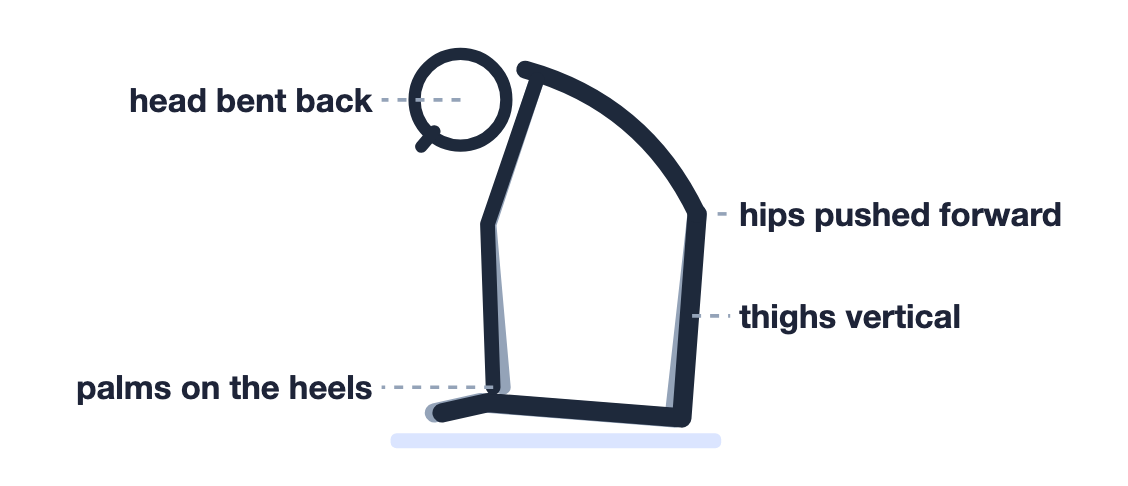
Stick diagram of Ushtrasana (kneeling, thighs vertical, back arched, head back, palms on the heels): see the figure. [1]
Procedure: sit in Vajrasana; stand on the knees and raise the arms to shoulder level; exhaling, place the right palm on the right heel, then the left palm on the left heel; push the abdomen and hips forward with the thighs vertical and bend the head and spine back; relax the back and hold; return in reverse order, one arm at a time, to Vajrasana. [2]
Contraindications (any two): hernia, abdominal injuries, back problems, severe arthritis, vertigo, pregnancy. [½ + ½]
Purpose: to measure aerobic (cardiovascular) fitness and the ability to recover from work. Equipment: a bench or wooden block 20 inches high, a stopwatch and a metronome.
Procedure: on ‘Go’ the student steps up and down at 30 steps a minute for up to 5 minutes, body erect, legs and back straight. If the pace cannot be kept up, the test stops and the duration in seconds is noted. The student sits down at once, and the pulse is counted from 1 to 1½ minutes after the exercise.
Formula: Fitness Index = (duration of exercise in seconds × 100) ÷ (5.5 × pulse count of 1 to 1½ minutes).
Rating: up to 49 Poor, 50 to 80 Average, 81 or above Good, so her fitness is Average.
3 marks for purpose, equipment and procedure; 2 marks for the calculation (1) and rating (1).
3+2=5
36
1+2+2=5
Flexibility is the range of motion around a joint: the ability to perform a movement with greater amplitude.
Passive flexibility: the range reached with external help (a partner or apparatus); it is always more than active flexibility.
Active flexibility: the range reached without help; it is (a) static (holding a still position) or (b) dynamic (during movement).
Slow stretching method: the muscles are stretched slowly, without jerks.
Slow stretch and hold method: stretch slowly to the maximum and hold it for some seconds; the most common method.
Ballistic method: rhythmic, swinging stretches using momentum (can cause injury if done carelessly).
PNF (proprioceptive neuromuscular facilitation): contract the muscle against resistance for a few seconds, then relax and stretch it further and hold; repeat.
1 mark for the definition, 2 marks for the types (passive and active), 2 marks for any two methods.
1+2+2=5
37
1+1+3=5
A lever is a rigid bar that turns about a fixed point (fulcrum) to overcome a resistance when a force is applied. In the body, bones act as levers and joints as fulcrums.
Components: fulcrum (axis), effort (force, the muscle pull), load (resistance) and the lever arm (bone).
First-class lever: the fulcrum lies between the effort and the load; e.g. the triceps straightening the elbow in throwing, the V-sit-up (also accepted: nodding the head).
Second-class lever: the load lies between the fulcrum and the effort; the force needed is less than the load; e.g. rising on the toes (fulcrum at the ball of the foot), push-ups.
Third-class lever: the effort lies between the fulcrum and the load; gives speed and range of movement; the most common lever in the body; e.g. the biceps bending the elbow (biceps curl), sit-ups (also accepted: kicking, fulcrum at the knee).
1 (meaning) + 1 (components) + 3 (each type with an example, 1 mark each).