Pattern: CBSE 2026-27 official Sample Question Paper (SQP) design · Maximum marks: 70 · Time: 3 hours. Solve the paper first, then open the marking scheme at the end to check your answers.
ANSHUL ACADEMY · anshulacademy.in
PHYSICAL EDUCATION (048)
Sample Question Paper 2
Class XII (2026-27) · English Medium
Time Allowed: 3 hoursMaximum Marks: 70
General Instructions:
Read the following instructions carefully and follow them:
This question paper contains 37 questions in five sections: A, B, C, D and E.
Section A: Questions 1 to 18 are multiple choice questions of 1 mark each. All of them are compulsory.
Section B: Questions 19 to 24 are very short answer questions of 2 marks each. Attempt any 5. Answer each in 60 to 90 words.
Section C: Questions 25 to 30 are short answer questions of 3 marks each. Attempt any 5. Answer each in 100 to 150 words.
Section D: Questions 31 to 33 are case studies of 4 marks each. There is an internal choice in Questions 31 and 33.
Section E: Questions 34 to 37 are long answer questions of 5 marks each. Attempt any 3. Answer each in 200 to 300 words.
Separate questions are given for Visually Impaired candidates in place of Questions 5, 31 and 33.
SECTION A (18 × 1 = 18 marks)
Q. No.
Marks
1
1 mark
Finalising sponsorships, watching the inflow and outflow of money and settling the payments of officials are the work of the committee known as the backbone of a sports tournament. This committee is the:
(A) Technical Committee
(B) Finance Committee
(C) Logistics Committee
(D) Marketing Committee
1
2
1 mark
Two statements are given below, labelled Assertion (A) and Reason (R). Read them and select the most appropriate option:
Assertion (A): Seeding is commonly used in league tournaments to keep strong teams apart.
Reason (R): Seeding places good teams so that they do not meet one another at an early stage of a tournament.
(A) Both Assertion (A) and Reason (R) are true, and Reason (R) is the correct explanation of Assertion (A).
(B) Both Assertion (A) and Reason (R) are true, but Reason (R) is not the correct explanation of Assertion (A).
(C) Assertion (A) is true, but Reason (R) is false.
(D) Assertion (A) is false, but Reason (R) is true.
1
3
1 mark
Match List I (community sports event) with List II (its main purpose or example) and choose the correct option.
List I
List II
(a) Health Run
(i) Spreads awareness about a social issue such as cleanliness or a green environment
(b) Run for Fun
(ii) Builds a feeling of integrity and brotherhood among people
(c) Run for Specific Cause
(iii) Friendly races such as the sack race and the three-legged race
(d) Run for Unity
(iv) Creates awareness of physical activity for good health; taking part matters, not winning
(A) (a)-(iv), (b)-(iii), (c)-(i), (d)-(ii)
(B) (a)-(iii), (b)-(iv), (c)-(i), (d)-(ii)
(C) (a)-(iv), (b)-(iii), (c)-(ii), (d)-(i)
(D) (a)-(i), (b)-(iii), (c)-(iv), (d)-(ii)
1
4
1 mark
An exaggerated inward curve of the lumbar (lower back) region of the spine, also known as sway back, is called:
(A) Kyphosis
(B) Scoliosis
(C) Lordosis
(D) Round shoulders
1
5
1 mark
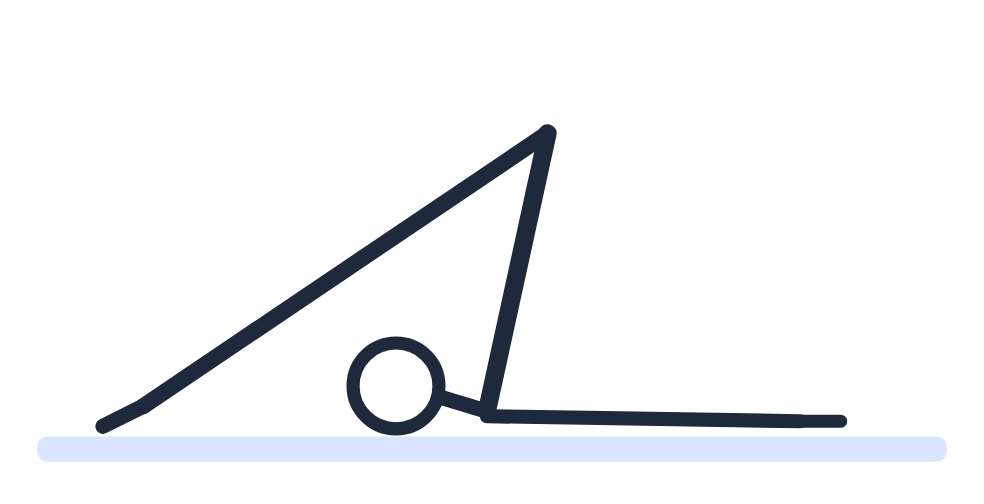
The stick figure below shows a yoga posture from your syllabus. Name it.
Figure for Q5 (stick figure drawn by Anshul Academy)
(A) Matsyasana
(B) Pavanmuktasana
(C) Paschimottanasana
(D) Halasana
Note: The following question is for Visually Impaired candidates only, in lieu of Q. No. 5. In which asana does the practitioner lie on the back, raise both legs together without bending the knees, and take them over the head until the toes touch the ground behind the head?
(A) Shavasana
(B) Halasana
(C) Makarasana
(D) Bhujangasana
1
6
1 mark
A hockey player tells her coach that her periods come with severe pain and frequent cramps in the lower abdomen. This menstrual disorder is called:
(A) Menorrhagia
(B) Dysmenorrhea
(C) Oligomenorrhea
(D) Amenorrhea
1
7
1 mark
Which practice consists of forceful and fast diaphragmatic breathing, in which one exhales forcefully by contracting the abdomen, in quick succession?
(A) Kapalabhati
(B) Sheetali pranayama
(C) Anulom-Vilom
(D) Surya Bhedana pranayama
1
8
1 mark
An eligible Paralympic impairment marked by an abnormal increase in muscle tension and a reduced ability of a muscle to stretch, as in cerebral palsy, is:
(A) Ataxia
(B) Athetosis
(C) Hypertonia
(D) Short stature
1
9
1 mark
The Stoke Mandeville Games of 1948 later grew into the Paralympic Games. The first Paralympic Games were held in 1960 at:
(A) London
(B) Seoul
(C) Paris
(D) Rome
1
10
1 mark
Which trace mineral is a part of haemoglobin, which carries oxygen, and of myoglobin, which is needed for muscle contraction?
(A) Iron
(B) Zinc
(C) Iodine
(D) Fluoride
1
11
1 mark
Dal and rice are often eaten together because each supplies the essential amino acid the other lacks. Which essential amino acid do pulses lack?
(A) Lysine
(B) Tryptophan
(C) Methionine
(D) Leucine
1
12
1 mark
In the push-up test for boys in the SAI Khelo India Fitness Test, the body is lowered with the back and knees straight until the angle at the elbows is about:
(A) 45 degrees
(B) 90 degrees
(C) 120 degrees
(D) 180 degrees
1
13
1 mark
With ageing, the pulse amplitude and secretion of growth hormone (GH) gradually decrease. This condition is termed:
(A) Osteoporosis
(B) Bradycardia
(C) Atrophy
(D) Somatopause
1
14
1 mark
Ignoring air resistance, the only force acting on a shot after it leaves the thrower’s hand is gravity. Its flight path is:
(A) A straight line
(B) A circle
(C) Parabolic
(D) Zig-zag
1
15
1 mark
In the standing posture, the centre of gravity of the human body is located near the centre of the:
(A) Upper pelvic region
(B) Chest
(C) Head
(D) Knees
1
16
1 mark
Two statements are given below, labelled Assertion (A) and Reason (R). Read them and select the most appropriate option:
Assertion (A): Regular exercise can make a person feel relaxed and happy.
Reason (R): During exercise the body increases the production of endorphins, which help produce positive feelings and improve mood.
(A) Both Assertion (A) and Reason (R) are true, and Reason (R) is the correct explanation of Assertion (A).
(B) Both Assertion (A) and Reason (R) are true, but Reason (R) is not the correct explanation of Assertion (A).
(C) Assertion (A) is true, but Reason (R) is false.
(D) Assertion (A) is false, but Reason (R) is true.
1
17
1 mark
To get out of the starting blocks quickly, a sprinter says the word ‘explode!’ to herself. This belongs to which category of self-talk?
(A) Task-specific statement
(B) Mood words
(C) Encouragement and effort
(D) Negative self-talk
1
18
1 mark
A tall school volleyball player is moved to basketball, where she has a much better chance to succeed. This step of talent identification and development is called:
(A) Talent detection
(B) Talent selection
(C) Talent development
(D) Talent transfer
1
SECTION B: Very Short Answer Type (attempt any 5 of 6; 5 × 2 = 10 marks)
Q. No.
Marks
19
1+1=2
Distinguish between intramural and extramural tournaments on any two points.
1+1=2
20
1+1=2
According to the International Paralympic Committee, classification in Para sport has two roles. State both of them.
1+1=2
21
1+1=2
Why is the Rikli and Jones Senior Citizen Fitness Test conducted? Who should not take this test?
1+1=2
22
1+1=2
Write the formula for Body Mass Index (BMI). Ravi weighs 63 kg and his height is 150 cm. Calculate his BMI.
1+1=2
23
1+1=2
What is meant by static and dynamic equilibrium? Support each with an example from a game or sport.
1+1=2
24
1+1=2
What is explosive strength? Name any two sports activities in which it is used.
1+1=2
SECTION C: Short Answer Type (attempt any 5 of 6; 5 × 3 = 15 marks)
Q. No.
Marks
25
1+1+1=3
Describe the Flamingo Balance Test of the SAI Khelo India Fitness Test under the headings: purpose, procedure and scoring.
1+1+1=3
26
1+1+1=3
A swimmer has trained regularly for three years. Explain any three long-term effects that this training will have had on her respiratory system.
1+1+1=3
27
1+2=3
State Newton’s third law of motion. Explain any two of its applications in sports.
1+2=3
28
1+2=3
Name the methods of reducing friction. Explain any two of them with examples from sports.
1+2=3
29
1+1+1=3
Speed is not a single ability. Describe any three of its types and name a sporting situation where each matters.
1+1+1=3
30
1+1+1=3
What is the interval method of training? State the principle on which it works and any two of its effects.
Study the league fixture of six teams, A to F, given below and answer the questions that follow.
Figure for Q31: league fixture of six teams (drawn by Anshul Academy)
(i)
The method used to draw this league fixture is the:
(A) Cyclic method
(B) Staircase method
(C) Knock-out method
(D) Seeding method
1
(ii)
In all, the six teams will meet one another in:
(A) 6 matches
(B) 12 matches
(C) 15 matches
(D) 30 matches
1
(iii)
If the same six teams were fixed by the cyclic method instead, the number of rounds would be:
(A) 6
(B) 3
(C) 15
(D) 5
1
(iv)
With the points scale win 5, draw 3, loss 0, team C won 2 matches, drew 2 and lost 1. Its total points are:
(A) 16
(B) 13
(C) 10
(D) 19
OR
Which of these is a merit of a league tournament over a knock-out tournament?
(A) It needs less time and money
(B) Good teams can be seeded
(C) The true winner emerges and every team can be ranked
(D) Fewer matches are played
1
Note: The following question is for Visually Impaired candidates only, in lieu of Q. No. 31. Eight houses of a school will compete in volleyball, each house meeting each of the others one time (a single league). The sports captain must prepare the programme. Answer the following questions.
(i)
How many matches will be played in the league?
(A) 7
(B) 28
(C) 56
(D) 16
1
(ii)
If the fixture is drawn by the cyclic method, how many rounds will be needed?
(A) 7
(B) 8
(C) 4
(D) 28
1
(iii)
If a ninth house joins, then in the cyclic method:
(A) Two teams get a bye in each round
(B) No bye is needed
(C) One team gets a bye in each round
(D) The number of rounds becomes 8
1
(iv)
In the staircase method, the team fixed on the highest step:
(A) Gets a bye in every round
(B) Plays only the last team
(C) Is the seeded team
(D) Plays all the other teams of the tournament
OR
Under the points scale win 5, draw 3, loss 0, a drawn match earns each team:
(A) 5 points
(B) 3 points
(C) 0 points
(D) 1 point
1
1×4=4
32
1×4=4
Read the passage given below and answer the questions that follow.
Mr Rao, the physical education teacher of a government school, has two new students in Class VI: Anjali, who has low vision, and Kabir, who has autism. Before each period he tells the class what they will do and where. He gives one instruction at a time, in simple words and a low tone, shows each skill himself and asks a classmate to demonstrate it too. The play area is small and free from noise, its starting point, finishing point and sitting area are clearly marked, and a corner is kept where Kabir can relax when he needs to. His lessons begin with balancing, twisting and turning, move on to running and hopping, and only then to throwing and catching. For Anjali he uses balls of a bright colour that make a sound when they roll.
Written for this paper
(a)
Which strategy is Mr Rao using when he gives one instruction at a time in simple words and uses peer demonstration? Name two kinds of instruction it combines.
1
(b)
The small, disturbance-free area with clearly marked boundaries and a relaxation corner shows which strategy? Why does Kabir need the corner?
1
(c)
Name the strategy followed in the order of Mr Rao’s lessons, and write the order of the three kinds of skills in it.
1
(d)
Which strategy do the brightly coloured, sound-making balls show? Give one more example of such equipment from your textbook.
1
1×4=4
33
1×4=4
The chart below shows the percentage of slow twitch and fast twitch fibres in the muscles of three groups of people. Study it and answer the questions that follow.
Figure for Q33: muscle fibre composition (data from the CBSE Physical Education textbook, Class XII; chart drawn by Anshul Academy)
(a)
Which group in the chart has the highest percentage of fast twitch fibres? Write one other name of these fibres.
1
(b)
Why are slow twitch fibres red in colour?
1
(c)
Which energy system mainly supplies energy to the sprinters in a 100 m race, and for activities of about how long does it provide energy?
1
(d)
On which factors does the proportion of the two fibre types in a person’s muscles depend?
OR
Name one sports activity each for which slow twitch fibres and fast twitch fibres are best suited.
1
Note: The following question is for Visually Impaired candidates only, in lieu of Q. No. 33. Priya trains for the 5000 m race of her school, while her brother Rohan is a shot putter. Their coach explains how their muscles and energy systems work. Answer the following questions.
(i)
Which muscle fibres should be in a higher percentage in Priya’s leg muscles?
(A) Slow twitch (Type I) fibres
(B) Fast twitch (Type II) fibres
(C) An exactly equal mix
(D) Fast glycolytic fibres
1
(ii)
Which energy system mainly supplies Rohan’s muscles during one put of the shot?
(A) Aerobic system
(B) ATP-CP system
(C) Anaerobic (lactic acid) system
(D) Fat burning system
1
(iii)
When Priya’s quadriceps contract to straighten her knee, her hamstrings relax and lengthen. Here the hamstrings act as:
(A) Agonists
(B) Synergists
(C) Antagonists
(D) Stabilizers
1
(iv)
Which food component gives instant energy during exercise?
(A) Fats
(B) Proteins
(C) Vitamins
(D) Carbohydrates
OR
Which energy system mainly supplies energy during a marathon?
(A) Aerobic system
(B) ATP-CP system
(C) Anaerobic system
(D) Immediate energy system
1
1×4=4
SECTION E: Long Answer Type (attempt any 3 of 4; 3 × 5 = 15 marks)
Q. No.
Marks
34
2+2+1=5
Sport is described as a tool of social empowerment for women. Explain any two physical, any two psychological and any one social benefit of women’s participation in sports.
2+2+1=5
35
1+2+1+1=5
Bhujangasana appears in the textbook’s lists of asanas for diabetes, asthma, hypertension and back pain. Draw its stick diagram and describe its technique. Also write any two of its benefits, and name the two pranayamas listed for the prevention of hypertension.
1+2+1+1=5
36
2+1+2=5
Your school football team will play a 90-minute final at 4 p.m. on a hot day. Plan the team’s food and fluid intake before, during and after the match, giving reasons.
2+1+2=5
37
1+4=5
What is exercise adherence? Many people who join a gym stop going within a few weeks. Explain any four strategies that would help them keep exercising.
1+4=5
~ End of Question Paper ~
Marking Scheme / अंकन योजना (उत्तर देखें)
ANSHUL ACADEMY · anshulacademy.in
PHYSICAL EDUCATION (048)
Sample Question Paper 2: Marking Scheme
Class XII (2026-27) · English Medium
Time Allowed: 3 hoursMaximum Marks: 70
For examiners and students:
For multiple choice questions, both the letter of the correct option and the answer are given.
For descriptive questions, value points are given. ‘Any two/three’ means that full marks are given for that many correct points from those listed.
Any other relevant point based on the CBSE Physical Education textbook (Class XII) may also be accepted, and application questions accept equivalent examples.
In Sections B, C and E only the required number of answers (5, 5 and 3) are marked; if a candidate answers more, the first ones answered are marked.
Word limits (B: 60 to 90, C: 100 to 150, E: 200 to 300 words) guide the length of answers; do not deduct marks for a few words more or less.
SECTION A (18 × 1 = 18 marks)
Q. No.
Answer / value points
Marks
1
1 mark
(B) Finance Committee. It provides financial oversight of the event (sponsorship, accounts, purchases, payments) and is called the backbone of the tournament.
1
2
1 mark
(D) A is false, but R is true. Seeding is a knock-out provision; a league tournament has no provision of seeding, because every team plays every other team anyway.
1
3
1 mark
(A) (a)-(iv), (b)-(iii), (c)-(i), (d)-(ii).
1
4
1 mark
(C) Lordosis (sway back): the normal concavity of the lumbar spine is increased and exaggerated.
1
5
1 mark
(D) Halasana (plough pose): lying on the back, the straight legs are taken over the head until the toes touch the ground, so the body looks like an Indian plough.
For Visually Impaired candidates: (B) Halasana.
1
6
1 mark
(B) Dysmenorrhea: menstruation with severe pain or frequent menstrual cramps.
1
7
1 mark
(A) Kapalabhati.
1
8
1 mark
(C) Hypertonia.
1
9
1 mark
(D) Rome.
1
10
1 mark
(A) Iron.
1
11
1 mark
(C) Methionine (cereals lack lysine), so the two together improve the protein quality of the meal.
1
12
1 mark
(B) 90 degrees.
1
13
1 mark
(D) Somatopause.
1
14
1 mark
(C) Parabolic: a projectile travels with a parabolic trajectory.
1
15
1 mark
(A) Upper pelvic region; it shifts with every new posture.
1
16
1 mark
(A) Both A and R are true, and R explains A: endorphins released during exercise produce positive feelings, so exercise increases happiness.
1
17
1 mark
(B) Mood words: words that increase mood or arousal, such as ‘go’, ‘explode’, ‘hard’ or ‘blast’.
1
18
1 mark
(D) Talent transfer: transfer from one sport to another where there are more significant opportunities to succeed.
1
SECTION B: Very Short Answer Type (attempt any 5 of 6; 5 × 2 = 10 marks)
Q. No.
Answer / value points
Marks
19
1+1=2
Meaning: intramural means ‘within the walls’, held among the students of one institution; extramural means ‘outside the walls’, held between players or teams of two or more institutions.
Participation: intramurals are for all the students (mass participation), not only for players; in extramurals a selected team represents the institution.
Aim: intramurals aim at participation, recreation and all-round development, and at selecting players for extramurals; extramurals aim at high performance at the highest level.
Examples: inter-house or inter-class matches (intramural); zonal, inter-district, state, national or international tournaments (extramural).
Any two differences, 1 mark each.
1+1=2
20
1+1=2
To determine who is eligible to compete in a Para sport: the athlete must have an eligible impairment that is permanent and limits the ability to take part in that sport.
To group the eligible athletes into sport classes for competition, according to how much their impairment affects performance in the sport.
1 mark for each role.
1+1=2
21
1+1=2
Purpose: to evaluate the functional ability (fitness) of older people (60 to 94 years), monitor their fitness status, identify problems and work on the weaknesses.
Should not take it: persons with medical conditions such as chest pain, dizziness, high blood pressure or heart problems (or those told by a doctor not to exercise).
1 mark for the purpose, 1 mark for who should not take it.
1+1=2
22
1+1=2
BMI = W ÷ (H × H), where W = body weight in kilograms and H = height in metres.
H = 150 cm = 1.5 m; H × H = 2.25; BMI = 63 ÷ 2.25 = 28 kg/m² (in the overweight range, 25.0 to 29.9).
1 mark for the formula, 1 mark for the calculation (naming the category is not required).
1+1=2
23
1+1=2
Static equilibrium: the body is at rest or completely motionless; e.g. a batsman’s stance, a sprinter in the ‘set’ position on the blocks, a handstand.
Dynamic equilibrium: the body is in motion with constant velocity (no change in speed or direction) and all the forces are in balance; e.g. a cyclist cycling at a steady speed, a footballer dribbling.
1 mark each (meaning with an example).
1+1=2
24
1+1=2
Explosive strength is the ability of the muscles to overcome resistance as fast as possible; it is a combination of strength and speed (it depends on inter- and intramuscular coordination).
Used in (any two): spiking in volleyball, jumps in basketball, sprint starts, long jump or high jump take-off, throwing events.
1 mark for the meaning, ½ mark for each activity.
1+1=2
SECTION C: Short Answer Type (attempt any 5 of 6; 5 × 3 = 15 marks)
Q. No.
Answer / value points
Marks
25
1+1+1=3
Purpose: to measure single-leg static balance (strength of the leg, pelvic and trunk muscles). Equipment: a non-slippery even surface or beam, and a stopwatch.
Procedure: the child stands on the beam on the preferred leg; the free leg is bent at the knee and its foot is held close to the buttocks; the watch starts when the instructor lets go of the child’s hand and is paused at each loss of balance (falling off the beam or letting go of the foot), then restarted.
Scoring: the number of falls in 60 seconds of balancing is counted; if there are more than 15 falls in the first 30 seconds, the test is ended.
1 mark each for purpose, procedure and scoring.
1+1+1=3
26
1+1+1=3
Efficiency of the respiratory muscles increases: breathing in and out becomes easier and more fluent.
Lung volume (capacity) increases: vital capacity rises considerably with training.
Pulmonary diffusion increases: more exchange of gases takes place in the lungs, as the alveoli become larger.
Residual volume increases (within normal limits), which helps gas exchange to continue between breaths.
Any three effects, 1 mark each.
1+1+1=3
27
1+2=3
Third law (law of reaction): to every action there is an equal and opposite reaction.
Springboard diving: the diver pushes down on the board, and the board pushes the diver up into the air.
Jumping: the athlete pushes against the ground, and the ground reaction force propels the body upwards.
Kicking a football: the ball pushes back on the foot as hard as the foot hits the ball (felt less because the leg has more mass); a swimmer pushes the water back to move forward.
1 mark for the law, 1 mark each for any two applications.
1+2=3
28
1+2=3
Methods: polishing, lubricating, using wheels or ball bearings, and streamlining.
Polishing: rubbing a surface smooth reduces its unevenness and so its friction; e.g. shining one side of a cricket ball to increase its swing.
Lubricating (e.g. oiling a racing bicycle chain) or wheels and ball bearings (rolling friction is less than sliding friction; e.g. skates).
Streamlining: giving a body a sharp, pointed front reduces air or water friction; e.g. the javelin, streamlined helmets and suits of cyclists, racing boats.
1 mark for naming the methods, 1 mark each for any two explained with an example.
1+2=3
29
1+1+1=3
Reaction ability: the ability to react quickly to a signal (simple or complex reaction); e.g. a sprinter’s start, a goalkeeper reacting to a penalty kick.
Acceleration ability: the ability to reach a high speed from a stationary position; depends on explosive strength, technique and movement frequency; e.g. the first 30 m of a sprint.
Movement speed: the ability to do a single movement in the minimum time; e.g. a punch in boxing, smashing in badminton (acyclic sports).
Locomotor ability: the ability to maintain maximum speed for the maximum distance or time; e.g. 100 m and 200 m sprints; also speed endurance (e.g. a 400 m race).
Any three types with an example, 1 mark each.
1+1+1=3
30
1+1+1=3
Meaning: a method of developing endurance in which work of comparatively high intensity is followed by breaks of incomplete recovery; it is the most versatile endurance method.
Principle: the work is done with enough speed and duration to raise the heart rate to about 180 beats per minute; the athlete then rests, and when the heart rate drops to 120 to 130 beats per minute, work starts again.
(i) (B) Staircase method; (ii) (C) 15 matches [n(n − 1)/2 = 6 × 5/2]; (iii) (D) 5 [even number of teams: rounds = n − 1]; (iv) (A) 16 [2 × 5 + 2 × 3 + 1 × 0]; OR (C) The true winner emerges and every team can be ranked.
For Visually Impaired candidates: (i) (B) 28 [n(n − 1)/2 = 8 × 7/2]; (ii) (A) 7 [even number of teams: rounds = n − 1]; (iii) (C) One team gets a bye in each round [odd number of teams; rounds = 9]; (iv) (D) Plays all the other teams of the tournament; OR (B) 3 points.
1×4=4
32
1×4=4
(a) Communication strategy; it combines verbal, visual and peer teaching (any two). [½ + ½]
(b) Space strategy; children with autism may need some time to relax, so a specific area is provided. [½ + ½]
(d) Equipment strategy (adapted or modified equipment); e.g. wheelchairs for recreation and sport, computerised devices, specially designed high-level equipment. [½ + ½]
1 mark for each part (1 × 4 = 4).
1×4=4
33
1×4=4
(a) Sprinters (70 to 75 percent fast twitch fibres); also called Type II or fast glycolytic fibres. [½ + ½]
(b) They have a higher concentration of capillaries, so they have a greater supply of blood (they also have more myoglobin).
(c) ATP-CP system (immediate or phosphagen system); for activities of less than about 10 seconds. [½ + ½]
(d) Genetics, hormones and habits of exercise (regular training can change the proportion). OR Slow twitch: long distance running, swimming or cycling; fast twitch: sprints, jumps or throws. [½ + ½]
1 mark for each part (1 × 4 = 4).
For Visually Impaired candidates: (i) (A) Slow twitch (Type I) fibres; (ii) (B) ATP-CP system; (iii) (C) Antagonists; (iv) (D) Carbohydrates; OR (A) Aerobic system.
1×4=4
SECTION E: Long Answer Type (attempt any 3 of 4; 3 × 5 = 15 marks)
Q. No.
Answer / value points
Marks
34
2+2+1=5
Physical (any two): lower chance of lifestyle diseases such as diabetes, high blood pressure and obesity; higher bone density, which matters because women face more osteoporosis; toned muscles; a stronger cardiovascular system with more capillaries and better oxygen intake; control of obesity.
Psychological (any two): stress management through ‘happy hormones’; better control over emotions; confidence that grows with every win; higher self-esteem and self-worth; leadership qualities.
Social (any one): coordination with team-mates; communication, becoming vocal and expressive; inter-relationships with the team and staff on and off the field; cooperation and working in harmony with others.
Conclusion: sport thus becomes a tool of social empowerment and gender equity.
1 mark for each physical and psychological benefit (2 + 2), 1 mark for the social benefit.
2+2+1=5
35
1+2+1+1=5
Stick diagram of Bhujangasana (prone; legs together on the mat; palms beside the shoulders; head, chest and trunk raised up to the navel): see the figure. [1]
Technique: lie prone with legs and toes together, hands by the sides and forehead on the ground; fold the arms and place the palms on the ground beside the shoulders; bring the chin forward onto the ground; raise the chin, turn the head back and raise the thorax, bending the spine back up to the navel (the navel stays down); hold for some time; come back slowly in the order upper navel, thorax, shoulders, chin and forehead; relax the hands by the thighs. Inhale while rising, exhale while lowering. [2]
Benefits (any two): strengthens the spine and makes it more flexible; opens the chest, shoulders and rib cage; tones the back (spinal extensor) muscles; stimulates the endocrine system and digestive organs; good for kyphosis. [½ + ½]
Pranayamas for hypertension: Nadi Shodhana (Anulom-Vilom) pranayama and Sheetali pranayama. [½ + ½]
Before (pre-event meal): aims to fill the glycogen stores and hydrate the body; a 500 to 1000 kcal meal, high in carbohydrate, moderate in protein, low in fat and fibre (e.g. pasta with fruit and curd, a potato sandwich with juice, a banana milkshake), 2 to 4 hours before the match (around 12 to 2 p.m.); familiar foods only; avoid high-sugar, fried or high-fibre food; a light snack or liquids up to an hour before; 150 to 250 ml of water every 15 minutes.
During: keeps up the water balance, body temperature and normal blood sugar, and delays fatigue; as the match lasts more than 60 minutes, sip water or carbohydrate-electrolyte drinks with 5 to 8 percent carbohydrate at half-time and breaks (banana or juice also suitable); avoid fizzy and caffeinated drinks.
After: replace the fluid lost (drink more than is lost, until the urine is pale or the pre-match weight returns); refill glycogen immediately with carbohydrates (juice, fruit, sweet curd, cereal) and replace electrolytes; eat a balanced meal with carbohydrate and good-quality protein within two hours, which speeds recovery and lowers the chance of injury the next day.
General: familiar foods only; on a hot day fluids matter most, as dehydration lowers performance.
2 marks for ‘before’, 1 mark for ‘during’, 2 marks for ‘after’ (food, fluid and the reason in each).
2+1+2=5
37
1+4=5
Exercise adherence is the extent to which a person keeps up active involvement in exercise as advised (interval, dose and regimen) despite opportunities and pressures to withdraw; it covers starting and maintaining exercise (the ‘stickability’ factor). [1]
Goal setting: set SMART goals and moderate bouts of 20 to 30 minutes, without going above the lactate threshold.
Adding variety: new exercises, methods, equipment and members prevent boredom.
Social support: exercising with a buddy partner, a youth leader or a mentor.
Contract: signing a written statement of intent with expectations and responsibilities.
Also accepted: reinforcement (rewards, badges), feedback on progress, process orientation, problem solving, health risk appraisal, health education.
1 mark for the meaning, 1 mark each for any four strategies.