Pattern: CBSE 2026-27 official Sample Question Paper (SQP) design · Maximum marks: 80 · Time: 3 hours. Solve the paper first, then open the marking scheme at the end to check your answers.
POLITICAL SCIENCE (028)
General Instructions:
Read the following instructions carefully and follow them:
- The question paper consists of five sections (A, B, C, D and E) with 30 questions in total. All questions are compulsory.
- Section A: Questions 1 to 12 are multiple choice questions of one mark each.
- Section B: Questions 13 to 18 carry 2 marks each. Answers to these questions should not exceed 50 to 60 words each.
- Section C: Questions 19 to 23 carry 4 marks each. Answers to these questions should not exceed 100 to 120 words each. There is an internal choice in two of the 4-mark questions.
- Section D: Questions 24 to 26 are data (chart), passage and map based questions of 4 marks each. Answer them as directed.
- Section E: Questions 27 to 30 carry 6 marks each. Answers to these questions should not exceed 170 to 180 words each. There is an internal choice in all the 6-mark questions.
- Note: Separate questions are given for candidates with Visual Impairment in lieu of Questions 24 and 26. Only such candidates should attempt them.
- The Biological Weapons Convention (BWC) bans the production and possession of biological weapons.
- The Nuclear Non-Proliferation Treaty (NPT) is signed.
- India conducts its first nuclear test.
- The Chemical Weapons Convention (CWC) bans the production and possession of chemical weapons.
Choose the correct option:
| Column ‘A’ | Column ‘B’ |
|---|---|
| I. Trygve Lie | i. Egypt |
| II. U Thant | ii. Ghana |
| III. Boutros Boutros-Ghali | iii. Norway |
| IV. Kofi A. Annan | iv. Burma (Myanmar) |

(I) How many of the 489 seats in the first Lok Sabha did the Congress win?
(II) Which party came second in terms of seats in the first general election?
(III) Which party was the second largest in terms of votes in 1952?
(IV) Who led the Congress campaign in the first general election?
We can see that dealing with many of these non-traditional threats to security require cooperation rather than military confrontation. Military force may have a role to play in combating terrorism or in enforcing human rights (and even here there is a limit to what force can achieve), but it is difficult to see what force would do to help alleviate poverty, manage migration and refugee movements, and control epidemics. Indeed, in most cases, the use of military force would only make matters worse!
Far more effective is to devise strategies that involve international cooperation. Cooperation may be bilateral (i.e. between any two countries), regional, continental, or global. It would all depend on the nature of the threat and the willingness and ability of countries to respond. Cooperative security may also involve a variety of other players, both international and national: international organisations (the UN, the World Health Organisation, the World Bank, the IMF etc.), non-governmental organisations (Amnesty International, the Red Cross, private foundations and charities, religious organisations, trade unions, associations, social and development organisations), businesses and corporations, and great personalities (e.g. Mother Teresa, Nelson Mandela).
Cooperative security may involve the use of force as a last resort. The international community may have to sanction the use of force to deal with governments that kill their own people or ignore the misery of their populations who are devastated by poverty, disease and catastrophe. It may have to agree to the use of violence against international terrorists and those who harbour them. Non-traditional security is much better when the use of force is sanctioned and applied collectively by the international community rather than when an individual country decides to use force on its own.
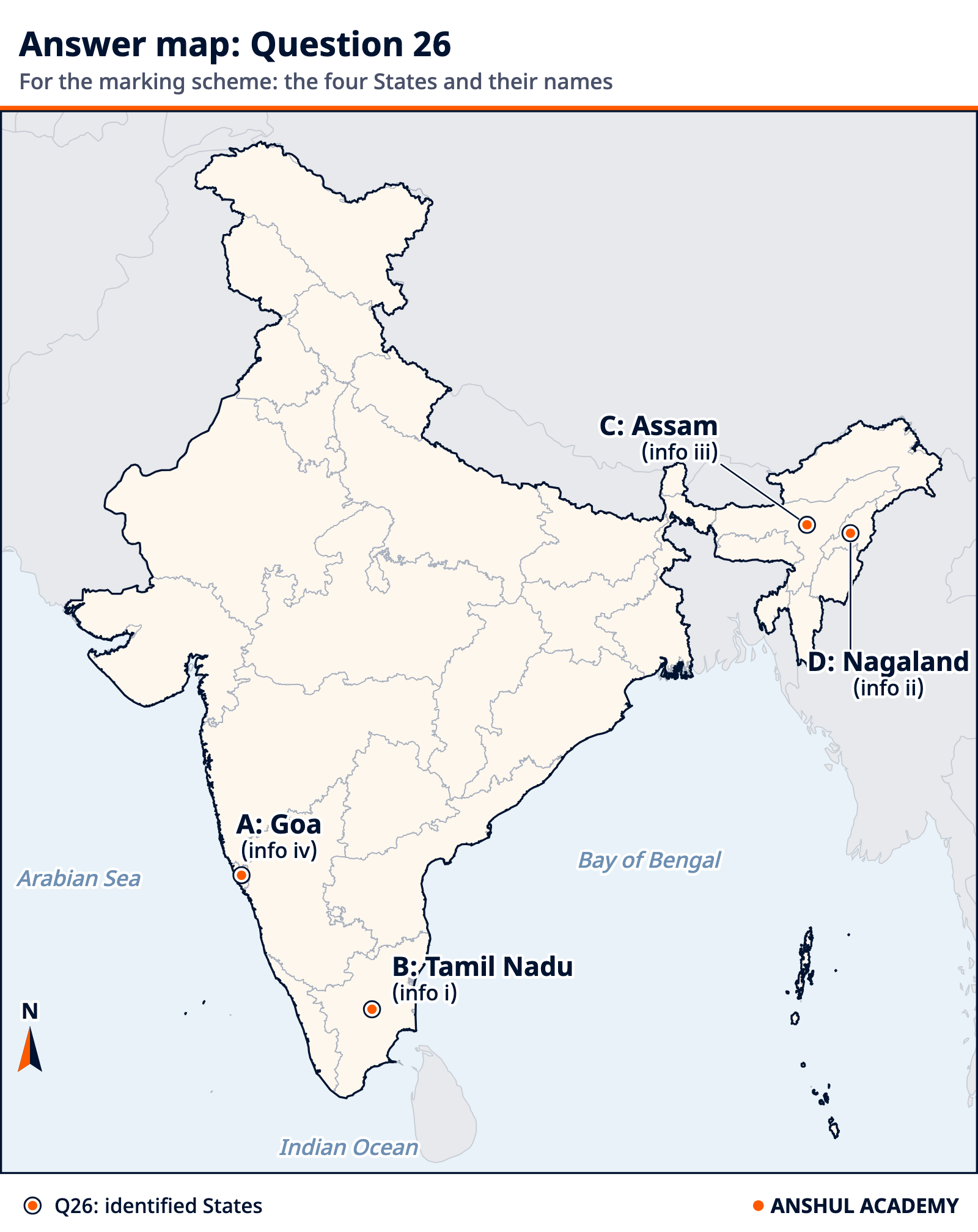
- The State where the DMK came to power in the Assembly elections of 1967; Dravidian parties have dominated its politics since then.
- The North-Eastern State created in 1963, where the Naga National Council had launched an armed struggle for sovereignty.
- The State where the All Assam Students’ Union led a movement against ‘outsiders’ from 1979 to 1985.
- The former Portuguese territory liberated by the Indian army in December 1961, which became a State of the Indian Union in 1987.
| Serial number of the information used | Concerned alphabet given in the map | Name of the State |
|---|---|---|
| (i) | ||
| (ii) | ||
| (iii) | ||
| (iv) |
(I) Name the regional party formed in Assam after the accord of 1985.
(II) In which year did Mizoram and Arunachal Pradesh become separate States?
(III) Which party led the demand that Goa should merge with Maharashtra?
(IV) The success of the anti-Hindi agitation of which year added to the DMK’s popularity?
Outline political map of India for Question 26 (Section D)

Marking Scheme / अंकन योजना (उत्तर देखें)
POLITICAL SCIENCE (028)
For examiners and students:
- For multiple choice questions, the letter of the correct option and the answer are given.
- For descriptive questions, value points are given. ‘Any two/three/four’ means full marks for that many correct points from those listed.
- Any other relevant point based on the NCERT textbooks may also be accepted.
- Word limits (Section B: 50 to 60 words; Section C: 100 to 120 words; Section E: 170 to 180 words) guide the length of answers; do not deduct marks for a few words more or less.
- Meaning: economic globalisation is likely to benefit only a small section while impoverishing those who depended on the government for jobs and welfare (education, health, sanitation); institutional safeguards or ‘social safety nets’ are meant to minimise its negative effects on the economically weak. (1)
- Inadequate: many movements feel safety nets are insufficient or unworkable and call for a halt to forced economic globalisation, as it would lead to economic ruin for weaker countries, especially for the poor within them. (1)
- Primary objective: to accelerate economic growth and, through that, ‘social progress and cultural development’. (1)
- Secondary objective: to promote regional peace and stability based on the rule of law and the principles of the UN Charter. (1)
- It was published in 1987, five years before the Rio Earth Summit of 1992. (1)
- It warned that traditional patterns of economic growth were not sustainable in the long term, especially in view of the demands of the South for further industrial development. (1)
- In 1944 a section of the big industrialists drafted a joint proposal for setting up a planned economy, in which the state would take major initiatives in industrial and other economic investments. (1)
- Private investors are usually expected to oppose planning and seek an open economy; when even big industrialists asked for planning, it showed that from left to right, planning was the obvious choice for India after Independence. (1)
- Meaning: people are arrested and detained not because they have committed an offence, but on the apprehension that they may commit one. (1)
- Use: the government made large-scale arrests of political workers under preventive detention acts, and the arrested persons could not challenge their arrest through habeas corpus petitions. (1)
- Similarity: like the National Front, the United Front included the Janata Dal and several regional parties. (1)
- Difference: in 1989 both the Left and the BJP supported the National Front to keep the Congress out of power; in 1996 the BJP did not support the government, while the Congress and the Left supported it to keep the BJP out of power. (1)
- Unemployment has risen in China, with nearly 100 million people looking for jobs.
- Female employment and conditions of work are as bad as in Europe of the eighteenth and nineteenth centuries.
- Environmental degradation has increased.
- Corruption has increased.
- Economic inequality has risen between rural and urban residents and between the coastal and the inland provinces.
- (Balance) The gains are real: privatisation of agriculture raised production and rural incomes, and Special Economic Zones made China a top destination for foreign direct investment; but these gains have not been shared equally.
- The forests of the South are still peopled, whereas the forests of the North are more or less devoid of human habitat, or are perceived as such.
- In the North, wilderness is seen as a ‘wild place’ where people do not live; humans are not seen as part of nature, and the environment is to be protected from humans through parks and reserves.
- In the South, most environmental issues are based on the assumption that people live in the forests.
- Wilderness-oriented views dominate in Australia, Scandinavia, North America and New Zealand, which still have large tracts of relatively ‘underdeveloped wilderness’.
- Wilderness campaigns in the South (eagles in the Philippines, Bengal tigers in India, elephants in Africa, forests of Brazil and Indonesia) have often been renamed biodiversity issues, and many are funded by NGOs like the WWF with local people.
- The Security Council no longer represents contemporary political realities.
- Its decisions reflect only Western values and interests and are dominated by a few powers.
- It lacks equitable representation.
- In view of the growing demands for restructuring, on 1 January 1997 Secretary-General Kofi Annan initiated an inquiry into how the UN should be reformed, for example how new Security Council members should be chosen.
- A strengthened and revitalised UN is desirable in a changing world.
- Development should be central to the UN’s agenda, as it is a vital precondition for the maintenance of international peace and security.
- The composition of the Security Council has remained largely static while the General Assembly has expanded considerably, harming its representative character (it grew from 11 to 15 members in 1965, with no change in permanent members).
- The overwhelming majority of General Assembly members are now developing countries, so they should have a role in shaping the Security Council decisions that affect them.
- India supports an increase in both permanent and non-permanent members, as the Council’s work has expanded and its success depends on the political support of the international community.
- The defeat of the Congress in the 1989 elections: from 415 seats in 1984 it fell to 197; this marked the end of the ‘Congress system’.
- The rise of the ‘Mandal issue’: the National Front government decided in 1990 to implement the Mandal Commission’s recommendation of reserving central government jobs for OBCs, which led to violent ‘anti-Mandal’ protests.
- A radically different economic policy: the structural adjustment programme or new economic reforms, visible from 1991, followed by every government since.
- The Ayodhya dispute (Ram Janmabhoomi) began to influence politics and changed the discourse on secularism and democracy.
- The assassination of Rajiv Gandhi in May 1991 during an election campaign in Tamil Nadu led to a change in Congress leadership; P.V. Narsimha Rao became Prime Minister.
- After the Emergency, the Bharatiya Jana Sangh merged with the Janata Party; after the Janata Party broke up, its former supporters formed the BJP in 1980.
- At first the BJP adopted a broader platform than the Jana Sangh, including ‘Gandhian Socialism’, but had little success in the 1984 elections.
- After 1986 it emphasised nationalism as the core of its ideology and pursued ‘Hindutva’ for political mobilisation; the Shah Bano case and the Ayodhya issue became central to its politics.
- It consolidated its position in 1991 and 1996, emerged as the largest party in 1996, led a coalition government from May 1998 to June 1999, and the NDA government re-elected in October 1999 under Atal Behari Vajpayee completed its full term.
- It won a majority on its own with 282 seats in 2014 and 303 seats in 2019.
- Meaning: on integration, the former rulers’ families were allowed to keep certain private property and given a hereditary grant or allowance based on the extent, revenue and potential of the merging state; this was the privy purse.
- Hereditary privileges did not fit the constitutional principles of equality and social and economic justice; Nehru had expressed dissatisfaction with it time and again.
- After the 1967 elections Indira Gandhi supported the demand for abolition; the Constitutional amendment of 1970 was not passed in the Rajya Sabha, and the ordinance that followed was struck down by the Supreme Court.
- Indira Gandhi made it a major issue in the 1971 election; after her massive victory the Constitution was amended to remove the legal obstacles to abolition.
| Serial number of the information used | Alphabet in the map | Name of the State |
|---|---|---|
| (i) | B | Tamil Nadu |
| (ii) | D | Nagaland |
| (iii) | C | Assam |
| (iv) | A | Goa |
- End of Cold War confrontations: the ideological dispute over whether socialism would beat capitalism was no longer an issue; since it had triggered a massive arms race, nuclear build-up and military blocs, its end demanded an end to the arms race and a possible new peace.
- Change in power relations: the US became the sole superpower and a unipolar system emerged; the capitalist economy became the dominant international economic system.
- Institutions like the World Bank and the IMF became powerful advisors to the post-Soviet countries, since they gave them loans for their transition to capitalism; politically, liberal democracy emerged as the best way to organise political life.
- Emergence of many new countries with their own aspirations: the Baltic and East European states wanted to join the European Union and NATO; the Central Asian countries wanted to keep close ties with Russia while building ties with the West, the US, China and others.
- Internal weaknesses of Soviet political and economic institutions failed to meet the aspirations of the people; economic stagnation led to severe consumer shortages.
- The economy spent much of its resources on a nuclear and military arsenal and on developing its satellite states in Eastern Europe and the Central Asian Republics, creating a huge economic burden.
- Ordinary citizens became aware of the economic advance of the West; the reality of Soviet backwardness came as a political and psychological shock.
- The Communist Party, which had ruled for over 70 years, was not accountable to the people; slow and stifling administration, rampant corruption, lack of openness and centralisation alienated them.
- Gorbachev’s reforms set in motion forces and expectations that could not be controlled; one section wanted faster change while party members felt he was moving too fast, so he lost support on all sides.
- The rise of nationalism and the desire for sovereignty in republics such as Russia, the Baltic Republics, Ukraine and Georgia proved the final and most immediate cause.
- Difficulty: there was no single belt of Muslim-majority areas; there were two areas of concentration, one in the west and one in the east, so Pakistan comprised two territories, West and East Pakistan.
- Difficulty: not all Muslim-majority areas wanted to be in Pakistan; Khan Abdul Gaffar Khan, leader of the North Western Frontier Province, was firmly opposed to the two-nation theory.
- Difficulty: Punjab and Bengal had very large areas where non-Muslims were in a majority, so these provinces were bifurcated at the district or even lower level; the decision could not be made by the midnight of 14-15 August.
- Difficulty: the problem of ‘minorities’ on both sides of the border, who feared for their lives and property.
- Consequence: large-scale communal violence; cities like Lahore, Amritsar and Kolkata were divided into ‘communal zones’; about 80 lakh people migrated across the new border and between five and ten lakh were killed.
- Consequence: people lived in refugee camps and were attacked on the way; thousands of women were abducted and forced into marriage; besides land, assets, government employees, the railways and the army were divided, and the new nation faced the question of whether it would be a Hindu nation (answered by the secular ideal of the Constitution).
- Most leaders of the national movement did not believe in the two-nation theory; they held that India must treat persons of all religions equally and not give superior status to the followers of one faith.
- Being religious or a believer would not be a test of citizenship; all citizens would be equal irrespective of their religious affiliation. This ideal was enshrined in the Constitution.
- Nehru pointed out that India had a Muslim minority so large in numbers that it could not, even if it wanted, go anywhere else; Muslims were still 10-12 per cent of the population in 1951.
- Whatever the provocation from Pakistan, India had to deal with this minority in a civilised manner and give them security and the rights of citizens in a democratic State.
- Nehru warned that failure to do so would create ‘a festering sore which will eventually poison the whole body politic and probably destroy it’: secularism was a prudential need, not only an ethical one.
- India was also home to other religious minorities (Sikhs, Christians, Buddhists, Jains, Parsis, Jews); after Partition violence, equal treatment of all was the only basis for national unity.
- Record: Ayub Khan, Yahya Khan, Zia-ul-Haq and Pervez Musharraf took over from civilian rule at different times; elected governments under Z.A. Bhutto (1971-77), Benazir Bhutto and Nawaz Sharif (1988-99) alternated with army rule, and elected leaders have ruled since 2008.
- Reason: the social dominance of the military, the clergy and the landowning aristocracy has led to the frequent overthrow of elected governments.
- Reason: the conflict with India has made the pro-military groups more powerful; they claim that political parties and democracy are flawed and that the army’s rule is needed for Pakistan’s security.
- Reason: the lack of genuine international support for democratic rule; the US and other Western countries encouraged military rule in the past, seeing it as the protector of Western interests and fearing that the nuclear arsenal might fall into terrorist hands.
- Forces for democracy: a strong pro-democracy sentiment; General Zia faced a pro-democracy movement from 1982.
- Forces for democracy: a courageous and relatively free press and a strong human rights movement.
- For: given India’s size and power, the smaller countries fear that India wants to be a regionally dominant power.
- For: Bangladeshi governments have felt that India behaves like a regional bully over sharing of river waters, the Chittagong Hill Tracts, natural gas and trade; many in Nepal feel India interferes in its internal affairs, has designs on its river waters and hydro-electricity, and blocks easier access to the sea.
- For: in Sri Lanka, the presence of Indian troops after the 1987 accord was seen as interference; some neighbours fear SAFTA is a way for India to ‘invade’ their markets.
- Against: India has often helped its neighbours: in November 1988 it stopped the attack of Tamil mercenaries on the Maldives at their request; it is the biggest source of development aid for Bhutan; it helped post-tsunami reconstruction in Sri Lanka; its treaty with Nepal lets citizens travel and work without visas and passports.
- Against: India itself often feels exploited by its neighbours and worries that their political instability may let outside powers gain influence in the region.
- Balance: not all conflicts involve India (Nepal-Bhutan, Bangladesh-Myanmar, Bangladesh-Nepal); many differences follow from India’s central location, as it is the only country that borders all the others.
- 1950: China took over control of Tibet; large sections of Tibetans opposed it, and India tried to persuade China to recognise Tibet’s claims for independence.
- 1954: through the Panchsheel agreement, which included respect for each other’s territorial integrity and sovereignty, India conceded China’s claim over Tibet.
- 1956: the Dalai Lama accompanied Zhou Enlai on his visit to India and told Nehru about the worsening situation; China had assured India that Tibet would get greater autonomy than any other region of China.
- 1958-59: an armed uprising in Tibet was suppressed by Chinese forces; in 1959 the Dalai Lama crossed into India and was granted asylum, and China strongly protested. Many Tibetans have since settled in India, Dharamshala being the largest settlement.
- Effect: China’s annexation of Tibet removed a historical buffer between the two countries, and China alleged that India was allowing anti-China activities from within India.
- Effect: together with the boundary dispute, these developments strained the relationship before the Chinese invasion of October 1962.
- Jawaharlal Nehru, also his own foreign minister (1946-64), set the national agenda: non-alignment, the objectives of sovereignty, territorial integrity and rapid economic development, Panchsheel (1954), Afro-Asian unity and the NAM.
- The same leadership was criticised after the 1962 war with China for a naive assessment of Chinese intentions and lack of military preparedness; Nehru’s stature suffered and the first no-confidence motion was moved against his government.
- Lal Bahadur Shastri answered Pakistan’s 1965 attack in Jammu and Kashmir with a counter-offensive on the Punjab border and signed the Tashkent Agreement in January 1966.
- Indira Gandhi signed the Treaty of Peace and Friendship with the Soviet Union in 1971, took the decision to go to war over Bangladesh, declared a unilateral ceasefire and signed the Shimla Agreement in July 1972.
- The Janata Party government of 1977 announced ‘genuine non-alignment’, correcting the pro-Soviet tilt; later governments sought better relations with China and closer ties with the US.
- Leadership changes the emphasis, not the core: broad agreement among parties on national integration, international boundaries and national interest keeps foreign policy largely out of party politics.
Answers to Question 26 (on the map)