
- How Marx, Weber and Durkheim linked industrialisation to urbanisation and the loss of face-to-face relationships, and what Marx meant by alienation
- How Indian industrialisation is different from the Western pattern, and what the organised and unorganised sectors actually are
- How liberalisation since the 1990s changed Indian industry: foreign investment, disinvestment and outsourcing, with real examples
- How people actually find jobs in India, from jobbers and badli workers to government employment and self-employment schemes
- What working conditions look like in mining, IT and home-based work such as the bidi industry
- Why workers form unions and go on strike, using the 1982 Bombay Textile Strike as the chapter’s own case
| Board | Marks | Status |
|---|---|---|
| CBSE 2026-27 | 10 | Unit 12 of the curriculum (Part B, Social Change and Development in India) |
Students of other boards should check their own board’s current syllabus and marking scheme.
1A City Built on Work
Mumbai’s film industry is a good place to start, because it shows everything this chapter is about in one picture. The dancers, stunt artists and extra artists on a film set belong to a junior artists association, whose demands include eight-hour shifts, proper wages and safe working conditions, like workers in any other industry. Film stars and mill owners live in areas like Juhu, while extras and textile workers may live in areas like Girangaon. Mumbai’s residents are divided by where they live, what they eat and what they can afford. Yet they are also united by things a city gives everyone alike: the same films, the same matches, the same air pollution, and the same hope that their children will do well.
This chapter asks a simple question with a complicated answer: how and where people work, and what kind of jobs they hold, is a central part of who they are. Social institutions like caste, kinship networks, gender and region also influence the way work is organised and the way products are marketed. That is exactly why work is a major area of sociological research, not just an economic fact.
2Images of Industrial Society
Many of sociology’s founding works were written when industrialisation was new and machinery was becoming central to life. Karl Marx, Max Weber and Emile Durkheim all connected a set of social features to industry: urbanisation, and the loss of the face-to-face relationships that people had in rural areas, working their own farms, or for a landlord they personally knew. In their place came anonymous, professional relationships in factories and offices.
Alienation (Marx) is the situation in which people do not enjoy their work and see it as something they have to do only in order to survive. Even that survival depends on whether the technology of the time leaves any room for human labour at all.
Industrialisation involves a detailed division of labour: workers often do not see the end result of their work, because they are producing only one small part of a product. The work is frequently repetitive and exhausting. Yet, as the book adds, even this is better than having no work at all, that is, being unemployed.
Modernisation theorist Clark Kerr argued that an industrialised 21st-century India shares more features with 21st-century China or the United States than with 19th-century India itself. The book asks you to reflect: does culture disappear with new technology, or does culture shape how people adopt new products?
What industrialisation reduces
- Caste distinctions matter less on trains, buses and in cyber cafes
- Some traditional social inequalities are genuinely narrowing
What persists or grows instead
- Older forms of discrimination survive inside new factories and workplaces
- Economic (income) inequality is rising even as some social inequality falls
- Upper-caste men still dominate well-paying professions like medicine, law and journalism
- Women are often paid less than men for similar work
3Industrialisation in India
3.1 A different pattern from the Western model
India’s experience of industrialisation is, in the book’s own words, similar to the Western model in some ways and different in others. Comparative study shows there is no single, standard model of industrial capitalism. One clear point of difference is what kind of work people actually do.
In developed countries, most people work in services, then industry, with less than 10% in agriculture (figures from the ILO, the International Labour Organization, the UN body that collects and compares world labour data). India’s own pattern in 2018-19 looked very different:
Even though nearly 43% of India’s workforce is in agriculture, agriculture’s contribution to economic growth has fallen sharply, while services now generate more than half of it. This is exactly why the book calls it a “very serious situation”: the sector employing the most people is not the sector generating the most income for them.
A more detailed break-up of employment by sector, also for 2018-19: agriculture 42.5%, mining and quarrying 0.4%, manufacturing 12.1%, trade, hotels and restaurants 12.6%, transport, storage and communication 5.9%, and community, social and personal services 13.8%.
3.2 Self-employed, salaried or casual?
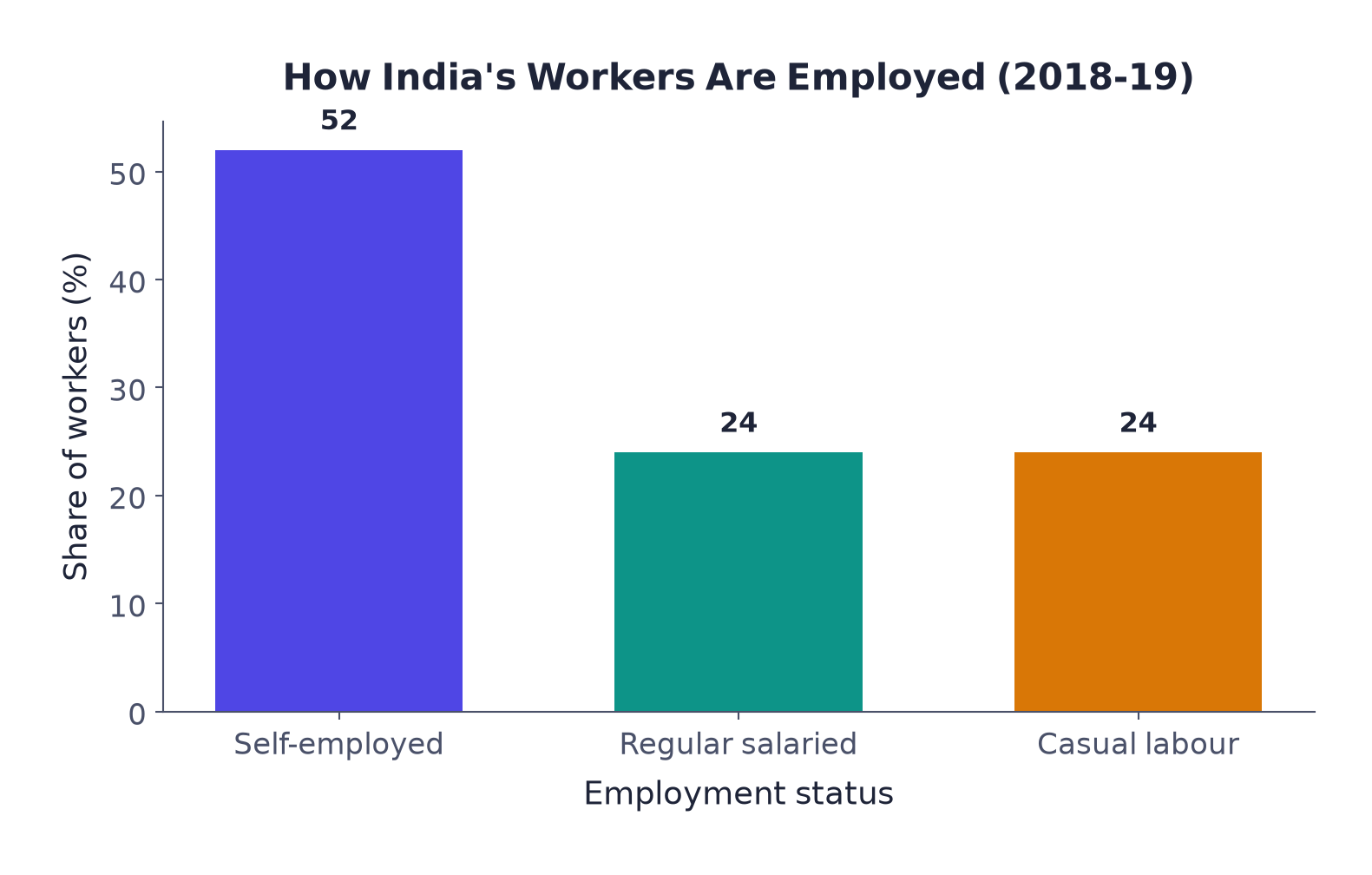
Another sharp difference from developed countries is the number of people in regular, salaried employment. In developed countries the majority are formally employed. In India, over 52% of workers are self-employed, only about 24% are in regular salaried employment, and roughly 24% work as casual labour.
There is a debate over how to define these sectors. According to one definition, the organised (formal) sector consists of all units employing ten or more people throughout the year. These have to be registered with the government so that their employees get proper salaries or wages, pension and other benefits. In India, over 90% of the work, whether in agriculture, industry or services, is in the unorganised (informal) sector.
Few people mix across backgrounds
Very few Indians experience employment in large firms where they meet people from other regions. Most work is still in small-scale workplaces, where personal relationships, not fixed rules, decide a raise, a complaint, or losing a job.
Very few secure jobs
Very few Indians have secure jobs with benefits, and two-thirds of those who do work for the government. That is why people compete hard for government jobs. Government employment has also helped cut across caste, religion and region: one sociologist has argued that there have never been communal riots in a place like Bhilai because the public-sector Bhilai Steel Plant employs people from all over India who work together. Others may question this.
Little experience of unions
Because so few people are union members, a feature of the organised sector, unorganised-sector workers rarely get the experience of fighting collectively for fair wages and safe conditions. The government has laws to monitor the unorganised sector, but in practice they are left to the whims and fancies of the employer or contractor.
3.3 Globalisation, liberalisation and Indian industry
Since the 1990s, the government has followed a policy of liberalisation. Private companies, especially foreign firms, were encouraged to invest in sectors once reserved for government, such as telecom, civil aviation and power. Licenses are no longer required to open industries, and foreign products are now easily available in Indian shops.
Liberalisation let multinationals buy up Indian companies, and some Indian companies became multinationals themselves. The book’s own example: Parle Drinks was bought by Coca-Cola. Parle’s annual turnover was ₹250 crore, while Coca-Cola’s advertising budget alone was ₹400 crore, a scale of advertising that naturally pushed up cola consumption across India, replacing many traditional drinks.
The book names retail as the next major area of liberalisation, and asks you to think: will Indians prefer to shop in neighbourhood grocery stores and small textile shops, or in departmental stores, or will the small shops go out of business?
The government has also been selling its share in public-sector companies, a process called disinvestment. Modern Foods, set up by the government to sell healthy bread at cheap prices, was the first company to be privatised, and 60% of its workers were forced to retire within the first five years.
To sum up the book’s own picture: India is still largely agricultural. The service sector (shops, banks, IT, hotels) is growing along with the urban middle class and its values, but very few Indians have secure jobs, and even the small number in regular salaried work face rising insecurity from contract labour. Government employment, once a major route to well-being, is shrinking. Worldwide, liberalisation and privatisation appear linked to rising income inequality, a theme the next chapter on globalisation takes further.
As secure employment in large industry declines, the government is embarking on a policy of land acquisition for industry. These industries do not necessarily provide employment to people of the surrounding areas, but they cause major pollution. Many farmers, especially adivasis, who are approximately 40% of those displaced, are protesting at the low rates of compensation and at being forced to become casual labour on the footpaths of India’s big cities: the same “competing interests” you studied in Chapter 3.
4How People Find Jobs
Only a small share of people find work through advertisements or an employment exchange. The self-employed, plumbers, electricians and carpenters at one end, private tutors, architects and freelance photographers at the other, all rely on personal contacts and hope their own work will be an advertisement for them. Mobile phones have widened the circle of people they can now serve.
Factory recruitment follows a different pattern. In the past, many workers got their jobs through contractors or jobbers. In the Kanpur textile mills these jobbers were known as mistris, and were themselves workers. They came from the same regions and communities as the workers, but because they had the owner’s backing they bossed over the workers; the mistri also put community-related pressures on the worker. Nowadays the importance of the jobber has come down: both management and unions play a role in recruiting their own people, and many workers also expect that they can pass on their jobs to their children.
A badli worker substitutes for a regular permanent worker who is on leave. Many badli workers have actually worked for many years for the same company but are not given the same status and security. This is what the book calls contract work inside the organised sector.
These schemes aim to generate employment and self-employment to support all sections of society, including marginalised sections such as SC, ST and other backward classes. The book calls them positive signs for creating economic potential amongst India’s demographic dividend (outside the book: the advantage a country gets from having a large share of its population of working age).
Unlike agricultural labourers once tied to a landlord by debt, an industrial casual worker is more free: still in debt, but not bound by other social obligations to the contractor, and free to break the contract and find another employer.
Sometimes whole families migrate together, and children help their parents
5How is Work Carried Out?
A manager’s basic task is to control workers and get more work out of them, in one of two ways: extending working hours, or increasing output within the same time. Machinery helps to increase production, but it also creates the danger that machines will eventually replace workers. Both Marx and Mahatma Gandhi saw mechanisation as a danger to employment.
Workers in textile mills, one of the oldest industries in India, often described themselves as extensions of the machine.
“You need energy. The eyes move, the neck, the legs and the hands, each part moves. Weaving is done under a continuous gaze – one cannot go anywhere, the focus must be on the machine. When four machines run all four must move together, they must not stop.”
Ramcharan, a weaver in the Kanpur cotton mills since the 1940s (Joshi, 2003)
Gandhi (1924, quoted in Activity 5.2) wrote that he objected not to machinery itself but to the “craze for machinery” that throws thousands out of work while trying to save the labour of a few. In 1934 he argued that adopting the spinning wheel as a nation would not only solve unemployment but declare that “we have no intention of exploiting any nation”, and would end the exploitation of the poor by the rich.
The more mechanised an industry, the fewer people it employs, but those who remain must work at the machine’s own pace. At Maruti Udyog Ltd, two cars roll off the assembly line every minute. Workers get only 45 minutes of rest in the entire day: two tea breaks of 7.5 minutes each, and one 30-minute lunch break. Most workers are exhausted by age 40 and take voluntary retirement. The firm has outsourced cleaning, security and even parts manufacture; suppliers deliver parts every two hours (just-in-time), which keeps company costs low but keeps workers tense whenever a delivery is late.
In the services sector, software professionals are middle-class and well educated, and their work is supposed to be self-motivated and creative. Yet, as Box 5.1 shows, it is also subject to Taylorist labour processes (outside the book: the term comes from F. W. Taylor’s idea of breaking work into small, timed, tightly supervised tasks).
An average IT workday runs 10 to 12 hours, and a “night out,” staying overnight for a deadline, is not unusual. Part of the reason is the time difference with client sites in the US, so conference calls fall in the Indian evening. Another reason is that outsourced project costs and timelines are usually underestimated in terms of “mandays” based on an eight-hour day, forcing engineers to put in extra hours to meet deadlines. “Flexi-time” in theory lets an employee choose their hours; in practice it means working as long as it takes. Even without real pressure, employees often stay late from peer pressure or to look hardworking to the boss.
As a result of these working hours, in places like Bengaluru, Hyderabad and Gurugram, where many IT firms and call centres are located, shops and restaurants have also changed their opening hours and are open late. If both husband and wife work, children have to be put in creches, and the joint family, which was supposed to have disappeared with industrialisation, seems to have re-emerged, as grandparents are roped in to help with children.
Deskilling (Harry Braverman) is the argument that the growing use of machinery actually reduces workers’ skill rather than raising it. For example, earlier architects and engineers had to be skilled draughtsmen, but now the computer does a lot of the work for them.
This connects to a live sociological debate: does industrialisation and the shift to services and knowledge-based work, like IT, lead to greater skills in society? We often hear the phrase ‘knowledge economy’ to describe the growth of the IT sector in India. The book poses the comparison directly: a farmer who knows how to grow many hundreds of crops using an understanding of the weather, the soil and the seeds is skilled in a different way from a software professional. Both are skilled, but in different ways.
6Working Conditions
The government has passed a number of laws to regulate working conditions. Take mining, where coal mines alone employ 5.5 lakh workers. The Mines Act, 1952, now folded into the Occupational Safety, Health and Working Condition Code, 2020, fixes the maximum weekly working hours, requires overtime pay, and lays down safety rules. These rules may be followed in big companies, but not in smaller mines and quarries, and sub-contracting is widespread, with many contractors failing to keep proper worker registers, which lets them avoid responsibility for accidents and benefits. Mining companies are also supposed to restore the land once mining ends. The book notes plainly that “they don’t do this.”
Underground mine hazards
- Flooding, fire, roof and side collapse
- Gas emission and ventilation failure
- Breathing diseases: tuberculosis, silicosis
Overground mine hazards
- Working through hot sun and rain
- Injuries from mine blasting and falling objects
- India’s mining-accident rate is high compared to other countries
Fish-processing plants along India’s coastline employ mostly single young women migrants from Tamil Nadu, Karnataka and Kerala. Young women are seen as “submissive” workers. Ten to twelve of them are often housed together in a small room, sometimes sharing it in shifts. Many men also migrate alone. With little time to socialise beyond other migrant workers, this kind of work can mean loneliness and vulnerability. Yet for many young women it also represents some independence and economic autonomy.
7Home-based Work
Home-based work, making lace, zari or brocade, carpets, bidis and agarbattis, is an important part of the economy and is mostly done by women and children. An agent supplies the raw material and collects the finished product; workers are paid on a piece-rate basis, by the number of pieces made.
A person can collect on average 100 bundles of tendu leaves (50 leaves each) a day. During the COVID-19 pandemic of 2020-21, hundreds and thousands of IT workers worked from home. The book’s own Activity 5.3 asks you to compare that experience with a home-based worker’s, to see what the two genuinely share and where they differ.
8Strikes and Unions
In response to harsh working conditions, workers sometimes go on strike. In a strike, workers do not go to work. In a lockout, management shuts the factory gate and keeps workers out. Calling a strike is a hard decision: managers may bring in substitute labour, and workers struggle to survive without wages.
Mill owners did not invest in machinery and modernisation. Today they are trying to sell the mill land to real-estate developers to build luxury apartments, opening a fresh battle over who gets to define Mumbai’s future: the workers who built the city, or the mill owners and real-estate agents.
Q1 framework. Describe any occupation around you along the book’s four lines: (a) social composition of the work force: caste, gender, age, region; (b) labour process: how the work takes place; (c) wages and other benefits; (d) working conditions: safety, rest times, working hours, etc.
Q2, how liberalisation affected employment patterns. Use the book’s points: private and foreign firms in sectors once reserved for the government; Indian companies bought by multinationals (Parle and Coca-Cola); disinvestment (Modern Foods, 60% forced to retire); fewer permanent employees and more outsourcing and contract labour; the service sector employing more people; very few secure jobs and government employment coming down; rising income inequality.
- Marx, Weber and Durkheim linked industry to urbanisation and the loss of face-to-face relationships; alienation is Marx’s term
- India in 2018-19: about 43% in the primary sector, about 25% secondary and about 32% tertiary
- Organised sector (one definition): units employing 10 or more people throughout the year, registered with the government; over 90% of India’s work is unorganised
- Liberalisation since the 1990s brought foreign investment, disinvestment (Modern Foods) and outsourcing
- Badli workers do contract work without permanent status; jobbers/mistris once controlled factory recruitment
- MUDRA, Aatmanirbhar Bharat and Make in India aim to widen employment and self-employment
- Maruti Udyog Ltd shows how machine-paced work and just-in-time outsourcing exhaust workers
- Harry Braverman’s deskilling thesis says machinery can reduce a worker’s skill, not just raise output
- Coal mining employs 5.5 lakh workers under the Mines Act 1952 / OSH Code 2020
- The bidi industry’s chain runs from tendu leaf to pan shop, through contractors, home workers, the manufacturer, a distributor and wholesalers
- The 1982 Bombay Textile Strike, led by Dr Datta Samant, is the chapter’s central case on strikes and unions
- Can I explain alienation in Marx’s own sense, not just as a synonym for loneliness?
- Can I state the organised-sector definition and the over-90% informal-sector figure?
- Can I give the Parle-Coca-Cola example with both figures, ₹250 crore and ₹400 crore?
- Can I describe the bidi industry’s full chain from tendu leaf to pan shop?
- Can I narrate the 1982 Bombay Textile Strike with its leader, duration and outcome?