
Note: This chapter is not part of the CBSE Class 12 Sociology syllabus for 2026-27 (CBSE has deleted it). Students of other boards should check their board’s latest syllabus.
- What “mass media” means, and why sociologists study its growth
- How print, radio and television began and grew in India, before and after Independence
- The named newspapers, radio milestones and TV shows the book gives, with their dates
- How globalisation changed print, television and radio in India from the 1990s
- How to discuss media’s link with the state, the market and Indian society
1What Is Mass Media, and Why Study It?
Mass media are the many forms through which communication reaches very large numbers of people at once: television, newspapers, films, magazines, radio, advertisements, video games and CDs. They are called “mass” because they reach mass audiences, and are also called mass communications.
Everyday examples the book gives: people wake up and switch on the radio or TV before anything else; children check missed calls on mobile phones; plumbers, electricians and other service providers stay reachable on a mobile phone; small shops keep a TV set for customers; NRIs and migrant workers keep in touch with home over the phone and Internet; even CBSE Board results and NCERT books are available online and on mobile.
Historical growth
Media’s structure and content are shaped by the economic, political and socio-cultural context of the time: the state’s vision dominated the early decades after Independence; the market became central after the 1990s globalisation.
A dialectical relationship
Media and society influence each other both ways: media shapes society, and the society it sits in shapes media’s nature and role.
Needs a formal organisation
Unlike ordinary communication, mass communication needs a formal structural organisation to meet large-scale capital, production and management demands: so the state and/or the market always play a major role.
Unequal access
Different sections of people can use mass media with very different ease: recall the digital divide (the gap between those who have easy access to technology like phones and the Internet, and those who do not) from the previous chapter.
27.1 The Beginnings of Modern Mass Media
The printing press was the first modern mass media institution. Though printing existed in some societies for centuries, modern printing technology began in Europe: Johann Gutenberg developed the technique in 1440, and the earliest printed books were religious.
The Industrial Revolution grew the print industry further, but its first products still reached only literate elites. Only in the mid-19th century, with better technology, transport and literacy, did newspapers start reaching a mass audience: people in different parts of a country began reading or hearing the same news.
Scholar Benedict Anderson argued that this shared reading gave people who would never meet each other a sense of belonging: a “we feeling” that helped grow nationalism. He called this the nation as an “imagined community”: people who do not know each other still feel like members of one family.
2.1 The nationalist press and colonial control
19th century social reformers wrote and debated in newspapers and journals, and the growth of Indian nationalism was closely tied to the anti-colonial struggle. The nationalist press nurtured and channelised anti-colonial public opinion: the colonial government responded by clamping down and imposing censorship, for example during the Ilbert Bill agitation of 1883.
| Newspaper | Language | Founder / detail | Year |
|---|---|---|---|
| Sambad-Kaumudi | Bengali | Raja Rammohun Roy: first paper with a distinct nationalist and democratic approach | 1821 |
| Mirat-Ul-Akbar | Persian | Raja Rammohun Roy | 1822 |
| Bombay Samachar | Gujarati | Fardoonji Murzban: pioneer of the Gujarati Press, started as a daily | 1822 |
| Shome Prakash | Bengali | Ishwar Chandra Vidyasagar | 1858 |
| The Times of India | English | Founded in Bombay | 1861 |
| The Pioneer | English | Allahabad | 1865 |
| The Madras Mail | English | — | 1868 |
| The Statesman | English | Calcutta | 1875 |
| The Civil and Military Gazette | English | Lahore | 1876 |
Source: Desai, 1948
Under British rule, radio was wholly owned by the state, so no nationalist views could be expressed on it. Newspapers and films were autonomous of the state but strictly monitored by the Raj. Circulation was limited by literacy, but their influence far exceeded circulation, since news spread by word of mouth from markets, trading centres, courts and towns. Papers that supported the national movement suffered the colonial state’s displeasure but did not stop advocating for it: the book names Kesari (Marathi), Mathrubhumi (Malayalam) and Amrita Bazar Patrika (English).
37.2 Mass Media in Independent India
3.1 The Approach
Jawaharlal Nehru, India’s first Prime Minister, called on the media to function as the “watchdog of democracy” and to spread the spirit of self-reliance and national development. Media was also encouraged to fight social evils such as untouchability, child marriage, ostracism of widows, and beliefs in witchcraft and faith healing, so as to build a rational, scientific ethos for a modern industrial society. The government’s Films Division produced newsreels and documentaries, shown before every film in every movie theatre, documenting the state-directed development process.
3.2 Radio
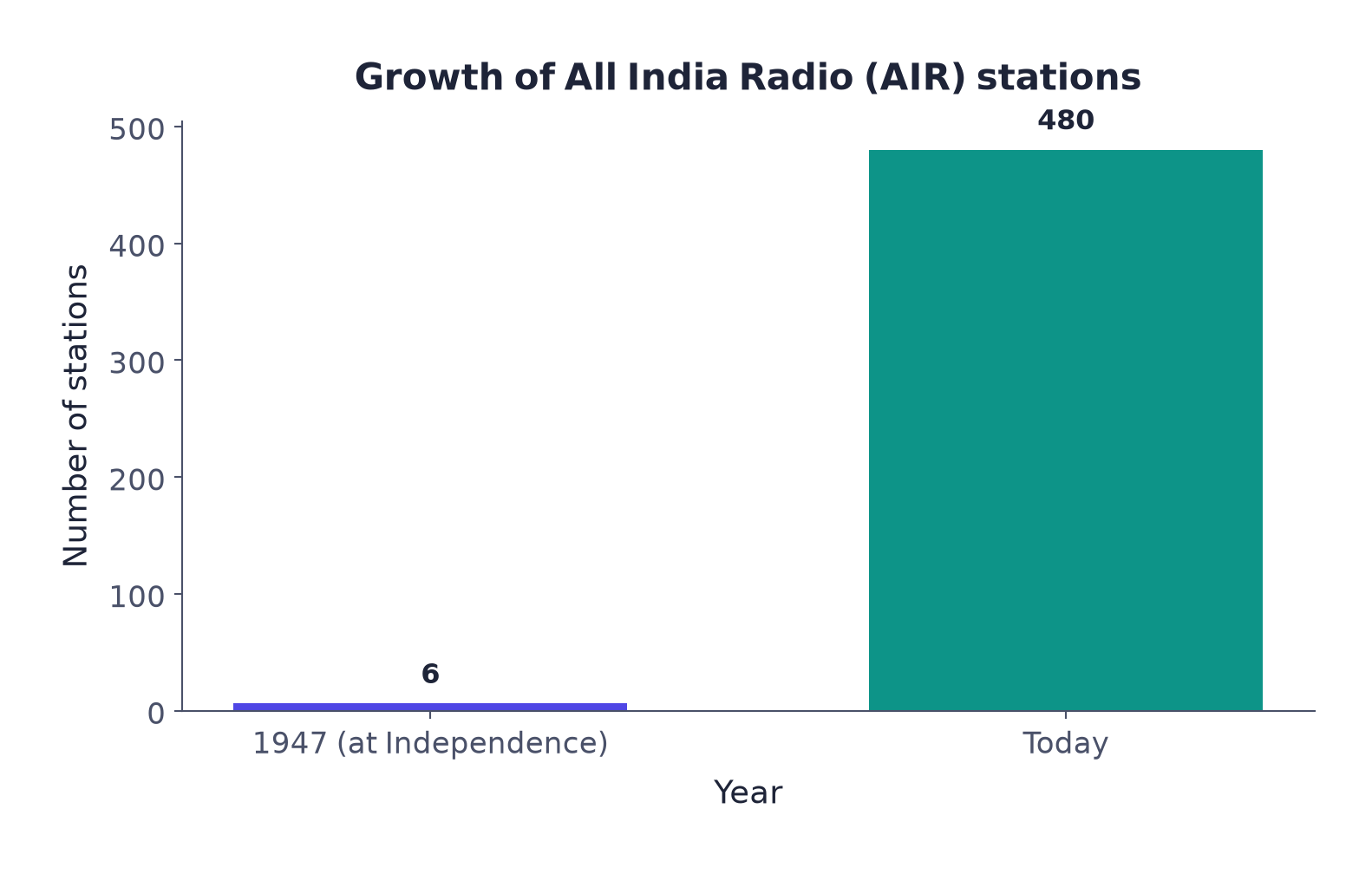
Radio broadcasting began through amateur “ham” broadcasting clubs in Kolkata and Chennai in the 1920s, and matured into a public broadcasting system in the 1940s, when it became a major instrument of Allied propaganda in South-east Asia during World War II. India’s own radio broadcaster, All India Radio (AIR), grew out of this system. At Independence there were only 6 radio stations, all in major cities, serving mainly an urban audience; by 1950 there were 5,46,200 radio licences across India.
In the 1960s, when high-yielding crop varieties were introduced under the Green Revolution, All India Radio ran a major countryside campaign on these crops, sustained day-to-day, for over 10 years starting in 1967. Subject-specialist units at AIR stations visited fields and broadcast first-hand accounts from farmers who had begun growing the new paddy and wheat varieties. Source: B.R. Kumar, “AIR’s broadcasts did make a difference,” The Hindu, 31 December 2006.
Wars and tragedies have repeatedly pushed AIR to expand: the 1962 war with China led to a new “talks” unit for a daily programme; during the Bangladesh crisis in August 1971, the News Service Division began hourly news from 6 am to midnight; and after Rajeev Gandhi’s assassination in 1991, AIR took the further step of round-the-clock bulletins.
3.3 Television
Television was introduced experimentally in 1959 to promote rural development. The Satellite Instructional Television Experiment (SITE) broadcast directly to community viewers in rural areas of six states between August 1975 and July 1976, reaching 2,400 TV sets directly for four hours daily. Meanwhile, Doordarshan, India’s own government-run television channel, set up stations in Delhi, Mumbai, Srinagar and Amritsar by 1975, adding Kolkata, Chennai and Jalandhar within a year. Each centre mixed news, children’s and women’s programmes, farmers’ programmes and entertainment.
As programmes were allowed to carry advertisements, the target audience shifted toward the urban consuming class, and entertainment programming grew. Colour broadcasting began during the 1982 Asian Games in Delhi, and the rapid expansion of the national network led to fast commercialisation.
Hum Log (1984-85)
India’s first long-running soap opera: 156 episodes over 17 months, using an “entertainment-education” strategy. Each 22-minute episode ended with a 30-40 second epilogue by actor Ashok Kumar connecting the drama to viewers’ lives. It drew ratings of 65-90% in North India and 20-45% in South India, ~50 million average viewers, and over 400,000 letters: most never opened.
Buniyaad (1986-87)
Another hugely popular indigenous soap opera of the same period, attracting substantial advertising revenue.
Ramayana (1987-88) & Mahabharata (1988-90)
Serialised epics that were similarly hugely popular and commercially successful for Doordarshan.
Hum Log’s advertising promoted a brand-new consumer product in India, Maggi 2-Minute noodles, and its rapid acceptance showed the power of TV commercials. This marked the start of Doordarshan’s commercialisation. (Box 7.5)
Per TRAI’s (India’s telecom regulator) Annual Report 2015-16, India has the world’s second largest TV market after China. As on March 2016, of the book’s stated 2,841 million households, around 1,811 million have television sets, served by cable TV, DTH and IPTV besides Doordarshan’s terrestrial network.
3.4 Print Media
After Independence, print media continued as a partner in nation-building, taking up developmental issues and giving voice to the widest sections of people.
“Journalism in India used to be regarded as a ‘calling’… conspicuously underpaid… The transformation of the calling into a profession took place over a long period, mirroring the change in character of a newspaper like The Hindu from a purely societal and public service mission into a business enterprise framed by a societal and public service mission.” Editorial, “Yesterday, Today, Tomorrow,” The Hindu, 13 September 2003, quoted in B.P. Sanjay (2006)
Do not confuse the two censorship events in this chapter: colonial censorship followed the Ilbert Bill agitation of 1883; the free press’s gravest post-Independence challenge was the Emergency declared in 1975, with democracy and a free media restored in 1977.
47.3 Globalisation and the Media
Media has always had some international dimensions: gathering news and distributing mostly western films overseas. But until the 1970s, most media companies worked within domestic markets under national regulations, and cinema, print, radio and television operated as distinct, independent sectors. Over the past three decades, national markets have given way to a fluid global market, and new technologies have fused these once-separate media forms together.
Music travels across globalisation more easily than other media because it reaches people who do not know the spoken or written language. Technology moved it along a chain: personal stereo systems, then music television (like MTV), then the compact disc (CD). Now the Internet lets music be downloaded digitally, which some feel threatens the traditional industry of factories, distribution chains, music shops and sales staff built around physical CDs and cassettes.
4.1 Print Media under globalisation
Many feared television and the Internet would sideline print media. In India this did not happen; newspaper circulation actually grew. Two reasons the book gives: (1) a rise in literate people migrating to cities, and (2) readers in small towns and villages having different needs from city readers, met through district and block editions.
The book’s figures for the first reason: the Hindi daily Hindustan printed 64,000 copies of its Delhi edition in 2003 and 425,000 by 2005, because of Delhi’s population of one crore and forty-seven lakhs, 52% had come from the Hindi belt of Uttar Pradesh and Bihar; of these, 47% came from a rural background and 60% were less than 40 years of age.

Hindi, Telugu and Kannada recorded the highest circulation growth. Regionally, the north zone grew fastest at 7.83%, ahead of the south (4.95%), west (2.81%) and east (2.63%). The top two Hindi dailies by average qualifying sales (July-December 2016) were Dainik Jagran (3.92 million) and Dainik Bhaskar (3.81 million). Source: Audit Bureau of Circulation, 2016-17.
Eenadu’s story: founder Ramoji Rao successfully ran a chit-fund (a savings-and-lending scheme where a group of people pool money and take turns receiving the pooled amount) before launching the Telugu paper in 1974; associating with the anti-arrack movement (a mid-1980s campaign against the sale of liquor) helped it reach the countryside, and it launched “district dailies” in 1989: tabloid inserts with sensational district news and classified ads from villages and small towns. By 1998, Eenadu published from 10 towns in Andhra Pradesh and held 70% of audited Telugu daily circulation.
Malayala Manorama and Eenadu pioneered district and block editions for local news; Dina Thanthi (Tamil) always used simple, colloquial language; and the Dainik Bhaskar group grew through consumer contact programmes, door-to-door surveys and research.
| Earlier figure | By 2019 | |
|---|---|---|
| Indian-language daily readers | 191 million | 425 million |
| English daily readers | Stagnant at around 31 million | |
In 2005: Dainik Jagran led with 74 million readers, Dainik Bhaskar with 51 million; among English dailies, The Times of India had over 15.2 million readers and The Hindu 5.3 million. Of the top 10 “ten million club” dailies, six were Hindi, two Malayalam, one Tamil and one English. Source: http://mruc.net
English newspapers (“national dailies”) circulate across regions, while vernacular newspapers grew fastest in the states and rural hinterland. To compete with electronic media, English newspapers reduced prices and launched multi-centre editions.
From the late 1980s, newspapers became fully automatic from a reporter’s desk to the final page-proof, ending the use of paper in production: enabled by PCs networked over LANs and newsmaking software like “Newsmaker.” A reporter’s old tools (shorthand notebook, pen, typewriter, plain telephone) were replaced by a digital recorder, laptop or PC, mobile/satellite phone, modem, dish and antenna: letting managements push deadlines to dawn and add editions. Amar Ujala (Meerut-based) is the book’s example: about 100 reporters/staffers and an equal number of photographers feeding 13 editions across Uttar Pradesh and Uttarakhand, all equipped with PCs, modems and digital cameras.
Infotainment is a combination of information and entertainment in news content, adopted by newspapers to hold the interest of readers with varied, segmented interests: older readers reading a paper in its entirety, younger readers going straight to sports, entertainment or gossip pages. (Box 7.11)
4.2 Television under globalisation
Privately run satellite channels have multiplied rapidly since the mid-1990s. In 2020, while Doordarshan broadcast over 35 channels, there were about 900 private television networks. On average 134 million individuals watched satellite TV every week in 2002, rising to 190 million in 2005.
The 1991 Gulf War popularised CNN, and Star-TV was launched the same year by the Whampoa Hutchinson Group of Hong Kong: together signalling the arrival of private satellite channels in India. Zee TV, a Hindi satellite entertainment channel, began in 1992. By 2000, India had 40 private cable and satellite channels, including regional ones such as Sun-TV, Eenadu-TV, Udaya-TV, Raj-TV and Asianet.
Through the 1980s, while Doordarshan expanded, the cable TV industry mushroomed in major cities, and the VCR multiplied entertainment options. Cable operators grew explosively:
Number of cable operators in India: a roughly 600-fold jump in 15 years.
Transnational channels (Star TV, MTV, Channel [V], Sony) worried some observers about the impact on Indian youth and culture. But research showed that “the familiar” worked better with India’s diverse audiences. Most foreign networks added a Hindi segment (MTV India) or launched a full Hindi channel (STAR Plus); STAR Sports and ESPN offered Hindi audio tracks; larger players launched regional channels in Bengali, Punjabi, Marathi and Gujarati.
The book’s most dramatic localisation example is STAR Plus. Originally all-English and from Hong Kong, it began a Hindi programming belt (7-9 PM) from October 1996, and by February 1999 converted to a fully Hindi channel, moving its English shows to STAR World. Its Hinglish slogan for the change was “Aapki Boli. Aapka Plus Point” (Butcher, 2003).
Most channels run 24×7 with a lively, informal news format that has made news “more immediate, democratic and intimate,” expanding public debate, while raising the question of whether serious political and economic issues get neglected. Entertainment TV produced superstars whose private lives fill gossip columns, and reality shows like Kaun Banega Crorepati, Indian Idol and Bigg Boss, largely modelled on western formats, grew hugely popular.
- DiscussIs this competitive live coverage a form of voyeurism, or a positive use of television to highlight events, or both?
A soap opera is a serialised, continuous story with no ending until it is taken off air completely: individual storylines and characters may end or disappear, but regular viewers build a history with the characters, their personalities and life experiences. (Box 7.13)
4.3 Radio under globalisation
By 2000, AIR reached two-thirds of Indian households in 24 languages and 146 dialects over ~120 million radio sets. Privately owned FM stations arrived in 2002, boosting entertainment programming: but private FM channels are not permitted to broadcast political news bulletins, so many specialise in a particular kind of popular music to hold their audience.
| FM channel | Owned by |
|---|---|
| Radio Mirchi | The Times of India group |
| Red FM | Living Media |
| Radio City | The Star Network |
Independent public-broadcasting stations like National Public Radio (USA) or the BBC (UK) are missing from India’s broadcasting landscape.
Rang De Basanti
- An angry college youth, inspired by the legend of Bhagat Singh, assassinates a minister
- Then captures All India Radio to broadcast his message to the people
Lage Raho Munna Bhai
- The heroine is a radio jockey who wakes the country with “Good Morning Mumbai!”
- The hero also uses the radio station to save a girl’s life
Possibly the only village FM radio station on the Asian sub-continent. Raghav Mahato, a mechanic in rural Bihar since 1997, built his own transmission kit around 2003 for ₹50, fitted to an antenna on a bamboo pole atop a neighbouring three-storey hospital. His station reaches thousands of villagers within a 20 km (12 mile) radius, broadcasting film songs, HIV and polio public-interest messages, and local news (missing children, new shop openings) from about 200 tapes of Bhojpuri, Bollywood and devotional songs. He earns nothing from the station, earning only about ₹2,000 a month from his repair shop instead, and did not know a government licence was required; villagers persuaded him to resume broadcasting after he once shut it down on hearing it was illegal. Source: BBC News (Amarnath Tewary), published 24 February 2006.
The book sees enormous potential in FM growth: further privatisation and community-owned radio stations are expected to drive it, alongside a growing demand for local news, matching a worldwide trend of local radio replacing large networks.
5Conclusion
Mass media is an essential part of our personal and public life today.
the chapter’s own closing line
This chapter cannot capture every reader’s personal experience of media, but it focuses on media’s key dimensions: its link with the state and the market, its social organisation and management, and its relationship with readers and audiences: looking both at the constraints media operates within, and the many ways it affects our lives.
- Mass media = forms reaching very large audiences at once; needs a formal organisation (state and/or market)
- Printing press (Gutenberg, 1440) is the first modern mass media institution; newspapers reached mass audiences only from the mid-19th century
- Benedict Anderson: newspapers built a sense of nationhood: the nation as an “imagined community”
- Colonial era: radio state-owned; press autonomous but monitored; Ilbert Bill agitation (1883) triggered censorship; Kesari, Mathrubhumi, Amrita Bazar Patrika persecuted
- Independent India: Nehru called media the “watchdog of democracy”; radio began 1920s, matured 1940s, 6 stations at Independence; TV began 1959, SITE (1975-76), Doordarshan’s first 4 cities by 1975
- Hum Log (1984-85), Buniyaad, Ramayana, Mahabharata were Doordarshan’s biggest hits; Emergency (1975-77) was print media’s gravest post-Independence challenge
- Globalisation (post-1970s/1990s): national markets became a global market; media forms fused together; print media grew rather than declined in India (Box 7.8, 7.9)
- TV: private satellite channels arrived after the 1991 Gulf War and Star-TV’s launch; STAR Plus’s Hindi conversion (1996-99) is the classic localisation example
- Radio: private FM arrived 2002, cannot air political news; Raghav FM Mansoorpur 1 (Box 7.14) shows community radio’s reach and limits
- Can I explain why sociologists say media and society have a “dialectical” relationship?
- Can I name at least five newspapers from Box 7.1 with their language, founder and year?
- Can I trace radio’s growth from 6 stations (1947) to today’s 480 stations?
- Can I explain “imagined community,” “infotainment” and “soap opera” in one line each?
- Can I describe how STAR Plus localised into a Hindi channel, with the two key dates?