
Pattern: CBSE 2026-27 official Sample Question Paper (SQP) design · Maximum marks: 80 · Time: 3 hours. Solve the paper first, then open the marking scheme at the end to check your answers.
SOCIOLOGY (039)
General Instructions:
Read the following instructions carefully and follow them:
- This question paper contains 35 questions. All questions are compulsory.
- The question paper is divided into four sections: Sections A, B, C and D.
- Section A: Questions 1 to 16 are Multiple Choice type questions. Each question carries 1 mark.
- Section B: Questions 17 to 25 are Very Short Answer type questions. Each question carries 2 marks. Answer to each question should not exceed 30 words.
- Section C: Questions 26 to 32 are Short Answer type questions. Each question carries 4 marks. Answer to each question should not exceed 80 words.
- Section D: Questions 33 to 35 are Long Answer type questions. Each question carries 6 marks. Answer to each question should not exceed 200 words.
- Question 33 is to be answered with the help of the given graph.
- There is no overall choice. However, an internal choice has been provided in some questions (Questions 18, 22 and 26). Attempt only one of the alternatives in such questions.
- Note: A separate question has been provided for candidates with Visual Impairment in lieu of the question having a visual input (Question 33). It is to be attempted by Visually Impaired candidates only.
Assertion (A): Malthus argued that the only way to increase prosperity was to control the growth of population.
Reason (R): According to Malthus, population grows in geometric progression while agricultural production grows only in arithmetic progression.
Assertion (A): Caste is determined by birth; a child is born into the caste of its parents.
Reason (R): A person can change his or her caste by acquiring education and wealth.
- India was perhaps the first country to explicitly announce a population policy, in 1952.
- During the National Emergency (1975-76), the family planning programme used coercive methods such as mass sterilisation.
- After the Emergency, the National Family Planning Programme was renamed the National Family Welfare Programme.
Which of the statements given above are correct?
Assertion (A): The commercialisation of agriculture strengthened the hereditary bonds between landowners and agricultural workers.
Reason (R): In the Green Revolution regions, payment to agricultural workers shifted from payment in kind (grain) to payment in cash.
Assertion (A): Most of the work in India, whether in agriculture, industry or services, is done in the organised sector.
Reason (R): Units in the organised sector have to be registered with the government so that their employees get proper wages, pension and other benefits.
- The 1850 Act was used to allow Dalits to enter government schools.
- The 93rd Amendment introduced reservation for the Other Backward Classes in institutions of higher education.
- The 1850 Act and the 93rd Amendment were both mainly concerned with land rights.
Which of the statements given above are correct?
- Scheduled Castes and Scheduled Tribes (Prevention of Atrocities) Act
- Caste Disabilities Removal Act
- Constitution Amendment (Ninety Third Amendment) Act
- The Constitution of India, which abolished untouchability
Assertion (A): The Bombay Textile Strike of 1982 was led by the trade union leader Dr. Datta Samant.
Reason (R): The strike ended within a few months because the mill owners accepted all the demands of the workers.
Assertion (A): In many poor regions, cultivation has become primarily a female task.
Reason (R): Male members of families from these regions spend much of the year working outside their villages.
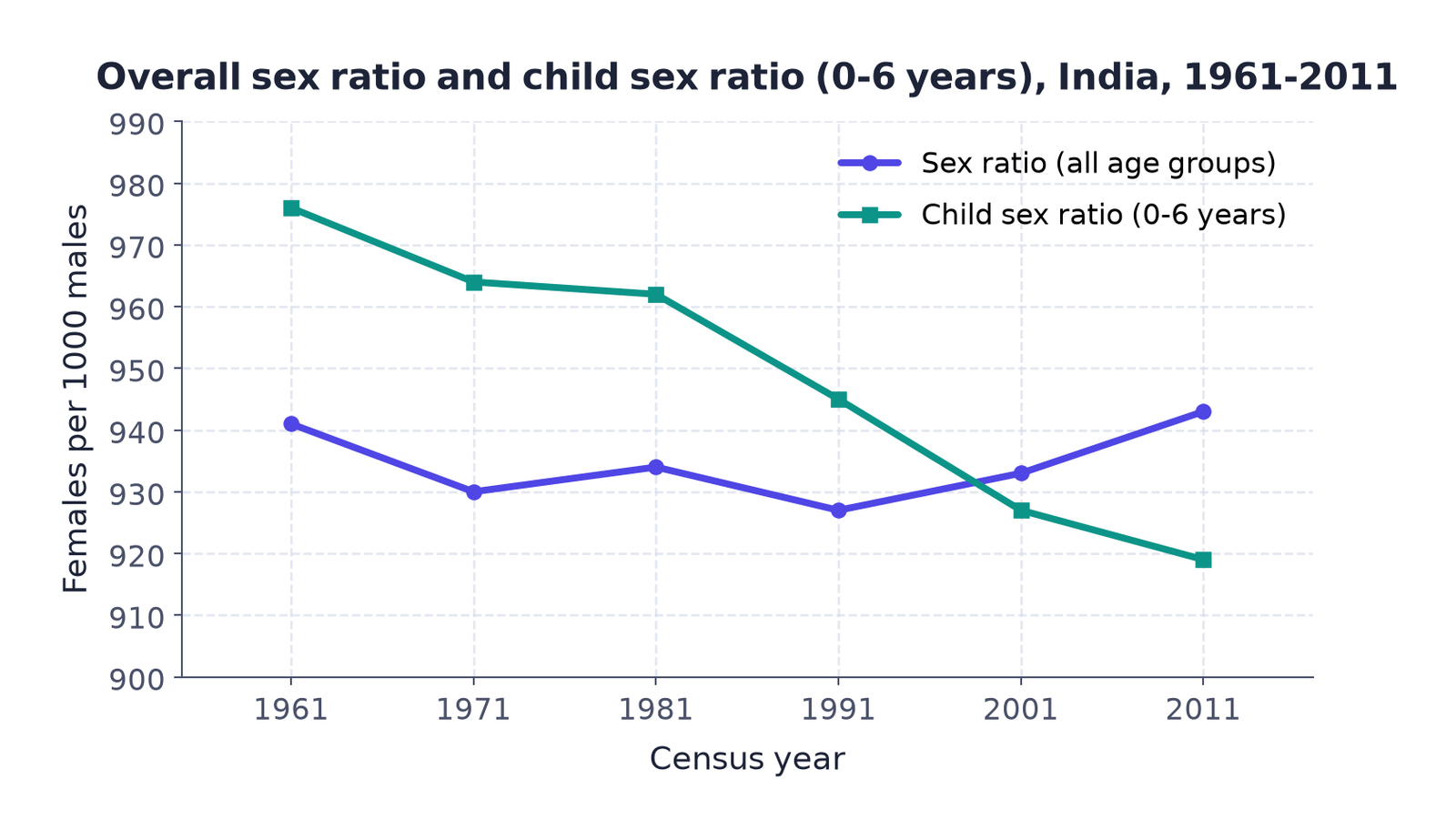
Read the following information and answer the questions that follow.
According to the Census, India’s overall sex ratio (females per 1000 males) was 941 in 1961, 930 in 1971, 934 in 1981, 927 in 1991, 933 in 2001 and 943 in 2011. The child sex ratio (0-6 years) was 976 in 1961, 964 in 1971, 962 in 1981, 945 in 1991, 927 in 2001 and 919 in 2011.
Examine how the policy of liberalisation followed since the 1990s has changed Indian industry and the lives of workers.
Marking Scheme / अंकन योजना (उत्तर देखें)
SOCIOLOGY (039)
For examiners and students:
- For multiple choice questions, both the letter of the correct option and the answer are given.
- For descriptive questions, value points are given with marks. ‘Any two/four/six’ means that full marks are given for that many correct points from those listed.
- Any other relevant point based on the NCERT textbooks may also be accepted.
- Word limits (Section B: 30 words; Section C: 80 words; Section D: 200 words) guide the length of answers; do not deduct marks for a few words more.
- This is due to population momentum: a large cohort of women is now in the reproductive age group. (1)
- Even if each woman has fewer children than earlier generations, the total number of births stays high, so the population keeps growing over the next generation. (1)
- Poverty leads to disability: malnutrition, mothers weakened by frequent childbirth, inadequate immunisation and accidents in overcrowded homes make disability more common among the poor. (1)
- Disability creates and exacerbates poverty by increasing isolation and economic strain, not just for the individual but for the family. (1) [Also accept: barriers to education and employment.]
- Exclusion, humiliation-subordination and exploitation. (1)
- Any one explained (1), e.g. exclusion: Dalits are prohibited from sharing drinking water sources or taking part in collective worship, social ceremonies and festivals; exploitation: forced, unpaid or under-paid labour, or confiscation of property; humiliation-subordination may be accepted if suitably explained, but exclusion and exploitation are the dimensions NCERT explains.
- Matriliny: descent and property pass from mother to daughter (through the female line). (1)
- Matriarchy: women exercise authority and dominance (as men do in patriarchy); it is a theoretical concept with no historical or anthropological evidence of such societies. (1)
- In their creation, language did not play a prominent role, unlike the linguistic states of 1956. (1)
- Instead, a combination of ethnicity based on tribal identity, language, regional deprivation and ecology gave rise to the regionalism that led to statehood. (1)
- Economic capital (material assets and income), cultural capital (educational qualifications and status) and social capital (networks of contacts and associations). (1)
- Example (1): a well-off family (economic capital) can pay for expensive higher education (cultural capital); OR influential relatives and friends (social capital) can help a person get a well-paid job.
- Civil society is the non-state and non-market part of the public domain, beyond the family, in which individuals come together voluntarily to create institutions and organisations. (1)
- Any two issues (½ + ½): tribal struggles for land rights; devolution in urban governance; campaigns against rape and violence against women; rehabilitation of people displaced by dams; fishermen’s struggles against mechanised fishing; housing rights; primary education reform; the Right to Information campaign.
- Weber: the state is a body that successfully claims a monopoly of legitimate force in a particular territory. (1)
- Nations are communities that have a state of their own; in recent times there has been a one-to-one bond between nation and state, hence ‘nation-state’. (1)
- Any two (1 + 1):
- Adivasis were not always oppressed: there were Gond kingdoms in Central India, such as Garha Mandla and Chanda.
- Many so-called Rajput kingdoms of central and western India emerged through stratification among adivasi communities.
- Adivasis often dominated plains people through raids and through their services as local militias.
- They occupied a special trade niche, trading forest produce, salt and elephants.
- The capitalist drive to exploit forest resources and minerals and to recruit cheap labour brought tribal societies into contact with mainstream society long ago.
- Strike: the workers do not go to work, as a form of protest. (1)
- Lockout: the management shuts the gate and prevents the workers from coming to work. (1)
- Social change is continuous and ongoing; it is the sum total of countless individual and collective actions across time and space (e.g. sanskritisation, westernisation). (1)
- A social movement is directed towards specific goals and involves long and continuous social effort and action by people (e.g. the efforts of 19th-century social reformers). (1)
- Why (2 marks): inputs (HYV seeds, fertilisers, pesticides) were expensive, and small and marginal farmers could not afford to spend as much on them; (1)
- farmers who could produce a surplus for the market, with access to land, capital, technology and know-how, reaped the most benefits, so inequality increased in the first phase. (1) [Supporting point: the package went only to areas with assured irrigation.]
- Effects (2 marks): tenants: as cultivation became profitable, landowners took back land from tenants and cultivated it directly, displacing tenant-cultivators; (1)
- service castes: machinery such as tillers, tractors, threshers and harvesters displaced the service caste groups who did these tasks, and increased rural-urban migration. (1)
- Meaning (1): the company identifies the crop, supplies seeds, inputs, know-how and often working capital, and guarantees to buy the produce at a predetermined fixed price (e.g. farmers in Punjab and Karnataka contracting with companies such as PepsiCo).
- Effects, any three (1 each): it seems to give financial security but creates insecurity, as farmers become dependent on the companies for their livelihood;
- export-oriented crops such as flowers and gherkins divert land away from food grain production;
- it disengages people from the production process and makes their indigenous knowledge of agriculture irrelevant;
- it caters mainly to elite items and, needing high doses of fertilisers and pesticides, is often not ecologically sustainable.
- These groups benefited most from the developmental policies after independence, so caste seems to have declined in significance for them.
- It appears to have declined precisely because it has done its job so well: their caste status gave them the economic and educational resources to use the new opportunities.
- The upper caste elite benefited from subsidised public education, especially professional education in science, technology, medicine and management, and from the expansion of public sector jobs.
- By the second and third generations, their economic and educational capital alone ensures the best life chances, so they believe their advancement had little to do with caste; caste seems limited to religious practice, marriage and kinship.
- For the SCs, STs and OBCs the opposite has happened: caste has become all too visible, as it is one of the few collective assets they have (reservations are their lifeline).
- Communalism is an aggressive political ideology linked to religion (aggressive chauvinism based on religious identity).
- There is no necessary relationship between personal faith and communalism: a communalist may or may not be devout, and devout believers may or may not be communalists.
- All communalists believe in a political identity based on religion and cultivate an aggressive attitude towards those with other identities, condemning or attacking them.
- It claims that religious identity overrides everything else (class, occupation, caste, political beliefs), constructing large and diverse groups as singular and homogeneous.
- Coastal cities such as Mumbai, Kolkata and Chennai were favoured, as primary commodities could be easily exported from them and manufactured goods cheaply imported.
- Bombay was planned and re-developed so that by 1900 over three-quarters of India’s raw cotton was shipped through the city.
- Calcutta exported jute to Dundee, while Madras sent coffee, sugar, indigo dyes and cotton to Britain.
- These cities were the concrete expression of global capitalism; older centres such as Surat and Masulipatnam declined while the new colonial cities (e.g. Kolkata, from three villages leased by Job Charnock in 1690) grew.
- One kind: a westernised sub-cultural pattern among a minority of Indians (intellectuals, many early 19th-century reformers) who adopted Western ways of thinking and styles of life and supported their spread.
- Another kind: the general spread of Western cultural traits such as new technology, dress, food and habits (e.g. television, fridge, sofa set and dining table in middle-class homes).
- People may be Western educated yet hold prejudiced views about some ethnic or religious communities, or decorate their homes in Western style yet keep conservative ideas about women’s role.
- Female foeticide combines a discriminatory attitude towards women with the use of very modern technology.
- Abolition of the zamindari system: the most effective; in most areas it took away the superior rights of the zamindars and strengthened actual landholders and cultivators. (1)
- Tenancy abolition and regulation acts: tried to outlaw tenancy or regulate rents; in most states never implemented effectively, except West Bengal and Kerala, where tenants got land rights. (1)
- Land Ceiling Acts: set an upper limit on land owned by a family, surplus to go to the landless, SCs and STs; but in most states they proved ‘toothless’. (1)
- Landowners escaped through loopholes and ‘benami transfers’ (some even divorced their wives on paper); so the agrarian structure remains highly unequal. (1)
- Raja Rammohun Roy led the campaign against sati in Bengal (a decade before founding the Brahmo Samaj in 1828), using both humanitarian and natural rights ideas and the Hindu shastras.
- M.G. Ranade, in the Bombay Presidency, supported widow remarriage and wrote on the shastric sanction for the remarriage of widows.
- Jotiba Phule, from a socially excluded caste, attacked both caste and gender discrimination; he founded the Satyashodak Samaj and worked for women and untouchables.
- Sir Syed Ahmed Khan (like Dayanand Saraswati of the Arya Samaj) supported education for girls, though within the home and with religious and household training.
- Most reformers drew on both modern Western ideas and India’s own traditions and sacred texts.
- Overall sex ratio: fell from 941 (1961) to an all-time low of 927 (1991), then rose to 933 (2001) and 943 (2011). (1)
- Child sex ratio: fell steadily from 976 to 919; the sharpest fall was in 1991-2001 (945 to 927), when it dropped below the overall ratio for the first time. (1)
- Any two (1 + 1): severe neglect of girl babies in infancy, leading to higher death rates; sex-specific abortions using ultrasound (sonogram) technology; female infanticide due to religious or cultural beliefs; son preference.
- States with high per capita income (e.g. Haryana, Punjab, Maharashtra, Chandigarh, Delhi) have low child sex ratios, so the problem is not due to poverty, ignorance or lack of resources. (1)
- It points to deliberate choice: prosperous families who want fewer children also wish to choose the child’s sex and can afford ultrasound for sex selection, reflecting bias against girl children. (1)
- Private companies, especially foreign firms, are encouraged to invest in sectors earlier reserved for the government (telecom, civil aviation, power); licences are no longer required to open industries.
- Many Indian companies have been bought over by multinationals, e.g. Parle drinks by Coca Cola (Parle’s turnover Rs 250 crore against Coca Cola’s advertising budget of Rs 400 crore), and traditional drinks were replaced.
- Disinvestment: the government sells its share in public sector companies; workers fear job loss. In Modern Foods, the first company to be privatised, 60% of the workers were forced to retire in five years.
- Outsourcing to smaller firms and homes: small firms compete for orders, so they keep wages low and working conditions poor; trade unions find it hard to organise there.
- Even regular salaried jobs are becoming insecure because of the rise of contract labour; employment by the government is also coming down.
- Liberalisation and privatisation appear to be associated with rising income inequality; very few Indians have access to secure jobs.
- Foreign products are now easily available in Indian shops, and liberalisation is extending to retail, threatening small neighbourhood shops.
- Any two (1 + 1): old movements aimed at reorganising power relations (class-based demands such as wages and social security), new ones focus on quality-of-life issues such as a clean environment;
- old movements functioned within the frame of political parties (e.g. Congress, Communist Party of China), new ones often work outside parties as non-party formations;
- new movements are not organised along class lines alone; identity politics and cultural concerns unite people across classes (e.g. the women’s movement);
- many new social movements are international in scope.
- People’s growing dissatisfaction with parliamentary democracy; the institutions of the state had been captured by elites. (1)
- Electoral representation through political parties was no longer an effective way for the poor to be heard, so people left out of the formal political system joined social movements or non-party political formations to put pressure on the state from outside. (1)
- Globalisation: firms are transnational, binding legal arrangements are international (e.g. WTO rules), and environmental and health risks and fears of nuclear war are global. (1)
- Example: old and new movements work together in new international alliances such as the World Social Forum, raising awareness about the hazards of globalisation. (1) [Also accept environmental, anti-nuclear or women’s movements working across borders.]