
- Tell a concave mirror from a convex mirror, and draw the symbol for each
- Describe the images that plane, concave and convex mirrors form as the object moves away
- State and draw the two laws of reflection, and work out angles from them
- Explain why a concave mirror converges light and a convex mirror diverges it
- Tell a convex lens from a concave lens and describe what you see through each
- Match every mirror and lens to its everyday uses
1 What Are Spherical Mirrors?
A plane mirror is flat. Some mirrors are curved instead, and they make your face look strangely big, tiny or even upside down. You can see this with a shiny metallic spoon (Activity 10.1):
Inner side of the spoon (curved inwards)
- Your image is inverted (upside down)
Outer side of the spoon (bulges outwards)
- Your image is erect (upright) but smaller
Curved mirrors like the spoon can also be specially made. A common type of curved mirror, the spherical mirror, is shaped like a part of a hollow glass sphere.
Spherical mirrors: Mirrors whose reflecting surfaces are spherical are called spherical mirrors.
The reflecting surface can curve inwards or outwards, which gives two kinds of spherical mirror. The outline of the mirror’s surface is circular.
Concave mirror: A spherical mirror which has a reflecting surface that curves inwards is called a concave mirror.
Convex mirror: A spherical mirror which has a reflecting surface that curves outwards is called a convex mirror.

ConCAVE caves in
A concave mirror is hollow like the mouth of a cave, so it curves inwards. A convex mirror bulges out towards you, like the back of a spoon.
1.1 How spherical mirrors are made
- They are not made by slicing a hollow glass sphere.
- A flat piece of glass is shaped by grinding and polishing it into a curved surface.
- A reflective coating, like a thin layer of aluminium, is then applied.
| Coating applied on the | Mirror formed |
|---|---|
| Outer curved surface | Concave mirror |
| Inner curved surface | Convex mirror |
How to tell them apart (Activity 10.2): place both mirrors on a table with the reflecting surfaces facing up and look from the side at eye level. The one curved inwards is concave; the one curved outwards is convex.
2 Images Formed by Spherical Mirrors
Five words describe any image. Learn them first, because the chapter’s questions use them.
| Word | Meaning |
|---|---|
| Erect | Upright, the same way up as the object |
| Inverted | Upside down |
| Enlarged | Bigger than the object |
| Diminished | Smaller than the object |
| Lateral inversion | Left and right are swapped in the image (your right hand looks like a left hand) |
In Activity 10.3 a small toy is kept 3 to 4 cm in front of a concave and a convex mirror, then slowly moved away. This is what you see:
| Mirror | Object close to the mirror | Object moved farther away |
|---|---|---|
| Plane | Erect, same size | Always erect, always the same size |
| Concave | Erect and enlarged | Becomes inverted; first enlarged, then keeps getting smaller |
| Convex | Erect and diminished | Always erect and diminished; size decreases slightly |
- In spherical mirrors, the size of the image changes as the object’s distance changes. A plane mirror never does this.
- Depending on the distance, a concave mirror’s image can be enlarged, diminished or of the same size as the object (Snapshots).
- Lateral inversion is seen in all three: plane, concave and convex.
- So you can identify a mirror just by looking at the images it forms.
“A concave mirror always makes things bigger” is wrong. Close up the image is enlarged, but far away it is inverted and finally smaller.
2.1 Uses of concave mirrors
Torch and headlights
The reflectors of torches and the headlights of cars and scooters are concave.
Dental mirror
A dentist’s mirror is concave. Held close to the teeth, it gives an enlarged view of them.
Telescopes
Most modern telescopes are reflecting telescopes; their main mirror is a large concave mirror.
2.2 Uses of convex mirrors
Side-view mirror
Always gives an erect, smaller image of the traffic behind, and because it curves outwards it shows a much wider area of the road.
Road safety mirror
Put up at road intersections and sharp bends so drivers from both sides can see the other side, which prevents collisions.
Surveillance mirror
Installed in big stores to watch a large area and deter thefts.

Side-view mirrors carry the warning “Objects in mirror are closer than they appear”. The book asks why but does not explain it. One explanation: the convex mirror makes the vehicles behind look smaller than they really are, so they seem farther away than they actually are.
3 The Laws of Reflection
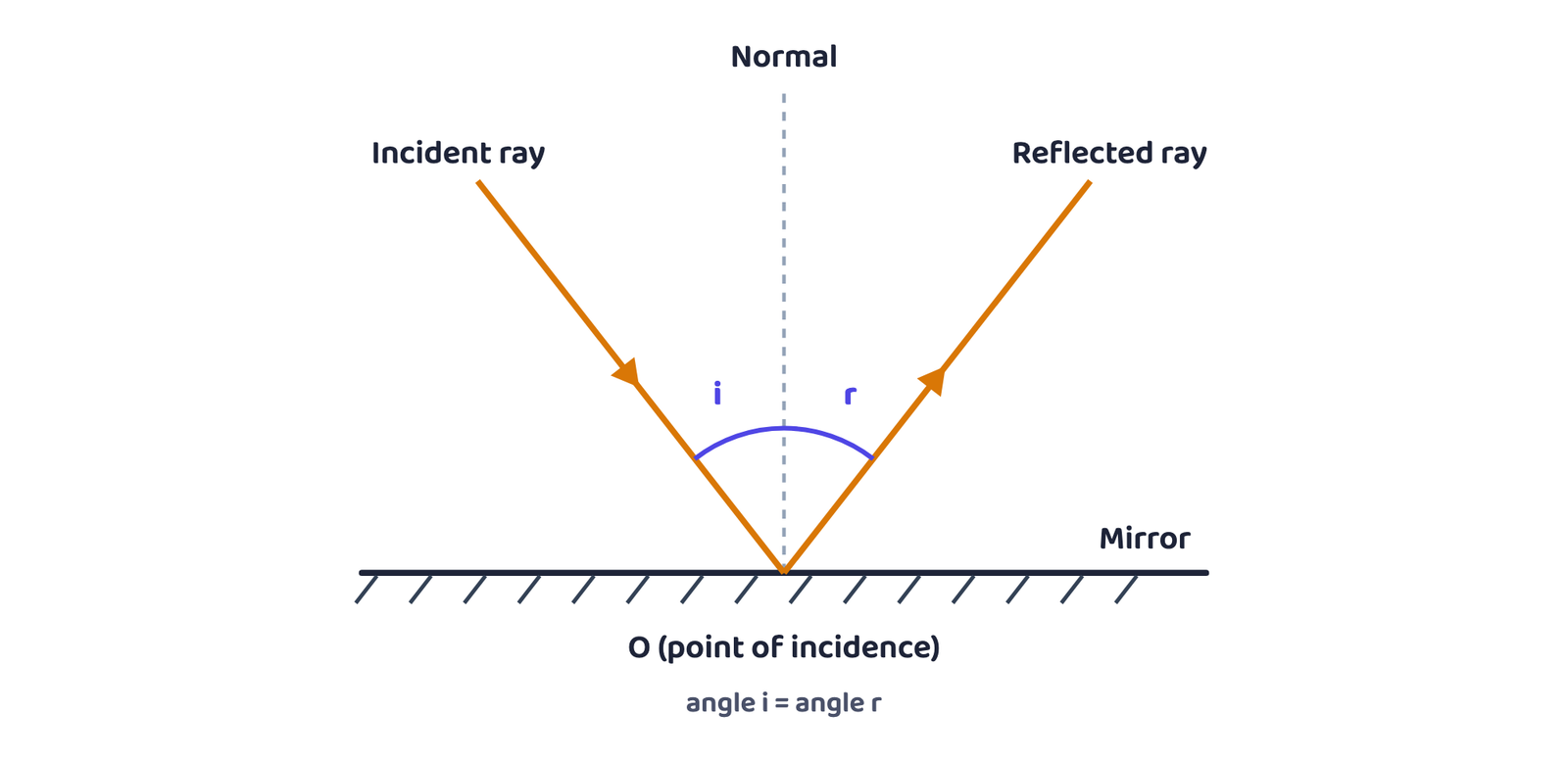
We show light using rays: straight lines with arrows. A ray shows the path along which light travels, and light travels in a straight line.
In Activity 10.4, a torch shines through a comb with only one gap open. This makes a thin beam, which falls on a plane mirror kept upright on white paper. When the beam falls at a different angle, the reflected beam also shifts. Drawing the beams on paper gives these terms:
Incident ray: The ray of light that falls on the mirror.
Reflected ray: The ray of light that comes back from the mirror.
Normal: The line drawn at an angle of 90° to the mirror at the point where the incident ray strikes it (the point of incidence, O).
Angle of incidence (i): The angle between the normal and the incident ray.
Angle of reflection (r): The angle between the normal and the reflected ray.
3.1 First law of reflection
The angles are measured for several beams and written in Table 10.1 (angle of incidence, angle of reflection). The measured angles come out nearly equal. If done carefully, the experiment shows that the angle of incidence is equal to the angle of reflection.
The angle of incidence is equal to the angle of reflection.
First law of reflection: ∠i = ∠r
Special case: if the beam falls on the mirror along the normal, the angle of incidence is 0° and the angle of reflection is also 0°. The ray goes straight back along the same path.
3.2 Second law of reflection
Activity 10.5 uses a stiff chart paper lying flat, with part of it sticking out beyond the table’s edge. The reflected beam is seen on the extended part. When that part is bent down, the reflected beam disappears; when it is flattened again, the beam comes back. Bending the paper makes a new plane, so the reflected beam must lie in the same plane as the incident beam.
The incident ray, the normal to the mirror at the point of incidence, and the reflected ray, all lie in the same plane.
Second law of reflection
A step further: if two incident rays come from different directions but fall at the same point on the mirror, the normal there is the same for both. Each reflected ray still lies in the same plane as its own incident ray and that normal.
Q. A ray makes an angle of 40° with the normal. Find (a) the angle of reflection, (b) the angle the reflected ray makes with the mirror.
Step 1: By the first law, angle of reflection = angle of incidence = 40°.
Step 2: The normal is at 90° to the mirror, so the reflected ray makes 90° − 40° = 50° with the mirror.
Do not measure the angle from the mirror’s surface. The angle of incidence and the angle of reflection are always measured from the normal. If a question gives the angle with the mirror, first subtract it from 90°.
3.3 Reflection from spherical mirrors: converge and diverge
The laws of reflection hold for all kinds of mirrors, plane and spherical. Something interesting happens when many parallel rays fall on them together (Activity 10.6, a comb with many gaps open):
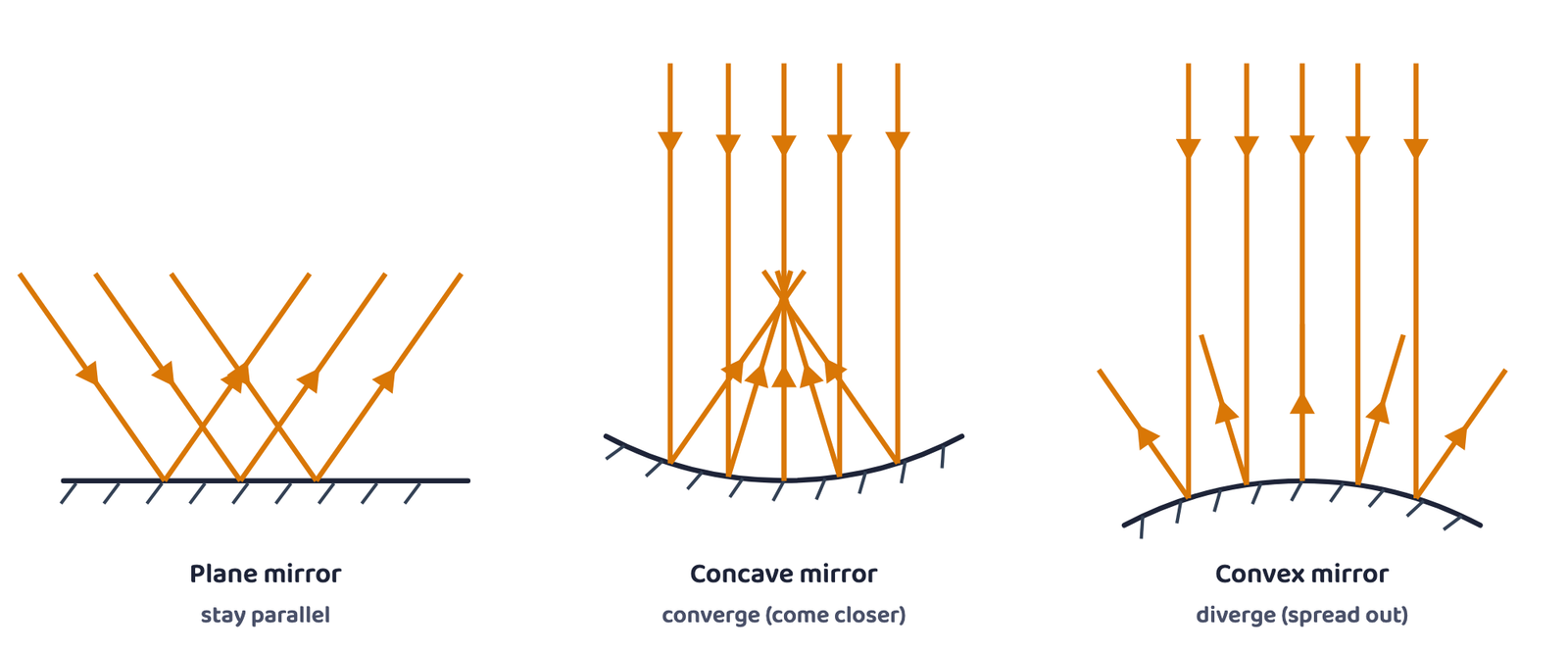
| Mirror | What happens to parallel reflected beams | Word to use |
|---|---|---|
| Plane | Stay parallel | (no change) |
| Concave | Get closer to each other | Converge |
| Convex | Spread apart | Diverge |
3.4 A concave mirror can burn paper
Since a concave mirror converges light, it can bring sunlight together on a small area (Activity 10.7). Hold the mirror facing the Sun and move a sheet of thin paper until a sharp bright spot forms on it. Held steady for a few minutes, the paper can start to burn and give smoke. The sunlight, after reflection, gets concentrated on that point, and this produces enough heat to ignite the paper.
✓ Safety first
- Do this only under a teacher or an adult
- Focus the reflected light only on paper
✗ Never
- Look towards the Sun or into the mirror reflecting it
- Point the reflected light at anyone’s face or eyes
Solar concentrators: Devices which concentrate sunlight into a small area, using mirrors and lenses.
- The concentrated sunlight heats a liquid to make steam, which can generate electricity.
- It also gives heat for large-scale cooking and for solar furnaces; solar furnaces can even melt steel.
- Solar cookers use mirrors to converge sunlight and produce heat. In Indian villages they save electricity and reduce the use of fossil fuels.
Project ideas (Discover, design, and debate): visit an ENT specialist or a dentist to identify the kind of mirror used for examining the ear, nose, throat and teeth, and design a solar cooker for your school or home with a detailed proposal including the budget.
More than 800 years ago, in the time of the great Indian mathematician Bhāskara II, astronomers looked at the reflections of stars and planets in shallow bowls of water, through tubes placed at appropriate angles, and measured their positions in the sky. The laws of reflection are not written in the literature of that time, but these methods suggest they might have understood them in practice.
4 What Is a Lens?
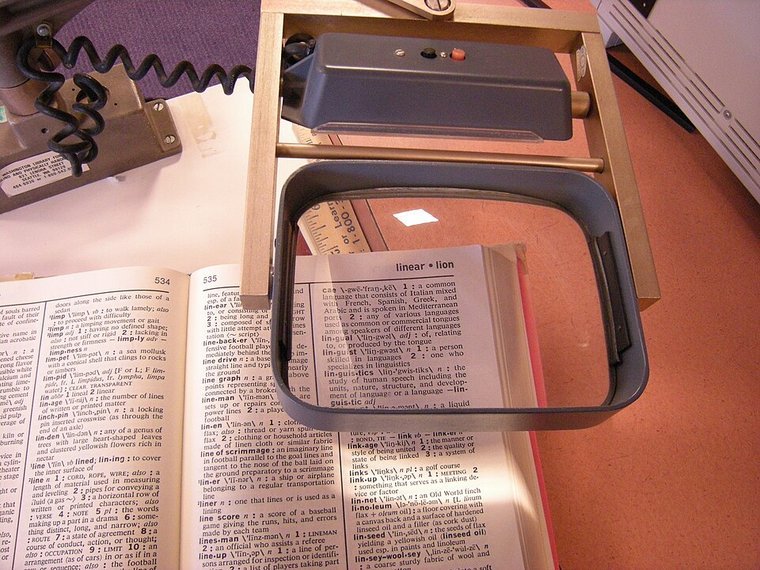
Through a flat glass window, everything looks the same size and shape. A curved transparent surface changes that. In Activity 10.8 a drop of water is placed on an oiled (or waxed) strip of glass or clear plastic, held over printed text. The drop’s surface curves outwards, and the letters under it look different: they may look bigger. The curved drop is acting like a simple lens. A magnifying glass is also a lens; it helps us read small print by making the letters look bigger.
Lens: A lens is a piece of transparent material, usually made of glass or plastic, which has curved surfaces.
Like mirrors, lenses can be convex or concave.
Convex lens: A lens which is thicker at the middle as compared to the edges.
Concave lens: A lens which is thicker at the edges as compared to the middle.
Mirror
- Light bounces back from it
- We see things in a mirror
Lens
- Light passes through it
- We see things through a lens
4.1 What we see through lenses
In Activity 10.9 an object is kept behind a lens and looked at from the other side, first close to the lens and then farther away.
| Lens | Object close behind the lens | Object moved farther away |
|---|---|---|
| Convex | Erect and enlarged | Appears inverted; first enlarged, then diminishes |
| Concave | Erect and diminished | Always erect and diminished; size changes with distance |
Depending on the distance, a convex lens’s image can be enlarged, diminished or of the same size as the object (Snapshots).
Convex twins, concave twins
A convex lens behaves like a concave mirror (can enlarge, can invert). A concave lens behaves like a convex mirror (always erect, always diminished).
4.2 Lenses converge or diverge light
In Activity 10.10, parallel beams from a comb fall on a thin glass plate, a convex lens and a concave lens in turn.

A convex lens is also called a converging lens, and a concave lens is also called a diverging lens.
Because a convex lens converges sunlight, it too can burn paper (Activity 10.11: repeat Activity 10.7 with a convex lens in place of the concave mirror). Safety first: never look at the Sun directly or through the lens; it can damage your eyes.
4.3 Uses of lenses
Eyeglasses
The glasses people wear to see clearly are lenses.
Cameras
Cameras, including smartphone cameras, work using lenses.
Telescopes and microscopes
Both use lenses to work.
Our eye
Our eye has a convex lens inside it.
The lens in our eye is amazing: it can change its shape, which lets us read a book and also see something far away.
5 Mirrors and Lenses Side by Side
| Device | Shape | Parallel light | Image | Uses |
|---|---|---|---|---|
| Concave mirror | Reflecting surface curves inwards | Converges | Erect and enlarged close up; inverted farther away | Torch reflector, headlights, dental mirror, reflecting telescope |
| Convex mirror | Reflecting surface curves outwards | Diverges | Always erect, diminished | Side-view, road safety, surveillance mirrors |
| Convex lens | Thicker at the middle | Converges | Erect and enlarged close up; inverted farther away | Magnifying glass, the lens in our eye |
| Concave lens | Thicker at the edges | Diverges | Always erect, diminished | Not named in this chapter |
- Spherical mirrors: concave (curves inwards) and convex (curves outwards); the back is drawn shaded
- Concave mirror image: enlarged, diminished or same size, erect or inverted, depending on the object’s distance
- Convex mirror image: always erect and diminished
- Law 1: angle of incidence = angle of reflection; Law 2: incident ray, normal and reflected ray lie in the same plane
- The laws of reflection hold for plane, concave and convex mirrors alike
- Concave mirror converges light (can burn paper); convex mirror diverges it
- Convex lens image: can be enlarged, diminished or same size, erect or inverted, depending on distance
- Concave lens image: always erect and diminished
- Convex lens = converging lens; concave lens = diverging lens
- Can I draw the normal, the incident ray and the reflected ray, and mark i and r correctly?
- If a ray makes 30° with the mirror, can I say the angle of reflection is 60°?
- Can I name three uses each of concave and convex mirrors?
- Can I say which mirror or lens made an image, just from the image’s size and whether it is upside down?