
- How lenses and microscopes opened up the invisible world, and what Hooke and Leeuwenhoek discovered
- How to prepare and observe onion peel and cheek cells, and name the parts of a cell with their jobs
- How plant, animal, fungal and bacterial cells differ, and why a cell’s shape suits its function
- The levels of organisation from cell to organism, and why the cell is the basic unit of life
- What microorganisms are, where they live, and how they make manure, biogas, bread, curd and soil nitrogen
nucleuscell wallchloroplastvacuoletissueorgan system
unicellularmulticellularmicroorganismprotozoafungialgae
bacteriavirusdecompositionbiogasLactobacillusRhizobiumnucleoid
1 Seeing the Invisible: Lenses and Microscopes
Our eyes can only see objects above a certain size. Anything smaller stayed unknown for a very long time. Then people found that a curved piece of glass makes small things look bigger. This glass was thick in the middle and thin at the edge, shaped like a lentil seed, so it was called a lens. Lenses kept improving, from the simple magnifying glass to the microscope, and the microscope opened up a hidden world full of tiny living things.
All living beings, whether plants or animals, big or tiny, are called organisms.
Fill a round-bottom glass flask with water, close its mouth with a cork and place it on an open book. Result: the letters look larger through the flask, because the water-filled flask acts like a magnifying glass. A real magnifying glass shows the body of a small organism, like an ant, more clearly.
Two scientists who first saw the tiny world

Hooke named the cell; Leeuwenhoek is the Father of Microbiology because he first saw bacteria and blood cells. Do not swap the two.
2 What Is a Cell?
All living beings are made up of cells. To see what a cell looks like, we prepare a thin layer of a plant or animal part on a glass slide and observe it under a microscope.
The cell is the basic unit of life: the tiny building block of which the bodies of all living organisms are made.
Activity 2.2: onion peel cells (teacher demonstration)
Observation: nearly rectangular cells, closely packed with no space between them, like the bricks of a wall. Peels of leaves from other plants also show cells, so all plants are made up of cells.
Activity 2.3: human cheek cells
Rinse your mouth, gently scrape the inside of your cheek with the blunt end of a clean toothpick and spread the material in a drop of water on a slide. Add a drop of methylene blue (a blue stain; staining increases contrast, so the cells show up better). After one minute add glycerin to stop drying, put a coverslip, remove extra glycerin with blotting paper and observe. Observation: polygon-shaped cells, which form the inner lining of the mouth.
| Onion peel (Activity 2.2) | Cheek cells (Activity 2.3) | |
|---|---|---|
| Stain used | Safranin (red), 30 seconds | Methylene blue (blue), one minute |
| Why glycerin | Prevents the cells from drying | |
| Shape seen | Nearly rectangular, tightly packed | Polygon-shaped, thin and flat |
| Extra outer layer | Yes, a cell wall | No cell wall |
Know why each step is done: the stain makes the cells visible, glycerin prevents drying, and the coverslip is lowered slowly with a needle so that no air bubbles get trapped.
The basic parts of a cell and their jobs
Both activities show the same three basic parts: an outer cell membrane, a round nucleus in the middle (covered by its own thin membrane), and the cytoplasm filling the space between them. Some cells, like onion peel cells, also have an extra outer layer, the cell wall.
| Part | What it does |
|---|---|
| Cell membrane | Encloses the cytoplasm and nucleus and separates one cell from another. It is porous: it lets in materials needed for life processes and lets out waste. |
| Cytoplasm | Holds the other parts of the cell and compounds like carbohydrates, proteins, fats and mineral salts. Most life processes take place here. |
| Nucleus | Regulates all activities of the cell, and also regulates growth. |
| Cell wall (plant cells) | Gives rigidity and strength to plants, which is why plant cells are packed compactly and look firm. |
Plastids and vacuoles (A step further)
- Plastids are tiny rod-shaped structures found in cells of all parts of a plant. Some plastids, the chloroplasts, contain the green pigment chlorophyll and help in photosynthesis (making food using sunlight). In non-green parts, plastids help store substances.
- A plant cell has a large, empty-looking space called the vacuole. It stores important substances, gets rid of waste and maintains the shape of the cell, which gives the plant strength and support.
- Animal cells usually have no vacuole; if present, vacuoles are small and store certain substances dissolved in water.
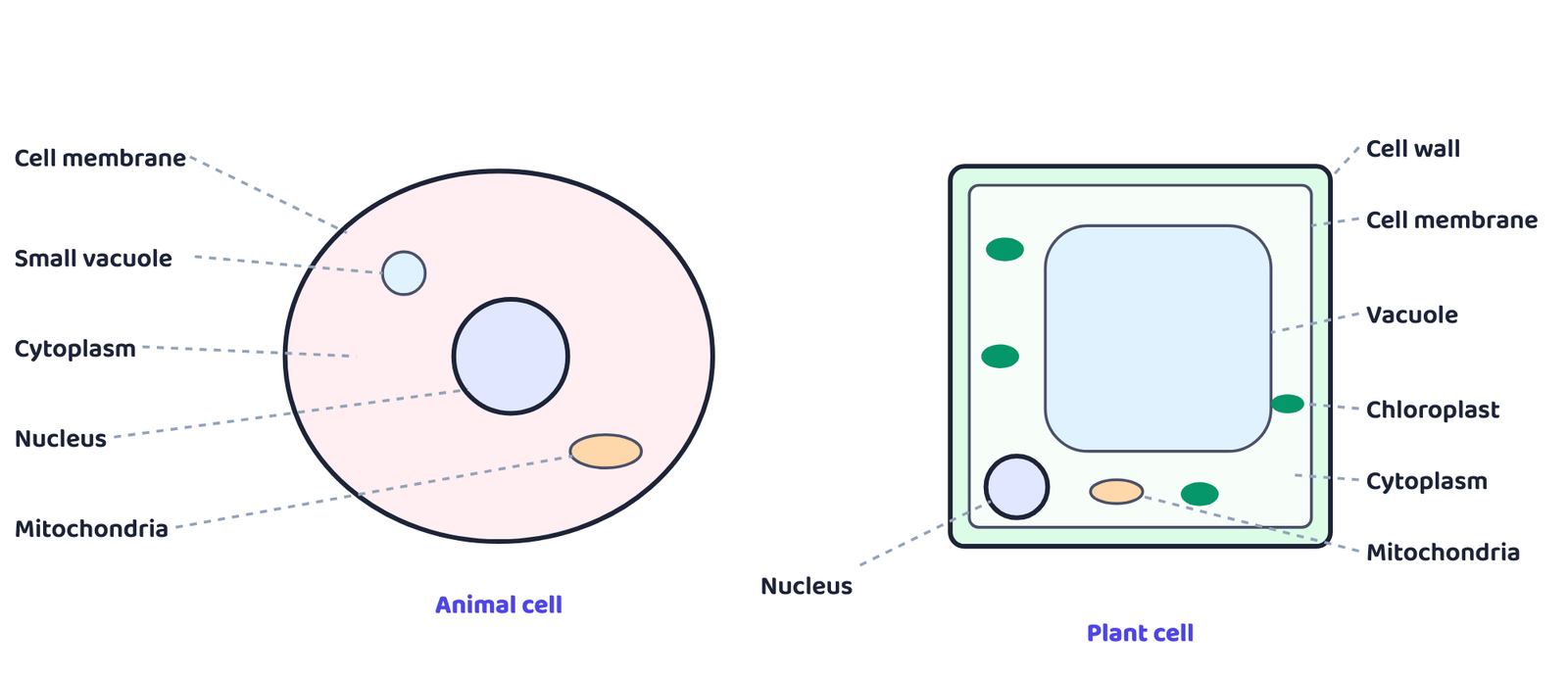
| Feature | Plant cell | Animal cell |
|---|---|---|
| Cell membrane, cytoplasm, nucleus | Present | Present |
| Cell wall | Present | Absent |
| Chloroplasts (plastids) | Present | Absent |
| Vacuole | One large vacuole | Usually absent, or small |
| Shape (in this chapter) | Onion peel nearly rectangular; plant cells may also be elongated, oval or tube-like | Varied: polygon, spindle, long and branched |
“So, a cell is not just a simple bag of liquid — it is a complex structure made up of many different parts, each with its own special function to allow the cell, and in turn the entire organism to work.”
the book, Section 2.1 (A step further)
Cells differ in shape, size and structure
Cells of one organism can look very different: some cells are round, while others are long and thin. The number of cells also varies from organism to organism. The rule to remember: the shape, size and structure of a cell help it carry out its specific function.
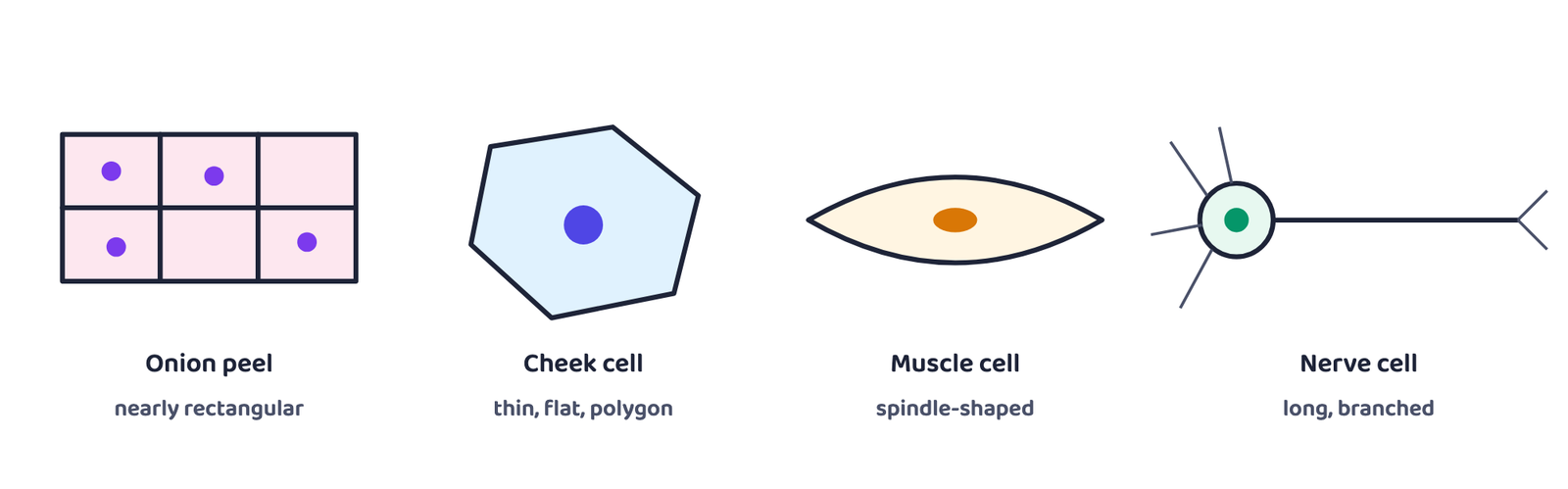
| Cell | Shape | How the shape suits the job |
|---|---|---|
| Cheek cells | Thin and flat | Form a protective lining on the inner surface of the cheek |
| Nerve cells (neurons) | Very long with branches | Carry messages; the long, branched shape reaches different body parts and passes messages quickly |
| Muscle cells of the food pipe | Spindle-shaped, thin, flexible | Contract and relax in a wave-like manner, pushing food down to the stomach |
| Stomach wall muscle cells | Shape not stated | Churn the food |
| Inner lining cells of the stomach | Shape not stated | Produce digestive juices and acid that break down food |
| Plant cells | Rectangular, elongated, oval or tube-like | Some form long tubes that carry water through the plant |
All the different cells of the digestive system work together, which is what makes digestion possible.
3 Levels of Organisation in a Living Body
A living body is organised in steps. Just as a brick is the basic unit of a wall, the cell is the basic unit of life.
A tissue is a group of similar cells.
An organ system is a group of several organs working together to perform a major function of the body.
The life of every complex organism begins as a single cell, the egg. The egg divides again and again to form a complete living being made of many cells.
Organisms whose bodies are made up of many cells are called multicellular organisms. All animals (including humans) and all plants are multicellular.
The yolk (yellow part) of an ostrich egg is a single cell, the largest known cell in the living world, about 130 mm to 170 mm in diameter. The shell (for protection) and the white liquid (which nourishes the cell as it develops) are extra non-cellular material.
4 What Are Microorganisms?
Tiny living beings that cannot be seen with the naked eye are called microorganisms or microbes (micro means very small; organisms means living beings). They are made of one or very few cells.
Unicellular (one cell)
- Bacteria
- Amoeba and other protozoa
- Yeast (a unicellular fungus)
Multicellular (many cells)
- Some fungi, for example mould
- Some algae
Plants and animals are also multicellular organisms, but they are visible to the naked eye, so they are not microorganisms.
Microorganisms are found all around us: in water, soil and air, and even inside our body. To see them we need a microscope. Scientists have also made a low-cost, foldable paper microscope. It does not show as much detail as a high-powered laboratory microscope, but it makes the microscopic world accessible to many more people.
Activities 2.4 and 2.5: pond water and soil
- Pond or stagnant water (Activity 2.4): collect it with the help of your teacher or an elder, put a drop on a slide with a dropper, add a coverslip and look for tiny organisms.
- Soil suspension (Activity 2.5): collect moist soil with a spoon or gloves (never bare hands), stir it with water using a glass rod and let it settle. The dirty-looking liquid with very fine soil particles is a soil suspension. A drop from the top layer may show small moving organisms, which indicates that even soil suspension contains a variety of tiny creatures.
What the students found (Activity 2.6)
| Table 2.1: Pond water | |
|---|---|
| Amoeba (Protozoa) | Single cell, moving, irregular shape |
| Paramecium (Protozoa) | Single cell, moves from place to place with the help of specialised structures |
| Algae | Single cell, green because of a green pigment, moves with the help of specialised structures |
| Table 2.2: Soil suspension | |
|---|---|
| Bread mould (Fungi) | Branched filament without chlorophyll, with a sac-like structure |
| Mould (Fungi) | Branched filament without chlorophyll, with a brush-like structure |
| Algae | Spherical, with chlorophyll (a green pigment) |
| Bacteria | Spherical, comma, spiral or rod-shaped; one long hair-like structure and many small hair-like projections around the cell |
Viruses are microscopic and acellular (not made of cells). They multiply only when they enter a living cell (the host), and may infect plants, animals or bacterial cells and cause disease.
5 How Are We Connected to Microbes?
- A lemon, tomato or orange left out for some time rots and shows a powdery or cotton-like growth. It has been infected by microbes, which are present everywhere: in water, soil, air and some food items.
- Pickles and murabbas do not rot easily because the salt or sugar added with spices acts as a preservative. A high concentration of salt or sugar does not allow microbes to grow.
- Microbes live on leaves, stems and roots, and even in extreme conditions like hot water springs and snow-cold zones, as well as at moderate temperatures.
- Our intestine (gut) has many bacteria that help in digestion.
- Like plants and animals, microorganisms vary in shape (spherical, rod-shaped, irregular), size and structure.
Key players in cleaning the environment
Fill a container halfway with garden soil, add fruit and vegetable peels, cover with a layer of soil and leave it for 2 to 3 weeks. Result: the peels turn into a dark-coloured material, manure, which is rich in nutrients and increases the fertility of the soil. Microorganisms in the soil, like fungi and bacteria, broke the plant waste down. This is why gardeners put dry leaves and plant waste into pits: to make natural manure.
Decomposition is the process in which microorganisms break down the complex substances of dead plants and animals (like fallen leaves) into simpler substances rich in nutrients, which go back to the soil.
- Microbes also decompose bodies of dead animals and animal wastes like dung.
- Manure formation occurs at an optimal temperature and an appropriate moisture level.
- So microbes do two jobs here: they help plants grow, and they clean the environment by breaking down waste.
Ancient Indian texts, particularly the Vedas, use the word ‘Krimi’ for tiny entities, both ‘Drishya’ (visible) and ‘Adrishya’ (invisible), and mention their beneficial and harmful effects. The Atharvaveda also refers to ‘Krimi’.
Biogas is the mixture of gases released when bacteria living in an oxygen-free environment decompose plant and animal waste or household wastewater. It is mainly carbon dioxide with a high proportion of methane.
Biogas is used as a fuel for cooking, heating, generating electricity and even running vehicles. India has a long history of biogas: one of our oldest biogas plants was set up in the late 1850s, and the Biogas Program was initiated by the Ministry of New and Renewable Energy, Government of India.
He studied bacteria. In 1971 he developed a special bacterium that could break down oil spills, helping to clean the environment. His discovery received a patent in 1980. His work showed that microorganisms can solve environmental problems like pollution.
A patent is a legal right given by the government to an inventor so that no one else can copy, use or sell the invention without permission.
Microorganisms and food
Take 200 g of flour (atta or maida) with a pinch of sugar in each of two bowls. Add a little yeast to bowl A only (bowl B is the comparison). Knead both with warm water, cover with a damp cloth and keep in a warm place. Observe both bowls after 4 to 5 hours; if there is no change, leave them for some more time. Result: after some time, dough A (with yeast) may have risen slightly, become fluffy and have a different smell compared with dough B (kneaded without yeast).
This property of yeast is used to make breads, cakes, pastries and more. Some bacteria, such as Lactobacillus, help in fermentation of the batter for idli and dosa and of the dough for bhatura.
Pour lukewarm milk into bowl A and cold milk into bowl B, add a small spoon of curd to each and mix. Keep A in a warm place and B in a cool place (like a refrigerator) for a few hours or overnight. Result: the milk in bowl A turns into curd and becomes a little sour; the milk in bowl B does not curdle, though it may be a little sour.
- Curd contains several types of bacteria; one of them is Lactobacillus.
- It feeds on the sugar in milk (lactose), multiplies and ferments the milk to form curd.
- Unlike yeast (which makes alcohol), it makes lactic acid, which makes curd sour.
- It grows well in warm conditions, which is why curd formed in bowl A and not in bowl B.
The book’s own summary (Snapshots) says yeasts are used in making breads, cakes, pastries, idlis, dosas and bhaturas, and that Lactobacillus is used in curd formation at home and in the fermentation process in the food industry. In the chapter text, Lactobacillus is named for idli and dosa batter and bhatura dough. If asked “which microbes help make idli, dosa or bhatura”, name both yeast and Lactobacillus.
Fermented foods such as fermented soya bean and fermented bamboo shoots are eaten as traditional food in some parts of India.
Rhizobium: bacteria that feed the soil with nitrogen
Some bacteria, such as Rhizobium, form swollen regions called root nodules and live inside them. Roots of certain legumes, such as beans, peas and lentils, have these nodules. The book’s Fig. 2.12 shows the root nodules of a cowpea plant, which contain Rhizobium.
- Rhizobium traps nitrogen from the air and makes it useful for the plant.
- So the plant grows well without chemical fertilisers.
- That is why farmers grow legumes in rotation with other crops: it naturally increases soil nitrogen and keeps the soil healthy for the next crop.

Amazing microalgae: tiny helpers in water
Microalgae are microscopic plant-like organisms that live in water, soil, air and even on trees, and make their own food using sunlight.
Oxygen
They release oxygen and produce more than half of the Earth’s oxygen supply.
Food
Rich in nutrients; food for many aquatic animals.
Health
Spirulina, Chlorella and Diatoms are used as health supplements and medicines.
Clean water and fuel
They help clean water and are used to make biofuel.
Pollution, climate change and habitat destruction threaten microalgae. Conserving them protects the environment and maintains the oxygen balance on Earth.
Spirulina is a good source of vitamin B12 and is rich in protein (more than 60 per cent of its body weight), with only a little fat and sugar. Farming it is becoming a livelihood: keep a clear glass tank in a bright place away from direct sunlight (shade net or moderate temperature), fill it with pond water, add living Spirulina from a pond, stir twice a week, and after 3 to 6 weeks harvest it by filtering through a fine cloth.
6 Why Is the Cell the Basic Unit of Life?
- The bodies of all living organisms are made of cells, and a single cell contains the parts that let an organism perform its functions.
- In multicellular organisms (plants and animals), cells carry out specialised functions individually but also cooperate with each other to increase the chance of survival.
- Algae and fungi are made of one or more cells (yeast and mould, compared in Section 4).
Organisms made up of just one cell, which carries out all the functions needed for survival, are called unicellular organisms, for example bacteria and protozoa.
Cells of microorganisms
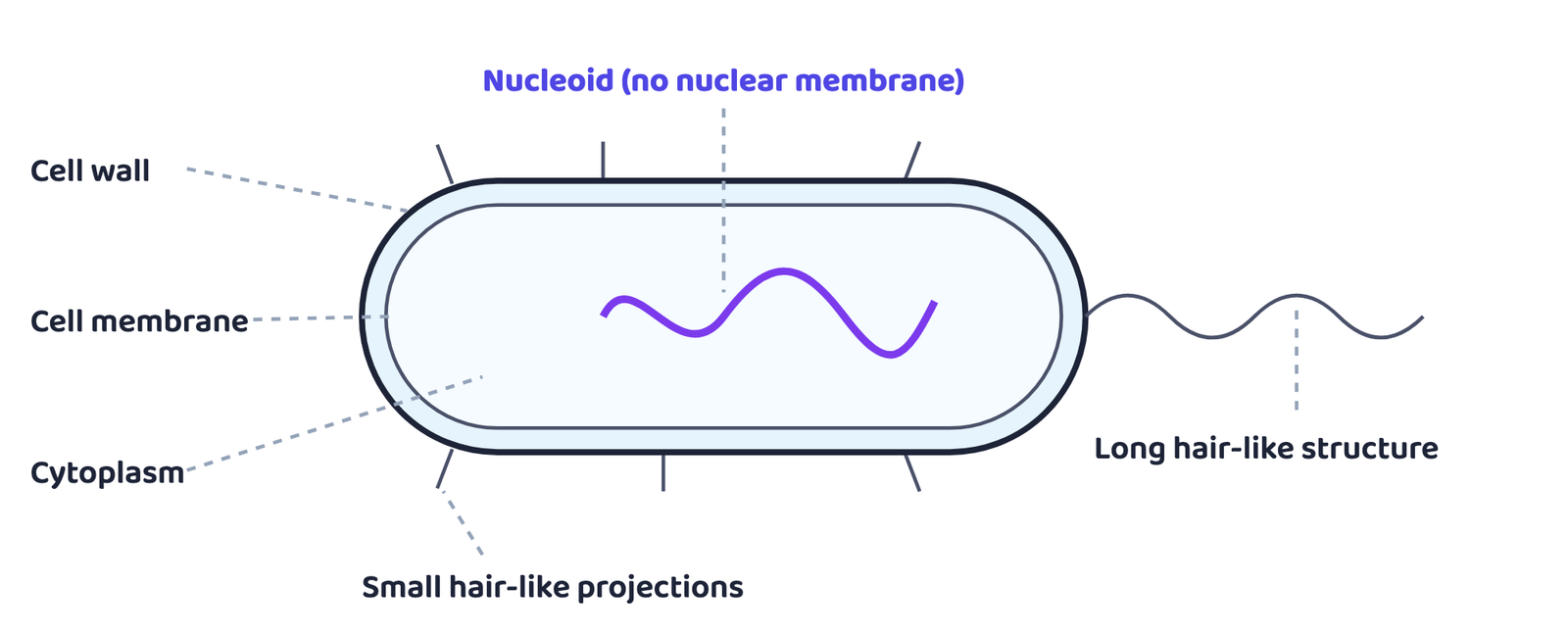
| Part | Animal cell | Plant cell | Fungal cell | Bacterial cell |
|---|---|---|---|---|
| Cell membrane | Yes | Yes | Yes | Yes |
| Cell wall | No | Yes | Yes | Yes |
| Chloroplasts | No | Yes | No (cannot make own food) | No |
| Well-defined nucleus | Yes | Yes | Yes | No: nucleoid instead |
Bacteria have no well-defined nucleus and no nuclear membrane; instead they have a nucleoid (the nucleoid region shown in the book’s Fig. 2.13). This feature sets bacteria apart from the cells of yeast, protozoa, algae, fungi, plants and animals.
“Which cell has a cell wall but no chloroplasts?” The answer is the fungal cell (and the bacterial cell). “Which cell has no well-defined nucleus?” Only the bacterial cell. To see the smaller parts inside a cell (subcellular components), we need an electron microscope, which shows many more structures.
- Find out about the Biogas Program initiated by the Ministry of New and Renewable Energy, Government of India.
- List traditional fermented foods from your area (such as fermented soya bean and fermented bamboo shoots) and find out their ingredients, method of preparation, the microorganism responsible for the fermentation, and their cultural and nutritional importance.
- Study the parts of a mushroom (a macro fungus) with a magnifying glass and a microscope in your school laboratory.
- Talk to an entrepreneur and learn the steps for cultivating mushrooms.
This chapter covered useful microbes. Some microbes also cause diseases in plants, animals and humans; those are studied in the next chapter.
- Lens = lentil-shaped glass; Hooke (1665, Micrographia, cork) named the cell; Leeuwenhoek (Dutch, 1660s) saw bacteria and blood cells, Father of Microbiology.
- Onion peel: safranin, rectangular cells with a wall. Cheek cells: methylene blue, polygon-shaped, no wall. Glycerin prevents drying.
- A typical cell: membrane (porous; lets in essential materials, lets out waste), cytoplasm (most life processes), nucleus (controls activities and growth). Plants add a cell wall, chloroplasts and a large vacuole.
- Cell shape suits function: flat cheek cells, spindle muscle cells, long branched neurons.
- Cell → tissue → organ → organ system → organism; every complex organism starts as one cell, the egg.
- Microorganisms: protozoa, algae, fungi, bacteria; unicellular or multicellular; found everywhere. Viruses are acellular and multiply only inside living cells.
- Useful microbes: decomposers make manure and clean the environment; biogas (CO₂ + methane); yeast raises dough; Lactobacillus makes curd; Rhizobium fixes nitrogen in legume nodules; microalgae give over half of Earth’s oxygen.
- Fungal cells have a wall but no chloroplasts; bacteria have a nucleoid, not a nucleus.
- Can I draw and label a plant cell and an animal cell, and list three differences?
- Can I explain why dough rises and why curd turns sour, naming the microbe and the product each time?
- Can I explain why farmers grow legumes in rotation with other crops?