
- How a compass needle shows that a current carrying wire acts like a magnet
- How to make an electromagnet, find its poles, and make it stronger or weaker
- Why a wire gets hot when current flows, and what decides how hot it gets
- How a Voltaic cell, a lemon cell and a dry cell produce electricity from chemicals
- Why rechargeable batteries matter, and how a used battery should be thrown away
At a science exhibition, Sumana shows a working model of a lifting electromagnet: in place of the hook of a typical crane, it has an iron nail wrapped with a wire, joined to a battery. When she closes the circuit, the nail picks up iron paper clips like a magnet. When she opens it, the clips fall. There is no magnet anywhere, only an electric circuit. This whole chapter explains her model.
1 Does an Electric Current Have a Magnetic Effect? (Book 4.1)
The compass test (Activity 4.1)
A magnetic compass has a needle that is itself a tiny magnet. It turns (deflects) whenever a magnet comes near it, and this magnetic effect works even through non-magnetic things kept in between, like cardboard.
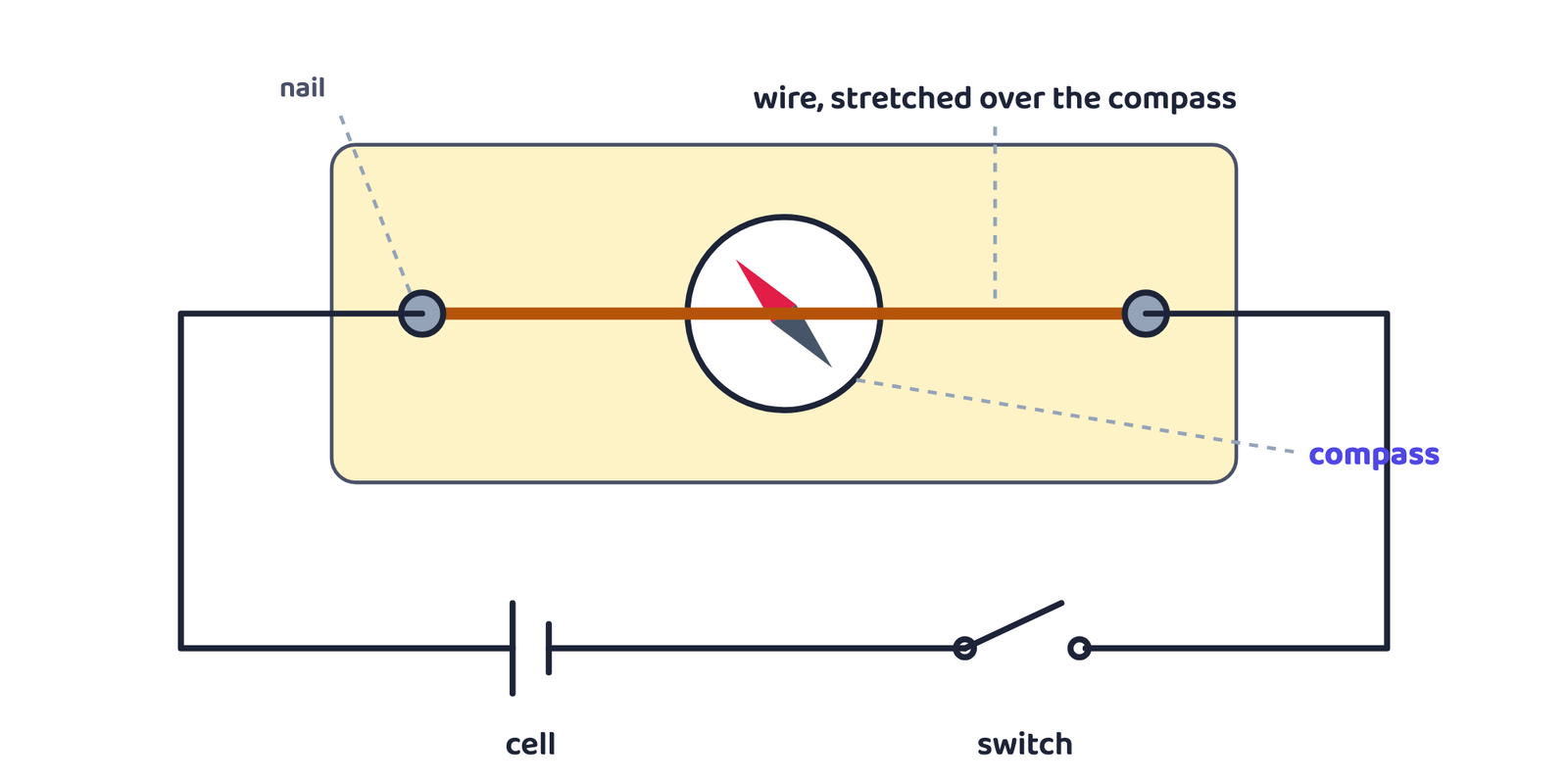
| What you do | What the compass needle does | What it tells us |
|---|---|---|
| Switch ON (current flows) | Deflects from its original direction | The current carrying wire has a magnetic effect |
| Switch OFF (current stops) | Returns to its original direction | The magnetic effect disappears with the current |
Magnetic field: the region around a magnet or a current carrying wire where its magnetic effect can be felt, for example by the deflection of a compass needle.
Magnetic effect of electric current: when electric current flows through a conductor (like a wire), it produces a magnetic field around it. The magnetic field disappears when the current stops flowing.
This answers the chapter’s first question: even without a lamp, you can tell whether current is flowing in a circuit. Keep a compass under a wire of the circuit. If the needle deflects, current is flowing.
Oersted’s discovery
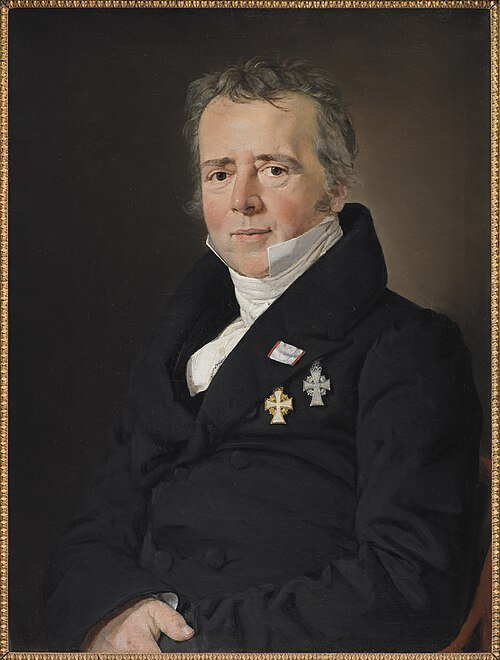
Electricity and magnetism are linked. Activity 4.1 is the same discovery Oersted made in 1820.
the one idea of section 1
The magnetic effect of electric current is used in electromagnets, electric bells, motors, fans and loudspeakers.
2 Electromagnets (Book 4.1.1)
Making a magnet with electric current (Activities 4.2 and 4.3)
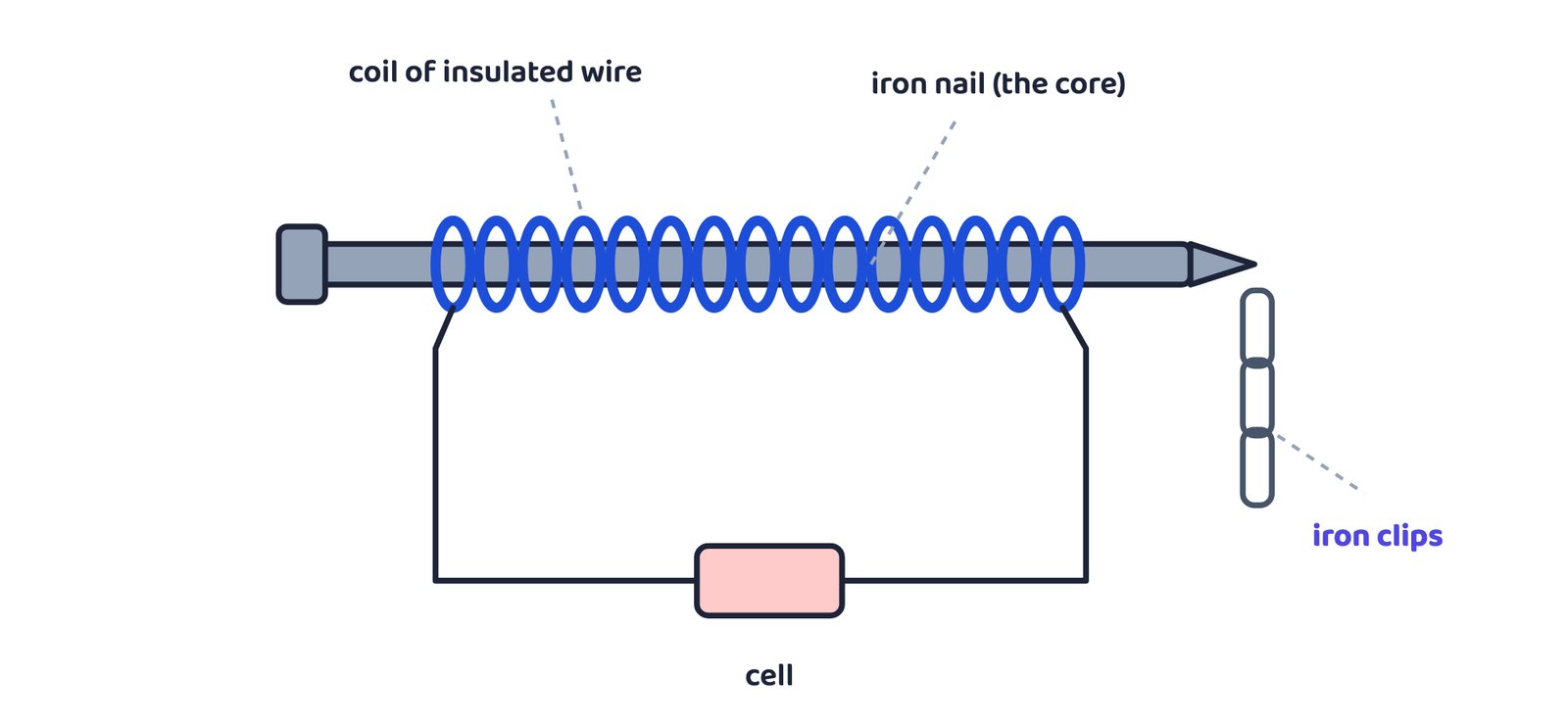
Electromagnet: a current carrying coil that behaves as a magnet. For practical applications, most electromagnets have an iron core to make them stronger.
An electromagnet is a temporary magnet. It is a magnet only while current flows. Switch the current off and it stops being a magnet, which is why the clips fall.
Poles of an electromagnet (Activity 4.4)
Label the two ends of the coil A and B. Keep a compass near end A and switch on the current. Remember the rule: unlike poles (north and south) attract each other.
So, just like a bar magnet, an electromagnet has two poles, north and south.
Changing the strength and the poles
| What you change | What happens | Why |
|---|---|---|
| Use a battery of 2 or 4 cells instead of 1 | More deflection; more clips picked up | More cells give a larger current, so a stronger magnetic field |
| Increase the number of turns of the coil | The coil becomes a stronger magnet | More turns, stronger field |
| Insert an iron nail (iron core) | Much stronger magnet | The iron core makes the electromagnet stronger |
| Reverse the direction of the current | The poles swap (north becomes south) | The poles depend on the direction of current |
More current, more turns or an iron core → stronger · Reverse the current → poles swap
Changing the amount of current, the number of turns, or both, changes the strength. Reversing the direction of the current reverses the poles (north and south swap).
Electromagnet
- A temporary magnet: a magnet only while current flows
- Switched on and off with the current
Bar magnet
- Keeps its magnetism without any current
- Not switched on or off by a current
Make coils of 25, 50, 75 and 100 turns. Connect them one by one to the same cell, with a compass kept at the same position each time, and note the deflection. The deflection grows with the number of turns: more turns make a stronger electromagnet.
A freely hanging magnet rests in the north-south direction because Earth itself behaves like a giant magnet. Deep inside Earth, the movement of liquid iron in the core creates electric currents, and these currents generate a magnetic field. Many migratory birds, fish and animals use this field to find their way across continents and oceans. The field also acts as a shield, blocking harmful particles from space and protecting life on Earth.
3 Lifting Electromagnets (Book 4.1.2)
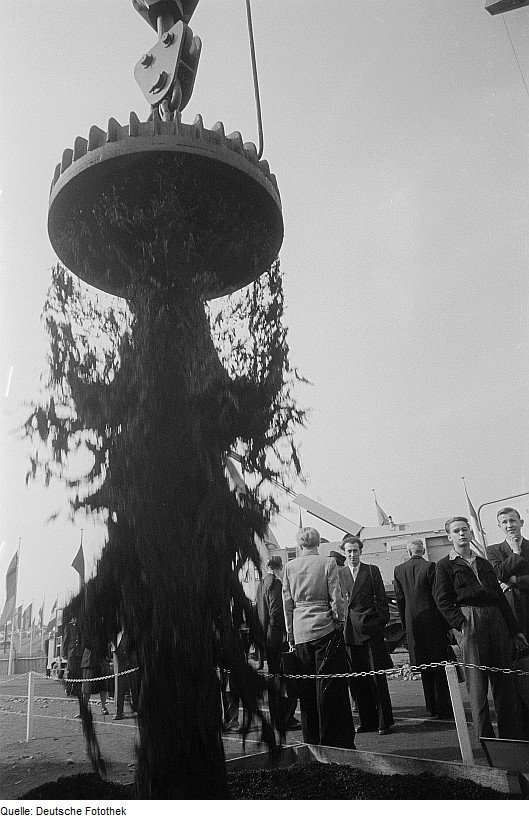
Lifting electromagnets are strong electromagnets that may be hung from cranes. The crane operator controls the magnet simply by switching the current ON and OFF.
They are widely used in factories and scrap yards to move, lift and sort heavy metal items efficiently. Sumana’s model at the exhibition is a small lifting electromagnet.
Just as electricity can produce magnetism, a moving magnet can also produce an electric current. You will study this in higher classes; it is the basis of electric motors and power generators.
4 Does a Current Carrying Wire Get Hot? (Book 4.2)
The nichrome wire test (Activity 4.5)
While making the electromagnet, you may have noticed the wire ends getting warm. Activity 4.5 checks this with a special wire called nichrome.
Do this activity only under a teacher’s supervision. Touch the wire only momentarily; never hold it or touch it for long, or you may get hurt.
Why the wire gets hot
Resistance: the opposition that a conductor offers to the flow of electric current through it. Different conductors offer different levels of resistance.
A nichrome wire offers higher resistance than a copper wire of the same size and length. This resistance causes some of the electrical energy to be converted into heat energy. That is why nichrome, which generates more heat for a given current, is commonly used in electrical heating devices such as heaters.
Heating effect of electric current: when an electric current passes through a conductor, the conductor gets heated. This generation of heat in conductors due to the flow of electric current is called the heating effect of electric current.
What decides how much heat is produced
Repeat Activity 4.5 with a battery of 2 cells: for the same time, the wire heats up more. So the heat depends on the size (magnitude) of the current.
Current
Larger current (more cells), more heat.
Material
Nichrome heats more than copper of the same size.
Thickness
Wires of different thickness heat differently.
Length
Wires of different length heat differently.
Duration
How long the current flows.
To recall what decides the heat, write all five factors from the cards above, one line each. The book’s project compares 0.3 mm and 0.6 mm nichrome wires, and wires of different lengths, to test thickness and length.
Where we use the heating effect
Heating element: the rod or coil of wire inside an electric heating appliance that gets heated when current flows through it. In some appliances it can be seen glowing red hot.
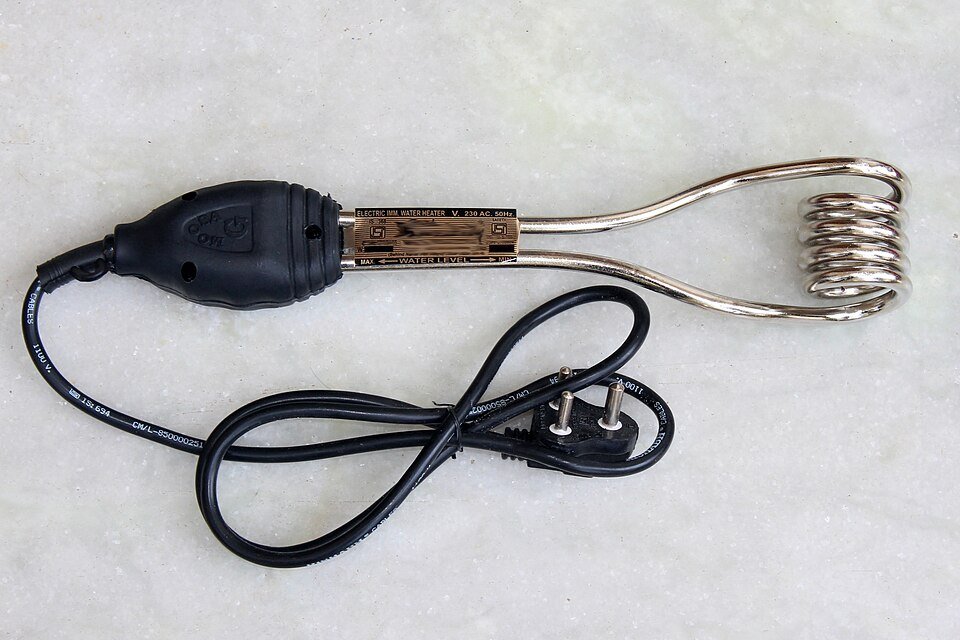
| Appliances that work on the heating effect | Where the heating happens |
|---|---|
| Electric room heater, electric stove, electric kettle, electric iron, water heating immersion rod, hair dryer | A heating element (rod or coil of wire) |
| Incandescent lamp (like an old torch bulb) | Its filament is heated by the current until it glows, which is why the lamp gets warm |
| Steel industry: high-temperature electric furnace | An enclosed space built to generate heat, used to melt and recycle scrap steel into usable steel |
Problems caused by the heating effect
✓ Do this
- Use wires, plugs and sockets rated for the specified current of the connection, so switchboards do not heat up unnecessarily
- Keep the safety devices placed in household circuits; they reduce such incidents
✗ Problems it causes
- Energy loss in wires during transmission
- Damage to plugs and sockets, where plastic parts may melt
- Fires
5 How Does a Battery Generate Electricity? (Book 4.3)
A cell can light a lamp, make a magnet and heat a wire. So what inside it produces electricity? The answer is chemistry.
Cell or battery: a device that generates electric current because of chemical reactions taking place inside it.
Voltaic cell (Book 4.3.1)
One of the earliest electric cells is the Voltaic cell, also known as the Galvanic cell. Its parts are kept in a glass or plastic container.
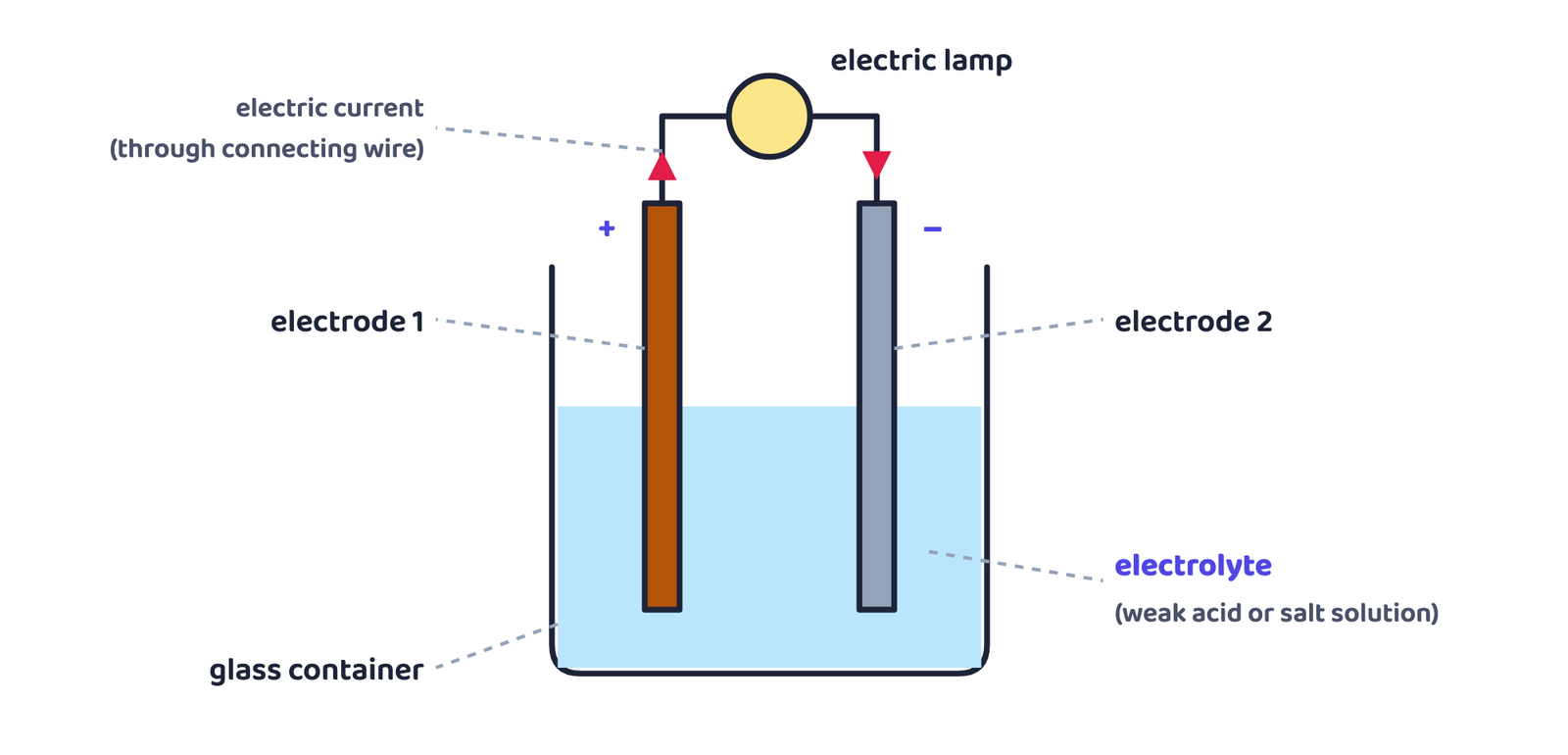
Electrodes: the two rods of a cell that are partly dipped in the electrolyte; in a Voltaic cell they are two metal rods made of different materials.
Electrolyte: the liquid (or paste) in a cell in which the electrodes are dipped; in a Voltaic cell it is usually a weak acid or a salt solution.
- A chemical reaction between the rods and the electrolyte produces electricity.
- When the circuit is connected, current flows from the positive terminal, through the circuit, to the negative terminal.
- Over time the chemicals get used up and the cell stops working. It is then called ‘dead’ and cannot supply any more electricity.
How the cell got its name: Galvani and Volta
Make your own cell: the lemon cell (Activity 4.6)
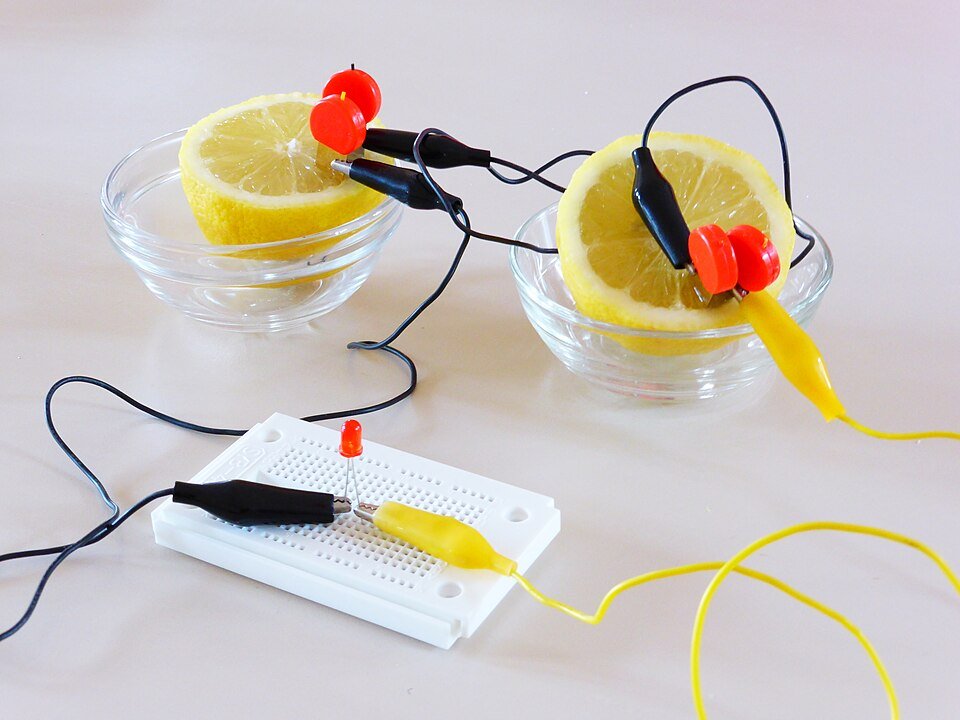
| Part of a cell | In the lemon cell |
|---|---|
| Electrodes | Copper wires and iron nails |
| Electrolyte | Lemon juice, which helps conduct electricity (a salt solution also works) |
If the LED does not glow, reverse its connections before deciding the cell has failed. Current passes through an LED only when its longer wire (positive terminal) is joined to the positive terminal of the battery and its shorter wire (negative terminal) to the negative terminal.
Project: try making an electric cell from various fruits and vegetables, and with electrodes of different metals, and write a brief report.
Common metal pairs for Voltaic cells: zinc/copper, zinc/silver, aluminium/copper, iron/copper, magnesium/copper and lead/copper. Some metals, like copper, act as positive electrodes; others, like zinc, act as negative electrodes. This is due to their chemical properties.
Dry cells (Book 4.3.2)
Voltaic cells were an important discovery, but they are not convenient for everyday use. Dry cells are one of the most widely used cells today.
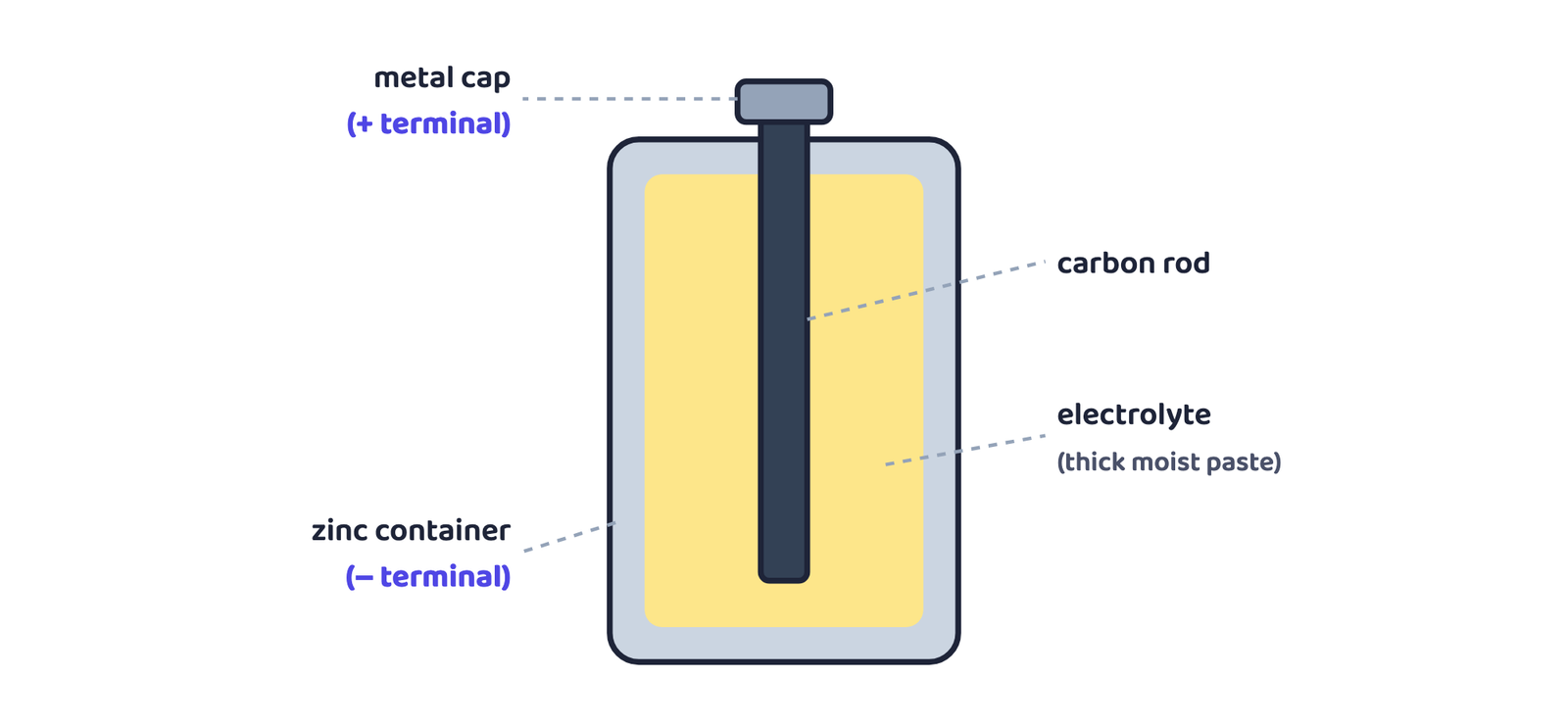
| Part | Job |
|---|---|
| Zinc container | Negative terminal |
| Carbon rod at the centre, covered with a metal cap | Positive terminal |
| Paste-like electrolyte around the carbon rod | The electrolyte; it is a thick moist paste, not a liquid, which is why the cell is called “dry” |
A dry cell is a single use cell: once it is used up, it has to be disposed of. For several applications, rechargeable batteries are increasingly being used now.
Rechargeable batteries (Book 4.3.3)
Rechargeable batteries: batteries that can be recharged and reused multiple times.
Dry cell
- Single use
- Thrown away once used up
Rechargeable battery
- Prevents wastage and saves money over time
- Still wears out slowly after many charges, so an old phone needs charging more often
Used in watches and phones, laptops and tablets, cameras, inverters, and vehicles including electric vehicles.
Lithium-ion (Li-ion)
Today’s most common rechargeable battery. Relies on lithium and cobalt, mined and processed in limited parts of the world, so countries are racing to secure supplies, recycle old batteries and develop new technologies.
Solid-state batteries
The next leap: they replace the liquid or paste electrolyte with solid materials. They would be safer, charge faster and last longer. Improved rechargeable batteries are very important as the world moves to developing environmentally friendly sources of electrical power.
Throwing away a used battery
A battery that stops working is not completely “dead”. It may still contain acids and metals like lead, cadmium, nickel or lithium.
✓ Do this
- Give used batteries to a special e-waste recycling facility (ask your teacher if unsure)
- Recycle: many battery materials are valuable and can be reused
✗ Never do this
- Throw batteries in regular garbage: they may cause fires or harm the environment
- A current carrying wire deflects a compass: current produces a magnetic field (Oersted, 1820, Denmark).
- A current carrying coil is an electromagnet; an iron core makes it stronger; it is a magnet only while current flows.
- An electromagnet has north and south poles; reversing the current reverses them.
- More current or more turns gives a stronger electromagnet.
- Lifting electromagnets on cranes pick up iron and steel when ON and drop them when OFF.
- Resistance turns some electrical energy into heat: the heating effect. Nichrome has high resistance, so it is used in heaters.
- Heat depends on current, material, thickness, length and duration.
- A cell makes current from chemical reactions between its two electrodes and its electrolyte (Voltaic cell: two rods of different metals in a liquid; dry cell: zinc container and carbon rod in a paste).
- Dry cell: zinc container (−), carbon rod with metal cap (+), paste electrolyte, single use.
- Rechargeable batteries are reused many times; old batteries go to e-waste recycling.