
- What it meant for the East India Company to become the Diwan of Bengal in 1765
- Why the Company’s hunger for revenue pushed Bengal into crisis and the famine of 1770
- How the Permanent Settlement, the mahalwari system and the ryotwari system worked, and why each ran into trouble
- Why Europe wanted Indian indigo, and how indigo was grown under the nij and ryoti systems
- How indigo dye was made in the factory vats
- Why the ryots of Bengal rose in the “Blue Rebellion” of 1859, what the Indigo Commission said, and how the story led to Champaran in 1917
This is Chapter 3 of the old NCERT History book “Our Pasts III” for Class 8. It is still taught in many schools and state boards. Everything here follows that book’s own text, dates and names.
1 The Company becomes the Diwan (1765)
- On 12 August 1765, the East India Company was made the Diwan of Bengal by the Mughal emperor. (The book’s Fig. 1 caption calls it the Diwani of Bengal, Bihar and Orissa.)
- The real event most probably took place in Robert Clive’s tent, with only a few Englishmen and Indians watching.
- But a painting made for Clive (the book’s Fig. 1) shows it as a grand, majestic ceremony. Clive had hired the painter to record the memorable events of his life, and the British saw the Diwani as one such big event.
As Diwan, the Company became the chief financial administrator: it now ran the money matters (revenue) of the land it controlled. The right it received is called the Diwani.
Becoming Diwan gave the Company two jobs at once:
Run the land and its revenue
It had to organise land revenue so that it earned enough to meet the Company’s growing expenses.
Keep trading
Being a trading company, it also had to make sure it could buy the goods it needed and sell what it wanted.
The Company was an alien (foreign) power. The people who had ruled the countryside earlier still had authority and prestige. So the Company had to pacify them: keep them under control, without wiping them out completely.
The rest of the chapter answers four questions the book itself asks: how the Company colonised the countryside, how it organised revenue, how it redefined people’s rights over land, and how it made peasants grow the crops it wanted.
2 Revenue for the Company, and the crisis in Bengal
- Even as Diwan, the Company still saw itself mainly as a trader.
- It wanted a lot of revenue, yet it did not want to build a regular system for assessing and collecting it.
- Its aim was simple: collect the most revenue it could, and pay the least it could for fine cotton and silk cloth.
- Within five years, the value of goods the Company bought in Bengal doubled.
Before 1765
- The Company bought Indian goods by importing gold and silver from Britain.
After 1765
- The revenue collected in Bengal itself paid for the goods bought for export.
Soon the Bengal economy fell into a deep crisis. Each problem fed the next:
Fig. 2 shows a weekly market (haat) in Murshidabad in Bengal. Peasants and artisans came to such markets to sell their goods and buy what they needed. In times of economic crisis these markets were badly hit.
3 The need to improve agriculture: the Permanent Settlement (1793)
If the economy was in ruins, the Company could not be sure of its revenue. So most officials came to believe that the answer was to get people to invest in land and improve farming. After two decades of debate, the Company introduced the Permanent Settlement in 1793. Charles Cornwallis was the Governor-General of India when it was introduced.

The Permanent Settlement (1793) recognised the rajas and taluqdars (local chiefs and big landholders; this gloss is ours, the book does not define the word) as zamindars. They collected rent from the peasants and paid revenue to the Company, and the amount of revenue was fixed permanently: it was never to be increased in future.
3.1 What the Company hoped for
Regular revenue
A fixed amount would ensure a regular flow of revenue into the Company’s coffers.
Investment in land
Since the state’s demand would never rise, the zamindar would keep the gain from higher production, so he would invest in improving the land.
3.2 The problem
The Permanent Settlement soon created problems. Two stages are clear in the book:
| Period | What happened |
|---|---|
| Early years | The revenue fixed was so high that zamindars found it hard to pay. A zamindar who could not pay had his zamindari taken away, and the Company auctioned a large number of zamindaris. Zamindars were not investing in the land. |
| First decade of the 19th century | Market prices rose and cultivation slowly expanded. Zamindars’ income increased, but the Company gained nothing, because the demand was fixed for ever and could not be raised. |
Even then, zamindars had no interest in improving the land. Some had already lost their lands; others found they could earn an easy income without spending or risking anything. Renting land to tenants and collecting rent was enough for them, so improving the land did not interest them.
For the cultivator in the village the system was very harsh: his rent to the zamindar was heavy, his right on the land was insecure, he often had to borrow from the moneylender to pay the rent, and if he failed to pay he was evicted from land his family had cultivated for generations.
Source 1: In many Bengal villages some powerful ryots did not cultivate themselves; they gave their land to under-tenants at very high rents. In 1806, H. T. Colebrook described these under-tenants as so weighed down by excessive rent in kind and by usurious (very high-interest) returns on the cattle, seed and food advanced to them, that they could never get out of debt, and worked without hope of bettering their condition.
Source 1 of the chapter, in our own words
4 A new system is devised: the mahalwari settlement (1822)
By the early nineteenth century many Company officials were sure the revenue system had to change again. How could revenue be fixed permanently when the Company needed more money for its administration and trade?
A mahal, in British revenue records, is a revenue estate, which may be a village or a group of villages.
The mahalwari settlement was devised by Holt Mackenzie for the North Western Provinces of the Bengal Presidency and came into effect in 1822. Revenue was assessed for each village (mahal), revised periodically, and collected by the village headman instead of the zamindar.
How the mahalwari revenue was worked out:
The book notes that most of the North Western Provinces of the Bengal Presidency is now in Uttar Pradesh.
5 The Munro system: ryotwari
The ryotwar (ryotwari) system was the revenue settlement of the British territories in the south, made directly with the cultivators (ryots), whose fields were carefully and separately surveyed before the revenue was assessed.
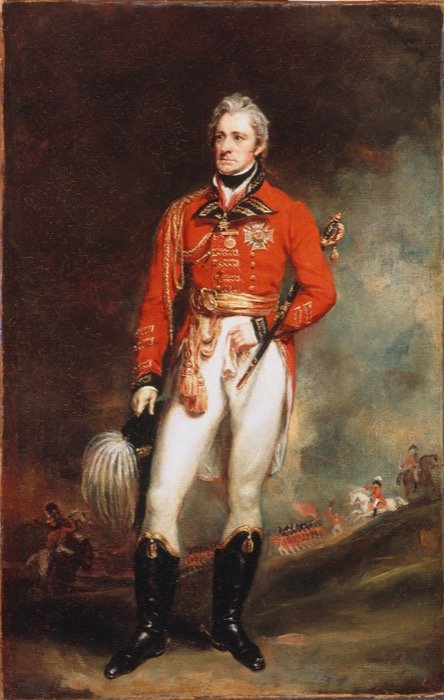
- Read and Munro argued that the south had no traditional zamindars, so the settlement had to be made with the ryots who had tilled the land for generations.
- Munro wanted the British to look after the ryots like a father protects his children; the book calls this acting as paternal father figures.
5.1 All was not well
Within a few years of the new systems (mahalwari and ryotwari), problems showed up:
5.2 The three revenue systems side by side
| Feature | Permanent Settlement | Mahalwari | Ryotwari |
|---|---|---|---|
| Year / person | 1793; Cornwallis was Governor-General | 1822; Holt Mackenzie | Alexander Read, then Thomas Munro |
| Area | Bengal | North Western Provinces of the Bengal Presidency (mostly today’s UP) | British territories in the south |
| Settled with | Rajas and taluqdars, recognised as zamindars | The village (mahal); village headman collected | The cultivators (ryots) directly |
| Revenue amount | Fixed permanently, never to be raised | Revised periodically | Assessed after a careful survey of each field |
| Main problem | Revenue too high, zamindaris auctioned; later the Company could not share rising income | Revenue demand fixed too high; ryots fled, villages deserted | |
“How was the mahalwari system different from the Permanent Settlement?” is a favourite. Give three clear contrasts: who collected (headman vs zamindar), whether the amount could change (revised vs fixed forever), and the unit (village/mahal vs zamindari estate).
6 Crops for Europe
The British realised that the countryside could give not only revenue but also the crops Europe needed. By the late eighteenth century the Company was trying hard to expand opium and indigo. Over the next century and a half, the British persuaded or forced cultivators to grow other crops too:
| Crop | Region |
|---|---|
| Jute | Bengal |
| Tea | Assam |
| Sugarcane | United Provinces (now Uttar Pradesh) |
| Wheat | Punjab |
| Cotton | Maharashtra and Punjab |
| Rice | Madras |
The book then follows one crop and one method of production closely: indigo.
7 Does colour have a history? Why Europe wanted Indian indigo
The book compares two cotton prints: a kalamkari print made by weavers of Andhra Pradesh (Fig. 5) and a floral print by William Morris, a well-known British poet and artist of the nineteenth century (Fig. 6). Both use a rich blue colour called indigo, made from the indigo plant. The blue in Morris’s prints was probably made from indigo grown in India, because at that time no country supplied more indigo to the world than India.
7.1 Indigo versus woad
Indigo
- Grows mainly in the tropics
- Gives a rich blue colour
- Used by cloth makers of Italy, France and Britain by the 13th century, but only small amounts reached Europe and it was very costly
Woad
- A plant of the temperate zones, easy to get in Europe
- Gives pale and dull violet and blue dyes
- Grown in northern Italy, southern France and parts of Germany and Britain
| European power | Where it grew indigo |
|---|---|
| French | St Domingue, in the Caribbean islands |
| Portuguese | Brazil |
| English | Jamaica |
| Spanish | Venezuela |
A plantation is a large farm operated by a planter employing various forms of forced labour. Plantations are linked with coffee, sugarcane, tobacco, tea and cotton.
A slave is a person who is owned by someone else, the slave owner. A slave has no freedom and is forced to work for the master.
In the French colony of St Domingue, French planters produced indigo and sugar. In 1791 the African slaves working there revolted: they set the plantations on fire and killed their wealthy owners. In 1792 France abolished slavery in its colonies. These events led to the collapse of indigo plantations on the Caribbean islands. (Fig. 7 is a painting of this revolt by January Scuhodolski.)
8 Britain turns to India
Facing rising demand in Europe, the Company looked for ways to expand indigo cultivation in India. Indigo farming in Bengal grew fast from the closing decades of the eighteenth century, until Bengal indigo led the world market.
Share of the indigo imported into Britain that came from India, as given in the book.
- With the trade growing, Company officials and commercial agents put their money into indigo.
- Many officials even quit their Company jobs to run indigo businesses.
- The hope of big profits brought many Scotsmen and Englishmen to India as planters.
- Those without money could get loans from the Company and the new banks.
9 How was indigo cultivated? Nij and ryoti
There were two main systems of indigo cultivation:
In nij cultivation, the planter produced indigo on lands he directly controlled. The land was bought or taken on rent from other zamindars, and the work was done by labourers he hired himself.
9.1 The problem with nij cultivation
Land
Indigo grew only on fertile land, which was already densely populated. Only small scattered plots could be had, but planters needed large compact blocks. Trying to lease land around the factory and evict peasants always caused conflict and tension.
Labour
A large plantation needed a vast number of workers, and they were needed exactly when peasants were busy with their rice cultivation.
Ploughs and bullocks
One bigha of indigo needed two ploughs, so 1,000 bighas needed 2,000 ploughs. Buying and keeping them was a big problem, and peasants’ ploughs and bullocks were busy on their rice fields at the same time.
A bigha is a unit of measurement of land. Its size differed from place to place before British rule; in Bengal the British fixed it at about one-third of an acre.
So, till the late nineteenth century, planters held back from expanding nij: under 25 per cent of all indigo land was nij. The rest was under the ryoti system.
9.2 Indigo on the land of ryots: the ryoti system
Under the ryoti system, the planter forced the ryots to sign a contract or agreement called a satta. The ryot took a cash advance and had to grow indigo on at least 25 per cent of his holding.
- At times the planters made the village headman sign for the ryots.
- The advance in Definition 10 came at a low interest rate.
- The planter provided the seed and the drill; the ryot did the rest: getting the soil ready, sowing and caring for the crop.
The ryoti system trapped the peasant in a loop:
9.3 Why the ryoti system was harsh
- The price ryots got for their indigo was very low.
- The cycle of loans never ended.
- Planters insisted on the best soils, where peasants preferred to grow rice.
- Indigo’s deep roots quickly drained the soil, so rice could not be sown on that field after an indigo crop.
Nij
- Planter’s own land (bought or rented)
- Hired labourers
- Planter needs ploughs, bullocks and labour himself
- Less than 25% of indigo land
Ryoti
- The ryot’s own land
- Ryot’s own labour under a satta: prepares soil, sows, looks after crop
- Planter gives seed, drill and a cash advance
- The rest (over 75%) of indigo land
10 How was indigo produced?
The planters’ indigo factories stood in the middle of the indigo villages. Once harvested, the plants went to the factory vats. Three or four vats were needed, each with a separate job.
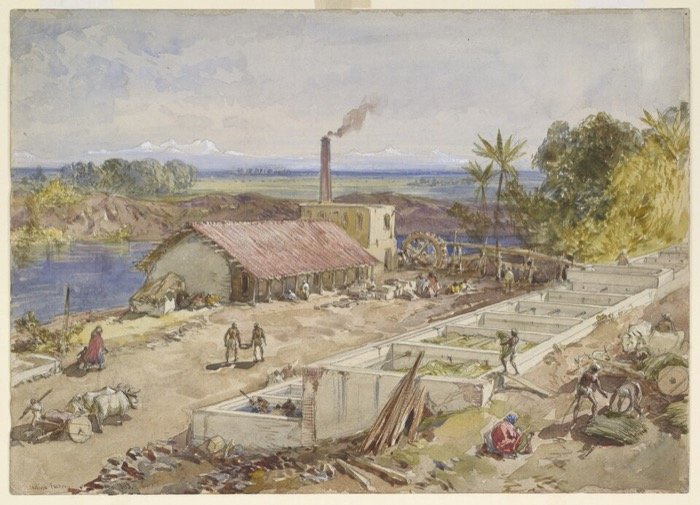
A vat is a fermenting or storage vessel.

In India, men did most of the cutting of indigo plants; women usually carried the plant to the vats. The vat-beaters stood in waist-deep water for over eight hours beating the indigo solution. In the last stage, workers stamped and cut the pressed pulp into blocks and carried them away to dry. Fig. 10 is a painting of an indigo factory by William Simpson, 1863; Fig. 8 is from Colesworthy Grant’s Rural Life in Bengal (1860).
11 The “Blue Rebellion” of 1859
In March 1859, Bengal’s ryots in their thousands said no to indigo. As the revolt grew:
- Ryots refused to pay rents to the planters.
- They raided indigo factories with swords, spears, bows and arrows.
- Women turned up to fight with pots, pans and kitchen implements.
- Anyone working for the planters faced a social boycott.
- Gomasthas who came for rent were thrashed.
- Ryots took an oath: no more advances for indigo, and no more fear of the planters’ lathiyals.
Gomasthas were the agents of planters who came to collect rent.
Lathiyals were the lathi-wielding strongmen maintained by the planters.
11.1 What gave the ryots the power to rebel?
The indigo system was intensely oppressive, but the oppressed do not always rise up; they do so only at times. In 1859 the ryots felt they had support from two sides:
Local zamindars and headmen
Headmen who had been made to sign indigo contracts gathered the peasants and fought the lathiyals face to face. Some zamindars went from village to village urging ryots to resist, because they were unhappy with the planters’ growing power and angry at being forced to give planters land on long leases.
The British government (they believed)
After the Revolt of 1857 the government feared another popular rebellion. When the Lieutenant Governor visited the area in the winter of 1859, the ryots took it as a sign that the government felt for them.
At Barasat, the magistrate Ashley Eden put out a notice saying ryots would not be forced to take indigo contracts. A rumour spread that Queen Victoria herself had ordered that nobody need grow indigo. Eden was only trying to calm the peasants and control an explosive situation, but his action was read as support for the rebellion.
As the rebellion spread, educated people (intellectuals) from Calcutta hurried to the indigo districts and wrote about the ryots’ suffering, the planters’ cruelty and the evils of the indigo system.
Source 2 is a song from an indigo-producing village of lower Bengal. It says the long lathis of the planter of Mollahati now lie in a heap, the babus of Kolkata have come down to watch the great fight, and this time the raiyats are ready: they will no longer be beaten in silence or give up their lives without fighting the lathiyals.
Source 2 of the chapter, in our own words
12 The Indigo Commission and after
Worried by the rebellion, the government did two things: it brought in the military to protect the planters from attack, and it formed the Indigo Commission to look into how indigo was produced.
1. It held the planters guilty and criticised their coercive methods.
2. It said that growing indigo did not pay the ryots.
3. It asked ryots to fulfil their existing contracts, but told them they could refuse to produce indigo in future.
“I would rather beg than sow indigo”
Hadji Mulla, indigo cultivator of Chandpore, Thana Hardi, to the Indigo Commission, Tuesday 5 June 1860 (Indigo Commission Report, Vol. II, Minutes of Evidence, p. 67)
In the same evidence, W. S. Seton Karr, President of the Indigo Commission, asked Hadji Mulla whether he would sow indigo on fresh terms, and Mr Sale asked whether he would sow it at a rupee a bundle. He refused both times and said he would rather go to another country.
12.1 From Bengal to Bihar to Champaran
In the early eighteenth century the French missionary Jean Baptiste Labat visited the Caribbean islands and wrote a great deal about them. A picture in one of his books shows every stage of indigo making on a French slave plantation: slaves putting plants into the settler vat, a worker churning the liquid with a mechanical churner, two workers carrying the pulp in bags to dry, two others mixing pulp for the moulds, and the planter on high ground supervising the slaves.
13 Timeline of the chapter
14 Quick revision
- 12 August 1765: Company becomes Diwan of Bengal = chief financial administrator; still behaves as a trader.
- Bengal revenue now pays for exports; artisans flee, peasants cannot pay; 1770 famine kills ten million (one-third).
- Permanent Settlement 1793: rajas and taluqdars become zamindars; revenue fixed forever; too high at first, zamindaris auctioned; later the Company loses out on rising prices.
- Mahalwari 1822: Holt Mackenzie, North Western Provinces; village (mahal) assessed; headman collects; revised periodically.
- Ryotwari: Alexander Read, then Thomas Munro; south India; direct settlement with ryots after a survey; demand too high, ryots fled.
- Crops for Europe: opium, indigo, jute, tea, sugarcane, wheat, cotton, rice.
- Indigo beat woad; Caribbean supply collapsed; India’s share of British imports 30% (1788) to 95% (1810).
- Nij (planter’s land, under 25%) vs ryoti (satta, advance, 25% of the ryot’s land).
- Vats: fermenting, beater (lime water), settling; pulp pressed and dried.
- Blue Rebellion March 1859; gomasthas beaten, lathiyals defied; support of zamindars and headmen; Ashley Eden’s Barasat notice.
- Indigo Commission: planters guilty, indigo not profitable for ryots, could refuse in future; production moves to Bihar; Champaran 1917.
- Can I list three features of the Permanent Settlement and two of its problems?
- Can I give three differences between the mahalwari system and the Permanent Settlement?
- Can I explain nij and ryoti cultivation, and why ryots disliked indigo?
- Can I give two reasons the ryots felt strong enough to rebel in 1859?
- Can I state the three findings of the Indigo Commission?