
- Why markets can be unfair to workers, consumers and producers, and why the government makes laws to stop this
- What the minimum wage law and the other laws in Table 1 of the book do, and whose interests they protect
- What “enforcement” of a law means, and why it matters most when the law protects the weak
- What the Constitution and the 2016 law say about child labour
- The Bhopal gas tragedy of 1984: what happened, why it happened, and why the victims are still fighting for justice
- How the idea of the environment changed after Bhopal, and how courts linked a clean environment to the Right to Life (Article 21)
This is Chapter 8 of the old NCERT Civics book “Social and Political Life III” for Class 8. It is still taught in many schools and state boards. Every name, date and number here follows that book.
1 Why do markets need laws?
In Class VII you read the “Story of a shirt”. A long chain of markets joined the person who grew the cotton to the person who bought the shirt in a supermarket, and at every step something was bought and sold.
- Many people in that chain were treated unfairly: the small cotton farmer, the weavers of Erode and the workers in the garment-exporting factory.
- The book’s point: markets everywhere tend to exploit people, whether they come to the market as workers, consumers or producers.
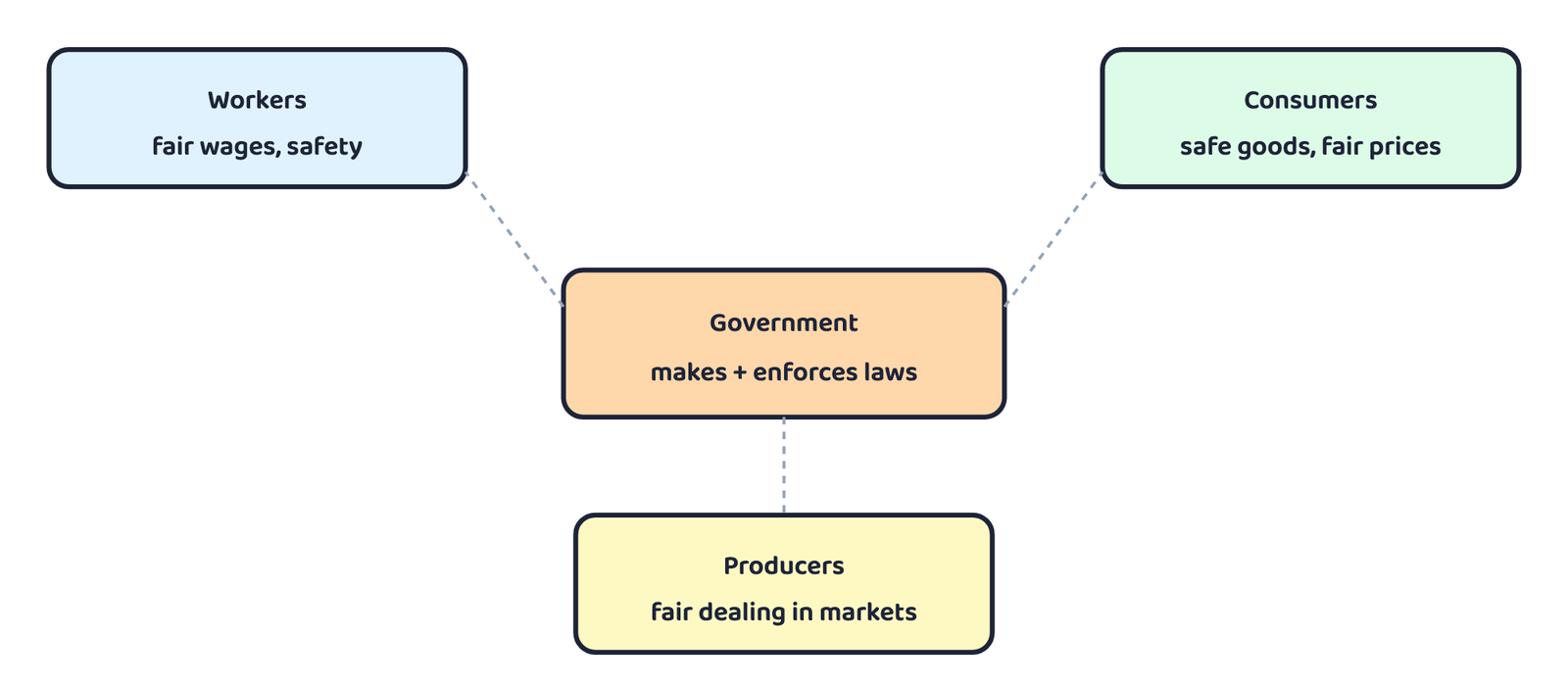
- To protect people from this, the government makes laws. These laws try to keep unfair practices in the market to a minimum.
A consumer is an individual who buys goods for personal use and not for resale.
Simple examples: a family buying wheat flour, salt, sugar or fruit to eat; a person buying a television, refrigerator or cycle to use at home. (Our CC notes add that people who pay for services such as electricity, telephone or transport are also consumers; the book’s glossary speaks only of goods.)
A producer is a person or organisation that produces goods for sale in the market. Sometimes a producer keeps part of the produce for his own use, like a farmer.
Exploitation means taking unfair advantage of someone who is weaker, for example making a person work hard but paying very little.
2 Workers’ wages and the minimum wage law
- Private companies, contractors and businesspersons usually want to make as much profit as they can.
- In the race for profit they may deny workers their rights, for example by not paying their wages. In the eyes of the law, denying workers their wages is illegal.
- To make sure workers are not underpaid, there is a law on minimum wages.
Under the minimum wage law, an employer must pay a worker not less than the minimum wage fixed by law. Minimum wages are revised upwards every few years.
Just as the minimum wage law protects workers, other laws protect producers and consumers. Together they try to make sure that the relations between the three parties, the worker, the consumer and the producer, are not exploitative.
A photo shows workers in a textile mill in Ahmedabad. Facing tough competition from power looms, most of the textile mills closed down in the 1980s and 1990s. Power looms are small units with 4-6 looms, run with hired and family labour, and their working conditions are known to be far from satisfactory.
3 Important laws that protect people (Table 1)
The book’s Table 1 lists laws that protect different groups. The first column is the law; we have filled the other two columns the way the book asks students to.
| Law | Why is it necessary? | Whose interests does it protect? |
|---|---|---|
| Minimum Wages Act: wages should not be below a fixed minimum | Many workers are denied fair wages. They badly need work, so they have no bargaining power and are paid low wages (book’s own entry) | All workers, especially farm labourers, construction workers, factory workers and domestic workers (book’s own entry) |
| Safety measures at workplaces: alarm system, emergency exits, properly functioning machinery | Without them, accidents can kill or injure workers | Workers, and people living near the workplace |
| Quality of goods must meet prescribed standards, e.g. electrical appliances must meet safety standards | Poor-quality electrical appliances, food and medicines can put consumers at risk (book’s own entry) | Consumers |
| Prices of essential goods (sugar, kerosene, foodgrains) must not be high | Traders may raise prices of things everyone needs | The poor, who would otherwise be unable to afford these goods (book’s own entry) |
| Factories must not pollute air or water | Pollution harms the health of people and the environment | People living around factories, and future generations |
| Laws against child labour in workplaces | Children are easy to exploit and lose their childhood and education | Children |
| Law to form workers’ unions / associations | Organised in unions, workers can use their combined power to demand fair wages and better working conditions (book’s own entry) | Workers |
A workers’ union is an association of workers. Its leaders bargain and negotiate with the employer on behalf of its members about wages, work rules, hiring, firing and promotion, benefits and workplace safety. Unions are common in factories and offices, and can also exist among other workers, for example domestic workers.
4 Enforcement: making a law is not enough
A law on paper helps nobody if it is not followed. The government has to make sure laws are implemented, that is, the law must be enforced.
Enforcement of a law means the government making sure the law is actually followed: for example, by regularly inspecting work sites and punishing those who break the law.
Enforcement becomes even more important when the law is meant to protect the weak from the strong.
4.1 Laws and social justice
- When the government makes, enforces and upholds laws, it keeps a check on what individuals and private companies do, and this is how social justice is secured.
- Many of these laws are based on the Fundamental Rights in the Indian Constitution.
Social justice, in this chapter, means that no group (workers, consumers, producers, children, people living near factories) is exploited, because the government makes fair laws, enforces them and upholds them.
Right against Exploitation
This Fundamental Right says that no one can be forced to work for low wages or under bondage.
No child labour below 14
The Constitution lays down that “no child below the age of 14 years shall be employed to work in any factory or mines or engaged in any other hazardous employment.”
5 Child labour: the 2016 law
- According to the 2011 census, over 4 million (40 lakh) children in India aged 5 to 14 work in various occupations, including hazardous ones.
- In 2016, Parliament amended the Child Labour (Prohibition and Regulation) Act, 1986:
- children below 14 years cannot be employed in any occupation;
- adolescents (14-18 years) cannot be employed in hazardous occupations and processes.
- Employing such children or adolescents is now a cognizable offence (in law, this means the police can arrest without a warrant from a court; this explanation is ours, the book does not give it).
- Punishment: jail from six months to two years and/or a fine of ₹20,000 to ₹50,000.
- The central government asked state governments to make plans to rescue and rehabilitate working children.
- An online portal, PENCIL (Platform for Effective Enforcement for No Child Labour), became functional in 2017. It is used for filing complaints, tracking children, and implementing and monitoring the National Child Labour Project (NCLP).
R.K. Laxman’s cartoon shows two women at a school gate. One says it is really cruel to burden kids with heavy school bags, so she “had to hire that boy” to carry her son’s bag. The irony: she pities her own child, but makes another, poorer child do the carrying as a labourer. Hiring a child below 14 for work is exactly what the 2016 law bans.
6 The Bhopal gas tragedy (1984)
The book calls it the world’s worst industrial tragedy. It shows what happens when safety laws are weak and are not enforced.
| Question | Answer from the book |
|---|---|
| Which company? | Union Carbide (UC), an American company |
| What did the factory make? | Pesticides |
| Where and when? | Bhopal, at midnight on 2 December 1984 |
| Which gas? | Methyl isocyanate (MIC), a highly poisonous gas (the book prints it as “methyl-isocyanite”) |
| Deaths | More than 8,000 people dead within three days; hundreds of thousands maimed |
| Who suffered most? | Poor, working-class families; nearly 50,000 people are still too sick to work |
| Long-term harm | Severe breathing (respiratory) disorders, eye problems, other illnesses; children developed peculiar (unusual) abnormalities |
“At about 12.30 am I woke to the sound of my baby coughing badly. In the half-light I saw that the room was filled with a white cloud. I heard people shouting ‘run, run’. Then I started coughing, with each breath seeming as if I was breathing in fire. My eyes were burning.”
Aziza Sultan, a survivor, as quoted in the book
6.1 It was not an accident
- UC had deliberately ignored essential safety measures to cut costs.
- Long before 1984 there had been gas leaks at the plant that killed a worker and injured several others.
- In spite of overwhelming evidence, UC refused to accept responsibility.
6.2 The fight for compensation
6.3 The struggle goes on
- UC stopped work but left tons of toxic chemicals behind. They seeped into the ground and contaminated the water.
- Dow Chemical, the company that now owns the plant, refuses to take responsibility for cleaning it up.
- “24 years later” (as the book puts it, counting from 1984), people were still fighting for safe drinking water, health care and jobs for those poisoned by UC.
- They also want Anderson, UC’s chairman, who faces criminal charges, to be prosecuted (tried in a court).
The book shows mass cremations, a child badly affected by the gas, members of the UC Employees Union protesting, gas victims with the Gas Relief Minister, and bags of chemicals still lying around the UC plant. Around the factory, the government painted the pumps at contaminated wells red, yet local people still use them because they have no other source of clean water.
7 What is a worker’s worth?
Why did Union Carbide set up its plant in India at all? The book’s answer begins with cheap labour.
Lower wages
Wages in countries like the U.S.A. are far higher than in poorer countries like India.
Longer hours
Even while paying less, a company can make people work more hours.
Fewer extra costs
Extra expenses such as housing for workers are also fewer.
Lower safety
Poorer working conditions and lower safety measures are another, dangerous way of cutting costs.
7.1 Cost cutting at the UC plant
| Item | Before | After |
|---|---|---|
| Work crew for the MIC plant (1980 to 1984) | 12 workers | 6 workers |
| Safety training for workers | 6 months | 15 days |
| Night-shift worker post for the MIC plant | Existed | Abolished |
| Safety devices | Every safety device was malfunctioning or in short supply | |
UC plant in West Virginia (U.S.A.)
- Computerised warning and monitoring systems
- Emergency evacuation plans in place
UC plant in Bhopal (India)
- Manual gauges and the human senses used to detect gas leaks
- No evacuation plans
7.2 Why such a difference?
- Part of the answer is how the worth of an Indian worker is seen: one worker can easily replace another.
- With so much unemployment, many people are willing to work in unsafe conditions just to earn a wage.
- Employers take advantage of this weakness (vulnerability) and ignore safety. Even today there are regular reports of accidents at construction sites, mines and factories because of employers’ careless (callous) attitude.
8 Enforcement of safety laws
As the lawmaker and enforcer, the government is supposed to make sure safety laws are followed. It also has a duty to protect the Right to Life.
The Right to Life is a Fundamental Right guaranteed under Article 21 of the Constitution. The government has a duty to see that it is not violated.
So what was the government doing at Bhopal? The book gives two answers:
- Government officials refused to call the plant hazardous and let it come up in a crowded (populated) locality.
- Some municipal officials of Bhopal objected that the installation of an MIC production unit in 1978 was a safety violation. The government’s reply: the state needs the plant’s investment, which gives jobs. Asking UC to move to cleaner technology or safer methods was “unthinkable” for them.
- Government inspectors kept approving the plant’s procedures even after repeated leaks.
- This is the opposite of what a law-making and enforcing agency should do. Both the government and the private company ignored people’s safety.
- With more Indian and foreign industries coming up, India needs stronger laws for workers’ rights and better enforcement.
Investment is money spent to buy new machinery, buildings or training, so as to increase or modernise production in the future.
A large travel agency was once asked to pay Rs 8 lakh to a group of tourists because their foreign trip was badly managed and they missed Disneyland and shopping in Paris. The book asks: why, then, did the Bhopal victims get so little for a lifetime of misery and pain?
9 New laws to protect the environment
Before Bhopal (1984)
- Very few environment laws, and hardly any enforcement
- The environment was treated as a “free” entity: any industry could pollute air and water freely
- UC spent nothing on cleaning up its pollution, although in the U.S.A. a company must pay for clean-up as part of making its goods
After Bhopal
- The environment came to the forefront
- New environment laws were made; the polluter was to be held accountable for the damage
- The environment is shared by people over generations and cannot be destroyed just for industrial growth
- Thousands of people who had nothing to do with the factory were badly affected by the gas. People realised that the existing laws, weak as they were, covered only the individual worker, not others hurt by industrial accidents.
- Under pressure from environmental activists and others, the government brought in new environment laws in the years after the tragedy.
One of these new laws was the Environment (Protection) Act, 1986, which lets the central government take steps to prevent pollution of every kind. The book itself only says “new laws on the environment”.
9.1 Courts and the right to a healthy environment
- Courts gave many judgments that the right to a healthy environment is a part of the Fundamental Right to Life.
- In Subhash Kumar vs. State of Bihar (1991), the Supreme Court held that the Right to Life under Article 21 includes the right to enjoy pollution-free water and air for full enjoyment of life.
- The government must make laws and procedures to check pollution, clean rivers and impose heavy fines on polluters.
A clean environment is a public facility: like water or health care, it is something every person, rich or poor, has a right to, and the government must protect it for all.
10 Environment as a public facility: who pays the price?
- Recent research shows that the middle classes’ growing concern for the environment often comes at the expense of the poor: slums are cleared to “beautify” a city, or a polluting factory is pushed to the outskirts.
- Meanwhile, hardly anyone worries about the safety of the workers.
- Workers thrown out of closed factories often become small traders or daily-wage labourers, or work in even smaller units where conditions are worse and laws are enforced even more weakly.
Find answers where everyone benefits from a clean environment: factories should move gradually to cleaner technologies and processes; the government should encourage and support them and fine those who pollute. Then workers keep their livelihoods, and both workers and nearby communities get a safe environment.
Vehicle smoke is a major cause of pollution. In a series of rulings from 1998 onwards, the Supreme Court ordered all public transport vehicles using diesel to switch to Compressed Natural Gas (CNG). As a result, Delhi’s air became much cleaner. Later, though, a report by the Center for Science and Environment, New Delhi, found high levels of toxic substances again, because of emissions from cars run on diesel and a sharp rise in the number of cars.
10.1 Hazardous industries move to poorer countries
- Rich (advanced) countries move their toxic and hazardous industries to developing countries, where laws are weaker, so that their own land stays safe.
- South Asian countries, especially India, Bangladesh and Pakistan, have become the base for factories making pesticides and asbestos, and for zinc and lead processing.
- Ship-breaking is another fast-growing hazardous industry: old ships full of harmful substances are sent to Bangladesh and India to be scrapped, for example at Alang, Gujarat.
11 Conclusion: the many roles of the government
- Weak and poorly enforced laws can cause serious harm, as Bhopal showed.
- The environment is one area where people pushed a public cause, and courts upheld a healthy environment as part of the Right to Life. People must now demand this facility for all.
- Workers’ rights (right to work, right to a fair wage and decent working conditions) are still very unfair. People must demand stronger laws so that every person truly gets the Right to Life.
12 The Constitution as a living ideal (book’s closing page)
Over the years, ordinary citizens have gone to court and widened the meaning of the Right to Life (Article 21):
| Right now included in Article 21 | Example from the book |
|---|---|
| Right to health | The case of the injured farmer Hakim Sheikh |
| Right to livelihood | The case of slum-dwellers evicted from Mumbai |
| Right to pollution-free water and air | This chapter (Subhash Kumar case, 1991) |
| Right to education and right to shelter | Other court rulings |
The Constitution is called a living document because it is flexible: it allows new interpretations, so new issues (like the right to health or shelter) can be included in the ideas of dignity and justice. These rights were not written in the text presented by the Constituent Assembly in 1949, but were present in spirit.
13 Timeline of the chapter
14 All definitions in one place
15 Quick revision
- Markets exploit workers, consumers and producers; the government makes laws to keep unfair practices to a minimum.
- Minimum wage: pay not below the legal minimum; revised upwards every few years.
- Table 1: minimum wages, workplace safety, quality standards, essential goods prices, no pollution, no child labour, workers’ unions.
- Enforcement = inspection + punishment; most important when protecting the weak from the strong.
- Right against Exploitation; no child below 14 in factories, mines or hazardous work.
- 2016: children below 14 banned from all occupations, 14-18 from hazardous ones; cognizable offence; 6 months-2 years jail and/or ₹20,000-₹50,000 fine; PENCIL 2017.
- Bhopal, 2 Dec 1984: Union Carbide (American), pesticides, MIC; 8,000+ dead in three days; 3 billion US dollars claimed (1985), 470 million US dollars accepted (1989).
- Cost cutting: crew 12 to 6, training 6 months to 15 days, no night-shift MIC worker; Bhopal had manual gauges, West Virginia had computers.
- Government failure: lax laws, not enforced, plant in a populated area, inspectors approved it.
- After Bhopal: polluter accountable; Subhash Kumar vs. State of Bihar (1991): Article 21 includes pollution-free water and air.
- Delhi closures hurt workers; CNG from 1998; hazardous industries and ship-breaking (Alang) move to South Asia.
- Can I give four laws from Table 1 and say whom each protects?
- Can I explain enforcement and say why it matters for poor workers?
- Can I list four reasons the Bhopal victims did not get justice?
- Can I give three advantages foreign companies get in India?
- Can I compare how the environment was treated before and after Bhopal?