- How to describe a sequence with an explicit rule or a recursive rule, and when each is useful
- What makes a sequence an Arithmetic Progression (AP), and how to find any term using
- How to find the sum of the first natural numbers using Gauss’s pairing method
- What makes a sequence a Geometric Progression (GP), and how to find any term using
1Sequences: Terms and Rules
A sequence is an ordered list of numbers, where each number is called a term. A sequence can be finite (a fixed number of terms) or infinite (continuing forever, shown by ““). We write for the first term, for the second term, and in general for the th term.
| Sequence | Rule in words |
|---|---|
| 1, 2, 3, 4, 5, … | Natural numbers: each term is one more than the previous |
| 1, 3, 5, 7, 9, … | Odd numbers: difference of 2 between consecutive terms |
| 1, 3, 6, 10, 15, … | Triangular numbers: each term adds the next natural number |
| 1, 4, 9, 16, 25, … | Square numbers: each term adds the next odd number |
An explicit rule gives the value of directly from its position number , e.g. . A recursive rule gives in terms of the previous term(s), e.g. for . An explicit rule finds any term instantly; a recursive rule needs every earlier term to be known first.
Given
A sequence with explicit rule
Find
The 10th term, and check whether 76 is a term
Solving gives , so : 76 is the 26th term
Given
A sequence with recursive rule for
Find
The first four terms
, ,
First four terms:
The sequence (each term the sum of the previous two) is the Virahānka-Fibonacci sequence. It was first written down by the Indian scholar Virahānka in the 7th century CE, while studying the rhythms of Prakrit poetry, centuries before the Italian mathematician Fibonacci described it around 1200 CE.
2Arithmetic Progressions (AP)
An Arithmetic Progression (AP) is a sequence in which every term after the first is obtained by adding a fixed number , the common difference, to the previous term. Its general form is , where is the first term.
Given
An AP: 7, 11, 15, 19, …
Find
The 15th term
, .
Given
A taxi charges a fixed booking fee of ₹200 plus ₹40 per km travelled
Find
The sequence of total fares, and the fare for 10 km
After 1, 2, 3 km the fares are ₹240, ₹280, ₹320, … an AP with , . Writing distance travelled as km, .
For : ₹600
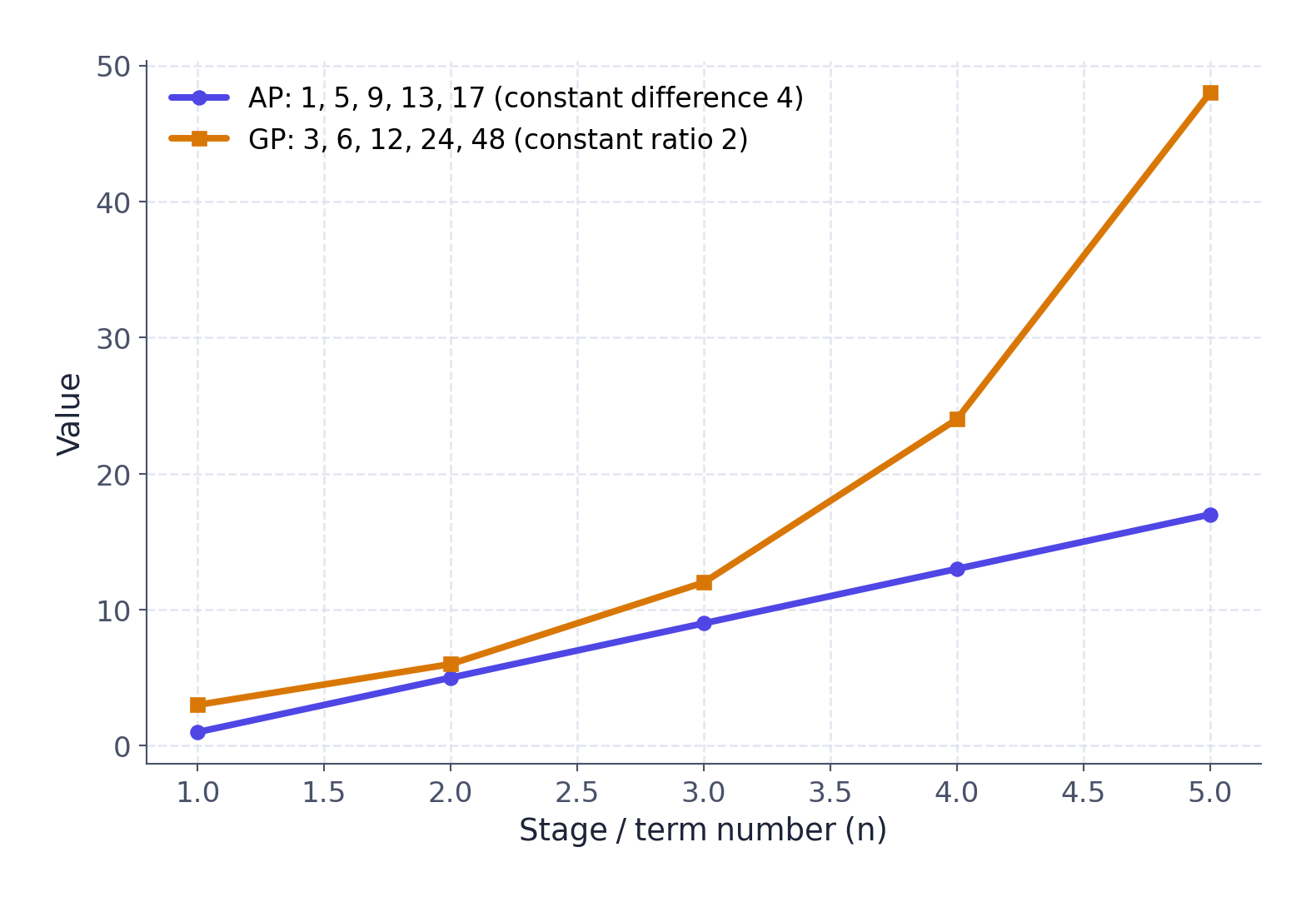
Plotting (stage, value) pairs of an AP always gives points that lie on a straight line, while a GP’s points curve sharply away, as the chart below shows.
To test if a sequence is an AP, check that , and so on. If the difference is not constant, it is not an AP.
3Sum of the First Natural Numbers
Let . Writing the same sum in reverse, . Adding the two, every pair of matching terms sums to , and there are such pairs:
The earliest known written record of this formula appears in Āryabhaṭa’s Āryabhaṭīya (Chapter 2, Verse 19), composed around 499 CE, describing the sum as the average of the first and last term, multiplied by the number of terms.
Given
The sum of the first 40 natural numbers
Find
, and the sum of the numbers from 41 to 60
This same formula gives the th triangular number: , since each triangular number is the sum of the natural numbers up to that point.
4Geometric Progressions (GP)
A Geometric Progression (GP) is a sequence in which every term after the first is obtained by multiplying the previous term by a fixed number , the common ratio. Its general form is , where is the first term.
Given
A GP where the 3rd term is 12 and the 6th term is 96
Find
The common ratio and the first term
and . Dividing, , so
Then
Given
A ball dropped from 50 m bounces back to 40% of its previous height each time
Find
The height reached after the 3rd bounce
Heights form a GP with and :
m
The Sierpiński triangle is built by repeatedly removing the central triangle from each remaining piece. The number of black triangles at stage is , while the shaded area shrinks as of the original: both are GPs, one growing without bound, the other shrinking towards zero.
An explicit rule lets you jump straight to any term; a recursive rule only lets you walk there one step at a time.
the single idea to carry out of this chapter
- Can I tell the difference between an explicit rule and a recursive rule, and use each one?
- Can I find any term of an AP using , and identify and ?
- Can I find the sum of the first natural numbers, and use it to sum a range of numbers?
- Can I find any term of a GP using , and identify and ?
- Explicit rule: from directly. Recursive rule: from
- AP: constant common difference ; ; points plot on a straight line
- (Gauss’s pairing method)
- GP: constant common ratio ; ; points curve away, not a straight line
- Virahānka-Fibonacci sequence: , first recorded 7th century CE
- 1 markA sequence has explicit rule . Find the first term and the 5th term.
- 2 marksFor the sequence , which term of the sequence is 76?
- 2 marksA sequence is given by the recursive rule , for . Find the first four terms.
- 2 marksFind the 15th term of the AP 7, 11, 15, 19, …
- 2 marksWhich term of the AP 100, 93, 86, … is 2?
- 3 marksFind the sum of the first 40 natural numbers. Hence find the sum of the numbers from 41 to 60.
- 2 marksHow many 2-digit numbers are divisible by 4? Find their sum.
- 2 marksShow that 2, 6, 18, 54, … is a GP, and find its 6th term.
- 3 marksIn a GP, the 3rd term is 12 and the 6th term is 96. Find the common ratio and the first term.
- 3 marksA ball is dropped from a height of 50 m and bounces back to 40% of its previous height each time. Find the height it reaches after the 3rd bounce, and write the explicit formula for the height after the th bounce.
- 1 markThe common difference of the AP 5, 2, −1, −4, … is:
(a) 3(b) −3(c) 2(d) −2 - 1 markThe th term of a GP with first term 3 and common ratio 2 is:
(a) (b) (c) (d) - 1 markWhich of these is neither an AP nor a GP?
(a) 2, 4, 6, 8(b) 3, 9, 27, 81(c) 1, 4, 9, 16(d) 5, 5, 5, 5
Reason (R): In a GP, the ratio of any term to its immediately preceding term is always constant.
- 1 markWhat is the salary in the 4th year?
- 1 markIn which year does the salary first reach ₹6,00,000?
- 2 marksFind the total salary earned over the first 5 years.