1 What Is a Cell?
The cell is the basic structural and functional unit of all living organisms.
Organisms with only one cell (bacteria, yeast) are unicellular; those built from many cells working together (plants, animals) are multicellular. A group of similar cells doing the same job forms a tissue; tissues form an organ; organs working together form an organ system.
2 Studying Cells
The human eye cannot separate two points closer than 0.1 mm apart (viewed from 25 cm): this is called the eye’s limit of resolution. Since most cells are far smaller than this, we need microscopes. Robert Hooke (1665) was the first to see cells, using a self-built microscope on a thin slice of cork: the box-like compartments he saw are why we call them “cells.” A light microscope magnifies using lenses; an electron microscope uses a beam of electrons to reveal detail down to the nanometre scale.
Formula:
Q. The visible field under the microscope is 5,000 µm across, and 25 onion cells fit along that diameter. Find the real size of one cell.
Solution: per cell.
3 The Cell Membrane and Osmosis
The cell membrane (plasma membrane) is a thin, selectively permeable boundary that lets some substances through and blocks others, giving the cell its individuality.
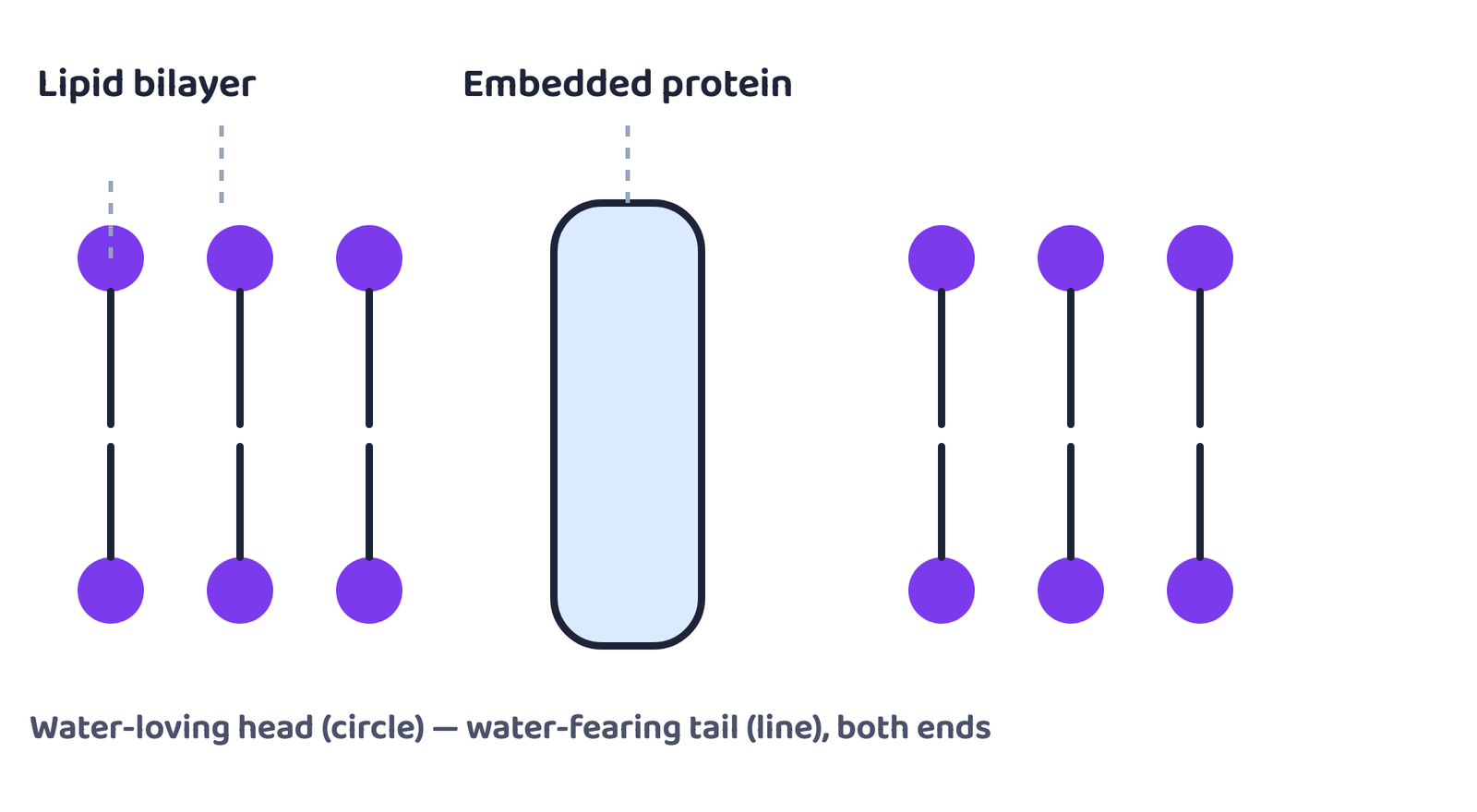
Its structure is called the fluid-mosaic model: a bilayer of fat molecules (water-loving heads pointing out, water-fearing tails pointing in) with proteins embedded in it: “fluid” because the molecules can move, “mosaic” because they’re arranged like tiles.
Diffusion is the net movement of particles from higher to lower concentration (no membrane needed). Osmosis is the diffusion of water specifically, across a selectively permeable membrane.
Activity: a potato piece in plain water swells (water moves in); the same potato in 20% salt solution shrinks (water moves out): the membrane lets water through but not the dissolved salt.
| Solution | Compared to the cell’s inside | Effect on the cell |
|---|---|---|
| Isotonic | Equal solute concentration | No net water movement |
| Hypotonic | Lower solute concentration outside | Water moves in: cell swells |
| Hypertonic | Higher solute concentration outside | Water moves out: cell shrinks |
4 The Cell Wall
The cell wall is a rigid, freely permeable covering outside the cell membrane, found in plant, fungal and bacterial cells: never in animal cells. It is made mainly of cellulose.
In a strong sugar solution, a plant cell’s wall keeps its outer shape while the membrane and contents shrink away from it: an animal cell, with no wall, simply shrinks all over.
5 Prokaryotic and Eukaryotic Cells
| Feature | Prokaryotic | Eukaryotic |
|---|---|---|
| Defined nucleus | Absent (DNA in a region called the nucleoid) | Present |
| Membrane-bound organelles | Absent | Present |
| Typical diameter | 1–10 µm | 10–100 µm |
| Example | Bacteria | Plant and animal cells |
“Pro” = primitive, “eu” = true, “karyon” = nucleus.
6 Cell Organelles
| Organelle | Job |
|---|---|
| Nucleus | Controls the cell; holds DNA as chromatin (resting) or chromosomes (dividing); nucleolus makes ribosome parts |
| Ribosomes | Protein factories: free in the cytoplasm or attached to the ER |
| Rough ER (RER) | Ribosomes attached: protein synthesis and secretion |
| Smooth ER (SER) | No ribosomes: synthesises lipids and hormones |
| Golgi apparatus | Modifies, sorts and packages proteins/lipids into vesicles |
| Lysosomes | Enzyme sacs: break down waste and damaged parts |
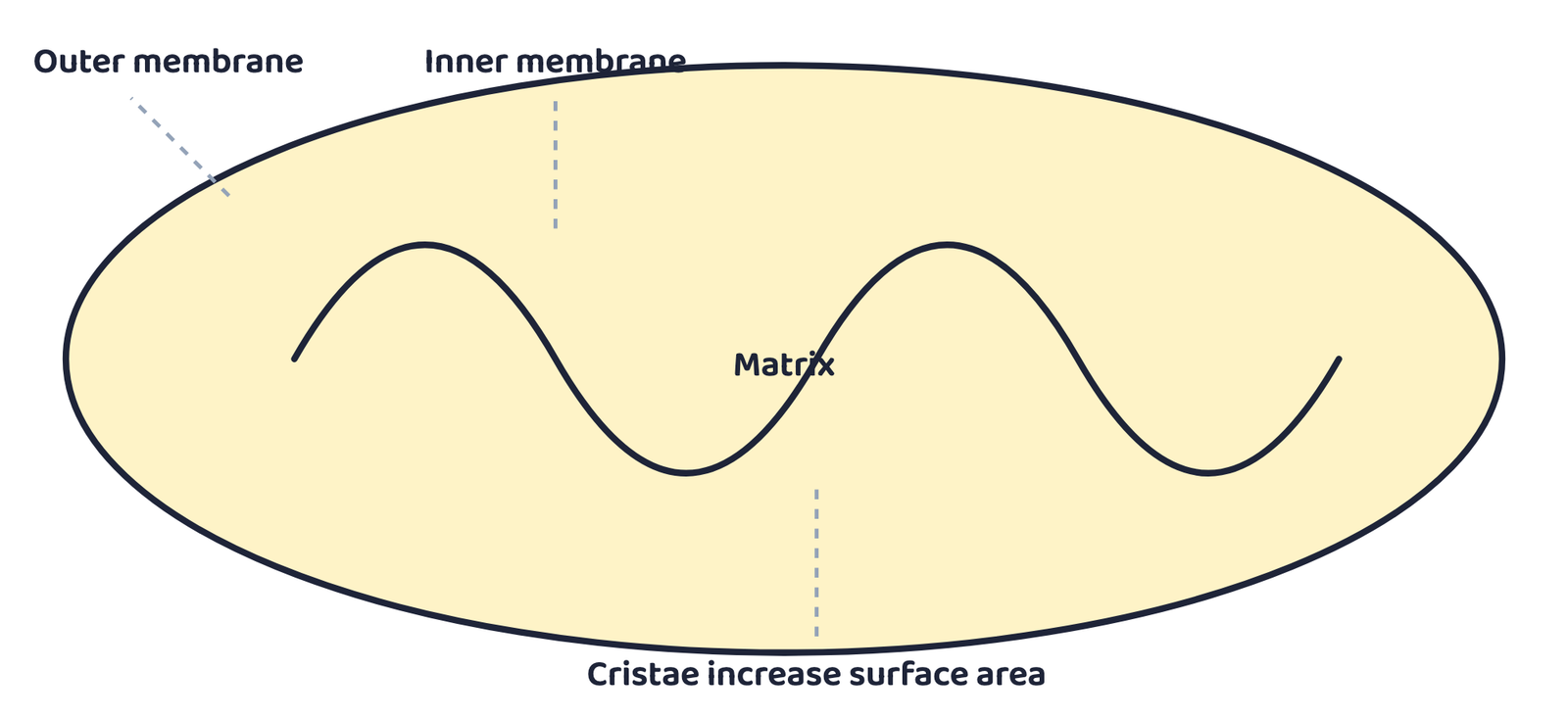
| Mitochondria | “Powerhouse”: cellular respiration releases energy, stored as ATP |
Mature red blood cells have no nucleus: the extra space lets them carry more haemoglobin (and so more oxygen), but it also means they can’t repair or divide themselves, so they live only about 120 days.
| Plastid | Colour / job |
|---|---|
| Chloroplast | Green (chlorophyll): carries out photosynthesis |
| Chromoplast | Yellow/orange/red pigments: colours flowers and fruits |
| Leucoplast | Colourless: stores starch, oil or protein (e.g. in potato) |
A mature plant cell also has one large central vacuole, filled with cell sap: it stores water and keeps the cell firm (a plant wilts when its vacuoles lose water). Animal cells have only small, temporary vacuoles.
7 Cell Division
| Mitosis | Meiosis | |
|---|---|---|
| Daughter cells | 2, genetically identical | 4, each with half the chromosomes |
| Where it happens | Throughout the body | Only in reproductive organs |
| Purpose | Growth, repair, asexual reproduction | Sexual reproduction, genetic diversity |
Normal cells stop dividing once they touch their neighbours: called contact inhibition. Cancer cells lose this control and keep dividing uncontrollably, forming tumours. This is an error in mitosis, not meiosis.
8 Cell Theory
Cell Theory: all living organisms are made of one or more cells; the cell is the basic unit of structure and function; all cells arise from pre-existing cells.
| Scientist | Year | Contribution |
|---|---|---|
| Schleiden | 1838 | All plants are made of cells |
| Schwann | 1839 | All animals are made of cells |
| Virchow | 1855 | All cells arise from pre-existing cells |
- The cell is the basic unit of structure and function of life
- Cell size = field-of-view diameter ÷ number of cells across it
- Cell membrane is selectively permeable; cell wall (plants only) is freely permeable
- Osmosis is the diffusion of water across a selectively permeable membrane
- Prokaryotic cells have no defined nucleus; eukaryotic cells do
- RER makes and secretes proteins; SER makes lipids and hormones
- Mitochondria release energy as ATP; chloroplasts capture light energy for photosynthesis
- Mitosis: 2 identical cells, for growth and repair. Meiosis: 4 half-chromosome cells, for reproduction
- Cell Theory: Schleiden (plants, 1838), Schwann (animals, 1839), Virchow (pre-existing cells, 1855)
- 1 markDefine a cell.
- 1 markWho first observed cells, and in what material?
- 1 markWhat is the limit of resolution of the human eye?
- 1 markDefine osmosis.
- 1 markName the chemical that makes up most of a plant cell wall.
- 1 markWhat is the “energy currency” of the cell, and which organelle makes it?
- 1 markName the scientist who showed that all cells arise from pre-existing cells.
- 1 markWhich blood cell has no nucleus?
- 2 marksA cell placed in pure water swells; the same type of cell placed in concentrated salt solution shrinks. Explain both observations.
- 2 marksWhy does a plant cell keep its shape in a strong sugar solution while an animal cell shrinks completely?
- 2 marksA microscope’s field of view is 4,000 µm across, and 20 cells fit along that diameter. Find the real size of one cell.
- 3 marksDistinguish between the cell membrane and the cell wall.
- 3 marksDistinguish between RER and SER.
- 3 marksDistinguish between chloroplasts and chromoplasts.
- 3 marksDistinguish between prokaryotic and eukaryotic cells, with one example of each.
- 3 marksWhat is contact inhibition, and how does its loss lead to cancer?
- 5 marksExplain the fluid-mosaic model of the cell membrane, and say why it is called “fluid” and why “mosaic.”
- 5 marksDescribe the structure and function of the nucleus, mitochondria and Golgi apparatus.
- 5 marksDistinguish between mitosis and meiosis: number of daughter cells, chromosome number, where each occurs, and its purpose.
- 5 marksState Cell Theory, naming the three scientists behind it and their contributions.
- 1 markThe fluid-mosaic model describes the structure of the:
(a) cell wall(b) cell membrane(c) nucleus(d) mitochondrion - 1 markA cell placed in a hypertonic solution will:
(a) swell(b) shrink(c) stay the same(d) divide - 1 markWhich organelle is correctly described?
(a) SER: lipid and cellulose synthesis(b) RER: protein synthesis and secretion(c) Golgi: cellular respiration(d) Lysosome: photosynthesis - 1 markA cell with no well-defined nucleus is called:
(a) eukaryotic(b) prokaryotic(c) multicellular(d) meristematic - 1 markCristae increase the surface area of the:
(a) nucleus(b) chloroplast(c) inner mitochondrial membrane(d) cell wall - 1 markMeiosis produces:
(a) 2 identical daughter cells(b) 4 daughter cells with half the chromosomes(c) 1 daughter cell(d) 2 daughter cells with double the chromosomes - 1 markWhich scientist showed that all animals are made of cells?
(a) Schleiden(b) Schwann(c) Virchow(d) Hooke
Choose: (a) both true, R explains A · (b) both true, R doesn’t explain A · (c) A true, R false · (d) A false, R true.
- 1 mark
Assertion (A): Plant cells never burst, even in pure water.
Reason (R): The rigid wall resists the pressure osmosis creates. - 1 mark
Assertion (A): Cancer cells divide uncontrollably.
Reason (R): They have lost contact inhibition.