
1 What Is a Tissue?
A tissue is a group of similar cells that work together to perform one specific function. Grouping into tissues creates division of labour, which makes the whole body more efficient.
2 Meristematic Tissue
Meristematic cells divide continuously to make a plant grow. Their cells are small, thin-walled, with a large nucleus, dense cytoplasm and no vacuoles: features that make rapid division possible.
| Meristem | Location | Causes growth in |
|---|---|---|
| Apical | Root and shoot tips | Length |
| Lateral | Ring around the stem | Girth (produces annual growth rings) |
| Intercalary | Base of internodes/nodes | Regrowth after cutting (why grass regrows after mowing) |
When meristematic cells stop dividing and specialise for a job (support, transport, storage), the process is called differentiation, and the result is permanent tissue.
3 Permanent Tissue: Simple
Simple permanent tissue is made of just one type of cell.
| Tissue | Cells | Job |
|---|---|---|
| Parenchyma | Living, thin walls, loosely packed | Stores food; photosynthesis in green parts; air spaces help aquatic plants float |
| Collenchyma | Living, corners thickened with pectin | Flexible support, lets stems and tendrils bend without breaking |
| Sclerenchyma | Mostly dead, thick walls (lignin) | Hard, woody strength: stems, leaf veins, seed coats |
4 Permanent Tissue: Complex, and the Tissue Systems
Complex tissue is made of more than one cell type working together.
| Xylem | Phloem | |
|---|---|---|
| Transports | Water and minerals | Food |
| Direction | Roots → rest of plant | Leaves → rest of plant |
| Made of | Tracheids, vessels, xylem parenchyma, xylem fibres: mostly dead | Sieve tubes, companion cells, phloem parenchyma, phloem fibres: mostly living |
The outermost layer, the epidermis, protects the plant and is covered by a waxy cuticle that cuts water loss. Its pores, stomata, allow gas exchange and transpiration: evaporation that pulls water up through the xylem.
These tissues organise into three tissue systems: dermal (outer covering), ground (the main plant body: parenchyma, collenchyma, sclerenchyma), and vascular (xylem + phloem).
5 Epithelial and Connective Tissue
| Epithelial type | Structure | Where / job |
|---|---|---|
| Squamous | Single layer, thin, flat cells | Blood vessels, lungs: fast diffusion |
| Stratified | Many flat, tightly packed layers | Skin, mouth: protection |
| Glandular | Cuboidal/columnar, secretory | Salivary and sweat glands: secretion |
| Sensory | Receptor cells with cilia | Nose, ear: smell, sound, balance |
| Columnar | Tall single layer, often ciliated | Small intestine: absorption |
| Connective type | Matrix | Job |
|---|---|---|
| Blood | Fluid (plasma) | Transports substances around the body |
| Bone | Rigid (calcium + phosphorus) | Strength, support, protection |
| Cartilage | Soft, jelly-like | Flexibility, cushions joints |
| Tendon | Tough fibres | Connects muscle to bone |
| Ligament | Tough fibres | Connects bone to bone, limits movement |
6 Muscular and Nervous Tissue
| Skeletal | Smooth | Cardiac | |
|---|---|---|---|
| Control | Voluntary | Involuntary | Involuntary |
| Shape | Long, cylindrical, unbranched | Spindle-shaped | Cylindrical, branched |
| Nucleus | Many (multinucleate) | One | One |
| Striations | Yes | No | Faint |
| Found in | Attached to skeleton | Stomach, intestine | Only the heart |
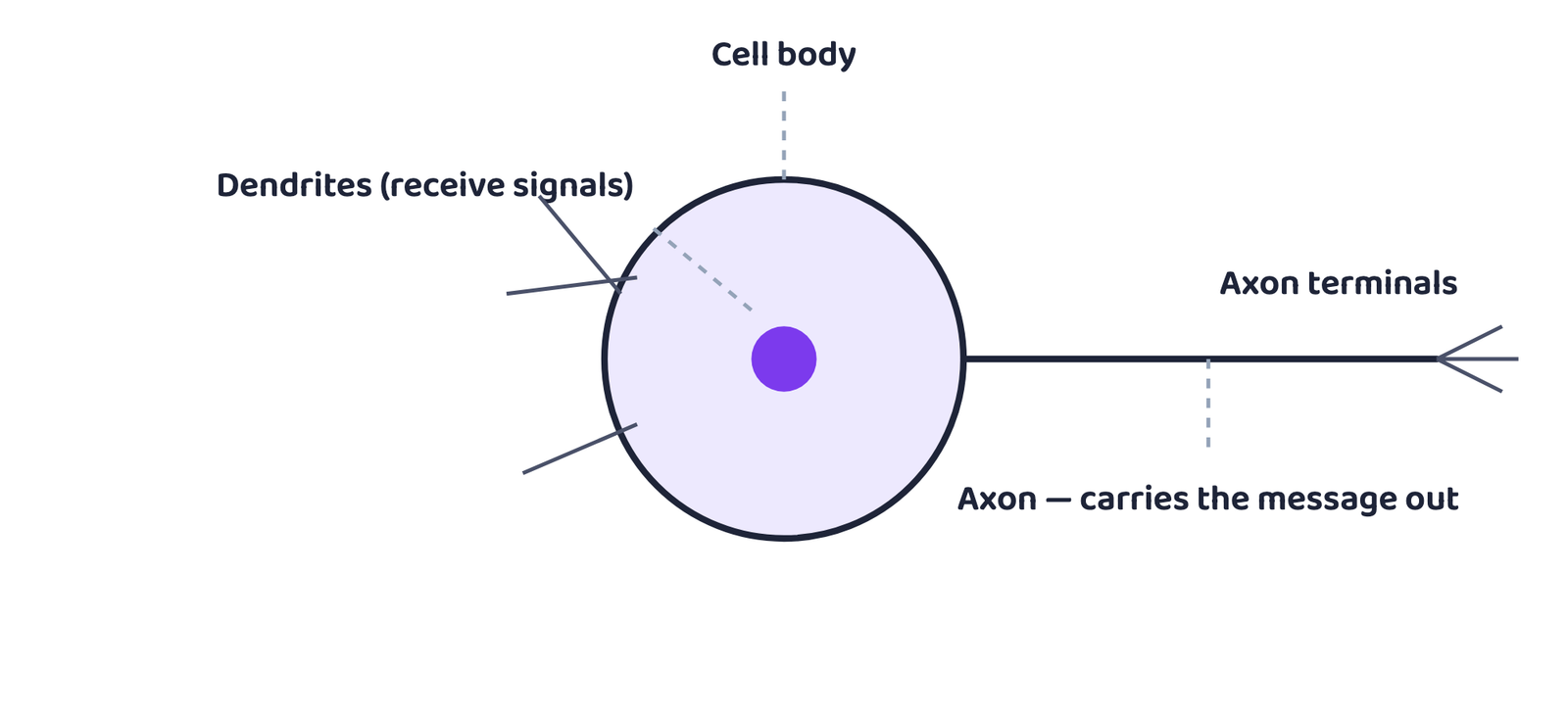
The cells of nervous tissue, neurons, receive, process and transmit messages.
7 The Musculoskeletal System and Joints
Bones, muscles, joints, cartilage, tendons and ligaments work together under nervous-system control. A tendon transmits a muscle’s contraction to the bone, producing movement at a joint: a junction between two or more bones.
| Joint | Movement | Example |
|---|---|---|
| Ball and socket | Forward, backward, sideways, circular | Shoulder |
| Hinge | One direction only, like a door | Elbow, knee |
| Pivot | Turning, like a doorknob | Neck (skull on backbone) |
| Fixed | No movement at all | Skull bones |
8 Skeletal System
The skeleton (skull, vertebral column, rib cage) protects delicate organs and gives the body its shape. The vertebral column is a chain of small bones (vertebrae) cushioned by cartilage discs, which allow bending. The rib cage: 12 pairs of ribs, joined to the spine and sternum by flexible cartilage: protects the heart and lungs and expands and contracts for breathing.
- A tissue is a group of similar cells doing one job: division of labour
- Apical meristem → length; lateral → girth; intercalary → regrowth after cutting
- Simple permanent tissue: parenchyma (storage), collenchyma (flexible support), sclerenchyma (rigid support)
- Xylem carries water up (mostly dead cells); phloem carries food (mostly living cells)
- Tendon = muscle to bone. Ligament = bone to bone
- Skeletal muscle is voluntary and striated; smooth is involuntary with no striations; cardiac is involuntary, branched, tireless
- A neuron has a cell body, dendrites (receive) and an axon (send)
- Ball-and-socket allows the most movement; fixed joints allow none
- 1 markDefine a tissue.
- 1 markWhich meristem is responsible for a tree’s annual growth rings?
- 1 markName the chemical that thickens collenchyma cell corners.
- 1 markWhat connects muscle to bone?
- 1 markWhat connects bone to bone?
- 1 markName the three parts of a neuron.
- 1 markHow many pairs of ribs does the human rib cage have?
- 1 markWhich joint allows movement in only one direction?
- 2 marksIf a plant cannot transport food from its leaves to its roots, which tissue is malfunctioning, and why?
- 2 marksWhy can meristematic cells divide repeatedly, when most other plant cells cannot?
- 2 marksWhy are the epithelial linings of internal organs usually only one or a few cells thick?
- 3 marksDistinguish between xylem and phloem.
- 3 marksDistinguish between parenchyma, collenchyma and sclerenchyma.
- 3 marksDistinguish between skeletal, smooth and cardiac muscle.
- 3 marksA mango sapling’s stem bends in strong wind without breaking. Which tissue makes this possible, and what would happen if it were sclerenchyma instead?
- 3 marksWhy is coconut husk fibre tough and strong? Could parenchyma serve the same purpose?
- 5 marksDescribe the three types of meristematic tissue, where each is found, and what kind of growth each produces.
- 5 marksDescribe the five types of epithelial tissue and how each one’s structure suits its function.
- 5 marksDescribe the four types of joints, with an example and the movement each allows.
- 1 markMeristematic tissue can divide repeatedly because its cells have:
(a) thick walls(b) large vacuoles(c) thin walls, dense cytoplasm, a large nucleus(d) no cytoplasm - 1 markBending the knee uses which type of joint?
(a) Ball and socket(b) Hinge(c) Pivot(d) Fixed - 1 markWhich tissue transports food from leaves to roots?
(a) Xylem(b) Phloem(c) Epidermis(d) Sclerenchyma - 1 markCardiac muscle can contract non-stop, without fatigue, mainly because:
(a) it is voluntary(b) it has a rich blood and mitochondria supply(c) it has no nucleus(d) it lacks striations - 1 markWhich is the correct location for lateral meristem?
(a) Root and shoot tips(b) A ring around the stem(c) Base of internodes(d) Leaf surface - 1 markWhich connective tissue has a fluid matrix?
(a) Bone(b) Cartilage(c) Blood(d) Tendon
Choose: (a) both true, R explains A · (b) both true, R doesn’t explain A · (c) A true, R false · (d) A false, R true.
- 1 mark
Assertion (A): Epithelium suits gas exchange in the lungs well.
Reason (R): It has many thick layers that slow diffusion down. - 1 mark
Assertion (A): Tendons connect bone to bone.
Reason (R): Tendons transmit a muscle’s pulling force to a bone.