1Historians and Feudalism
1.1 What This Chapter Covers
This chapter is about the socio-economic and political changes in western Europe between the ninth and sixteenth centuries. After the Roman Empire fell, Germanic groups from eastern and central Europe occupied Italy, Spain and France. With no single political authority left standing, military conflict was frequent, and controlling land became the key to survival. Christianity, the Roman Empire’s official religion from the fourth century, survived Rome’s collapse and spread further into central and northern Europe, and the Church itself became a major landholder and political power.
Out of this world came the “three orders”, three social categories that give this chapter its name: Christian priests, landowning nobles and peasants. How the relationship between these three groups changed over several centuries is what shapes the rest of the story.
1.2 How Do Historians Know? Marc Bloch and His Sources
Over the last hundred years, European historians have done detailed work even on the histories of single villages. This was possible because the medieval period left behind a lot of material: documents, land-ownership records, prices, legal cases. Churches kept records of births, marriages and deaths, which let historians reconstruct family and population structure; inscriptions in churches describe traders’ associations; and songs and stories give a sense of festivals and community life. All of this lets historians study both long-term change, like population growth, and short-term change, like a peasant revolt.
Marc Bloch (1886-1944) was one of the earliest and most important French historians of feudalism. He argued that history is much more than political history, international relations and the lives of great people, and stressed the importance of geography and the collective behaviour of ordinary groups of people. His book Feudal Society studies European, and especially French, society between 900 and 1300 in remarkable detail: its social hierarchies, land management and popular culture.
Do not write that Marc Bloch died of natural causes or old age. NCERT’s own text says plainly that his career was “cut short tragically”: he was shot by the Nazis during the Second World War, as an active member of the French Resistance.
1.3 What Is Feudalism?
Feudalism is the term historians use for the economic, legal, political and social relationships that existed in medieval Europe. It comes from the German word feud, meaning “a piece of land”, and describes the kind of society that first developed in medieval France, and later spread to England and southern Italy.
In an economic sense, feudalism means a kind of agricultural production based on the relationship between lords and peasants. Peasants cultivated their own land as well as the lord’s, performing labour services in exchange for the lord’s military protection; lords also held extensive judicial control over their peasants. So feudalism was never only economic, it shaped the social and political sides of life just as much. Its roots go back to practices in the Roman Empire and in the age of the French king Charlemagne (742-814), but feudalism as an established way of life across large parts of Europe only emerged later, in the eleventh century.
The Eastern Church’s head, in Constantinople, had a similar relationship with the Byzantine emperor as the Pope had with kings in western Europe. “Church and king closely linked” was not unique to France alone.
1.4 France and England: The Political Background
Gaul, a province of the Roman Empire, had two long coastlines, mountain ranges, long rivers, forests and large plains well suited to farming. The Franks, a Germanic tribe, gave Gaul their own name, “France”. From the sixth century, this was a kingdom ruled by Christian Frankish/French kings, closely linked to the Church: a link made even stronger in 800 CE, when the Pope crowned King Charlemagne “Holy Roman Emperor” to secure his support.
Across a narrow channel lay the island of England-Scotland, conquered in the eleventh century by a duke from the French province of Normandy, a story covered in full in Section 5.
1.5 The Three Orders: An Overview
French priests believed that everyone belonged to one of three “orders”, depending on what work they did. A bishop put it simply: “Here below, some pray, others fight, still others work…” So the three orders of society were, broadly, the clergy, the nobility and the peasantry.
“Who would think of herding his entire cattle in one stable, cows, donkeys, sheep, goats, without difference? Therefore it is necessary to establish difference among human beings, so that they do not destroy each other… God makes distinctions among his flock, in heaven as on earth. All are loved by him, yet there is no equality among them.”
Abbess Hildegard of Bingen, twelfth century, justifying the three-orders idea as part of a natural, God-given order
First order: Clergy
Priests, bishops and monks. Placed themselves first because they prayed for everyone’s soul.
Second order: Nobility
Kings, nobles and knights. Controlled land and fought to protect it.
Third order: Peasantry
Free peasants and serfs. Grew the food that sustained the other two orders.
2The Nobility
2.1 Vassalage
In reality, the nobility had the central role in medieval society, because they controlled land, and this control worked through a practice called vassalage. The kings of France were linked to their people by vassalage, a practice shared with other Germanic peoples like the Franks. Big landowners, the nobles, were vassals of the king, and peasants were vassals of the landowners.
Vassalage was a relationship in which a nobleman accepted the king as his seigneur (senior/lord: the word “lord” comes from a term meaning “one who provided bread”), and the two made a mutual promise: the lord would protect the vassal, who in turn would stay loyal to him. The ceremony involved elaborate rituals and vows taken on the Bible in a church; the vassal received a written charter, or a staff, or even a clod of earth, as a symbol of the land being granted to him.
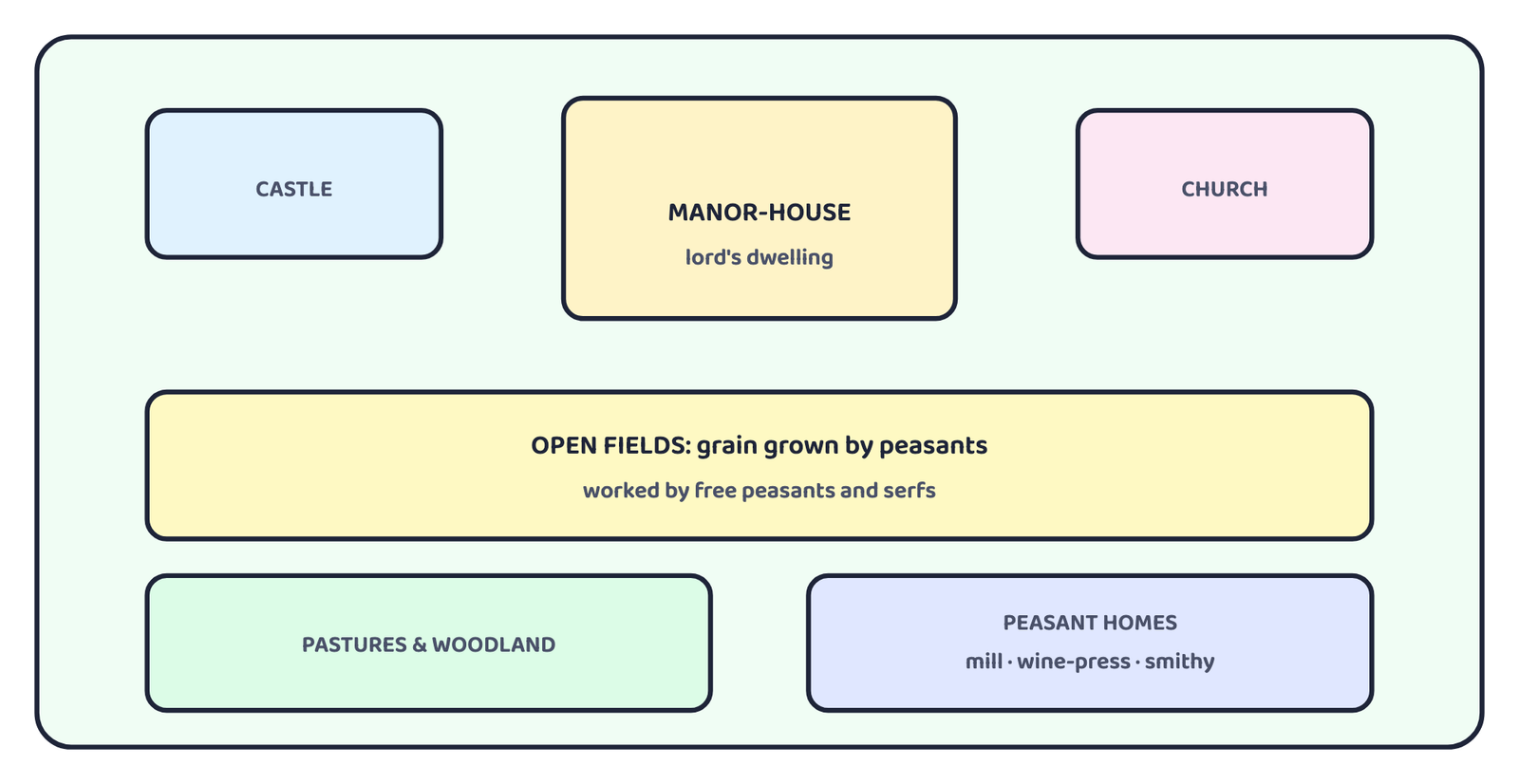
The noble enjoyed a privileged status: absolute, perpetual control over his property, the right to raise troops called “feudal levies”, his own courts of justice, and even the right to coin his own money. He was lord over everyone settled on his land, his own dwellings, private fields and pastures, and the homes and fields of his tenant-peasants, all under one roof called a manor.
2.2 The Manorial Estate
A lord had his own manor-house, and could control anywhere from a dozen to hundreds of villages. A small manorial estate might hold a dozen families, a larger one fifty or sixty. Almost everything needed for daily life was found on the estate: grain grown in the fields, blacksmiths and carpenters maintaining tools and weapons, stonemasons looking after buildings. Women spun and wove fabric, and children worked in the lord’s wine-presses. The estate had woodlands for hunting, pastures for cattle and horses, a church, and a castle for defence.
From the thirteenth century, some castles were enlarged into residences for a knight’s family. In England, castles were practically unknown before the Norman Conquest, and only developed as centres of political and military power once feudalism arrived. But a manor could never be completely self-sufficient: salt, millstones and metalware had to come from outside, and lords who wanted a luxurious life had to import furnishings, instruments and ornaments from elsewhere.
Activity 1 in the textbook asks you to discuss social hierarchies based on occupation, language, wealth and education, and to compare medieval France with Mesopotamia and the Roman Empire. This is a discussion prompt, not a fact to memorise, but be ready to explain that all three societies ranked people by function (who prays, who fights, who works), even though the exact categories differed.
2.3 Knights and the Fief
From the ninth century, frequent localised wars in Europe meant amateur peasant-soldiers were no longer enough: good cavalry was needed. This is what made a new group important, the knights. They were linked to the lords just as the lords were linked to the king.
A fief was a piece of land, typically between 1,000 and 2,000 acres or more, granted by a lord to a knight in exchange for military service. It could be inherited, and included a house for the knight’s family, a church and other establishments, plus a watermill and a wine-press: its land was cultivated by peasants, just like a feudal manor. In exchange, the knight paid his lord a regular fee and promised to fight for him in war.
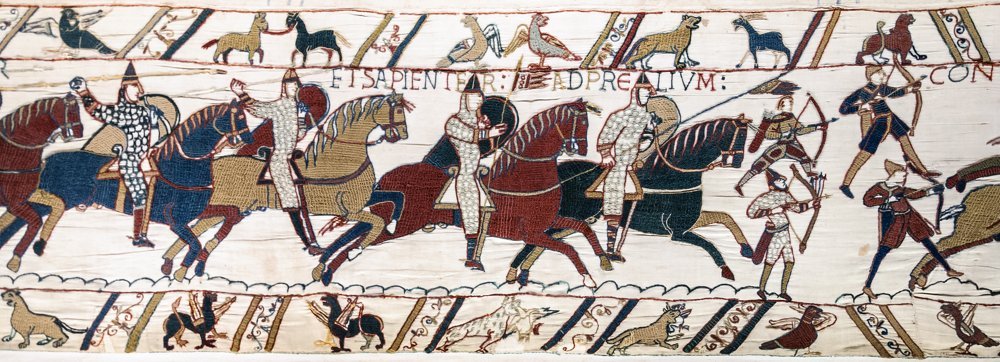
To keep up their skills, knights spent time every day fencing and practising tactics with dummies. A knight might serve more than one lord, but his foremost loyalty was always to his own lord. From the twelfth century, minstrels travelled from manor to manor in France, singing partly historical, partly invented songs about brave kings and knights, very popular entertainment in an age when few could read. Many manors had a narrow balcony called the minstrels’ gallery, above the great hall, from where singers entertained the feasting nobles.
“If my dear lord is slain, his fate I’ll share, / If he is hanged, then hang me by his side. / If to the stake he goes, with him I’ll burn; / And if he’s drowned, then let me drown with him.”
Doon de Mayence, a thirteenth-century French poem (to be sung) on a knight’s loyalty to his lord
3The Clergy
3.1 The Power of the Catholic Church
The Catholic Church had its own laws, owned lands granted by rulers, and could levy taxes: it was a powerful institution that did not depend on the king. The Pope, who lived in Rome, headed the western Church; bishops and clerics guided Europe’s Christians and made up the first “order”. Most villages had their own church, where people gathered every Sunday to hear the priest’s sermon and pray together.
Not everyone could become a priest. Serfs were banned, as were the physically challenged, and women could not become priests; men who became priests could not marry. Bishops were the “religious nobility”: like lords, they had the use of vast estates and lived in grand palaces.
A tithe was the Church’s entitlement to a tenth share of whatever peasants produced from their land over the year. The Church also received money in the form of endowments made by the rich, for their own welfare and for that of their deceased relatives in the afterlife.
Interestingly, some Church ceremonies copied formal customs of the feudal elite: kneeling while praying, with hands clasped and head bowed, exactly mirrored how a knight conducted himself while taking vows of loyalty to his lord, and the term “lord” for God was itself borrowed from feudal culture. The religious and everyday worlds of feudalism shared many customs and symbols this way.
3.2 Monks and Monasteries
Apart from parish clergy who lived among people in towns and villages, some deeply religious Christians chose to live isolated lives in religious communities called abbeys or monasteries, often far from human habitation. Two of the best-known were founded by St Benedict in Italy in 529 and at Cluny in Burgundy in 910.
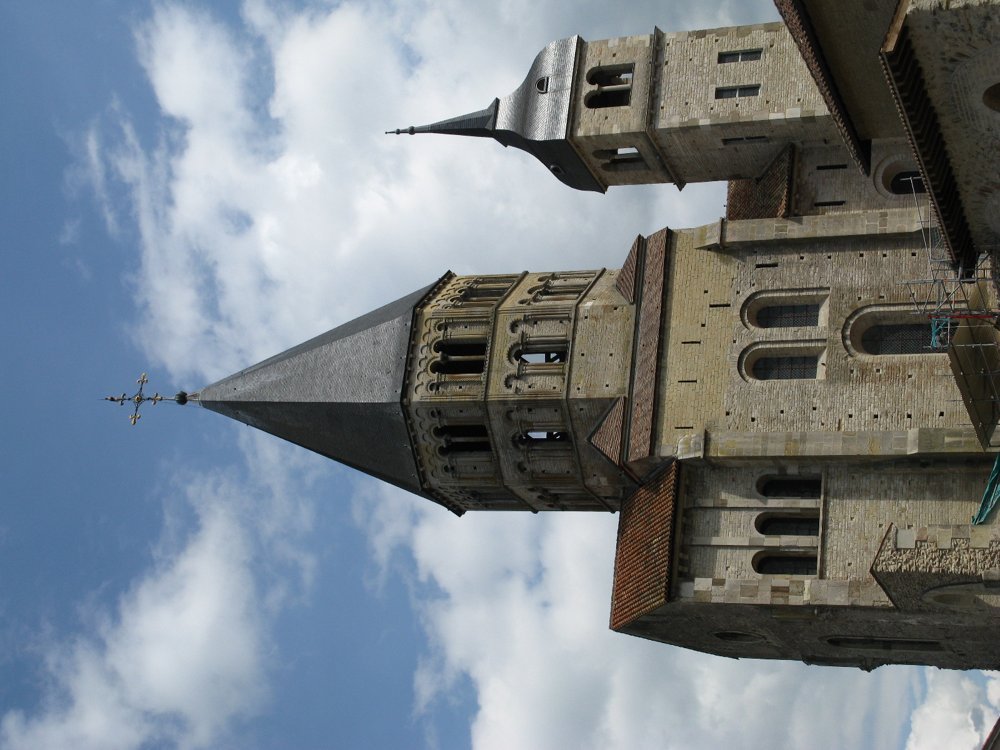
Monks took vows to remain in the abbey for life, spending their time in prayer, study and manual labour like farming. Unlike priesthood, this life was open to both men (monks) and women (nuns), though except in a few cases, all abbeys were single-sex, with separate abbeys for men and women, and monks and nuns did not marry. From small communities of 10-20, monasteries grew to communities of several hundred, with large buildings, landed estates, and attached schools, colleges and hospitals. Abbess Hildegard of Bingen, besides her writings, was a gifted musician who did much to develop community singing of prayers in church. From the thirteenth century, some monks called friars chose not to stay in one monastery, moving from place to place preaching and living on charity.
Two famous monasteries, two numbers: 529 and 910
St Benedict’s, Italy, is 5-2-9. Cluny, Burgundy, is 9-1-0. Say them as a pair and the dates stick together.
| Selected Benedictine Rule chapters (73 in total) | What it said |
|---|---|
| Chapter 6 | Permission to speak should rarely be granted to monks |
| Chapter 7 | Humility means obedience |
| Chapter 33 | No monk should own private property |
| Chapter 47 | Idleness is the enemy of the soul, so friars and sisters must do manual labour and sacred reading at fixed hours |
| Chapter 48 | The monastery should hold everything needed within its own bounds: water, mill, garden, workshops |
By the fourteenth century, there was growing uncertainty about the value of monasticism. In England, Langland’s poem Piers Plowman (c.1360-70) contrasted the ease and luxury of some monks’ lives with the “pure faith” of simple ploughmen, shepherds and labourers; Chaucer’s Canterbury Tales gave comic portraits of a nun, a monk and a friar.
3.3 The Church and Society
Though Europeans became Christian, they held on to old beliefs in magic and folk tradition. Christmas (25 December) replaced an old pre-Roman solar-calendar festival marking the winter; Easter, its date fixed by the older lunar calendar, replaced a spring festival, and marked Christ’s crucifixion and resurrection. Villagers continued their old custom of touring the village lands, but now called the village a “parish” (the area under one priest’s supervision). Overworked peasants welcomed “holy days” as days off, meant for prayer but often spent on fun and feasting. Pilgrimage, long journeys to the shrines of martyrs or big churches, was an important part of a Christian’s life.
“When in April the sweet showers fall… Then people long to go on pilgrimages, And palmers long to seek the foreign shrines Of far-off saints… And especially from every shire Of England, to Canterbury they make their journey.”
Geoffrey Chaucer (c.1340-1400), The Canterbury Tales, on medieval pilgrimage
4The Peasants
4.1 Free Peasants and Serfs
The vast majority of people sustained the first two orders. Cultivators were of two kinds: free peasants and serfs (from the verb “to serve”).
Free peasants
- Held their farms as tenants of the lord
- Men owed military service (at least 40 days a year)
- Set aside several days a week for labour-rent on the lord’s land
- Also owed unpaid labour: digging ditches, gathering firewood, repairing roads
- Paid “taille”, a direct royal tax the clergy and nobles were exempt from
Serfs
- Cultivated plots that belonged to the lord, not to them
- Most produce went straight to the lord; received no wages
- Could not leave the estate without the lord’s permission
- Had to use the lord’s mill, oven and wine-press, for a fee
- Needed the lord’s consent, and a fee, to marry
A serf was an unfree peasant, bound to the lord’s land, who could not leave without permission and had to use the lord’s mill, oven and wine-press at a price. A taille was the one direct tax kings sometimes imposed specifically on peasants, since the clergy and nobles were exempted.
Besides fieldwork, women and children had other tasks: spinning thread, weaving cloth, making candles, and pressing grapes for the lord’s wine.
5England
Feudalism developed in England only from the eleventh century. The Angles and Saxons, from central Europe, had settled England in the sixth century: the country’s name “England” is a variant of “Angle-land”. In the eleventh century, William, Duke of Normandy, crossed the English Channel with an army and defeated the Saxon king. From this point, France and England were often at war over territory and trade.
The present Queen of England is descended from William I, a single conquest in 1066 that still connects to the royal family today.
William I had the land surveyed and mapped, and distributed it among 180 Norman nobles who had migrated with him. These lords became the king’s chief tenants, owed him military help, and had to supply a set number of knights. Unlike on the Continent, though, English nobles were forbidden from using their knights for private warfare. Anglo-Saxon peasants became tenants of various levels of landholders under this new system.
6Land, Climate and New Technology
6.1 Climate and the Old Two-Field System
From the fifth to the tenth centuries, most of Europe was covered in vast forests, limiting the land available for farming, though dissatisfied peasants could always flee into the forest. Europe was also going through an intensely cold climatic spell: severe winters, a shortened growing season, and reduced yields.
From the eleventh century, Europe entered a warm phase: longer growing seasons, easier ploughing, and the forest line receding across much of Europe, which allowed the area under cultivation to expand.
Early agricultural technology, though, was very primitive: the only tool was a wooden plough drawn by oxen, which could barely scratch the soil’s surface. Farming was extremely labour-intensive, with fields dug by hand, often once every four years. Farmers used an inefficient two-field system: half the land planted with winter wheat, the other half left fallow, alternated with rye the next year. The soil slowly deteriorated under this system, and famines were not uncommon. Lords still pushed peasants to maximise output, and peasants resisted passively, keeping more of their own harvest, avoiding extra unpaid labour, and clashing with lords over the use of common pasture and forest land.
6.2 New Technology from the Eleventh Century
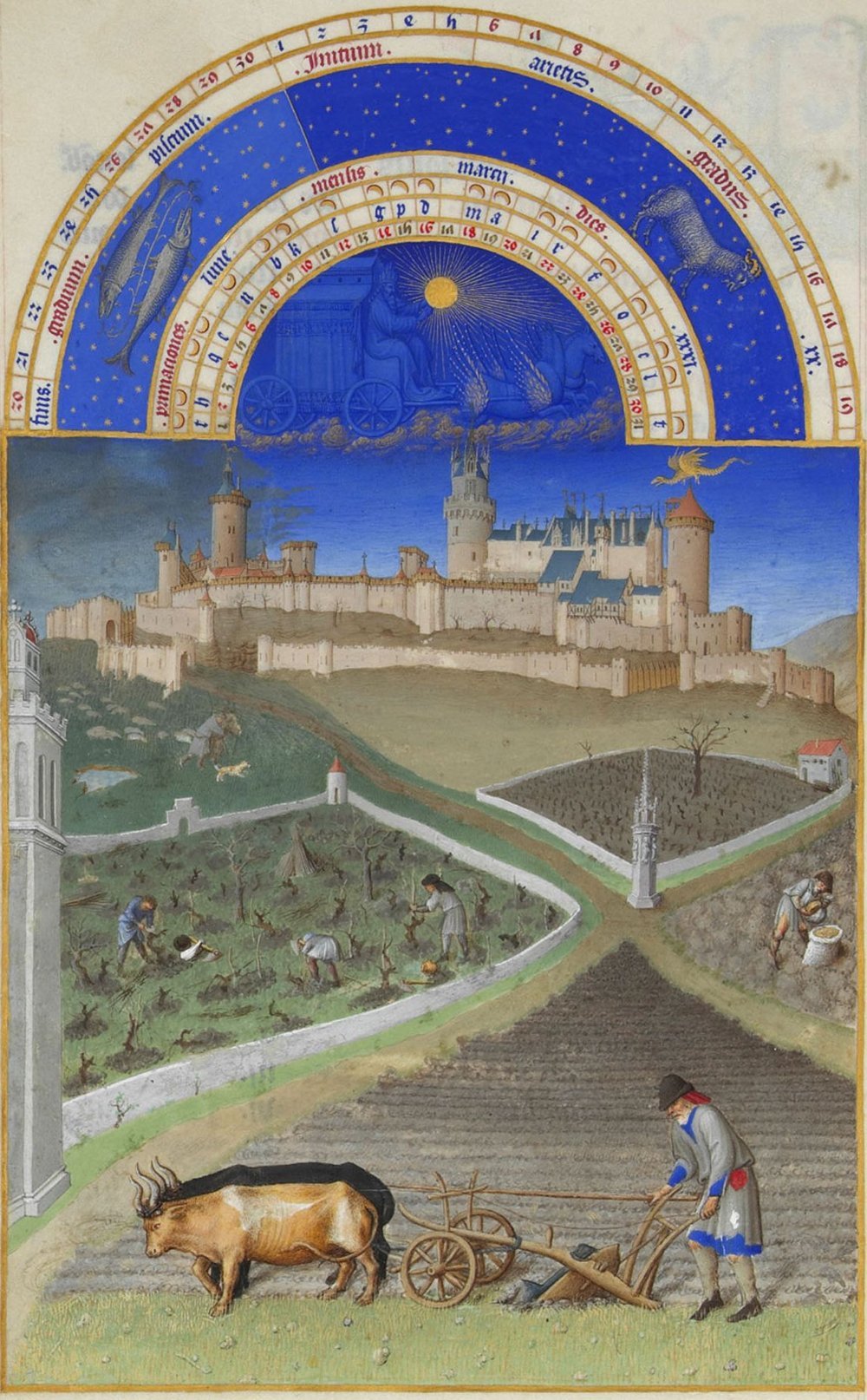
By the eleventh century, several technological changes appear. Heavy iron-tipped ploughs with mould-boards replaced the basic wooden plough, digging deeper and turning the topsoil properly, so soil nutrients were used better. The shoulder-harness replaced the neck-harness, letting animals pull with greater power, and iron horseshoes prevented foot decay. Wind and water power was used more, with more mills built across Europe for milling corn and pressing grapes.
The three-field system replaced the older two-field system: land was divided into three parts, so peasants could use each field two years out of three, one crop in autumn, a different crop in spring a year and a half later, and the third field left fallow, rotating each year. It let farmers grow wheat/rye for people, peas/beans/lentils/oats/barley for people and horses, all while resting one-third of the land at a time.
The result was almost immediate: food output nearly doubled. More vegetable protein, from peas and beans, improved diets and animal fodder alike. Peasants could now farm less land more efficiently: the average peasant farm shrank from about 100 acres to 20-30 acres by the thirteenth century, and smaller, more efficient holdings freed up time for other activities. Peasants took the lead in extending arable land, adopting the three-field rotation, and setting up small village smithies to make and repair iron ploughs and horseshoes cheaply, though lords, who had more money, mostly funded the expensive watermills and windmills. From the eleventh century, personal feudal bonds weakened as the economy became more money-based: lords preferred rent in cash over services, and peasants sold crops for money to traders rather than exchanging goods directly. In England, for instance, agricultural prices doubled between the 1270s and the 1320s.
7Towns and the Fourteenth-Century Crisis
7.1 The Growth of Towns
Agricultural expansion came with population growth: Europe’s population rose from roughly 42 million in 1000, to 62 million around 1200, to 73 million in 1300. Better food meant longer lives: by the thirteenth century, an average European could expect to live 10 years longer than in the eighth century (though women and girls had shorter lifespans than men, since men ate better food).
Roman towns had become deserted after the empire’s fall, but from the eleventh century, as agriculture could sustain higher populations, towns began growing again. Peasants with surplus grain needed places to sell it and buy tools and cloth, leading to periodic fairs and small marketing centres that developed town-like features: a town square, a church, merchant roads and shops, an office for the town’s governors. In towns, people paid a tax, not services, to the lord who owned the land.
“Town air makes free” was a popular saying: if a serf could hide undiscovered in a town for a year and a day, he became a free man. Towns held free peasants, escaped serfs (as unskilled labour), shopkeepers, merchants, and later specialists like bankers and lawyers. Bigger towns held around 30,000 people, enough that they have been called a possible “fourth order”.
A guild was an association that organised each craft or industry, controlling the quality, price and sale of its products. The “guild-hall” was a town building used for ceremonial functions, and where the heads of all the guilds met formally.
By the eleventh century, new trade routes with West Asia were developing; Scandinavian merchants sailed south to exchange furs and hunting-hawks for cloth, and English traders sold tin. By the twelfth century, commerce and crafts grew in France, and craftsmen found it easier to settle in one place rather than travel manor to manor. As trade expanded, town merchants grew rich and powerful, rivalling the nobility.
7.2 Cathedral-Towns
Rich merchants often spent money on donations to churches. From the twelfth century, large churches called cathedrals were built in France, belonging to monasteries but funded by many people’s labour, materials and money. Built of stone, they took years to complete, and the area around them grew more populated as they were built; once finished, they became pilgrimage centres, and small towns developed around them.
Cathedrals were designed so the priest’s voice and the monks’ singing could be heard clearly, and bells could call people to prayer from a distance. Stained-glass windows, radiant with sunlight by day and visible by candlelight at night, narrated Bible stories in pictures that illiterate people could “read”.
“…we caused to be painted, by the exquisite hands of many masters from different regions, a splendid variety of new windows… we appointed an official master craftsman for their protection, and also a goldsmith… who would never neglect their duty, to look after these [works of art].”
Abbot Suger (1081-1151), describing the rebuilding of the Abbey of St Denis near Paris
7.3 Three Causes of the Fourteenth-Century Crisis
By the early fourteenth century, Europe’s economic expansion had slowed, for three connected reasons.
The Black Death was an outbreak of bubonic plague that struck western Europe between 1347 and 1350, carried by rats aboard trading ships. The modern estimate of mortality is about 20 per cent of Europe’s whole population, with some places losing as much as 40 per cent.
“How many valiant men, how many fair ladies, (had) breakfast with their kinfolk and the same night supped with their ancestors in the next world!… They sickened by the thousands daily, and died unattended and without help… Consecrated churchyards did not suffice for the burial of the vast multitude of bodies, which were heaped by the hundreds in vast trenches, like goods in a ship’s hold and covered with a little earth.”
Giovanni Boccaccio (1313-75), Italian author, on the Black Death
Cities, as trade centres, were hit hardest, and in enclosed communities like monasteries, once one person caught the plague almost everyone did. The plague took its worst toll among infants, the young and the elderly, with further minor outbreaks in the 1360s and 1370s. Europe’s population fell from 73 million in 1300 to just 45 million in 1400.
7.4 Social Unrest and Peasant Revolts
Depopulation created a major labour shortage: agricultural prices fell (fewer buyers), while wages rose sharply. Agricultural wages in England rose by as much as 250 per cent after the Black Death, and surviving labourers could demand double their earlier wages. This badly hit lords’ incomes, and in desperation, many tried reviving old labour-services in place of cash contracts. Peasants resisted violently: revolts broke out in 1323 in Flanders, 1358 in France, and 1381 in England.
Though these revolts were ruthlessly crushed, they occurred most intensely in the very areas that had prospered the most from earlier economic expansion, showing that peasants were defending real gains, not just reacting to hardship. Despite severe repression, the old feudal relations could not be fully reimposed: the money economy was too far advanced to reverse.
7.5 Timeline: Eleventh to Fourteenth Centuries
8Political Change
8.1 The Rise of the “New Monarchs”
In the fifteenth and sixteenth centuries, European kings strengthened their military and financial power, building states as significant to Europe’s history as the economic changes had been. Historians call these rulers the “new monarchs”.
| Ruler(s) | Kingdom |
|---|---|
| Louis XI (1461-83) | France |
| Isabelle and Ferdinand | Spain |
| Henry VII | England |
| Maximilian | Austria |
The book calls this the “New Monarchy” and separately dates it by kingdom, not by any one ruler’s own reign:
| Kingdom | New Monarchy period |
|---|---|
| France | 1461-1559 |
| Spain | 1474-1556 |
| England | 1485-1547 |
These absolutist rulers built standing armies, a permanent bureaucracy and national taxation, and in Spain and Portugal, began overseas expansion. The chief reason for their success was the dissolution of the old feudal system of lordship and vassalage, plus slow economic growth, which together gave kings their first real chance to expand control. Feudal levies were replaced by professionally trained infantry with guns and siege artillery, directly under royal control, and aristocratic resistance crumbled before this new royal firepower.
Higher taxes gave monarchs the revenue for larger armies, letting them defend and expand their frontiers and put down internal resistance. But centralisation did not happen without a fight: taxation was the common thread in every kind of opposition. England saw rebellions in 1497, 1536, 1547, 1549 and 1553; in France, Louis XI (1461-83) waged a long struggle against dukes and princes, and lesser nobles resisted through local assemblies; the sixteenth-century “religious” wars in France were partly a contest between royal privilege and regional liberties.
Remember why “royal absolutism” is sometimes called “a modified form of feudalism”: the very same lordly class that ruled under feudalism kept dominating politics under the new monarchs, only now as loyal administrators with permanent government posts, not independent rivals to the crown.
The nobility made a tactical shift, from opponents of the new regimes to loyalists, gaining permanent positions in the administrative service. The king was no longer at the apex of a pyramid based on personal loyalty; he was now at the centre of a courtier society and a network of patron-client relationships, where patronage was obtained through money. This gave non-aristocratic merchants and bankers a route into the royal court, since they lent money to kings, who used it to pay soldiers’ wages, a real opening for non-feudal elements in the new state system.
8.2 France and England: Diverging Paths
France
- 1614: the Estates-General met under child-king Louis XIII, with three houses for clergy, nobility and “the rest”
- Not summoned again for almost two centuries, until 1789
- Kings did not want to share power with the three orders
- Today: a republic
England
- Even before 1066, the Anglo-Saxons had a Great Council the king had to consult before taxing
- Developed into Parliament: House of Lords (lords and clergy) and House of Commons (towns and rural areas)
- Charles I ruled 11 years (1629-40) without Parliament, was later executed after civil war; monarchy restored, but Parliament had to meet regularly
- Today: a monarchy
The Estates-General was the French royal consultative assembly, with three houses representing the clergy, the nobility and “the rest”. Parliament was its English counterpart, made up of the House of Lords (lords and clergy) and the House of Commons (representing towns and rural areas).
Today France has a republican government and England has a monarchy, a difference traced directly to the different directions their histories took after the seventeenth century.
- The “three orders” of medieval Europe were the clergy (who prayed), the nobility (who fought) and the peasantry (who worked)
- Marc Bloch pioneered the historical study of feudalism, a system of land-based relationships going back to Roman practice and Charlemagne’s age, but only fully established by the 11th century
- Nobles held land through vassalage; a lord’s manor housed his own fields plus tenant-peasants’ fields, worked with the help of knights holding a fief
- The Church (first order) collected tithes and ran parish life; monks and nuns lived apart in abbeys like St Benedict’s (529) and Cluny (910)
- Peasants (third order) were either free (owing labour-rent and military service) or serfs (bound to the lord’s land, using his mill/oven/wine-press for a fee)
- England developed feudalism only after the Norman Conquest of 1066; William I distributed land to 180 Norman nobles
- New technology (iron plough, three-field system) nearly doubled food output from the 11th century, feeding population growth and town growth, and possibly a “fourth order” of townspeople
- The 14th century brought crisis: bad climate, a money shortage, and the Black Death (1347-50), killing about 20% of Europe and triggering peasant revolts in Flanders (1323), France (1358) and England (1381)
- From the 15th century, “new monarchs” (Louis XI, Henry VII, Isabelle and Ferdinand) built centralised states with standing armies and taxation, replacing feudal levies
- France’s Estates-General was not called between 1614 and 1789; England’s Parliament grew stronger after Charles I’s execution, which is why France is a republic today and England a monarchy
- Can I define feudalism and explain why it went beyond the economic sphere?
- Can I explain vassalage and describe the ceremony that sealed it?
- Can I list what made up a manorial estate, and why it was never fully self-sufficient?
- Can I explain what a fief was, and what a knight owed his lord in return?
- Can I state what a tithe was, and who could not become a priest?
- Can I explain the difference between a free peasant and a serf?
- Can I describe the three-field system and why it nearly doubled food output?
- Can I explain “town air makes free” and what a guild did?
- Can I name the three causes of the fourteenth-century crisis, and the dates of the Black Death?
- Can I explain why France and England ended up with different forms of government?
- 3 marksDescribe two features of early feudal society in France.
- 4 marksHow did long-term changes in population levels affect the economy and society of Europe?
- 3 marksWhy did knights become a distinct group, and when did they decline in importance?
- 3 marksWhat was the function of medieval monasteries?
- 6 marksImagine and describe a day in the life of a craftsman in a medieval French town.
- 6 marksCompare the conditions of life for a French serf and a Roman slave.
- 4 marksExplain how the three-field system was an improvement over the two-field system, and what effects the change had.
- 4 marksWhat three factors caused the crisis of the fourteenth century in Europe?
- 1 markThe term “feudalism” comes from the German word meaning:
(a) a lord(b) a piece of land(c) a soldier(d) a promise - 1 markThe Church’s entitlement to a tenth of a peasant’s yearly produce was called:
(a) taille(b) fief(c) tithe(d) guild fee - 1 markWhich monastery, founded in 910 in Burgundy, became one of the most famous of medieval Europe?
(a) St Benedict’s(b) Cluny(c) Canterbury(d) Chartres - 1 markThe Black Death struck western Europe in the years:
(a) 1315-17(b) 1338-1461(c) 1347-50(d) 1381
Every Assertion-Reason (A-R) question in CBSE exams uses the same four options: (a) both A and R are true, and R correctly explains A; (b) both A and R are true, but R does not explain A; (c) A is true, but R is false; (d) A is false, but R is true. Decide first whether A is true, then whether R is true, then whether R actually explains A.
Reason (R): A serf was bound to the lord’s land and could not leave the estate without the lord’s permission.
Reason (R): These revolts occurred most intensely in areas that had prospered the most during the earlier economic expansion, as peasants tried to defend gains they had already made.