1 Why an Independent Judiciary?
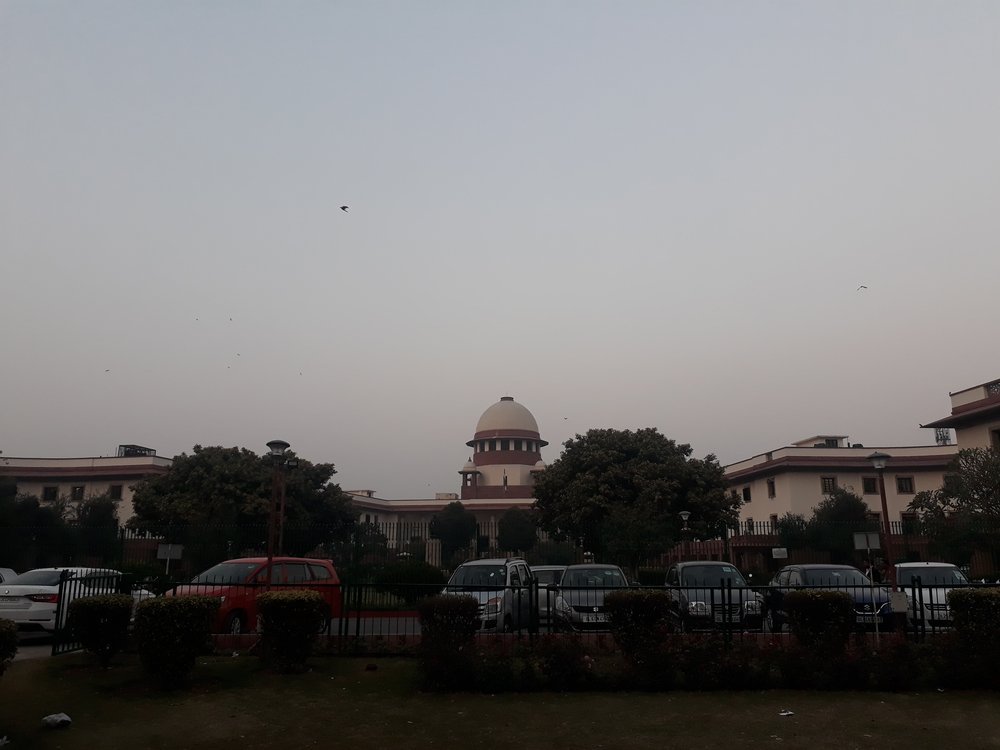
Courts are often seen only as arbitrators settling disputes between individuals. But the judiciary does far more than that, it is a vital organ of government. The Supreme Court of India is one of the most powerful courts in the world. Since 1950, the judiciary has played a key role in interpreting and protecting the Constitution.
In any society, disputes are bound to arise between individuals, between groups, and between individuals or groups and the government. All such disputes must be settled by an independent body, in accordance with the principle of the rule of law. The rule of law means that all individuals, rich or poor, men or women, forward or backward castes, are subject to the same law.
The judiciary’s principal role is to protect the rule of law and ensure the supremacy of law. It safeguards the rights of individuals, settles disputes in accordance with the law, and ensures that democracy does not give way to the dictatorship of an individual or a group.
2 Independence of the Judiciary
2.1 What Independence Means
- Other organs like the executive and legislature must not restrain the judiciary’s functioning to the point where it cannot do justice
- Other organs must not interfere with the judiciary’s decisions
- Judges must be able to perform their functions without fear or favour
Independence of the judiciary does not mean arbitrariness or an absence of accountability. The judiciary is part of the democratic political structure, so it is accountable to the Constitution, to democratic traditions, and to the people of the country.
2.2 Four Measures That Ensure Independence
- Legislature not involved in appointment: this was meant to keep party politics out of appointments; a judge must have experience as a lawyer and/or be well versed in law, not political opinion or loyalty
- Fixed tenure: judges hold office until the retirement age; they can be removed only in exceptional cases, giving them security of tenure
- Financial independence: judges’ salaries and allowances are not subject to the legislature’s approval
- Protection from criticism: judges’ actions and decisions are immune from personal criticism; the power to penalise for contempt of court protects this; Parliament cannot discuss a judge’s conduct except during removal proceedings
3 Appointment and Removal of Judges
The appointment of judges has never been free from political controversy, it is part of the political process, since a judge’s political philosophy affects how laws are interpreted.
For years, a convention held that the senior-most judge of the Supreme Court would be appointed Chief Justice of India (CJI). This convention was broken twice: in 1973, A.N. Ray was appointed CJI, superseding three senior judges, and in 1975, M.H. Beg was appointed, superseding H.R. Khanna.
The other judges of the Supreme Court and High Courts are appointed by the President after “consulting” the CJI. In effect, this meant the final decision in appointments rested with the Council of Ministers. Between 1982 and 1998, this matter came up before the Supreme Court again and again: first the Court held the CJI’s role was purely consultative, then that the President must follow the CJI’s opinion, and finally the Court suggested a new procedure, the CJI would recommend names in consultation with the four senior-most judges of the Court. This gave the opinion of this group of senior judges the greatest weight in appointments.
This group-based mechanism for recommending judges is popularly called the “collegium system” in everyday usage, but note that the textbook itself never uses this word, it only describes “the principle of collegiality” and “the group of senior-most judges”.
3.1 Removal of Judges
Removing judges of the Supreme Court and High Courts is also extremely difficult. A judge can be removed only on the ground of proven misbehaviour or incapacity. The motion must be approved by a special majority in both Houses of Parliament.
In 1991, the first-ever motion to remove a Supreme Court judge was signed by 108 Members of Parliament. Justice V. Ramaswami was accused of misappropriating funds while serving as Chief Justice of the Punjab and Haryana High Court. In 1992, an inquiry commission found him “guilty of wilful and gross misuses of office… and moral turpitude”. Despite this strong indictment, the motion got the required two-thirds majority among members present and voting, but the Congress party abstained from voting, so the motion could not get the support of one-half of the total strength of the House, and Ramaswami survived.
Note that the executive plays the crucial role in appointment, while the legislature holds the power of removal. This division has ensured both a balance of power and the judiciary’s independence.
4 Structure of the Judiciary
The Constitution of India provides for a single integrated judicial system. Unlike some other federal countries, India does not have separate State courts. The structure is pyramidal, with the Supreme Court at the top, High Courts below them, and District and subordinate courts at the lowest level. Lower courts function under the direct superintendence of the higher courts.
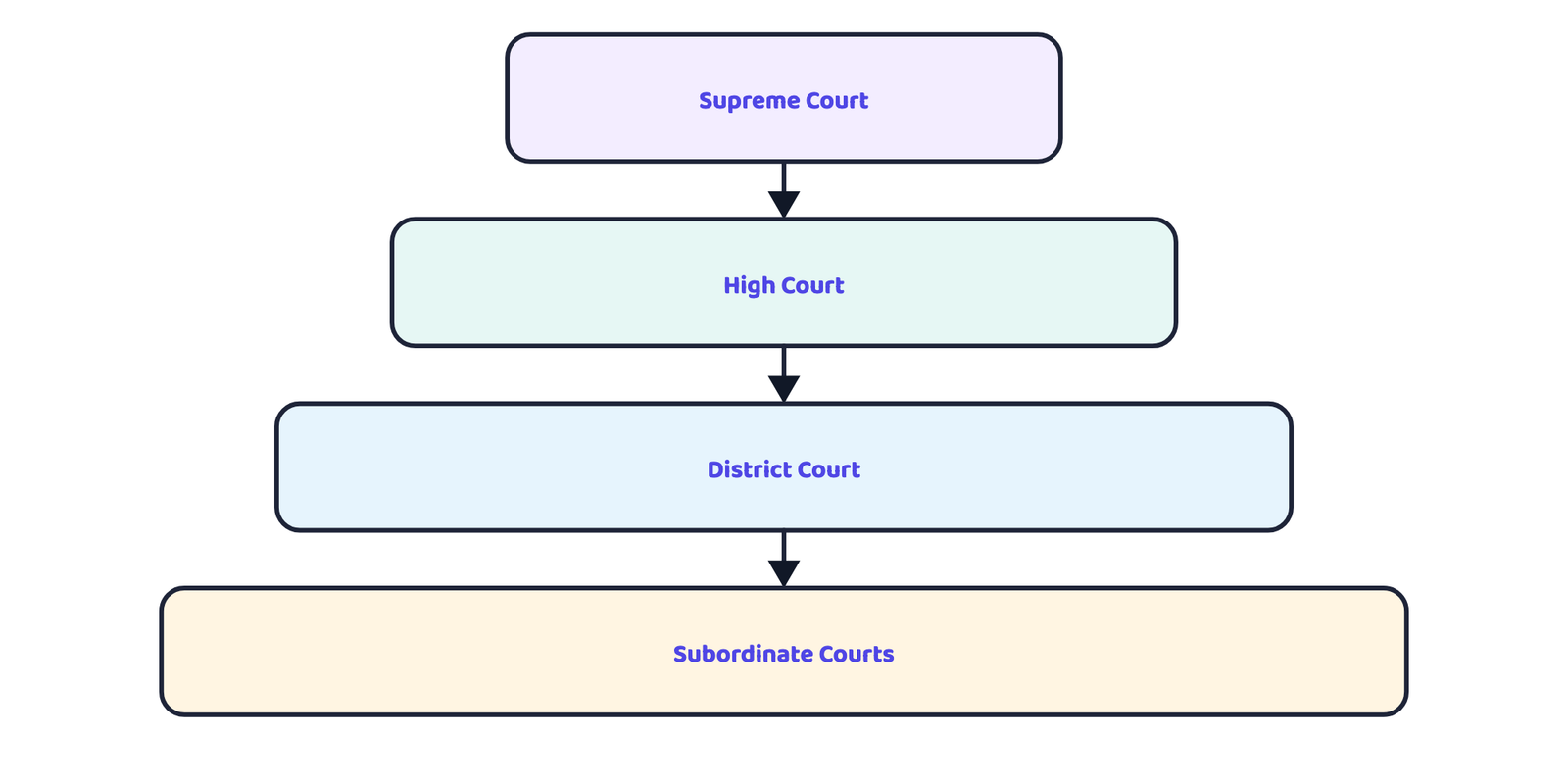
- Supreme Court: its decisions are binding on all courts; can transfer High Court judges; can move cases from any court to itself; can transfer cases from one High Court to another
- High Court: can hear appeals from lower courts; can issue writs to restore Fundamental Rights; deals with cases within the State’s jurisdiction; exercises superintendence and control over courts below it
- District Court: deals with cases arising in the district; considers appeals on lower courts’ decisions; decides cases involving serious criminal offences
5 Jurisdiction of the Supreme Court
5.1 Four Kinds of Jurisdiction
Original jurisdiction means that certain cases are heard directly by the Supreme Court, without first going through a lower court. In disputes concerning federal relations, the Supreme Court acts as the umpire, neither the High Courts nor the lower courts can hear such cases.
Writ jurisdiction: any individual whose fundamental right has been violated can move the Supreme Court directly. The Supreme Court can issue writs of Habeas Corpus, Mandamus, Prohibition, Certiorari and Quo Warranto to protect Fundamental Rights. High Courts too can issue writs, giving the aggrieved person a choice between the High Court and the Supreme Court.
Appellate jurisdiction: the Supreme Court is the highest court of appeal. The High Court must certify that a case is fit for appeal, meaning it involves a serious question of interpretation of law or the Constitution. In criminal cases where a lower court has awarded the death sentence, an appeal can be made to the High Court or Supreme Court. The Supreme Court can admit an appeal even when the High Court has not allowed it, and can change the ruling and give a fresh interpretation. High Courts too have appellate jurisdiction over the decisions of courts below them.
Advisory jurisdiction: the President can refer any matter of public importance or Constitution-interpretation to the Supreme Court for advice. But the Court is not bound to give advice, and the President is not bound to accept it. Its utility is two-fold: first, it lets the government seek legal opinion before acting, preventing later litigation; second, in light of the advice, the government can make suitable changes to its actions or legislation.
Article 137: the Supreme Court has the power to review any judgment or order it has itself pronounced. Article 144: all civil and judicial authorities in India must act in aid of the Supreme Court. Besides this, the Supreme Court can grant special leave to appeal from any judgment or matter passed by any court in India.
6 Judicial Activism and Public Interest Litigation
The chief instrument of judicial activism is Public Interest Litigation (PIL), also called Social Action Litigation (SAL). Normally, only a person who had been personally aggrieved could approach the courts. This changed around 1979, when the Court decided to hear a case filed not by the aggrieved persons but by others on their behalf. Around the same time, the Supreme Court also took up the case of prisoners’ rights.
1. 1979, Hussainara Khatoon vs. Bihar: newspapers published reports of “undertrials” in Bihar’s jails who had spent longer years in jail than they would have if they had been punished for the offences they were arrested for. Prompted by this report, an advocate filed a petition, which became one of the early PILs.
2. 1980, Sunil Batra vs. Delhi Administration: a Tihar jail inmate managed to send Justice Krishna Iyer a scribbled note narrating physical torture of prisoners, which the judge converted into a petition. The Court later abandoned the practice of considering letters, but this case remained one of the pioneers of PIL.
Through PIL, the courts expanded the idea of rights, clean air, unpolluted water and decent living came to be seen as rights of the entire society. After 1980, this allowed public-spirited citizens, organisations, and lawyers to file petitions on behalf of the needy and the deprived, who cannot easily approach the courts themselves.
“It must be remembered that the problems of the poor… are qualitatively different from those which have hitherto occupied the attention of the Court and they need… a different kind of judicial approach. If we blindly follow the adversarial procedure in their case, they would never be able to enforce their fundamental rights.”
Justice Bhagwati, Bandhua Mukti Morcha vs. Union of India, 1984
6.1 The Effect of Judicial Activism: Two Sides
Positive Effects
- Access to courts extended to groups, not just individuals
- Forced greater executive accountability
- Candidates now file asset/income/education affidavits, making elections fairer
Negative Effects
- Overburdened the courts
- Blurred the line between the executive, legislature and judiciary
- Court intervention in matters like pollution, corruption investigation or electoral reform, which really belong to the executive
Many countries are now adopting PIL. South Africa’s constitution has gone further and incorporated PIL into its own bill of rights, there it is a citizen’s fundamental right to bring another person’s rights-violation case before the Constitutional Court.
7 Judiciary, Rights and Judicial Review
The Constitution provides two remedies for a rights violation: first, the Supreme Court can restore Fundamental Rights by issuing writs under Article 32 (High Courts have the same power under Article 226); second, the Supreme Court can declare the concerned law unconstitutional and non-operational under Article 13.
Judicial Review is the power of the Supreme Court (or a High Court) to examine a law’s constitutionality, and declare it unconstitutional and inapplicable if it is inconsistent with the Constitution. The term is nowhere mentioned in the Constitution itself, but is implicit in India having a written constitution combined with the Supreme Court’s power to strike down laws that violate fundamental rights.
This review power also extends to federal-relations cases, if a law is inconsistent with the Constitution’s distribution of powers, for instance a central law that States claim concerns a State List subject, States can approach the Supreme Court, and the Court can declare it unconstitutional. This review power extends to laws passed by State legislatures too. Together, the writ power and the review power make the judiciary very powerful, letting it interpret both the Constitution and the laws passed by the legislature.
8 Judiciary and Parliament
A controversy arose over Parliament’s power to restrict the right to property. Parliament wanted to restrict property rights to implement land reforms. The Court held that Parliament cannot restrict fundamental rights this way. Parliament then tried to amend the Constitution, but the Court held that even an amendment cannot abridge a fundamental right.
- What is the scope of the right to private property?
- What is the scope of Parliament’s power to curtail, abridge or abrogate fundamental rights?
- What is the scope of Parliament’s power to amend the Constitution?
- Can Parliament make laws that abridge fundamental rights while enforcing Directive Principles?
“While there can be no two opinions on the need for the maintenance of judicial independence, …it is also necessary to keep in view one important principle. The doctrine of independence is not to be raised to the level of a dogma so as to enable the judiciary to function as a kind of super-legislature or super-executive. The judiciary is there to interpret the Constitution or adjudicate upon the rights…”
Alladi Krishnaswami Ayyar, CAD, Vol. XI, p. 837, 23 November 1949
Between 1967 and 1973, this controversy grew serious. Land reform laws, laws enforcing preventive detention, laws governing job reservations, regulations acquiring private property for public purposes, and laws on compensation for such acquisition were all at its centre.
In 1973, the Supreme Court gave a decision that has become central to regulating relations between Parliament and the judiciary ever since. The Court ruled that there is a basic structure of the Constitution, which nobody, not even Parliament through amendment, can violate. It also ruled two more things: first, that the right to property (the disputed issue) was not part of the basic structure and could be suitably abridged, and second, that the Court reserved to itself the right to decide whether various matters are part of the basic structure.
The right to property was removed from the list of Fundamental Rights in 1979, which changed the nature of this conflict thereafter. Some issues remain unresolved: can the judiciary intervene in and regulate how legislatures function, such as punishing a member for breaching legislative privilege? Similarly, the Constitution provides that judges’ conduct cannot be discussed in Parliament. Both sides have at times criticised each other, and legislatures see the judiciary’s instructions to them as violating the principle of parliamentary sovereignty.
- The judiciary protects the rule of law; independence does not mean an absence of accountability
- The CJI convention was broken twice (1973 A.N. Ray, 1975 M.H. Beg); V. Ramaswami is the only removal case that reached Parliament, and it failed
- Pyramidal structure: Supreme Court, High Courts, District and subordinate courts
- Four types of jurisdiction: original, writ, appellate, advisory; Articles 137 and 144
- Hussainara Khatoon (1979) and Sunil Batra (1980), the early PILs; remember both sides of judicial activism’s effects
- Judicial review is not in the Constitution’s text but is implicit; Kesavananda Bharati (1973) gave the basic structure doctrine
- The balance between judiciary and Parliament is delicate; both operate within the Constitution’s limits
- Do I remember the three meanings and four measures of judicial independence?
- Can I explain all four jurisdictions of the Supreme Court with examples?
- Do I remember both early PILs, with names and years?
- Can I state all three holdings of the Kesavananda Bharati case separately?
- Do I remember the exact numbers in the V. Ramaswami case?