
1 What is an Executive?
Who is in charge of the administration of your school? Who takes the big decisions there? In any organisation, some office holder has to take decisions and get them implemented. Government works the same way, just at a much bigger scale.
Government mainly has three organs: the legislature (which makes laws), the executive (which implements them) and the judiciary (which interprets laws and settles disputes). In a parliamentary system, the legislature and the executive are interdependent, the legislature controls the executive, and is in turn controlled by it, and that relationship is the subject of this chapter.
The Executive is the organ of government primarily responsible for implementing the laws and policies made by the legislature, and for running day-to-day administration. The executive is not limited to the President, Prime Minister and ministers, it also includes the entire administrative machinery (civil servants).
1.1 Two Kinds of Executive
Political Executive
- Heads of government and their ministers
- Carry overall responsibility for government policy
- Change with elections
Permanent Executive
- Officials responsible for day-to-day administration
- Called the bureaucracy
- Stay in place even when the government changes
2 Types of Executive
Not every country’s executive looks the same. The powers of the President of the USA and the President of India are very different, even though both hold the same title.
| Country | System | Head of State | Head of Government |
|---|---|---|---|
| USA | Presidential | President | President himself |
| Canada | Parliamentary, constitutional monarchy | Queen Elizabeth II (formal) | Prime Minister |
| United Kingdom | Parliamentary, constitutional monarchy | Monarch (formal) | Prime Minister |
| France | Semi-presidential | President | Prime Minister (President appoints, cannot dismiss) |
| Japan | Parliamentary | Emperor (formal) | Prime Minister |
| Italy | Parliamentary | President (formal) | Prime Minister |
| Russia | Semi-presidential | President | Prime Minister (appointed by President) |
| Germany | Parliamentary | President (formal) | Chancellor |
In 1978 Sri Lanka’s constitution was amended to introduce Executive Presidency. Here the President is directly elected by the people, chooses the Prime Minister from the majority party in Parliament, and can remove the Prime Minister or ministers, though ministers must be Members of Parliament. The President is Head of State, Commander-in-Chief and Head of Government, all at once. The term is 6 years, and removal needs a resolution passed by at least two-thirds of Members of Parliament. In addition, if a motion is passed by at least one-half of the total Members and the Speaker is satisfied the allegations merit inquiry, the Speaker can refer the matter to the Supreme Court.
Don’t assume that any country with a “President” must be a presidential system. India, Germany and Italy all have a President, but the real Head of Government there is the Prime Minister. What decides the system is where real power lies, not the name of the office.
3 Parliamentary Executive in India
- India already had experience running a parliamentary system under the Acts of 1919 and 1935, even before the Constitution was written
- That experience showed that in a parliamentary system, the executive can be effectively controlled by the people’s representatives
- In a presidential system the president becomes the sole source of executive power, creating a danger of personality cult
- So the Constitution-makers adopted the parliamentary system of executive at both the Union and State levels
- At the Union: President (formal head), Prime Minister and Council of Ministers (who actually run the government)
- At the State: Governor, Chief Minister and Council of Ministers
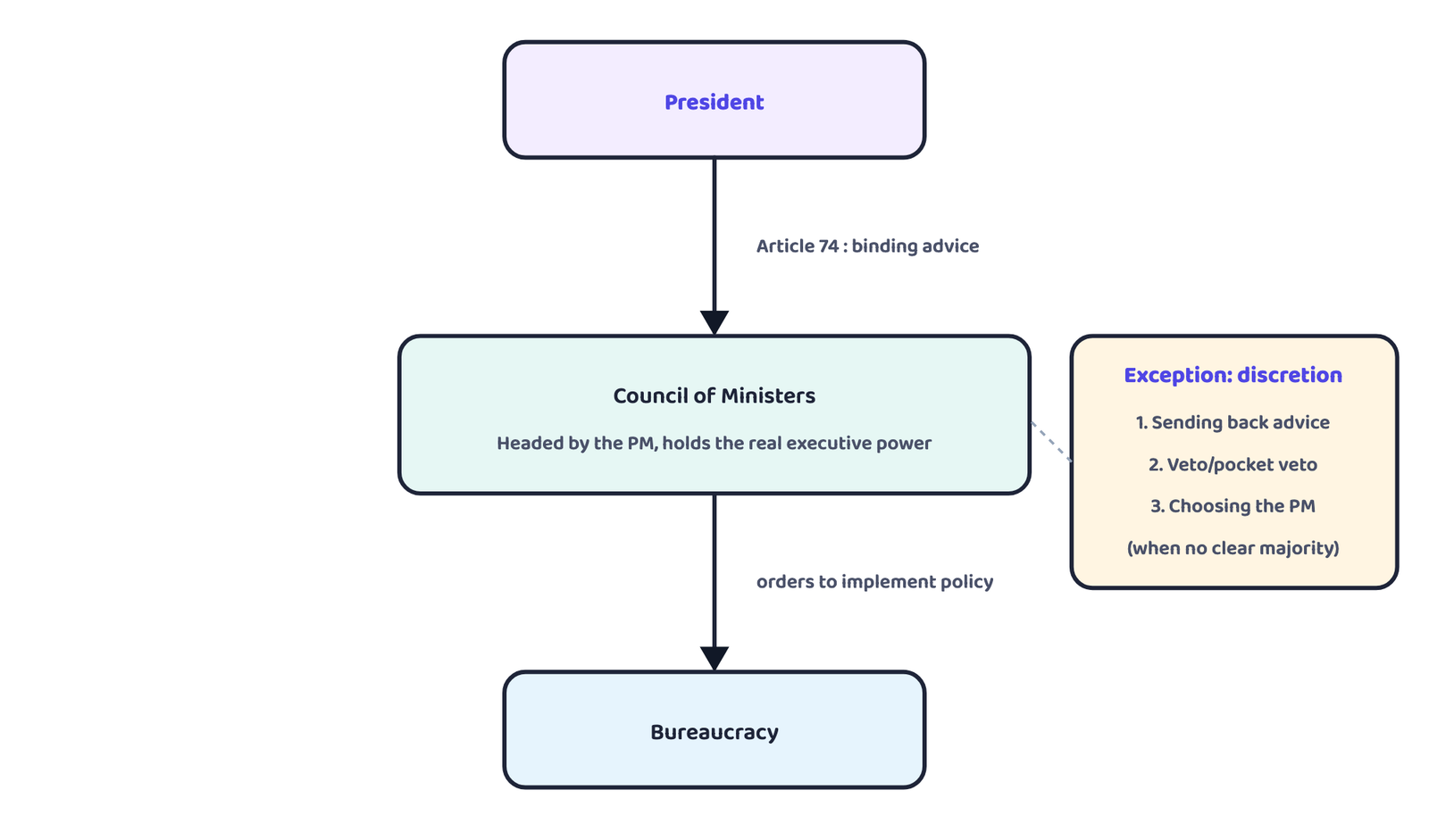
- The Union’s executive power is formally vested in the President, but in practice the President exercises it through the Council of Ministers
- The President’s term is 5 years; the President is not directly elected by the people, the election is indirect, by elected MLAs and MPs, following proportional representation with the single transferable vote
- The President can be removed only through impeachment, which requires a special majority; the only ground for impeachment is violation of the Constitution
Article 74(1): “There shall be a Council of Ministers with the Prime Minister at the head to aid and advise the President who shall in the exercise of his functions, act in accordance with such advice. Provided that the President may require the Council of Ministers to reconsider such advice …, and the President shall act in accordance with the advice tendered after such reconsideration.”
The word “shall” itself shows that the advice is binding on the President. This was once disputed, so one amendment made clear that the Council’s advice is binding, and a later amendment settled that the President may ask for reconsideration but must accept the reconsidered advice.
“We did not give him any real power but we have made his position one of authority and dignity. The Constitution wants to create neither a real executive nor a mere figurehead, but a head that neither reigns nor governs; it wants to create a great figurehead…”
Jawaharlal Nehru, CAD, Vol. VI, p. 734
4 Discretionary Powers of the President
Formally, the President’s power is exercised through the Council of Ministers. That does not mean the President has no discretion at all. Constitutionally, the President has a right to be informed of all important matters and deliberations of the Council of Ministers. The Prime Minister is obliged to furnish all the information that the President may call for, and the President often writes to the Prime Minister expressing views on matters confronting the country.
Besides this, there are three situations where the President uses his or her own discretion.
4.1 The Three Discretionary Powers
A pocket veto is the informal power a President gets because the Constitution sets no time limit for returning a Bill for reconsideration, the President can simply keep a Bill pending indefinitely, in effect vetoing it without ever formally rejecting it. The veto itself is limited: if Parliament passes the same Bill again and sends it back, the President has to give assent.
The pocket veto’s real example: the 1986 Indian Post Office (Amendment) Bill. Parliament passed this Bill in 1986, widely criticised for curtailing the freedom of the press. President Gyani Zail Singh took no decision on it throughout the rest of his term. His successor, Venkataraman, later sent the Bill back to Parliament for reconsideration, but by then the government had changed, a new coalition government elected in 1989 never brought the Bill back before Parliament. The Bill thus never became law.
After 1977, party politics in India became more competitive, and there have been many instances since when no party had a clear majority in the Lok Sabha. In the elections held in March 1998, no party or coalition secured a majority. The BJP and its allies won 251 seats, 21 short of a majority. President K.R. Narayanan asked the alliance leader, Atal Behari Vajpayee, to furnish documents of support from the concerned parties, and further advised him to secure a vote of confidence within ten days of being sworn in.
Why presidential discretion grew after 1989. In the four parliamentary elections held from 1989 to 1998, no single party or coalition won a majority in the Lok Sabha. These situations demanded the President’s intervention, either to constitute a government or to grant a request for dissolution of the Lok Sabha by a Prime Minister who could not prove a majority in the House. Presidential discretion is thus related to political conditions: there is greater scope for it when governments are not stable and coalitions occupy power.
Then why do we need a President at all? Because the Council of Ministers can fall at any time, a Head of State with a fixed term is needed who can appoint a new Prime Minister and represent the country symbolically, that is exactly the President’s role in ordinary times.
5 The Vice President
- The Vice President’s term is 5 years, the election method mirrors the President’s, except that members of State legislative assemblies are not part of the electoral college
- The Vice President can be removed by a Rajya Sabha resolution passed by a majority and agreed to by the Lok Sabha
- The Vice President is the ex-officio Chairman of the Rajya Sabha
- The Vice President takes over as acting President whenever the office falls vacant, whether by death, resignation, removal or otherwise, until a new President is elected
An acting President is the Vice President stepping into the President’s role when the office is vacant, only until a new President is elected. B.D. Jatti acted as President after the death of Fakhruddin Ali Ahmed, until a new President was elected.
6 Prime Minister and Council of Ministers
6.1 Formation and Size of the Council of Ministers
- The Prime Minister decides who the ministers will be, and allocates their portfolios
- By seniority and political importance, ministers get the rank of cabinet minister, minister of state, or deputy minister
- Chief Ministers choose their ministers the same way at the State level
- The Prime Minister and all ministers must be Members of Parliament; anyone who becomes a minister or PM without being an MP must get elected within six months
“Swiss system under which the legislature elects the executive for a certain period… is to my mind the best form of government for the provinces… The system of the single transferable vote is… the best system that can be adopted for the appointment of the executive because in that all interests will be represented and no party in the legislature will have any occasion to feel that it is not represented.”
Begum Aizaz Rasul, CAD, Vol. IV, p. 631, 17 July 1947
This suggestion was never adopted, in India the Prime Minister alone selects the ministers, the legislature does not elect them directly.
Before the 91st Amendment Act (2003), the size of the Council of Ministers was decided purely by circumstance, which often made it very large. The Amendment now caps the Council of Ministers at 15 percent of the total membership of the Lok Sabha (or State Assembly, for the States).
6.2 Collective Responsibility
Collective responsibility means the entire Council of Ministers is collectively responsible to the Lok Sabha. A Council that loses the Lok Sabha’s confidence must resign. The principle rests on cabinet solidarity, so a no-confidence motion against even a single minister brings down the entire Council of Ministers.
- A minister who disagrees with a policy must either accept it or resign
- Every minister is bound to support a policy decided under collective responsibility
6.3 The Prime Minister’s Importance and Sources of Power
- The Council of Ministers cannot exist without the Prime Minister, it comes into being only after the PM takes the oath of office
- The PM’s death or resignation dissolves the entire Council, but any other minister’s death, dismissal or resignation only creates a single vacancy
- The Prime Minister is the link connecting the Council of Ministers to both the President and Parliament; communicating all Council decisions to the President is the PM’s constitutional obligation
“The linchpin of Government.”
Pt. Jawaharlal Nehru, describing the Prime Minister
6.4 The Effect of the Coalition Era
As noted earlier, party politics in India became more competitive after 1977. Since 1989, India has seen many coalition governments, and quite a few did not complete a full term. This has had four effects on the office of Prime Minister.
Before (clear majorities)
- President’s role limited
- PM free to choose ministers
In the coalition era
- President’s discretionary role grows, much more consultation needed
- Restrictions on choosing ministers and on policymaking, both
- The President’s discretionary role in selecting the PM has grown
- Constant consultation with coalition partners is now necessary, eroding the PM’s authority
- The PM’s freedom to choose ministers and portfolios is restricted
- Even policies and programmes are no longer decided by the PM alone, they are settled through negotiation and compromise among allies, making the PM act more as a negotiator than a leader
At the State level, a similar system exists. The Governor is appointed by the President on the Union government’s advice, and the Chief Minister, like the Prime Minister, is the leader of the majority party in the Assembly. Unlike the President at the Centre, however, the Governor has more discretionary powers. The main principles of the parliamentary system operate at the State level too.
7 Permanent Executive: Bureaucracy
The bureaucracy (civil service) is the body of trained, permanent government officials who help ministers frame policy and implement it. It is called “civil” service specifically to distinguish it from the military.
In a democracy the elected ministers are in charge of the government, and the administration works under their control and supervision. India has a professional administrative machinery that is also made politically accountable.
Political neutrality means the bureaucracy will not take any political position on policy matters. If a party is defeated in elections and the new government wants new policies in place of the previous government’s, it is the responsibility of the administrative machinery to faithfully and efficiently participate in drafting the new policy and in its implementation.
The Indian bureaucracy today is an enormously complex system. It consists of the All-India services, State services, employees of the local governments, and technical and managerial staff running public sector undertakings.
7.1 Recruitment: the Public Service Commissions
The makers of the Constitution wanted a non-partisan, professional bureaucracy selected impartially on the basis of merit. The Union Public Service Commission (UPSC) conducts the recruitment of civil servants for the Government of India, and similar public service commissions are provided for the States. Members of the Public Service Commissions are appointed for a fixed term, and their removal or suspension is subject to a thorough enquiry made by a judge of the Supreme Court.
7.2 Classification of Civil Services
7.3 IAS-IPS vs State Civil Services
IAS and IPS
- Backbone of the States’ higher-level bureaucracy
- Recruited and appointed by the Union government
- Only the Union government can take disciplinary action
State Civil Services
- Recruited through State Public Service Commissions
- Work under the State government’s control
This is why the district collector, usually an IAS officer, is the government’s most important officer at the district level, and why this arrangement strengthens the Union government’s control over State administration, a theme picked up again in the chapter on federalism.
The bureaucracy is meant to be the instrument through which the government’s welfare policies reach the people, but it is often so powerful that ordinary citizens are afraid to approach a government officer, and find the bureaucracy insensitive to their demands and expectations. Only a democratically elected government’s control over the bureaucracy can address this, yet too much political interference turns the bureaucracy into a tool in the hands of politicians. Many feel there is not enough protection for civil servants against political interference in their duties, nor enough provision to make the bureaucracy accountable to citizens. The Right to Information (RTI) is expected to make the bureaucracy somewhat more responsive and accountable.
Constitution-makers wanted the civil service to be recruited strictly on merit, but they also wanted it to reflect the whole of society: reservation began with Scheduled Castes and Scheduled Tribes, and was later extended to women, Other Backward Classes (OBC) and Economically Weaker Sections (EWS).
8 Conclusion
- Government’s three organs: legislature, executive (political + permanent), judiciary
- Three types of executive: presidential (USA, Brazil), parliamentary (India, UK, Germany, Italy, Japan), semi-presidential (France, Russia, Sri Lanka)
- India chose the parliamentary system for accountability: prior experience under 1919/1935, guarding against personality cult, and routine legislative control over the executive; Article 74 makes the Council of Ministers’ advice binding on the President
- 1986 Postal Bill: the pocket veto’s real example; March 1998: discretion in choosing the PM, in action
- Vice President: ex-officio Rajya Sabha Chairman, acting President when needed (e.g. B.D. Jatti)
- 91st Amendment (2003): Council of Ministers capped at 15% of the House
- Begum Aizaz Rasul’s Swiss-system suggestion was never adopted, the PM alone chooses ministers
- Bureaucracy: politically neutral but politically accountable; All India, Central and State services; recruited via UPSC/State PSCs (members have a fixed term, removal only after an enquiry by a Supreme Court judge); Union control over IAS-IPS discipline; reservation for SC, ST, women, OBC, EWS
- Can I name at least four countries and correctly classify their executive type?
- Do I know all three of the President’s discretionary powers, with their real examples, and the President’s right to be informed?
- Do I understand the collective responsibility principle and its effect on the whole Council?
- Do I remember the 91st Amendment’s 15% cap?
- Can I explain Union control over the IAS/IPS?